Tech
NASA’s LRO Spots the Crater a SpaceX Falcon 9 Rocket Carved into the Moon
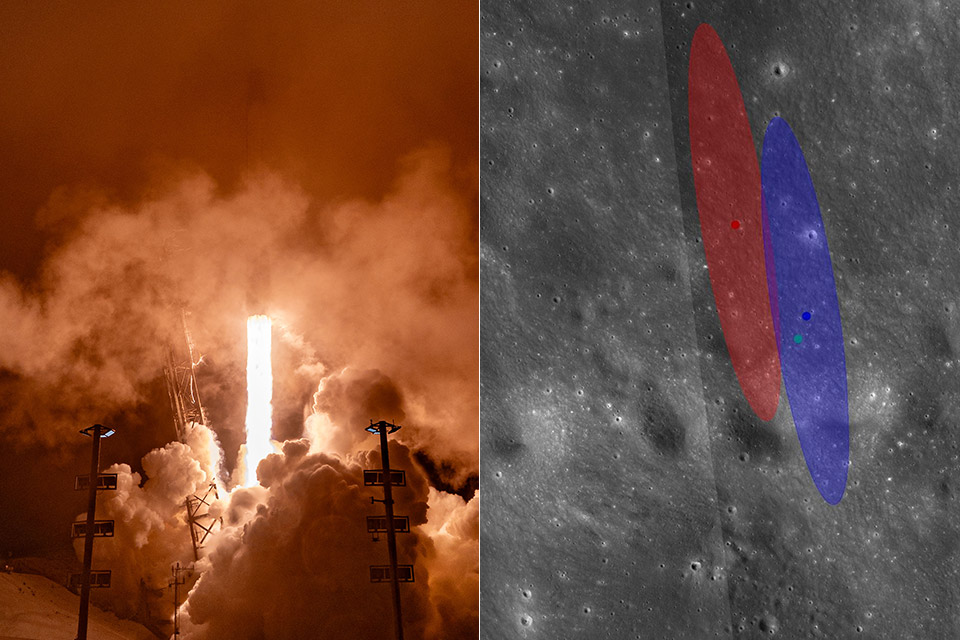
Between August 11 and 12 NASA’s Lunar Reconnaissance Orbiter locked onto a quiet patch of lunar ground and returned the clearest views yet of a brand-new scar. The crater formed six days earlier when a spent Falcon 9 upper stage struck the surface at roughly 5,400 miles per hour.


On January 15, 2025, a Falcon 9 upper stage launched Firefly Aerospace’s Blue Ghost 1 lander toward the Moon. After that happened, that section had almost no fuel remaining. Going through the motions, attempting to manage re-entry into Earth’s atmosphere, was no longer possible. So, starting in January 2025, for well over a year, this empty rocket stage just kinda hung there, floating in a roughly elliptical orbit under the gravitational influences of the Earth, the Moon, and the Sun, and then suddenly on August 5, its path came to an end on the lunar surface, at 6:35 in the morning (according to the clocks on UTC).


LEGO Icons NASA Artemis Space Launch System – DIY Rocket Model Building Set for Adults, Ages 18+ – Gifts…
- NASA rocket model kit – Launch into a creative project with the LEGO Icons NASA Artemis Space Launch System model building project for adult space…
- What’s in the box? – This creative building set includes everything you need to craft a multistage rocket with 2 solid-fuel boosters, an Orion…
- Features and Functions – This NASA-themed rocket model features retractable launch tower umbilicals, rocket support and crew bridge, detachable…
Independent observers first noticed that the stage was heading for a collision with the Moon’s surface in April, prompting NASA’s Center for Near Earth Object Studies to take a closer look at the trajectory, essentially refining the math to improve their models; once completed, the predicted zones were passed on to South Korea’s Danuri orbiter. Danuri then took some images of the new crater site, barely hours after the impact, which turned out to provide them a very accurate position, not too far from the expected collision zone, allowing the LRO team to plan their own passes.

Every two hours, the LRO orbiter passes by the Moon from pole to pole at a speed of about a mile per second and an altitude of about 60 miles, which is the type of speed that requires some effort to tilt. The Narrow-Angle Camera on board has fairly decent resolution at that speed, and can pick up details as small as three feet across – but in order to keep the new crater centered, the spaceship had to make some very severe rotations on repeated orbits, tilting by more than 20 degrees at times. It also had to be precise in terms of time, because even a ten-second delay would have relocated the target nearly ten miles out of the frame. Only by imaging the stage in various lighting settings were they able to obtain the series of views presented this week.
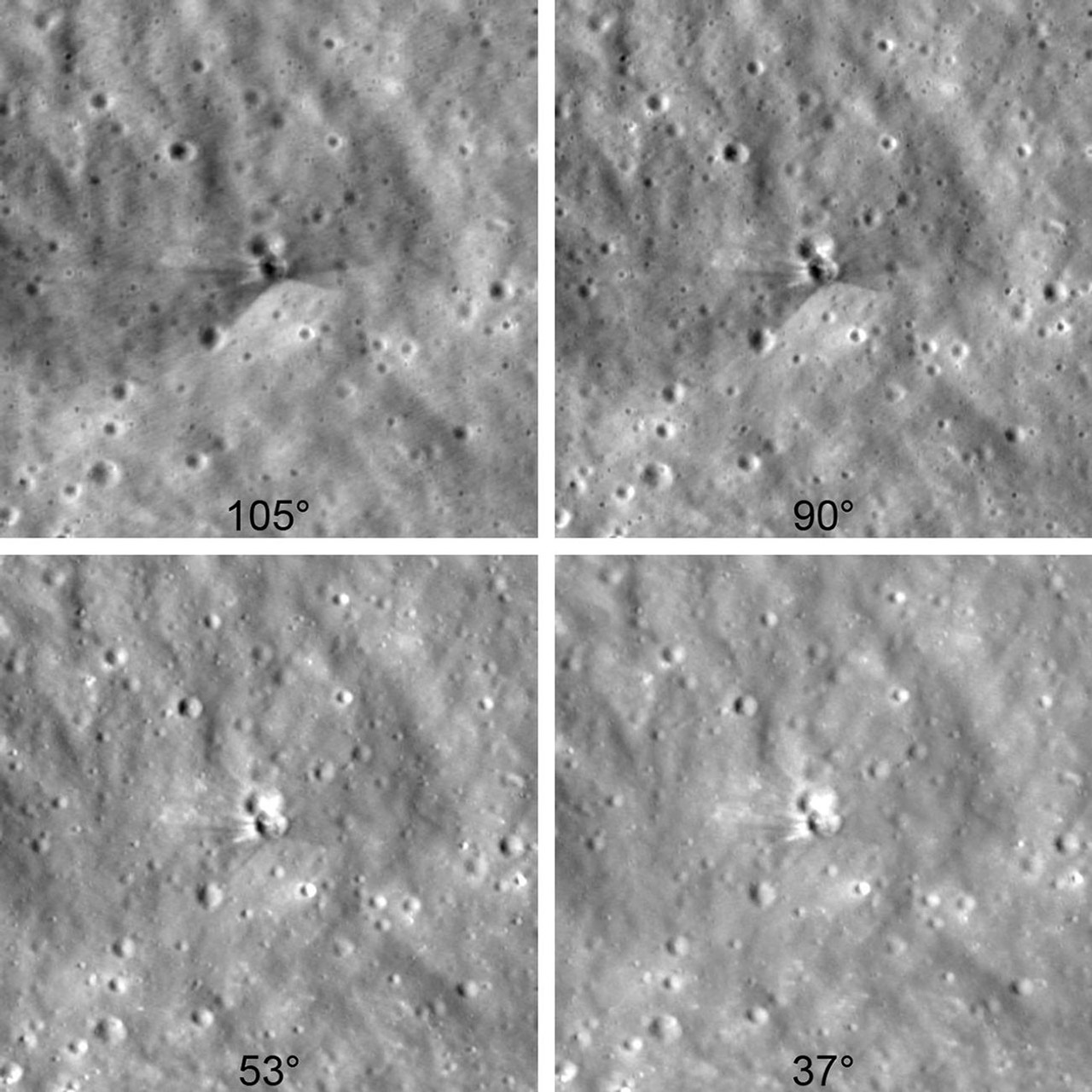
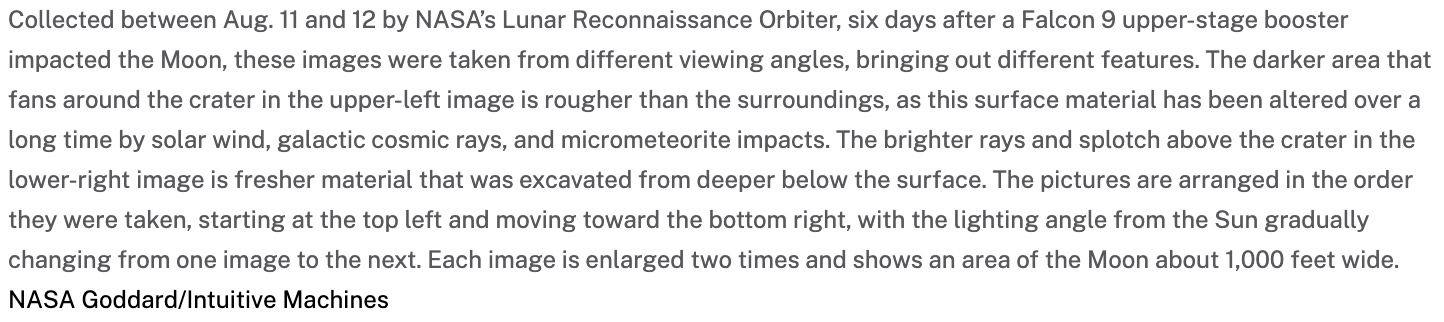
The measurements they took of the rim put the crater at 60 feet across, and based on the shadows on the floor, they estimate the depth is less than 10 feet. The impact occurred at an angle of about 31 degrees to the horizontal, resulting in the V-shaped spray of ejecta on the southern side, and the darker material fanning out was all from the top foot and a half of the regolith, a layer that had been exposed to solar wind, cosmic rays, and micrometeorites for a long time, so it is naturally rougher in texture and more muted in color. The brighter pieces near the rim, on the other hand, are most likely younger rock and dust that was pulled up from deeper underground and has not yet had time to change color.


The crater’s updated coordinates are 19.4759 degrees north, 266.7138 degrees east, and 511 meters elevation, and comparing the new images to earlier images of the same area, there’s no doubt that this change is relatively recent, and engineers will find it an interesting opportunity to test their tools for predicting collisions with objects of known size, mass, and speed. Furthermore, it demonstrates how a seemingly minor collision can mess up strata on the Moon that have been in place for millions of years.
You must be logged in to post a comment Login