Tech
Neoson Evolution Tube Amplifier Review: When 20 Watts Are Enough

Decibel+ is built around a fairly simple idea: high-fidelity audio should not require a five-figure budget, and the components in a system should actually make sense together. Founder Gabe Toro grew up around high-end audio through his father’s company, Supreme Acoustic Systems, where he was exposed to some exceptional equipment, along with the reality that much of it was priced beyond the reach of most music listeners.
When Toro launched Decibel+, he carried over one of the more important lessons from that experience: systems integration matters. Rather than simply assembling a catalog of affordable components, Decibel+ focuses on finding amplifiers, loudspeakers, sources, and accessories that work well together and deliver strong performance without pushing buyers into the upper reaches of high-end audio pricing. That combination of system-building experience and a more budget-conscious approach is what makes Decibel+ interesting in an increasingly crowded affordable hi-fi market.


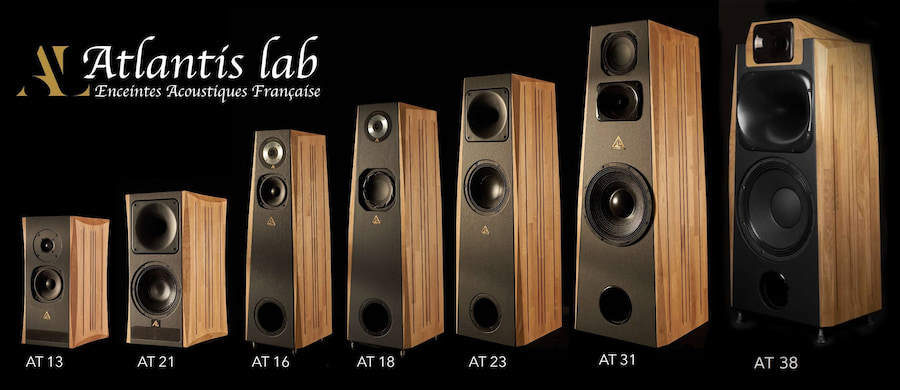
The system I reviewed paired the Atlantis Lab AT-23 Pro loudspeakers with the Neoson Evolution tube amplifier. It is a pairing that makes sense on paper and, more importantly, in the listening room. The AT-23 Pro is an extremely efficient loudspeaker, making it particularly well suited to tube amplification, while the Evolution combines a strong feature set with the kind of sonic performance that makes this French combination far more interesting than its relatively understated appearance might suggest.
There is also some visual harmony here. Both products are made in France and share similar blond wood finishes, so the system looks as carefully matched as it is technically. That might sound secondary, but when you are building a two-channel system that will probably occupy a prominent place in the room, it certainly does not hurt.
Related Reviews:
Neoson: French Tube Amplification With a Different Priority
Neoson is considerably less familiar to American audiophiles than many of the established tube-amplifier brands, in large part because its U.S. distribution has been limited. Decibel+ is looking to change that. Founded by designer Walter Blondel, Neoson is a relatively new French audio brand whose products are designed and hand-built in Normandy, with the company based in Argences, Calvados, near Caen. Blondel, however, brings more than two decades of development work to the project, so this is not quite a case of somebody waking up one morning and deciding that the world needed another KT88 amplifier.
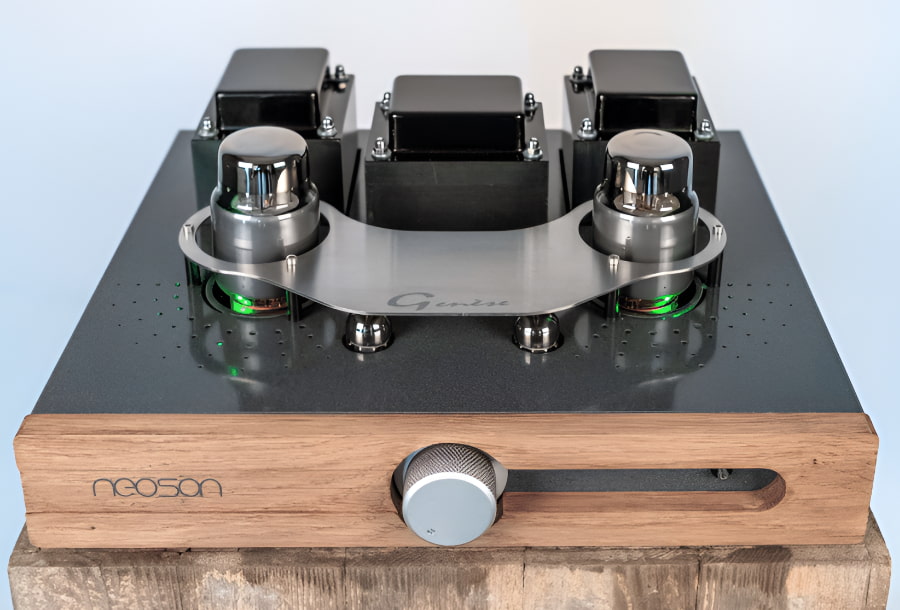
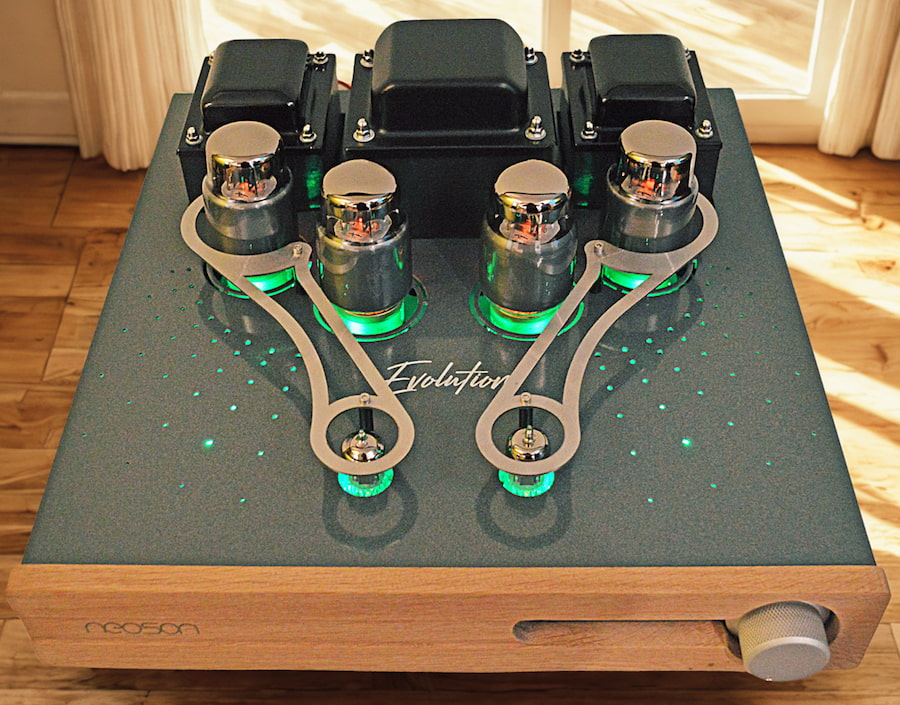


The current lineup consists of two integrated tube amplifiers, the Genèse and Evolution, and neither was designed around winning a horsepower competition. Neoson’s stated philosophy is that output power alone does not determine musical expressiveness, which explains its focus on single-ended tube circuits, pure Class A operation, and carefully selected components.
The Genèse is rated at 10 watts per channel into 8 ohms and uses two PSVANE KT88 TII Art output tubes configured as pseudo-mono triodes, along with two PSVANE 12AX7-S Art tubes in the preamplifier stage. The larger Evolution doubles the output to 20 watts per channel into 8 ohms through a double single-ended topology using four KT88 TII Art output tubes, while retaining the same pair of 12AX7-S Art tubes in the input stage. Both operate in pure Class A and are supplied with PSVANE tubes.
Twenty watts may not sound especially impressive in a world where increasingly affordable solid-state amplifiers routinely offer 100 watts per channel or more, but that somewhat misses the point of what Neoson is trying to accomplish. These amplifiers were designed around musicality, efficiency, and appropriate loudspeaker matching rather than brute force, which also helps explain why the Evolution and highly efficient Atlantis Lab AT-23 Pro looked like such an interesting combination for this review.

Built Like a Tube Amplifier Should Be
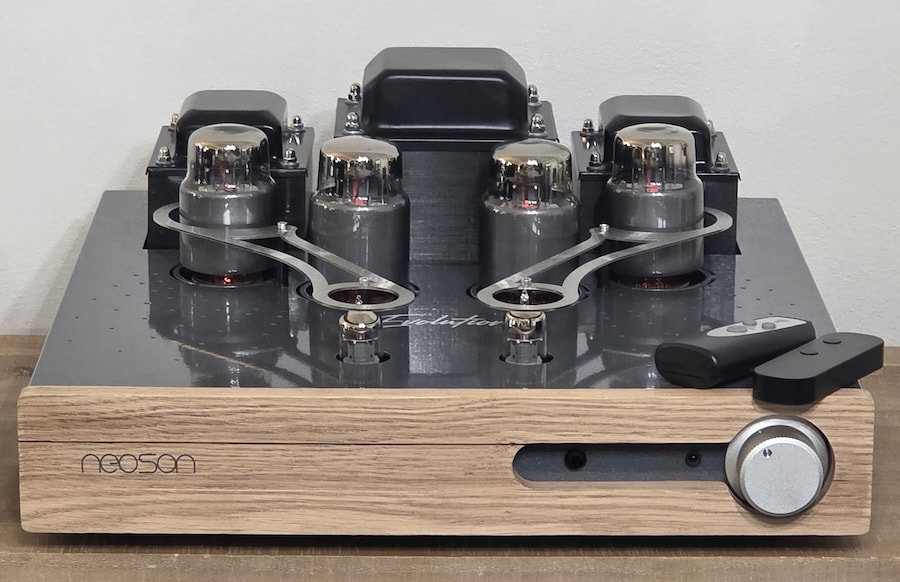
Tube amplifiers are rarely lightweight, and the Neoson Evolution is no exception at 53 pounds (24 kg). Its footprint is roughly 16 inches wide and deep, with the main chassis standing about four inches tall before the tubes and protective cages roughly double the overall height. One important clarification: despite its four KT88 output tubes, the Evolution is not a conventional push-pull design. Neoson describes it as a double single-ended topology operating in pure Class A.
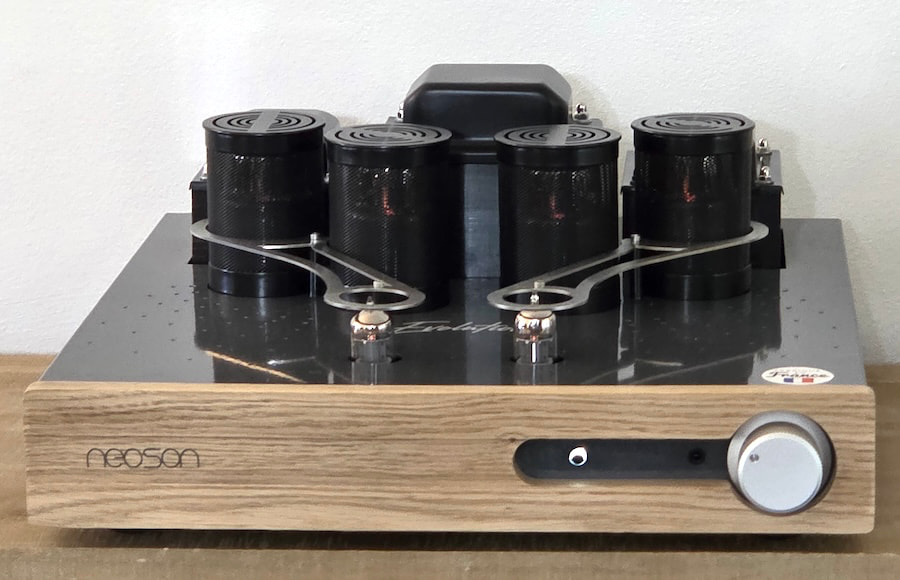
The front panel combines a blond wood fascia with a recessed control section on the right side. Controls are deliberately simple, consisting of a multifunction button, IR receiver, and a large volume control at the far right. Behind the wooden faceplate sits a steel chassis finished in a mottled blue-gray coating. Ventilation is extensive, and when the amplifier is powered on, green illumination can be seen through the series of vents surrounding the KT88 output tubes.
Neoson also provides substantial protection for the exposed tubes without enclosing them completely. A pair of distinctive guards, which I can best describe as wrench-shaped, protect the smaller 12AX7 tubes and the outer sections of the output stage. Each KT88 also receives its own black wire cage, providing some protection against accidental contact while still leaving enough airflow for the amplifier to be operated safely with the cages installed.

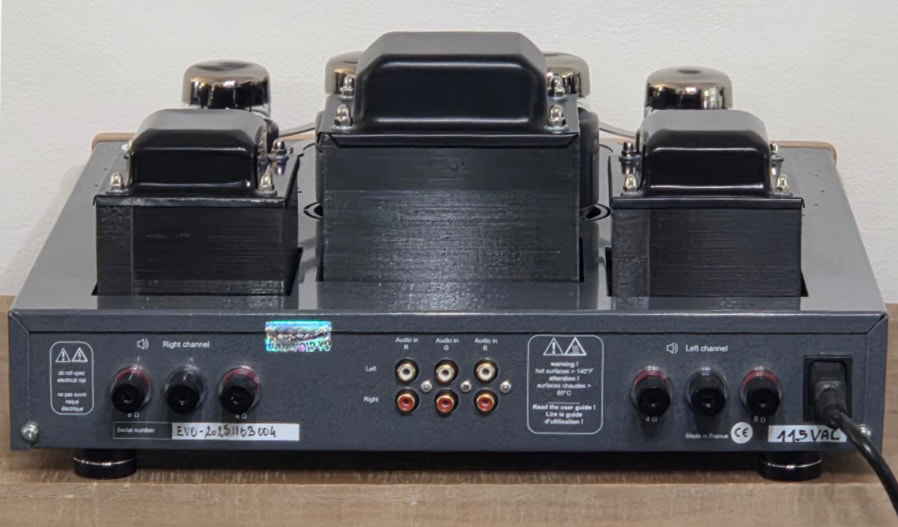
The rear panel is equally straightforward. The IEC power inlet is positioned at the far right, with separate 4-ohm and 8-ohm loudspeaker outputs arranged toward either side and three pairs of RCA line-level inputs located in the center. The Evolution is available for either 115V or 230V AC operation, depending on market configuration, and Neoson specifies power consumption at 260 watts.
There are no digital inputs, network connections, Bluetooth, or other attempts to turn the Evolution into an all-in-one system. Neoson has instead concentrated on the analog fundamentals. Three RCA inputs provide enough flexibility for something like a phono preamplifier, streamer or DAC, and another analog source such as a reel-to-reel deck. For the kind of system this amplifier is designed to anchor, that should be more than adequate.
A Different Way to Use Four KT88 Tubes
The Evolution combines some traditional tube-amplifier thinking with a more contemporary approach to component selection and mechanical isolation. Neoson uses Mundorf MCap Supreme Evo Silver Gold coupling capacitors between the amplification stages, a motorized ALPS volume potentiometer, and vibration absorbers for the preamplifier stage, transformers, and output tubes. Those choices are intended to reduce mechanical vibration and potential sources of noise in a circuit where tubes can be susceptible to microphonics.
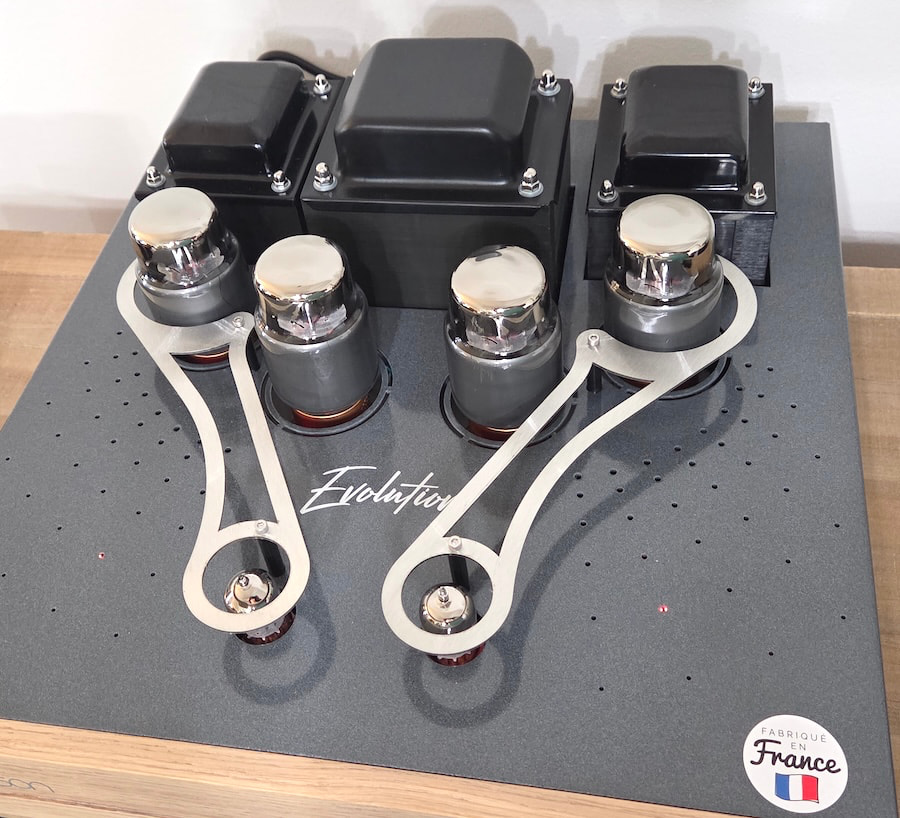

The more interesting part of the Evolution is its output stage. Looking at four KT88s, I initially expected a conventional push-pull amplifier. That would hardly have been unusual. A pair of KT88s operating in push-pull can produce considerably more power than the Evolution’s 20 watts per channel, with the actual output depending on operating voltage, bias, transformer design, and whether the tubes are being run in triode, ultralinear, or tetrode operation.
Neoson has gone in a very different direction. The company describes the Evolution as a double single-ended integrated amplifier operating in pure Class A, with four PSVANE KT88 TII Art tubes configured as “pseudo mono triodes.” The smaller Genèse uses two KT88s to produce 10 watts per channel, while the Evolution uses four and doubles output to 20 watts RMS per channel into 8 ohms. The additional output tubes therefore provide more power without abandoning the single-ended architecture that defines both amplifiers.
That distinction helps explain why four KT88s produce only 20 watts per channel. This is not an attempt to extract the maximum possible output from the tubes. Operating a KT88 in a triode-type configuration substantially reduces its available power compared with conventional tetrode or ultralinear operation, but it can also produce different transfer characteristics and distortion behavior. Combined with Class A operation and a single-ended circuit, Neoson is deliberately trading efficiency and maximum output for the characteristics it wants from the amplifier.
There is also some terminology worth clearing up. The KT88 is not technically a pentode. It is a beam power tetrode, and the “KT” designation derives from “kinkless tetrode.” Beam tetrodes and power pentodes frequently perform the same job in audio amplifiers and are sometimes discussed interchangeably, but their internal construction is different. Neoson’s description of its KT88s as “pseudo mono triodes” is the company’s terminology; without a complete circuit schematic, I would not go further and speculate about precisely how every electrode is connected.
The preamplifier stage uses two PSVANE 12AX7-S Art tubes. The 12AX7 is a high-gain dual triode commonly used in the voltage-gain stages of tube amplifiers, so there is nothing unusual about its presence here. What I would not do is assume Neoson selected it specifically because it provides a better impedance match for the KT88 than something such as a 12AT7 or 6922. That depends on the surrounding circuit, and Neoson does not make that claim. My problem with the 12AX7 was considerably more mundane: my stash of good examples is not as deep as it is for some other tube types.
The internal construction also suggests that Neoson has kept the audio path relatively direct, which is consistent with the simplicity of the overall design. Fewer unnecessary stages and connections can reduce opportunities for added noise, although implementation matters considerably more than simply counting components.
The published specifications are encouraging for this type of amplifier. Neoson rates the Evolution at 20 watts RMS per channel into 8 ohms, with a frequency response of 15 Hz to 20 kHz within ±1 dB and an input sensitivity of 0.9 Vrms. If the supplied test data showing channel balance within 0.2 dB and an unweighted signal-to-noise ratio of 84 dB are included with the review documentation, those figures are also worth noting.
An 84 dB unweighted SNR is not remotely competitive with the headline measurements of many modern solid-state amplifiers, but that comparison only tells part of the story. SNR is a ratio between the amplifier’s reference signal level and its residual noise; it should not be compared directly with an 80 dB SPL listening level. With a 20-watt tube amplifier intended to drive very efficient loudspeakers, the practical concern is whether hum or hiss becomes audible through those speakers at the listening position. That is the test that ultimately matters with the Evolution.


Component Selection
The Evolution’s 0.9 Vrms input sensitivity makes it compatible with a broad range of source components, although that does not mean every source will produce the same perceived volume at a given setting on the amplifier. Output levels can vary considerably between a phono preamplifier, DAC, streamer, or other line-level source. In my system, an adjustable phono stage proved useful because it allowed me to keep the turntable’s output closer to that of the digital sources and avoid large changes in volume when switching inputs.
Loudspeaker matching is considerably more important. With only 20 watts per channel available, the Evolution is best partnered with efficient loudspeakers that do not present an unnecessarily difficult load. That helps explain why Decibel+ pairs it with Atlantis Lab loudspeakers such as the AT-23 Pro. Their high sensitivity makes much better use of the Evolution’s available output than a conventional low-sensitivity loudspeaker that might require considerably more current and power to reach the same listening levels.
Heat management also needs to be considered. The Evolution is a pure Class A tube amplifier with a specified power consumption of 260 watts, and a substantial portion of that energy is ultimately released as heat. Unlike many Class AB amplifiers, a Class A design continues to dissipate significant power even when music levels are low, so the chassis and tubes remain quite warm during normal operation.
That makes placement important. The Evolution should be given plenty of open space above and around the chassis, with unrestricted airflow through its ventilation openings. Putting it inside a tightly enclosed cabinet is not a good idea. Proper ventilation will help keep internal temperatures under control and should also benefit long-term component and tube life.

Listening
To my ear, the KT88 is one of the hardest tubes to categorize, but so much depends on what is put around it and the overall amplifier design. A quick search will turn up push-pull KT88 amplifiers ranging from 80 watts per channel on down, with some manufacturers even using language such as “conservatively rated at 45 watts.” Every amplifier design involves trade-offs: power for distortion, cleanliness for heat, and cost for noise. It is simply not possible to maximize output, clarity, and musicality at the same time.
With the Evolution, Neoson has clearly chosen to sacrifice power and accept the additional heat generated by Class A operation in pursuit of clarity and musicality. When paired with a high-efficiency loudspeaker like the Atlantis Lab AT-23 Pro, the result is a warm, rich sound with good weight throughout the audible range. There is no thinning of the bass or harshness at the top end, just consistently even behavior across the spectrum with fantastic midrange tonality.
Sub-bass performance is quite good for a design using smaller drivers, while the mid-bass is well controlled with plenty of weight and detail. Unless you are using this combination as part of a home theater system, I see little reason to add a subwoofer.
The midrange is the heart of any system, and this is where the Neoson and Atlantis Lab pairing really shines. The tonal quality of piano and strings is as good as I have heard from some substantially more expensive systems over the years. No matter how busy the track or complex the passage, I heard no congestion or thickening of the sound.
As expected, the horn tweeter does an excellent job of presenting a detailed treble, although it may be a touch hot for some listeners. The Evolution takes just enough of that edge away, making the top end sound slightly warmer without sacrificing detail in the process.
Overall, the combination of the Atlantis Lab AT-23 Pro and Neoson Evolution shows that Decibel+ did its homework when putting this system together. This was clearly not a case of, “They both have blond wood, so let’s go with that.”
The other side of the equation becomes obvious when the Evolution is paired with the wrong loudspeaker. Connecting it to my Magnepan 3.7s was a mistake. Their lower sensitivity and more demanding load are simply not a good match for a 20-watt amplifier like the Evolution. The gorgeous, energetic presentation I heard from the AT-23 Pros quickly became somewhat lethargic and lifeless.
Switching to a smaller bookshelf speaker like the Klipsch RP-600M brought the musicality back, and the Evolution once again sounded right at home. I also had an opportunity to try it with a friend’s Wharfedale Linton Heritage loudspeakers, and the pairing acquitted itself quite well there, too.
Tube Rolling
Some listeners buy tube amplifiers for that wonderful glow, others for their warmer tonal character, and some of us simply cannot resist tube rolling in search of the combination that best suits our system and preferences. The PSVANE tubes supplied with the Evolution are quite good, so anyone interested in using the amplifier with minimal fuss should be perfectly happy with what Decibel+ provides.
For those of us who cannot leave well enough alone, however, there are plenty of options. My first piece of advice is to be very careful when buying vintage 12AX7s unless you know and trust the seller. The 12AX7 was used extensively in both guitar and hi-fi amplifiers during the tube era, which means there are enormous numbers of used examples floating around. Condition varies considerably, and tubes advertised as NOS are not always what the seller claims them to be.
I generally start with the preamplifier tubes because, in my experience, changing them often has a greater impact on the amplifier’s tonal character than replacing the output tubes. I did not try 5751s because Neoson’s documentation does not recommend them, and without discussing the substitution with the manufacturer first, I was not comfortable experimenting.
My 12AX7 options included early-1970s Philips 12AX7WA JAN tubes, RCA clear tops, Telefunken ECC803S, early Ei 12AX7s, Tungsram 12AX7s, and a pair of Mullards from 1968. The Ei pair was eliminated almost immediately because one channel developed a severe howl. The other tube sounded quite good when I shifted the balance entirely to that channel, but one member of the pair was clearly unhappy in the Evolution.
The Philips tubes were solid performers but offered little, if any, improvement over the stock PSVANEs, making their additional cost difficult to justify. The RCAs were similar overall, although I heard slightly greater treble clarity. Listeners looking for a little more openness at the top might find them worthwhile.
The larger changes came from the Tungsram, Mullard, and Telefunken tubes. The Tungsrams and Mullards pushed the Evolution in a warmer, more saturated direction, with slightly darker treble and a more prominent midrange. Those looking for strong bass, richer mids, and less top-end energy may prefer either of these to the stock tubes.
The Telefunken ECC803S went in the opposite direction. It delivered the cleanest and most analytical presentation of the group, with excellent detail retrieval, greater top-end sparkle, and somewhat less warmth and fluidity through the bass and midrange. Listeners who generally find tube amplifiers a little too soft or overly lush may find the Telefunken the most appealing option.
None of this means the stock PSVANEs need replacing. In fact, their balanced presentation makes them a very sensible starting point. Tube rolling simply allows the Evolution’s character to be pushed in either direction: warmer and richer with the Mullards or Tungsrams, or cleaner and more incisive with the Telefünkens.
Rolling the Output Tubes
I don’t know too many people who regularly roll KT88 output tubes because the cost can get out of hand rather quickly. A good matched quad of current-production tubes can run several hundred dollars, while matched quads of desirable vintage NOS examples can easily climb into the thousands.
I started with a set of vintage GE 6550A gray plates, which are among the more commonly encountered American 6550-family tubes. They performed well in the Evolution, but I did not find the improvement over the stock PSVANEs significant enough to justify buying a matched quad specifically for this amplifier. If the Evolution eventually needed a new set of output tubes anyway, that calculation might be different.
The more exotic options in my collection were a set of British-made M-OV/GEC KT88s from 1966 and a set of vintage 1960s Tung-Sol 6550s. The GECs are the classic British KT88s, and examples from this period with their brown base wafers and triple-getter construction have become highly sought after. Finding a genuine, properly matched quad today can be painfully expensive. Fortunately, mine have been in my collection for more than 20 years, so I avoided paying current market prices.
The same applies to the vintage Tung-Sols. Original American Tung-Sol 6550s have become increasingly scarce and expensive, particularly when you need four closely matched examples. Mine were also purchased long before prices headed into the stratosphere.
Both vintage sets improved the Evolution to my ear, although the differences were not transformational. They sounded slightly cleaner as volume increased and delivered a little more impact in the bass at lower listening levels than the stock PSVANEs. There was an improvement, but whether it is worth spending four figures on a set of vintage output tubes is an entirely different question.
For most owners, I don’t think it is. The supplied PSVANEs are already very good and suit the Evolution well, so there is no reason to feel that you are hearing a compromised version of the amplifier by leaving the factory tubes in place. Vintage output tubes are an expensive final bit of tuning for those who already own them or have very deep pockets, not something I would consider necessary.
If I were keeping the review sample, my preferred combination would be the Telefunken ECC803S input tubes with the GEC KT88s. That combination offered the balance of clarity, tonal weight, detail, and treble energy that best suited my own listening preferences. The fact that getting there with vintage tubes could now cost a small fortune is also a very good argument for enjoying the PSVANEs and spending the difference on music.

The Bottom Line
Tube amplifiers are rarely inexpensive, and every design involves trade-offs. At $11,828, the Neoson Evolution certainly does not change that equation. What matters is where Neoson has chosen to make those compromises. Rather than chasing maximum output from its four KT88s, the Evolution uses a pure Class A, double single-ended topology to deliver 20 watts per channel, with the emphasis firmly on musicality, tonal richness, and clarity.
That approach works exceptionally well when the amplifier is paired with the right loudspeakers. The Atlantis Lab AT-23 Pro gives the Evolution the efficiency it needs to perform at its best, and the resulting combination delivers excellent tonal weight, a rich and expressive midrange, and enough detail without pushing the treble too far forward. The additional heat is something owners will have to accommodate with proper ventilation, but the limited power output becomes far less important when the loudspeaker has been selected accordingly.
The Evolution will make the most sense for listeners who already own efficient loudspeakers or want to build a system around them. Those with more modest spaces and similarly efficient speakers should also consider the 10-watt-per-channel Neoson Genèse, which follows much of the same design philosophy at $7,885.
The Evolution is not the amplifier for difficult loads, inefficient planar speakers, or anyone who judges an amplifier primarily by the size of the number next to “watts.” With the right loudspeaker, however, its 20 watts proved more than sufficient, and the quality of those watts is ultimately why this French tube amplifier deserves attention.
Pros:
- Rich, warm presentation with excellent midrange tonality
- Very good clarity and detail without sounding overly bright
- Excellent match for high-efficiency loudspeakers
- High-quality internal components and thoughtful vibration control
- Stock PSVANE tubes are good enough that tube rolling is optional
Cons:
- 20 watts per channel severely limits loudspeaker compatibility
- Runs hot and requires plenty of ventilation
- Analog-only connectivity with just three RCA inputs
- At $11,828, proper system matching becomes even more important
- Rolling vintage KT88/6550 tubes can become extremely expensive
Our Ratings
★★★★★★★★★★ Performance*
★★★★★★★★★★ Usability
★★★★★★★★★★ Build Quality
★★★★★★★★★★ Value
* Performance is highly dependent what speakers are connected. However, when connected to high efficiency loudspeakers such as the Atlantis Labs AT-23 Pro, performance was excellent.
For more information: For more information about Neoson products see https://decibel-plus.com/ or https://neoson.fr/produits/
You must be logged in to post a comment Login