Tech
Neumann Expands Its Studio Monitor Line With KH 310 II and KH 350 Powered Speakers

In late 2025, German pro audio brand Neumann expanded its Studio Monitor line with several DSP-powered subwoofers. For 2026, Neumann is following up with the KH 310 II and KH 350, two next-generation 3-way powered studio monitors that combine decades of acoustic expertise with a new DSP platform and improved integration. Both are designed to deliver higher performance, greater flexibility, and the accuracy that has made Neumann a reference in professional recording, mixing, and mastering studios worldwide.
The line separating professional studio monitors from high-end home audio has also become considerably less rigid in recent years. Powered loudspeakers, DSP, room correction, and increasingly sophisticated digital connectivity have made products originally aimed at engineers and producers far more practical for home studios and serious two-channel listening systems.
For listeners who value accuracy, controlled dispersion, and removing a stack of amplifiers and boxes from the equation, a monitor such as the KH 310 II or KH 350 is no longer something that automatically belongs behind a mixing console. That crossover makes Neumann’s latest models relevant to a much wider audience than their “studio monitor” label might suggest.
Building on Tradition, Designed for What Comes Next
The introduction of the KH 310 II and KH 350 marks the latest step in the evolution of Neumann’s monitor portfolio. All Neumann KH loudspeakers follow the same core design philosophy: high linearity, low distortion, and adaptability to the acoustic environment. That consistency also allows models across the KH line to be combined in surround and immersive audio systems.
Neumann’s KH series continues the legacy of German loudspeaker pioneer Klein + Hummel, whose monitoring solutions became a reference for broadcasters and recording studios across Europe. Klein + Hummel helped establish the modern concept of powered studio monitors with active crossovers as early as 1967 with the legendary OY 3-way monitor, the original predecessor to today’s KH 310 II.
The KH 310 II and KH 350 combine in-house-designed drivers, powerful amplification, and advanced 32-bit DSP processing to deliver consistent performance and reliable translation while addressing different monitoring requirements. The KH 310 II advances one of the industry’s established studio references, the KH 310 A, while the KH 350 is a new full-range monitor designed to deliver greater low-frequency extension and output for larger rooms.
Although both models share Neumann’s core acoustic and DSP technologies, they are aimed at different applications. The KH 310 II builds on a familiar nearfield and midfield platform, while the larger KH 350 is intended for environments that require higher output levels and deeper bass response without immediately relying on a separate subwoofer.
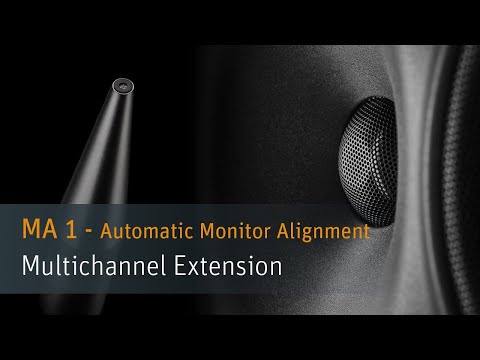
Both monitors support Neumann’s MA 1 Automatic Monitor Alignment room correction solution and include both analog and AES3 coaxial digital connectivity. They build on the midrange resolution of the original KH 310 A while offering lower distortion, nearly twice the amplifier power, and tighter production tolerances for greater consistency between speakers.
The result is more precise imaging, predictable performance, and easier integration across stereo, surround, and immersive audio systems. MA 1 support also gives users the ability to adapt each monitor to the acoustic characteristics of the room, an increasingly important feature in both professional studios and high-performance home listening environments.
“The KH 310 has earned an exceptional reputation among recording, mixing, and mastering engineers worldwide,” says Roman Kramer, Product Manager at Neumann. “With the KH 310 II, we worked long and hard to retain everything users love about the original while elevating performance in virtually every area. At the same time, the KH 350 opens new possibilities for engineers who need greater low-frequency authority and the flexibility to work confidently across both nearfield and midfield environments.”
The KH 310 II and KH 350 both incorporate Neumann’s 3-inch soft-dome midrange driver, precision 1-inch tweeter, and advanced 8.25-inch woofer, supported by DSP processing. This combination is designed to improve transparency, phase coherence, and overall accuracy for critical monitoring and production decisions.
“The KH 310 II and KH 350 share the same acoustic DNA and commitment to truthful sound reproduction,” says Stephan Mauer, Product Management Director at Neumann. “Today’s engineers work across a wide range of rooms, formats, and production styles. Our goal was to provide two solutions that deliver the same trusted reference standard while allowing users to choose the monitoring concept that best supports their workflow.”
KH 310 II and KH 350 Shared Features
- In-house-designed custom drivers
- Exceptional midrange resolution from a dedicated 3-inch soft-dome driver
- Advanced precision through 32-bit DSP processing
- Compatibility with Neumann’s MA 1 Automatic Monitor Alignment
- Analog and AES3 coaxial (AES3id) digital connectivity
- 585 watts of amplifier power with high energy efficiency
- Consistent voicing across stereo, surround, and immersive systems
- Tight production tolerances for precise imaging and multichannel installations
KH 310 II

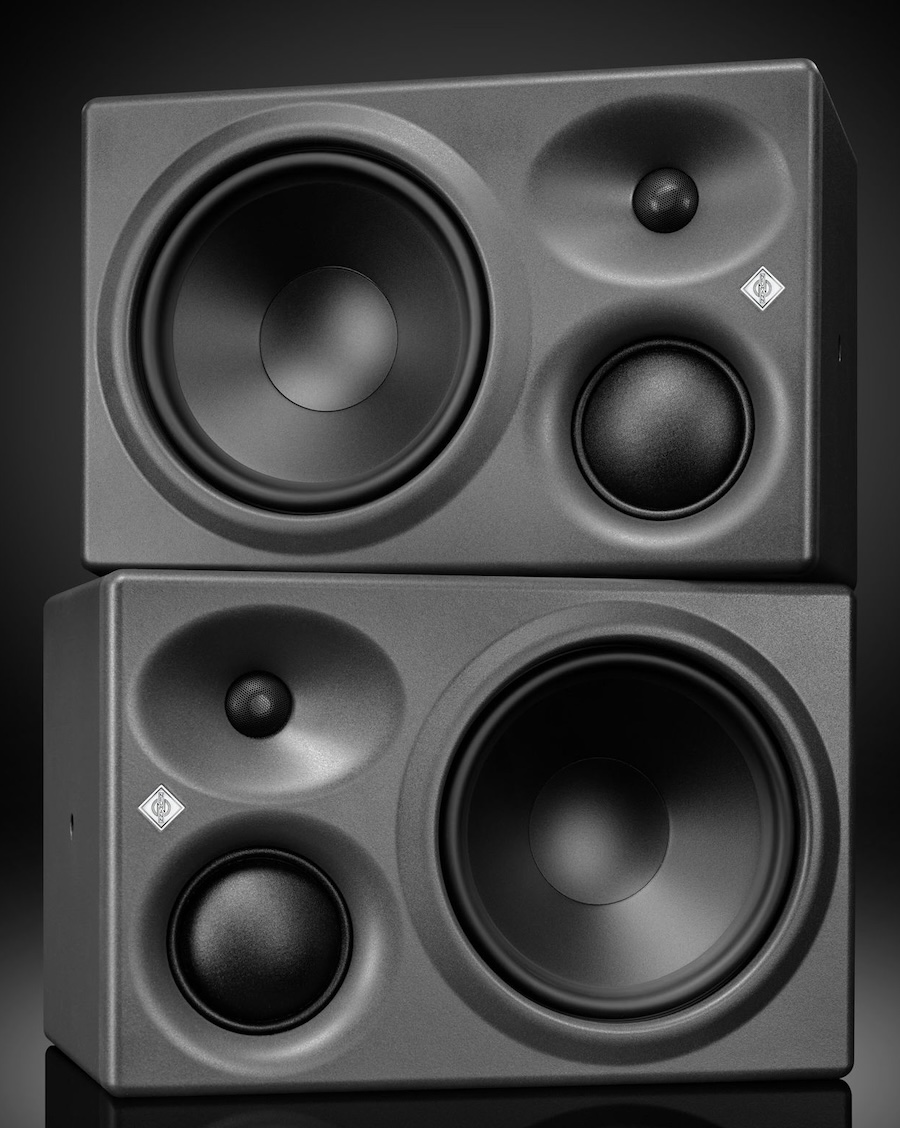
The KH 310 II is the successor to one of professional audio’s most trusted studio monitors, the original KH 310 A, which earned its reputation through accuracy, exceptional midrange clarity, and precise low-frequency reproduction.
The new KH 310 II retains the sealed-cabinet design prized for its fast transient response, low group delay, and tightly controlled bass reproduction. Neumann’s celebrated 3-inch soft-dome midrange driver also remains unchanged, preserving the natural tonal balance and vocal clarity that helped establish the KH 310 A as a studio reference.
Beyond those similarities, the KH 310 II has been extensively re-engineered. A newly developed woofer, increased amplifier power, advanced DSP processing, improved linearity, and lower distortion combine to deliver a substantial performance upgrade. Despite producing a maximum SPL that is 5 dB higher than its predecessor, the KH 310 II retains the same cabinet dimensions as the KH 310 A, simplifying integration into existing studios and installations.
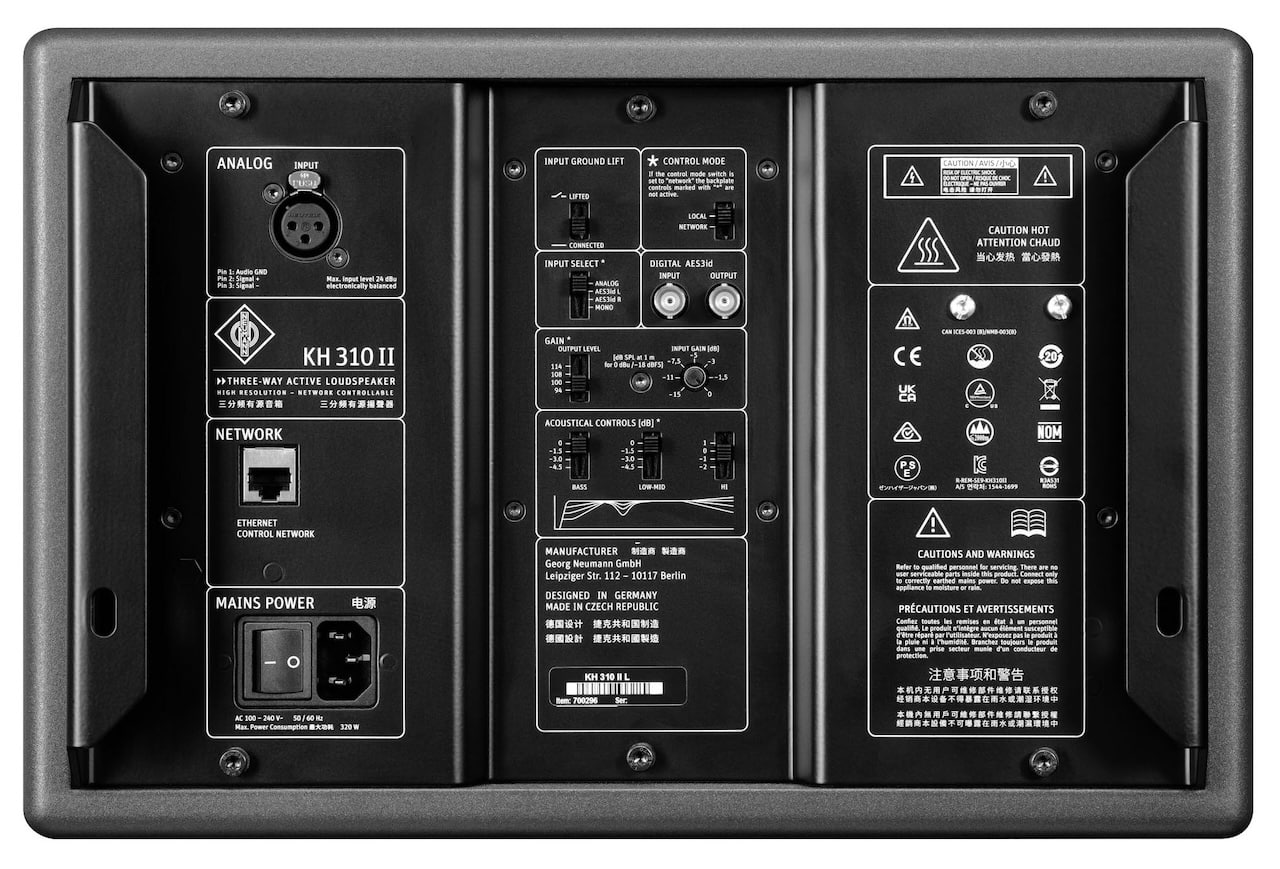

By preserving the strengths of the original platform while updating its amplification, DSP, woofer, and overall performance, the KH 310 II carries Neumann’s established design philosophy forward without abandoning what made the original so successful.
KH 310 II Highlights
- Sealed-cabinet design for fast transient response, low group delay, and tightly controlled bass
- Optimized for critical nearfield monitoring
- Lower distortion and improved linearity
- 5 dB higher maximum SPL than the KH 310 A
- Identical cabinet dimensions for straightforward replacement in existing studios and installations
KH 350

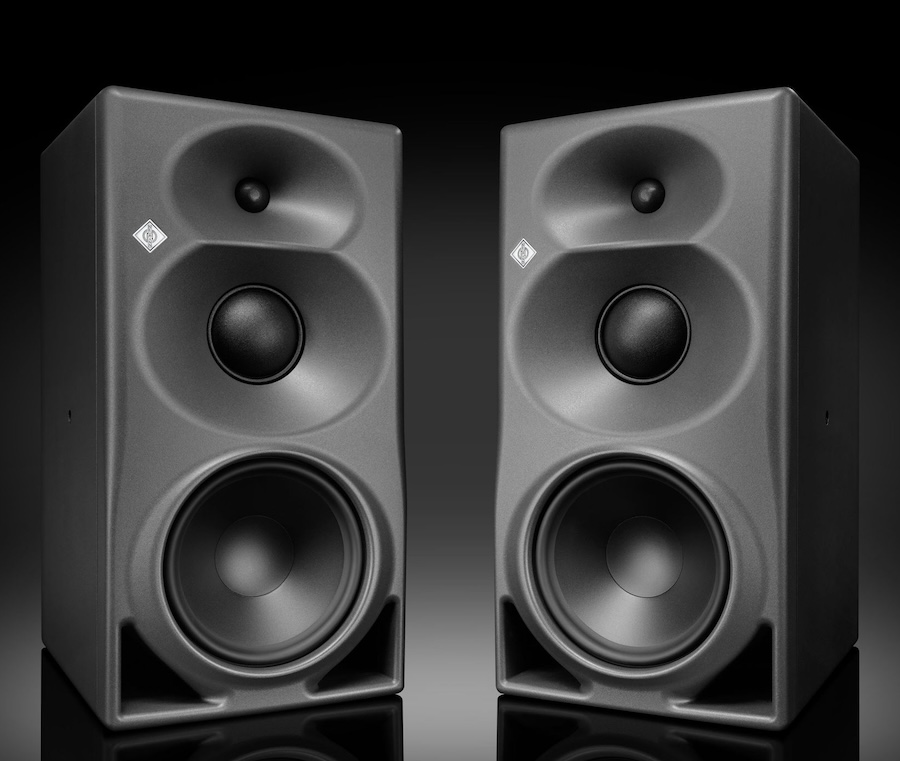
The KH 350 introduces a new monitoring option within Neumann’s studio monitor lineup.
Designed for both nearfield and midfield applications, the KH 350 combines Neumann’s established midrange and high-frequency platform with a bass-reflex enclosure engineered for deeper low-frequency extension, greater physical impact, and full-range performance.
With a cabinet nearly twice the size of the KH 310 II and a vertical driver arrangement, the KH 350 is intended for larger listening environments that require higher SPL capability and greater listening-distance flexibility.
A large MMD waveguide provides improved directivity control across the frequency range, helping to maintain stable imaging, reliable translation, and consistent in-room performance. That also makes the KH 350 well suited for use as an LCR or surround loudspeaker in immersive audio systems.
With low-frequency extension down to 27 Hz (±6 dB), increased output capability, and support for longer listening distances, the KH 350 is designed to deliver the scale and authority required for modern music production, film scoring, post-production, broadcast, and immersive audio workflows.
Positioned between the KH 310 II and the flagship KH 420, the KH 350 gives recording and mixing engineers a new option for deeper bass extension, higher output, and greater placement flexibility without sacrificing the accuracy expected from Neumann’s KH series.
KH 350 Highlights
- Bass-reflex design for extended low-frequency response
- Suitable for both nearfield and midfield monitoring
- Large MMD waveguide for more precise directivity control
- Greater low-frequency authority with full-range performance
- Optimized for larger control rooms and immersive audio applications
Specifications Comparison
| Neumann Model | KH 350 | KH 310 II |
| Product Type | Studio Monitor Speaker | Studio Monitor Speaker |
| Price | $3,599 | $2,999 |
| Monitor Type | Powered | Powered |
| Enclosure Type | Bass Reflex | Sealed |
| Woofer | 210 mm (8 1/4″) | 210mm (8 1/4″) |
| Midrange | 75 mm (3″) with magnetic shielding | 75 mm (3″) with magnetic shielding |
| Tweeter | 25 mm (1″) with protective black metal grille | 25 mm (1″) with protective black metal grille |
| Frequency Response (Free Field) | ±3 dB 30 Hz – 21 kHz
±6 dB 27 Hz – 21 kHz |
±3 dB 33 Hz – 21 kHz
±6 dB 29 Hz – 21 kHz |
| Crossover | 700 and 1700 Hz | 700 and 1700 Hz |
| Crossover Slope | 24 dB / octave | 24 dB / octave |
| Automatic room calibration via MA 1 | Yes | Yes |
| Max. SPL in full space at 3% THD at 1m (averaged between 100 Hz and 6 kHz) | 116.6 dB SPL | 115.4 dB SPL |
| Max. SPL in half space at 3% THD at 1m (averaged between 50 Hz and 100 Hz) | 109.7 dB SPL | 107.8 dB SPL |
| Analog input(s) | XLR: analog electronically balanced | XLR: analog electronically balanced |
| Digital input(s) | BNC (75 Ω): AES3id | BNC (75 Ω): AES3id |
| Digital output(s) | BNC (75 Ω): AES3id | BNC (75 Ω): AES3id |
| Dolby D.A.R.D.T. Max SPL full-range | 120 dB | 118 dB |
| Dolby D.A.R.D.T. Max SPL Bsdd Managed | 124 dB | 123 dB |
| Input Selector | Analog; AES3id L; AES3id R; Mono | Analog; AES3id L; AES3id R; Mono |
| DSP Resolution | 32 Bit Audio, processing 64 Bit double precision | 32 Bit Audio, processing 64 Bit double precision |
| Status Display | Limit / Clip / Errors / Protection /Boot Mute / Shut Down Mute | Limit / Clip / Errors / Protection /Boot Mute / Shut Down Mute |
| Output Power (THD+N with limiter deactivated: 10%) | Woofer – 300 W Midrange – 160 W Tweeter – 125 W |
Woofer – 300 W Midrange – 160 W Tweeter – 125 W |
| Output Power (THD+N with limiter deactivated: 0.1%) | Woofer – 185 W Midrange – 125 W Tweeter – 125 W |
Woofer – 185 W Midrange – 125 W Tweeter – 125 W |
| Mains Power Supply: input voltage; frequency | SMPS: 100-240 V; 50/60 Hz | SMPS: 100-240 V; 50/60 Hz |
| Power consumption (230 V / 100 V) | Standby <300 mW Idle 26 W Full output 320 W |
Standby <300 mW Idle 26 W Full output 320 W |
| Cabinet material | Composite polycarbonate front, wooden sleeve, aluminum electronics panel | Composite polycarbonate front, wooden sleeve, aluminum electronics panel |
| Internal Net Volume | 35 liters | 16.2 liters |
| External Net Volume | 52 liters | 24 liters |
| Cabinet Surface Finish; Color (front/back) | Painted; metallic anthracite (RAL 7021) / black (RAL 9005) | Painted; metallic anthracite (RAL 7021) / black (RAL 9005) |
| Product Dimensions (HWD) | 545 x 280 x 363 mm
21 1/2″ x 11″ x 14 1/4″ |
253 x 383 x 292 mm
10″ x 15 1/8″ x 11 1/2″ |
| Product Weight | 20.0 kg (44 lbs 1 oz) | 13.0 kg (28 lbs 11 oz) |
The Bottom Line
The KH 310 II and KH 350 continue Neumann’s long-established approach to professional monitoring, but the combination of built-in amplification, 32-bit DSP, digital connectivity, controlled directivity, and integration with MA 1 makes these considerably more flexible than traditional powered studio monitors.
The differences between the two new models are equally important. The KH 310 II is the more compact sealed design, optimized for critical mixing, mastering, and nearfield monitoring where transient response and controlled bass behavior take priority. The larger KH 350 uses a bass-reflex enclosure, extends down to 27 Hz (±6 dB), and offers greater output and listening-distance flexibility for larger control rooms, film production, bass-heavy music, and immersive audio installations.
What makes these particularly interesting is the system approach. Rather than treating DSP and room correction as optional features bolted onto otherwise conventional powered speakers, Neumann has designed the KH range to work as an integrated monitoring ecosystem. Anyone spending this much on the KH 310 II or KH 350 should seriously consider budgeting for Neumann’s MA 1 Automatic Monitor Alignment system as well. Buying reference monitors at this level and ignoring what the room is doing to them rather defeats the purpose.
Competition is hardly nonexistent. The Focal Trio6 ST6, which we have covered extensively through Focal’s professional monitoring initiatives, is priced at roughly $3,499 per monitor and offers a very different three-way approach, including its unusual Dual Focus modes. Genelec’s 8341A is another obvious rival, combining a three-way coaxial design with DSP and Genelec’s GLM room-calibration platform, although its current $3,675-per-speaker price puts it slightly above the KH 350.
JBL’s 708P also belongs in the broader conversation, particularly for studios that want DSP, substantial output, and controlled directivity without spending Neumann money. At its current $1,899-per-speaker price, however, it is no longer a direct price competitor. Amphion’s One25A is another studio reference we have covered, but at $14,900 per pair it occupies a considerably more expensive neighborhood.
At $2,999 each for the KH 310 II and $3,599 each for the KH 350, neither model is remotely inexpensive, especially once you multiply that across an immersive system. But Neumann is offering the amplification, DSP, digital signal path, room-alignment capability, and loudspeaker engineering as one coordinated platform. For professional users—and increasingly for serious home listeners who would rather eliminate amplifiers, passive crossovers, and some of the usual system-matching nonsense—that is the real attraction.
You must be logged in to post a comment Login