Security teams log 54% of successful attacks and alert on just 14%. The rest move through your environment unseen.
The Picus whitepaper shows how breach and attack simulation tests your SIEM and EDR rules so threats stop slipping by detection.





A new ransomware operation named ‘Prinz Eugen’ prioritizes recently modified files for encryption and leaves no ransom note on the system.
An investigation from Threatdown, Malwarebytes’ enterprise cybersecurity arm, found that the Prinz Eugen hackers have a hands-on-keyboard style and prefer to use legitimate remote monitoring and management (RMM) software and living-off-the-land tools.
According to the researchers, initial access is likely achieved through stolen RDP credentials, followed by the manual download and execution of the main payload, ‘servertool.exe.’
In an investigated incident, the researchers observed the use of the RemotePC RMM tool and a backdoor administrator account that provided persistence.
Unlike many modern extortion operations, Prinz Eugen does not operate under the ransomware-as-a-service (RaaS) model, and its developers are not currently recruiting affiliates.
Unlike most extortion operations, Prinz Eugen is not a ransomware-as-a-service (RaaS), or at least the developers are not currently looking for affiliates.
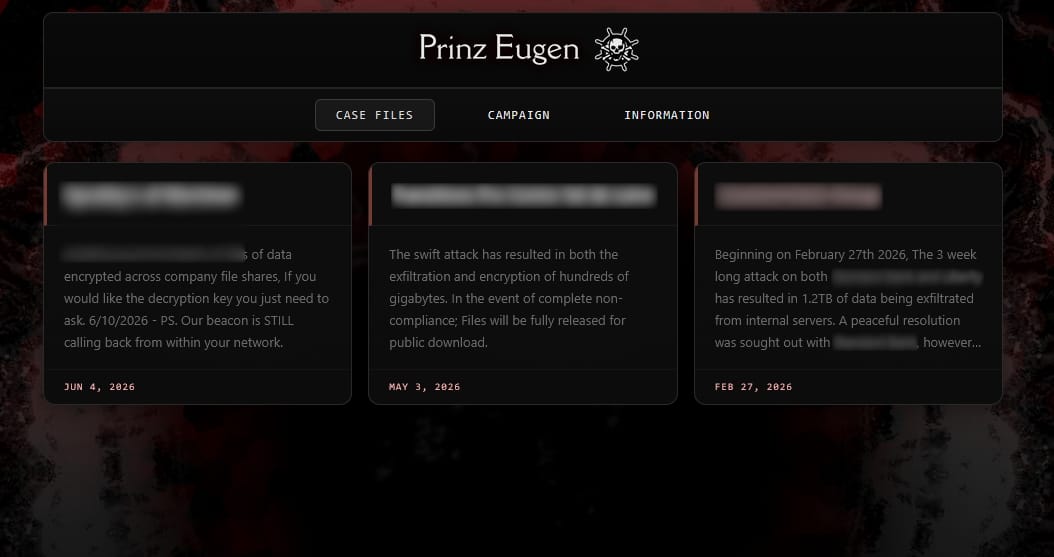
Currently, the threat actor’s data leak site only lists three victims, each one showing that the hackers engage in data encryption, exfiltration, or both. However, the cybersecurity community is aware of more organizations impacted by Prinz Eugen ransomware.
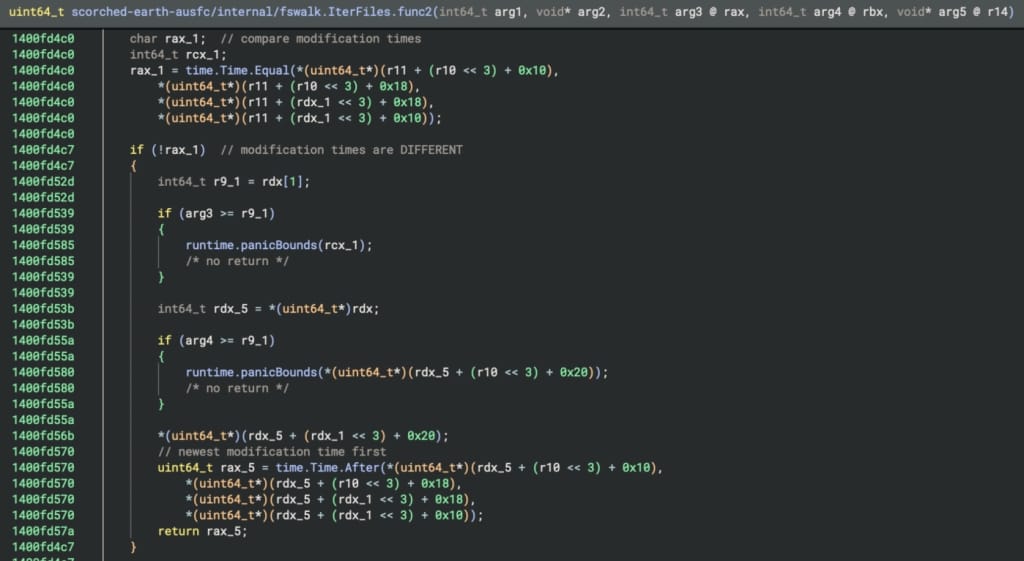
An analysis of a Prinz Eugen attack revealed that the Go-based malware prioritizes the encryption of the most recently modified files. When multiple files share the same timestamp, they are processed in alphabetical order.
Threatdown researchers believe this approach is intended to maximize the impact on victims by targeting files that are more likely to be business-critical and in active use, increasing the pressure to pay the ransom.
The analyzed sample checks directories recursively with no depth limit and no exclusions, and encrypts virtually every file except those with the .prinzeugen extension, which Prinz Eugen uses for encrypted files.
The ransomware employs ChaCha20-Poly1305 encryption with a 32-byte master key, a random initialization vector for each file, and a key derivation function based on Argon2id, SHA-256, and HKDF-SHA256.
The encryption process is carried out in 1 MB chunks, and file integrity is checked using the SHA-256 hash function.
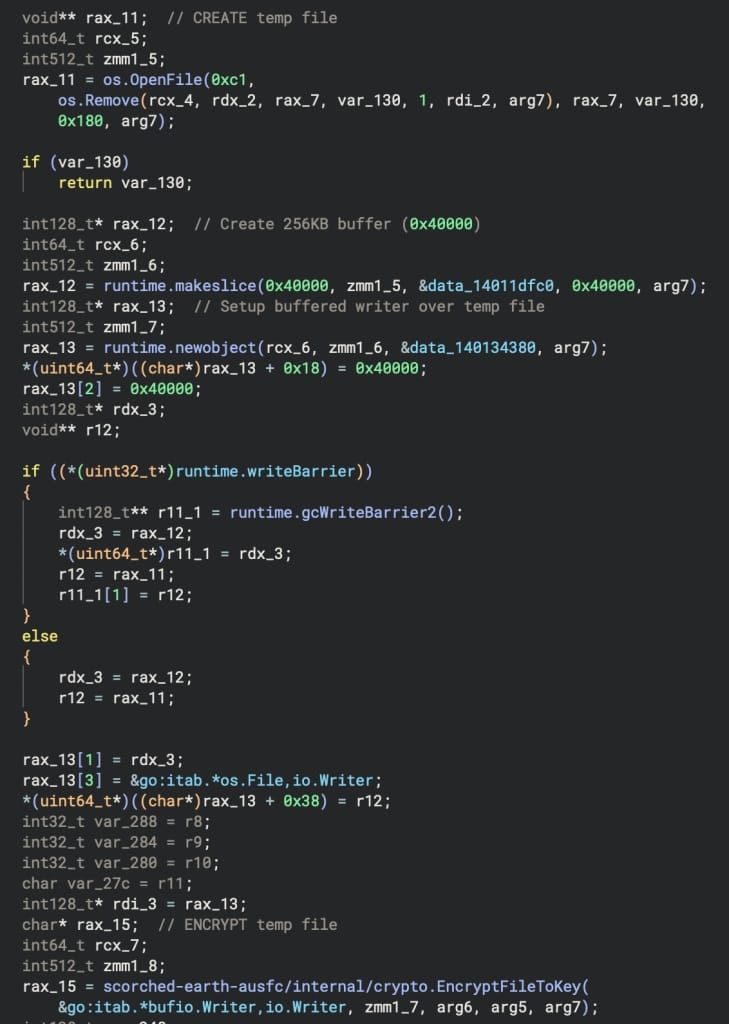
The researchers noticed that when the malware uses the –delete flag to delete the original file after encrypting it, a check occurs to make sure that the file can be decrypted before removing it from the system.
To prevent the encryption key from being retrieved, Prinz Eugen ransomware overwrites it with zeroes, forces garbage collection to eliminate it from memory, and then self-deletes from disk.
Analysis of the encryptor showed no functionality to drop a text ransom note or change the desktop wallpaper. Threatdown researchers say that the absence of a ransom note “is a tactic we see more often among organized ransomware groups.”
This is typically done to reduce the forensic footprint and make it more difficult for the extortion step to be detected automatically.
“By moving ransom communications entirely out-of-band (through direct email, phone contact, or dark-web victim portals), the actor reduces forensic artifacts and complicates automated detection of the extortion phase,” the researchers say.
The researchers identified at least five Prinz Eugen victims, saying that in the case of the Standard Bank breach, the attacker demanded a ransom of 1 BTC and was refused.
ThreatDown’s report provides a list of indicators of compromise to help both organizations and researchers analyze, detect, and defend against Prinz Eugen ransomware attacks.

Security teams log 54% of successful attacks and alert on just 14%. The rest move through your environment unseen.
The Picus whitepaper shows how breach and attack simulation tests your SIEM and EDR rules so threats stop slipping by detection.

Some municipalities implement bike counters on cycling routes in order to monitor traffic. [nullpxl] recently investigated how these counters work, and explored methods that can be used to trick the counter into thinking a bike passed over it.
A great many of these devices are built using inductive loop sensors. This involves passing a current through a loop of wire embedded in the ground. When a conductive item such as the metal wheel of a bike passes through the electric field, eddy currents are generated in the item, creating their own magnetic field which reacts with the loop’s field itself. This creates a change in inductance which can be measured, and thus used to log the number of times a conductive item has passed over the sensor. By looking at the signature of the inductance change, a system can be tuned to detect specific objects—for example, two bicycle wheels passing over a sensor will create a signal that varies over time in a characteristic way.
[nullpxl] first tried to recreate a “bike” signal for the inductive loop by running over the area holding two metal pans. This wasn’t close enough, so a new idea was needed. Experiments with a scrap bike then indicated that there was a speed gate involved, and that wheeling one wheel over the sensor and back again could trick the sensor into thinking a bike had passed by. Eventually, [nullpxl] distilled all this learning down to create “the BIKE BASKET.” It’s simply a bag with a bike wheel in it, and swinging it over the sensor twice makes the counter tick up.
Is there any money in tricking the average municipal bike counter in your local city? We doubt it, unless Big Bike is getting increasingly filthy in its lobbying efforts. In any case, we love to see weird sensor hacks around these parts.


Microsoft has attributed a recent Mastra AI supply chain attack that compromised more than 140 npm packages to the North Korean hacking group Sapphire Sleet, also known as BlueNoroff.
This attribution comes after Microsoft first disclosed earlier this week that attackers hijacked an npm maintainer account and used it to publish malicious package updates.
“Microsoft assesses with high confidence that this activity is attributable to Sapphire Sleet, a North Korean state actor that primarily targets the financial sector,” the company said in a June 19 update.
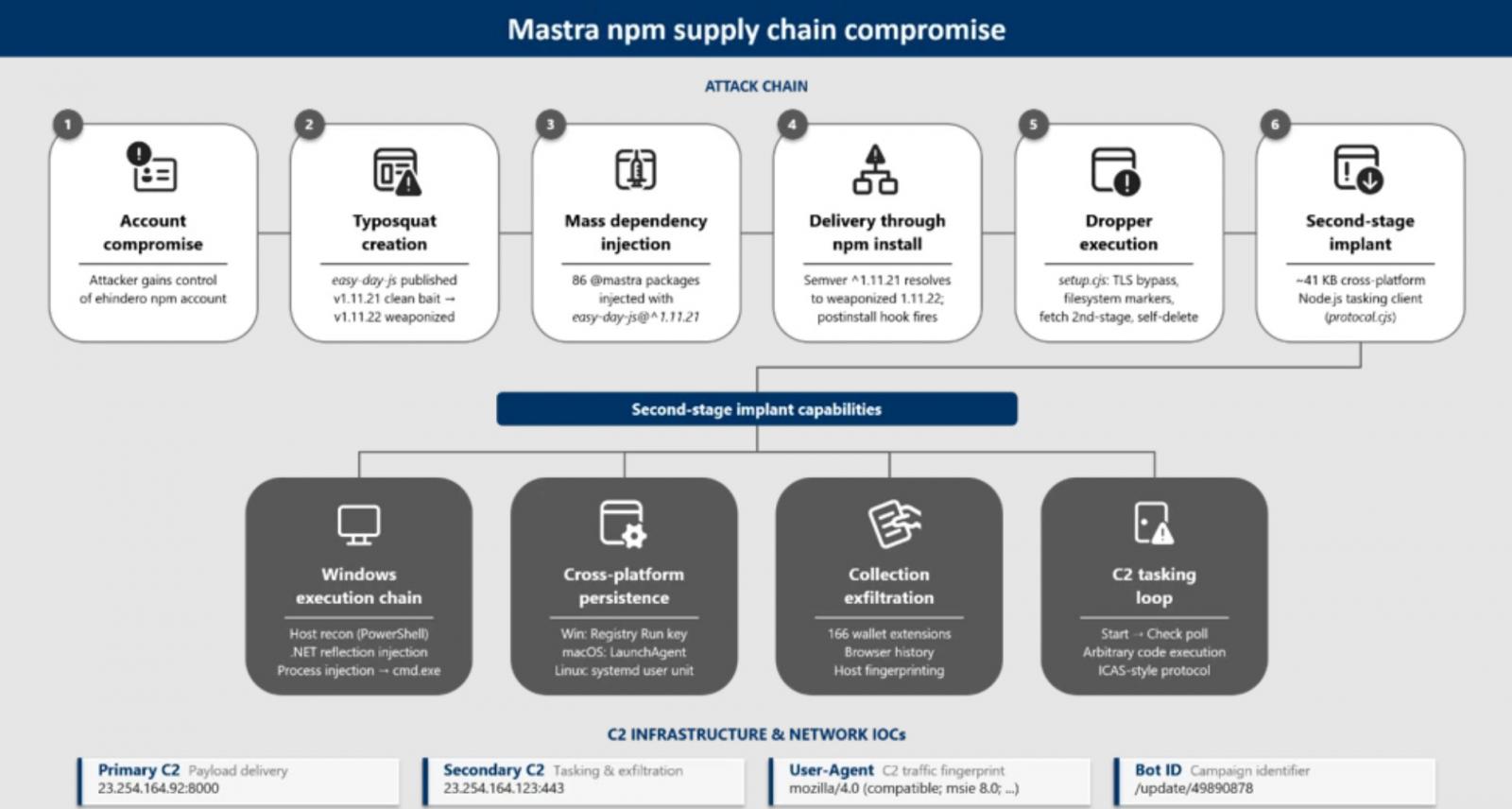
According to Microsoft, the attack began when threat actors compromised the npm maintainer account “ehindero,” which had publishing privileges across the Mastra package environment.
Using the account, the attackers published malicious updates for more than 140 packages in the @mastra scope that injected a malicious dependency named “easy-day-js”. This dependency is a typosquat of the legitimate and widely used dayjs JavaScript library.
When the compromised packages were installed, the malicious dependency executed a post-install hook that deployed a malware dropper on developers’ devices, ultimately aimed at stealing sensitive credentials, API keys, authentication tokens, and cryptocurrency wallets.
“Once installed, easy-day-js triggered a postinstall hook that executed an obfuscated dropper script, disabled Transport Layer Security (TLS) certificate verification, contacted attacker-controlled command-and-control (C2) infrastructure, downloaded a second-stage payload, and executed the payload as a detached hidden process,” explains Microsoft.
The downloaded second-stage payload was a cross-platform information stealer designed to target Windows, Linux, and macOS systems
The implant collected information about the host, browser histories, installed applications, and running processes, and checked whether 166 cryptocurrency wallet browser extensions were installed, including MetaMask, Phantom, Coinbase Wallet, Binance Wallet, and TronLink.
The malware also used different persistence methods depending on the operating system, such as Windows Registry Run keys, macOS LaunchAgents, and Linux systemd services.
Microsoft says systems that communicated with the attackers’ command-and-control servers had follow-on activity that utilized tactics previously associated with Sapphire Sleet.
This includes the deployment of a PowerShell backdoor previously used by the group, additional persistence mechanisms, Microsoft Defender exclusions, and a malicious Windows service that granted SYSTEM privileges.
“The PowerShell backdoor, tradecraft, and C2 infrastructure have been used by Sapphire Sleet in other, prior campaigns,” Microsoft explained.
Sapphire Sleet is a North Korean state-sponsored threat actor known for cryptocurrency theft campaigns, malicious browser extensions, fake job offers, and software supply chain compromises designed to steal credentials and cryptocurrency assets.
Microsoft says the group was also responsible for a separate npm supply chain attack on the Axios HTTP client in April 2026.
Security teams log 54% of successful attacks and alert on just 14%. The rest move through your environment unseen.
The Picus whitepaper shows how breach and attack simulation tests your SIEM and EDR rules so threats stop slipping by detection.
For those who want a career that encompasses all that is positive about the technology space and that leaves the world a more equitable place, Industry 4.0 is a gamechanger.

For many within Industry 4.0 type careers, there is often no one way to define or describe a role. With the advancement of working expectations and technologies, many roles have morphed into one another, to form hybrid jobs that cover many areas. That is certainly true of careers in sustainability that sit at the intersection of the business, environmental and tech landscapes.
The professionals who operate within technology-driven sustainability-focused roles are often expected to wear many hats to address the problems of a modern era, in a modern way.
With that in mind, what skills are needed for those who envision a career in a space where business acumen, tech-knowledge and a passion for a leaner, greener and cleaner world, merge? And what kind of companies have a need for a professional with this particular skillset?
When job hunting, it can be difficult to find an organisation that perfectly aligns with your professional or even personal goals, as well as one that is genuinely committed to making a significant and lasting change. For the most part companies will say and do the right things initially, but what is important is sourcing the organisations that have a history of blending their long-term sustainability and technology strategies, so you have evidence of their commitment. This might be in a large multinational or an SME – regardless, make sure you research a company and even ask about their policies and opportunities before fully committing to a role.
It is also critical that, especially in the early days of your career, you don’t put yourself in a box because you can’t find the right title, or because the organisation itself isn’t in the sustainability space. The joy of working in this capacity is that you get to be the drive behind an organisation’s commitment to doing better. So roles in areas such as climate data science, renewable energy, AI solutions architecture, digital twins, additive manufacturing, smart manufacturing and more, in diverse companies, create opportunities to better align an organisation with future sustainability goals. It makes an impact.
As with any job in an industry that depends on major technological achievement, popular in-demand skills include AI, machine learning, data analytics, 3D imaging, IoT and so on. But when you are working in a sustainability-driven Industry 4.0 role, there are additional abilities that are needed to make up a robust skillset. Many of those skills fall under what is known as the circular economy.
The circular economy is a system by which global production and consumption focuses on sustainable, less harmful practices such as sharing, leasing, reusing, repairing, refurbishing and recycling existing materials and products as long as possible. An item’s life cycle and potential for use is extended and waste is reduced to a minimum in this system.
To achieve a circular economy, companies and their employees need to rethink how they engage with supply chains, the manufacturing process, energy usage, waste disposal and other key areas to avoid the more wasteful linear economy that tends to adopt a ‘use it and throw it away’ kind of mindset.
Skills to prioritise in this area include systems thinking, which is the ability to better understand how all parts of a value chain, the materials, supplies, consumption, waste recovery, policies and infrastructure work in tandem.
Also, consider circular design skills, which enable a professional to design and develop materials and items that are durable, repairable and reusable, effectively undermining ‘planned obsolescence’, which is the practice of deliberately making something fragile, less-powerful or prone to wear and tear, so you have no choice but to replace it – often too soon.
Another important element of careers in the sustainability and Industry 4.0 space, is the ability to advocate for the work itself and to show its value in a way that is measurable and irrefutable.
As mentioned before, careers in this area are no longer ‘just one thing’, rather professionals cover strategy, operations, policy, consultations, finances and green technologies, often while managing teams and dealing with internal and external communications.
With that in mind, professionals need to have a significant understanding of how the business works financially, how the budget can accommodate new green initiatives, how it might align regional climate-focused guidelines, as well as how to report and disseminate findings, outcomes and other relevant information.
This may require a commitment to education, a focus on leadership and management skills, a study of specific frameworks, analytical skills and capability in public speaking and engagement. If you aim to work as a consultant for an organisation or with larger institutions and government bodies, presentation skills could be of use.
The thing about careers in this space is that there are so many opportunities for qualified and ambitious tech professionals to make their role sustainability focused. We have only just scratched the surface here, so if your job sits at that intersection, don’t be panicked about choosing a lane, forge your own course.
Don’t miss out on the knowledge you need to succeed. Sign up for the Daily Brief, Silicon Republic’s digest of need-to-know sci-tech news.
Although the basic principle of radio direction finding is easy to understand (measure the phase difference between different antennas, then calculate the angle of arrival from this difference), the radio hardware to actually implement this has historically been hard for hackers to access. The QuadRF project aims to change this by building a phase-coherent four-channel SDR which makes direction mapping easy (GitHub repository).
The QuadRF uses two boards: one to receive and pre-process radio waves, and a Raspberry Pi 5 for additional processing. The RF board has four patch antennas, each capable of either transmitting or receiving in the 4.9 GHz to 6.0 GHz range, with switchable right- or left-hand polarization. For on-device processing, it uses a Lattice ECP5 FPGA, which uses two MIPI cables to connect to the camera and display interfaces on the Raspberry Pi. These form a very high-speed data exchange, and after further processing, the Pi can pass data on over Ethernet or Wi-Fi. Individual QuadRF boards can connect together in a lattice grid to form larger phased arrays.
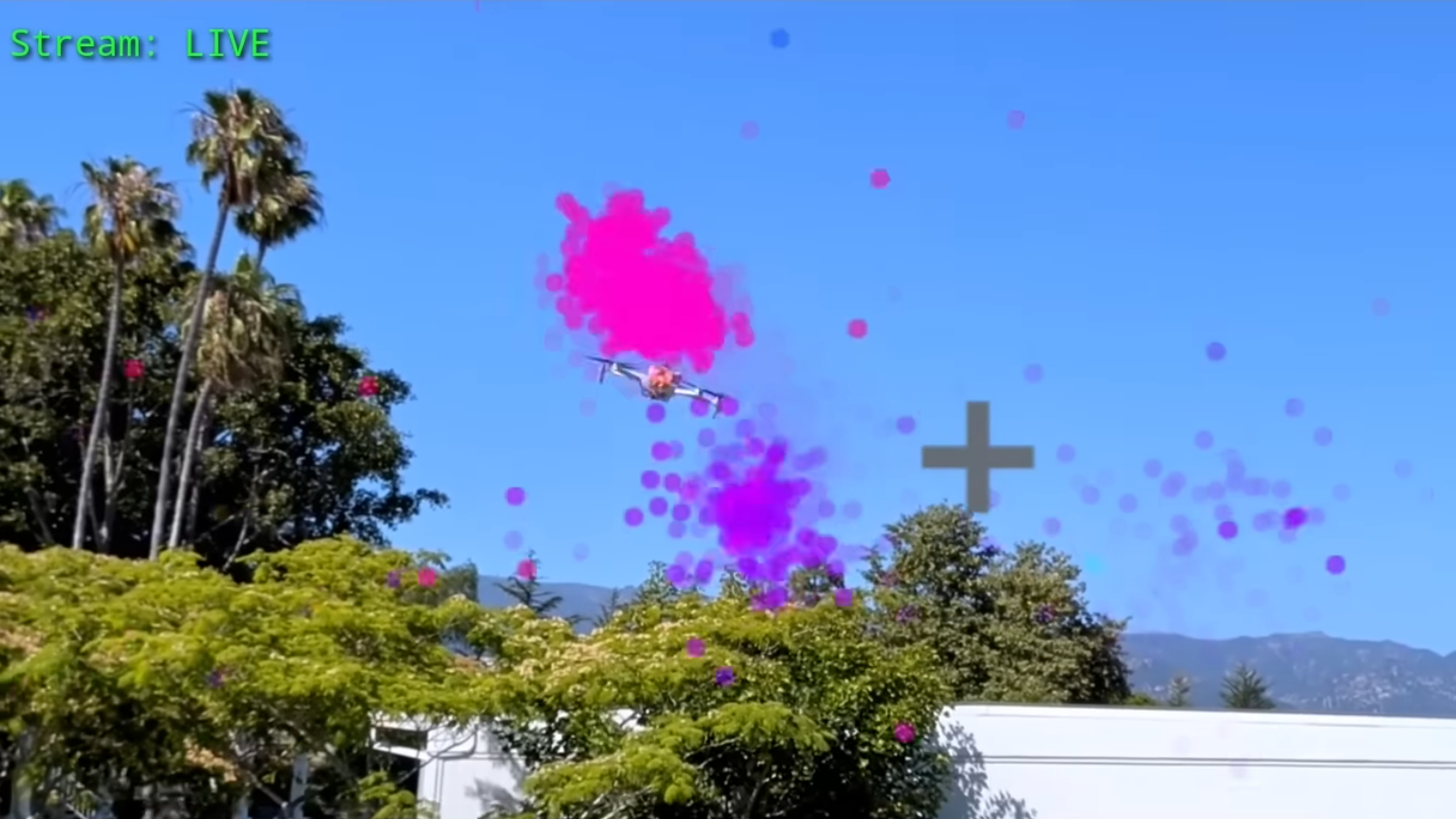
The QuadRF’s software shows off its real strength: it’s compatible with standard programs like GNU Radio, but it also hosts a few of its own programs. The most striking of these is an “RF camera” which scans its entire frequency range at 30 fps, tracking the direction of detected signals and visualizing them on a spatial plot. When overlaid on a camera feed, this plot lets one easily see the radio signals emitted from electronics; as an example, the creators tracked a drone in flight, even distinguishing the two radio transmitters on the drone.
This isn’t the first multi-antenna SDR we’ve seen, though this is the first that could transmit. It’s important to be careful, though: some applications of this kind of hardware run afoul of arms regulations.
Thanks to [Swake] for the tip!


Security
Hunting and fishing license incident catches 3M residents
The Texas Parks and Wildlife Department (TPWD) says 3 million Texans had their data stolen following a breach at one of its suppliers.
People with state-issued hunting and fishing licenses are among those affected after attackers breached the vendor that handles license sales and copied customer data.
Details of victims’ driving license and passport numbers may be present in the leaked data. Basic personal information, such as email addresses, phone numbers, and residential addresses also leaked.
Social Security numbers (SSNs), financial data, or information relating to minors were not involved, according to the department’s disclosure.
According to a filing with the Office of the Attorney General, the attack on the unnamed vendor affected 3,087,721 Texans. The filing appears to contradict the department’s disclosure, noting that individuals’ names and SSNs were also involved.
Affected Texans were offered the usual one year of free credit monitoring services provided by Kroll, as long as they enroll by September 14.
A Kroll webpage dedicated to the incident reveals that an investigation has not determined when the breach took place. The department notified Texas Cyber Command on May 13, however.
“We recognize the seriousness of this issue and have identified and implemented additional security options to better protect customer information,” said TPWD. “Many of our staff are hunters and anglers and were affected by this incident. We are committed to continuing to work with the license system vendor to implement increased safeguards to prevent future incidents.”
TPWD said it is working with the affected vendor to introduce additional preventive measures, including enhanced monitoring and access controls.
The org went on to say that new license sales currently scheduled for August will go ahead as planned, although the website used to purchase licenses was unreachable at the time of writing. ®


THX Ltd. has spent more than four decades teaching moviegoers to expect the room to move before the film even begins. Founded by George Lucas in 1983 and developed out of Lucasfilm’s push to improve theatrical sound and presentation, THX became inseparable from Tomlinson Holman’s work, James A. Moorer’s thunderous Deep Note, and the kind of pre-movie trailer that made weak subwoofers beg for mercy.
The company’s latest Deep Note trailer, “Spark,” is not just another nostalgia play from one of cinema’s most recognizable audio brands. Now operating under Razer ownership after the 2016 acquisition, THX is using “Spark” to connect its Lucasfilm-era legacy with the next phase of immersive entertainment, including HDR10+ video and Eclipsa Audio. For a logo that once told audiences the theater was properly calibrated, this is THX trying to make the same argument in a very different format war.
Pro Tip: The first THX Deep Note trailer debuted in 1983.
“Spark” blends the nostalgia of THX’s Lucasfilm-era origins with a more modern visual and sonic presentation. The trailer reflects the company’s long-standing mission to help audiences experience movies, music, games, and home theater content closer to the way creators intended.
It also acknowledges THX’s role in raising theatrical presentation standards during the Star Wars era, when George Lucas and Tomlinson Holman pushed for better sound and picture quality in cinemas. More than four decades later, “Spark” gives the Deep Note a fresh identity while preserving the familiar slow build and signature crescendo that made the THX trailer part of the moviegoing experience.
“As entertainment evolves, so does the role THX plays in bringing a creator’s full vision to audiences,” said Tuyen Pham, chief executive officer of THX Ltd. and veteran immersive audio innovator. “This trailer honors our legacy while embracing a future for open technology format standards for broader access for creators and deeper enjoyment by the audience. By releasing the Trailer in HDR10+ and Eclipsa Audio, we are empowering more storytellers, artists, and technologists to build extraordinary experiences that reach fans exactly as intended—faithfully, powerfully, and without compromise, with technology accessible to all via open standards of excellence and fidelity.”
The artistic approach for “Spark” is intended to symbolize imagination taking shape as an audiovisual journey, beginning with a “spark” from THX’s early innovations and media playback standards. It celebrates the creative possibilities of today’s entertainment landscape across concert venues, cinemas, home theaters, gaming rooms, and mobile devices enjoyed with headphones.
“THX was built on the idea that technical rigor and artistic ambition go hand in hand,” said Grace Qaqundah, senior vice president, THX Ltd. “Spark is a tribute to our history and a beacon for what lies ahead. We are thrilled to share it with audiences around the world as a spark of what’s possible when imagination meets high fidelity.”
The Spark also marks the first THX trailer released in the new open standards HDR10+ video and Eclipsa Audio. This is a strategic movie by THX that illustrates their commitment to open standard technology ecosystems that enable broad creator adoption and high-fidelity experiences across theaters, home entertainment, gaming platforms, and certified devices.
Samsung has been one of the first major TV brands to support Eclipsa Audio, bringing the format to its 2026 TV and soundbar lineup. HDR10+ also has a much broader device footprint, with more than 22,000 certified products across categories including TVs, computer monitors, projectors, automotive displays, tablets, mobile phones, streaming devices, AVRs, and Blu-ray players. Supporting brands include Samsung, Panasonic, JVC, Xiaomi, TCL, Hisense, and Skyworth.
“Spark” is also expected to appear in THX Certified Cinemas in the second half of 2026, as well as on displays from THX brand partners and THX Certified devices.
The inclusion of both HDR10+ and Eclipsa Audio follows THX’s recent expansion of its audio/video technology laboratories in Asia. The company’s Shenzhen lab has been named an Authorized Test Center for both HDR10+ and Eclipsa Audio certifications for consumer electronics and home theater devices.
For more details, see our reference article: THX Expands Global Certification with New Shenzhen and Taipei Labs, Adds HDR10+ and Eclipsa Audio Testing.
The THX Deep Note has been part of the cinema experience since 1983, when it debuted ahead of Star Wars: Episode VI — Return of the Jedi. That history matters because THX helped establish the idea that going to the movies should come with a higher standard for sound, picture, and presentation, not just a bigger screen and a sticky floor.
Since then, theater chains and studios have pushed premium formats such as IMAX, Dolby Cinema, ScreenX, RPX, and others, but the THX Deep Note still carries a very specific meaning for moviegoers. It is a signal that the room, the sound system, and the presentation are supposed to matter. “Spark” updates that ritual for today’s immersive cinema landscape while keeping the familiar build that tells audiences the outside world can wait for the next two hours.
THX says “Spark” is expected to debut in THX Certified Cinemas in the second half of 2026, along with appearances on displays from THX brand partners and THX Certified devices.
For more information: thx.com/deepnote/


When you first think of music streaming services, Pandora probably doesn’t come to mind before other platforms, even though it was once a staple. But it’s definitely not one to forget about, especially if you’re keen to find a more affordable alternative to Spotify Premium. In case you need a refresher, or this is your first time hearing about it, Pandora is a music, podcast, and comedy streaming platform primarily based around customizable online radio stations.
You can use Pandora for free — or, if you want to unlock more functionality, you can subscribe to a paid tier. The cheapest paid tier, Pandora Plus, is $4.99 per month, making it a much more affordable option than the majority of other music streaming services. This tier gives you access to custom radio stations uninterrupted by ads, alongside unlimited skips and limited offline listening.
There is a small catch, though, and it’s an integral part of how Pandora Plus works. Since it revolves around personal radio stations and custom listening experiences, it doesn’t really prioritize searching for and picking out individual songs on demand — at least not without listening to an ad first. So, if you frequently find yourself reaching for your phone to hear one specific song, you might decide to opt for Pandora Premium for $10.99 instead. But if you don’t mind letting Pandora’s algorithm work its magic and listening to the occasional ad, then Pandora Plus could suit you just fine.

Exactly how Pandora compares to its competitors like Apple Music, Spotify, or Tidal, depends on which tier of Pandora you’re using. For example, Pandora and Spotify’s respective free tiers aren’t all that different from one another, as they both set restrictions around your ability to select and play a specific song, and they both include ads. Similarly, Pandora Premium is roughly on par with other streaming services’ premium tiers in terms of functionality, offering ad-free access to its entire library, unlimited skips, offline listening, and playlists.
The real differences between Pandora and other streaming platforms arise with the mid-tier Pandora Plus, because of its focus on stations instead of purely listener-directed listening. With this tier, you’ll spend more time listening to algorithmically informed, never-ending playlists, rather than specific albums, artists, or songs. However, it’s not solely Pandora driving the music. You get plenty of say over what you’re listening to, since you can skip as many songs as you want, and there are several different stations to choose from. Plus, you influence the stations based on your tastes, and by giving any given track a thumbs up or thumbs down. You can also download stations to listen to offline.
Pandora Plus effectively creates a kind of bridge between free and premium subscriptions, which differs from how other platforms work. For that reason, it might not serve as a one-to-one replacement if you’re hoping to ditch your Spotify or Amazon Music subscription. That doesn’t mean that it couldn’t work as an alternative, particularly if you regularly find yourself flicking between Spotify mixes or artist radio stations on Tidal.

Pandora stations work a little differently from autogenerated mixes or playlists on some other streaming services, and that’s because it uses something called the Music Genome Project. According to Pandora’s official website, the Music Genome Project is the “most comprehensive analysis of music ever undertaken,” and it’s a bespoke musical database that has been compiled for more than 20 years. It keeps track of a massive amount of different details about every song logged on the service. That project is what provides the backbone of your listening experience when you tune in via Pandora’s stations.
When working on the Music Genome Project, Pandora’s researchers log information into the database on a song-by-song basis, rating each track based on hundreds of different parameters. This information is then used to create networks and relationships between different songs to find similarities. That’s a much more granular approach than just finding different artists that may be similar to one another, which makes the database much more detailed — and arguably, more accurate.
When you give a song a thumbs up or down on a station, it tells Pandora what you do or don’t like about it, such as its key, rhythm, or instrumentation. That makes it far more likely to find another song that sounds similar to the one you liked than if it were basing its algorithm on a rough idea that two artists generally belong to the same genres, or that their music came out around the same time.

Optical computing has emerged as a promising alternative to traditional electronic systems struggling with increasingly large-scale AI and deep learning workloads.
By harnessing the physical properties of light, including interference and diffraction, optical computing systems offer faster speeds, better energy efficiency, and stronger parallel processing capabilities.
Chinese researchers have now proposed a digital twin model that fundamentally changes how these complex systems are developed and tested.
Traditional optical computing systems face a persistent challenge, since task development relies heavily on direct access to physical hardware platforms.
When multiple researchers need to work with the same system, they typically wait in line, then repeatedly tune parameters and perform error calibration before any genuine computation can begin.
Once one user finishes, the next often must readjust the entire system state, making parallel research nearly impossible across competing projects.
That cycle of waiting, tuning, and recalibrating drives up trial-and-error costs while severely limiting overall research efficiency.
To address that bottleneck, researchers developed what they call the Digital Twin Optical Computing System, or DT-OCS, published in Opto-Electronic Advances.
The framework constructs a digital model that reproduces the input-output responses of a physical optical computing system across different configuration parameters entirely within software.
If the physical system resembles an expensive, heavily occupied real machine, researchers describe DT-OCS as functioning like a high-fidelity simulator running alongside it.
Using a high-speed optical computing system paired with a silicon photonic feature-computing chip, the research team tested DT-OCS on image classification and sequential decision-making tasks.
The results showed that configuration parameters trained and optimized within the digital twin transferred directly to the physical system without requiring further adjustment.
Task performance on the physical hardware matched the digital model’s predictions closely, validating both the fidelity and transferability of the entire approach.
Because training and optimization happen primarily within the digital domain, researchers can now develop multiple distinct tasks simultaneously rather than queuing for shared hardware access.
The team has also made the DT-OCS framework and its associated datasets openly available.
This will allow other researchers to conduct training and validation without ever touching physical equipment themselves.
According to the researchers, they designed DT-OCS as “a reproducible, accessible, and scalable software resource for wider sharing and validation.”
The openness effectively transforms optical computing from a specialized resource constrained by device availability into something closer to a shareable, reproducible research platform.
The researchers argue that future optical computing systems should pair physical hardware with openly available digital models offering equivalent computational behaviour.
Drawing a comparison to how modern transportation depends on both physical roads and continuously updated digital maps, they suggest mature optical computing platforms need a similar dual structure going forward.
Via EurekAlert

Follow TechRadar on Google News and add us as a preferred source to get our expert news, reviews, and opinion in your feeds.
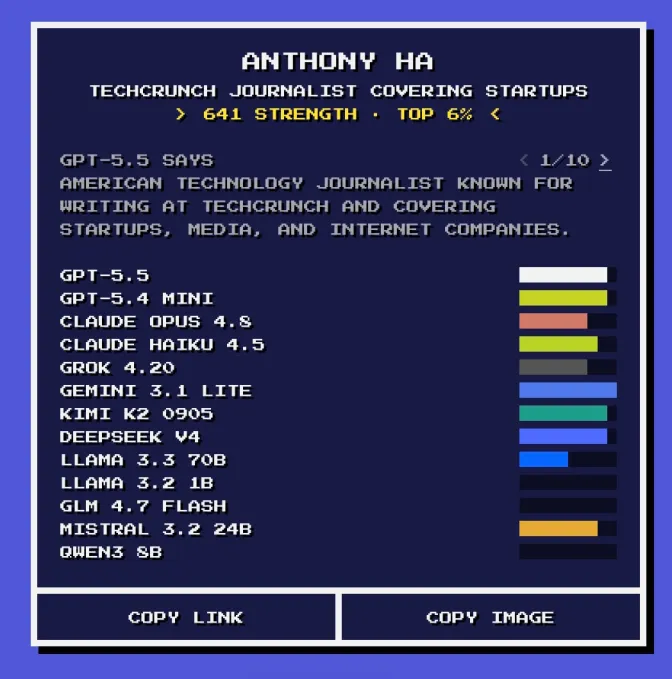
Anyone who’s Googled themselves recently knows that it doesn’t quite hit the way it used to. Sure, there’s everything going on with Google search itself, but there’s also an inescapable feeling that web search isn’t the canonical source of information that it used to be, with just as many people learning about you and me from chatbots.
Thomas Dimson and Joey Flynn had a similar feeling, leading them to create In the Weights. The “weights” in question are the numerical parameters that shape an AI model’s training and output, so the website purports to measure how well “a model is able to recall someone without using tools like web search.”
“Being in the weights means your existence was deemed important in the process of creating superhuman artificial intelligence,” the website says.
To achieve this, In the Weights supposedly queries different models (including Grok, Gemini, multiple versions of GPT, Claude, and Llama, plus lesser known models) with a question similar to, “Who is

For example, this humble tech blogger received a strength score of 641, placing me in the top 6% of names. I was feeling pretty good until I saw that multiple TechCrunch colleagues scored even higher. And the leaderboard has been shifting as I write this post, with “Home Alone” star Macaulay Culkin currently in the top slot with a strength score of 988, followed by opera singer Luciano Pavarotti.
The results also show which models returned answers for a given name, and they highlight potential hallucinations — apparently GPT-5.4 Mini says that Anthony Ha is an “ambiguous name form that could refer to multiple people with the initials A.H.A.”
Asked why he built In the Weights, Dimson told TechCrunch via email that he and Flynn were looking to “get the creative juices flowing again” after leaving OpenAI (which they both joined through the acquisition of their design startup Global Illumination).
Dimson said he was thinking about how “Google vanity searches are the wrong objective in 2026 as more traffic moves to LLMs” and about the fact that “so many lives are encoded somehow in a bunch of floating point numbers inside the AI brain.” He also said the direction of the site was “sealed” by a tongue-in-cheek blog post riffing on AI weights and Terry Bisson’s classic short story “They’re Made Out of Meat.”
“Reception has been insane so far, we thought this would be a mild curiosity but it seems like it has struck a nerve of wanting to see if you live forever in the super intelligence (the comparison factor doesn’t hurt either!)” Dimson added.

While I’m not as convinced that being “remembered” by a chatbot is a guaranteed ticket to immortality, I can’t deny that I find the results both intriguing and jealousy-inducing, especially since they’re codified in an easy-to-compare score. (AI critic Anthony Moser scoffed that this is “literally the same as asking 13 chatbots to tell you about yourself.”) Also helping: The fact that the site features a cute, Nintendo-inspired retro design.
Dimson said he plans to dig in further into why different models in the same series return different results, which models are biased towards different types of people, and which people “should have a Wikipedia article but don’t.”
When you purchase through links in our articles, we may earn a small commission. This doesn’t affect our editorial independence.


Learning to drive might be less of a priority than it once was for American teenagers, but the majority still have their licence by the time they turn 19. Depending on where they live, some teens might need to wait a few years longer than others to get on the road. As shown by the Insurance Institute for Highway Safety, the lowest age for getting an unrestricted driver’s license varies from state to state, with some states requiring drivers to wait until they’re 18 to drive without curfews and passenger restrictions.
In contrast, the lowest minimum age for an unrestricted driving license is 16. Only a handful of states allow drivers who have just turned 16 to hold a regular license: They are Idaho, Montana, North Dakota, and South Dakota. In Montana, 16 year old drivers have to have held their license for 12 months or more in order to get nighttime and passenger restrictions lifted. A range of other states lift restrictions at 16 years and six months, including Arizona, Kansas, Mississippi, and New Mexico, among others.
The minimum entry age for learners similarly varies between states, with the lowest age across the country being 14 years old. Drivers in Alaska, Arkansas, Iowa, Kansas, North Dakota, and South Dakota can all get a learner’s permit at the age of 14.

Anyone looking to get their license will need a car to practise in, and if you’re a first timer looking to purchase your first car, it’s worth choosing your new ride carefully. Picking a car with modern safety features should give you extra reassurance in the case of an accident, even though it might not be the cheapest option on the market. When asked, Jay Leno suggested that cars from 2005 onwards are a good bet, but at a minimum, making sure you have something with airbags and modern seatbelts is advisable.
Plenty of car enthusiasts like the feeling of control and involvement that a manual transmission gives them, but learning to drive stick also comes with its own challenges. There are a few beginner tips worth keeping in mind when you start learning, like memorizing your car’s shift pattern, that should make it a little easier.
After you pass the learner stage, all states have an intermediate stage that imposes restrictions about the time of day you can drive and the passengers you can carry. The restrictions vary considerably between states, so be sure to check restriction rules before you head out on the road. To have those restrictions lifted, you’ll usually need to have held your license for a set period of months, or reach a specific age, but again, the time period and age requirements vary depending on where in the country you live.





No Jackpot Winner as $257 Million Prize Rolls Over to $269 Million Monday Draw


Weekend Open Thread: Miami – Corporette.com

Zimbabwe Requires Crypto Businesses to Register Annually Under New FIU Regulations

Wall Street Week Ahead: Investors see Micron earnings as pulse check of AI rally momentum

Matt Damon’s Viral Sci-Fi Thriller Has Taken Over HBO Max


As AI companies race to go public, who else is along for the ride?


Anthropic staff to meet White House officials next week, Axios reports


Deion Sanders Shares Powerful Post After Viral Advice To Deiondra

Bitcoin could crash to $48,000, if this historical pattern is triggered

what doctors are seeing in ebike crashes

Warning of disruption as Cardiff Crossrail works to start


“Israel’s” ban on ICRC visits ruled illegal, but Knesset moves to stop them permanently

Tributes to former deputy head teacher at Cambridge school among death and funeral notices


HIVE shares jump as $220M AI deal speeds Bitcoin mining pivot


Financial Accounting | Last Day Revision Strategy and Booster | CMA Inter – June 2026

Kate Middleton Glare Goes Viral After Kids Booed At Royal Event


Singer Oliver Tree dies aged 32 in helicopter crash in Brazil


Over 400 Arch Linux packages compromised to push rootkit, infostealer


XRP ETFs Outperform As Bitcoin And Ethereum Funds Extend Outflow Trend


Dick Advocaat’s Curacao scores first-ever World Cup goal against Germany




You must be logged in to post a comment Login