Connect with us

Tech

New Tool Makes 3D Printed PCBs, Fast

Published

on

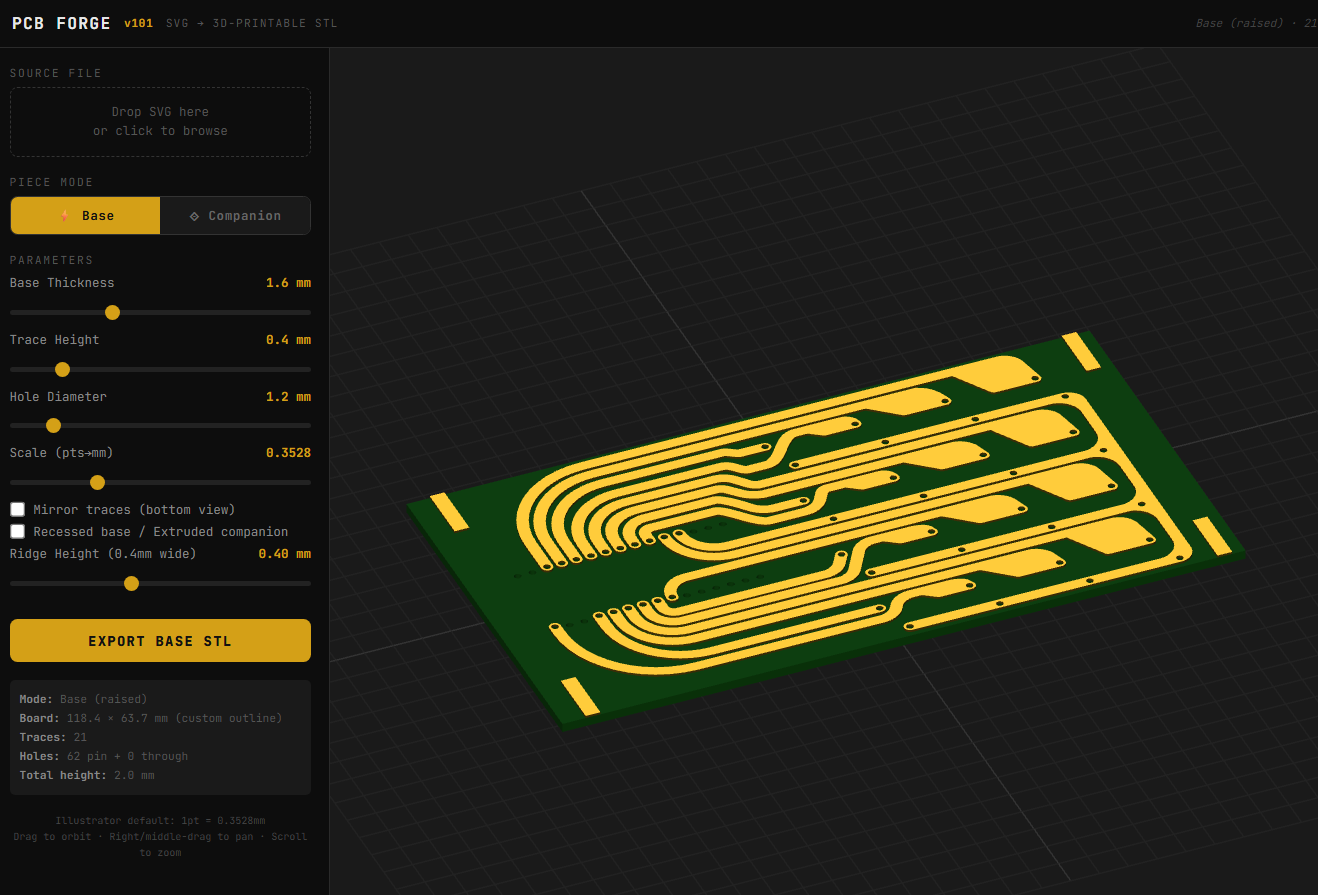
Getting PCBs made is often the key step in taking a dodgy lab experiment and turning it into a functional piece of equipment. However, it can be tedious to wait for PCBs to ship, and that can really slow down the iterative development process. If you’ve got a 3D printer, though, there’s a neat way to make your own custom PCBs. Enter PCB Forge from [castpixel].

The online tool.

The concept involves producing a base and a companion mold on your 3D printer. You then stick copper tape all over the base part, using the type that comes with conductive adhesive. This allows the construction of a fully conductive copper surface across the whole base. The companion mold is then pressed on top, pushing copper tape into all the recessed traces on the base part. You can then remove the companion mold, quickly sand off any exposed copper, and you’re left with a base with conductive traces that are ready for you to start soldering on parts. No etching, no chemicals, no routing—just 3D printed parts and a bit of copper tape. It rarely gets easier than this.

You can design your PCB traces in any vector editor, and then export a SVG. Upload that into the tool, and it will generate the 3D printable PCB for you, automatically including the right clearances and alignment features to make it a simple press-together job to pump out a basic PCB. It bears noting that you’re probably not going to produce a four-layer FPGA board doing advanced high-speed signal processing using this technique. However, for quickly prototyping something or lacing together a few modules and other components, this could really come in handy.

The work was inspired by a recent technique demonstrated by [QZW Labs], which we featured earlier this year. If you’ve got your own hacks to speed up PCB production time, or simply work around it, we’d love to know on the tipsline!

Advertisement

Source link

Advertisement
Continue Reading
Click to comment

Leave a Reply

Your email address will not be published. Required fields are marked *

Tech

NYT Connections hints and answers for Sunday, March 15 (game #1008)

Published

on

Looking for a different day?

A new NYT Connections puzzle appears at midnight each day for your time zone – which means that some people are always playing ‘today’s game’ while others are playing ‘yesterday’s’. If you’re looking for Saturday’s puzzle instead then click here: NYT Connections hints and answers for Saturday, March 14 (game #1007).

Good morning! Let’s play Connections, the NYT’s clever word game that challenges you to group answers in various categories. It can be tough, so read on if you need Connections hints.

Advertisement

Source link

Advertisement
Continue Reading

Tech

Rise of model context protocol in the agentic era

Published

on

We have all heard about model context protocol (MCP) in the context of artificial intelligence. In this article, we will dive into what MCP is and why it is becoming more important by the day. When APIs are already available then why do we need MCP? Although we have seen a large rise in popularity of MCP, is there staying power in this new protocol? In the first section, we will look at the parallels between APIs and MCP and then start to explore what sets it apart.

From APIs to model context protocol

A single isolated computer is limited in the amount of data that it can access and that has a direct impact on its usability. APIs were created to enable data transfer between systems. Just like APIs, Model Context Protocol (MCP) is the protocol for communication between AI agents that are using large language models (LLMs). APIs are primarily written for developers while MCP servers are created for AI agents (Johnson, 2025). 

What is MCP?

MCP was introduced by Anthropic on November 25, 2024 as an open source standard to enable communication between AI assistants and external data sources. AI agents are constrained by the fragmentation of data in isolated systems (Anthropic, 2024). The protocol defines how agents can interact with external systems, elicit user input and enable automated agents.

At its core MCP utilizes the client server model and there are three main features for clients and servers.

Advertisement
  • MCP servers: tools, resources, and prompts
  • MCP clients: elicitation, roots, and sampling

To keep this article concise, focus will be kept on the most important feature of both client and server. For MCP servers, tools are the primary way to perform complex tasks and clients utilize elicitation to enable a two way communication between the agent and the user.

Instead of explicitly calling APIs, agents select and use the appropriate tools (functions) based on the input they receive from the user. If a tool requires certain parameters the agent will use elicitation to get the data from the user. This allows for a more responsive workflow where two way communication between LLM and the user is possible.

Advertisement

Why do we need MCP now?

A very valid question to ask is if APIs are already present then why is there a need for MCP? APIs are designed to connect fragmented data systems and SaaS applications already enable a two way communication with a user. So, why do we need MCP now?

The main need for MCP is that the user of external data has changed from developers to AI agents. A developer will usually program an application using APIs that behaves in a deterministic fashion. Whereas, AI agents will use the user prompt and make autonomous decisions to execute on the user request. By nature, the execution of a workflow by an AI agent is not deterministic.

APIs are a machine-executable contract which acts in a deterministic fashion. APIs work if the users of APIs know what action needs to be taken next (Posta, 2025). AI agents run on top of probabilistic LLMs which do not consistently deliver repeatable results across all tasks (Atil, 2024). Variance in a LLM’s response is expected and this poses a problem for autonomous execution.

MCP to the rescue

MCP solves the problem of variance in agent execution by providing high level abstraction that wraps functionality rather than API endpoints. Tools enable LLM models to perform actions like searching for a flight, booking a calendar and more (Understanding MCP Servers, 2026). 

Advertisement

One common misconception for tools is that they are just an abstraction over existing API calls. Tools are not designed to be an abstraction over API calls but rather abstraction over functionality. If a lot of APIs are just exposed as tools it will increase the cost and context size for the agent which is not ideal (Johnson, 2025).

A tool may include multiple API calls in its implementation to achieve the desired outcome. An agent will review the list of available tools to automatically select the most appropriate tools and determine the appropriate order of execution.

MCP adoption boom

Since its release in 2024 MCP has seen a steady rise in popularity. The following chart from Google Trends showcases the relative interest in MCP since its launch.

A lot of companies have launched their own MCP servers to facilitate building autonomous agents. As of February 2026, the official MCP registry has over 6400 MCP servers already registered. This number of MCP servers is only expected to grow in the near future. The official registry for MCP servers is still in preview and the ecosystem has grown massively in less than a year.

Advertisement

Other major players in the market have adopted MCP and added support to their clients. OpenAI added MCP support to ChatGPT in March and Google added support a few weeks later in April 2025. This showcases the staying power of the protocol and the fast pace of adoption.

What lies ahead?

MCP is still in the early stages of widespread adoption where a lot of applications need to mature and start hitting production. Leonardo Pineryo from Pento AI summarized it the best “MCP’s first year transformed how AI systems connect to the world. Its second year will transform what they can accomplish” (2025). 

Guardrails around tools is an area that will see further development as trust is one of the biggest concerns with AI agents. With better guardrails in the tools, an AI agent can be allowed to perform with more autonomy. Over the next year, MCP is certain to see continued growth, both in the sophistication of its capabilities and the volume of its application.

Advertisement

Source link

Continue Reading

Tech

NYT Strands hints and answers for Sunday, March 15 (game #742)

Published

on

Looking for a different day?

A new NYT Strands puzzle appears at midnight each day for your time zone – which means that some people are always playing ‘today’s game’ while others are playing ‘yesterday’s’. If you’re looking for Saturday’s puzzle instead then click here: NYT Strands hints and answers for Saturday, March 14 (game #741).

Strands is the NYT’s latest word game after the likes of Wordle, Spelling Bee and Connections – and it’s great fun. It can be difficult, though, so read on for my Strands hints.

Advertisement

Source link

Advertisement
Continue Reading

Tech

Don’t Get Used To Cheap AI

Published

on

AI services may not stay cheap for long, as companies like OpenAI and Anthropic are currently subsidizing usage to rapidly grow market share. As these companies move toward profitability and potential IPOs, Axios reports that investors will likely push them to increase prices and improve margins. An anonymous reader shares an excerpt from the report: Flashback: Silicon Valley has seen this movie before. The so-called “millennial lifestyle subsidy” meant VC money helped underwrite cheap Uber rides and DoorDash deliveries. Before that, Amazon built its base with low prices, free shipping and, for years, no sales tax in most states. Eventually, all of these companies had to charge enough to cover costs — and make a profit.

Follow the money: The current iteration of AI subsidies won’t last forever. Both OpenAI and Anthropic are widely expected to go public. Public investors will demand earnings growth and expanding margins. Even as chips get more efficient, total spending keeps rising. Labs need more capacity, more upgrades and more supply to meet demand.

The bottom line: The costs of AI will keep going down. But total spend from customers will need to keep going up if AI companies are going to become profitable and investors are ever going to get returns on their massive investments.

Source link

Advertisement
Continue Reading

Tech

Spotify launches Taste Profile editor

Published

on

The feature, announced at SXSW by co-CEO Gustav Söderström, lets Premium listeners see and shape the data model powering their recommendations, starting with a beta rollout in New Zealand


For a decade, Spotify’s recommendation engine has worked largely in silence. It watched what you played, noted what you skipped, inferred meaning from the time of day and the tempo of your commute, and it never told you what it had concluded. On Friday, at SXSW in Austin, the company decided to change that.

Gustav Söderström, Spotify’s co-CEO, announced Taste Profile: a new feature that surfaces the algorithmic model the platform has been building about each listener, and crucially lets users modify it directly. The beta will begin rolling out to Premium subscribers in New Zealand in the coming weeks.

The premise is straightforward enough. Taste Profile aggregates a listener’s behaviour across music, podcasts, and audiobooks into a single view: the genres explored recently, the artists listened to most, the patterns that define a listening day.

Advertisement

The 💜 of EU tech

The latest rumblings from the EU tech scene, a story from our wise ol’ founder Boris, and some questionable AI art. It’s free, every week, in your inbox. Sign up now!

Where a user notices the profile is wrong, too heavy on music they played years ago, or missing a phase they have been quietly working through, they can flag it. They can ask for more of a particular vibe, or less. They can describe a current context, training for an event, commuting on weekdays, and the system will factor that in when deciding what to surface on the Spotify homepage.

“This is the next step in our vision to make personalization more transparent, responsive, and truly yours,” Söderström told the SXSW audience.

Advertisement

Spotify cited an internal figure that more than 80% of its listeners name personalisation as what they value most about the service. The claim, which the company has referenced in various forms since at least 2023, positions algorithmic curation not just as a feature but as the primary reason people stay.

The competitive logic behind Taste Profile follows directly from that: if personalisation is the product, giving users more control over it is a way to deepen their investment in it.

The announcement comes roughly two months after Spotify expanded Prompted Playlist, a separate but related feature that lets users generate playlists by describing what they want in natural language, from its initial New Zealand testing to Premium users in the US and Canada in late January 2026, and subsequently to subscribers in Australia, Ireland, Sweden, and the UK in February. The sequencing is deliberate.

Both features push the same underlying argument: that the future of streaming personalisation is collaborative, not passive.

Advertisement

Where Prompted Playlist is generative,  it creates something new from a description, Taste Profile is corrective. It works with the model that already exists, giving users a chance to audit and adjust what years of listening have written about them.

Whether someone has been an accidental customer of the algorithm (playing whatever appeared on the homepage, not particularly caring) or has strong views about the direction their recommendations have taken, the feature is designed to accommodate both. “You can shape your Taste Profile as much as you’d like,” the company said in its announcement, “or leave it and enjoy Spotify as usual.”

The beta will start in New Zealand, a market Spotify has used repeatedly for early-stage testing of AI-adjacent features, including the initial Prompted Playlist launch. No timeline was given for a broader global rollout. Taste Profile will be available to Premium subscribers only; there was no indication of when, or whether, it might reach free-tier accounts.

Spotify is marking 2026 as its 20th anniversary year, and its SXSW presence this week has been calibrated accordingly, concerts, a headline session with Söderström, country artist Lainey Wilson, and podcast host David Friedberg.

Advertisement

The Taste Profile announcement landed on the last day of the company’s main SXSW programming, providing a product note to accompany the celebration.

What the feature represents, beyond its functionality, is a shift in how Spotify frames its relationship with listeners. The algorithm has always existed; the company is now making the case that knowing it is there, and having some say in what it does, is a feature in itself.

Source link

Advertisement
Continue Reading

Tech

U.S. State Bans on Lab-Grown Meats Challenged in Court

Published

on

Last June Texas Agriculture Commissioner Sid Miller said in a statement that Texans “have a God-given right to know what’s on their plate, and for millions of Texans, it better come from a pasture, not a lab. It’s plain cowboy logic that we must safeguard our real, authentic meat industry from synthetic alternatives.”

But California company Wildtype sells lab-grown salmon — and is suing Texas over its ban on cell-cultivated meat, the Austin Chronicle reported this week. The company’s founder says lab-grown salmon eliminates the mercury, microplastic, and antibiotic contamination commonly found in seafood. And one chef in Austin, Texas says lab-grown salmon is “awesome” and “something new”– at the only Texas restaurant that was serving it last summer:

Just two months after the salmon hit the menu, Texas banned the sale of cell-cultivated meat…
A lawsuit from Wildtype and one other FDA-approved cultivated meat company [argues] it’s anti-capitalism and unconstitutional… This law “was not enacted to protect the health and safety of Texas consumers — indeed, it allows the continued distribution of cultivated meat to consumers so long as it is not sold. Instead, SB 261 was enacted to stifle the growth of the cultivated meat industry to protect Texas’ conventional agricultural industry from innovative competition that is exclusively based outside of Texas….” [according to the lawsuit]. It was filed in September, immediately after the ban took effect, and cell-cultivated companies are awaiting judgment.

That Texas ban would last two years, notes U.S. News and World Reports, adding that
Alabama, Florida, Indiana, Mississippi, Montana, and Nebraska have also passed bans, some temporary “on the manufacturing, sale or distribution of cell-cultured meat.” Meanwhile, a new five-year moratorium on lab-grown meat was signed this week by the governor of South Dakota “after rejecting a permanent ban last month,” reports South Dakota Searchlight:

The new law bars the sale, manufacture or distribution of “cell-cultured protein” products from July 1 this year through June 30, 2031. Violations are punishable by up to 30 days in jail, a fine of up to $500, or both.
“But supporters of lab-grown meat are not going down without a fight,” adds U.S. News and World Reports, with another lawsuit also filed challenging a ban in Florida:

Advertisement


When Florida Gov. Ron DeSantis signed the ban in Florida, he described it as “fighting back against the global elite’s plan to force the world to eat meat grown in a petri dish or bugs to achieve their authoritarian goals.” He added that his administration “will save our beef.”

Source link

Continue Reading

Tech

Amazon's ad-free Prime Video tier gets a new name, and a new price

Published

on

Amazon’s streaming service is getting a significant upgrade as the company transitions its ad-free tier to the new “Prime Video Ultra” branding. And with that branding, comes a price hike.

Prime Video logo with the word prime in blue, video in dark gray, above the signature curved Amazon arrow in blue on a white background
Prime Video Ultra

Launching April 10, the Ultra tier expands existing features, making it ideal for larger households. Beyond removing ads, the updated plan increases the concurrent stream limit to five devices, doubles the offline download capacity to 100 items, and gives users the option to watch in 4K/UHD.
Amazon is also increasing the benefits for those who have the ad-supported video plan that comes gratis with a Prime membership. Those customers will be allowed to watch 4 concurrent streams, up from three, and download 50 items for offline viewing, up from 25.
Continue Reading on AppleInsider | Discuss on our Forums

Source link

Continue Reading

Tech

Proof over promises: a new doctrine for cybersecurity

Published

on

For years, third-party cybersecurity relationships between vendors and customers have relied on contracts and trust. That model is now showing its age. In the past year alone, 51% of UK organizations have reported a third party-related breach, while vendors have become ideal attack vectors for hostile actors.

Sam Kirkman

Director of EMEA Services at NetSPI.

Advertisement

Source link

Continue Reading

Tech

Peter Gabriel “Taking the Pulse” Blu-ray Review: Symphonic Concert in a Roman Amphitheater with DTS-HD Master Audio

Published

on

I’ll admit that when I first started watching the recently released Blu-ray Disc of Peter Gabriel’s Taking the Pulse, it all felt very familiar. If you saw his orchestral tour around the time of Scratch My Back, or already own New Blood: Live in London on Blu-ray, a sense of déjà vu might set in. Look a little closer, however, and the differences start to emerge. What initially feels like a continuation of the same orchestral concept reveals a number of subtle but meaningful changes that aren’t immediately obvious.

In fact, the Blu-ray Disc packaging and frankly most of the press materials I had read, don’t offer much reason why fans should rush to add this show to their Peter Gabriel collection. Fortunately, I found more clues on Mr. Gabriel’s website, where his daughter Anna, who directed the film, offers some insight into her approach:

eter Gabriel's Taking The Pulse concert video on Blu-ray Disc

“When I spoke to my dad about shooting one of his shows I jumped at the chance of shooting at the Roman amphitheatre in Verona, Italy. Italians have always been very enthusiastic audience and give a lot back to the performer and to the camera. I made this film with my friend Andrew Gaston who was truly my collaborator throughout the process. It is always fun for me to shoot my father as I know the material and his performances so well I feel that I can capture a side to him that feels more personal. I also wanted to shoot the orchestra in an exciting way and along with Andrew’s editing I think we really captured the energy of the entire performance. I look forward to sharing this film.”

Indeed, Taking the Pulse offers a fresh visual perspective on this remarkable music when compared to New Blood: Live in London. Happily, it also delivers a different sonic experience, with a more immersive 5.1 surround sound presentation that better envelops the listener.

Advertisement

Presented in 24-bit/48 kHz resolution, the DTS-HD Master Audio soundtrack is generally quite rich. But my appreciation grew once I realized that the surround channels were being used for more than just crowd noise and venue ambience. One of my recurring complaints about many concert videos is that the surround mixes often feel lazy, failing to take full advantage of what the technology can actually deliver.

peter-gabriel-taking-pulse-blu-ray-screenshot

While most of the action resides in the front channels, the audio for Taking The Pulse nearly wraps around the listener.  I imagine this perspective is bit more like what I’d like to think the orchestra conductor was hearing on stage or — perhaps better still — Peter Gabriel himself!

The sometimes dark, moody lighting looks great (expect lots of blues and reds as well as bursts of light and sparkle). In general, I think I preferred the intercuts and perspective offered in Taking The Pulse over New Blood Live In London (which, mind you, I’ve long enjoyed!). 

All in all, Taking The Pulse is a winner Blu-ray video and for $18.29 on Amazon it seems to be an easy decision to pick this up if you are a fan.


Mark Smotroff is a deep music enthusiast / collector who has also worked in entertainment oriented marketing communications for decades supporting the likes of DTS, Sega and many others. He reviews vinyl for Analog Planet and has written for Audiophile Review, Sound+Vision, Mix, EQ, etc.  You can learn more about him at LinkedIn.

Advertisement
Advertisement. Scroll to continue reading.

Source link

Advertisement
Continue Reading

Tech

Ball x Pit on mobile, Piece by Piece x2 and other new indie games worth checking out

Published

on

Welcome to our latest roundup of what’s going on in the indie game space. A bunch of intriguing games arrived this week, including a mobile port of one of the most absorbing things I’ve played in years and two completely different titles with the same name. Let’s get things started with a look at a few projects that were featured in the latest edition of the Future Games Show.

Hyperwired (from SidralGames and publisher SelectaPlay) is a 2D roguelike shooter with an interesting resource-management twist. To recharge your weapons and systems, you have to plug a cable that trails behind your spaceship into a socket. While you’re plugged in, your movement is restricted by the length of the tether, but you gain more firepower.

There are a whole bunch of upgrades and bullet modifiers to play around with here, including a slow-motion system you can activate at almost any time. Hyperwired is slated to hit Steam, PS4, PS5, Xbox One, Xbox Series X/S and Nintendo Switch this summer.

In Clean Up Earth, you and other players can work together to restore polluted environments. You can play solo if you like, but on the larger maps you’ll need to team up with others to handle large bits of junk. One particularly neat aspect of Clean Up Earth is that in-game actions will automatically trigger micro-donations from developer Magic Pockets and its partners to environmental organizations.

Advertisement

Clean Up Earth is coming to Steam, Epic Games Store, PS5, and Xbox Series X/S on April 2. A Nintendo Switch 2 version is on the way in the future. There’s a demo available on Steam as well.

Mr. Magpie’s Harmless Card Game is a minesweeper-style riff on the likes of Inscryption and Buckshot Roulette. As with some other roguelike deckbuilders, you’re trapped in a creepy situation and the only way to escape alive is to gamble and earn enough money in time to meet quotas. To do that, you’ll need to twist the odds in your favor by building multipliers and synergies. You can boost your deck with powerful cards you can buy from a shop.

However, there are dangerous JERRY cards on the board that could spell doom if you flip them over. You can use hints and strategies to try to figure out where those cards are and avoid them.

There’s no release date as yet for Mr. Magpie’s Harmless Card Game, which is from Giant Light Studios. However, you can request access to a playtest on Steam.

Advertisement

A press release described Herdles as “Spyro meets Breath of the Wild, with a dog.” I’m immediately sold.

Playing as a magical version of creative director Christian Hübel’s own dog, Snoopy, you’ll “restore balance to a fracturing world” in this open-world platformer. On your journey, you’ll rescue Herdles, or corrupted creatures. Doing so will unlock new powers, such as being able to glide, bust through walls and swim up waterfalls.

There’s no combat or death in this game, which seems to be largely about solving puzzles, experimenting with physics-based abilities and exploring. It’s said to have “deep accessibility and customization options” too. Fire Sword Studios and One More Journey are behind Herdles, which does not have a release window, though the Steam page is live.

New releases

I took an earlier-than-usual lunch break on Thursday to check out the mobile version of Ball x Pit (from Kenny Sun and friends and publisher Devolver Digital) as soon as it was released. I adore this game. I’m happy it runs smoothly on my iPhone 16, because that should give me more reason to avoid doomscrolling.

Advertisement

It’s the same Ball x Pit. It’s still fantastic. The touchscreen dual-stick controls work well enough, especially when the auto-fire option is enabled. Still, a mobile controller like OhSnap’s MCON or the Backbone Pro works better for me.

A bunch more people will be able to enjoy Ball x Pit now that it’s on iOS and Android. You can play the first level for free and it costs $10 to unlock the full game.

It’s a pretty good week for folks who are into brick-breaking roguelites, because here’s another one. ITER-8 (from fluckyMachine and publisher Fireshine Games) blends mining and tower defense. It’s a bit like Dome Keeper.

You’re tasked with acquiring resources from an enormous monolith that’s above your base. You’ll need to drag these items back to your base so you can upgrade your character, ship, shield and weapon. There are relics to find and you can swap these for installations like lasers, barriers and cannons. There are also puzzle-based sections that sees your character leave their ship for some in-person mining and upgrade collecting, temporarily switching from 2D to 3D action.

Advertisement

After a while, the monolith starts to thrum with an ominous sound. That means it’s time to race back to base (with the help of a fast-travel system) to fend off waves of alien enemies.

The two sides of ITER-8 work fairly well together and I’ve enjoyed my time with it so far. I actually find it pretty relaxing overall, though the tower-defense aspect could have been designed a bit more elegantly. Switching aim from one side of the base to the other doesn’t feel snappy enough. ITER-8 is available on Steam for $13. There’s a 25 percent launch discount available until March 23.

Piece by Piece is billed as a cozy repair shop game from Gamkat and publisher No More Robots. It looks cute!

You can decorate your shop and make it homely by cleaning, keeping the log fire burning and making sure the cookie jar is full. Of course, you’ll be fixing up heirlooms and antiques for customers too. It’s out now on Steam for $12, with a 20 percent discount until March 25.

Advertisement

Piece by Piece is a puzzle platformer in the most literal sense. You manipulate levels by moving puzzle pieces around. It’s a great idea from Neon Polygons and I’m keen to check this one out on Steam. It typically costs $13, but there’s a 15 percent discount until March 27.

Wait a second here… Two games called Piece by Piece that were released in the same week? That’s a heck of a coincidence. Thankfully, the teams behind both games saw the funny side. They’ve even created a bundle of both games so you can buy them both for an extra 10 percent off.

Here’s another puzzle-forward game, albeit one that’s more of an adventure. In Rhell: Warped Worlds & Troubled Times, you’ll discover and combine spells in creative ways to solve riddles in similar fashion to games like Baba Is You. There are said to be more than a million ways to combine the magical keywords. Since every spell works on any object in the game, there are more than 102 million possible configurations. Neat!

Solo developer Alice Jarratt from SlugGlove spent three years making Rhell: Warped Worlds & Troubled Times and drew more than 10,000 frames of animation for it. The game is available on Steam for $15, with a 20 percent launch discount until March 26. A demo is available too.

Advertisement

Upcoming

I’ve had Hoa on my wishlist for forever, so it’s probably time for me to check out that puzzle platformer before the sequel arrives later this year. Hoa 2 (from Skrollcat Studio and publisher PM Studios) sticks with the hand-painted art of the original game but it’s a 3D game this time.

It begins a long, long time after the end of Hoa, with the eponymous fairy returning to a world that’s been transformed by time. But many of her old friends have passed away, so Hoa seeks a new purpose.

Along with platforming and spatial puzzles, Hoa 2 features secrets and mini-games. It’s coming to Steam, PS5, Xbox Series X/S and Nintendo Switch 2.

I dig what I’ve seen of MotorSlice, which seems to have Mirror’s Edge-style parkour action but in a much grittier-looking world. The developers also took inspiration from the Prince of Persia series and Shadow of the Colossus here — perhaps not too surprising in the latter case given that you’ll be scaling huge bosses. This action adventure sees you on a mission to destroy every piece of machinery inside a ruined megastructure.

Advertisement

MotorSlice is coming to Steam this spring. A demo for this game from Regular Studio and publisher Top Hat Studios is available now.

Being a lifelong soccer fan is a curse that’s punctuated with infrequent moments of the most intense joy you’ll ever feel. Plus, every few years, I lose about a month of my life to the most recent version of Football Manager (I gave up on the last one after winning every possible trophy with Borussia Mönchengladbach for three seasons in a row). So, it’s safe to say that a game focused on perhaps the least glamourous job in soccer is up my alley.

Kitman — a job you might know of as “equipment manager” — is a sports management game with co-op for up to four people in which you take care of things behind the scenes of a soccer team. You’ll clean locker rooms, polish boots, make sure players have the right uniforms and so on, while taking care of details on the fly on match days.

There’s a fun twist here in that you can secretly take on some of the manager’s duties, such as scouting players and adjusting formations. Maybe that explains what’s been happening with Tottenham Hotspur lately.

Advertisement

Kitman, from Outlier, is coming to Steam later this year. In the meantime, you can sign up to take part in a playtest.

If, like me, you adore Astro Bot, here’s something to keep an eye on. Astrolander is a 2.5D platformer with lovely-looking 3D environments. As a robot named Feedback, you set out on a journey with a rocket-powered sidekick named Haptic (heh) to save bots known as the Most Valuable Programs, or MVPs. A second player can join in and help take control of Feedback.

Astrolander is from 16-year-old Max Trest of Lost Cartridge Creations. The PlayStation team (including its then-head of indie games Shuhei Yoshida) tried Astrolander at an event a few years back and offered Trest the chance to bring his game to PS5. Astrolander is also coming to Steam. It’s set to arrive later this year.

Source link

Advertisement
Continue Reading

Trending

Copyright © 2025