Tech
NVIDIA G-SYNC Pulsar is proof that gaming monitors don’t just need more Hz

There is something slightly ridiculous about the gaming-monitor arms race. We now have displays pushing 500Hz, 560Hz, and even 720Hz, with esports gamers understandably chasing every last millisecond. The problem? The faster you go, the more you’re often asked to compromise on resolution.
NVIDIA G-SYNC Pulsar takes a very different approach. I got to see it in action at Gamescom, and after watching NVIDIA switch the technology on and off in front of me, I came away thinking that perhaps the industry has been asking the wrong question.
OLED has instant pixels. Pulsar has a different trick
The way Pulsar works is that it uses variable-frequency backlight strobing. The basic idea is that instead of simply leaving the LCD backlight on, NVIDIA synchronises pulses from the backlight with the display’s scanout and variable refresh rate. The company uses multiple backlight zones and compensation pulses to make the process work without introducing distracting flicker.
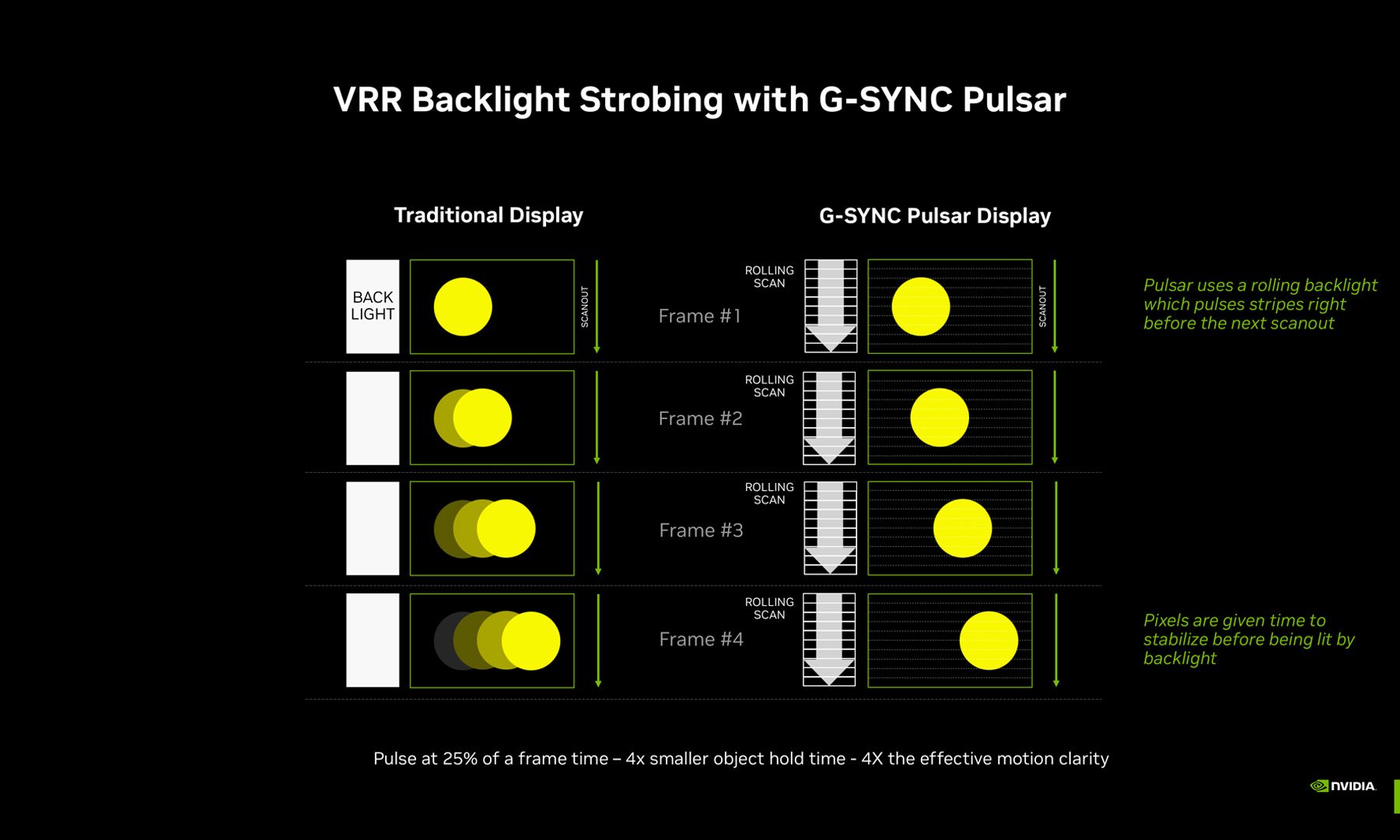

That also explains the elephant in the room: OLED doesn’t work with Pulsar in the same way, because OLED pixels don’t have a backlight to strobe. And while OLED has near-instantaneous pixel response, it can still suffer from perceived motion blur because of the sample-and-hold effect: your eyes track a moving object while each frame remains visible, and your visual system interprets that movement as blur. Pulsar attacks that particular problem at the display level.
5K Goodness, now with 240Hz on the side
The monitor NVIDIA used for the demonstration was AOC’s AGON AGP327KG, a 31.5-inch 5K IPS display running at 144Hz. It is a surprisingly gorgeous IPS panel, with a glossy finish, impressive brightness, and the sort of pixel density that makes everything look ridiculously crisp. AOC lists its native resolution as 5120×2880, while NVIDIA positions it as the first 5K G-SYNC Pulsar display.

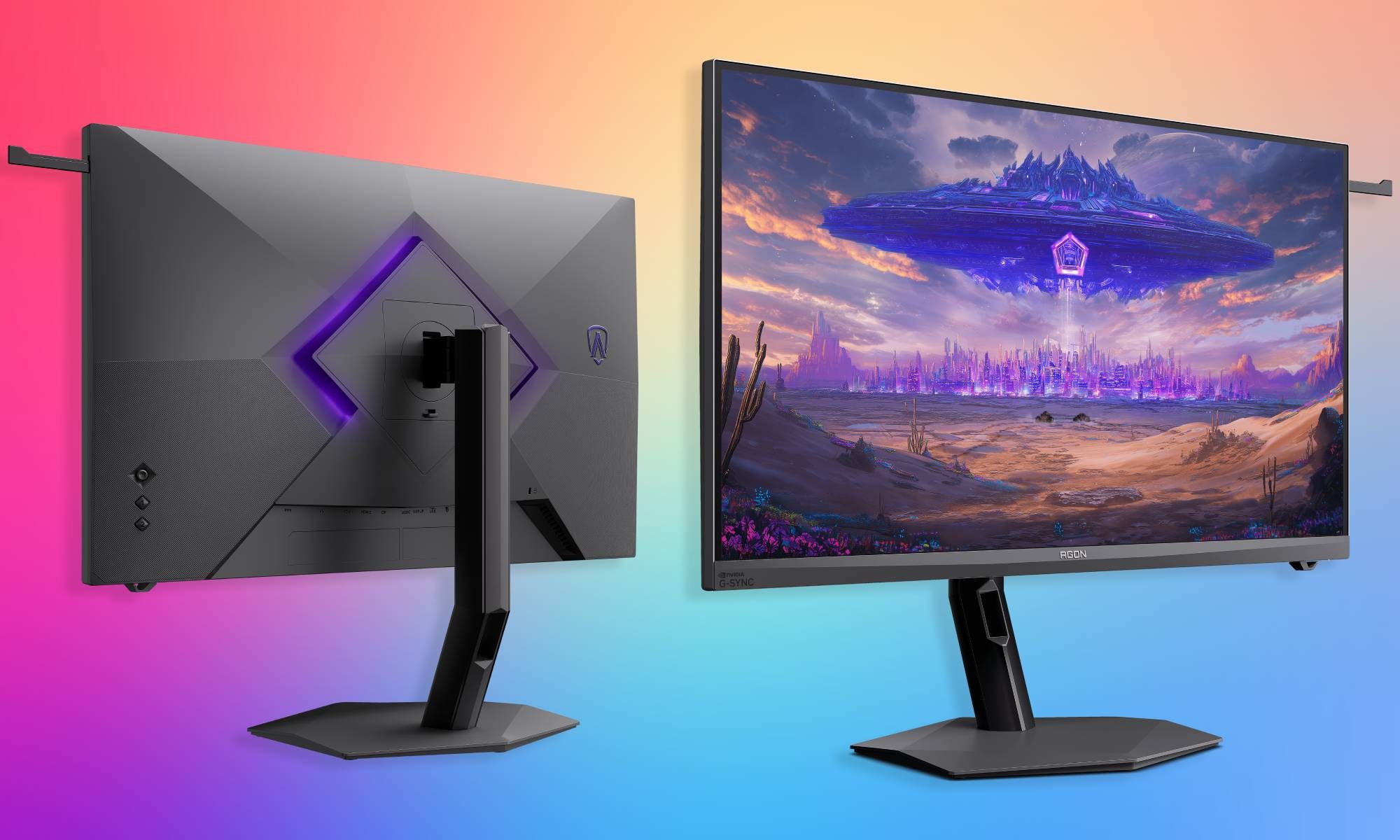
But the clever part is the dual-mode setup. You can run it at 5K and 144Hz, or switch down to 1440p and 240Hz, with Pulsar available in both modes.
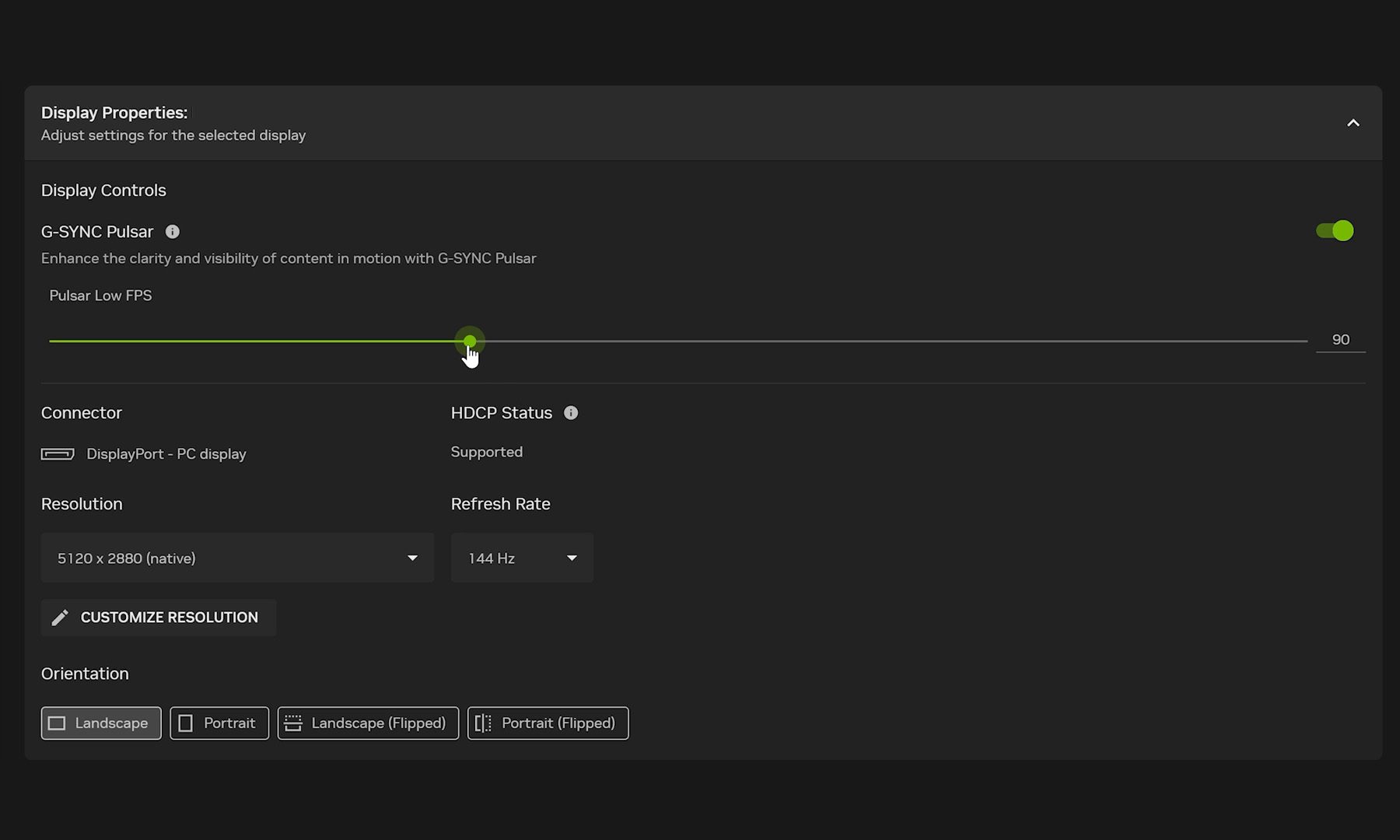
That makes considerably more sense than dropping a 4K monitor all the way down to 1080p just to chase a higher refresh rate. At 5K, you get the resolution for immersive games, while 1440p/240Hz gives competitive players a much more realistic target. And yes, getting anywhere near 144fps at native 5K in demanding games is a serious GPU workout; NVIDIA’s representative suggested an RTX 5090 with frame generation for those scenarios.
Then NVIDIA pressed the magic switch
Then came the actual demonstration, and this was the bit that sold me on Pulsar. NVIDIA first showed a simple motion-clarity test. With Pulsar disabled, moving text became difficult to read. Switch it on, and suddenly the same text remained clear enough to make out. The same thing happened in Delta Force: as the camera moved, environmental text and even the structure of a fence remained substantially easier to see.

And that’s where I finally understood the pitch. For games such as Valorant, Apex Legends, or Call of Duty, you’re constantly tracking moving targets while simultaneously moving your own viewpoint. Traditional motion blur settings aren’t exactly beloved by competitive players, so you’re left with the inherent motion-clarity limitations of the display.
The best part is that Pulsar doesn’t require developers to support anything.
Instead, NVIDIA told me it works independently of the game. There is, however, one caveat: Pulsar needs sufficient frame rate. NVIDIA’s default minimum is 90fps, although the threshold can be lowered to 75fps. Below that point, Pulsar switches off to avoid visible flicker.
Could Mini-LED make Pulsar even more interesting?
This is where I think things could get particularly spicy. Because Pulsar needs a backlight, Mini-LED could theoretically be an interesting future partner for the technology. Mini-LED can give LCDs far better local contrast and HDR performance, although packing in enough zones can make these monitors expensive enough that OLED starts looking like the easier choice.

But combine Mini-LED’s contrast advantages with Pulsar’s motion-clarity benefits, and LCD suddenly has another compelling reason to exist. That’s entirely theoretical for now, rather than an NVIDIA product announcement, but it could be an interesting way to make the technology genuinely differentiated.
NVIDIA’s smarter answer to the Hz race
What impressed me most about Pulsar is that NVIDIA isn’t simply trying to win the refresh-rate arms race. While everyone else keeps asking how many more frames a monitor can display, NVIDIA is asking how clearly you can actually see those frames while they’re moving. And after seeing 5K at 144Hz remain surprisingly clear during motion, I think that’s a much more interesting question. The AGP327KG proves that Pulsar doesn’t have to be confined to 27-inch 1440p esports monitors.
It can potentially sit alongside high-resolution gaming, giving you detail and motion clarity instead of forcing you to choose one over the other.
That, ultimately, is why G-SYNC Pulsar might be one of NVIDIA’s more interesting display technologies in years. It isn’t making a 144Hz panel secretly become a 500Hz panel. It’s doing something arguably more useful: making those 144 frames easier for your eyes to follow. And after watching the difference appear and disappear with a single toggle at Gamescom, I really want to see what Pulsar feels like in my own Valorant matches.
You must be logged in to post a comment Login