

Tech
Offshore Wind and Military Radar: Solving Security Gaps

When the Trump administration last year sought to freeze construction of offshore wind farms by citing concerns about interference with military radar and sonar, the implication was that these were new issues. But for more than a decade, the United States, Taiwan, and many European countries have successfully mitigated wind turbines’ security impacts. Some European countries are even integrating wind farms with national defense schemes.
“It’s not a choice of whether we go for wind farms or security. We need both,” says Ben Bekkering, a retired vice admiral in the Netherlands and current partner of the International Military Council on Climate and Security.
It’s a fact that offshore wind farms can degrade radar surveillance systems and subsea sensors designed to detect military incursions. But it’s a problem with real-world solutions, say Bekkering and other defense experts contacted by IEEE Spectrum. Those solutions include next-generation radar technology, radar-absorbing coatings for wind turbine blades and multi-mode sensor suites that turn offshore wind farm security equipment into forward eyes and ears for defense agencies.
How Do Wind Farms Interfere With Radar?
Wind turbines interfere with radar because they’re large objects that reflect radar signals. Their spinning blades can introduce false positives on radar screens by inducing a wavelength-shifting Doppler effect that gets flagged as a flying object. Turbines can also obscure aircraft, missiles and drones by scattering radar signals or by blinding older line-of-sight radars to objects behind them, according to a 2024 U.S. Department of Energy (DOE) report.
“Real-world examples from NATO and EU Member States show measurable degradation in radar performance, communication clarity, and situational awareness,” states a 2025 presentation from the €2-million (US$2.3-million) offshore wind Symbiosis Project, led by the Brussels-based European Defence Agency.
However, “measurable” doesn’t always mean major. U.S. agencies that monitor radar have continued to operate “without significant impacts” from wind turbines thanks to field tests, technology development, and mitigation measures taken by U.S. agencies since 2012, according to the DOE. “It is true that they have an impact, but it’s not that big,” says Tue Lippert, a former Danish special forces commander and CEO of Copenhagen-based security consultancy Heimdal Critical Infrastructure.
To date, impacts have been managed through upgrades to radar systems, such as software algorithms that identify a turbine’s radar signature and thus reduce false positives. Careful wind farm siting helps too. During the most recent designation of Atlantic wind zones in the U.S., for example, the Biden administration reduced the geographic area for a proposed zone off the Maryland coast by 79 percent to minimize defense impacts.
Radar impacts can be managed even better by upgrading hardware, say experts. Newer solid-state, phased-array radars are better at distinguishing turbines from other objects than conventional mechanical radars. Phased arrays shift the timing of hundreds or thousands of individual radio waves, creating interference patterns to steer the radar beams. The result is a higher-resolution signal that offers better tracking of multiple objects and better visibility behind objects in its path. “Most modern radars can actually see through wind farms,” says Lippert.
One of the Trump administration’s first moves in its overhaul of civilian air traffic was a $438-million order for phased-array radar systems and other equipment from Collins Aerospace, which touts wind farm mitigation as one of its products’ key features.
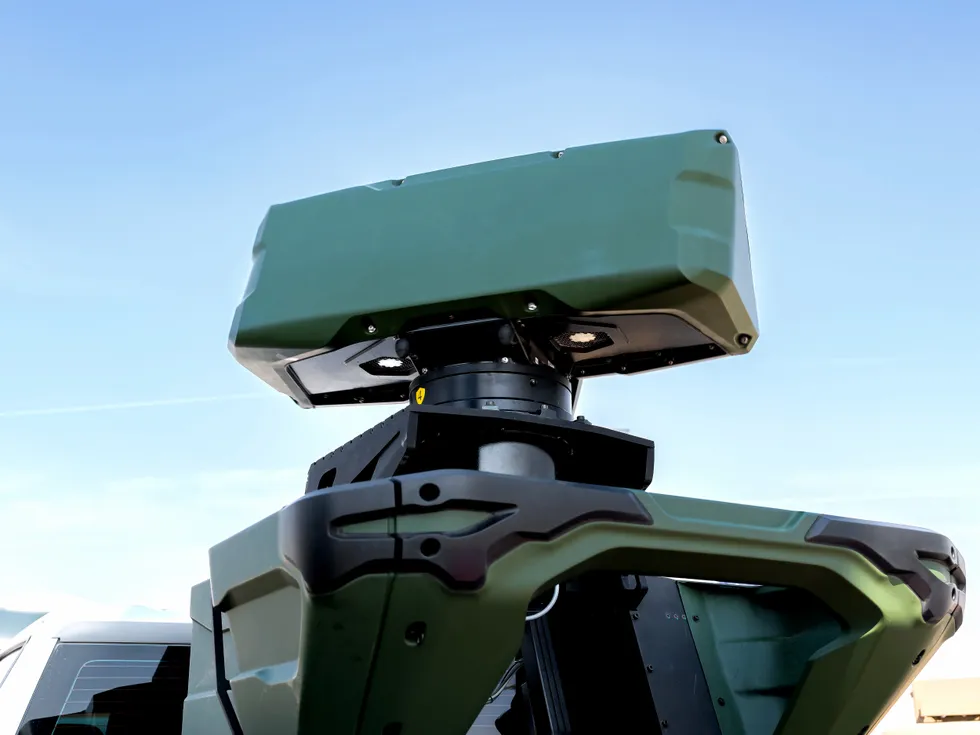
 Saab’s compact Giraffe 1X combined surface-and-air-defense radar was installed in 2021 on an offshore wind farm near England.Saab
Can Wind Farms Aid Military Surveillance?
Another radar mitigation option is “infill” radar, which fills in coverage gaps. This involves installing additional radar hardware on land to provide new angles of view through a wind farm or putting radar systems on the offshore turbines to extend the radar field of view.
In fact, wind farms are increasingly being tapped to extend military surveillance capabilities. “You’re changing the battlefield, but it’s a change to your advantage if you use it as a tactical lever,” says Lippert.
In 2021 Linköping, Sweden-based defense contractor Saab and Danish wind developer Ørsted demonstrated that air defense radar can be placed on a wind farm. Saab conducted a two-month test of its compact Giraffe 1X combined surface-and-air-defense radar on Ørsted’s Hornsea 1 wind farm, located 120 kilometers east of England’s Yorkshire coast. The installation extended situational awareness “beyond the radar horizon of the ground-based long-range radars,” claims Saab. The U.K. Ministry of Defence ordered 11 of Saab’s systems.
Putting surface radar on turbines is something many offshore wind operators do already to track their crew vessels and to detect unauthorized ships within their arrays. Sharing those signals, or even sharing the equipment, can give national defense forces an expanded view of ships moving within and around the turbines. It can also improve detection of low altitude cruises missiles, says Bekkering, which can evade air defense radars.
Sharing signals and equipment is part of a growing trend in Europe towards “dual use” of offshore infrastructure. Expanded dual-use sensing is already being implemented in Belgium, the Netherlands and Poland, and was among the recommendations from Europe’s Symbiosis Project.
In fact, Poland mandates inclusion of defense-relevant equipment on all offshore wind farms. Their first project carries radar and other sensors specified by Poland’s Ministry of Defense. The wind farm will start operating in the Baltic later this year, roughly 200 kilometers south of Kaliningrad, a Russian exclave.
The U.K. is experimenting too. Last year West Sussex-based LiveLink Aerospace demonstrated purpose-built, dual-use sensors atop wind turbines offshore from Aberdeen. The compact equipment combines a suite of sensors including electro-optical sensors, thermal and visible light cameras, and detectors for radio frequency and acoustic signals.
In the past, wind farm operators tended to resist cooperating with defense projects, fearing that would turn their installations into military targets. And militaries were also reluctant to share, because they are used to having full control over equipment.
But Russia’s increasingly aggressive posture has shifted thinking, say security experts. Russia’s attacks on Ukraine’s power grid show that “everything is a target,” says Tobhias Wikström, CEO for Luleå, Sweden-based Parachute Consulting and a former lieutenant colonel in Sweden’s air force. Recent sabotage of offshore gas pipelines and power cables is also reinforcing the sense that offshore wind operators and defense agencies need to collaborate.
Why Is Sweden Restricting Offshore Wind?
Contrary to Poland and the U.K., Sweden is the one European country that, like the U.S. under Trump’s second administration, has used national security to justify a broad restriction on offshore wind development. In 2024 Sweden rejected 13 projects along its Baltic coast, which faces Kaliningrad, citing anticipated degradation in its ability to detect incoming missiles.
Saab’s CEO rejected the government’s argument, telling a Swedish newspaper that the firm’s radar “can handle” wind farms. Wikström at Parachute Consulting also questions the government’s claim, noting that Sweden’s entry into NATO in 2024 gives its military access to Finnish, German and Polish air defense radars, among others, that together provide an unobstructed view of the Baltic. “You will always have radars in other locations that will cross-monitor and see what’s behind those wind turbines,” says Wikström.
Politics are likely at play, says Wikström, noting that some of the coalition government’s parties are staunchly pro-nuclear. But he says a deeper problem is that the military experts who evaluate proposed wind projects, as he did before retiring in 2021, lack time and guidance.
By banning offshore wind projects instead of embracing them, Sweden and the U.S. may be missing out on opportunities for training in that environment, says Lippert, who regularly serves with U.S. forces as a reserves liaison officer with Denmark’s Greenland-based Joint Arctic Command. As he puts it: “The Chinese and Taiwanese coasts are plastered with offshore wind. If the U.S. Navy and Air Force are not used to fighting in littoral environments filled with wind farms, then they’re at a huge disadvantage when war comes.”
From Your Site Articles
Related Articles Around the Web


Nvidia is planning to launch an open-source platform for AI agents, people familiar with the company’s plans tell WIRED.
The chipmaker has been pitching the product, referred to as NemoClaw, to enterprise software companies. The platform will allow these companies to dispatch AI agents to perform tasks for their own workforces. Companies will be able to access the platform regardless of whether their products run on Nvidia’s chips, sources say.
The move comes as Nvidia prepares for its annual developer conference in San Jose next week. Ahead of the conference, Nvidia has reached out to companies including Salesforce, Cisco, Google, Adobe, and CrowdStrike to forge partnerships for the agent platform. It’s unclear whether these conversations have resulted in official partnerships. Since the platform is open source, it’s likely that partners would get free, early access in exchange for contributing to the project, sources say. Nvidia plans to offer security and privacy tools as part of this new open-source agent platform.
Nvidia did not respond to a request for comment. Representatives from Cisco, Google, Adobe, and CrowdStrike also did not respond to requests for comment. Salesforce did not provide a statement prior to publication.
Nvidia’s interest in agents comes as people are embracing “claws,” or open-source AI tools that run locally on a user’s machine and perform sequential tasks. Claws are often described as self-learning, in that they’re supposed to automatically improve over time. Earlier this year, an AI agent known as OpenClaw—which was first called Clawdbot, then Moltbot—captivated Silicon Valley due to its ability to run autonomously on personal computers and complete work tasks for users. OpenAI ended up acquiring the project and hiring the creator behind it.
OpenAI and Anthropic have made significant improvements in model reliability in recent years, but their chatbots still require hand-holding. Purpose-built AI agents or claws, on the other hand, are designed to execute multiple steps without as much human supervision.
The usage of claws within enterprise environments is controversial. WIRED previously reported that some tech companies, including Meta, have asked employees to refrain from using OpenClaw on their work computers, due to the unpredictability of the agents and potential security risks. Last month a Meta employee who oversees safety and alignment for the company’s AI lab publicly shared a story about an AI agent going rogue on her machine and mass deleting her emails.
For Nvidia, NemoClaw appears to be part of an effort to court enterprise software companies by offering additional layers of security for AI agents. It’s also another step in the company’s embrace of open-source AI models, part of a broader strategy to maintain its dominance in AI infrastructure at a time when leading AI labs are building their own custom chips. Nvidia’s software strategy until now has been heavily reliant on its CUDA platform, a famously proprietary system that locks developers into building software for Nvidia’s GPUs and has created a crucial “moat” for the company.
Last month The Wall Street Journal reported that Nvidia also plans to reveal a new chip system for inference computing at its developer conference. The system will incorporate a chip designed by the startup Groq, which Nvidia entered into a multibillion-dollar licensing agreement with late last year.
Paresh Dave and Maxwell Zeff contributed to this report.

Verdict
The Ryobi RY18BLCXA-125 blower is a powerful yet lightweight garden tool. With an extremely comfortable grip shape like to the ones you’d find on Ryobi’s drills, it’s easy to manoeuvre around with minimal hand fatigue. It lacks a bit of raw power but makes up for it by being so easy to handle.
-
Comfortable grip shape -
Light and manoeuvrable -
Comes with two nozzle tips
-
Can only be locked on full power
Key Features
-
Cordless
Uses the same batteries as Ryobi’s cordless tools -
Powerful for smaller jobs
Blows air up to 7m/s (from one metre away), making it good for smaller jobs
Introduction
Compatible with the company’s range of batteries, the Ryobi RY18BLCXA-125 is a flexible and versatile leaf blower. A little limited in power, it’s still a good choice for smaller jobs, particularly for those who own Ryobi tools already.
Heading
Design and Features
- The grip shape is ergonomically designed and very comfortable
- Supplied with two nozzle tips for focus and wide sweeping
- Can be locked on full power
If you’re familiar with Ryobi’s bright green offerings, then the RY18BLCXA-125 is another cleverly designed tool to join the family. It feels sturdy, well-thought-out and is more like holding a drill than a leaf blower. This choice makes it supremely easy to point the nozzle tip at individual leaves that stick to wet grass.
Weighing just 1.5 kg with the battery in place, this blower is ultra lightweight and very easy to hang on to. It boasts a variable speed trigger that is sensitive and responsive. The trigger can be locked on, a bit like cruise control on a car, but it only locks on full power.

The Ryobi RY18BLCXA-125 comes with a 2.5 Ah battery and charger, as well as a pair of nozzle tips and extension tubes. The standard round tip is for focused blowing, while the wide tip works a bit like a broom. You lose a bit of air speed, but the wide stream of air is great for jobs like clearing a path of fallen leaves.

And because it comes with a battery and charger, you can use it in any one of hundreds of Ryobi tools. You can take apart the extension pieces and nozzle tips to store the blower away neatly, and hang it up by the handle to save floor space.

Performance
- Excellent focused air stream
- Lightweight yet powerful
- Loud and harsh on full power
What stands out about the RY18BLCXA is how easy it is to point at the target. Thanks to the excellent grip shape and overall light weight, it’s a doddle to use. Unlike some of the big and chunky blowers, anyone could use this tool without getting tired after a few minutes.
At high speed from one metre away, I measured the air speed at 7m/s, which is enough of a gust to blower lighter debris around. This blower lacks the raw strength of the Einhell GP-LB 36/270 but has an impressive power-to-weight ratio. Overall, this kind of power is good for smaller jobs in smaller gardens, but you’ll need something larger and more powerful for bigger piles of leaves or bigger gardens.
I like the idea of being able to lock the trigger on, but as it only does so on full power it will drain the battery in less than 10 minutes, so it’s not always ideal. Keeping the blower on about half power extends the runtime to a decent 15 minutes.
The real downside of this blower is the noise that it makes. The noise levels of 80dB on the lowest power setting and 98dB on the highest are not ideal. The tone is quite high too – on full power, it’s quite piercing.
Should you buy it?
You want a lightweight yet powerful little leaf blower
If you already own Ryobi tools, it’s an easy decision to make.
You want to move big piles of leaves around
More suitable for focused blowing, this leaf blower lacks the raw power of bigger machines.
Final Thoughts
I like this blower for its lightness and ease of use. The two nozzle tips make it useful for focused blowing as well as path clearance too. The brushless motor is mighty enough for smaller jobs, but annoyingly loud on full power. If you need something more powerful, read the guide to the best leaf blowers.
How We Test
We test every leaf blower we review thoroughly over an extended period of time. We use standard tests to compare features properly. We’ll always tell you what we find. We never, ever, accept money to review a product.
Find out more about how we test in our ethics policy.
- Tested with a variety of garden debris
- We measure wind speed and air flow
FAQs
Yes, you can use the standard batteries you use with the cordless drills and so on with this leaf blower.
Test Data
| Ryobi RY18BLCXA-125 | |
|---|---|
| Sound (normal) | 93 dB |
| Air speed 15cm (low) | 10 m/s |
| Air speed 15cm (high) | 15 m/s |
Full Specs
| Ryobi RY18BLCXA-125 Review | |
|---|---|
| UK RRP | £129.99 |
| Manufacturer | – |
| Weight | 1.53 KG |
| Release Date | 2026 |
| First Reviewed Date | 03/03/2026 |
| Accessories | Two nozzles |
| Leaf blower type | Cordless |
| Speed settings | Variable speed trigger, trigger lock |
| Max air speed | 15 m/s |
| Adjustable length | – |

Samsung’s long-rumoured smart glasses may finally be getting closer to reality.
Speaking at MWC 2026 in Barcelona, Samsung executive vice president Jay Kim confirmed that the company is actively developing the wearable. He also hinted that a launch could happen sooner than many expected.
While details remain limited, Kim did confirm one key feature: the glasses will include a camera positioned at eye level. That camera will capture what the wearer is looking at and send the information to a connected Galaxy smartphone. The phone then processes the data and returns relevant insights to the user.
The approach keeps the glasses lightweight by shifting the heavy lifting to the phone. It’s a similar concept to Meta’s Ray-Ban smart glasses. In this case, the wearable acts mainly as the sensor while the smartphone handles computing tasks.
What Samsung didn’t confirm is whether the first version will include a built-in display. When asked about screens, Kim pointed toward Samsung’s existing devices including its smartphones and smartwatches. This suggests the glasses may rely on them instead of embedding a display directly in the frames.
That doesn’t necessarily rule out a display in the future. Reports suggest a more advanced version with integrated visuals could arrive later. Possibly around 2027, with the first model focusing more heavily on camera and AI-driven features.
Samsung’s broader vision for the product appears to centre on context-aware AI. The glasses could recognise what you’re looking at and provide helpful information instantly. For example, they could translate a menu, identify landmarks, or help with tasks like navigation and messaging without needing to pull out your phone.
The project has reportedly been in development since 2023, with Qualcomm and Google involved in building the underlying chips and software platform.
Samsung hasn’t given a precise launch date yet, but executives at MWC suggested the company aims to bring the glasses to market sometime in 2026. If that timeline holds, Samsung could soon be stepping into the fast-growing smart glasses space. Rivals like Meta are already establishing an early lead.

Rode’s not done releasing trimmed-down versions of its production tools with an eye on budget conscious creators. Today, it’s launching Rodecaster Video Core, an all-in-one studio setup which sits below its flagship Rodecaster Video and its (now) mid-range Video S. It’s aimed at folks who are either dipping a toe into this world, or already have audio gear and just want to broaden out to HD video as well. Arguably, the biggest change is the lack of any controls on the hardware itself, as you’ll be running the show entirely from inside the Rodecaster App.
In terms of connectivity, you’ll find three HDMI-in, one HDMI-out, four USB-C, two 3.5mm and two Neutrik combo ports ‘round back. Connect a compatible video device to a USB-C port and you’ll be able to run up to four sources at a time, and you can even use network cameras via Ethernet. Plus, you’ll be able to use the Rode Capture app to wirelessly connect the feed from an iOS device to your setup. And you’ll even be able to set it up to automatically switch between feeds based on audio inputs, reducing your need to micromanage multi-person feeds.
Rode
And, if you’re already rocking one of Rode’s audio consoles, the Rodecaster Sync app will make your life a lot easier. Essentially, if you’ve got a Rodecaster Pro 2 or Duo, you’ll be able to hook it up to your Video Core, allowing you to set shortcuts directly to your pads. In fact, you can run your audio and video setup from the one desk, hopefully reducing the amount of fiddling you need to do in the middle of your stream.
Core is designed to stream straight to YouTube, Twitch and any other platforms you’d care to use instead. You’ll be able to record your footage to an external drive and, thanks yo a new firmware update across the range, you’ll also be able to output a EDL file for DaVinci Resolve. Oh, and you’ll now be able to import media in non-standard resolutions and aspect ratios — such as square footage from social media — which will be automatically scaled and optimized for your show.
Rodecaster Video Core is available to pre-order now for $599, but there’s no word yet on when the sturdy boxes will start winging their way around the world.

New kinds of aircraft, sorts of “flying cars” that can take off and land with little space like helicopters but function like airplanes, will start operating in US airspace as early as June, the US Department of Transportation announced on Monday.
Eight regions across the US, including New York and New Jersey, Texas, Florida, and Albuquerque, New Mexico, will take part in a three-year pilot program that will see new aircraft designs ferrying people and cargo around the country even before they formally receive full certifications from the Federal Aviation Administration.
The companies building the tech say their aircraft are quieter, cheaper, and release fewer emissions than helicopters or airplanes. Some promise totally autonomous trips. Many involved in the project, including electric vertical takeoff and landing aircraft, or eVTOLs, and ultra-short takeoff aircraft, require way less space to operate, landing and taking off outside of traditional airports and closer to where people live and work. The companies outline futures in which regular people can zip between neighboring cities in a matter of minutes, sailing above traffic and reordering the economy as they go.

On an earnings call with investors earlier this month, Adam Goldstein, the CEO and founder of Archer Aviation, one of the firms involved, called the federal pilot program “our Waymo moment,” a science fiction project turned real life. “Now the goal is to have half a million people in the biggest cities in the country start to see these aircraft as part of your everyday commute, just like they started to see Waymos every day,” he said.
Archer’s electric air taxi, called Midnight, is built to carry up to four passengers on 60 to 90-minute trips. The company will take part in pilot projects in Texas, Florida, and New York. Goldstein told investors that Midnight would complete another important step toward certification “in the coming quarters.” The company has received funding from automaker Stellantis and United Airlines.
Other companies involved in the pilot projects include the small electric plane manufacturer Beta Technologies, Toyota- and Jet Blue-funded air taxi maker Joby Aviation, and Electra, which is building a hybrid electric ultra short aircraft. All four of those firms have completed test flights in the US.
“What we love about the [pilot] is the chance to demonstrate that this is not fantasy,” Electra CEO Marc Allen tells WIRED. “It’s not science fiction. It’s in the real world.”
Tech
Jay Graber steps down as Bluesky CEO, moves into chief innovation officer role at social media platform


Bluesky CEO Jay Graber announced Monday that she’s stepping down from her position and moving to a new role as chief innovation officer of the decentralized social network.
“As Bluesky matures, the company needs a seasoned operator focused on scaling and execution, while I return to what I do best: building new things,” Graber, who is based in Seattle, wrote in a post.
Toni Schneider, former CEO of Automattic (operates WordPress.com) and partner at True Ventures, is joining Bluesky as interim CEO while the board searches for a permanent new leader.
“I deeply believe in what this team has built and the open social web they’re fighting for,” Schneider, who has been an advisor to Bluesky and Graber, wrote on LinkedIn. He also penned a blog post on Bluesky.
Graber has led Bluesky since 2021, when it spun out of Twitter. The platform has become a leading alternative to X, growing its user base 60% last year from 25.9 million users to 41.4 million. The company reported Monday that it now has 43 million users.
“Scaling up this company has been a learning experience unlike anything else,” Graber wrote in her post. “I’ve grown a lot as a leader and had the privilege of assembling the best team I’ve ever worked with.”
She added: “I’m most energized by exploring new ideas, bringing a vision to life, and helping people discover their strengths. Transitioning to a more focused role where I can do what brings me energy is my way of putting that belief into practice.”
Wired reported that the chief innovation officer position was created for Graber, who also sits on the company’s board.
Bluesky has differentiated itself from other social media networks with the AT Protocol, an open technical standard for social media that Bluesky’s team built as the foundation for its network. Most social networks today are walled gardens, where one company runs the servers, owns the data, and sets the rules.
“Last year, we grew a world-class team, expanded the AT Protocol ecosystem, and proved that a values-driven social network could thrive at scale,” Graber wrote.
Bluesky has no official headquarters. Graber and several employees work out of a co-working space in Seattle.
Graber was honored at last year’s GeekWire Gala as one of five Uncommon Thinkers — inventors, scientists, and entrepreneurs selected in partnership with Greater Seattle Partners for their work transforming industries and the world.
Related: Uncommon Thinkers: Bluesky CEO Jay Graber is planting the seeds for a decentralized digital world

A new set of laws in Australia requiring adult websites and app stores to age-restrict content for those under 18, and requiring AI companies to restrict chatbot offerings from displaying certain types of sensitive or adult content to minors, is apparently driving many to download Virtual Private Network apps there.
Major adult sites have closed their virtual doors to those who aren’t age-confirmed in Australia, and these changes follow a nationwide ban on social media use by teenagers and young children that went into effect in December.
According to reports from Reuters, The Guardian and others, in response to the bans, downloads of VPN-related apps, which people can use to circumvent location-based restrictions, are sharply on the rise. According to Reuters, three of the 15 most downloaded free iPhone apps in the country were VPN-related as the new laws went into effect on Monday.
Lawmakers in some regions, including the US, are well aware that people use VPNs in this way. In states such as Michigan and Wisconsin, laws are being proposed to limit or outright ban VPN use. Wisconsin’s proposed law would require adult sites to block VPN traffic, while Michigan’s proposal would ban VPN use entirely in the state.
There is also a proposal in England under consideration to ban VPN use by minors. That proposal is currently under review.

An anonymous reader quotes a report from KrebsOnSecurity: AI-based assistants or “agents” — autonomous programs that have access to the user’s computer, files, online services and can automate virtually any task — are growing in popularity with developers and IT workers. But as so many eyebrow-raising headlines over the past few weeks have shown, these powerful and assertive new tools are rapidly shifting the security priorities for organizations, while blurring the lines between data and code, trusted co-worker and insider threat, ninja hacker and novice code jockey.
The new hotness in AI-based assistants — OpenClaw (formerly known as ClawdBot and Moltbot) — has seen rapid adoption since its release in November 2025. OpenClaw is an open-source autonomous AI agent designed to run locally on your computer and proactively take actions on your behalf without needing to be prompted. If that sounds like a risky proposition or a dare, consider that OpenClaw is most useful when it has complete access to your entire digital life, where it can then manage your inbox and calendar, execute programs and tools, browse the Internet for information, and integrate with chat apps like Discord, Signal, Teams or WhatsApp.
Other more established AI assistants like Anthropic’s Claude and Microsoft’s Copilot also can do these things, but OpenClaw isn’t just a passive digital butler waiting for commands. Rather, it’s designed to take the initiative on your behalf based on what it knows about your life and its understanding of what you want done. “The testimonials are remarkable,” the AI security firm Snyk observed. “Developers building websites from their phones while putting babies to sleep; users running entire companies through a lobster-themed AI; engineers who’ve set up autonomous code loops that fix tests, capture errors through webhooks, and open pull requests, all while they’re away from their desks.” You can probably already see how this experimental technology could go sideways in a hurry. […] Last month, Meta AI safety director Summer Yue said OpenClaw unexpectedly started mass-deleting messages in her email inbox, despite instructions to confirm those actions first. She wrote: “Nothing humbles you like telling your OpenClaw ‘confirm before acting’ and watching it speedrun deleting your inbox. I couldn’t stop it from my phone. I had to RUN to my Mac mini like I was defusing a bomb.”
Krebs also noted the many misconfigured OpenClaw installations users had set up, leaving their administrative dashboards publicly accessible online. According to pentester Jamieson O’Reilly, “a cursory search revealed hundreds of such servers exposed online.” When those exposed interfaces are accessed, attackers can retrieve the agent’s configuration and sensitive credentials. O’Reilly warned attackers could access “every credential the agent uses — from API keys and bot tokens to OAuth secrets and signing keys.”
“You can pull the full conversation history across every integrated platform, meaning months of private messages and file attachments, everything the agent has seen,” O’Reilly added. And because you control the agent’s perception layer, you can manipulate what the human sees. Filter out certain messages. Modify responses before they’re displayed.”

Wallpapers created for the all-new MacBook Neo have now been made available to all macOS Tahoe users, as of macOS 26.4 beta 4.

MacBook Neo wallpapers are now available for all Macs, as of macOS 26.4 beta 4.
On March 4, Apple announced the MacBook Neo, a colorful budget-oriented laptop, powered by an iPhone chip. The low-end Mac is available in four bright color options — Blush, Citrus, Indigo, and Silver, each with a matching wallpaper.
The MacBook Neo ships with a special build of macOS 26.3, AppleInsider as predicted. All other Macs will need macOS 26.4 beta 4 to get the wallpapers made for the machine.
Continue Reading on AppleInsider | Discuss on our Forums
Tech
Anthropic rolls out Code Review for Claude Code as it sues over Pentagon blacklist and partners with Microsoft


Anthropic on Monday released Code Review, a multi-agent code review system built into Claude Code that dispatches teams of AI agents to scrutinize every pull request for bugs that human reviewers routinely miss. The feature, now available in research preview for Team and Enterprise customers, arrives on what may be the most consequential day in the company’s history: Anthropic simultaneously filed lawsuits against the Trump administration over a Pentagon blacklisting, while Microsoft announced a new partnership embedding Claude into its Microsoft 365 Copilot platform.
The convergence of a major product launch, a federal legal battle, and a landmark distribution deal with the world’s largest software company captures the extraordinary tension defining Anthropic’s current moment. The San Francisco-based AI lab is simultaneously trying to grow a developer tools business approaching $2.5 billion in annualized revenue, defend itself against an unprecedented government designation as a national security threat, and expand its commercial footprint through the very cloud platforms now navigating the fallout.
Code Review is Anthropic’s most aggressive bet yet that engineering organizations will pay significantly more — $15 to $25 per review — for AI-assisted code quality assurance that prioritizes thoroughness over speed. It also signals a broader strategic pivot: the company isn’t just building models, it’s building opinionated developer workflows around them.
How a team of AI agents reviews your pull requests
Code Review works differently from the lightweight code review tools most developers are accustomed to. When a developer opens a pull request, the system dispatches multiple AI agents that operate in parallel. These agents independently search for bugs, then cross-verify each other’s findings to filter out false positives, and finally rank the remaining issues by severity. The output appears as a single overview comment on the PR along with inline annotations for specific bugs.
Anthropic designed the system to scale dynamically with the complexity of the change. Large or intricate pull requests receive more agents and deeper analysis; trivial changes get a lighter pass. The company says the average review takes approximately 20 minutes — far slower than the near-instant feedback of tools like GitHub Copilot’s built-in review, but deliberately so.
“We built Code Review based on customer and internal feedback,” an Anthropic spokesperson told VentureBeat. “In our testing, we’ve found it provides high-value feedback and has helped catch bugs that we may have missed otherwise. Developers and engineering teams use a range of tools, and we build for that reality. The goal is to give teams a capable option at every stage of the development process.”
The system emerged from Anthropic’s own engineering practices, where the company says code output per engineer has grown 200% over the past year. That surge in AI-assisted code generation created a review bottleneck that the company says it now hears about from customers on a weekly basis. Before Code Review, only 16% of Anthropic’s internal PRs received substantive review comments. That figure has jumped to 54%.
Crucially, Code Review does not approve pull requests. That decision remains with human reviewers. Instead, the system functions as a force multiplier, surfacing issues so that human reviewers can focus on architectural decisions and higher-order concerns rather than line-by-line bug hunting.
Why Anthropic thinks $20 per review is a bargain
The pricing will draw immediate scrutiny. At $15 to $25 per review, billed on token usage and scaling with PR size, Code Review is substantially more expensive than alternatives. GitHub Copilot offers code review natively as part of its existing subscription, and startups like CodeRabbit operate at significantly lower price points. Anthropic’s more basic code review GitHub Action — which remains open source — is itself a lighter-weight and cheaper option.
Anthropic frames the cost not as a productivity expense but as an insurance product. “For teams shipping to production, the cost of a shipped bug dwarfs $20/review,” the company’s spokesperson told VentureBeat. “A single production incident — a rollback, a hotfix, an on-call page — can cost more in engineer hours than a month of Code Review. Code Review is an insurance product for code quality, not a productivity tool for churning through PRs faster.”
That framing is deliberate and revealing. Rather than competing on speed or price — the dimensions where lightweight tools have an advantage — Anthropic is positioning Code Review as a depth-first tool aimed at engineering leaders who manage production risk. The implicit argument is that the real cost comparison isn’t Code Review versus CodeRabbit, but Code Review versus the fully loaded cost of a production outage, including engineer time, customer impact, and reputational damage.
Whether that argument holds up will depend on the data. Anthropic has not yet published external benchmarks comparing Code Review’s bug-detection rates against competitors, and the spokesperson did not provide specific figures on bugs caught per dollar or developer hours saved when asked directly. For engineering leaders evaluating the tool, that gap in publicly available comparative data may slow adoption, even if the theoretical ROI case is compelling.
What the internal numbers reveal — and what they don’t
Anthropic’s internal usage data provides an early window into the system’s performance characteristics. On large pull requests exceeding 1,000 lines changed, 84% receive findings, averaging 7.5 issues per review. On small PRs under 50 lines, that drops to 31% with an average of 0.5 issues. The company reports that less than 1% of findings are marked incorrect by engineers.
That sub-1% figure is the kind of stat that demands careful unpacking. When asked how “marked incorrect” is defined, the Anthropic spokesperson explained that it means “an engineer actively resolving the comment without fixing it. We’ll continue to monitor feedback and engagement while Code Review is in research preview.”
The methodology matters. This is an opt-in disagreement metric — an engineer has to take the affirmative step of dismissing a finding. In practice, developers under time pressure may simply ignore irrelevant findings rather than actively marking them as wrong, which would cause false positives to go uncounted. Anthropic acknowledged the limitation implicitly by noting the system is in research preview and that it will continue monitoring engagement data. The company has not yet conducted or published a controlled evaluation comparing agent findings against a ground-truth baseline established by expert human reviewers.
The anecdotal evidence is nonetheless striking. Anthropic described a case where a one-line change to a production service — the kind of diff that typically receives a cursory approval — was flagged as critical by Code Review because it would have broken authentication for the service. In another example involving TrueNAS’s open-source middleware, Code Review surfaced a pre-existing bug in adjacent code during a ZFS encryption refactor: a type mismatch that was silently wiping the encryption key cache on every sync. These are precisely the categories of bugs — latent issues in touched-but-unchanged code, and subtle behavioral changes hiding in small diffs — that human reviewers are statistically most likely to miss.
A Pentagon lawsuit casts a long shadow over enterprise AI
The Code Review launch does not exist in a vacuum. On the same day, Anthropic filed two lawsuits — one in the U.S. District Court for the Northern District of California and another in the D.C. Circuit Court of Appeals — challenging the Trump administration’s decision to label the company a supply chain risk to national security, a designation historically reserved for foreign adversaries.
The legal confrontation stems from a breakdown in contract negotiations between Anthropic and the Pentagon. As CNN reported, the Defense Department wanted unrestricted access to Claude for “all lawful purposes,” while Anthropic insisted on two redlines: that its AI would not be used for fully autonomous weapons or mass domestic surveillance. When talks collapsed by a Pentagon-set deadline on February 27, President Trump directed all federal agencies to cease using Anthropic’s technology, and Defense Secretary Pete Hegseth formally designated the company a supply chain risk.
According to CNBC, the complaint alleges that these actions are “unprecedented and unlawful” and are “harming Anthropic irreparably,” with the company stating that contracts are already being cancelled and “hundreds of millions of dollars” in near-term revenue are in jeopardy.
“Seeking judicial review does not change our longstanding commitment to harnessing AI to protect our national security,” the Anthropic spokesperson told VentureBeat, “but this is a necessary step to protect our business, our customers, and our partners. We will continue to pursue every path toward resolution, including dialogue with the government.”
For enterprise buyers evaluating Code Review and other Claude-based tools, the lawsuit introduces a novel category of vendor risk. The supply chain risk designation doesn’t just affect Anthropic’s government contracts — as CNBC reported, it requires defense contractors to certify they don’t use Claude in their Pentagon-related work. That creates a chilling effect that could extend well beyond the defense sector, even as the company’s commercial momentum accelerates.
Microsoft, Google, and Amazon draw a line around Claude’s commercial availability
The market’s response to the Pentagon crisis has been notably bifurcated. While the government moved to isolate Anthropic, the company’s three largest cloud distribution partners moved in the opposite direction.
Microsoft on Monday announced it is integrating Claude into Microsoft 365 Copilot through a new product called Copilot Cowork, developed in close collaboration with Anthropic. As Yahoo Finance reported, the service enables enterprise users to perform tasks like building presentations, pulling data into Excel spreadsheets, and coordinating meetings — the kind of agentic productivity capabilities that sent shares of SaaS companies like Salesforce, ServiceNow, and Intuit tumbling when Anthropic first debuted its Cowork product on January 30.
The timing is not coincidental. As TechCrunch reported last week, Microsoft, Google, and Amazon Web Services all confirmed that Claude remains available to their customers for non-defense workloads. Microsoft’s legal team specifically concluded that “Anthropic products, including Claude, can remain available to our customers — other than the Department of War — through platforms such as M365, GitHub, and Microsoft’s AI Foundry.”
That three of the world’s most powerful technology companies publicly reaffirmed their commitment to distributing Anthropic’s models — on the same day the company sued the federal government — tells enterprise customers something important about the market’s assessment of both Claude’s technical value and the legal durability of the supply chain risk designation.
Data security and what enterprise buyers need to know next
For organizations considering Code Review, the data handling question looms especially large. The system necessarily ingests proprietary source code to perform its analysis. Anthropic’s spokesperson addressed this directly: “Anthropic does not train models on our customers’ data. This is part of why customers in highly regulated industries, from Novo Nordisk to Intuit, trust us to deploy AI safely and effectively.”
The spokesperson did not detail specific retention policies or compliance certifications when asked, though the company’s reference to pharmaceutical and financial services clients suggests it has undergone the kind of security review those industries require.
Administrators get several controls for managing costs and scope, including monthly organization-wide spending caps, repository-level enablement, and an analytics dashboard tracking PRs reviewed, acceptance rates, and total costs. Once enabled, reviews run automatically on new pull requests with no per-developer configuration required.
The revenue figure Anthropic confirmed — a $2.5 billion run rate as of February 12 for Claude Code — underscores just how quickly developer tooling has become a material revenue line for the company. The spokesperson pointed to Anthropic’s recent Series G fundraise for additional context but did not break out what share of total company revenue Claude Code now represents.
Code Review is available now in research preview for Claude Code Team and Enterprise plans. Whether it can justify its premium in a market already crowded with cheaper alternatives will depend on whether Anthropic can convert anecdotal bug catches and internal usage stats into the kind of rigorous, externally validated evidence that engineering leaders with production budgets require — all while navigating a legal and political environment unlike anything the AI industry has previously faced.
Brooke Hogan teases emotional song inspired by dad Hulk Hogan's death after skipping his funeral

Trump is delaying Texas Senate endorsement to pressure GOP senators on SAVE America Act

Australia Grants Asylum To 5 Members Of Iran Women’s Football Team: Minister

Smart energy pays enters the US market, targeting scalable financial infrastructure

Why Israel is blocking foreign journalists from entering

Bitcoin: We’re Entering The Most Dangerous Phase

TRUMP AND REPUBLICANS LIED ABOUT CRYPTO CBDC! EPIC XRP VS ADA DRAMA #xrp #ada #crypto #trump

Early Retirement Expert: A House Vs Stocks… (Here Is The Truth)

Paid Off My Debt and Immediately Made This Mistake #debtfree #finance #relatable
-

 Politics7 days ago
Alan Cumming Brands Baftas Ceremony A ‘Triggering S**tshow’
-
Business3 days ago
Form 8K Entergy Mississippi LLC For: 6 March
-

 Fashion3 days ago
Weekend Open Thread: Ann Taylor
-

 News Videos12 hours ago
10th Algebra | Financial Planning | Question Bank Solution | Board Exam 2026
-

 Crypto World8 hours ago
Paradigm, a16z, Winklevoss Capital, Balaji Srinivasan among investors in ZODL
-

 Tech5 days ago
Bitwarden adds support for passkey login on Windows 11
-
 Sports4 days ago
499 runs and 34 sixes later, India beat England to enter T20 World Cup final | Cricket News
-

 Sports2 days ago
Three share 2-shot lead entering final round in Hong Kong
-

 Sports2 days ago
Braveheart Lakshya downs Lai in epic battle to enter All England Open final | Other Sports News
-

 Business6 days ago
Guthrie Disappearance Enters Fifth Week as Family Visits Memorial
-

 NewsBeat4 days ago
Piccadilly Circus just unveiled ‘London’s newest tourist attraction’ and it only costs 80p to enter
-

 Politics4 days ago
Top Mamdani aide takes progressive project to the UK
-

 Business1 day ago
Search for Nancy Guthrie Enters 37th Day as FBI Probes Wi-Fi Jammer Theory
-

 Entertainment3 days ago
Hailey Bieber Poses For Sexy Selfies In New Luscious Lip Thirst Traps
-
 Sports7 days ago
Jack Grealish posts new injury update as Man City star enters crucial period
-

 Tech10 hours ago
Despite challenges, Ireland sixth in EU for board gender diversity
-

 Crypto World5 days ago
New Crypto Mutuum Finance (MUTM) Reports V1 Protocol Progress as Roadmap Enters Phase 3
-

 Tech5 days ago
ACIP To Discuss COVID ‘Vaccine Injuries’ Next Month, Despite That Not Being In Its Purview
-
Entertainment5 days ago
Harry Styles Has ‘Struggled’ to Discuss Liam Payne’s Death
-

 Business4 hours ago
Search Enters 39th Day with FBI Tip Line Developments and No Major Breakthroughs