Growing up in the 80s, everybody wanted a stereo system. The older guys called it a “HiFi” but we kids just wanted something that could play our records (and eventually tapes and CDs) loud and clear. That system usually included a receiver or integrated amp, a pair of speakers (the bigger, the better) and a turntable.
Over time, listening to music migrated to headphones and earbuds. Those who wanted to listen to music out loud maybe bought wireless speakers and those who were serious about it might have invested in a whole home music system like a Sonos.
TVs got bigger and cheaper while picture quality began to rival – or even exceed – that of local movie theaters. But TV sound really never improved that much. So the soundbar market was born for those who wanted better sound from movies and TV shows. Soundbars can play music too, of course, but mostly they just serve the singular purpose of making terrible-sounding TVs sound less terrible.
Receivers never really went away. They just faded into the background.
Advertisement
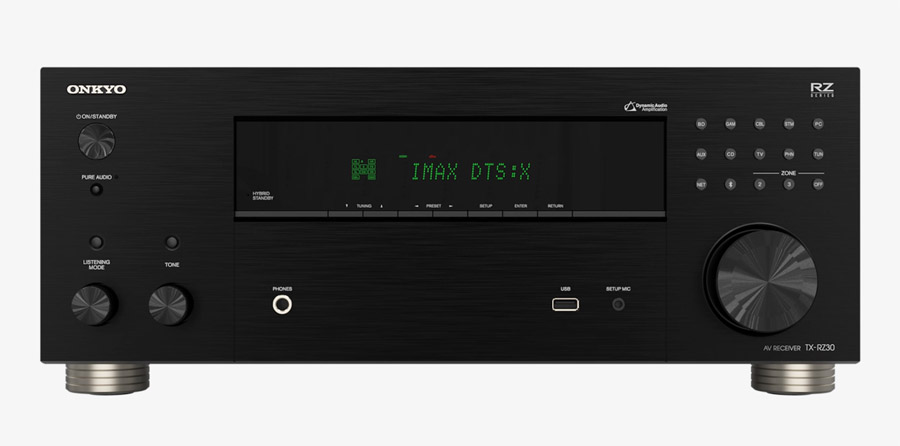
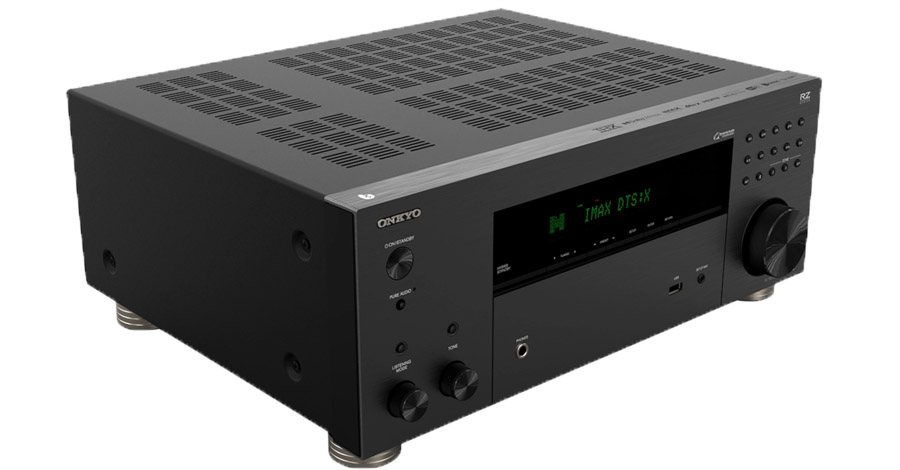
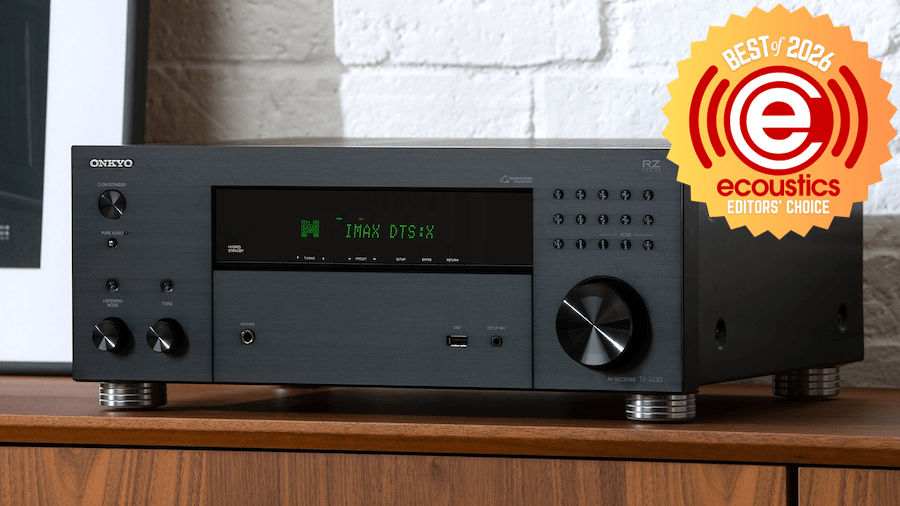
Onkyo’s latest AV Receiver, the TX-RZ30.
Then a global pandemic happened. People stopped going out to dinner or to the movies, to concerts or sporting events. They stopped traveling, too, or at least cut way back. Suddenly people were spending a lot more time at home and found they had a little extra disposable income. Now instead of going out to the movies or concerts, they were watching movies – and concerts – and listening to more music at home. And that’s when many noticed that their little wireless speakers and puny soundbars didn’t actually sound that great.
Since then, receivers have made a comeback. In 2020-2021, many retailers couldn’t keep popular models in stock as demand exceeded supply. Companies who hadn’t released new models in years started doing exactly that. Brands like Denon, Marantz and Sony all began gearing up production and releasing new models. But this surge in popularity didn’t save Onkyo. On May 13, 2022, Onkyo, one of the top Japanese HiFi brands since 1946, declared bankruptcy. It was a sad day for audiophiles and home theater aficionados.
But dry those eyes, dear readers, because Premium Audio Company, a joint venture between VOXX International and Sharp, stepped in to rescue Onkyo, Integra and Pioneer from oblivion and obscurity. Last year, VOXX was itself acquired by Gentex, and, sadly, Pioneer exited the A/V receiver market as a result. However, Onkyo is still going strong with several new models introduced in the past three years. The Onkyo TX-RZ30 is the latest model from this revitalized brand.
What Is It?
The Onkyo TX-RZ30 is a home theater receiver or audio/video receiver (AVR). As such, it includes a built-in AM/FM tuner, audio and video decoding, processing and switching, and built-in power amplifiers to drive a multi-channel fully immersive surround sound speaker system. The RZ30 specifically can drive up to nine channels (nine speakers) plus two powered subwoofers with a power rating of 100 Watts/Channel. This means it can power a 5.2.4-channel or 7.2.2-channel Dolby Atmos or DTS:X immersive surround system. Of course, you may not need this many speakers in your specific room, but it’s nice to have the option to expand and upgrade over time. If your system needs are smaller, then you can use the built-in amps to power speakers in a second or even third zone or room.
In addition to the essentials like Dolby Atmos, multi-channel PCM and DTS:X decoding, the TX-RZ30 is also IMAX-Enhanced Certified which means it can reproduced the full visual and audio bandwidth of IMAX Enhanced content on Blu-ray Disc, UHD Blu-ray and on streaming services such as Disney+ and Sony Pictures Core. The RZ30 also features full-bandwidth Dirac Live optimization and room correction, built-in at no additional charge. This advanced speaker calibration software adjusts speakers in both the level (magnitude) and time (phase) domains so they’ll provide the optimum performance in your specific room. It used to be that Dirac Live was only available in very high end gear or incurred a separate fee, but we’re starting to see this in more budget-friendly products, including the RZ30.
The RZ30 lacks decoding for Sony 360 Reality Audio, MPEG-H immersive audio and Auro-3D. While none of these codecs are currently that widely used, it’s worth mentioning their lack in case you’re looking for any of these formats in a receiver.
Advertisement
Originally priced at $1,199 (MSRP), but recently lowered to $999, the RZ30 is currently the “entry-level” receiver in Onkyo’s high-end RZ line-up. The “RZ” doesn’t seem to stand for anything official, so I’m going to call it the “Reference Zeries” because it sounds fancy, and maybe slightly French. It joins the RZ70 introduced in 2023 and the RZ50, introduced in 2021. You can find out more about the differences among these models (including a comparison chart) in our earlier news post about the RZ30.
Advertisement. Scroll to continue reading.
For music, the RZ30 supports high resolution audio playback up to 24-bit/192kHz. Digital audio file format compatibility includes MP3, WMA, WAV, MPEG-4/AAC, FLAC, and ALAC. The RZ30 also includes several streaming music services built-in, including Apple Music, Amazon Music HD, Spotify Connect, Tidal, Deezer, Pandora and Tune-In. Additional third party audio networking integration includes DTS Play-Fi support, “Works with Sonos” certification and “Roon ready” certification. Wireless connectivity for the RZ30 includes Bluetooth (aptX HD), AirPlay 2, Chromecast Built-in, and Wi-Fi networking. An ethernet port is also included for those who prefer a hard-wired network connection.
Weighing in at 11.5 kilograms (about 25.4 pounds), the RZ30 feels substantial, and a peek inside its cover shows some pretty solid components including beefy transformers and thick aluminum heat sinks. The unit features Class A/B amplification which means it runs a bit warmer than Class D amps would, but it never got excessively warm during our testing. We sure to leave it some room to breathe in your A/V cabinet and it should be fine.
Advertisement
The Ins and Outs
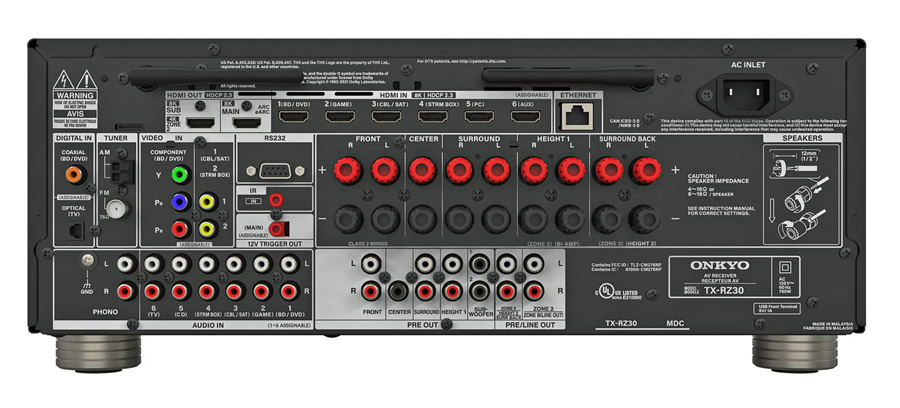
The TX-RZ30 includes six HDMI inputs and two HDMI outputs. It supports HDMI ARC (Audio Return Channel) and eARC and provides HDMI 2.1a and HDCP 2.3 compatibility. It can handle gaming and other video source devices at 4K/120Hz or 8K/60Hz with up to 40 Gbps transfer rate, VRR (Variable Refresh Rate), ALLM (Auto Low Latency Mode), QFT (Quick Frame Transport), SBTM (Source-based Tone Mapping) and Dynamic HDR. Pass-through support is provided for virtually all the HDR formats, including Dolby Vision, HDR10+, HDR10 and HLG (Hybrid Log Gamma).
The RZ30 supports legacy gear, too with one component video, two composite video, six analog audio, one coax digital audio, one fiberoptic digital audio and one USB input. Analog video sources are converted to digital for output over the HDMI port. Your old laserdisc player and VHS deck are welcome here. There’s also a phono input for moving magnet cartridges, in case you’re still rocking that vintage (or not so vintage) turntable.
Outputs include the afore-mentioned two HDMI outputs, speaker level outputs for up to nine speakers, two independently adjustable subwoofer outputs, nine channels of preamp out (in case you want to use separate power amps) and a quarter-inch analog headphone output.
To operate the myriad features that the RZ30 has to offer, Onkyo has provided several control options, including a standard remote control, a smartphone app, voice control via Google Assistant and Siri, and third-party CI control via an RS232 connection. Home automation and control standards like Control4, Crestron, Savant, URC, Elan and RTI are all supported.
Advertisement
All things considered, the RZ30 certainly lives up to its “smart receiver” name and provides enough features, inputs, outputs, decoders, processing and third party integration options to satisfy the needs of even the most demanding consumers.
The Set-Up
A receiver does take a bit more effort to install than most soundbars, but the Onkyo set-up wizard does a decent job walking you through it. There are so many speaker configuration options that you will want to pay attention to plug each speaker into the appropriate output. Also, be sure to keep phase (black and red) consistent for all speakers. Every speaker wire comes with a marked side and an unmarked side in the pair. I usually use the marked side for red (+) and the unmarked side for black (-) on both the receiver and speaker ends of each wire.
If you make any mistakes connecting the speakers, you may find out about phase errors or incorrectly attached speakers during the calibration. If you make phase mistakes, you will still get sound from all speakers but it will affect imaging and tonal balance across the system as some speakers will be canceling each other out at some frequencies.
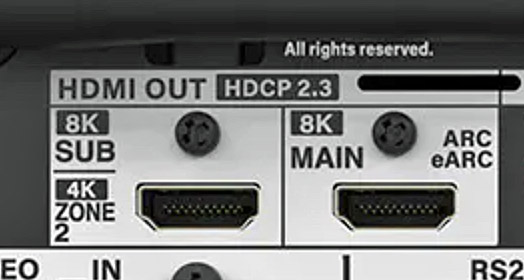
The Onkyo TX-RZ30 features Main and Sub/Zone 2 HDMI outputs, but only the Main output supports ARC/eARC.
With the speakers and subwoofers connected, it’s time to connect your TV to the receiver using a high speed HDMI cable. Use the HDMI ports labeled “eARC” or “ARC” on both the TV and receiver for this connection, if possible. Also, connect any analog source components like a turntable or cassette deck to the receiver. With HDMI eARC, you can connect any video components to the TV and the TV will pass the audio (even lossless multi-channel PCM, Dolby Atmos or DTS:X audio) to the receiver for processing. An exception would be if you’re using a projector or a TV with the older ARC type of HDMI connection. In this case, it’s probably best to connect all components (digital, analog, video and audio) directly to the receiver and just send the video signal to your TV or projector over the HDMI output.
Corrections Corner
Once all the connections are made, it’s time for some corrections. And no, I’m not talking about factual errors or typos (please!). I mean room correction of course. Most receivers come with some sort of speaker calibration routine (with Audyssey being the most popular in AV Receivers). Onkyo offers its own home-grown calibration software called “AccuEQ Room Calibration.” This can take care of the basics like adjusting EQ, crossover points and distance settings for the speakers. But the RZ30 includes Dirac Live, a much more advanced software package which compensates for anomalies in the room itself which can impact the overall sound.
Advertisement
Dirac Live full bandwidth control handles adjustments to all speakers. If you opt for a second subwoofer for deeper, more extended bass response and better bass uniformity throughout your listening room, then you may want to purchase the optional DIRAC Live Bass Control upgrade, which is an additional $299, directly from DIRAC. The RZ-30 is one of most affordable receivers on the market that can even handle Dirac Bass Control and which includes dual independently adjustable subwoofer outputs.
Advertisement. Scroll to continue reading.
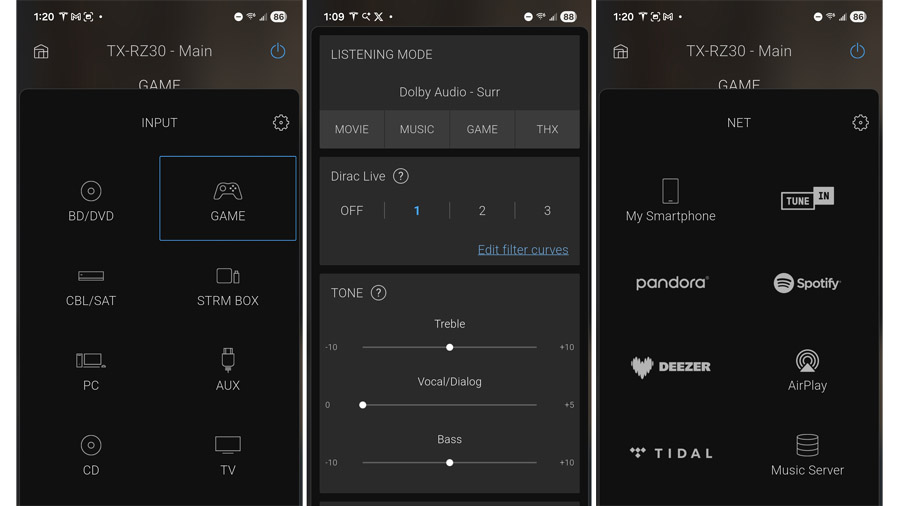
In addition to performing DIRAC Live measurement and room correction, the Onkyo Controller app for Android and iOS allows you to select input, adjust EQ or choose a streaming music service for listening on the TX-RZ30.
To perform Dirac room correction, you’ll need to install the Onkyo Controller app, available in Apple’s App Store and in the Google Play Store. Plug in the included calibration mic to the receiver’s front panel, then click through the instructions in the app. You can perform a basic correction using three measurement points or a full correction using nine measurement points. I opted for the basic 3-point correction, which took less than 30 minutes to complete. I found that Dirac was a bit more sensitive to ambient noise and subwoofer level settings than its competitor, Audyssey, so we had to restart the calibration a couple of times. But once it successfully completed, the results were obvious: better imaging specificity, clearer, more natural sounding dialog, more natural tonal balance overall and smoother transitions from main speakers to the powered subwoofer.
If you prefer, you can also perform Dirac Live room correction on a laptop by downloading the Dirac software and plugging in a compatible microphone like a miniDSP UMIK-1. Doing DIRAC calibration this way can be more accurate and effective as each miniDSP mic has its own unique measurement signature which you identify to Dirac so it can compensate. After performing the calibration, you can then download these Dirac profiles from your laptop to the RZ30 to apply the profile or profiles to the receiver.
Listening Notes
I evaluated the Onkyo TX-RZ30 with a 5.1.4-channel Klipsch reference speaker system I had previously been using with a Denon AVR-X3800H receiver. I hit the system with dozens of my favorite movie clips as well as several music tracks mixed in Dolby Atmos immersive surround as well as some stereo music tracks. I did some listening pre-calibration, but with the big improvement added with DIRAC Live, I left that applied for the remainder of testing.
Advertisement
The RZ30 has a wealth of different listening options, accessible by hitting the “Music” and “Movie/TV” buttons on the remote. Want to listen to your music in Dolby Surround in an orchestral concert hall? No problem! For stereo material, you can choose between Dolby Surround or DTS: Virtual:X to expand the soundstage to fill the room, or select “Direct” or “Stereo” modes for a more purist 2-channel approach. There’s also an “All Channel Stereo” mode if you want to fill a room with background music like for a party or gathering. I found Dolby Surround to work pretty well to expand the soundstage on most stereo music.
Dolby Atmos and DTS:X content in particular sounded wonderfully immersive through the RZ30. Sound objects that traveled around in space moved seamlessly from front to back, side to side and top to bottom. The Dolby Atmos mix of KX5/Deadmau5 “Alive” presented a huge soundstage and the rhythmic synth snare drum roll around 4 minutes into the song presented a nicely defined circle as it moved all around the room. And when the chorus of the Dolby Atmos mix of Elton John’s “Rocket Man” came along, the room came alive with instruments and vocals placed in a virtual dome that expanded beyond the borders of the room. This is an extremely effective mix for those who like to be brought inside the music mix and it was very well represented on the RZ30.
Moving onto IMAX content, the RZ30, with its IMAX Enhanced certification, is able to identify IMAX Enhanced DTS:X content from UHD Blu-ray Disc and from streaming services such as Disney+ and Sony Pictures Core, decode the DTS:X soundtrack and apply the IMAX EQ and processing. This gives IMAX movies a more theatrical sound as it uses the far-field IMAX cinematic mix, which results in more impactful bass, extended dynamic range and, in some cases, more pronounced height effects.
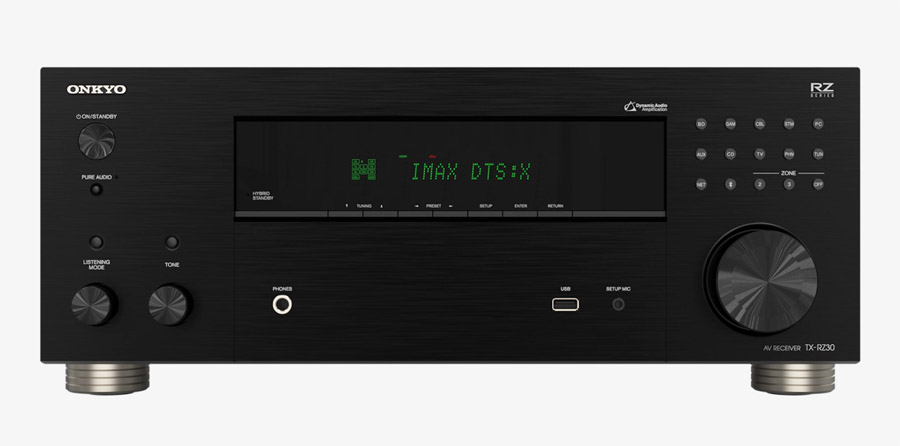
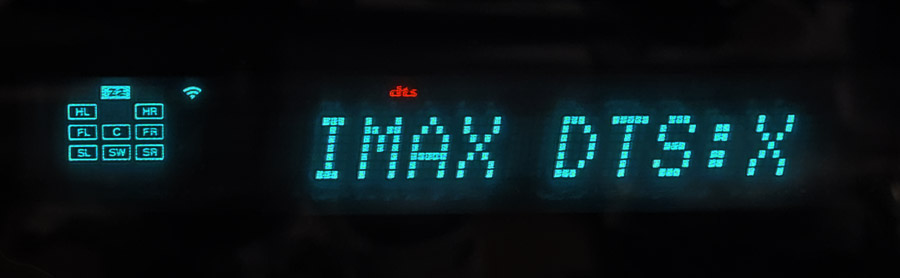
The RZ30’s display screen identifies what type of sound format is being decoded as well as how many speaker channels are active.
The RZ30 delivers these IMAX Enhanced DTS:X soundtracks as expected showing IMAX DTS:X on the front panel display. And the sound on the few titles I was able to test was quite bombastic with deep rumbling bass and enveloping height effects. “Zombieland: Double Tap” is one of the few UHD Blu-ray Discs with IMAX Enhanced certification and a lossless DTS:X soundtrack. Both the RV zombie attack scene and the final battle scene provided great examples of DTS:X IMAX Enhanced audio with gunshots, shuffling zombie growls and other sonic mayhem exploding into the room. And over on Disney+, the “Queen Rock Montreal” IMAX film had a raw power and immediacy in IMAX Enhanced DTS:X making the viewer feel like he (or she) was there in the audience. Marvel IMAX Enhanced titles like “The Fantastic 4” and “Guardians of the Galaxy Volume 3” also sounded dynamic and engaging with their IMAX/DTS:X soundtracks activated.
Sadly, actually finding this IMAX Enhanced content with a DTS:X soundtrack is tricky. There are only a handful of IMAX Enhanced titles on UHD Blu-ray Disc, and only two streaming services — Disney+ and Sony Picture Core — can deliver the necessary DTS:X soundtracks. And DTS:X support on Disney+ is currently limited to select TVs from Hisense, TCL and Sony. Though we were happy to see that the Disney+ app on the Valerion Max projector’s Google TV OS, also supports DTS:X/IMAX Enhanced audio output. This is the first projector we’ve tested that supports the feature.
Comparisons
The Denon AVR-X3800H ($1,699) offers similar features and functionality to the Onkyo TX-RZ30 ($999). They both include nine channels of amplification, but the Denon can be expanded to 11 channels by connecting an external 2-channel amplifier and using the preamp outputs. The Denon also offers Dirac Room Correction, but at an additional cost (ranging from $259 for the basic limited bandwidth DIRAC Live version to $799 for a full license with Bass Control and ART included). To get the same level of Dirac room correction on the Denon vs. the Onkyo would require spending an additional $349 on the full bandwidth Dirac version on the Denon, bringing its price (with Dirac) up to $2048 (MSRP), roughly twice the price of the Onkyo TX-RZ30. However, the 3800H includes four independently adjustable subwoofer outputs compared to the Onkyo TX-RZ30’s two so it can work better in larger or problematic rooms where more subwoofers are preferred.
Advertisement
Sound quality-wise, the Denon 3800H and Onkyo RZ30 are not far off. Both offer excellent dynamics and cohesiveness of sound. The Denon may have a slight warmth compared to the RZ30’s more neutral sonic signature but both can create an outstanding immersive soundstage, particularly on Dolby Atmos and DTS:X content, particularly after DIRAC calibration and room correction. The Denon receiver does add decoding for Sony 360 Reality Audio, MPEG-H immersive sound and Auro 3D, none of which are particularly popular but which may appeal to those who want universal format support.
Compared to the similarly priced Denon AVR-X2800H ($1,199), the Onkyo TX-RZ30 represents a clear upgrade with more channels, more features, a full set of preamp outputs, dual independent subwoofer outputs and Dirac Live room correction.
Onkyo’s own TX-NR7100 may be a more likely competitor to the TX-RZ30 as it also includes nine channels of amplification and has Dirac Live full bandwidth room correction built-in. However, the 7100 does not offer preamp outputs so you can’t upgrade the on-board amplification. Also, the two subwoofer outputs on the NR7100 are identical and not independently adjustable and the 7100 has no option to add Dirac Bass Control. Still, at a street price now of around $750, the TX-NR7100 offers a very compelling value proposition for a 9.2-channel receiver and offers a fine choice if you’re on a more limited budget.
Advertisement. Scroll to continue reading.
Advertisement
The Bottom Line
Onkyo’s TX-RZ30 is built to satisfy even the pickiest audiophiles and home theater aficionados with a strong feature set, excellent sonics and best-in-class Dirac Live room correction. It may not offer the upgradability of the Denon AVR-X3800H but it sells for a significantly lower price, particularly when you consider that the Onkyo includes Dirac Live full bandwidth room correction, while that option adds $349 to the cost of the Denon. Its only real competition is from Onkyo itself, in the TX-NR7100, but that unit is less flexible, older and less upgradeable.
If you’re looking for a solid 9-channel A/V receiver with excellent sound quality, best-in-class Dirac Live room correction built-in and a path toward upgrade, the Onkyo TX-RZ30 should definitely be on your short list.
Pros:
Full bandwidth Dirac Live room correction included, with upgrade to Direct Live Bass Control available
9 channels of power with full set of preamp outputs for use with external amps
Intuitive operation
Transparent, neutral sound
Dual independently adjustable subwoofer outputs
A plethora of analog audio and video inputs including phono input, component and composite video
Cons:
Cannot be expanded beyond nine channels (maxes out at 5.2.4 or 7.2.2)
Lacks Sony 360RA, MPEG-H and Auro 3D audio decoding and processing
Spotify is rolling out a new Exclusive Mode on desktop for listeners who care about audio quality. This feature gives you more control over how sound is delivered, reducing system interference and allowing bit-perfect playback.
In simple terms, your music can now reach your headphones or speakers without being altered by your computer’s audio system. This update is currently available on the desktop app for Windows, with Mac support coming later.
What is Exclusive Mode in Spotify, and how does it work?
Exclusive Mode is designed for people who use external DACs or high-end audio setups, where even small processing changes can affect sound.
Spotify
Normally, your operating system mixes audio from different apps, which can resample or modify the signal. Exclusive Mode changes that by letting Spotify take full control of the audio output.
When you turn on Exclusive Mode, Spotify bypasses the system mixer. That means your music is sent directly to your audio device without being changed. This is what allows bit-perfect playback, where the audio data remains exactly as intended.
Advertisement
It also reduces interruptions from other apps. Since Spotify controls the output, other system sounds are blocked while you are listening.
How to turn on Exclusive Mode in Spotify?
Spotify
To enable Exclusive Mode, first connect your external audio device, such as a DAC or audio interface, to your computer. If your system already has a headphone or speaker port, it may include a built-in DAC.
Next, open the Spotify desktop app and go to Settings. Scroll down to Playback, then under Output, select your audio device from the dropdown menu. Once that is set, turn on Exclusive Mode.
Spotify also suggests turning off certain features in its settings for the best playback. This includes Automix, Crossfade, Equalizer, and Normalize Volume, all available under Settings > Playback.
If you want to turn it off, go back to Settings and switch off Exclusive Mode. This will return audio control to your system, allowing other apps to play sound alongside Spotify.
Rotel’s luxury Michi brand has expanded its digital lineup with the Michi Prestige Q430 CD Player, a full-function disc player designed for listeners who still take Red Book CD playback seriously. Unlike a transport-only design, the Q430 includes its own internal DAC while also offering a digital output for those who prefer to experiment with an external converter. Rotel already has a long track record in the two-channel component space, and while we’ve covered the brand extensively at eCoustics, the Michi line sits firmly at the company’s high-end tier.
The Prestige Q430 now enters a surprisingly competitive premium CD player category that includes impressive new models from Marantz, Quad, Hegel, TEAC, Shanling, and several other brands determined to prove that the compact disc still has plenty of life left in it.
In recent years, we’ve also covered several other Michi products including the Q5 CD Transport DAC (2024), the Series 2 Amplifiers and Preamplifiers (2023), and our full review of the Michi X3 Integrated Amplifier (2022); all of which reinforced the brand’s focus on premium construction, refined industrial design, and performance aimed squarely at the higher end of the hi-fi market.
Michi Prestige Line Adds the Q430 CD Player
The Michi Prestige line is designed to give listeners a clear entry point into ultra-high-performance components built with the same design discipline, power supply priorities, and craftsmanship expected of reference-level audio.
Advertisement
Drawing on more than 60 years of Rotel amplifier and circuit development, Prestige models aim to deliver effortless dynamics, exceptional clarity, and the kind of long-term reliability that serious two-channel systems demand.
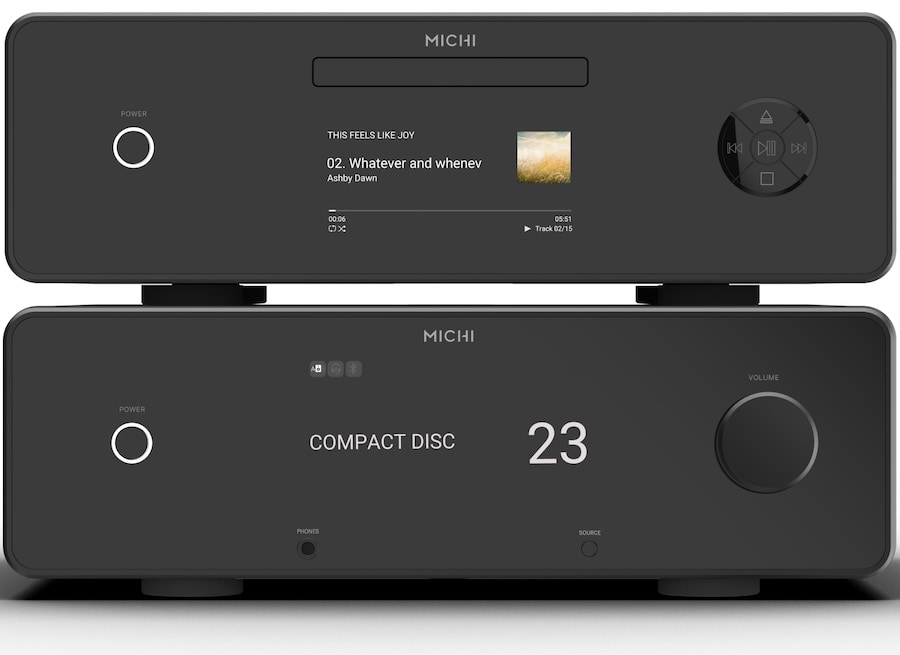
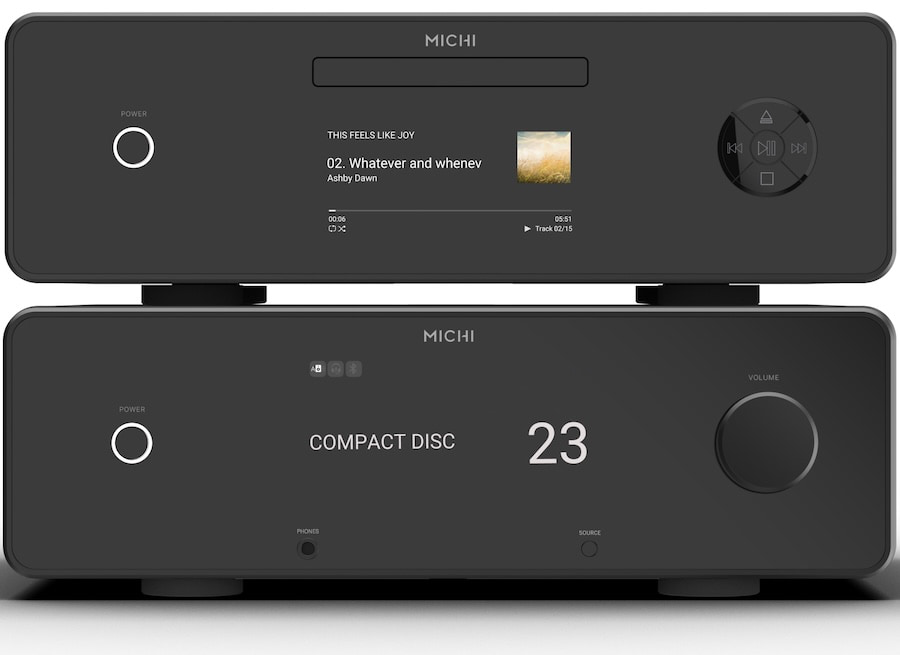
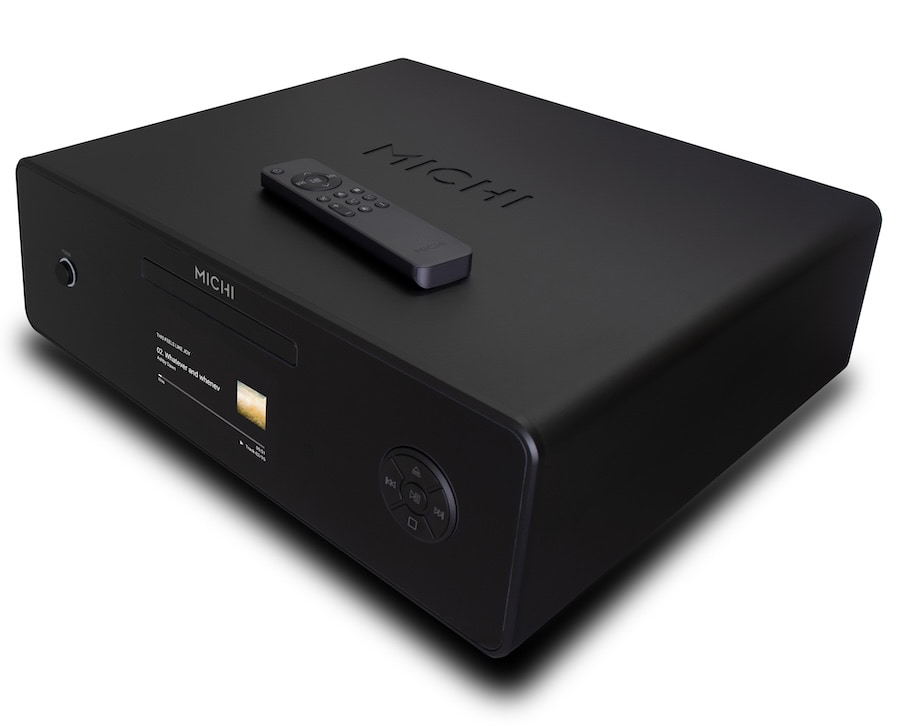
Michi Prestige Q430 CD Player atop Michi X430 Integrated Amplifier
For 2026, Michi has introduced two new additions to the series: the Prestige Q430 CD Player and the X430 Integrated Amplifier. We covered the X430 in a companion article, but here the focus shifts to the Q430 CD Player, a premium disc player designed for listeners who still value dedicated CD playback in a high-end system.
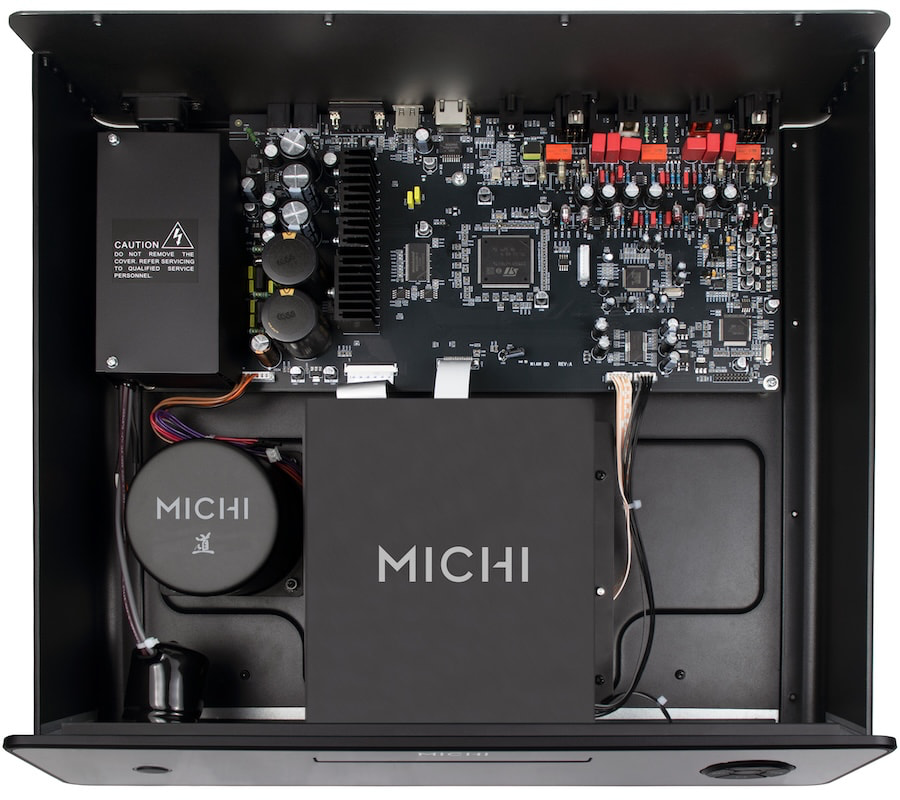
Building on Michi’s heritage of precision engineering and industrial design, the Q430 combines a high-quality floating CD mechanism capable of playing Red Book CD, CD-R, and CD-RW discs with a meticulously designed proprietary power supply built in-house. Multiple stages of isolated voltage regulation reduce noise at the source, helping deliver exceptionally low distortion and a very quiet acoustic background where subtle details and ambient cues can emerge clearly from the mix.
At the heart of the digital stage is an ESS SABRE ES9028PRO 8-channel DAC, configured and optimized for stereo playback. The DAC is intended to deliver precise, neutral sound with wide soundstage presentation and strong resolution through both single-ended RCA and balanced XLR analog outputs, providing flexibility when integrating the player into a wide range of high-end systems.
Advertisement
Measured performance is equally ambitious. The Q430 is rated for ultra-low distortion (THD below 0.0006%) and a signal-to-noise ratio exceeding 120 dB, helping preserve transient impact and low-level detail even in complex musical passages. Channel separation greater than 105 dB at 10 kHz further supports precise stereo imaging and spatial detail, contributing to a convincingly three-dimensional soundstage.
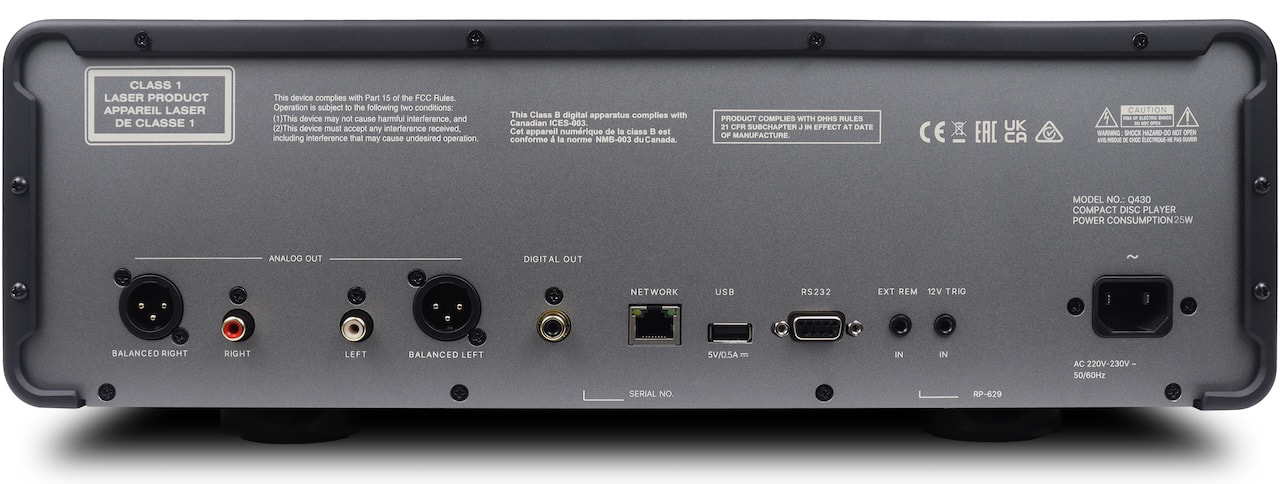
Connectivity is straightforward but purposeful. In addition to its analog outputs, the Q430 includes a coaxial digital output, allowing the player to function as a dedicated CD transport when paired with an external DAC for listeners who prefer to experiment with different digital conversion stages.
However, there are a few notable omissions for a player positioned at this level. The Q430 does not support SACD playback, which some listeners may expect given its price category and the capabilities offered by competing models. In addition, the internal DAC cannot be used with external digital sources or streamers, a feature that has become increasingly common in 2026 as manufacturers try to broaden the utility of standalone disc players within modern streaming-focused systems.
Advertisement. Scroll to continue reading.
Advertisement
For ease of operation, the Michi Prestige Q430 CD Player includes a wireless remote control that allows listeners to navigate album artwork, settings, and disc information displayed on the front panel’s full-color TFT display. The interface is designed to make browsing and playback straightforward while providing clear visual feedback during use.
All of the internal components are housed inside a precision-milled aluminum chassis that reflects Michi’s design philosophy of durability, performance, and long-term reliability. The solid enclosure also helps minimize vibration and electrical interference, supporting stable disc playback and consistent sonic performance.
The Q430 measures 431 x 148 x 385 mm (17 x 6 x 15-1/4 inches) with a front panel height of 131 mm (approximately 5-1/6 inches). The unit weighs 8.8 kg (19.5 lbs), reflecting the robust chassis construction and internal power supply design typical of Michi components.
Unbalanced (RCA) > 105 dB @ 10 kHz Balanced (XLR) > 110 dB @ 10 kHz
> 104 dB @ 10k Hz
Signal to Noise Ratio (IHF A-Weighted)
Unbalanced (RCA) > 120 dB Balanced (XLR) > 125 dB
> 115 dB
Dynamic Range
> 99 dB
> 99 dB
Input Sensitivity
Not Indicated
0 dBfs / 75 ohms
CD Output
Not Indicated
Digital output (16-Bit / 44.1k Hz, 0 dBFS)
Analog Output Level / Impedance
Unbalanced (RCA) 1.96 V / 100 ohms
Advertisement
Balanced (XLR) 4.2 V / 2 k ohms
Unbalanced (RCA) 2.3 V / 100 ohms
Balanced (XLR) 4.9 V / 4K ohms
Digital to Analog Converter
ESS ES9028PRO DAC
ESS ES9028PRO DAC
Digital Output
Coaxial Out
SPDIF LPCM (up to 24-bit / 192 kHz)
PC-USB
USB provided for power and firmware updates only.
USB Audio Class 2.0 (up to 32-bit / 384k Hz)* *Driver installation required
Advertisement
Support native DSD (up to 4X, 11.2M) and DoP (up to 2X, 5.6M)
Support MQA and MQA Studio (up to 24-bit / 384 kHz)
Power Requirements
Europe 230 V, 50 Hz USA 120 V, 60 Hz
Europe 230 V, 50 Hz USA 120 V, 60 Hz
Power Consumption
25 watts
25 watts
Standby Power Consumption
< 0.5 watts
< 0.5 watts
Full-color TFT Display
Yes
Yes
Control
Wireless Remote, RS232, Ethernet, 12V Trigger
Wireless Remote, RS232, and Ethernet
Dimensions (WxHxD)
431 x 148 x 385 mm (17 x 6 x 15-1/4 inches)
485 x 150 x 452 mm (19 x 6 x 17-3/4 inches)
Front Panel Height
131 mm (5-1/6 inches)
132 mm (5-1/4 inches)
Net Weight
8.8 kg (19.5 lbs)
23.5 kg (51.8 lbs)
Finish
Black
Black
The Bottom Line
The Michi Prestige Q430 CD Player is aimed at listeners who still value dedicated Red Book CD playback and want a component that matches the build quality and aesthetic of a high-end two-channel system. With its floating transport mechanism, ESS SABRE ES9028PRO DAC optimized for stereo use, balanced and single-ended outputs, and robust aluminum chassis, the Q430 is clearly designed to deliver refined CD performance rather than serve as a digital hub for multiple sources.
However, its focus is also its limitation. At $4,000, the Q430 lacks several features that competing players in this price category increasingly offer, including SACD playback and digital inputs that would allow the internal DAC to be used with external streamers or transports. For some buyers, those omissions will be difficult to ignore.
Ultimately, the Q430 is best suited for high-end two-channel listeners who still maintain a substantial CD collection and want a dedicated player that prioritizes build quality and straightforward disc playback rather than broad digital flexibility. For everyone else, especially those looking for SACD support or a more versatile DAC—the competition from brands like Marantz, Esoteric, TEAC, and Shanling may offer a more compelling case.
Advertisement
Price & Availability
Priced at $3,999, the Michi Q430 CD Player will initially be available in North America beginning March 2026, with global availability to follow early in the second quarter of 2026 through Rotel’s Dealer Network at €3,999 or £3,599.
Rumors are swirling that a DJI Pocket 4 is on its way, but don’t let the promise of a shiny new action cam distract you from what’s available right now — the DJI Osmo Pocket 3 is currently cheaper than ever. Although it’s nearly three years old now, the Pocket 3 is still an extremely capable camera. With features like a portrait filming mode and a 2-inch screen that’s ideal for viewing a live camera feed, the Pocket 3 has proven hugely popular with vloggers and content creators in particular.
In our DJI Osmo Pocket 3 review, our tester called it “class-leading”, and highlighted the “amazing video quality and beautiful slow-motion scenes”. It was awarded a near-perfect 4.5 stars. TechRadar’s camera editor Tim Coleman thinks it’s well worth considering, even with the Pocket 4 on the horizon, commenting: “For many solo vloggers it will serve their needs perfectly, and for a much lower price than the latest models.”
Today’s best DJI Osmo action cam deals
Advertisement
More DJI Osmo action cam deals
The Osmo Pocket 3 deals sit amongst a variety of excellent DJI action cam price drops available right now — there are also lowest-ever prices on the likes of the “seriously feature-packed” DJI Osmo Action 5 Pro and “fantastic” Osmo Action 4.
I’ve checked prices across leading retailers, and the best prices right now are at Amazon, but many options are available for only a few cents more at Best Buy. Typically, these cameras are sold in Essential, Standard, or Adventure Combos, with each bundle, respectively, including more accessories.
Protex AI, Altra, Barespace, Tines, Nory and CleverCards also made it to this year’s list.
Despite the usual London dominance in Sifted’s annual list of the 100 fastest-growing Irish and UK start-ups, Dublin’s Kota has managed to place in the top 10 this year.
The Irish insurance and employee benefits platform has made it to the ninth spot on the 2026 list, with a two year revenue CAGR (compound annual growth rate) of more than 640pc. The four-year-old start-up last raised $14.5m in May 2025, taking its total raise to date to nearly $23m.
“This ranking is a reflection of the work we’ve done over the last three years building out our infrastructure and network of insurance and pension providers, and the value that lets us deliver to customers,” Kota celebrated in a post on LinkedIn.
Advertisement
The company’s employee health insurance and benefits platform aims to empower start-ups and scaling organisations to automate and manage team benefits.
Others in this year’s list include the Dublin-based Limerick-founded workplace safety start-up Protex AI, which secured $36m early last year to expand across the US. The 2021-founded company ranked 21 on the Sifted list with a CAGR of 313pc.
Protex’s AI-powered platform plugs into CCTV devices and uses computer vision to capture unsafe events autonomously. The start-up already has around 80 employees.
Meanwhile, Care-tech Altra placed number 41 with a CAGR of just above 200pc. Founded in 2019, the start-up has reached profitability. “This recognition reflects a real shift in the care sector,” the company said.
Advertisement
Dublin’s Barespace, on the other hand, which bills itself as the “operating system” for the hair and beauty industry, has made it to the 56th spot – and the highest ranking seed start-up on the list.
Founded in 2022, the company has around 32 employees. Last September, it announced a €2.9m round to accelerate its UK and European expansion.
Irish automation unicorn Tines has climbed 12 positions on the list since last year, reaching the 70th spot with a CAGR of 136pc. The company, which has around 400 workers, recently announced 100 new jobs in Boston as demand for its AI tools rise in the US.
Founded in 2018, Tines reached unicorn status in February 2025 after a $125m Series C round. The company has raised $272m to date from investors including Goldman Sachs, SoftBank, Felicis, Addition, Accel, Blossom Capital and Lux Capital.
Advertisement
Food sector-focused AI start-up Nory has dropped seven spots since last year, reaching the 44th rank in this year’s list. The dual-headquartered start-up in Dublin and London raised $37m last September, also to drive expansion in the US. Nory has a two-year revenue CAGR of around 182pc.
While insurtech CleverCards dropped 27 spots to the 54th rank on the 2026 list. Founded it 2019, CleverCards’s payments technology allows businesses and public sector organisations to create prepaid digital Mastercards and send them to anyone. The service was launched to market in 2023.
Previous year’s entrants, that did not rank this year include e-SIM provider Holafly, VR simulation training provider VRAI, data company CitySwift, e-commerce financier Wayflyer, and AI copyright protection provider Ceartas.
Don’t miss out on the knowledge you need to succeed. Sign up for the Daily Brief, Silicon Republic’s digest of need-to-know sci-tech news.
The San Francisco startup emerges from stealth with Mayfield backing and a pitch that treats ad creative as a continuous learning loop, not a quarterly deliverable.
Every B2B marketing team knows the problem. A campaign launches, the creative is fresh, the targeting feels right, and then, slowly, it starts dying. Audiences tune out. Click rates fall.
The agency comes back for a creative refresh and the cycle begins again. Matt Jayson calls this “decaying ads,” and it is, by his account, a structural failure of how digital advertising is built: campaigns that start losing effectiveness the moment they go live, because the feedback loop between what customers actually say and what the ads actually say is too slow.
On Wednesday, the startup Multiply emerged from stealth with $9.5 million in funding to tackle that problem. The round was led by Mayfield, with participation from Sorenson Capital, Instacart co-founder Max Mullen, and Josh Woodward, Google’s VP of Labs and Gemini, the executive credited with building NotebookLM and overseeing Google’s flagship AI app.
Advertisement
The 💜 of EU tech
The latest rumblings from the EU tech scene, a story from our wise ol’ founder Boris, and some questionable AI art. It’s free, every week, in your inbox. Sign up now!
Executives from HubSpot, Braze, Brex, Sierra, and Common Room also joined the round.
Multiply’s pitch is that modern B2B companies are already sitting on the data they need to run far better advertising, they just aren’t using it. Sales call recordings, CRM pipelines, and closed-won deal data contain precise information about why customers actually buy.
Advertisement
Multiply’s system plugs directly into those sources and uses a suite of AI agents to translate them into continuously improving ad campaigns on Google Search and LinkedIn.
Hundreds of structured experiments run in parallel each week, testing messaging, audiences, and creative, with winners scaled and losers cut automatically.
The agent architecture breaks down into five components. A Customer Insights Agent extracts language from sales calls to personalise ad copy. An ICP Agent analyses closed-won deals to tighten audience targeting.
A Quality Score Agent tunes keyword alignment and copy for Google’s ranking signals. A Creative Design Agent refreshes imagery on a weekly cycle. An A/B Testing Agent runs the experiments and identifies what’s working.
Advertisement
Human media buyers sit above all of it, providing brand oversight and compliance review, the “hybrid” in what Multiply describes as a hybrid AI-plus-human agency model.
Jayson, who previously worked at Google in user acquisition and then at Brex as Head of Product for core experiences, describes the gap the company is trying to close: the insights that land deals, the specific objections, the competitor comparisons, the language that actually resonates, rarely make their way back into ad campaigns quickly enough.
His co-founder and CTO, Ashish Warty, spent five years as SVP of Product and Engineering at HackerOne and held senior engineering roles at Airship and Dropbox.
“Modern companies already have all the data needed to create radically better ads,” Jayson said in a statement. “Sales conversations, CRM systems, and pipeline outcomes reveal exactly why customers buy, yet those insights rarely make their way into ad campaigns fast enough.”
Advertisement
The timing is deliberate in another sense. Multiply’s infrastructure is, the company says, already being positioned for ChatGPT advertising, a format that OpenAI has signalled it intends to launch but has not yet released at scale.
The argument is that the same campaign learning systems built for search and social can extend into conversational and AI-driven ad formats as they emerge. That is a forward-looking claim that will depend entirely on how those platforms eventually structure their ad products.
“There is a major shift happening in the $50 billion B2B advertising market,” said Patrick Salyer, Partner at Mayfield and a Multiply board member, in a statement. “Service-as-Software is redefining how companies grow, and Multiply has built the first AI model for B2B advertising.”
The $50 billion market figure comes from Mayfield’s own framing and has not been cross-referenced against independent market data.
Advertisement
Multiply is, in essence, making a structural argument about where the ad agency model breaks down: not in creative execution, but in the speed of the feedback loop.
Whether a $9.5 million AI stack can fix that faster than incumbents adapt is the question its pipeline metrics are presumably meant to answer.
sciencehabit shares a report from Science.org: In The Martian, fictional astronaut Mark Watney survives the wasteland of Mars by growing potatoes in lunar soil — with a bit of help from human poop. The idea may not be so far-fetched. In a preprint posted this month on bioRxiv, researchers show potatoes can indeed grow in the equivalent of Moon dust, though they need a lot of help from compost found on Earth. To make the discovery, scientists first had to re-create lunar regolith — the loose, powdery layer that blankets the Moon’s surface. To replicate that in the lab, David Handy, a space biologist at Oregon State University (OSU), and his colleagues used a mix of crushed minerals and volcanic ash that matched the chemistry of the Moon.
But lunar regolith is entirely devoid of the organic matter that plants need to grow. “Turning an inorganic, inhospitable bucket of glorified sand into something that can support plant growth is complex,” says Anna-Lisa Paul, a plant molecular biologist at the University of Florida not involved with the work. So Handy and his colleagues added vermicompost — organic waste from worms — into the regolith. They found that a mix with 5% compost allowed the potatoes to grow while still emulating the stressful conditions of the lunar environment. After almost 2 months of growth, the team harvested the tubers, freeze-dried them, and ground them up for further testing.
Analysis of the potatoes’ DNA showed stress-related genes had been activated. The potatoes also had higher concentrations of copper and zinc than Earth-grown ones, which may make them dangerous for human consumption. The plants’ nutritional value, though, was similar to traditional potatoes — a surprise to the scientists, who expected lower levels of nutrition “because the plants might have been working overtime to overcome certain stressors,” Handy says.
Dell is doubling down on AI-powered computing with a new lineup of Pro Precision workstations designed to bring serious AI performance directly to desks.
At the centre of the announcement is a refreshed Dell Pro Precision range. It includes both tower and mobile workstations built specifically for AI-heavy workloads like model training, simulations, and creative production.
The idea is straightforward: instead of relying on cloud infrastructure, Dell wants AI development to happen locally. This way, teams can experiment faster and keep control over their data.
The new Pro Precision 9 tower series, available in T2, T4, and T6 configurations, is aimed at high-end users who need sustained performance. The top-end T6 model pushes things furthest, with support for up to Intel Xeon processors (up to 86 cores), multiple NVIDIA RTX PRO Blackwell GPUs, and as many as 15 PCIe slots. Dell says it’s its most scalable workstation yet, built to handle long-running AI workloads without slowing down.
Advertisement
Advertisement
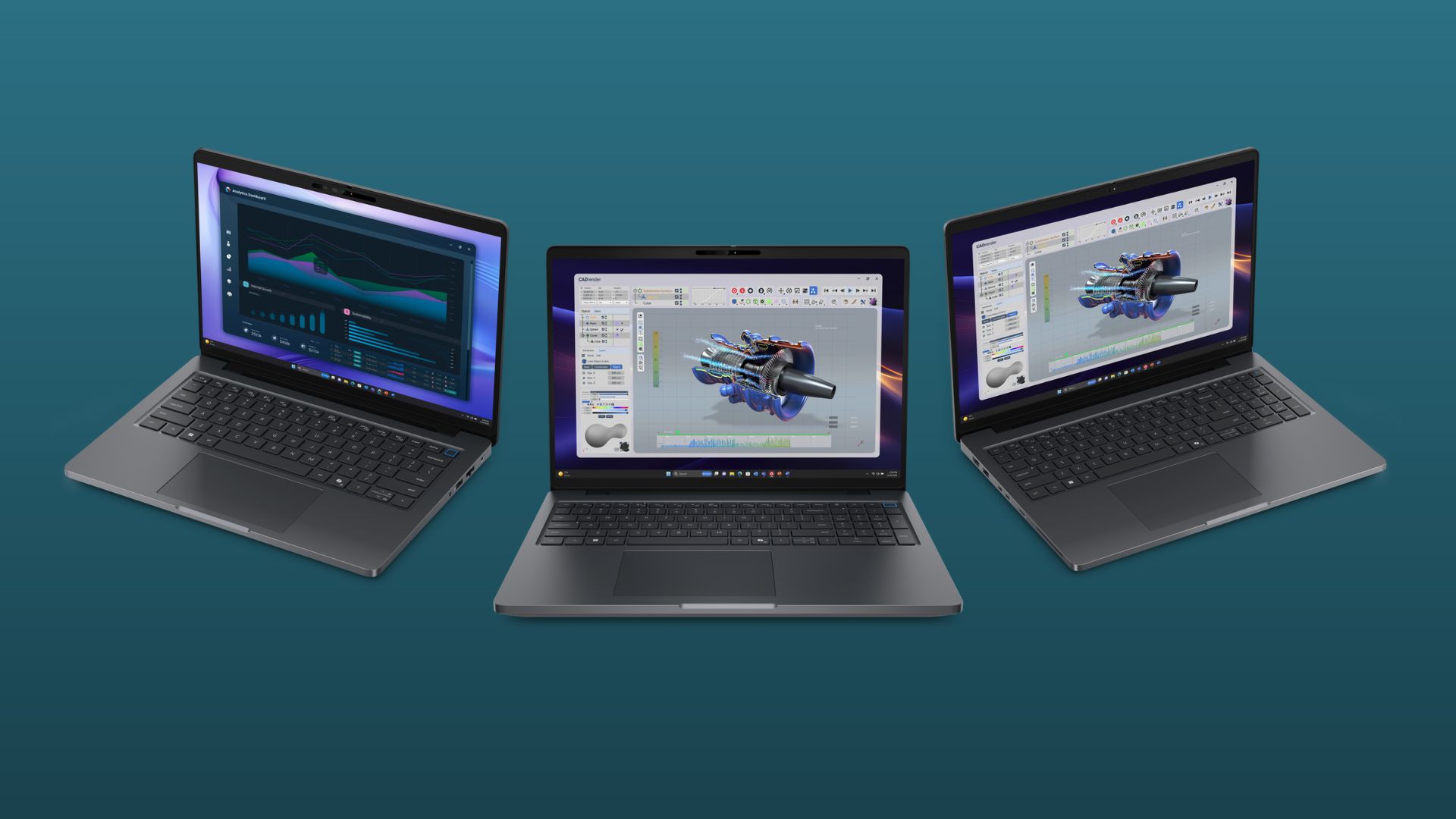
Moreover, that same focus is now extending to laptops. Dell’s updated Pro Precision 5 and 7 Series mobile workstations bring AI-ready performance into more portable designs, powered by the latest Intel and AMD chips with improved NPUs.
These systems are designed for on-device AI tasks, including local inferencing, without needing constant cloud access. Optional RTX PRO GPUs, faster memory, and Gen 5 storage round out the package.
Dell isn’t stopping at traditional workstations, either. It’s also introducing Pro Max systems with NVIDIA’s GB10 and GB300 platforms, which aim to bring data centre-level AI capabilities to a desk setup. The GB300 model, in particular, is built around NVIDIA’s Grace Blackwell architecture and is designed to run large AI models locally, reducing latency and ongoing cloud costs.
Advertisement
All of this ties into what Dell calls its AI Factory with NVIDIA — a broader ecosystem that connects local development to large-scale deployment, whether on-premises or in the cloud. The goal is to let teams move from prototype to production without needing to rebuild workflows.
In practice, this is less about flashy features and more about shifting how AI work gets done. By pushing more compute power into desktops and laptops, Dell is betting that faster iteration, lower costs, and better data control will matter just as much as raw performance.
Of course, you’re supposed to try and have some subtlety in this so the public isn’t fully aware of the con. But the Trump administration doesn’t do subtlety.
Last week Secretary of Defense Pete Hegseth apparently got upset by the fact Trump’s war in Iran isn’t going very well. Poor Donald clearly didn’t understand the evolving nature of modern and inexpensive drone warfare (despite all the brutal evidence in Ukraine), and has gotten the country bogged down in precisely the sort of clusterfuck the fake populist pretended he opposed last election season.
Even our soggy corporate press has occasionally been making this clear to the public, something that upsets Pete Hegseth very much. Hegseth apparently got particularly upset with CNN recently insisting that the Iran War had “intensified.” It made him so upset that he openly pined for the moment when Larry Ellison (and his nepobaby son) control CNN, so they can cheerlead for war:
Advertisement
Hegseth: “Some in the press can’t stop. Allow me to make suggestions. People look at the TV and they see banners, ‘Mideast War Intensifies.’ What should it read instead? How about, ‘Iran increasingly desperate.’ More fake news from CNN. The sooner David Ellison takes over that network, the better”
One of the funniest parts about this is that claims the war had “intensified” was made by his own agency in a press release!
It’s very clear that the U.S. right wing won’t be satisfied until the entirety of U.S. media is owned by a handful of rich right wingers like Larry Ellison and Elon Musk, allowing them to create a North Korea bullhorn of daily, uniform propaganda that does nothing but lavish praise upon them. To build something like that here in the States requires a level of subtlety they’re simply not capable of:
Democrats historically suck on media policy and reform (even the progressive wing of the party is fairly incompetent on the subject), so you can’t expect much help there.
Advertisement
But there are several things working in our favor, including America’s sheer size (it’s very difficult to maintain the kind of control they’re looking for), our diversity, the decentralized nature of the modern internet, and the fact that most of the nepobabies (David Ellison) and brunchlords (Bari Weiss) integral to their plans appear to have absolutely no Earthly idea what they’re actually doing.
For example, all the debt Ellison has adopted from the purchase of CBS and Warner Brothers is going to force them to engage in massive, unprecedented cost cuttings and layoffs, making it hard to maintain informational control and build an effective, ratings-grabbing propaganda operation (even if Bari Weiss knew what she was doing, which she assuredly does not).
And the public still has agency. Larry Ellison can buy TikTok and Elon Musk can buy Twitter, but they can’t control the flow of the public as they flee to other, less white supremacist, right wing friendly alternatives. It’s sheer hubris to think they can maintain information control in a country this massive and diverse, and there will be some useful entertainment value in watching them set money on fire trying.
The Samsung Galaxy Z TriFold is already on its way out. A new report suggests that the company is killing sales for the triple foldable phone just three months after its debut, putting an end to its $2,899 experimental showcase.
But while the Galaxy Z TriFold sales are being halted, it’s apparently not the end of the road for such an ambitious smartphone.
Samsung’s Galaxy Z TriFold in a durability test.JerryRigEverything
What’s left to unfold?
Amid the TriFold’s reported phase-out, fresh rumors hint that Samsung doesn’t plan on abandoning the concept entirely. It would appear that the brand is doubling down with a better successor, which is slimmer and more refined than the original Z TriFold.
Samsung took feedback on the first-generation TriFold, and the thickness seems to be one of its biggest drawbacks. Early tri-folding designs being bulky isn’t a surprise, considering their multi-hinge structure. But Samsung could make the next version even thinner, and refine the overall form factor to make it more practical for everyday use.
John McCann / Digital Trends
Why thickness matters for tri-fold devices
One of the biggest challenges of any foldable phone is its overall width when folded, which is especially true for a triple-folding design. The multiple folding sections can make the device a lot thicker than standard foldables when folded, which can affect everything from portability to in-hand comfort.
In comparison, the notebook-style and clamshell folding flip phones are more mature in their designs. Even the first-gen Galaxy Fold had its fair share of issues, which were ironed out with each passing generation. So Samsung seems to be making a quicker move to improve the TriFold concept before pushing it further.
The chair starts at $8,995, but that doesn’t include the side table or ottoman. Add those and it costs $10,995. The model pictured above uses Alpaca wool fabric and brings the cost up to $14,995. (There are more than 300 fabrics and colors to choose from, and the swiveling table comes in various woodgrains.) The Herman Miller Eames, of which the Diffrient Lounge also takes inspiration, costs roughly $8,500 today, depending on which leather you choose.
“The Eames is obviously an iconic design—it’s timeless, it’s beautiful—but it’s not something you can work comfortably in for a long time,” Silva says.
Levers on the edges of the armrest let you mechanically adjust the recline of the backrest and headrest.
Photograph: Julian Chokkattu
Don’t let the Lounge in the name fool you. Silva assures me that every chair the company designs is built with ergonomic comfort in mind, with the adjustable work surface and headrest allowing for different postures. While traditional lounge chairs focus on style, Silva says the Lounge prioritizes comfort. In my brief time on the chair, it indeed felt enveloping and cushy yet supportive. And the mechanical levers made it easy to shift the chair into a more active sitting position or a more relaxing posture, without disrupting the ergonomics with a laptop on the table.
Advertisement
Diffrient had been tinkering with the idea of a lounge chair that could double as a workstation for a long time, Silva says, and believed that technology allowed people to work in different ways.
“The chair acknowledges the fact that creativity and productivity don’t necessarily happen when you’re tied to your desk,” he says. “They happen in different postures; more relaxed or moving around the office, and this chair supports those transitions.”
King recites a famous quote from Diffrient: “The best chair is a bed.” When you sit upright, your weight compresses your spine, but when you lean back, a large portion of that weight goes into the backrest, so when you’re lying down, there’s significantly less pressure on your spine. “Reclining is really healthy,” King says. “He always thought it would be a good way to work.”
Luxe Seat
How does a chair come to cost $15,000? Silva highlights Humanscale’s long-standing approach to simplicity. After all, it’s a hallmark of the original Freedom chair. While the Diffrient Lounge may not look very complex, that’s by design, cleverly masking the engineered mechanical system with clean lines and curves. There’s even some automation in the headrest. If you’re fully reclined and the headrest is in a forward position to support your head, as you come back up, the headrest will automatically go into a neutral position.
Advertisement
There are two USB-C ports on the chair to power your devices, which means the Diffrient Lounge needs to be connected to an outlet.
















.jpg)









































You must be logged in to post a comment Login