Tech
Onkyo TX-RZ30 9.2-Channel A/V Receiver Review: Sound Matters

Growing up in the 80s, everybody wanted a stereo system. The older guys called it a “HiFi” but we kids just wanted something that could play our records (and eventually tapes and CDs) loud and clear. That system usually included a receiver or integrated amp, a pair of speakers (the bigger, the better) and a turntable.
Over time, listening to music migrated to headphones and earbuds. Those who wanted to listen to music out loud maybe bought wireless speakers and those who were serious about it might have invested in a whole home music system like a Sonos.
TVs got bigger and cheaper while picture quality began to rival – or even exceed – that of local movie theaters. But TV sound really never improved that much. So the soundbar market was born for those who wanted better sound from movies and TV shows. Soundbars can play music too, of course, but mostly they just serve the singular purpose of making terrible-sounding TVs sound less terrible.
Receivers never really went away. They just faded into the background.

Then a global pandemic happened. People stopped going out to dinner or to the movies, to concerts or sporting events. They stopped traveling, too, or at least cut way back. Suddenly people were spending a lot more time at home and found they had a little extra disposable income. Now instead of going out to the movies or concerts, they were watching movies – and concerts – and listening to more music at home. And that’s when many noticed that their little wireless speakers and puny soundbars didn’t actually sound that great.
Since then, receivers have made a comeback. In 2020-2021, many retailers couldn’t keep popular models in stock as demand exceeded supply. Companies who hadn’t released new models in years started doing exactly that. Brands like Denon, Marantz and Sony all began gearing up production and releasing new models. But this surge in popularity didn’t save Onkyo. On May 13, 2022, Onkyo, one of the top Japanese HiFi brands since 1946, declared bankruptcy. It was a sad day for audiophiles and home theater aficionados.
But dry those eyes, dear readers, because Premium Audio Company, a joint venture between VOXX International and Sharp, stepped in to rescue Onkyo, Integra and Pioneer from oblivion and obscurity. Last year, VOXX was itself acquired by Gentex, and, sadly, Pioneer exited the A/V receiver market as a result. However, Onkyo is still going strong with several new models introduced in the past three years. The Onkyo TX-RZ30 is the latest model from this revitalized brand.

What Is It?
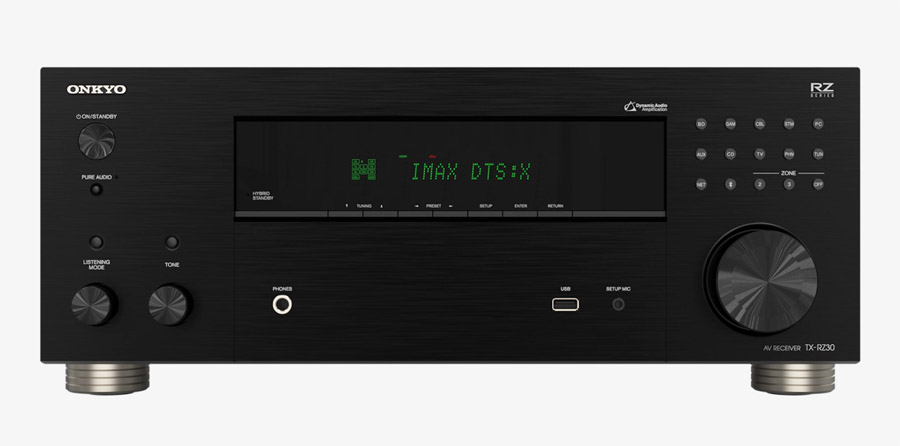
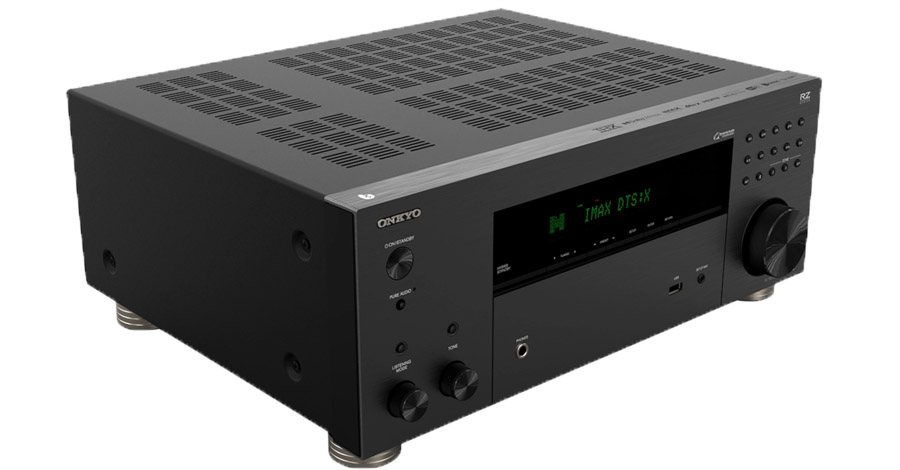
The Onkyo TX-RZ30 is a home theater receiver or audio/video receiver (AVR). As such, it includes a built-in AM/FM tuner, audio and video decoding, processing and switching, and built-in power amplifiers to drive a multi-channel fully immersive surround sound speaker system. The RZ30 specifically can drive up to nine channels (nine speakers) plus two powered subwoofers with a power rating of 100 Watts/Channel. This means it can power a 5.2.4-channel or 7.2.2-channel Dolby Atmos or DTS:X immersive surround system. Of course, you may not need this many speakers in your specific room, but it’s nice to have the option to expand and upgrade over time. If your system needs are smaller, then you can use the built-in amps to power speakers in a second or even third zone or room.
In addition to the essentials like Dolby Atmos, multi-channel PCM and DTS:X decoding, the TX-RZ30 is also IMAX-Enhanced Certified which means it can reproduced the full visual and audio bandwidth of IMAX Enhanced content on Blu-ray Disc, UHD Blu-ray and on streaming services such as Disney+ and Sony Pictures Core. The RZ30 also features full-bandwidth Dirac Live optimization and room correction, built-in at no additional charge. This advanced speaker calibration software adjusts speakers in both the level (magnitude) and time (phase) domains so they’ll provide the optimum performance in your specific room. It used to be that Dirac Live was only available in very high end gear or incurred a separate fee, but we’re starting to see this in more budget-friendly products, including the RZ30.
The RZ30 lacks decoding for Sony 360 Reality Audio, MPEG-H immersive audio and Auro-3D. While none of these codecs are currently that widely used, it’s worth mentioning their lack in case you’re looking for any of these formats in a receiver.
Originally priced at $1,199 (MSRP), but recently lowered to $999, the RZ30 is currently the “entry-level” receiver in Onkyo’s high-end RZ line-up. The “RZ” doesn’t seem to stand for anything official, so I’m going to call it the “Reference Zeries” because it sounds fancy, and maybe slightly French. It joins the RZ70 introduced in 2023 and the RZ50, introduced in 2021. You can find out more about the differences among these models (including a comparison chart) in our earlier news post about the RZ30.
For music, the RZ30 supports high resolution audio playback up to 24-bit/192kHz. Digital audio file format compatibility includes MP3, WMA, WAV, MPEG-4/AAC, FLAC, and ALAC. The RZ30 also includes several streaming music services built-in, including Apple Music, Amazon Music HD, Spotify Connect, Tidal, Deezer, Pandora and Tune-In. Additional third party audio networking integration includes DTS Play-Fi support, “Works with Sonos” certification and “Roon ready” certification. Wireless connectivity for the RZ30 includes Bluetooth (aptX HD), AirPlay 2, Chromecast Built-in, and Wi-Fi networking. An ethernet port is also included for those who prefer a hard-wired network connection.
Weighing in at 11.5 kilograms (about 25.4 pounds), the RZ30 feels substantial, and a peek inside its cover shows some pretty solid components including beefy transformers and thick aluminum heat sinks. The unit features Class A/B amplification which means it runs a bit warmer than Class D amps would, but it never got excessively warm during our testing. We sure to leave it some room to breathe in your A/V cabinet and it should be fine.
The Ins and Outs
The TX-RZ30 includes six HDMI inputs and two HDMI outputs. It supports HDMI ARC (Audio Return Channel) and eARC and provides HDMI 2.1a and HDCP 2.3 compatibility. It can handle gaming and other video source devices at 4K/120Hz or 8K/60Hz with up to 40 Gbps transfer rate, VRR (Variable Refresh Rate), ALLM (Auto Low Latency Mode), QFT (Quick Frame Transport), SBTM (Source-based Tone Mapping) and Dynamic HDR. Pass-through support is provided for virtually all the HDR formats, including Dolby Vision, HDR10+, HDR10 and HLG (Hybrid Log Gamma).
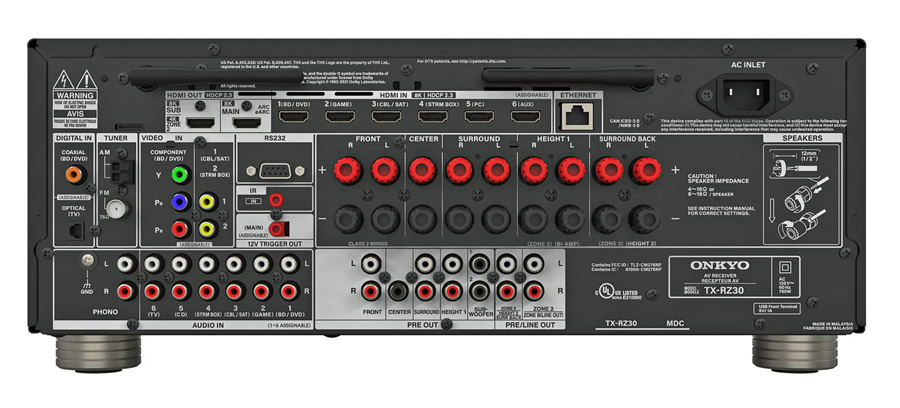

The RZ30 supports legacy gear, too with one component video, two composite video, six analog audio, one coax digital audio, one fiberoptic digital audio and one USB input. Analog video sources are converted to digital for output over the HDMI port. Your old laserdisc player and VHS deck are welcome here. There’s also a phono input for moving magnet cartridges, in case you’re still rocking that vintage (or not so vintage) turntable.
Outputs include the afore-mentioned two HDMI outputs, speaker level outputs for up to nine speakers, two independently adjustable subwoofer outputs, nine channels of preamp out (in case you want to use separate power amps) and a quarter-inch analog headphone output.
To operate the myriad features that the RZ30 has to offer, Onkyo has provided several control options, including a standard remote control, a smartphone app, voice control via Google Assistant and Siri, and third-party CI control via an RS232 connection. Home automation and control standards like Control4, Crestron, Savant, URC, Elan and RTI are all supported.
All things considered, the RZ30 certainly lives up to its “smart receiver” name and provides enough features, inputs, outputs, decoders, processing and third party integration options to satisfy the needs of even the most demanding consumers.
The Set-Up
A receiver does take a bit more effort to install than most soundbars, but the Onkyo set-up wizard does a decent job walking you through it. There are so many speaker configuration options that you will want to pay attention to plug each speaker into the appropriate output. Also, be sure to keep phase (black and red) consistent for all speakers. Every speaker wire comes with a marked side and an unmarked side in the pair. I usually use the marked side for red (+) and the unmarked side for black (-) on both the receiver and speaker ends of each wire.
If you make any mistakes connecting the speakers, you may find out about phase errors or incorrectly attached speakers during the calibration. If you make phase mistakes, you will still get sound from all speakers but it will affect imaging and tonal balance across the system as some speakers will be canceling each other out at some frequencies.

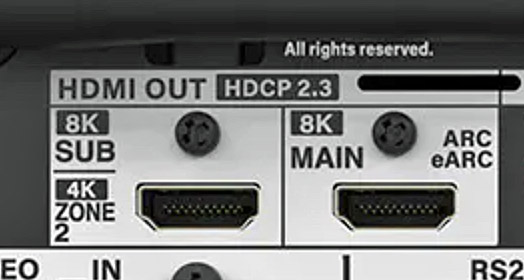
With the speakers and subwoofers connected, it’s time to connect your TV to the receiver using a high speed HDMI cable. Use the HDMI ports labeled “eARC” or “ARC” on both the TV and receiver for this connection, if possible. Also, connect any analog source components like a turntable or cassette deck to the receiver. With HDMI eARC, you can connect any video components to the TV and the TV will pass the audio (even lossless multi-channel PCM, Dolby Atmos or DTS:X audio) to the receiver for processing. An exception would be if you’re using a projector or a TV with the older ARC type of HDMI connection. In this case, it’s probably best to connect all components (digital, analog, video and audio) directly to the receiver and just send the video signal to your TV or projector over the HDMI output.
Corrections Corner
Once all the connections are made, it’s time for some corrections. And no, I’m not talking about factual errors or typos (please!). I mean room correction of course. Most receivers come with some sort of speaker calibration routine (with Audyssey being the most popular in AV Receivers). Onkyo offers its own home-grown calibration software called “AccuEQ Room Calibration.” This can take care of the basics like adjusting EQ, crossover points and distance settings for the speakers. But the RZ30 includes Dirac Live, a much more advanced software package which compensates for anomalies in the room itself which can impact the overall sound.
Dirac Live full bandwidth control handles adjustments to all speakers. If you opt for a second subwoofer for deeper, more extended bass response and better bass uniformity throughout your listening room, then you may want to purchase the optional DIRAC Live Bass Control upgrade, which is an additional $299, directly from DIRAC. The RZ-30 is one of most affordable receivers on the market that can even handle Dirac Bass Control and which includes dual independently adjustable subwoofer outputs.

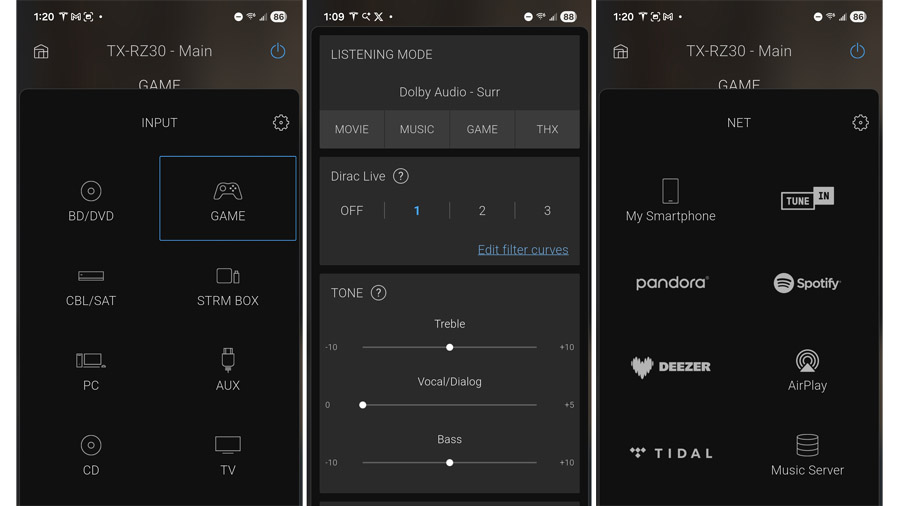
To perform Dirac room correction, you’ll need to install the Onkyo Controller app, available in Apple’s App Store and in the Google Play Store. Plug in the included calibration mic to the receiver’s front panel, then click through the instructions in the app. You can perform a basic correction using three measurement points or a full correction using nine measurement points. I opted for the basic 3-point correction, which took less than 30 minutes to complete. I found that Dirac was a bit more sensitive to ambient noise and subwoofer level settings than its competitor, Audyssey, so we had to restart the calibration a couple of times. But once it successfully completed, the results were obvious: better imaging specificity, clearer, more natural sounding dialog, more natural tonal balance overall and smoother transitions from main speakers to the powered subwoofer.
If you prefer, you can also perform Dirac Live room correction on a laptop by downloading the Dirac software and plugging in a compatible microphone like a miniDSP UMIK-1. Doing DIRAC calibration this way can be more accurate and effective as each miniDSP mic has its own unique measurement signature which you identify to Dirac so it can compensate. After performing the calibration, you can then download these Dirac profiles from your laptop to the RZ30 to apply the profile or profiles to the receiver.
Listening Notes
I evaluated the Onkyo TX-RZ30 with a 5.1.4-channel Klipsch reference speaker system I had previously been using with a Denon AVR-X3800H receiver. I hit the system with dozens of my favorite movie clips as well as several music tracks mixed in Dolby Atmos immersive surround as well as some stereo music tracks. I did some listening pre-calibration, but with the big improvement added with DIRAC Live, I left that applied for the remainder of testing.

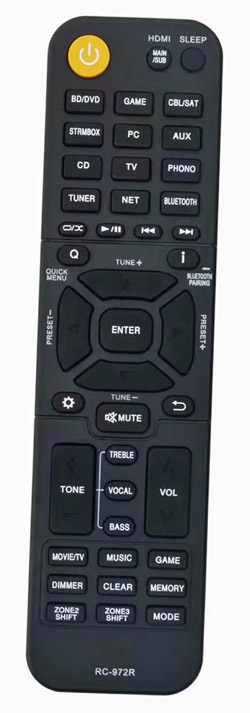
The RZ30 has a wealth of different listening options, accessible by hitting the “Music” and “Movie/TV” buttons on the remote. Want to listen to your music in Dolby Surround in an orchestral concert hall? No problem! For stereo material, you can choose between Dolby Surround or DTS: Virtual:X to expand the soundstage to fill the room, or select “Direct” or “Stereo” modes for a more purist 2-channel approach. There’s also an “All Channel Stereo” mode if you want to fill a room with background music like for a party or gathering. I found Dolby Surround to work pretty well to expand the soundstage on most stereo music.
Dolby Atmos and DTS:X content in particular sounded wonderfully immersive through the RZ30. Sound objects that traveled around in space moved seamlessly from front to back, side to side and top to bottom. The Dolby Atmos mix of KX5/Deadmau5 “Alive” presented a huge soundstage and the rhythmic synth snare drum roll around 4 minutes into the song presented a nicely defined circle as it moved all around the room. And when the chorus of the Dolby Atmos mix of Elton John’s “Rocket Man” came along, the room came alive with instruments and vocals placed in a virtual dome that expanded beyond the borders of the room. This is an extremely effective mix for those who like to be brought inside the music mix and it was very well represented on the RZ30.
Moving onto IMAX content, the RZ30, with its IMAX Enhanced certification, is able to identify IMAX Enhanced DTS:X content from UHD Blu-ray Disc and from streaming services such as Disney+ and Sony Pictures Core, decode the DTS:X soundtrack and apply the IMAX EQ and processing. This gives IMAX movies a more theatrical sound as it uses the far-field IMAX cinematic mix, which results in more impactful bass, extended dynamic range and, in some cases, more pronounced height effects.

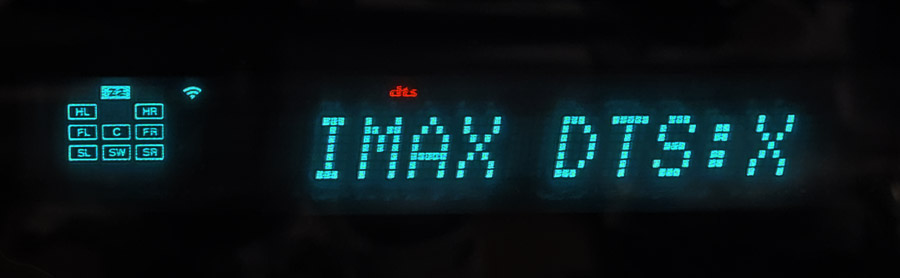
The RZ30 delivers these IMAX Enhanced DTS:X soundtracks as expected showing IMAX DTS:X on the front panel display. And the sound on the few titles I was able to test was quite bombastic with deep rumbling bass and enveloping height effects. “Zombieland: Double Tap” is one of the few UHD Blu-ray Discs with IMAX Enhanced certification and a lossless DTS:X soundtrack. Both the RV zombie attack scene and the final battle scene provided great examples of DTS:X IMAX Enhanced audio with gunshots, shuffling zombie growls and other sonic mayhem exploding into the room. And over on Disney+, the “Queen Rock Montreal” IMAX film had a raw power and immediacy in IMAX Enhanced DTS:X making the viewer feel like he (or she) was there in the audience. Marvel IMAX Enhanced titles like “The Fantastic 4” and “Guardians of the Galaxy Volume 3” also sounded dynamic and engaging with their IMAX/DTS:X soundtracks activated.
Sadly, actually finding this IMAX Enhanced content with a DTS:X soundtrack is tricky. There are only a handful of IMAX Enhanced titles on UHD Blu-ray Disc, and only two streaming services — Disney+ and Sony Picture Core — can deliver the necessary DTS:X soundtracks. And DTS:X support on Disney+ is currently limited to select TVs from Hisense, TCL and Sony. Though we were happy to see that the Disney+ app on the Valerion Max projector’s Google TV OS, also supports DTS:X/IMAX Enhanced audio output. This is the first projector we’ve tested that supports the feature.
Comparisons
The Denon AVR-X3800H ($1,699) offers similar features and functionality to the Onkyo TX-RZ30 ($999). They both include nine channels of amplification, but the Denon can be expanded to 11 channels by connecting an external 2-channel amplifier and using the preamp outputs. The Denon also offers Dirac Room Correction, but at an additional cost (ranging from $259 for the basic limited bandwidth DIRAC Live version to $799 for a full license with Bass Control and ART included). To get the same level of Dirac room correction on the Denon vs. the Onkyo would require spending an additional $349 on the full bandwidth Dirac version on the Denon, bringing its price (with Dirac) up to $2048 (MSRP), roughly twice the price of the Onkyo TX-RZ30. However, the 3800H includes four independently adjustable subwoofer outputs compared to the Onkyo TX-RZ30’s two so it can work better in larger or problematic rooms where more subwoofers are preferred.
Sound quality-wise, the Denon 3800H and Onkyo RZ30 are not far off. Both offer excellent dynamics and cohesiveness of sound. The Denon may have a slight warmth compared to the RZ30’s more neutral sonic signature but both can create an outstanding immersive soundstage, particularly on Dolby Atmos and DTS:X content, particularly after DIRAC calibration and room correction. The Denon receiver does add decoding for Sony 360 Reality Audio, MPEG-H immersive sound and Auro 3D, none of which are particularly popular but which may appeal to those who want universal format support.
Compared to the similarly priced Denon AVR-X2800H ($1,199), the Onkyo TX-RZ30 represents a clear upgrade with more channels, more features, a full set of preamp outputs, dual independent subwoofer outputs and Dirac Live room correction.
Onkyo’s own TX-NR7100 may be a more likely competitor to the TX-RZ30 as it also includes nine channels of amplification and has Dirac Live full bandwidth room correction built-in. However, the 7100 does not offer preamp outputs so you can’t upgrade the on-board amplification. Also, the two subwoofer outputs on the NR7100 are identical and not independently adjustable and the 7100 has no option to add Dirac Bass Control. Still, at a street price now of around $750, the TX-NR7100 offers a very compelling value proposition for a 9.2-channel receiver and offers a fine choice if you’re on a more limited budget.
The Bottom Line
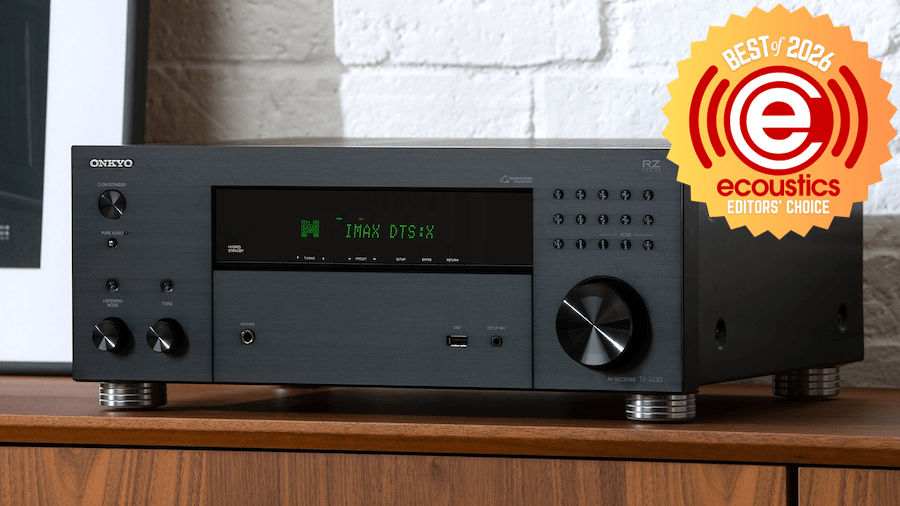
Onkyo’s TX-RZ30 is built to satisfy even the pickiest audiophiles and home theater aficionados with a strong feature set, excellent sonics and best-in-class Dirac Live room correction. It may not offer the upgradability of the Denon AVR-X3800H but it sells for a significantly lower price, particularly when you consider that the Onkyo includes Dirac Live full bandwidth room correction, while that option adds $349 to the cost of the Denon. Its only real competition is from Onkyo itself, in the TX-NR7100, but that unit is less flexible, older and less upgradeable.
If you’re looking for a solid 9-channel A/V receiver with excellent sound quality, best-in-class Dirac Live room correction built-in and a path toward upgrade, the Onkyo TX-RZ30 should definitely be on your short list.
Pros:
- Full bandwidth Dirac Live room correction included, with upgrade to Direct Live Bass Control available
- 9 channels of power with full set of preamp outputs for use with external amps
- Intuitive operation
- Transparent, neutral sound
- Dual independently adjustable subwoofer outputs
- A plethora of analog audio and video inputs including phono input, component and composite video
Cons:
- Cannot be expanded beyond nine channels (maxes out at 5.2.4 or 7.2.2)
- Lacks Sony 360RA, MPEG-H and Auro 3D audio decoding and processing
- No option to upgrade to DIRAC ART
- Basic remote lacks backlighting
Where to Buy
Onkyo TX-RZ30 9-channel AV Receiver with Dirac Live on Amazon.com or Crutchfield.
You must be logged in to post a comment Login