Tech
Open-ear Earbuds Are Booming While Traditional TWS Stalls

The wireless earbud industry spent the better part of a decade convincing consumers that progress meant sealing their ear canals more effectively, adding increasingly aggressive active noise cancellation and pretending the outside world could safely be placed on mute.
Apparently, a growing number of listeners would like to hear the bus coming.
New market data from Omdia, the global technology research firm owned by Informa TechTarget, shows that open wireless stereo (OWS) products are moving in the opposite direction from conventional true wireless earbuds. Global TWS (aka regular wireless earbuds) shipments slipped 0.7% year over year to 82.1 million units in Q2 2026, the category’s first annual decline since Q2 2023. Conventional in-ear and semi-in-ear TWS declined 2%, while open-ear shipments grew 12% to 11.1 million units.
Open-ear products now represent 13.5% of global TWS shipments, up from 12% one year ago. That is still a minority of the market, but it is becoming far too large for major headphone brands to treat as a fitness niche populated exclusively by runners who refuse to stop at intersections.
Related Reading:
Clip-On Earbuds Are Driving the Growth
The most revealing number may be the form factor.
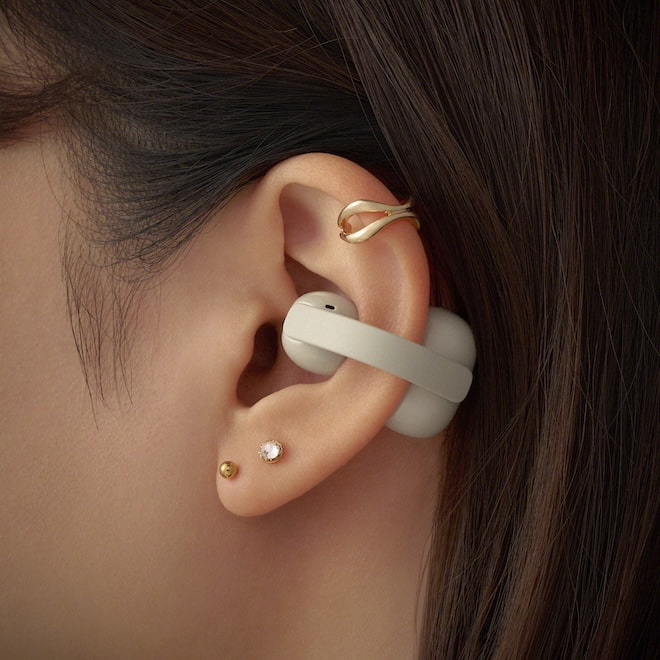
Omdia says clip-on models accounted for 61% of OWS shipments during Q2, compared with 39% for ear-hook designs. Clip-ons increasingly blur the line between wearable technology and fashion accessory, while ear hooks remain particularly attractive for sports and activities where staying attached to the listener is generally considered useful.
Price growth is even more striking. The $100 to $199 segment jumped 253% year over year, driven in part by established brands including Huawei, Shokz and OPPO. Below $50, shipments exploded 323%, demonstrating that open-ear audio is spreading in both directions rather than becoming another premium category with a $299 entrance fee and a velvet rope.
Omdia expects annual OWS shipments to climb from 43.9 million units in 2026 to 90.5 million by 2030, when open-ear models could represent nearly one in five TWS shipments.
That is not a fad. It is an adjacent market becoming a substantial one.
Why Now?
The mistake would be interpreting these numbers as consumers suddenly rejecting conventional earbuds. They are not. Sealed TWS remains vastly larger, and ANC still makes considerably more sense on airplanes, trains and anywhere else where situational awareness mostly means hearing somebody else’s child watch YouTube without headphones.
Open-ear audio solves a different set of problems.
Long-term comfort matters to people who dislike having silicone tips inserted for hours. Runners and cyclists need environmental awareness. Office users may need to hear coworkers while listening to music, and parents generally appreciate being able to detect whatever object has just broken in the next room.
Omdia Research Director Jason Low expects vendors to focus increasingly on fitness, commuting and office productivity, while adding smarter ecosystem and AI features. Sound quality remains the harder engineering problem because an open design cannot exploit the acoustic seal that helps conventional earbuds produce deeper bass and greater isolation.
That explains why the category is suddenly attracting considerably more serious engineering.
The Open-Ear Models Defining the Market

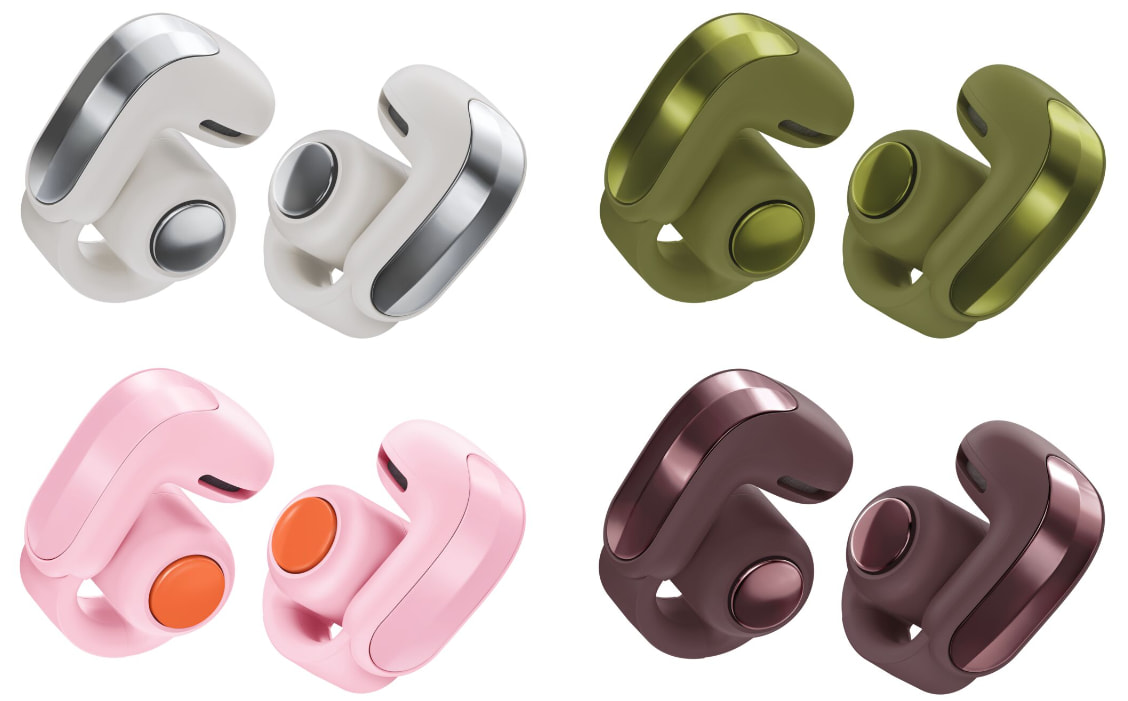
Bose made its intentions very clear this morning with the new $199 Sport Open Earbuds and $299 Ultra Open Earbuds 2nd Gen. The Sport model targets workouts with an IP54 cuff design, while the Ultra adds deeper bass, higher output, improved calling and Cinema Mode. Bose is no longer treating open-ear as one experimental SKU hiding in the catalog.
Shokz OpenDots ONE ($199.95) sit almost directly in the segment where Omdia is seeing explosive growth. Their clip-on design combines 11.8mm drivers, Dolby Audio, IP54 protection and up to 10 hours of playback, with 40 hours available from the wireless charging case. Shokz is particularly noteworthy because Omdia specifically identifies the company among the brands driving growth in the $100 to $199 tier.
Sony has gone more premium with the $229.99 LinkBuds Clip, which we reviewed earlier this year. Their strengths were comfort, situational awareness and useful listening modes rather than outright fidelity; our testing also exposed the fundamental challenge facing every manufacturer in this space — open-ear convenience still comes with compromises in bass extension and resolution.
At the other end, the $99 CMF Clip Pro demonstrates how quickly pricing pressure is arriving. LDAC, multipoint, a 10-hour battery and IP54 protection are now available below $100, which should make companies charging two or three times as much increasingly uncomfortable unless the audible difference justifies it.

The Bottom Line
Open-ear earbuds are not replacing conventional TWS. They do not need to.
The market is splitting according to use case. Sealed earbuds remain the better option when isolation, ANC and maximum bass performance matter. Open-ear designs increasingly make more sense when comfort, awareness and all-day wear take priority.
The important change is that consumers no longer have to accept terrible sound or awkward hardware to make that trade. Bose, Shokz, Sony and a rapidly expanding group of competitors are spending real engineering money trying to close the performance gap, while lower-cost brands are attacking the category from underneath.
Omdia’s numbers suggest consumers have noticed.
After a decade spent perfecting ways to block out the world, the next big wireless-audio growth story may be about letting some of it back in.
You must be logged in to post a comment Login