






Connect with us

Tech

Open Letter To Tech Companies: Protect Your Users From Lawless DHS Subpoenas

Published

on

from the take-a-stand dept

We are calling on technology companies like Meta and Google to stand up for their users by resisting the Department of Homeland Security’s (DHS) lawless administrative subpoenas for user data. 

In the past year, DHS has consistently targeted people engaged in First Amendment activity. Among other things, the agency has issued subpoenas to technology companies to unmask or locate people who have documented ICE’s activities in their community, criticized the government, or attended protests.   

These subpoenas are unlawful, and the government knows it. When a handful of users challenged a few of them in court with the help of ACLU affiliates in Northern California and Pennsylvania, DHS withdrew them rather than waiting for a decision. 

But it is difficult for the average user to fight back on their own. Quashing a subpoena is a fast-moving process that requires lawyers and resources. Not everyone can afford a lawyer on a moment’s notice, and non-profits and pro-bono attorneys have already been stretched to near capacity during the Trump administration.  

Advertisement

 That is why we, joined by the ACLU of Northern California, have asked several large tech platforms to do more to protect their users, including: 

  1.  Insist on court intervention and an order before complying with a DHS subpoena, because the agency has already proved that its legal process is often unlawful and unconstitutional;  
  2. Give users as much notice as possible when they are the target of a subpoena, so the user can seek help. While many companies have already made this promise, there are high-profile examples of it not happening—ultimately stripping users of their day in court;  
  3. Resist gag orders that would prevent companies from notifying their users that they are a target of a subpoena. 

 We sent the letter to Amazon, Apple, Discord, Google, Meta, Microsoft, Reddit, SNAP, TikTok, and X.  

Recipients are not legally compelled to comply with administrative subpoenas absent a court order 

 An administrative subpoena is an investigative tool available to federal agencies like DHS. Many times, these are sent to technology companies to obtain user data. A subpoena cannot be used to obtain the content of communications, but they have been used to try and obtain some basic subscriber information like name, address, IP address, length of service, and session times.  

Unlike a search warrant, an administrative subpoena is not approved by a judge. If a technology company refuses to comply, an agency’s only recourse is to drop it or go to court and try to convince a judge that the request is lawful. That is what we are asking companies to do—simply require court intervention and not obey in advance. 

It is unclear how many administrative subpoenas DHS has issued in the past year. Subpoenas can come from many places—including civil courts, grand juries, criminal trials, and administrative agencies like DHS. Altogether, Google received 28,622 and Meta received 14,520 subpoenas in the first half of 2025, according to their transparency reports. The numbers are not broken out by type.   

Advertisement

DHS is abusing its authority to issue subpoenas 

In the past year, DHS has used these subpoenas to target protected speech. The following are just a few of the known examples. 

On April 1, 2025, DHS sent a subpoena to Google in an attempt to locate a Cornell PhD student in the United States on a student visa. The student was likely targeted because of his brief attendance at a protest the year before. Google complied with the subpoena without giving the student an opportunity to challenge it. While Google promises to give users prior notice, it sometimes breaks that promise to avoid delay. This must stop.   

In September 2025, DHS sent a subpoena and summons to Meta to try to unmask anonymous users behind Instagram accounts that tracked ICE activity in communities in California and Pennsylvania. The users—with the help of the ACLU and its state affiliates— challenged the subpoenas in court, and DHS withdrew the subpoenas before a court could make a ruling. In the Pennsylvania case, DHS tried to use legal authority that its own inspector general had already criticized in a lengthy report.  

In October 2025, DHS sent Google a subpoena demanding information about a retiree who criticized the agency’s policies. The retiree had sent an email asking the agency to use common sense and decency in a high-profile asylum case. In a shocking turn, federal agents later appeared on that person’s doorstep. The ACLU is currently challenging the subpoena.  

Advertisement

Read the full letter here

Originally posted to the EFF’s Deeplinks blog.

Filed Under: 4th amendment, administrative subpoenas, dhs, due process, privacy

Companies: amazon, apple, discord, google, meta, microsoft, reddit, snap, tiktok, x

Advertisement

Source link

Continue Reading
Click to comment

Leave a Reply

Your email address will not be published. Required fields are marked *

Tech

After the 2026 Winter Olympics, Figure Skating Will Never Be the Same

Published

on

These athletes here have reminded a lot of people that Americans are good people. Americans are kind people. And Americans stand up for the little guy and they stand up for their communities and they speak out because those are rights that Americans are given.

You watch the news and see what the current administration is saying and doing and it’s really awful. It’s fucked-up shit. I don’t even think that what these people are saying is political. They’re talking about things that are happening in their own communities.

And some of them have faced backlash for speaking out. Amber Glenn said she got “a scary amount of hate/threats.” Vice President JD Vance and President Trump have responded to some of the athletes who’ve made comments. They seem to be putting themselves out there, and the echo chamber seems even louder than it was a few years ago.

One hundred percent. This is 100 times louder than it was during the first Trump administration. It sometimes feels scary to say something, because it feels like there might be repercussions. They’re targeting people, and they’re sending people away without due process. So it’s even more important to speak out now. It’s also scarier.

Advertisement

I don’t want to take too much of your time, but I do want to end on perhaps a lighter note. Have you been watching Heated Rivalry?

I have all the time in the world to talk about Heated Rivalry.

Then by all means, go ahead.

I wasn’t watching it when everybody was really into it at first. Finally, it was like maybe the second or third week it was out and I was like, “OK, now I have to watch it.” People really built up how smutty it was. I was like, “I’ve definitely seen this on a different Netflix show before.”

Advertisement

Right?

There was a lot of sex in the first few episodes. By the time we got to maybe the fourth or fifth episode, I understood why there was so much sex, because like you had to just know all the heat-of-the-moment stuff. Because that fifth episode was one of the best episodes of TV I’ve ever seen.

Yeah, it was really good.

With the kiss on the ice, and then as soon as I thought the episode was amazing, Ilya calls Shane and says, “I’m going to …”

Advertisement

“I’m coming to the cottage”!

That was when I was like, “Oh my God.” It’s just amazing. The performances were great. I think that’s why it transcended. I loved it.

And now we have a new group of fans getting into hockey.

Stuff like that is amazing for sports as long as the sport embraces those kinds of shows, and it feels like they really want to. Sports really should be for everybody.

Advertisement

Source link

Continue Reading

Tech

Apple's latest Ferret AI model is a step towards Siri seeing and controlling iPhone apps

Published

on

Apple is still working on ways to help Siri see apps on a display, as a new paper explains how it is working on a version of Ferret that will work locally on an iPhone.

Curious dark brown ferret with a white snout and ears peeks up from dense green grass and leaves, framed closely by foliage outdoors
A ferret in the wild – Image Credit: Pixabay/Michael Sehlmeyer

The work by Apple to bring Siri up to speed with other AI systems usable on a smartphone is gradually accelerating. While immediate attempts to bring a new more contextual Siri to fruition isn’t quite ready for primetime, Apple is still looking to the future for other updates it can do to its assistant and Apple Intelligence.
It seems that the path ahead is to focus on its strength: local processing of queries.
Continue Reading on AppleInsider | Discuss on our Forums

Source link

Continue Reading

Tech

T2 Linux Restores XAA In Xorg, Making 2D Graphics Fast Again

Published

on

Berlin-based T2 Linux developer René Rebe (long-time Slashdot reader ReneR) is announcing that their Xorg display server has now restored its XAA acceleration architecture, “bringing fixed-function hardware 2D acceleration back to many older graphics cards that upstream left in software-rendered mode.”


Older fixed-function GPUs now regain smooth window movement, low CPU usage, and proper 24-bit bpp framebuffer support (also restored in T2). Tested hardware includes ATi Mach-64 and Rage-128, SiS, Trident, Cirrus, Matrox (Millennium/G450), Permedia2, Tseng ET6000 and even the Sun Creator/Elite 3D.

The result: vintage and retro systems and classic high-end Unix workstations that are fast and responsive again.

Source link

Advertisement
Continue Reading

Tech

The Salvation Army Opens a Digital Thrift Store On Roblox

Published

on

Slashdot reader BrianFagioli writes: The Salvation Army has launched what it calls the world’s first digital thrift store inside Roblox, an experience named Thrift Score that lets players browse virtual racks and buy digital fashion for their avatars.

While I understand the strategy of meeting Gen Z and Gen Alpha where they already spend time and money, I feel uneasy about turning something that, in the real world, often serves low income families in genuine need into a gamified aesthetic inside a video game, even if proceeds support rehabilitation and community programs, because a thrift store is not just a quirky brand concept but a lifeline for many people, and packaging that reality as entertainment creates a strange disconnect that is hard to ignore.
“To be clear, proceeds from Thrift Score are intended to support The Salvation Armyâ(TM)s programs nationwide…” this article points out. “If it drives awareness and funds programs that help people in need, that is a win. But if it turns thrifting into just another cosmetic skin in a digital marketplace, then we should at least be willing to say that it feels off.”

Source link

Continue Reading

Tech

This Blink Outdoor 4 XR 4-camera kit is 45% off, and it’s a smart way to cover more of your property for less

Published

on

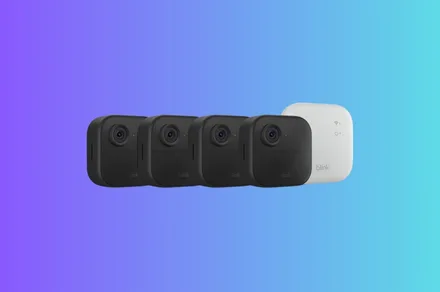
Home security deals can get expensive fast once you start adding multiple cameras, which is why this one stands out. The Blink Outdoor 4 XR 4-camera system is down to $164.99 for a limited time, which is a big drop from $299.99. That’s 45% off, and more importantly, it gets you a full multi-camera setup at a price that feels realistic for most households.

The angle here is coverage. A lot of people start with one camera and then realize they need another for the driveway, one for the backyard, and one near a side entrance. This bundle skips that slow, piecemeal process and gives you a more complete setup from day one.

What you’re getting

This is a 4-camera wireless security system built around convenience and range. The standout features are the two-year battery life claim and the extended wireless range, with up to 1000 feet open-air range (or around 400 feet with typical use).

That matters because placement is usually where camera systems get annoying. If you’ve got a detached garage, a longer driveway, or a larger yard, range can be the difference between “works great” and “constant headaches.”

Advertisement

A four-camera kit also gives you flexibility right away. You can cover the obvious spots first, then move things around as you learn where your blind spots are.

Why it’s worth it

This deal works because it solves a practical problem without overcomplicating it. You’re getting a recognizable, battery-powered outdoor camera setup at a price that’s well below what many four-camera packages cost. The long battery life is also a big part of the appeal, because fewer battery swaps mean you’re more likely to keep the system running consistently.

The other reason this is worth a look is the timing. Security camera deals this deep don’t always show up on full bundles, and when they do, the best value is usually in the multi-pack rather than buying individual units later.

The bottom line

At $164.99, this Blink Outdoor 4 XR 4-camera system is a genuinely good deal if you want broad home coverage without spending a ton upfront. The long battery life and strong range make it especially appealing for larger properties or tricky camera placements. If you’ve been putting off a home security setup because the cost adds up too quickly, this limited-time price makes the decision a lot easier.

Advertisement

Source link

Continue Reading

Tech

We tested Amazon’s speedy delivery live on the podcast: Here’s what it says about the future of retail

Published

on

GeekWire’s Todd Bishop unpacks an Amazon Now delivery that was ordered when the show began, and arrived well before it ended.

Amazon promises 30-minute delivery with its new Amazon Now service. We put it to the test — live on the GeekWire Podcast — with help from Michael Levin and Josh Lowitz, co-founders of Consumer Intelligence Research Partners and two of the sharpest Amazon watchers we know.

While we wait for our order of yogurt, blueberries, and flossers (long story), Levin and Lowitz explain why Amazon closed its grocery stores, what its massive future 225,000-square-foot superstore in suburban Chicago could mean, and why Amazon’s real play is becoming the ultimate convenience store.

“They’ve totally rewritten so much of retail, and I don’t think they’re done,” Levin said. Amazon has essentially substituted its logistics operation for its physical retail presence, with well over half of orders now arriving same day or next day, up from a small fraction five years ago.

In other words, don’t take the store closures as capitulation.

“Their investments in logistics are working, and I wouldn’t expect them to take their foot off the gas at all,” Lowitz said. “They’re not scared of making mistakes.”
Plus: Test your Amazon knowledge in our trivia segment. Will Josh and Mike get it right?

Advertisement

Related stories and links: 

Audio editing and production by Curt Milton.

Source link

Continue Reading

Tech

How Mike Markkula transformed Apple from garage experiment into the business that reshaped personal computing

Published

on


Long before Apple became synonymous with Steve Jobs’ product launches and minimalist design philosophy, the company’s survival depended on a quieter figure operating behind the scenes.

An InfoWorld article published on July 18 1983 described Mike Markkula as the person who turned Apple from a clever engineering experiment into a real business — the man who wrote its first proper business plan, secured crucial funding, and helped build the company that would later dominate consumer technology.

Source link

Continue Reading

Tech

A sub-$100 Sony ANC headphone deal is hard to ignore

Published

on

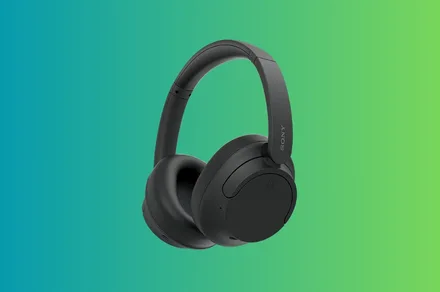
This is the kind of deal that doesn’t need much overthinking. If you’ve been wanting a pair of wireless noise-canceling headphones from a brand you already trust, $99.99 is a very comfortable price to jump in. That’s $78.01 off the $178 comp value, and it puts Sony’s WH-CH720N in a range where they make a lot more sense for everyday buyers.

What I like about this deal is that it hits the practical middle ground. You’re not paying premium flagship prices, but you’re also not gambling on a random off-brand pair that looks good on paper and disappoints a week later. For commuting, working from home, travel, or just getting some quiet time, this is the kind of upgrade you’ll actually use every day.

What you’re getting

The Sony WH-CH720N is a wireless over-ear headphone with active noise canceling, which is exactly what most people want in this category. You get the comfort of full-size headphones, Bluetooth convenience, and noise reduction that helps take the edge off background sound when you’re on a flight, in a coffee shop, or trying to focus in a noisy house.

This is also the kind of headphone that works well as an “all-arounder.” It’s not trying to be a niche audiophile product or a flashy fashion piece. It’s built to be easy to live with. That matters more than people admit. If a pair is comfortable, reliable, and simple to use, it tends to become your default pair fast.

Advertisement

Sony also has a long track record with headphones, and that shows up in the little things. The controls are usually straightforward, the wireless connection is stable, and the overall experience tends to feel polished instead of frustrating.

Why it’s worth it

At $99.99, this deal stands out because it brings real ANC headphones into impulse-buy territory without feeling cheap. That’s a big difference. A lot of under-$100 headphones look tempting, but many of them cut too many corners. This one feels more like a “buy once and use it for a while” purchase.

It’s a particularly good fit for students, office workers, frequent travelers, and anyone who just wants less noise in their day. It also makes a lot of sense as a backup pair for work or travel if you already own something nicer and don’t want to risk losing your expensive set.

The bottom line

The Sony WH-CH720N at $99.99 is a smart, easy recommendation for anyone who wants wireless noise-canceling headphones without spending a ton. It’s a practical deal on a product category people use constantly, and that usually ends up being money well spent.

Advertisement

Source link

Continue Reading

Tech

Predator spyware hooks iOS SpringBoard to hide mic, camera activity

Published

on

Predator spyware hooks iOS SpringBoard to hide mic, camera activity

Intellexa’s Predator spyware can hide iOS recording indicators while secretly streaming camera and microphone feeds to its operators.

The malware does not exploit any iOS vulnerability but leverages previously obtained kernel-level access to hijack system indicators that would otherwise expose its surveillance operation.

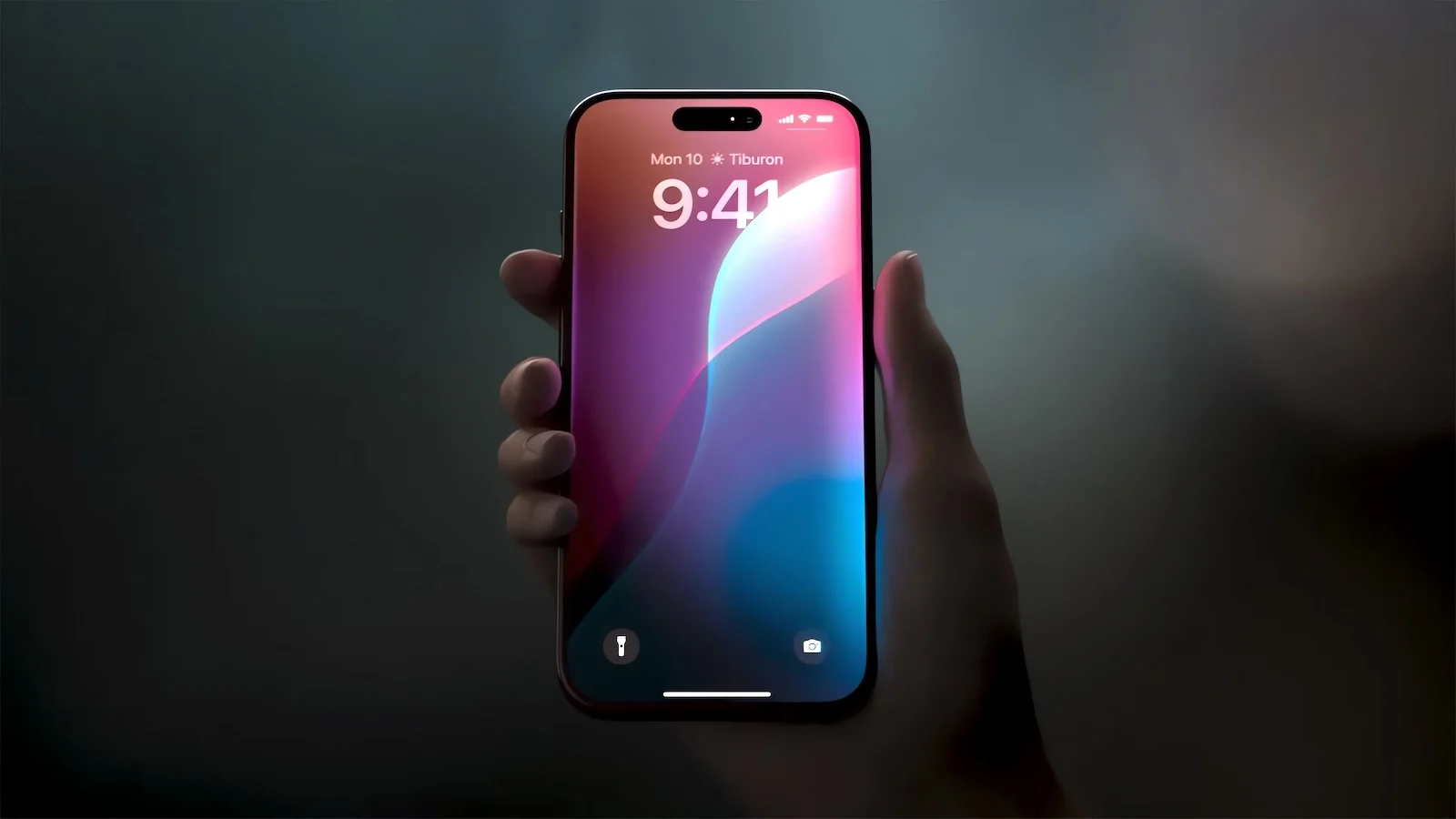
Apple introduced recording indicators on the status bar in iOS 14 to alert users when the camera or microphone is in use, displaying a green or an orange dot, respectively.

Wiz

US-sanctioned surveillance firm Intellexa developed the Predator commercial spyware and delivered it in attacks that exploited Apple and Chrome zero-day flaws and through 0-click infection mechanisms.

While its ability to suppress camera and microphone activity indicators is well known, it was unclear how the mechanism worked.

Advertisement
iPhone cam/mic activation indicators
Source: Jamf

How Predator hides recording

Researchers at mobile device management company Jamf analyzed Predator samples and documented the process of hiding the privacy-related indicators.

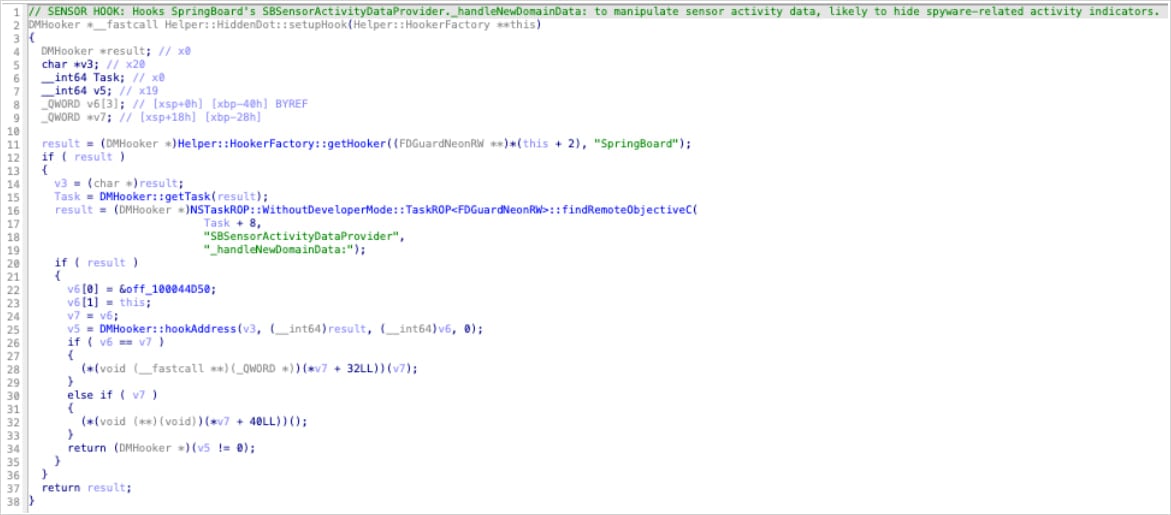
According to Jamf, Predator hides all recording indicators on iOS 14 by using a single hook function (‘HiddenDot::setupHook()’) inside SpringBoard, invoking the method whenever sensor activity changes (upon camera or microphone activation).

By intercepting it, Predator prevents sensor activity updates from ever reaching the UI layer, so the green or red dot never lights up.

“The target method _handleNewDomainData: is called by iOS whenever sensor activity changes – camera turns on, microphone activates, etc.,” Jamf researchers explain.

“By hooking this single method, Predator intercepts ALL sensor status updates before they reach the indicator display system.”

Advertisement
Function targeting the SBSensorActivityDataProvider
Source: Jamf

The hook works by nullifying the object responsible for sensor updates (SBSensorActivityDataProvider in SpringBoard). In Objective-C, calls to a null object are silently ignored, so SpringBoard never processes the camera or microphone activation, and no indicator appears.

Because SBSensorActivityDataProvider aggregates all sensor activity, this single hook disables both the camera and the microphone indicators.

The researchers also found “dead code” that attempted to hook ‘SBRecordingIndicatorManager’ directly. However, it doesn’t execute, and is likely an earlier development path that was abandoned in favor of the better approach that intercepts sensor data upstream.

In the case of VoIP recordings, which Predator also supports, the module responsible lacks an indicator-suppression mechanism, so it relies on the HiddenDot function for stealth.

Jamf further explains that camera access is enabled through a separate module that locates internal camera functions using ARM64 instruction pattern matching and Pointer Authentication Code (PAC) redirection to bypass camera permission checks.

Advertisement

Without indicators lighting up on the status bar, the spyware activity remains completely hidden to the regular user.

Jamf notes that technical analysis reveals the signs of the malicious processes, such as unexpected memory mappings or exception ports in SpringBoard and mediaserverd, breakpoint-based hooks, and audio files written by mediaserverd to unusual paths.

BleepingComputer has contacted Apple with a request for a comment on Jamf’s findings, but the company never responded.

Modern IT infrastructure moves faster than manual workflows can handle.

In this new Tines guide, learn how your team can reduce hidden manual delays, improve reliability through automated response, and build and scale intelligent workflows on top of tools you already use.

Advertisement

Source link

Continue Reading

Tech

Ultra Rare 1996 Nissan NISMO 400R Could Be Yours for the Right Price

Published

on

1996 Nissan NISMO 400R
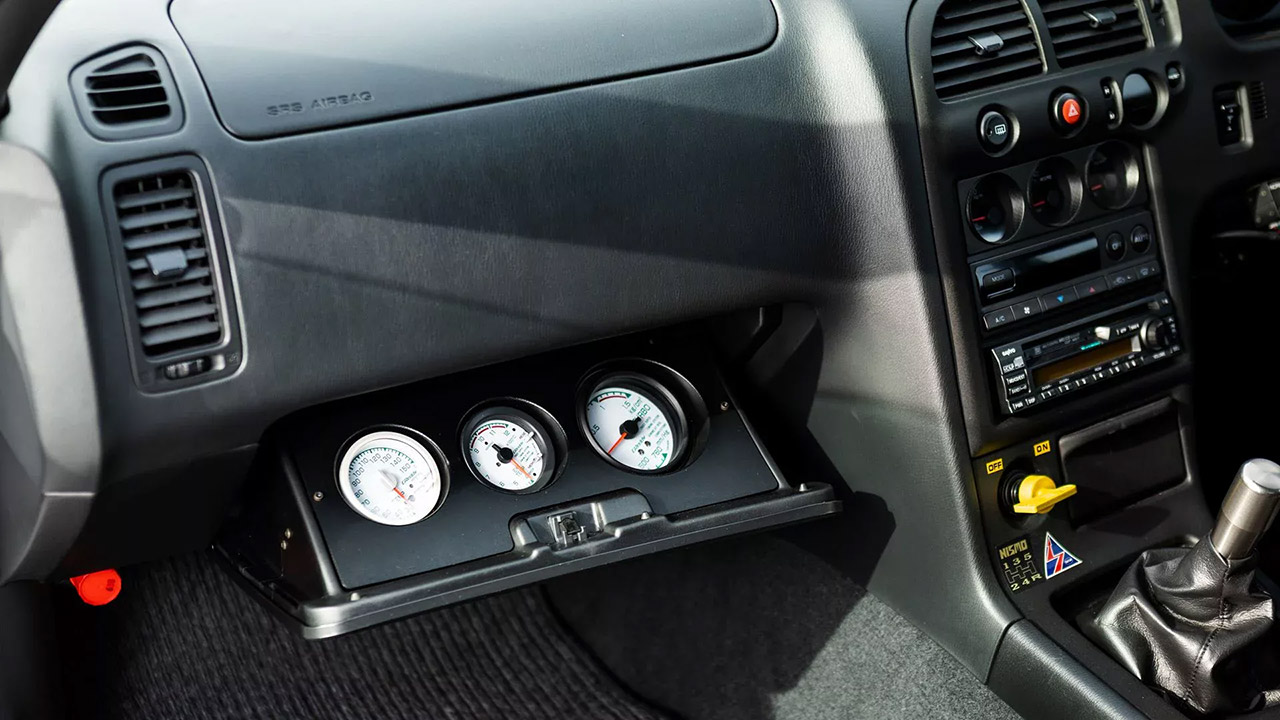
The 1996 Nissan NISMO 400R is one of those rare, ultra exclusive performance cars that came out of Japan in the 1990s and currently up for auction. To be honest, NISMO built this model mostly as a tribute to their work on the Le Mans GT-R LM. Engineers took the R33 Skyline GT-R V-Spec base and made it into something far more capable than a production car.


The engine, a twin-turbo inline-six, was bored from 2.6 to 2.8 liters, resulting in the RBX-GT2 engine built by REINIK. This resulted in it generating an impressive 400 horsepower and 346 pound-feet of torque, well above the unofficial Japanese limit of 276 horsepower. The acceleration from zero to 60 mph takes around four seconds, and the top speed is 186 mph.


LEGO Technic 2 Fast 2 Furious Nissan Skyline GT-R (R34) Car – DIY Kit and Building Set for Adults…
  • BUILD AN ICONIC CAR – Adults can relive their favorite movie moments with the LEGO Technic 2 Fast 2 Furious Nissan Skyline GT-R (R34), a detailed…
  • CAR MODEL KIT FOR ADULTS – Fans of model car kits and building blocks will enjoy discovering details as they build, like functioning steering, a…
  • GROUNDBREAKING DRIFT FUNCTION – The first-ever LEGO Technic drift mechanism raises the car so builders can recreate the movie’s most impressive…

1996 Nissan NISMO 400R
They tackled the challenge with a twin-plate clutch and a six-speed manual transmission to handle the power coming from that behemoth. The suspension was also updated with NISMO springs and Bilstein dampers, which reduced the ride height by nearly two inches in order to make the car drive more sharply. The brakes on the V-Spec base were fine, but NISMO chose to enhance them with their own pads. The styling has also been updated, with bigger fenders, new bumpers to increase airflow, side skirts, a carbon fiber hood, and a large rear spoiler. Then they slapped on some three-piece Rays LM-GT1 wheels.

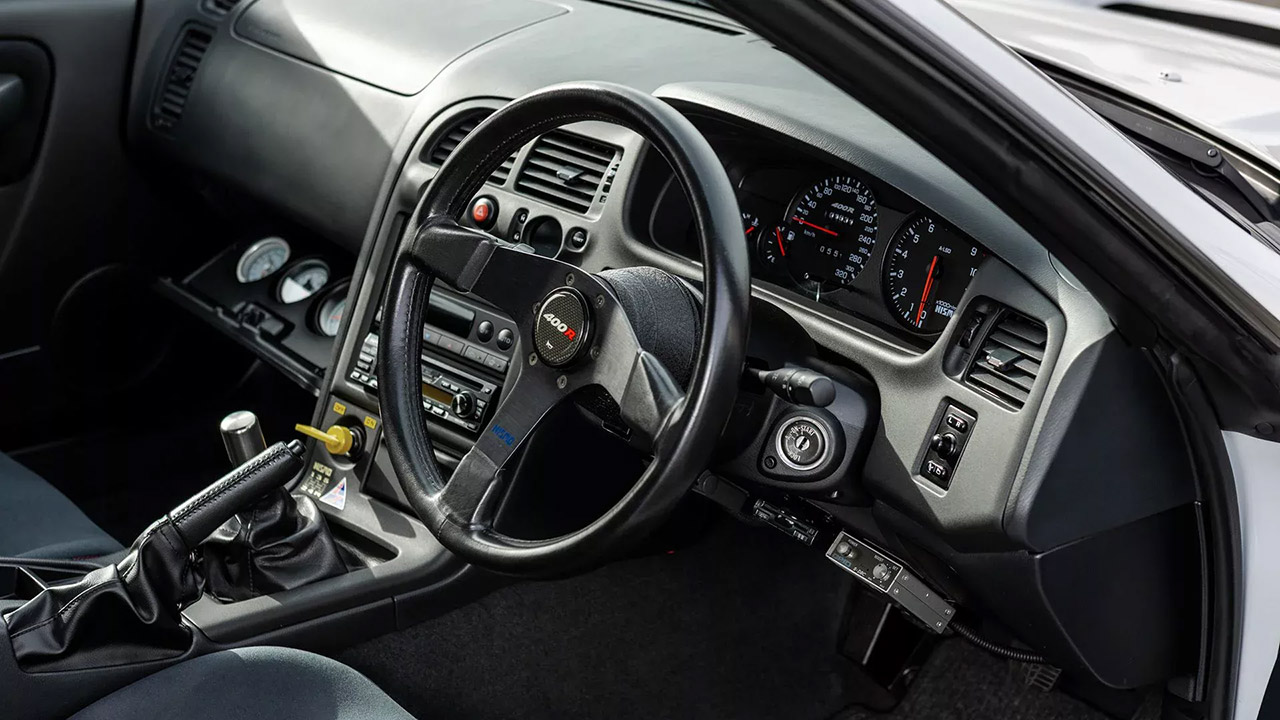
1996 Nissan NISMO 400R Interior
Prior to the R33 shutdown, just 44 units were built, compared to the original plan of 100 units. Because of its rarity, the 400R has become the ultimate collector’s item. The majority of them were held in Japan for many years.

1996 Nissan NISMO 400R
This specific car carries the chassis number 008, indicating that it is the eighth car ever manufactured. It’s a true show stopper, with QM1 White exterior and a black interior with plenty of red stitching. There are just 16,313 kilometers (10,136 miles) on the odometer and was initially registered in July 1996. It remained in Japan for more than 30 years until being shipped to Canada in 2023 and, finally, to the United States in 2024. Last year, this car won the Hagerty Car Culture Award at the Amelia Concours.

1996 Nissan NISMO 400R
Broad Arrow Auctions will offer this 400R at The Amelia Auction on March 7, 2026, in conjunction with the Amelia Concours. They estimate the price between $900,000 and $1,100,000, demonstrating the increasing value of low-mileage and documented cases. A similar vehicle sold for $995,000 at the RM Sotheby’s Monterey auction in 2025.
[Source]

Source link

Advertisement
Continue Reading

Trending

Copyright © 2025