

Connect with us
DAPA Banner
DAPA Coin
DAPA
COIN PAYMENT ASSET
PRIVACY · BLOCKDAG · HOMOMORPHIC ENCRYPTION · RUST
ElGamal Encrypted MINE DAPA
🚫 GENESIS SOLD OUT
DAPAPAY COMING

Tech

OpenAI Rolls Out A Lockdown Mode For Extra Protection Against Prompt Injection Attacks

Published

on

The company says most users don’t need to use the feature.

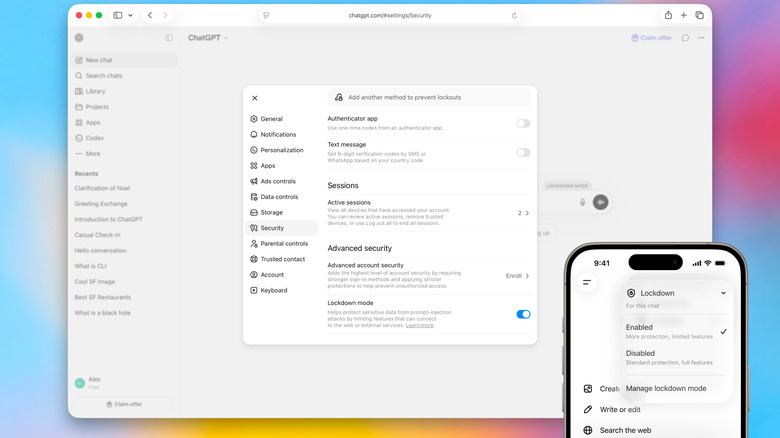
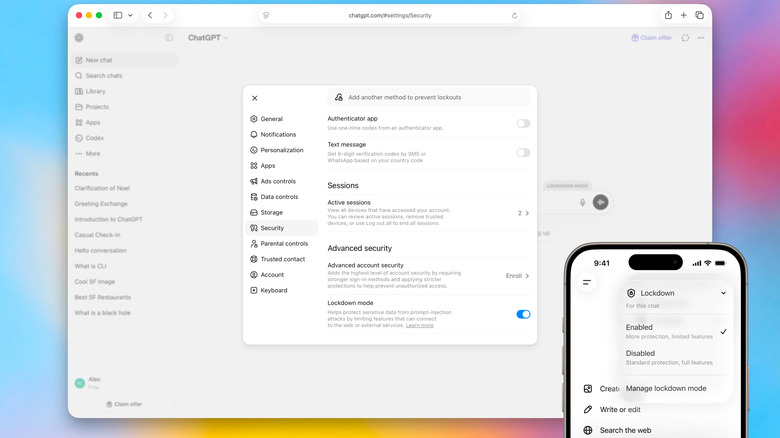
OpenAI has begun rolling out Lockdown Mode, an optional security setting designed to offer users advanced protection from prompt injection attacks. For the unfamiliar, prompt injection is a form of social engineering that is specific to conversational chatbots. As AI systems have become better at pulling information from the internet, people have begun hiding malicious instructions on webpages and other places to try and trick those systems.

OpenAI is billing Lockdown Mode as a sort of last line of defense against prompt injections, building on the robust protections that it says it already offers through ChatGPT, its models and backend systems. “Lockdown Mode is not intended for everyone,” OpenAI explains. “It is designed for people and organizations that handle sensitive data and want stricter protection from data exfiltration risks related to prompt injection.”

To that end, enabling Lockdown Mode limits some of the features OpenAI offers through ChatGPT and its other products. For instance, you can still use image generation and upload photos to ChatGPT, but it may not pull images from the internet or display any images inside of a response. The chatbot also cannot download files to analyze, though you can still manually upload documents if you want its insight. Other features, such as Deep Research and Agent Mode are disabled completely. “Lockdown Mode does not change memory, file uploads, the ability to share a conversation, or whether your conversations may be used to improve models,” OpenAI adds. “Many of these settings are separately configurable by workspace admins.”

Advertisement

The company also notes Lockdown Mode won’t stop prompt injections from appearing in content ChatGPT processes. Instead, it’s designed to prevent an attacker from extracting sensitive data from your account by limiting network requests that someone could exploit. Lockdown Mode is available to all personal accounts, including those using ChatGPT through OpenAI’s free tier. To activate it, open ChatGPT’s settings menu and select Safety and security. Under Advanced security, tap Lockdown mode and flip on the toggle. You can temporarily disable the additional protection by selecting Manage from the status message that appears above the chat window and selecting Turn off for this chat

Separately, OpenAI is rolling out an active session manager that allows users to see any devices or browsers that have been used to access their account. From there, the company offers the option to log out of individual or all sessions at once. Just note the latter can take up to 30 minutes to complete. “If you suspect unauthorized account activity, change your password if you use one, review your sign-in methods, and contact OpenAI Support,” the company adds.

Advertisement

Source link

Continue Reading
Click to comment

You must be logged in to post a comment Login

Leave a Reply

Tech

Chesky plans AI lab, entering competition with Altman’s OpenAI

Published

on

TL;DR

Airbnb CEO Brian Chesky plans to back a new AI lab focused on user interaction and design, while remaining at Airbnb. The move puts him in competition with Sam Altman, whom he helped reinstate at OpenAI in 2023.

Brian Chesky has spent years as an AI kingmaker. He met Sam Altman through Y Combinator in 2006, advised him on managing OpenAI’s hypergrowth, and helped broker Altman’s return to power after the board fired him in November 2023. He was reportedly considered for a seat on OpenAI’s board.

Advertisement

Now he is entering competition with his protégé’s company. Chesky plans to back a new AI lab of his own, Bloomberg first reported on Wednesday, with a focus on user interaction and design. He will remain as Airbnb’s CEO and will not lead the lab himself. The details are early-stage and could change.

Why Chesky is unsatisfied

The move reflects a frustration Chesky has voiced publicly for more than a year. He said last year that Airbnb had not struck an LLM partnership because existing products were not quite ready for what he wanted to build. His argument is that travel and commerce require a rich visual interface, not the text-based chatbots that OpenAI and Anthropic have popularised.

Airbnb has not been idle on AI. The company hired Ahmad Al-Dahle, who led generative AI work at Meta including the Llama model family, as chief technology officer in January 2026. It has rebuilt its app around a large language model for conversational search, automated 40% of customer support queries with an AI bot, and rolled out AI-generated listing details and review summaries. A voice-based assistant is planned for later this year.

But Chesky appears to have concluded that buying AI from frontier labs is not enough. He wants to build at the model layer, not just the application layer.

A growing pattern

Chesky is not alone. Brett Adcock launched Hark late last year with $100 million of his own money to build a universal AI interface, then raised a $700 million Series A at a $6 billion valuation. Hark is also emphasising user interaction and hardware, with the lead iPhone designer from Apple now heading its design effort.

Advertisement

Mira Murati’s Thinking Machines Lab is pursuing “interaction models” that process continuous streams of audio, text, and video in real time. The common thread is a belief that the frontier labs have focused on intelligence at the expense of interface, and that the next defensible layer sits between the model and the user.

The trend carries a broader implication. When founders of Chesky’s stature stop waiting for OpenAI, Anthropic, or Google to deliver what they need and start building their own research capacity, it signals that the application layer has run into the limits of what commodity models can provide.

The Altman dynamic

The personal dimension is hard to ignore. Chesky and Altman’s relationship spans nearly two decades. Chesky met Altman through Y Combinator, which incubated Airbnb. When OpenAI took off, Chesky began meeting regularly with Altman to advise on scaling a technology company. During the November 2023 board crisis, Chesky advised Altman on public relations and rallied support among Silicon Valley executives.

Now Chesky is building an operation that will compete, at least in part, with OpenAI’s own ambitions in user-facing AI. It is unclear whether the new lab will train its own models or build specialised systems on top of existing ones. But the direction is clear: Chesky wants proprietary AI research, not an API subscription.

Advertisement

What we do not know

Nearly everything about the lab remains unspecified. There is no name, no announced team, no disclosed funding amount, and no timeline. Chesky’s commitment to remaining at Airbnb raises questions about how much of his attention the new venture will receive, and whoever leads it will inherit a founding chair whom TechCrunch described as “known as a micromanager.

What is clear is the thesis. Chesky has watched the AI lab landscape from closer than almost anyone outside it, and he has decided that the interface problem, making AI useful in rich, visual, consumer-facing contexts, is important enough to warrant its own research operation. Whether a part-time founder can build one that matters is the open question.

Source link

Advertisement
Continue Reading

Tech

These 3 young hawkers put cheese in a curry puff & made S$500K in a yr

Published

on

What The Puff produces up to 1,500 puffs a day

Singapore’s hawker scene is not short of curry puff stalls. But when Lim Yuan Ming, 24, and his older brother Brandon, 29, decided to start one, they weren’t trying to out-tradition the traditionalists—they wanted to give the curry puff a modern twist.

Growing up around their parents’ Teochew porridge stall in Bedok, the brothers had a front-row seat to the realities of the hawker grind. That experience shaped their decision to build something simpler, more scalable.

With their friend Oh Chin Jie, 31—a trained cook—they pooled S$10,000 and launched What The Puff at Changi Village Hawker Centre in Dec 2024.

One and a half years later, they have three outlets, a central kitchen producing 1,500 puffs a day, and have made S$500,000 in revenue for 2025, all while Yuan Ming is still finishing his finance degree at SUSS.

Advertisement

We spoke with Yuan Ming to find out how they got here.


Hawker blood runs in the family

Paoh T via Google Reviews

The Lim brothers are no strangers to the hawker trade. Their parents have been running Lao Er, a Teochew porridge stall at Block 216 Bedok Food Centre, for over a decade. Yuan Ming grew up helping out—cashiering on weekends, loading toppings on porridge, and absorbing the rhythms of the trade without realising it.

But Teochew porridge, with its 20-dish daily spread prepared from the early hours, wasn’t the model they wanted to follow.

It was their father who pointed them toward curry puffs, even suggesting they experiment with adding cheese to the curry filling—a slightly unusual combination, partly inspired by the cheese-topped curry ramen trend.

When we tasted it, we thought, oh my god, it actually works. Then we just went for it.

Lim Yuan Ming

Advertisement

Once they had the idea settled, they brought in Chin Jie, Brandon’s friend from National Service, who had gained culinary experience at salad bar chain The Daily Cut.

Chin Jie took the lead on recipe development, while Brandon focused on operations and Yuan Ming handled the backend work, including administration, payroll, and supplier relations.

Six months to get the puff right

what the puff flavourswhat the puff flavours
What The Puff has five flavours, with the Cheesy Curry Puff being their best seller./ Image Credit: travelforlife2511 via Instagram

What The Puff currently sells five flavours, all wrapped in a thick, crumbly, old-school curry puff crust: the Original Curry Puff and Sardine Puff at S$2 each, and the Cheesy Curry Puff, Black Pepper Chicken Puff, and Char Siew Chicken Puff at S$2.50 each.

Simple enough on paper—but getting there was anything but easy.

R&D began at home in Oct 2024, two months before the first stall opened, and continued well after.

Advertisement

The trio spent weeks eating curry puffs with friends and family as unofficial taste-testers, producing up to eight iterations a day. After perfecting the basics, the Cheesy Curry Puff alone went through about 10 variations before they were satisfied.

The pastry proved the hardest part to nail, as small changes in ingredients, temperature, moisture, or even wind could affect the result. It took nearly six months of iterating before the recipe was finalised.

“We just ate a lot of curry puffs—to the point we got a little sick of them,” Yuan Ming said with a laugh.

From one stall to three

punggol bedok stalls what the puffpunggol bedok stalls what the puff
What The Puff’s Bedok and Punggol stalls./ Image Credit: chris koh and Matthew Lee via Google Reviews

Although the early days at their first outlet at Changi Village were slow, it taught them a lot about business.

Sales were modest enough that the three founders spent over a month making the puffs themselves daily before hiring their first employee, and none of them drew full salaries for the first six months.

Advertisement

Soon enough, their determination paid off, with returning customers spreading the word about their funky puff flavours.

By late Jan 2025, they reinvested S$15,000 from the first stall’s earnings to open a second outlet at Block 216 Bedok Food Centre—just two months after their launch, and in the same hawker centre where their parents run Lao Er.

In Jul 2025, they opened a third outlet at Punggol Coast Hawker Centre in Punggol Digital District, funded with S$20,000. It has since become their strongest-performing outlet.

One surprise for the team was that curry puffs aren’t just a breakfast item. When they trialled extended evening hours at Punggol, demand stayed strong well past their initial 3PM closing time, prompting them to adjust operating hours accordingly.

Advertisement

“Whatever can go wrong, will go wrong”

Image Credit: Matthew Lee via Google Reviews

But running a business is not without its ups and downs.

In Mar 2025, Brandon and Chin Jie were called up for reservist at the same time—right when Yuan Ming was in the middle of his exams. He ended up running the business largely alone for two weeks, working 14-hour days. Along the way, he also had to contend with a delivery failure and a refrigerator breakdown that ruined 400 puffs.

Whatever can go wrong, will go wrong. Now I know to have a plan for it.

Lim Yuan Ming

The team also eventually decided to close their Changi Village outlet.

Despite being their founding location, its distance from central Singapore made logistics challenging, and foot traffic was affected by nearby roadworks. In Jan 2026, they closed the stall and opened a new outlet at Haig Road Market & Food Centre instead.

Advertisement
gastrobeats what the puffgastrobeats what the puff
What The Puff at Gastrobeats in 2025./ Image Credit: What The Puff

Financial setbacks have also been part of the journey for the team.

Beyond the hawker centres, they brought What The Puff to GastroBeats, a food and music festival, earlier in 2025. It gave them room to experiment with flavours, introducing festival-only specials like chilli crab, mentaiko tuna, and truffle mushroom.

However, the pop-up came at a cost as they took a financial hit of around S$8,000. Yuan Ming doesn’t see it as a failure, though.

“It gave us the chance to figure out if events are something we want to pursue,” he said. The experience also connected them with other entrepreneurs further along in their journey, offering a perspective they couldn’t have gotten from behind a hawker counter.

45,000 puffs a month & counting

Image Credit: Hypha Provisions

Recently, What The Puff made its first CBD appearance, expanding beyond the heartlands in late May. Through a collaboration, the brand is now stocked at Hypha Provisions at Raffles Place MRT.

The most significant operational milestone, however, came in Dec 2025, when What The Puff set up a central kitchen: a 100 to 200 sqft space staffed by four to five people to scale production.

Advertisement

Most of the puffs are now prepared there and distributed to outlets for frying on-site, with the Punggol outlet remaining the only one handling end-to-end production.

This has increased capacity to around 1,500 puffs a day, translating to roughly 40,000 to 45,000 puffs a month across all outlets. At S$2 to S$2.50 per puff, it is not surprising that the brand hit S$500,000 in revenue in 2025.

What The Puff's Curry Puff and Sardine Puff.What The Puff's Curry Puff and Sardine Puff.
Image Credit: What The Puff

However, the central kitchen has also introduced new cost pressures, with manpower emerging as the biggest expense. The team is now exploring automation for certain parts of production, though Yuan Ming is careful not to lose what makes the product distinct.

Currently, all puffs and fillings are still made from scratch.

The dough is beaten the day before, then portioned and wrapped from around 8AM until early afternoon. “The texture you get from hand-forming the edges is not easily replicated by machinery,” Yuan Ming said. “That matters to us.”

Advertisement

Wrapping speed, at least, has improved dramatically—from 30 to 45 seconds per puff in the early days to under 20 seconds now.

What The Puff also makes sure not much goes to waste. Unfried puffs are kept frozen until needed, so the team only fries what they expect to sell. For damaged or leftover stock, they’ve partnered with food redistribution platform Food Tool, where excess puffs are listed at lower prices for anyone who wants them.

10 stalls in five years

For now, the trio prioritises stability over speed. The team wants to tighten production consistency, refine the menu, and get their systems solid before pushing further.

They have their eye on the West, North, and South of Singapore, as online orders have already been coming in from those regions, and a fourth outlet is planned for the second half of 2026. Their five-year goal is 10 stalls islandwide.

Advertisement

Collaborations are also on the horizon, though Yuan Ming is waiting until production is stable enough to take them on properly.

For anyone thinking of getting into the hawker scene, his advice is to expect chaos, plan for it anyway, and don’t underestimate how taxing the environment is. 

“It’s hot, oily, and things will inevitably go wrong,” he said. “But the government gives a lot of subsidies and grants to help people come in. If you want to try it, try it now—before the pressure to play it safe gets too loud.”

  • Find out more about What The Puff here.
  • Read other articles about Singaporean businesses here.

Featured Image Credit: HungryGoWhere/ @springtomorrow via Instagram

Advertisement

Source link

Continue Reading

Tech

You Can Watch The Among Us Animated Series Right Now

Published

on

All ten episodes are available to stream on Paramount+.

The entire season of the Among Us animated show is now streaming. Paramount+ surprise-dropped the ten-episode season on its platform as part of a Summer Game Fest promotion. We knew the cartoon was coming, but had no idea it would be part of a surprise launch. That’s always fun and pretty rare with TV shows.

Advertisement

The show has a decent pedigree. It was created by Owen Dennis, who previously made the criminally underrated Infinity Train. Good luck streaming that one, as HBO Max deleted it from existence as part of its massive corporate content purge that preceded the merger of Warner and Discovery. You can buy episodes on Amazon or via Apple TV.

In any event, the involvement of Dennis bodes well for the writing on this show. The voice cast is also stacked, with Yvette Nicole Brown, Randall Park, Dan Stevens, Phil LaMarr, Elijah Wood and Patton Oswalt all playing the variously-colored astronauts. Titmouse handled animation duties, which is the company behind The Legend of Vox Machina, newer The Venture Bros. episodes, The Midnight Gospel and the absolutely gorgeous Scavengers Reign.

The show is based on the popular multiplayer social deduction game Among Us. The game tasks players with sussing out a murderous saboteur, and the trailer indicates its following that basic premise. This game has proven so popular that it spun off into a VR title and a 3D version.

Advertisement

Source link

Continue Reading

Tech

Tupac Is Coming To Stranger Than Heaven And We’re As Confused As You Are

Published

on

Did that Coachella appearance land him the gig?

Stranger Than Heaven, the upcoming game from RGG Studio and Sega, will include Tupac. Yes, that Tupac. No, we don’t have good answers. The West Coast rapper is being digitally resurrected once again, this time to accompany the game’s protagonist, Makoto Daito, on his generational journey through Japan. Snoop Dogg arrived on scene at Summer Games Fest 2026 alongside producer Hiroyuki Sakamoto to make the announcement and to hype up Death Row Games, the studio he co-founded with his son.

The new trailer for Stranger Than Heaven shows our protagonist setting out on an epic quest across latter 20th century Japan, with cast members including Snoop Dogg credited on-screen in Pulp Fiction font. Then, things take a puzzling turn as the trailer takes a dramatic pause and Tupac steps out of the shadows, clad in an open-chest kimono and his distinctive paisley print bandana. The reveal is followed by a January 2027 launch date for the title, firming up the winter release date we had previously reported. Tupac will not be the only recipient of digital necromancy in the game, as Japanese actor Bunta Sugawara, who died a decade ago, will also see his likeness appear.

Advertisement

It appears Tupac will be “playing” a character named Amaru in Stranger Than Heaven. That’s also the birth name given to ‘Pac by his mother. In a press release, Sega wrote, “Tupac’s portrayal of the character Amaru in Stranger Than Heaven is made possible with the permission and ongoing supervision of his estate, Amaru Entertainment. RGG Studio is treating this integration with the utmost respect for his legacy, crafting every aspect in close collaboration and without the use of AI, including his character design based on archival footage and photographs. More details regarding his role will be shared at a later date.”

Tupac’s memory is sacrosanct in hip-hop culture, especially on the West Coast. Nevertheless, the late rapper’s legacy has been co-opted in increasingly strange ways over the past decade and a half. A giant, holographic ‘Pac appeared at Coachella in 2012, stirring controversy over the ethics of the stunt. Skip forward to 2024, and Drake’s biggest mistake during his generational beef with Kendrick Lamar was arguably the use of AI voice-changer to mimic the martyred artist’s voice. That seemed to draw Lamar’s ire, as he referenced the legacy of Tupac in several bars on his most venomous diss tracks toward Drake. Now, we can add Stranger Than Heaven to the list of Tupac’s virtual ghosts.

Advertisement

Source link

Continue Reading

Tech

Reid Hoffman is leaving Microsoft’s board to go ‘founder mode’ with startup Manus

Published

on

After a very profitable decade on Microsoft’s board, Reid Hoffman is stepping down, the company announced Thursday. Hoffman joined the board after Microsoft bought his company LinkedIn for $26.2 billion in 2016.

Hoffman was on Microsoft’s board when it invested its first $1 billion into OpenAI in 2019. Hoffman was one of OpenAI’s original investors and served on the model maker’s board until he stepped down in 2023, citing too many potential conflicts of interest to continue. He was also on Microsoft’s board when the tech giant entered into one of those non-acquisition, acqui-hire deals for $650 million with his AI startup Inflection AI. Microsoft hired Inflection co-founder Mustafa Suleyman through that deal.

Hoffman said on a recent episode of his “Possible” podcast, while talking with Microsoft CEO Satya Nadella, that he’s ready to go “founder mode” with his latest AI startup, Manus. Manus is a drug discovery company that raised over $50 million through a couple of seed rounds last year. Hoffman is an investor, as is General Catalyst.

Hoffman is cited as a co-founder of Manus and chairman of the board, not the CEO, though. That job belongs to Dr. Siddhartha Mukherjee, a physician, biologist, and Pulitzer Prize-winning author of the 2011 book “The Emperor of All Maladies: A Biography of Cancer.”

Advertisement

Still, Hoffman said he’s excited to give Manus more attention.

“One of the things I realized over the last month was that, we’re seeing such progress with Manus. I need to get back to founder mode,” he said. He believes the startup is making progress on “Move 37” AI, meaning AI that supersedes human creativity in chemistry, especially to combat various cancers, he added.

Source link

Advertisement
Continue Reading

Tech

Everything to Know About World Cup 2026: Teams, Hosts, Where and Who to Watch

Published

on

We’ve been hearing about the 2026 FIFA World Cup for months, and it’s now upon us. 

There are more teams and host stadiums than ever this year, and tickets to World Cup matches have been a hot topic since they were first released, with many fans priced out, and transportation to the US and to the stadiums themselves becoming a barrier to attending for some. That’s why you’ll find me watching every match from the comfort of my home (or maybe at a local park or bar for a watch party) when the tournament begins on June 11. 

Matches will run daily until July 19, and this year, you’ll be able to watch them all on Fox and FS1. You can catch every single match in Spanish on Peacock, too.

Advertisement

Here’s a primer on everything else you might be wondering about this year’s World Cup, including which teams are playing, where matches will be held and who’s headlining the first-ever World Cup final halftime show. 

When is the 2026 FIFA World Cup?

This year’s World Cup begins on June 11 with a match between co-host Mexico and South Africa, to be held in Mexico City. 

There will be 48 teams playing in 104 matches over a little over a month. The championship final is scheduled to take place on Sunday, July 19, at New York New Jersey Stadium (aka MetLife Stadium), home to the NFL’s Jets and Giants, in East Rutherford, New Jersey. 

Advertisement

The group stage runs until June 27, after which the knockout stage begins. The Round of 32 will run from June 28-July 3, the Round of 16 is July 4-7, the quarterfinals are July 9-11 and the semifinals are July 14 and 15.

2026 World Cup bracket

Moondes/Jeffrey Hazelwood/CNET

Which teams are in the 2026 FIFA World Cup?

This year’s World Cup is the biggest ever in terms of the number of clubs participating in the tournament. In a FIFA first, 48 teams have qualified, and, in another first, there are three host nations: Mexico, the US and Canada. Argentina returns to the pitch as the most recent World Cup champions, having defeated France in 2022. 

  • Canada (host country)
  • Mexico (host country)
  • USA (host country)
  • Algeria
  • Argentina
  • Australia
  • Austria
  • Belgium 
  • Bosnia and Herzegovina
  • Brazil
  • Cabo Verde
  • Colombia
  • Congo DR
  • Côte d’Ivoire 
  • Croatia
  • Curaçao
  • Czechia
  • Ecuador
  • Egypt
  • England
  • France
  • Germany
  • Ghana 
  • Haiti
  • Iran
  • Iraq
  • Japan
  • Jordan
  • Morocco
  • Netherlands
  • New Zealand
  • Norway
  • Panama
  • Paraguay 
  • Portugal
  • Qatar
  • Saudi Arabia
  • Scotland
  • Senegal
  • South Africa
  • South Korea
  • Spain
  • Sweden
  • Switzerland
  • Tunisia
  • Türkiye
  • Uruguay
  • Uzbekistan 
shutterstock-2639356483-ronaldo

Many fans will be tuning in to see Cristiano Ronaldo in his sixth World Cup tournament, but he’s not the only player deemed a favorite this year. 

Vitalii Vitleo/Shutterstock

Players to watch at the 2026 World Cup

The top-ranked teams heading into the 2026 World Cup (in order) are France, Spain, Argentina and England, so naturally some of the top players to watch will be playing for those countries. 

Advertisement

At age 18, Lamine Yamal of Spain is one of the youngest players in this year’s series (he’ll actually celebrate his birthday midtournament). When he was 17, Yamal was the runner-up for the 2025 Ballon d’Or, the award recognizing the best international footballer of the year, losing to Ousmane Dembélé of France. Dembélé is headed into his third World Cup and is fresh off a UEFA Champions League win with his club, Paris Saint-Germain. 

Lionel Messi, one of the most famous soccer players in the world, returns this year as captain of the Argentina team (aka La Albiceleste), in what will likely be his final World Cup. Messi, 39, along with Cristiano Ronaldo, 41, are two of the oldest players in the tournament and among the most respected and renowned players of all time. Even if Messi doesn’t win a second consecutive title, his World Cup performances will likely be a highlight of the tournament. 

Harry Kane, captain of England, will also be one to watch. Kane is England’s all-time top goal scorer and indeed one of the top scorers in every league he has played in, with a staggering 61 goals in 51 games for Bayern Munich this season. However, a World Cup title has eluded Kane and England — they last won in 1966.

Fans will also have their eyes on Japan’s Kaishū Sano, whose performance as a midfielder in the Bundesliga has earned him praise, and Nico Paz, a midfielder on Argentina’s squad, known for his footwork and creative play. Paz, 21, is making history as the first player on the Argentina national team to play in the World Cup without ever having played for any of the nation’s football clubs.

Advertisement

Other names who could go big include Australia’s Nestory Irankunda and Ardon Jashari, a midfielder on Switzerland’s team who has made waves at AC Milan. 

Who’s performing at the FIFA World Cup final halftime show?

While we don’t yet know which teams will play in this year’s World Cup final match, we do know there will be world-class entertainment at halftime. 

With a roster that rivals some of the best Super Bowl halftime shows, the 2026 World Cup final show will be headlined by Madonna, Shakira and BTS. Having just one of these global artists would have been impressive, but all three will share the stage on Sunday, July 19, at MetLife Stadium. If those names weren’t enough, the performance will be curated by Chris Martin of Coldplay and, yes, I’ve buried the lede: the Muppets will also appear

Host cities at World Cup 2026

The US, Canada and Mexico are the host nations of this year’s tournament, and matches will be played in 16 cities across the three countries. The last time the US hosted the World Cup was in 1994; it was a simpler time back then, as that year, only 24 teams participated in matches across nine venues. Mexico has also previously hosted twice, in 1970 and 1986. This year, two venues are in Canada, three in Mexico and 11 in the US. 

Advertisement
estadio monterrey in mexico, one of the host sites for FIFA World Cup 2026

Estadio Monterrey (otherwise known as BBVA Stadium) is one of the stadiums in Mexico hosting World Cup matches this year. 

NortePhoto/Shutterstock

One thing you’ll notice is that the venues have been temporarily renamed for the massive event, in line with FIFA’s branding guidelines. For example, Atlanta’s Mercedes-Benz Stadium is referred to as Atlanta Stadium, while Gillette Stadium in Foxborough, Massachusetts, is now Boston Stadium. 

A statement on the FIFA website explains: “All listed stadium capacities are preliminary at this stage and subject to change before the tournament. Stadium official names for the FIFA World Cup 2026 have been matched with Host City names and may differ from the common designation used locally.”

Advertisement
  • Toronto Stadium (BMO Field)
  • BC Place Vancouver
  • Estadio Guadalajara (Estadio Akron)
  • Estadio Monterrey (Estadio BBVA)
  • Mexico City Stadium (Estadio Azteca)
  • Atlanta Stadium (Mercedes-Benz Stadium)
  • Boston Stadium (Gillette Stadium)
  • Dallas Stadium (AT&T Stadium)
  • Houston Stadium (NRG Stadium)
  • Kansas City Stadium (Arrowhead Stadium)
  • Los Angeles Stadium (SoFi Stadium)
  • Miami Stadium (Hard Rock Stadium)
  • New York New Jersey Stadium (MetLife Stadium)
  • Philadelphia Stadium (Lincoln Financial Field)
  • San Francisco Bay Area Stadium (Levi’s Stadium)
  • Seattle Stadium (Lumen Field)

There are official World Cup songs, too

The first time I realized the World Cup had an official song was in 1998, when Ricky Martin’s Cup of Life (La Copa de la Vida) was released. The song was an international hit, and in the years since, the World Cup has expanded not just to include an official song but also an official playlist featuring songs from several music superstars. 

This year’s anthem, Dai Dai, a collaboration between Shakira and Nigerian singer/producer Burna Boy, has already racked up more than 65 million views on YouTube in its first two weeks, and is one of several singles on the soundtrack. Also out now is Game Time by Future and Tyla, Lighter by Jelly Roll and Mexican singer Carín León and Goals, a collab between international stars Lisa, Anitta and Rema.

Here’s a rundown of all the songs on the 2026 World Cup soundtrack; you can listen to playlists on Spotify and Apple Music:

  • Dai Dai by Shakira and Burna Boy (Official Song)
  • Goals by Lisa, Anitta and Rema
  • Illuminate by Jessie Reyez and Elyanna
  • Echo by Daddy Yankee and Shenseea
  • Por Ella by Los Ángeles Azules and Belinda
  • Lighter by Jelly Roll and Carín León
  • Game Time by Future and TYLA

Where to watch World Cup 2026 matches

If you’re planning to watch all the action on TV at home, Fox will show every US Men’s National Team group match, plus every match from the round of 16 onward, including the championship final. You’ll be able to catch 34 additional matches on FS1. Fox and FS1 are available on services like DirecTV, YouTube TV and Fox One. 

For fans looking to watch matches in Spanish, every game will air on either Telemundo or Universo and will stream on Peacock. Free streaming service Tubi will also be showing the opening match on June 11 and USA vs. Paraguay on June 12.

Advertisement

Source link

Continue Reading

Tech

This new Chrome trick could make Googling feel a lot faster

Published

on

Google looks like it’s experimenting with a small but potentially useful change to Chrome that could make searching the web feel much faster.

The feature, spotted in Chrome Canary (Google’s early testing version), is a floating search bar. It can be summoned anywhere on your desktop using a keyboard shortcut: Ctrl + Shift + Space on Windows and Linux, or Cmd + Shift + Space on macOS.

Instead of launching a full browser window, the shortcut brings up a compact search panel in the middle of the screen, much like Spotlight on macOS or Microsoft’s PowerToys Run on Windows. This will give you instant access to search without switching apps or tabs.

It will still behave just like Google Search, but the interface is designed to be a faster way to type a query.

Advertisement

Early reports suggest the floating panel also includes Google’s AI Mode and allows users to interact with AI answers directly inside the same window. That means you could ask a question and get an AI-generated response, all without ever needing to open a traditional search results page.

Advertisement

It also appears to support more than just text input. A “+” button reportedly lets users upload files and images directly into the search box, which suggests users can analyse documents or visual content on the fly. On top of that, image generation tools are also said to be built in. In other words, the feature could be more of a centralised AI hub rather than a simple search shortcut.

The idea isn’t entirely new, with Microsoft previously offering a similar floating search experience in Edge for a while. However, Google’s version seems more tightly tied to its wider push into generative AI. Rather than treating AI as a separate tool, it looks like Chrome is slowly being shaped into a single entry point for search, analysis, and creation.

Advertisement

That said, this isn’t something you’ll be using in the stable version of Chrome just yet, as the feature is still hidden behind an experimental flag in Chrome Canary. Furthermore, Google hasn’t confirmed if or when it will roll out more widely. Like many early tests, it could change significantly or disappear entirely.

Source link

Advertisement
Continue Reading

Tech

Ruark Talisman-R Makes Its European Debut at High End Vienna 2026 and Brings the R710 With It

Published

on

Back at AXPONA 2026, the Ruark Talisman-R was my second favorite loudspeaker of the entire show. Not my second favorite “affordable” loudspeaker. Not my second favorite “interesting British thing hiding in a room people should have visited.”

My second favorite. Period.

The short list included ATC, Quad, Opera, and DeVore Fidelity; and somehow the Ruark Talisman-R, expected to land under $2,000, was right there with them.

That should make a few far more expensive loudspeakers look over their shoulders.

Advertisement

At the time, Ruark was still keeping some of the details close to the vest. The Talisman-R was not expected to be available until September, and while the compact floorstander sounded far more finished than “forthcoming product” usually suggests, we still did not have the full technical picture.

Now we do.

The Talisman-R has made its European debut at High End Vienna 2026, and the timing is not accidental. Ruark has also launched the new R710 Music Console, the more powerful R-Series component we were told about in confidence at AXPONA — the one being developed specifically to give the Talisman-R the drive, control, and system simplicity it deserved.

ruark-talisman-r-loudspeaker-lifestyle-no-grille

That matters because the Talisman-R was already being demonstrated with the smaller R610 at AXPONA, and it did not sound underfed. It sounded bold, articulate, wide, and far more composed than its compact footprint suggested. The R710 changes the equation by bringing substantially more power and a more serious all-in-one platform to the party.

Advertisement

The original story was that Ruark had revived one of its important loudspeaker names and built something that looked like a lifestyle product but behaved like a proper hi-fi speaker. The Vienna story is sharper: Ruark now has the matching electronics to turn the Talisman-R into a complete system.

And not some sad beige “just add speakers” lifestyle rig that apologizes for existing.

The Talisman-R Specs Are Here, and the Little Brit Has Teeth

ruark-talisman-r-front-back

The new Talisman-R is a compact two-way floorstanding loudspeaker rated at 87 dB sensitivity, with a 6-ohm nominal impedance that dips to 3.8 ohms at 5kHz. Ruark recommends amplifiers between 50 and 250 watts, which makes the arrival of the R710 rather convenient.

Advertisement. Scroll to continue reading.

The speaker uses a 27mm silk dome tweeter with a neodymium motor and a 17cm / 6.5-inch Ruark NS+ long-throw woofer with a treated fibre cone, 35mm two-layer copper voice coil, and Strontium ferrite motor. The crossover is set at 2.2kHz and uses an optimized second-order design with premium audio film capacitors and low-loss inductors.

Advertisement

Bass output is handled by a dual-flared tuned bass-reflex cabinet with decoupled baffle technology. Cabinet volume is 14.5 litres / 0.51 cubic feet, with a tuning frequency of 42Hz. Ruark specifies frequency response at 40Hz to 22kHz in a typical room, which is exactly the kind of number that made the AXPONA demo feel more convincing than its size suggested.

Physically, the Talisman-R is very living-room friendly for a floorstander: 850mm high, 210mm wide, and 250mm deep, or roughly 33.5 x 8.3 x 9.8 inches. Each speaker weighs 17.6kg / 38.8 pounds. That is substantial enough to feel serious, but not so heavy that you need a friend to help you move them.

Connections are via dual gold-plated 4mm multi-way binding posts for single-wire or bi-wire use, compatible with banana plugs, spades, or bare wire. The removable magnetic grille uses acoustically transparent fabric, and buyers can choose between a Fused Walnut veneer baffle with Charcoal cabinet and mottled fabric grille, or a Satin Charcoal lacquer baffle with matching Charcoal cabinet and grille.

Each speaker ships with a quick start guide, adjustable rubber coned feet, and adjustable carpet spikes.

Advertisement
ruark-talisman-r-loudspeakers

The Bottom Line

The Talisman-R gives Ruark Audio a proper floorstanding loudspeaker again, while the R710 supplies the power, connectivity, and system simplicity to make it feel fully current in 2026.

The Talisman-R impressed me at AXPONA because it sounded like a speaker built by people who still understand tone, scale, and restraint. It did not chase fake detail. It did not need a room full of glowing monoblocks and emotional support cables to make its point. It just played music with confidence.

Expect a full review once Fidelity Imports gets a pair into our hands. If the Talisman-R lands near $2,000, it could prove to be one of the stronger high-end floorstanding speaker values of 2026. And based on what I heard at AXPONA, the Ruark should not be locked into Ruark electronics only; it sounded like a speaker that will respond well to a range of properly matched amplifiers.

For more information: ruarkaudio.com

Advertisement

Source link

Continue Reading

Tech

Ruark R710 CD Hi-Fi Console Brings 1970s Music Centre Energy to High End Vienna 2026

Published

on

Ruark has uncovered the R710 CD Hi-Fi Console at High End Vienna 2026, and the pitch is not hard to understand. This is a modern music centre inspired by the classic 1970s console era, but rebuilt for listeners who use CDs, streaming services, Internet Radio, Bluetooth, TV audio, headphones, and external loudspeakers in the same system.

The R710 joins Ruark’s growing 100 Series family alongside the R410 all-in-one system, R610 Music Console, and R810 High Fidelity Radiogram. It also arrives as Ruark continues expanding beyond compact lifestyle audio with the new Talisman-R floorstanding loudspeakers, which we previewed at AXPONA 2026. That context matters. The R710 is not just a pretty box with a slot-loading CD player hiding behind the wooden slats. It is Ruark making a stronger play for the listener who wants a complete hi-fi hub without building a shrine to black boxes and cable anxiety. These blokes are so thoughtful that they even include 10 feet of speaker cable in the packaging.

Built-In CD Playback Returns to the Console

ruark-r710-cd-slot

The R710 includes an integrated slot-loading CD player that supports Red Book CD-DA and CD-R discs. That gives Ruark a clear point of separation from some of its other 100 Series products, where CD playback depends on an external component. If the internal CD player offers the playback quality of Ruark’s existing R-CD100 CD Player, the value of this console starts looking a lot better; like finding a clean seat on the Central line and realizing nobody has spilled lager on it.

Streaming, Internet Radio, AirPlay 2, and Google Cast

Ruark has loaded the R710 with the streaming options most users actually need. Apple AirPlay 2 and Google Cast are built in, along with Spotify Connect, TIDAL Connect, Qobuz Connect, and Internet Radio. The console is also UPnP/DLNA compatible for playback from networked media servers.

That combination makes the R710 flexible without forcing every user into one control method. Apple users, Android users, TIDAL users, Qobuz users, Spotify users, and Internet Radio listeners are all covered. Democracy, but with better woodwork.

Advertisement
ruark-r710-cd-slot-top

Hi-Res Playback and Burr-Brown Digital Conversion

The R710 supports high-resolution audio up to 32-bit/192kHz, with FLAC, AIFF, ALAC, and WAV supported up to that resolution. MP3 is supported up to 48kHz/320kbps, while AAC is supported up to 96kHz/320kbps.

Ruark also specifies Burr-Brown 32-bit/192kHz DAC and ADC stages. That is useful because the R710 is not only dealing with digital sources. It also includes analog inputs, including a moving-magnet phono stage, so the quality of both digital-to-analog and analog-to-digital conversion matters inside the system.

400 Watts of Class D Amplification

The amplifier section is rated at 2 × 200 watts into 4 ohms at 0.01% THD. That gives the R710 considerably more drive than a typical compact all-in-one music system and positions it as a proper hub for passive loudspeakers.

Ruark also includes adjustable bass and treble, switchable Loudness EQ, and switchable Stereo+ processing. The goal is clearly not just source flexibility, but enough control to make the R710 work in much larger systems beyond the existing speaker lineup. Think Spendor, Neat, Q Acoustics, ProAc, Wharfedale, and Acoustic Energy.

HDMI ARC/eARC and Real System Connectivity

The R710 includes HDMI ARC/eARC, which makes it suitable for TV audio without adding a soundbar. It also includes optical input up to 24-bit/96kHz PCM, stereo RCA line input, RCA selectable line/pre-out, mono RCA subwoofer output, and gold-plated 4mm multi-way speaker binding posts.

Advertisement

There is also an MM phono input rated for cartridges up to 8mV, giving turntable owners a direct path into the system. That makes the R710 a more complete music console than the word “console” might suggest.

Advertisement. Scroll to continue reading.

Bluetooth, Headphones, Wi-Fi, Ethernet, and USB-C

Wireless support includes Wi-Fi 802.11 a/b/g/n/ac/ax, Ethernet via RJ45, and Bluetooth 5.1 with aptX HD, SBC, and AAC. Ruark also includes Bluetooth headphone support and a 3.5mm wired headphone output.

The USB-C port provides 5V/1A charging and multi-format audio file playback. That gives the R710 another practical source option for listeners who still keep music on local storage rather than trusting everything to the cloud. A wise move. The cloud has commitment issues.

Advertisement

Display, RotoDial, and Physical Control

ruark-r710-display-controller

The R710 uses a 6.8-inch high-contrast colour TFT display with auto dimming, along with Ruark’s familiar RotoDial control system. A rechargeable wireless remote is included.

That interface matters because one of Ruark’s strengths has always been usability. The R710 is designed to be operated from the front panel, the remote, or modern streaming apps without making the user feel like they are configuring enterprise networking gear during a power outage.

Finishes, Dimensions, and What Comes in the Box

Ruark lists two standard finishes: Fused Walnut cabinet with Fused Walnut facia, and Charcoal Lacquer cabinet with Fused Walnut facia. The cabinet measures 105 x 375 x 310mm, or approximately 4.1 x 14.8 x 12.2 inches. Including feet, controls, and cables, it measures 125 x 375 x 345mm, or approximately 4.9 x 14.8 x 13.6 inches. Product weight is 6.6kg, or about 14.6 pounds.

Inside the box, Ruark includes the R710, a 2m AC power cable, quick start guide, rechargeable wireless remote, and two 3m oxygen-free copper 400-strand speaker cables.

ruark-r710-front-black

The Bottom Line

The Ruark R710 CD Hi-Fi Console is not just another retro-inspired box with a pretty face. For £2,199, it combines a slot-loading CD player, 32-bit/192kHz hi-res support, AirPlay 2, Google Cast, Spotify Connect, TIDAL Connect, Qobuz Connect, Internet Radio, MM phono input, HDMI ARC/eARC, wired and Bluetooth headphone support, subwoofer output, and 2 × 200W of Class D amplification into one compact console.

Advertisement

What makes it unique is the mix: CD playback, modern streaming, TV integration, real loudspeaker power, and Ruark’s furniture-grade industrial design in one system. It is aimed at listeners who want fewer boxes without surrendering physical media or proper stereo playback.

U.K. pricing is £2,199, with Ruark working toward October availability. U.S. pricing has not been announced yet, which means American buyers will have to wait for the inevitable exchange-rate pain parade.

For more information: ruarkaudio.com

Advertisement

Source link

Continue Reading

Tech

New ISS leaks send astronauts to Dragon safe haven

Published

on

SCIENCE

Business is back to normal in the orbital station, but one of two newly discovered leaks is still unrepaired

A serious air leak in the Russian segment of the ISS forced NASA astronauts to put on their spacesuits and shelter in their Dragon capsule for a brief period of time on Friday, but all appears to be safe for now and operations have resumed.

At around 1316 UTC Friday, NASA spokesperson Bethany Stevens announced that, after the crew discovered new leaks, Roscosmos had decided to do a repair operation. During this time, the US space agency ordered astronaut Chris Williams and the four-member SpaceX Crew-12 team into the Dragon spacecraft as part of a precautionary safe-haven procedure.

Advertisement

Reuters, citing an unnamed NASA official, said that leaks in the Russian section of the station escalated this week from around a pound of air a day to two pounds. A source The Register spoke with said that the latest discoveries were the longest cracks in the module they’d seen, though we’re still not clear on how large the cracks actually are. 

Approximately two hours later, Stevens confirmed that NASA had instructed crew members sheltering in a docked Dragon spacecraft to resume normal operations aboard the International Space Station after Roscosmos paused repair work in the Zvezda service module’s transfer tunnel, known as PrK.

An exploded view of the ISS, showing all the modules by contributor

The ISS, with the Russian Zvezda module in the upper left, labeled as “Service Module” in red.

The Roscosmos crew was planning to conduct repairs on the transfer tunnel on Friday, but Stevens said that the plan was paused in order to further assess “measurements and data” regarding the new leaks. 

“Given this development, NASA has instructed the crew members inside the Dragon spacecraft to end the safe haven procedures and return to planned operations aboard the International Space Station,” Stevens said. 

Advertisement

What’s life in space without some risks?

Just how big is this crack, exactly?

We’ve known about problems with Zvezda leaks for some time now, as Stevens noted.

“The cracks have always been a concern that NASA watches very closely,” the NASA mouthpiece said in Friday’s X post about the leak. “NASA and Roscosmos have been working to determine the root cause of the cracks, and Roscosmos manages the issue through operational mitigation measures and periodic partial-repair efforts.” 

The Register has been reporting on leaks in the Russian segment of the orbital lab since they were first identified in 2020. Multiple repair efforts over the past few years have failed to stop the leaks entirely, and newly identified cracks suggest the problem is continuing.

Advertisement

Russian news wire Interfax reported that cosmonauts identified two potential air leaks in the transfer chamber, one of which was sealed on Friday with a layer of Germetall-1 two-component sealant, but the second hasn’t been addressed yet. 

“Efforts are underway to prepare it for hermetic sealing,” Roscosmos said in a statement. 

We’ll update this story if we hear anything new from NASA, including whether the continued leaks, with cause unknown, could lead to an early retirement for the station. ®

Source link

Advertisement
Continue Reading

Trending

Copyright © 2025