As AI models have become more powerful, the potential for those models to be misused has grown — as has a clamor for safety guardrails that can stop such abuse from happening. AI companies must now walk a delicate tight rope between respecting their enterprise customers’ privacy while also watching usage for possible issues.
Sensing an opportunity to one-up its rival Anthropic, OpenAI just announced a privacy-centric safety approach to monitoring for misuse. The company is previewing a new service to select customers that it calls Private Safety Processing. This is an automated system that watches for potential abuse while simultaneously retaining none of the customer’s data.
This system clearly runs counter to Anthropic’s recently announced data-retention policy. The policy, which has aggravated some customers, enables the AI lab to keep user data (all of their sessions — and the conversations therein) for a period of 30 days, when it comes to “covered models.” Those models include all Mythos-class models and “future models with similar capabilities,” the company says.
This policy, which was announced in July, was designed for the purposes of safety, allowing the lab to sift and analyze potential impropriety. However, it has deeply concerned some enterprises that handle large amounts of sensitive data and don’t want it harbored (or inspected) by the AI lab.
Advertisement
OpenAI — like most other AI companies — already afford customers a relative level of privacy by adhering to a policy known as Zero Data Retention. ZDR uses agents within the OpenAI API to monitor for abuse on a per session basis. In this way, customer data isn’t retained by the company but companies are still able to scan for bad activity without the need for human intervention. It’s worth noting that Anthropic also largely abides by ZDR — except when it comes to “covered models,” like Fable.
OpenAI says that Private Safety Processing is a new technology that widens ZDR’s scope. It describes it as a form of long-horizon safety monitoring that assesses the inputs and outputs of multiple conversations — not just one. Again, the monitoring is conducted by an agent, which, if triggered, catches interactions and analyzes them across sessions for signs of potential misuse.
The new tech helps OpenAI detect malicious use of AI that takes place over multiple sessions, a spokesperson told TechCrunch. A bad actor — hypothetically someone trying to engineer malware for a cyberattack — may spread out their requests to avoid detection. Private Safety Processing can analyze those multiple conversations for signs of abuse without human review of a user’s conversations.
In the case where the system is triggered, it may send a “narrowly defined signal” to OpenAI that warns of a specific type of activity, the company says. Based on that signal, OpenAI can then decide whether “enforcement is necessary,” it says. If so, OpenAI will reach out to the customer for more context or to work with them on the issue and a customer may choose to share data with OpenAI at their discretion, the spokesperson said.
Advertisement
By contrast, Anthropic notes that human review of customer data can occur, but only “through a controlled access path” that involves “a small set of approved reviewers.” Every one of those review sessions is “recorded in a tamper-proof log that reviewers cannot suppress or modify,” the company says.
The corporate competition between OpenAI and Anthropic is tense at the moment, with both companies looking for any opportunity to gain an advantage on the other. A recent report showed that OpenAI’s Q2 grew more slowly than Anthropic. Anthropic’s annualized revenue run rate is now reportedly $65 billion. Anthropic investors have said it could IPO at $2 trillion, while OpenAI is also working on its IPO.
When you purchase through links in our articles, we may earn a small commission. This doesn’t affect our editorial independence.
Quick Share is a useful tool for flipping files between Android smart phones in a fuss-free wireless manner. [unrealJune] has now implemented the feature on Kindle devices.
You’ll need a jailbroken Kindle to use this, which is running the Kindle Unified Application Launcher and KOReader as well. You’ll also want SSH access, and a machine that has Go and Docker for you to build the project. [unrealJune] steps through the steps to compile and install the Quick Share plugin to KOReader, as well as explaining how it works. Notably, it’s receive only—so you can spit files onto the Kindle, but you can’t send them from the Kindle to other devices. The Kindle will also automatically accept files, which is worth noting if you’re security conscious. If there’s no network, the Kindle is also able to appear as its own AP if needed.
Think of this as a nifty convenience if you find yourself regularly trying to truck files on to your jailbroken Kindle. It’s also a neat to see a Quick Share implementation from the open source world. Between-device sharing still sucks, as we’ve discussed before, but there are at least attempts being made to make it better. That’s something!
Produced by Nick Matzke of Bayview Audio, “Beyond the Room” has been created to showcase the movement, dynamics, impact, and scale of high-performance home cinema systems.
“Beyond the Room” pays homage to a part of CEDIA many in the industry remember: discovering new demo material at the show, taking it back to the showroom, and having something exciting to put in front of customers. “Beyond the Room” brings that tradition back, reimagined for a new generation of listeners to discover the excitement of the classic demo disc.
As part of the Paragons of Home Cinema – Episode II 9.4.6 Channel System CEDIA Sound Room 7 experience, attendees will hear a special edition of “Beyond the Room” to open the Paragons demo. From there, the Paragons presentation will continue with a curated selection of additional clips chosen to showcase the very best in audio and video performance from NextLevel speakers, NextLevel Acoustics, and components by Lumagen, Christie, Storm Audio, Stewart Filmscreen, SpeakerPower, Simplified Acoustics, and Cinemotion Posters.
Advertisement
Why “Beyond The Room” Was Created
Rather than relying on typical regurgitated movie clips, “Beyond the Room” was created as dedicated demonstration content, with movement around and above the listener, powerful low-frequency moments, and precise placement of effects and large-scale transitions designed to make the room disappear.
“One of the things we always loved about CEDIA was finding a great new demo and bringing it back to share with friends, family, and customers,“ said Lee Weber, Co-Owner of NextLevel Acoustics. “That was the inspiration behind “Beyond the Room”. We wanted to create something people would be excited to experience at the show—and just as excited to bring home and play in their own theaters.“
In addition to the Paragons of Home Cinema Episode II demo in Sound Room 7, Beyond the Room” will also be featured at CEDIA Expo Booth 1346.
NextLevel Acoustics “Beyond The Room” FAQs
What is Beyond The Room?
Advertisement
Beyond the Room is an original 90-second demo created by NextLevel Acoustics as a modern tribute to the demo discs once handed out at shows like CEDIA. It has been designed as a fun, impactful way for dealers, calibrators, and enthusiasts to show off, demonstrate, and enjoy their surround sound systems.
How is Beyond The Room related to the Paragons of Home Cinema – Episode II demo in Sound Room SR7 at the 2026 CEDIA Expo?
In addition to providing all of the loudspeakers being featured in SR7, NextLevel Acoustics has created a special 1-minute, 47-second Paragons of Home Cinema – Episode II-branded edition of “Beyond the Room” that will serve as the opening segment of the SR7 presentation. Once the introductory clip concludes, the SR7 demo will continue with a curated selection of movie clips via Kaleidescape.
Advertisement. Scroll to continue reading.
Advertisement
When and where can I get “Beyond the Room” for dealer, calibrator, and home theater enthusiast use?
“Beyond The Room” will be available beginning September 2nd via the NextLevel Acoustics website, QR codes distributed at CEDIA for downloadable copies, and a limited number of physical copies (USB Drives) available at Booth 1346. Additional special editions and alternate versions are forthcoming. “Beyond The Room” will be available in the MP4 and MKV video formats.
Bottom Line
One of the great things about attending Audio and AV Tradehows, such as CEDIA, is taking in all the great demos that show off the latest and greatest speakers and components. However, after all the excitement dies down, many times all we have are memories of what we saw and heard.
In the past, one of the things that attendees and press always looked forward to was getting their hands on DTS, Dolby, THX, and other demo discs that they could use to test and show off the latest gear at dealers and at home.
Advertisement
The most popular test and demo discs available these days for testing and showing off gear are from Spears and Munsil and Trinnov. For 2026, Next Level Acoustics is joining in with a demo that takes users “Beyond The Room,” putting your speakers and components to the test in a home theater environment.
We won’t know the specific nature of the original audio demo clips that NextLevel that “Beyond The Room” will provide until its debut and availability begins on Sept 2nd, 2026.
China holds more than 97pc of the burgeoning humanoid robotics market despite lacking big budget VC attention.
Investors rushed to back China’s first publicly listed humanoid maker Unitree Robotics, sending the company’s share price surging by 460pc in its Shanghai trading debut today (19 August) after it raised $904m in its initial public offering (IPO).
At the peak of the spike, Unitree’s shares rose by nearly 630pc of their IPO price of 150.80 yuan – or roughly $22 – to 1,100 yuan. That figure is now down to 845 yuan.
The company said it plans to invest roughly 4.2bn yuan ($620m) from the IPO proceeds into research, innovation and development projects, and a robot manufacturing base.
Advertisement
Around 20pc of the company’s offering was allocated to select private investors, including Chinese AI research lab DeepSeek and state-owned enterprises including China National Petroleum and China Telecom.
DeepSeek has invested $20.8m in Unitree in exchange for 2.31pc of its shares. The companies have agreed to jointly develop AI models for humanoid machines.
Unitree’s prospectus showed revenue rose to 1.7bn yuan in 2025 from 392.77m yuan in 2024, with humanoid robot shipments exceeding 5,500 units in 2025.
Unitree’s listing comes amid China’s continued dominance over global humanoid robotics, with recent reports suggesting that the country alone holds more than 97pc of the burgeoning market, while also representing more than 85pc of global demand. The sector is expected to grow from nearly $5.5bn this year to more than $50bn by 2035.
Advertisement
Shanghai-based Agibot recently overtook Unitree to become the world’s largest humanoid robot vendor, capturing 44pc of the global market. Together, the two vendors account for 75pc of humanoid robot sales across the world. Behind the two leaders are Beijing-based Galbot, Shenzhen’s Ubtech and Guangdong-based Leju.
Growing advancements in physical AI are helping prove humanoids’ place in industrial settings, as global sales surged 272pc in a year, with shipments growing 14,000 units in the first half of 2026.
Venture capital funding into physical AI – the same technology behind robotaxis, drones, sensors and other industrial automation capabilities – reportedly surged fourfold in the first half of this year, compared to the six months beforehand, totalling more than $47bn across 521 deals.
Combined funding in this space between 2022 and 2024 amounted to $41.9bn, highlighting investor belief in the industry’s maturity.
Advertisement
Major VC investments in this space this year included Waymo’s $16bn Series D, defence company Anduril Industries’ $5bn raise, Germany’s Neura Robotics’ $1.4bn Series C and the UK’s Wayve securing $1.26bn.
AI2 Robotics, a Shenzhen-based start-up building wheeled humanoid robots with five-fingered hands, raised roughly $881m.
China’s humanoid advantage comes as a result of its vast network of component manufacturers and production capacity. Along with government support, this network is able to quickly develop and implement newer technologies with the economies of scale.
JP Morgan data finds that a typical humanoid robot’s materials cost roughly $46,000 in China versus $131,000 in the US. China also produces about 70pc of the global supply of actuators, a key component type in humanoids that can account for up to 50pc of a unit’s total cost.
Advertisement
Don’t miss out on the knowledge you need to succeed. Sign up for the Daily Brief, Silicon Republic’s digest of need-to-know sci-tech news.
Google is making Pixel Screenshots more useful with a new update that adds date, collection and app filters. These changes give Pixel users more control over a growing screenshot library, making it easier to find specific images without relying solely on text search.
The update arrives alongside the Pixel 11 series and expands the existing “Filter screenshots” menu. Previously, the menu was limited to tags such as Places, Articles, Events, Notes, Receipts and Tracking info.
With version 1.26.281.05, users can now filter screenshots by date range, with options covering the past 24 hours, seven days, 30 days, six months and one year. There’s also a Custom option that lets you specify a particular period when the preset ranges aren’t enough.
Google has also added Collections as a filter. Rather than opening collections individually, you can now use them to narrow down the screenshots shown in the main feed. The same filtering options are available within Collections, too.
Advertisement
The third addition is Sources, which lets you filter screenshots by the application they came from. Pixel Screenshots already records the source app and displays it in the bottom-right corner of each screenshot. Therefore, this update essentially makes that information more useful when searching through your library.
Advertisement
Together, the new filters should make it much easier to work through a large collection of screenshots. They also complement the app’s existing text search. This gives you another way to narrow down results when you know roughly when a screenshot was taken or which app it came from.
There aren’t any other major changes in this update. The previous Pixel Screenshots update, released in June, added cloud-based Private AI Compute for processing. It also introduced a “Use mobile data when processing” toggle in Settings.
Advertisement
Google is rolling out version 1.26.281.05 through the Play Store, and the update is already live on Pixel 10 devices.
Broadcom’s VCF-or-nothing licenses are coming to Azure
Microsoft has signalled it will end one of the last remaining ways to acquire VMware products outside of a big bundle.
Redmond’s main offer for Virtzillains is the Azure VMware Solution (AVS), a cloudy affair that includes vCenter, vSAN, vSphere, and NSX and licenses for them all – but not the Software-Defined Datacenter Manager tool that Broadcom uses to package its wares into a centrally-manageable hybrid cloud in its flagship Cloud Foundation (VCF) suite.
Advertisement
Since acquiring VMware, Broadcom has gone all-in on VCF and no longer sells a standalone low-end server virtualization product. The Register understands the VMware channel and sales team almost never sell licenses for vSphere Foundation, a bundle that’s useful on the edge or branch office, unless it’s part of a bigger deal that includes VCF.
Services like AVS therefore represent an alternative for orgs that want to keep using VMware, but don’t want to jump to VCF.
Broadcom isn’t keen on licensing anything other than the entire VCF bundle and made that plain with licensing changes that mean its hyperscale partners are not allowed to sell VMware licenses. The code-and-chips shop therefore requires customers to bring their own VCF licenses to any cloudy VMware service.
Microsoft this week announced that it will therefore retire the license-included version of AVS, and that customers who use the service will need to acquire a VCF license and move to a different Azure arrangement by August 30, 2027.
Advertisement
The Windows giant said it will stop selling license-included AVS from October 31, 2026 and warned users to start planning a move because their current rigs won’t work in the future.
“Allow plenty of time to purchase VCF licenses from Broadcom and complete the transition to AVS VCF BYOL,” the company advises. “For customers evaluating modernization opportunities, start assessing current AVS environments immediately, and develop a transition roadmap to ensure you have ample time to exit AVS and avoid service disruption on August 31, 2027.”
Broadcom announced the requirement for BYOL licensing late last year, and other hyperscalers have already adopted it, so VCS users should have had an inkling that change was coming.
For some, this will not be their first recent VMware migration, as Broadcom has twice made changes that meant smaller cloud providers had to discontinue service, making a move to an alternative provider or platform necessary.
Advertisement
Broadcom doesn’t mind much if smaller VMware customers move to another server virtualization vendor: it unashamedly focuses on larger customers it thinks will get the most benefit from VCF and points to most of its target customers acquiring the suite, and increased VMware revenue, as evidence its strategy is working. ®
The past 18 months have seen a significant number of health issues, perhaps crises, arise in America. Measles, cyclosporiasis, whooping cough, and more have all been in the news. RFK Jr. is either stroking his pet conspiracy theories alongside Trump, or else he’s completely out to lunch. In the meantime, Kennedy is also continuing to sow doubts about vaccines generally, while also trying to claim he’s not, which helped result in a Trump executive order to reduce vaccination schedule recommendations for children. It’s as though this administration saw before it a four alarm fire and asked out loud, “How can we make this worse?”
The Centers for Disease Control and Prevention on Monday released data on the vaccination rates of US kindergarteners in the 2025–2026 school year, revealing that rates have once again decreased from the previous school year.
Vaccination rates have been slipping since the 2019–2020 school year, when the US had obtained rates of around 95 percent, the threshold needed to keep outbreaks of vaccine-preventable diseases from spreading in communities. The latest data shows the US is moving further away from that target.
Nationally, only 92.4 percent of kindergartners were vaccinated with the measles, mumps, and rubella (MMR) vaccine in the 2025–2026 school year, down from 92.5 percent last year. Coverage with the DTaP vaccine, which covers diphtheria, tetanus, and acellular pertussis (whooping cough), similarly fell from 92.1 percent to 92.0 percent.
Advertisement
This is bad quite generally, but it’s not equally bad in every state. And it’s very easy to demonstrate that state and local policies when it comes to vaccine requirements for school and the availability for non-religious exemptions are having quite the effect. This data is partially from the last school year, for instance, but it does a nice job highlighting the differences between states. In California, where exemptions face relatively tight requirements, 95.7% of kindergartners had the MMR vaccinations. In Florida, where the DeSantis administration has attempted to end all vaccination requirements for public schools, 88.9% of kindergartners had their MMR vaccinations.
The messaging from state and local leaders matters. The same is true for federal leaders. Public and health policy matter. And when we fall below herd immunity vaccination levels, the consequences are, well, precisely what we’re seeing out in the American wild at the moment.
If the overall number of exemptions exceeds 5 percent in any given location, it means that the location will not be able to achieve the 95 percent coverage target. Currently, 24 states have exemption rates at or above 5 percent. That’s up from 14 states in the 2023–2024 school year.
The data lands as vaccine-preventable diseases continue to rise and spread in the US. The country is on the verge of losing its measles elimination status as cases have reached a 34-year high and are still ticking upward. Last week, President Trump and Kennedy continued their efforts to undermine childhood vaccines, announcing an executive order to reduce the number of recommended vaccinations. The order has no scientific basis, and at a White House signing event, Trump and Kennedy spread vaccine falsehoods, misinformation, and disinformation.
This will get worse before it gets better, in other words. And the only real question is how many people have to get sick and/or die before we correct course.
In almost every respect, the KEF LS Luxe is one of the best pound-for-pound wireless stereo speaker systems you can buy. Take care with positioning, accept the stands are less optional than KEF suggests, and deeply satisfying performance is basically guaranteed
Eloquent, balanced and assertive sound
Impressive specification includes a startling amount of power
Standard of build and finish cannot be argued with
Require careful positioning
Optional stands are not all that optional and quite expensive
More colour-dependent than most speaker designs
Key Features
Introduction
Having established something approaching domination over most of the wireless stereo speaker system market below the £2.5K price-point, KEF has set its sights further upmarket.
Advertisement
Is the LS Luxe set to continue the company’s many successes, or is it a triumph of questionable style over substance?
Design
Another KEF/Ross Lovegrove collaboration
Choice of three finishes
Bulk moulding compound allows for quite a complex cabinet shape
Advertisement
Not for the first time and not, I’m sure, for the last, a design collaboration between KEF and Ross Lovegrove has resulted in a swoopy, almost organically curvaceous product that sits at one remove from pretty much all of its nominal competitors.
The smooth, seamless, edgeless shape of the LS Luxe is possible thanks to the use of BMC (bulk moulding compound) in its construction – and the shape makes the cabinet less prone to the build-up of internal standing waves compared to boxier cabinets, too.
It also requires less internal bracing than a more traditional cabinet, which means there’s greater internal volume that is usually the case in an enclosure of these dimensions.
Advertisement
Image Credit (Trusted Reviews)
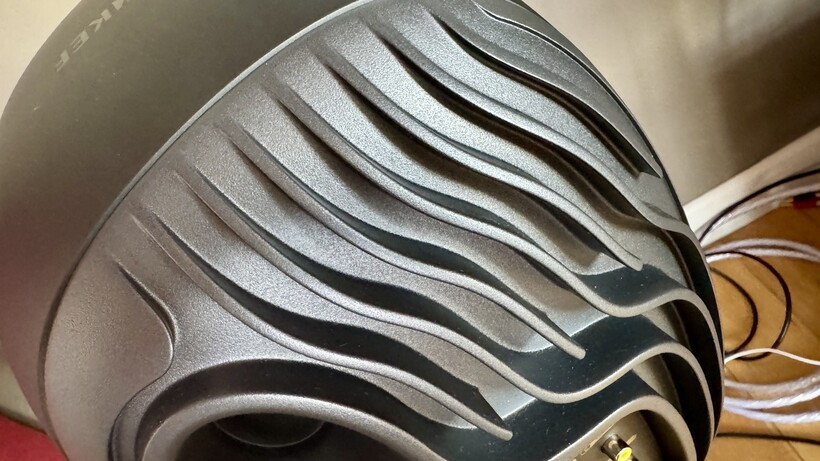
There’s some additional visual drama at the front and the rear of the cabinet, too. The front is dominated by the Uni-Q driver arrangement that’s discussed in the features section of this review, while at the rear there’s a quite complex aluminium heat-sink arrangement that uses its relatively large surface area to efficiently dissipate the heat generated by the internal electronics.
There’s also a quite sizable bass reflex port on the rear, too – its use of KEF’s Flexible Port Technology, which means the walls of the port are slightly pliant, ought to help keep internal resonance minimised.
Advertisement
The bespoke S-Luxe speaker stands are quite pricey (£799 / $799 / AU$1199), but if only for aesthetic reasons they’re worth considering.
Image Credit (Trusted Reviews)
I put the speakers on a pair of perfectly decent Soundstyle Z2 stands during this test, and they work well in sonic terms – but the way the speakers curve and taper towards the bottom of their cabinets means a lot of the (standard) top-plate of the stand is visible. It’s an inelegant look and not really in keeping with the carefully realised design of the system.
The speakers themselves are available in three finishes: dusk titanium, mineral white and the eclipse black of my review sample. I’ve seen all three, and I think it’s fair to say the LS Luxe are more colour-dependent than the vast majority of loudspeakers.
Advertisement
For my money, ‘eclipse black’ is not especially successful – it makes the speakers look lumpier than either of the other two finishes. Of course, you’re well within your rights to disagree.
Features
760 watts of power
12th-gen Uni-Q driver array
Plenty of connectivity
Advertisement
KEF’s Uni-Q driver technology that debuted back in 1988 is now a dozen generations old – and here the 12th-gen Uni-Q array consists of a 25mm aluminium tweeter behind an elaborate waveguide sitting in the throat of a 165mm aluminum mid/bass cone.
The idea behind this layout has never changed: it’s intended to deliver superior time-alignment and smooth driver integration. A rather more recent KEF creation, Metamaterial Absorption Technology, is positioned behind the tweeter where it negates the energy moving backwards from the tweeter dome and, in theory, allows for cleaner, purer treble response.
The driver module is mechanically isolated from the cabinet, and a decoupling chassis minimises vibrations from the motor system – in each case, reducing vibrations that might affect the cabinet structure is the idea.
Advertisement
Image Credit (Trusted Reviews)
Properly implemented, this arrangement ought to allow the driver array to deliver minimum distortion and maximum clarity. Elsewhere, the Velocity Control Technology first seen in KEF’s XIO soundbar, is on hand to measure the speed of movement of the mid/bass driver and compensate – in real time – for discrepancies in the expected and actual values. And tonal consistency at any and all volume levels is maintained by the company’s Music Integrity Engine.
KEF has given the LS Luxe plenty of power, and of two different types. Each tweeter is driven by 100 watts of Class A/B power, while each mid/bass driver gets 260 watts of Class D amplification – a total of 760 watts feels like it really should be plenty, while frequency response of 42Hz – 28kHz seems more than adequate too.
Advertisement
Image Credit (Trusted Reviews)
You can take control of the LS Luxe in a couple of different ways. The system is supplied with a metal-fronted remote control handset that covers off the fundamentals like power, input selection and volume control.
More extensive control is available via the KEF Connect app that’s free for iOS and Android – as well as the usual playback stuff, it allows you to search for and store internet radio stations, integrate your favourite music streaming service(s), use Expert mode to fine-tune the system’s response in relation to the specifics of the space it’s in, check for firmware updates and plenty more besides. It can sometimes take a beat before it responds, but in general it’s a stable and usable interface.
Image Credit (Trusted Reviews)
Connectivity
Bluetooth and Wi-Fi
HDMI input
There are plenty of connectivity options when the time comes to get some audio information into the hands of all these technologies. Wireless options, all under the control of KEF’s W2 wireless platform, consist of Bluetooth 5.3 and dual-band Wi-Fi – the latter means the LS Luxe is compatible with UPnP, the Connect versions of Qobuz, Spotify and TIDAL, Google Cast and AirPlay 2.
Advertisement
Advertisement
Internet radio is also available, and Roon Ready certification is expected early in 2027.
The primary speaker is in charge of wireless functionality, and it’s also where all physical connections are. An Ethernet socket offers optimum network stability, and in addition there’s an HDMI eARC socket, optical and coaxial inputs, and a 3.5mm line-level analogue input too.
An RJ45 socket allows the primary to be physically connected to the secondary speaker, the USB-C slot turns out to be just for charging external equipment, and there’s a pre-out for use with a subwoofer too. The secondary speaker has the RJ45 and a pre-out of its own, too.
Image Credit (Trusted Reviews)
The KEF is capable with resolutions of up to 24-bit/384kHz PCM and DSD218 via any of its network inputs, and can support 24-bit/192kHz via HDMI and coaxial – the optical input tops out at 24-bit/96kHz.
Connect the speakers together using the supplied cable and all audio information is scaled to 24-bit/192kHz – this drops to 24-bit/96kHz if you connect the speakers wirelessly instead.
Advertisement
Advertisement
Sound Quality
Revealing, authoritative and balanced presentation
Excellent midrange communication
Not the outright scale of sound you might be expecting
There are a couple of small caveats to everything I’m about to say about the way the KEF LS Luxe performs – I’ll save them until the end, because the uncomplicatedly good stuff is much more fun to write about.
No matter which of the KEF’s inputs you utilise – wired or wireless, digital or analogue – it’s an admirably consistent listen. Even if lower-resolution content is easy to spot next to Hi-Res stuff, the character and attitude of this system never falters. In every circumstance, it’s a beautifully balanced, eloquently revealing and profoundly enjoyable listen.
A 24-bit/96kHz Qobuz Connect FLAC file of Frank Ocean’s Super Rich kidsreveals a lot of what makes the LS Luxe such a pleasant sonic experience. The amount of detail, both broad and fine, it’s able to tease out and contextualise is straightforwardly impressive – no aspect of the recording is too subtle or too minor to escape the KEF’s attention. And it’s not revealing of detail simply for the sake of it – it’s all in the service of the overall picture.
Image Credit (Trusted Reviews)
The tonal balance is just so, and the same goes for frequency response. In both cases, the LS Luxe seems more than willing to wind its neck in and let the music it’s playing dictate terms – nothing is added and nothing is taken away when it comes to tonality, and there’s a complete disinclination to over- or underplay any area of the frequency range.
Advertisement
Advertisement
Low frequencies hit hard and with tremendous solidity, but the system is no simple thumper – bass sounds are textured and varied, and there’s such grippy control of their attack that rhythmic expression is coherent and persuasive.
The top of the frequency range is just as authoritative and just as nicely realised – treble sounds have ample crunch and bite, but they’re never in danger of hardening, and they have more than enough substance to keep the reproduction balanced.
And in the midrange, where your hearing is at its most sensitive and discerning, the KEF system communicates in the most eloquent and expressive fashion – no transient escapes the LS Luxe, no element of a vocal performance is too nuanced to elude it.
Image Credit (Trusted Reviews)
There’s energy and drive to the way the system presents music, but it’s of the considered and grown-up type rather than the eyes out on stalks alternative. That’s not to say the KEF can’t throw down hard when needs be – big upshifts in volume or intensity or attack in a recording are tracked faithfully, and even when you think the system is playing quite loudly it’s always able to get louder still. And it can move through these gears effortlessly, with no sense of stress.
So yes, caveats. The soundstage the LS Luxe presents is not the biggest you’ve ever heard – it’s open and carefully laid out and properly controlled, but there’s not quite the outright scale you might have been anticipating. And that’s the best-case scenario – the KEF LS Luxe is about as sensitive to the way its speakers are positioned as any stereo system I’ve tested.
Advertisement
Advertisement
Unlike the vast majority of stereo speakers, which prefer a little toe-in towards the listener’s seated position, the KEF are much happier when positioned almost directly straight ahead – get the positioning wrong and both the width and the height of their presentation can be quite badly impacted. So be prepared to spend a little longer than you might have expected ensuring the speakers are facing exactly the right direction…
Should you buy it?
You want a well-specified, high-performing wireless stereo speaker system that’s in no danger of being mistaken for anyone else’s wireless stereo speaker system…
Advertisement
You have a perfectly good pair of speaker stands already and don’t see the point of buying another
Advertisement
Final Thoughts
I don’t think I’ve ever had as divisive a system in my listening room – everyone who’s seen the KEF LS Luxe while I’ve been testing it has had an opinion about it before they’ve even heard it.
Obviously I’m not here to explain why the design is good, bad or indifferent – you’ll have made your own mind up about it long before now. But when you consider how pedestrian and safe the vast majority of loudspeaker designs are, KEF should be congratulated on having the neck to deliver something a little bit different.
How We Test
I put the KEF LS Luxe on my pair of Soundstyle Z2 speaker stands, and plug each one into the mains. I listen with the speakers connected wirelessly, I listen when they’re physically joined together.
I stream music using Qobuz Connect and TIDAL Connect, and I also listen to a lot of very hi-res content from the Synology BeeStation Plus NAS device on a common network. I connect a preamplified Technics SL-1300G turntable to the analogue input, a Rega Apollo CD player to the coaxial input, and a Philips OLED TV to the HDMI eARC socket.
This way I’m able to access lots of different sorts of content, in lots of different digital file types, and in a wide variety of resolutions.
Tested for several days
Tested with real world use
FAQs
Is there a choice of finishes?
You can choose between eclipse black, dusk titanium or mineral white.
Advertisement
Can I connect a turntable?
As long as it’s preamplified – the single analogue input here is at line-level.
Are the speakers supplied with grilles?
Advertisement
Certainly not – why would you want to hide away the drama of that driver array?
Advertisement
Advertisement
Full Specs
KEF LS Luxe Review
Manufacturer
KEF
Size (Dimensions)
233 x 298 x 336 MM
Weight
10 KG
Release Date
2026
Driver (s)
25mm aluminium tweeter; 165mm aluminium mid/bass
Ports
3.5mm line-level analogue; digital coaxial; digital optical; Ethernet; HDMI eARC, 2 x subwoofer pre-out; USB-C
Audio (Power output)
760 W
Connectivity
Bluetooth 5.3; Apple AirPlay 2; Google Cast; Qobuz Connect; Spotify Connect; TIDAL Connect; UPnP
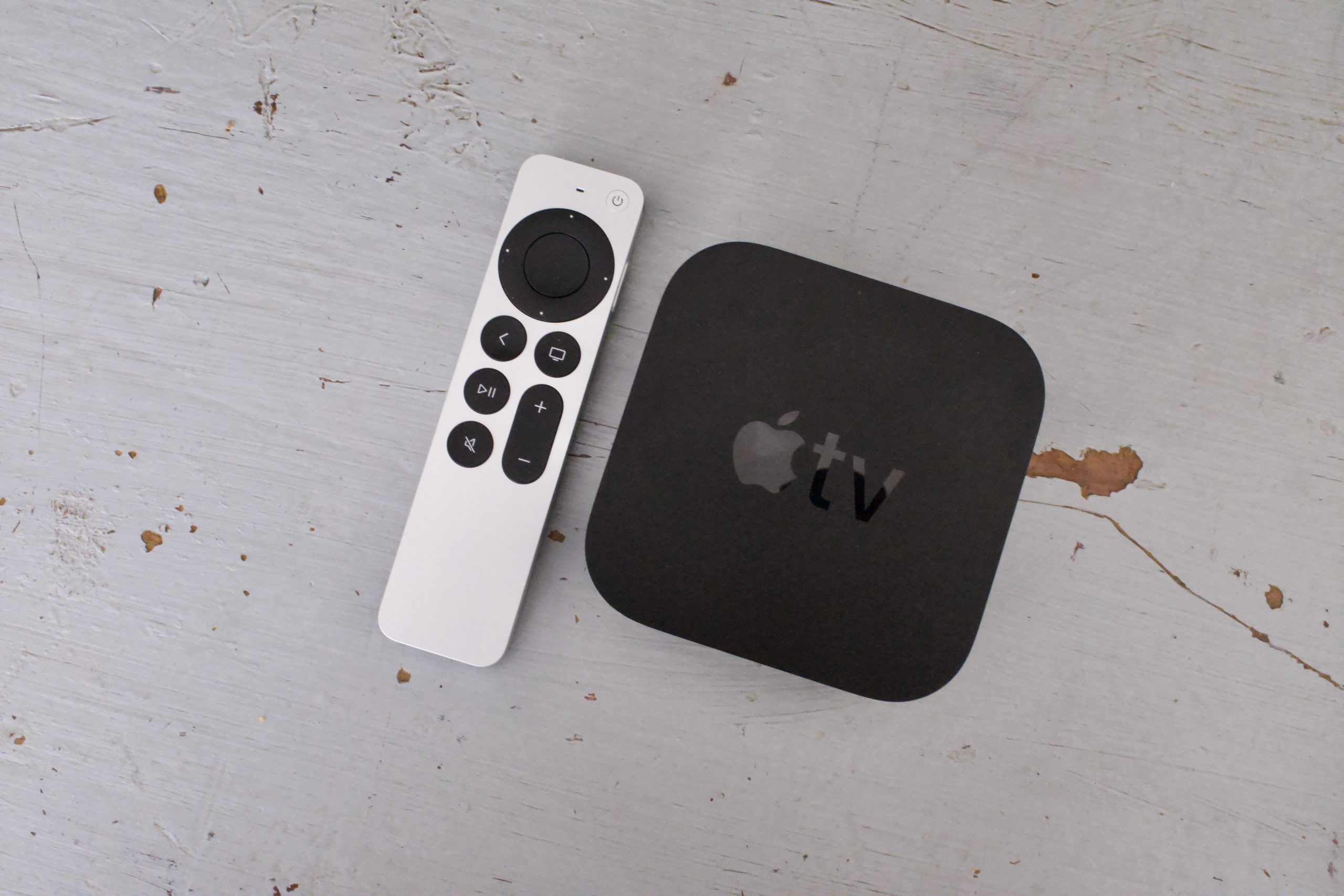
Apple’s next Apple TV 4K could arrive with a refreshed Siri Remote, according to references found in the latest macOS software.
The clue comes from ATVRemote1,5, a device identifier discovered in the macOS Tahoe 26.7 release candidate. The code appears to correspond to a new Apple TV remote, suggesting Apple is working on an updated version of its streaming box and its accompanying controller.
Unfortunately, the software doesn’t reveal what Apple has changed. There’s no indication yet of a new design, additional buttons or new functionality. Therefore, the upgraded remote remains something of a mystery.
A new Apple TV could finally be on the way
The discovery is interesting because Apple’s current Apple TV 4K has been around since 2022, despite rumours of a new model circulating for several years. The next version is expected to receive a much more significant internal upgrade, with an A17 Pro chip or newer tipped to power the device.
Advertisement
The new remote reference adds another piece to that puzzle. Rather than simply updating the Apple TV internally, Apple could be preparing a refreshed package that includes a new controller.
Advertisement
There’s no confirmed launch date, but the latest code findings point towards a potential announcement in September or October.
Apple’s macOS Tahoe 26.7 release candidate contains references to a surprisingly large number of unreleased products. Alongside the Apple TV remote, the code points towards new home accessories, AirPods, iPhones, Macs and iPads.
For now, though, ATVRemote1,5 is all we have to go on for the new Siri Remote. The code confirms the apparent existence of a new remote but doesn’t explain what makes it different from the current model.
That means it’s best not to expect a radical redesign just yet; Apple could be preparing relatively modest changes. On the other hand, the new remote could introduce features that simply aren’t exposed by the software reference.
Either way, after several years without a new Apple TV, it looks increasingly likely that Apple has an updated streaming box in the works.
Elon Musk is expected to spend big to boost Republicans in the midterms this November, according to Trump officials briefed on the matter.
The precise amount could change, but the officials expect Musk to spend around $100 million to $200 million with a focus on voter turnout in key races, including Texas, where the fate of Republican nominee Ken Paxton could determine which party controls the US Senate.
The planned cash injection—or any in-kind contribution relating to voter turnout—would be a boon for Paxton, who has been vastly outraised in contributions. According to the latest FEC filings, James Talarico had raised roughly $69 million compared to Paxton’s $9 million.
While an endorsement from President Donald Trump carried him to victory, Paxton lagged behind in contributions throughout a bruising primary against Senator John Cornyn that resurfaced past scandals, and has fared little better since becoming the nominee.
Advertisement
To date, neither of the two largest national GOP entities have committed to spend on Paxton. The Senate Leadership Fund is run by allies of Senate Majority Leader John Thune, who supported Cornyn, while MAGA Inc has not released its spending plans.
Democrats in close races have generally outraised their Republican counterparts this cycle, so Paxton is not unique in being behind in fundraising. Numerous candidates are relying on national party committees and outside groups to make up the difference.
Musk’s projected spend adds to the Republican National Committee’s $128 million war chest, while the Democratic National Committee is $2 million in debt. The two main GOP super PACs for House and Senate races have $380 million, compared to Democrats’ $116 million. MAGA Inc has about $400 million on hand; there is no Democratic equivalent.
A spokesperson for America PAC declined to comment on the group’s spending plans. The New York Times earlier reported that Musk had authorized his PAC to spend at least $100 million for the 2026 midterms.
Advertisement
But Musk’s track record in setting up voter turnout operations has been mixed.
In the 2024 election, the Trump campaign outsourced its field operations to America PAC, which paid third-party canvassing firms more than $46 million across several battleground states in an attempt to turn out “low propensity” voters, who like Trump but don’t always vote.
In the end, Trump swept all six battleground states, but Trump officials were unconvinced that was a result of America PAC’s work with paid canvassers (who often are not as enthusiastic as in-house canvassers and are known to pretend to hit doors to claim their paychecks), as opposed to Trump’s celebrity appeal and ability to turn out his base.
The 2024 America PAC operation also faced complaints from workers who claimed that they had been tricked, and threatened with having to pay for their own lodging unless they hit massive quotas. (America PAC and Musk did not respond to requests for comment at the time.)
There are some interesting things happening in the PC market these days and, more importantly, the potential for even more impactful changes over the next year or so. At a high level, overall PC shipments were predicted to decline and are indeed starting to do so on a unit basis. Read Entire Article Source link





















































You must be logged in to post a comment Login