Because everything runs wirelessly via Bluetooth and Wi-Fi, there is also no cable clutter to deal with. This isn’t just a convenience thing. It means no wires dangling within reach of sneaky toddler hands.
Where Tech Collides
This is where the real test comes in. In split screen mode, the system shows CarPlay and the camera feed side by side, with CarPlay positioned on the left for easier tapping access. It’s a smart layout in theory because you get the best of both worlds, but there are some limitations. To fit the camera feed, the CarPlay interface is significantly condensed. It’s still usable, but small enough that I often touch the wrong icon, especially while driving, when precision tapping isn’t exactly my priority. It’s not a deal-breaker, but you’ll notice it, especially if your fingers aren’t very dainty.
Switching to camera mode gives a full-screen view of the back seat, but it comes at the cost of CarPlay controls. Music still plays and calls don’t drop, but I lose access to inputs like my steering wheel’s “skip track” and “end call” buttons. If you rely heavily on steering wheel controls, the trade-off is noticeable, but I find myself sticking with split screen mode most of the time anyway.
Advertisement
Photograph: Nicole Kinning
One more interface quirk worth flagging is that whenever I tap the screen, Ottocast overlays a back arrow in the top-left corner and a camera icon (the brand’s owl) in the top-right corner. The issue is that CarPlay uses these corners for key controls: the back button in Spotify, the exit button in Google maps, the now-playing shortcut. The Ottocast overlay gets in the way of your tap. It disappears after a few seconds, but if my next tap doesn’t land precisely where I want it, the Ottocast icons pop right back up and get in the way again.
Overall, the Ottocast Cabin Care works best when you treat it as a convenient upgrade, rather than a perfect solution. It solves the problem of being able to check on your kid in the car without turning around, and does so in a way that feels (mostly) seamless in daily use.
Long-time Slashdot reader Anne Thwacks frequently uses YouTube’s subtitles “not to disturb others in the room, or because my hearing is not very good.” But they say there’s a new problem.
“The subtitling is terrible!”
Almost every sentence has a huge error. Proper names are more often wrong than right. Non-English place names are almost always mangled to barely recognizable. And no effort whatsoever is made to use context to figure out whether a place name is Russian or Arabic, and often complete garbage is used in place of a common French, Spanish or Italian name!
If AI actually works (I have my doubts about this), surely it would be possible to figure out language contexts. If it is about an event in Italy, then expect a lot of Italian names! If it is about the Russia-Ukraine war, then expect places in Russia or Ukraine to be more plausible than mindless gobbledygook! Does YouTube not know that there are places in the world that are not in America? (However, plenty of names of people and places famous in America are also regularly screwed up.)
They argue the subtitles are “appallingly bad” — and that “the situation seems to be getting worse,” wondering why the problem isn’t addressed with some basic spell-checking. (“I’m sure that the vast majority of foul-ups could be fixed by the use of a dictionary.”) Have any Slashdot readers seen similar problems? A friend of mine noticed that YouTube’s subtitles even bungled this innocuous song from the 1966.
Advertisement
ANNETTE FUNICELLO: “If your love is true love, you can tell by his touch.” YOUTUBE SUBTITLE: “If your love is too lava, you can tell by his touch…”
Share your own experiences and thoughts in the comments. And do you think YouTube’s subtitles are “appallingly bad”?
Criminal IP partners with Securonix to integrate Criminal IP’s Threat Intelligence into ThreatQ, allowing organizations to incorporate external IP intelligence into their existing workflows, helping security teams accelerate analysis and response with more actionable context.
Unlike traditional intelligence feeds, Criminal IP provides visibility into how assets and infrastructure are exposed across the internet. By embedding this data into ThreatQ, organizations can incorporate real-world context into investigations without disrupting existing processes.
ThreatQ centralizes and prioritizes threat data from multiple sources. With Criminal IP integrated, organizations can enrich this data with continuously updated, exposure-based intelligence, strengthening investigation and response workflows without added complexity.
Automated Intelligence Enrichment at Scale
Within the integrated environment, Criminal IP’s threat intelligence APIs automatically enrich incoming IP indicators in ThreatQ with contextual data such as maliciousness scoring, VPN and proxy detection, remote access exposure, open ports, and known vulnerabilities.
Advertisement
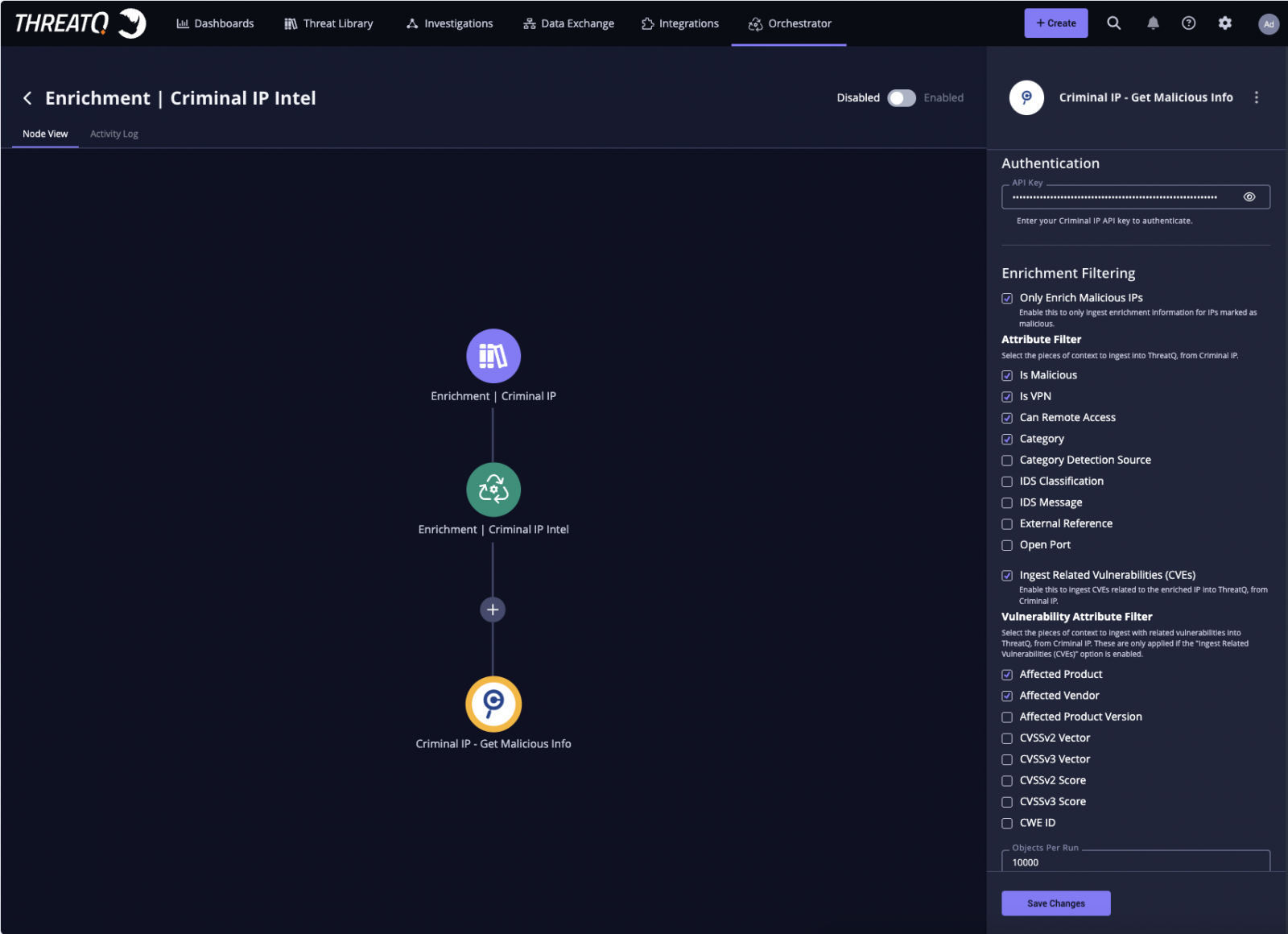
Powered by ThreatQ’s data-driven orchestration engine, organizations can configure automated workflows that continuously evaluate incoming indicators against Criminal IP’s threat database.
This ensures that threat context remains current without requiring manual analyst effort, supporting faster triage and more consistent prioritization.
Integrate Criminal IP’s exposure-based threat intelligence into ThreatQ to enrich IP indicators with real-time context.
Automate analysis with maliciousness scoring, VPN/proxy detection, and infrastructure insights to accelerate investigation and response within a unified workflow.
Real-Time Investigation Within a Unified Workspace
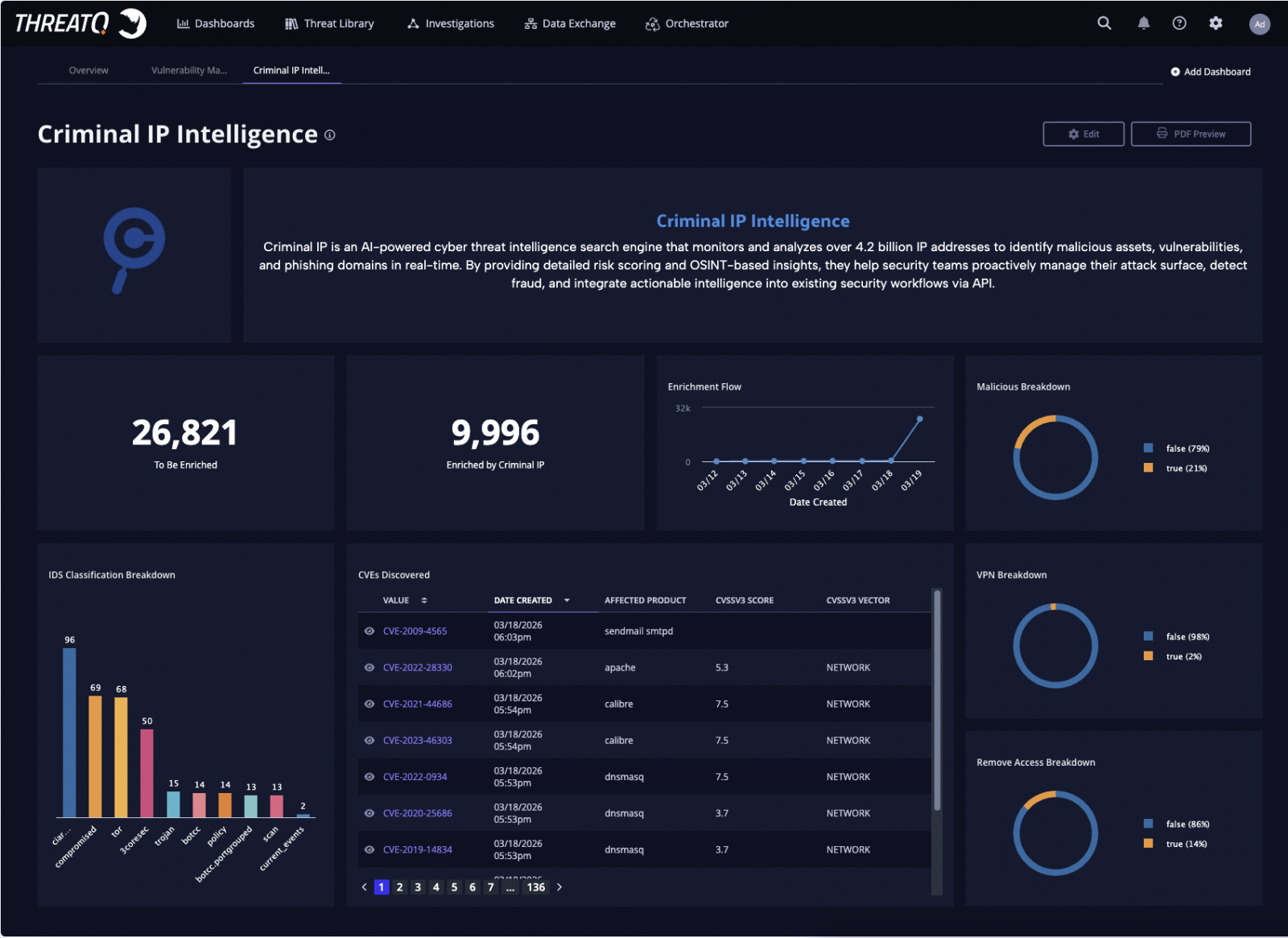
Criminal IP intelligence integrated into the ThreatQ dashboard,
enabling unified visibility into enriched indicators and risk context
The integration allows analysts to access Criminal IP intelligence directly within the ThreatQ interface, enabling real-time validation of suspicious IP activity without switching tools. By combining exposure data with infrastructure-level insights, teams can assess risk more effectively within their existing workflows.
Analysts can also perform on-demand Criminal IP lookups directly from indicator detail views or investigation boards, providing immediate access to additional context during active investigations.
Criminal IP further enhances ThreatQ’s investigation graph by revealing relationships between IP addresses, associated infrastructure, and attack activity, helping analysts better understand connections and patterns across threats.
Intelligence-Driven Prioritization and Response
Criminal IP enrichment integrated within the ThreatQ Orchestrator,
enabling automated ingestion and filtering of exposure-based IP intelligence directly into analysis workflows
By integrating Criminal IP’s intelligence into ThreatQ’s scoring framework, organizations can align risk evaluation with their specific operational environment. This enables more precise prioritization and supports more effective decision-making during investigations.
Enriched data can also be visualized through dashboards, providing clearer visibility into maliciousness trends, VPN usage, and risk distribution across indicators.
Expanding Visibility with Exposure Intelligence
The integration highlights the growing importance of exposure-based intelligence in modern threat analysis. By continuously monitoring and analyzing internet-facing assets and IP infrastructure, Criminal IP provides differentiated visibility that extends beyond traditional indicator-based approaches.
Advertisement
“This integration enables organizations to bring IP reputation and exposure intelligence directly into the ThreatQ platform, supporting faster analysis and more effective response throughout the investigation lifecycle,” said Byungtak Kang, CEO of Criminal IP. “By integrating our intelligence into existing workflows, security teams can improve visibility and make more informed decisions without adding operational complexity.”
“This collaboration strengthens the role of IP intelligence at critical points of investigation and decision-making,” said Scott Sampson, Chief Revenue Officer, Securonix. “By combining ThreatQ’s orchestration and prioritization capabilities with Criminal IP’s real-time threat data, organizations can accelerate enrichment processes, reduce manual workloads, and focus on the most relevant threats within their environment.”
Through this partnership, Criminal IP and Securonix enable security teams to operationalize threat intelligence more effectively by integrating automated enrichment, workflow orchestration, and precise prioritization within the ThreatQ platform.
About Criminal IP
Criminal IP is a cyber threat intelligence solution operated by AI SPERA that provides decision-ready IP address and domain reputation data to security teams worldwide.
Advertisement
By continuously scanning the global internet, Criminal IP aggregates and contextualizes threat signals across IPs, domains, URLs, and attack infrastructure, covering malicious indicators, known vulnerabilities, exposed assets, and attacker behavior.
Criminal IP’s mission is to give organizations real visibility into their cyber landscape and accelerate threat detection and response by delivering the intelligence needed to outsmart attackers. For more information, visit www.criminalip.io.
About Securonix
Securonix is transforming security operations with the industry’s first Unified Defense SIEM with Agentic AI, built to decide and act across the threat lifecycle with a human-in-the-loop philosophy. Its cloud-native platform unifies detection, investigation, and response, while enabling Sam, the AI SOC Analyst, and a productivity-based AI operating model for the SOC, so organizations can measure and govern AI by the analyst work it delivers. Helping enterprises become Breach Ready and Board Ready, Securonix delivers accountable, outcome-driven security operations at scale. Recognized as a Leader in the Gartner® Magic Quadrant™ for SIEM and a Customers’ Choice by Gartner Peer Insights™, Securonix delivers trusted security operations for global enterprises. Learn more at www.securonix.com.
A new disclosed cPanel flaw tracked as CVE-2026-41940 is being mass-exploited to breach websites and encrypt data in “Sorry” ransomware attacks.
This week, an emergency update for WHM and cPanel was released to fix a critical authentication bypass flaw that allows attackers to access control panels.
WHM and cPanel are Linux-based web hosting control panels for server and website management. While WHM provides server-level control, cPanel provides administrator access to the website backend, webmail, and databases.
Internet security watchdog Shadowserver now reports that at least 44,000 IP addresses running cPanel have since been compromised in ongoing attacks.
cPanel flaw exploited for Sorry ransomware attacks
Numerous sources told BleepingComputer that hackers have been exploiting the cPanel flaw since Thursday to breach servers and deploy a Go-based Linux encryptor for the “Sorry” ransomware [VirusTotal].
There have been numerous reports of websites impacted by the attacks, including on the BleepingComputer forums, where a victim shared samples of the encrypted files and the contents of the ransom note.
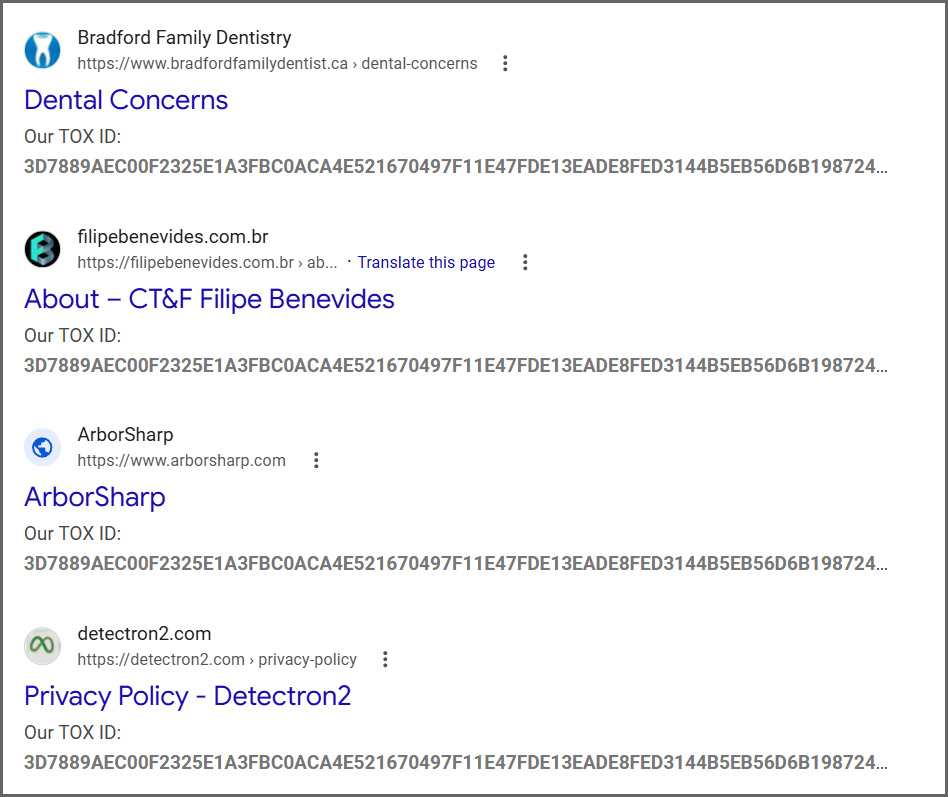
Since then, widespread exploitation and ransomware attacks have been spotted, with hundreds of compromised sites already indexed in Google.
Advertisement
Google listing of websites hit in Sorry ransomware attacks Source: BleepingComputer
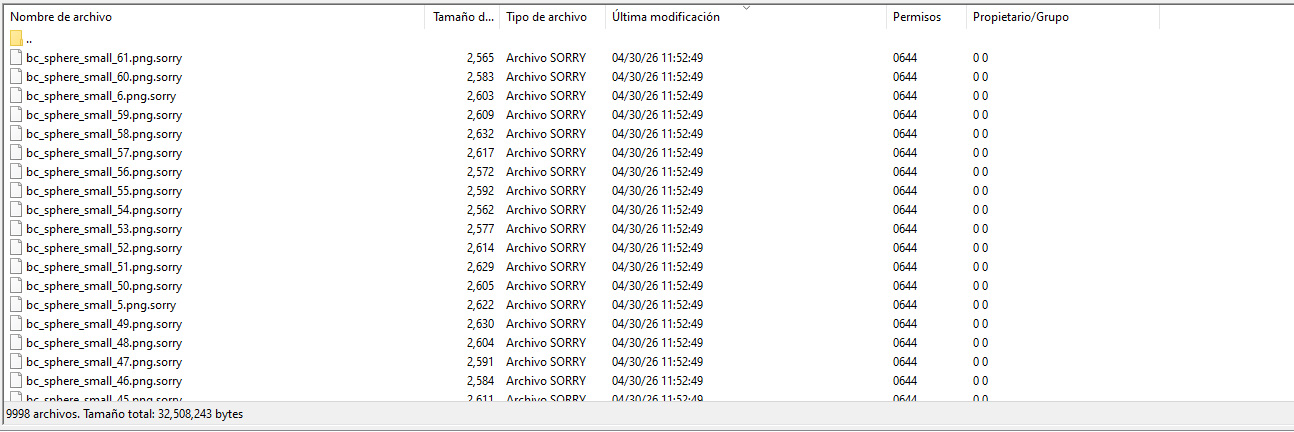
The Sorry ransomware encryptor is designed specifically for Linux and will append the “.sorry” extension to all encrypted files.
Files encrypted by the Sorry ransomware Source: diozada on the BleepingComputer forums
BleepingComputer was told that the ransomware uses the ChaCha20 stream cipher to encrypt files, with the encryption key protected using an embedded RSA-2048 public key.
Ransomware expert Rivitna says the only way to decrypt these files is to obtain the corresponding private RSA-2048 key.
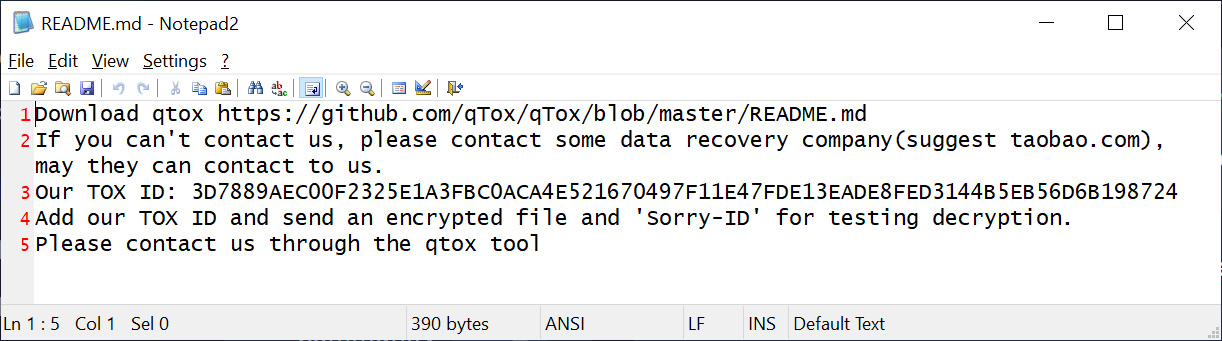
In each folder, a ransom note named README.md is created, instructing the victim to contact the threat actor on Tox to negotiate a ransom payment.
The ransom note is the same for each victim of this ransomware campaign, including the Tox ID “3D7889AEC00F2325E1A3FBC0ACA4E521670497F11E47FDE13EADE8FED3144B5EB56D6B198724,” which is used to contact the threat actor.
It should be noted that a 2018 ransomware campaign utilized a HiddenTear encryptor to encrypt files and append the .sorry extension. This current campaign uses a different encryptor and is unrelated.
All cPanel and WHM users are urged to immediately install the available security updates to protect their websites from ransomware attacks and data theft.
The attacks have just started, and we will likely see increased exploitation over the coming days and weeks.
AI chained four zero-days into one exploit that bypassed both renderer and OS sandboxes. A wave of new exploits is coming.
At the Autonomous Validation Summit (May 12 & 14), see how autonomous, context-rich validation finds what’s exploitable, proves controls hold, and closes the remediation loop.
“Scientists have created a miraculous new way to stop fires from spreading through neighborhoods using nothing but sound,” reports the New York Post:
Former NASA engineers with California-based Sonic Fire Tech found that using sound waves can snuff out blazes and potentially be used to stop another Pacific Palisades inferno… The technology works by targeting oxygen molecules using low-frequency sound waves that vibrate them, stopping the fire from growing. “Sound waves vibrate the oxygen faster than the fuel can use it, and break the chemical reaction of the flame,” Remington Hotchkis, Chief Commercialization Officer at Sonic Fire Tech told The Post.
The San Bernardino County Fire Department recently tested out the equipment using a backpack version and the results were incredible. Video shows firefighters fighting small blazes on a shrub and a stove top fire with the technology putting it out… In the home application, the system would be alerted/activated if there was a fire, sending the sound waves through a home duct system, essentially snuffing out the blaze. The sound waves can reach as far as 30ft from a home, the report noted. The sound is also harmless to pets and humans. The article includes this quote that an executive at the company gave local news station KMPH. “Our former NASA engineers are rocket scientists, and they say it seems like magic, but it’s just physics.”
These three Prime Video shows have one thing in common. They are all brilliant, criminally overlooked, and none of them got the audience they deserved. A broken spy who processes trauma through folk songs. A woman who survives a car crash and can’t decide if she’s gifted or unraveling. And a small Ohio town sitting on top of a machine that quietly warps everything around it.
Prime Video built something quietly remarkable with all three, and then apparently forgot to tell anyone, but they are still worth a watch.
John Tavner is an intelligence officer assigned to stop Iran from going nuclear. His cover is a job at a Midwestern industrial piping company. That setup sounds like a straightforward spy thriller, but Patriot is one of the strangest, funniest, and most underrated Prime Video TV shows you’ve ever seen.
John processes his unraveling mental state by writing and performing folk songs, which the show uses as a kind of Greek chorus for the chaos around him. The comedy is bone dry, the plotting is absurdist, and the emotional core is genuinely devastating. It ran two seasons and despite an IMDB rating of 8.2, the series got cancelled, but the people who found it have never stopped being angry about it.
Undone is the kind of Prime Video series that makes you question why more animation isn’t made this way. The show uses rotoscoping, a technique where animators trace over live-action footage frame by frame, to create something that feels like a waking dream.
Rosa Salazar plays Alma, a young Mexican American woman who survives a car crash and starts experiencing time non-linearly. Her dead father begins appearing to her, asking for her help. The show never fully commits to whether Alma is gifted or experiencing a psychotic break, and that ambiguity is exactly where it lives. It earned 8.2 rating on IMDB and still barely made a dent in mainstream conversation.
Based on the paintings of Swedish artist Simon Stalenhag, this underrated TV series on Prime Video is unlike anything else. Set in a small Ohio town built above a mysterious scientific facility called the Loop, each episode follows a different resident whose life quietly intersects with the unexplainable.
There are no villains, no chase sequences, and very little explanation. What the show offers instead is atmosphere, longing, and a quietly accumulated grief that hits you only after the credits roll. It picked up two Emmy nominations and an 7.4 on IMDB and somehow still slipped through the cracks entirely.
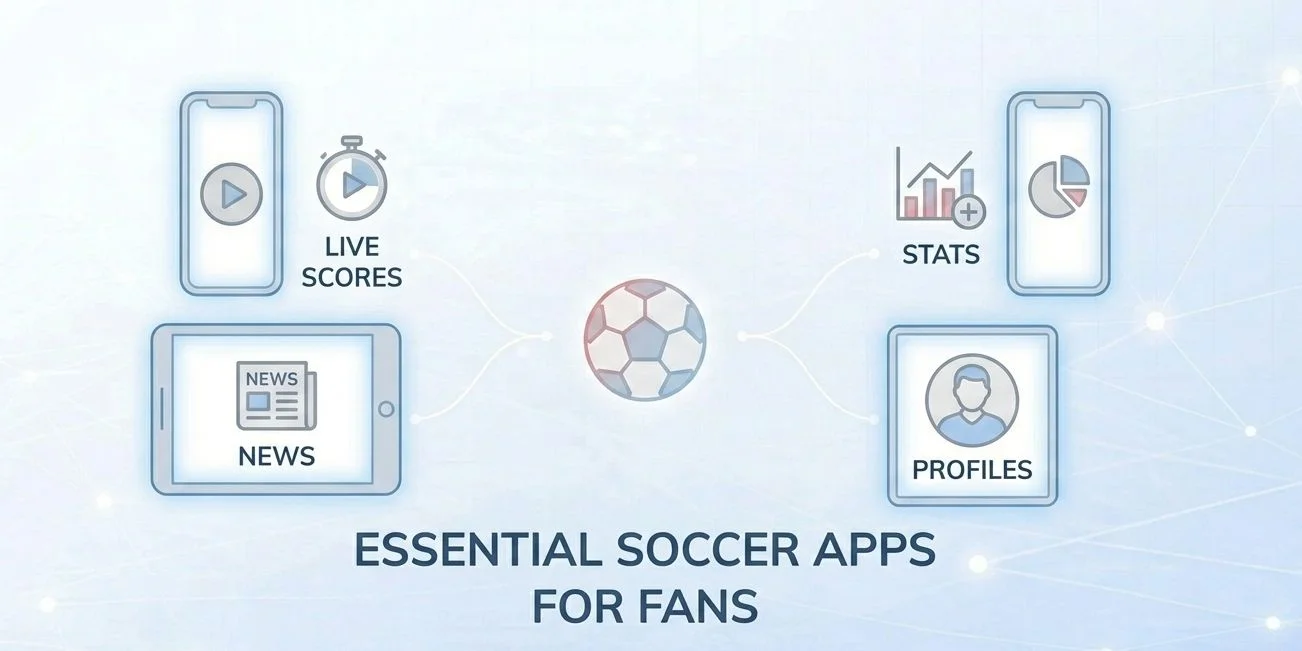
There are hundreds of soccer apps in the App Store and Google Play. Most are forgettable. A small number have become genuinely useful tools that serious fans check before, during, and after every match. This guide covers the best of them in 2026 — organized by what you actually want to do, not just ranked in a list.
Best App for Each Use Case — At a Glance
Free live streaming: FIFA+ (powered by DAZN)
Live scores, fastest updates: Flashscore
Deep in-match stats and xG: SofaScore
Clean matchday UI and notifications: FotMob
News and match previews: OneFootball
Fantasy Premier League: Official Premier League App
All-in-one (scores + AI predictions): Tiki Taka
No single app does everything equally well. The honest answer for most fans is two apps: one for live scores and stats during the match, and one for news and previews between gameweeks. Everything below is rated on what it actually does best — including what it does poorly.
FIFA+ — Best Free Streaming App
FIFA+ (Powered by DAZN)
Free | iOS + Android + Smart TV | Global availability
The biggest development in soccer fan apps for 2026 is the FIFA and DAZN partnership that relaunched FIFA+ as a free global platform ahead of the World Cup. The new FIFA+ combines what was previously a limited free-tier app with DAZN’s streaming infrastructure, creating a single destination for live matches, on-demand replays, highlights, and original documentaries — all at no cost.
The platform carries live content from more than 100 men’s and women’s leagues, with behind-the-scenes access from national teams and major clubs. For World Cup 2026, FIFA+ is the global home for tournament content, including match archive, player profiles, and exclusive video — making it the most important new soccer app of 2026 for fans who want professional-quality content without a subscription.
Advertisement
Best for: Fans who want free live matches, replays, and World Cup content on any device. Limitation: Does not carry top domestic league matches in most major markets (Premier League, Champions League, etc.) — those rights remain with national broadcasters.
Live Score Apps: Flashscore, FotMob, and SofaScore
These three apps dominate the live score category — but they’re not interchangeable. Each has a distinct strength, and the right choice depends on whether you prioritize speed, depth, or range.
Flashscore — Best for Speed Across Many Sports
Free (ads) / Premium tier available | iOS + Android | Global
Flashscore is the fastest live score app available, and it covers the widest range of competitions and sports of any tool in this category. If you follow multiple leagues simultaneously or want to track matches across different sports during the same evening, no other app matches its breadth. The interface is dense but efficient: fixtures, results, league tables, and H2H records are all one tap away.
Advertisement
Best for: Multi-league fans, fast score checking, fans who also follow non-soccer sports. Limitation: UI is data-heavy and can feel overwhelming for casual fans. In-match stats are shallower than SofaScore.
FotMob — Best Matchday Experience
Free / FotMob Pro (paid) | iOS + Android | Global
FotMob covers live scores, fixtures, tables, match stats, and personalized news from over 500 football leagues. Its edge over the competition is design: it’s the cleanest, most navigable soccer app on mobile. Match pages are well laid out, push notifications are reliable and configurable (goal, lineup, kickoff, final), and the player performance ratings system — where FotMob assigns a match rating to every player — is a feature fans check consistently after full-time.
Best for: Fans who want one polished app for their primary team or league. The “My Teams” personalization layer makes it the best daily companion for following specific clubs. Limitation: Less deep on expected goals (xG) and advanced stats compared to SofaScore.
SofaScore is the most data-rich live soccer app available to general consumers. During a live match, it surfaces possession, xG (expected goals), shot maps, player heatmaps, pass accuracy, duel success rate, and a live match timeline that logs every event in sequence. SofaScore ranks best for broad match coverage and live event data among independent evaluations of 2026 football stat tools. The player ratings system covers over 5,000 leagues — a scope that few competitors match.
Best for: Tactically engaged fans, analysts, journalists, and FPL players who use xG and heatmaps as part of their research. Limitation: The free tier is ad-supported; some advanced filters are behind the paid tier. Less polished visually than FotMob.
OneFootball
Free | iOS + Android | Global
Advertisement
OneFootball is the best app for fans who want editorial content — match previews, post-match analysis, transfer news, and club-specific coverage — rather than raw scores. It covers over 100 international soccer leagues and competitions with live commentary and breaking news. For the 2025/26 season, OneFootball added individual player match stats, heatmaps, and shot charts — significantly closing the gap on SofaScore for stat-focused users who prefer a news-first interface.
Best for: Fans who want context alongside scores — club news feeds, manager quotes, pre-match analysis, and transfer rumors curated by competition. Limitation: Live scores are slightly slower to update than Flashscore or FotMob. Stats depth still trails SofaScore for advanced metrics.
Fantasy Premier League — Best Fantasy App
Official Premier League App (FPL)
Free | iOS + Android | Global
If you play Fantasy Premier League — and with tens of millions of managers globally it’s hard to avoid — the official Premier League app is the authoritative tool for managing your FPL squad, tracking points, and researching player history across 30+ years of match data. For 2025/26, the Premier League introduced meaningful rule changes: points now reward defensive contributions (not just clean sheets), and managers receive two full sets of chips across the season, including the new “Wildcard reset” mechanic that gave veteran players new strategic options mid-season.
Advertisement
Beyond FPL, the app includes official match highlights, the full Premier League fixture list, club news, and historical stats — making it a useful general companion for EPL fans even if you don’t play fantasy.
Best for: Fantasy Premier League players — no third-party app fully replicates the official FPL interface. Also strong for EPL-only fans who want an official, ad-light source. Limitation: Coverage is limited to the Premier League; no use for following other competitions.
How to Build Your App Stack (Practical Workflow)
Most fans don’t need seven apps — they need two or three that serve different moments in the matchday cycle. Here’s a practical structure by fan type:
Fan Type
Primary App
Secondary App
Optional Add
Casual EPL fan
FotMob (scores + news)
Official PL App (FPL + highlights)
FIFA+ (free streaming)
Multi-league follower
Flashscore (breadth + speed)
OneFootball (news by competition)
SofaScore (deep stats)
Tactical / stats-focused fan
SofaScore (xG, heatmaps, ratings)
FotMob (notifications + match UI)
OneFootball (previews + context)
Fantasy Premier League player
Official PL App (team management)
SofaScore (player form research)
FotMob (live GW scoring)
World Cup 2026 casual fan
FIFA+ (free streams + content)
FotMob (scores + fixtures)
—
For more on where to find full live streams beyond what FIFA+ carries free, see our guide on the best official soccer streaming services by region — which covers Peacock, Paramount+, Stan Sport, beIN, and the other major paid platforms in detail.
Advertisement
What to Avoid
A note worth adding: the App Store and Google Play are full of apps with “Soccer 2026” or “Football Live” in their titles that are either clones, data scrapers, or ad-farms built to rank on search. The apps in this guide are independently developed, widely used, and actively maintained. Before installing any soccer app not mentioned here, check: when was it last updated? Does it have a verified developer? Is the review score based on genuine engagement or padding? These are small checks that save frustration. If you want to go deeper on how technology shapes the fan experience more broadly, our overview of how technology has transformed the soccer fan experience covers smart stadiums, AI officiating, AR tools, and streaming infrastructure in one place.
Key Takeaways
FIFA+ is the most significant new app development for 2026 — relaunched with DAZN as a free global platform covering 100+ leagues, live and on-demand.
Flashscore is the fastest live score app for fans who follow multiple competitions or sports simultaneously.
FotMob offers the most polished matchday experience, best push notifications, and the cleanest UI in the category.
SofaScore is the go-to for tactical fans who want xG, heatmaps, player ratings, and deep in-match data.
OneFootball added heatmaps and shot charts for 2025/26, making it a stronger all-round app for fans who want news alongside stats.
Official Premier League App is the only tool to use for FPL management; the 2025/26 season introduced defensive contributions scoring and two chip sets.
You don’t need six apps. Two or three, chosen by use case, covers everything most fans need.
Frequently Asked Questions
What is the best free soccer app in 2026?
For live streaming, FIFA+ (powered by DAZN) is the best free option — it carries content from 100+ leagues globally at no cost. For live scores, FotMob and Flashscore are both free at their base tier and cover the vast majority of what most fans need without paying. All three are available on iOS and Android.
What is the difference between FotMob and SofaScore?
FotMob is cleaner and better designed for casual matchday use — great notifications, smooth navigation, and strong player ratings. SofaScore goes deeper on data: expected goals (xG), player heatmaps, pass accuracy, and duel statistics are all available live during a match. For general fans, FotMob is the better daily driver. For tactical or analytically-minded fans, SofaScore provides more useful information.
Is FIFA+ actually free? What’s the catch?
Yes — the relaunched FIFA+ platform on DAZN is free globally. The trade-off is that it does not carry the major domestic league competitions (Premier League, La Liga, Serie A, Champions League) that are licensed exclusively to national broadcasters. What it does carry — international football, women’s football, lower-tier leagues, World Cup content, and documentaries — is genuinely high quality and available without any subscription or registration requirement.
Which soccer app is best for Fantasy Premier League players?
The official Premier League app is the primary tool for managing your FPL squad, transferring players, and tracking points. For research and player form analysis, SofaScore is the best complement — its player ratings, heatmaps, and match-by-match stats are directly useful for FPL transfer decisions. FotMob is useful during live gameweeks for tracking provisional points in real time.
Advertisement
Does OneFootball show live scores?
Yes. OneFootball shows live scores, live match commentary, and basic stats for over 100 competitions. For the 2025/26 season it added heatmaps, shot charts, and individual player match statistics. It is slightly slower to update than Flashscore or FotMob during live matches, but for fans who primarily want news, previews, and post-match analysis, it covers all the basics well.
What soccer apps work best outside Europe and North America?
SofaScore, FotMob, and Flashscore all have global league coverage that extends well beyond European competitions — including South American, Asian, and African leagues. FIFA+ is also fully global and covers women’s and lower-tier competitions often ignored by other platforms. For live streaming in MENA specifically, the TOD app (beIN Sports) is the primary option for top-tier European club football.
Are there soccer apps specifically designed for the 2026 World Cup?
FIFA+ is the official platform for World Cup 2026 content — free globally, covering live tournament matches, highlights, player profiles, and archive material. The BestFootball 2026 Cup app on iOS is a dedicated competition-tracking tool specifically built for the tournament, useful for bracket tracking and scheduling. All major score apps (FotMob, Flashscore, SofaScore) will also carry full World Cup live coverage.
Do I need to pay for any app to follow soccer in 2026?
For scores, stats, news, and some live content — no. FotMob, Flashscore, SofaScore, OneFootball, and FIFA+ all have robust free tiers that cover most of what casual to passionate fans need. Paid tiers on SofaScore and FotMob remove ads and unlock advanced filters, but are not necessary for core functionality. For full live streaming of the Premier League, Champions League, and other top competitions, a paid streaming subscription (Peacock, Paramount+, Stan Sport, etc.) is required — see our regional streaming services guide for details.
To earn a spot as one of Consumer Reports’ thoroughly tested top picks, cars not only have to drive well but also be reliable. Some models prove to be consistently durable and stay at the top of the outlet’s rankings year after year, but some slip down the table as owners begin to report issues. For 2026, Consumer Reports stopped recommending 18 models from 12 different manufacturers, primarily due to reliability concerns.
These models included a mix of EVs such as the Audi Q4 e-tron, which saw owners report a variety of issues with its onboard electrical systems, and gas-powered cars like the Chevrolet Equinox, which suffered transmission issues. The Chevy wasn’t the only car that lost its recommended status due to transmission issues, either, with the Chrysler Pacifica, GMC Terrain, and Ford Explorer all seeing similar problems reported.
Advertisement
Genesis told Consumer Reports that issues with the GV60 and GV80, both of which lost recommended status for 2026, had been fixed. However, owners of some other non-recommended vehicles are still waiting for remedial work to be carried out. Owners of the Chevrolet Traverse, as well as the related GMC Acadia and Buick Enclave, are affected by an all-wheel drive issue that GM currently doesn’t have a permanent fix for. In a bulletin, the company said its engineering department is reportedly working on solving it, but advised dealers to simply clear the fault code and hand cars back to customers for now.
Advertisement
Data suggests cars are getting more unreliable overall
Dusan Petkovic/Shutterstock
The latest Consumer Reports data highlights several specific car models that have seen a rise in reported problems over the last year, but data suggests that decreasing reliability is a much wider problem. In its latest Vehicle Dependability Study, J.D. Power says that it received the highest level of reports from owners about reliability problems since its survey was launched in its current format.
On average, the 2026 study found that owners reported 204 problems per 100 vehicles after their cars had been on the road for three years. The majority of those problems were classified as infotainment problems, which can include issues with smartphone connectivity, wireless charging pads, and bugs and glitches with the car’s integrated apps. Tellingly, almost all of the cars that lost their recommended status from Consumer Reports suffered from issues with their in-car electrical systems or electrical accessories to some degree.
At the other end of the reliability spectrum, Consumer Reports’ most reliable manufacturers list was dominated by Japanese brands. Toyota, Subaru, Lexus, and Honda all scored highly, with one of those brands dethroning the previous year’s winner as the least-complained about on the market.
Custom peripheral projects are among the most rewarding. Especially if you’re like me and you sit at the computer eight hours per day, anything that you can use on a daily basis is super satisfying. This topic of DIY peripherals came up on the podcast while chatting with Kristina, who is no stranger to odd inputs herself.
We were talking about a trackball that had been modified to read twisting gestures, by a clever hijacking of the twin mouse sensors inside. If you do a lot of 3D modeling, you can absolutely get by with just a mouse and shift-ctrl-alt as modifiers, but it’s so much more immediate to use a dedicated 3D input device. (I’ve got an ancient serial Space Mouse just under my left hand as I type this.)
My old favorite, which I haven’t used in ages, is the guts of a 5” hard-drive platter stack that I turned into a scroll wheel. Unfortunately, I don’t have space for it on my desk anymore, but it was just so pleasing to scroll through a document with something that had some real chonky momentum to it.
Point is, the software side of almost any peripheral device you can imagine is sorted out already, and interfacing with the hardware is equally simple. Peripheral hacks have such a low barrier to entry, but afford so many creative hardware possibilities. And nothing says “Jedi” like building your own lightsaber.
E. M. Delafield’s novel Diary of a Provincial Lady was a smash hit when it was published in 1930, and it’s remained in print ever since. Its success came from its combination of comedy with authentic slice-of-life insight into a particular lifestyle, and its stylistic influence can be seen even in modern classics like Bridget Jones’s Diary. This game of the same name might not quite achieve the same status, but there’s no reason it couldn’t: it’s an excellent little party game that blends the mechanics of games like Apples to Apples with the appropriation-and-remix techniques of blackout poetry and similar art forms.
Like many such games, it all starts with a randomly selected prompt — in this case, a random combination of an illustration from the novel with a short question or fill-in-the-blank sentence.
Players compete to impress the rotating judge (or Provincial Lady) for the round by deploying a card from their hand to match the prompt. But rather than just making a selection, first they make alterations. Players are asked to modify a diary entry from the novel by crossing out, changing, and inserting words, adding emphasis with underlines and circles, and otherwise editing the text on their card to craft the best prompt response.
Like any such party game, how it plays out depends entirely on the creativity and taste of the players. The creative freedom of the editing aspect opens it up to so many expressive possibilities beyond the acts of contrast and juxtaposition that dominate other similar games. The charming illustrations and tone-setting text of the diary entries give shape to this freedom, rooting everything in the sometimes-dated, sometimes-timeless atmosphere of the novel. Put it all together and you’ve got a genuinely fun and replayable exercise that is this year’s Best Analog Game.
Congratulations to donnaboobyfor the win! You can get everything you need to play Diary of a Provincial Lady from its page on Itch. That’s the end of our winner spotlights this time around, but don’t forget to check out the many great entries that didn’t quite make the cut. Thanks again to everyone who participated in the jam, and stay tuned for next year when we’ll be back for Gaming Like It’s 1931!
The Bluetooth connection has also been improved, from Bluetooth 5.0 to Bluetooth 5.3. As anyone who has ever experienced having 45 different strangers’ headphones pop up on your iPhone in an airport, the improvement in connection stability is the most noticeable in Bluetooth-heavy environments; I didn’t notice any dropouts. You can also now plug the headphones into your phone to reduce latency and for better sound quality, which is a bit useless for me since I’m one of the vast majority for whom lossless audio makes no difference.
As far as the sound goes: These are some of the best-sounding headphones I’ve ever tried. (I compared them in listening tests with the Sonos Ace.) Anything with a big bass line sounds amazing with Apple headphones, and that iconic “headbanger” intro to Missy Elliott’s “Get Ur Freak On” vibrated right through my skull without sounding muddy.
Photograph: Adrienne So
The main criticism of the AirPods Max line in general is that the highs are painfully bright, but I didn’t notice this with Kacey Musgraves’ pure, clear vocals on “Everybody Wants to Be a Cowboy”. I could also enjoy the full speed and articulation of Billy Strings’ intricate fingerpicking. Dance music also sounds incredible—I loved the big brass in La Roux’s Trouble in Paradise and also found myself listening to a lot of Robyn’s Sexistential. There’s still no manually adjustable EQ, so you better be happy with how it sounds because you’re not changing it.
As is the case with most Apple products, if you already own a pair of the OG AirPods Max, you don’t really need to shell out the money to upgrade. However, if you own an iPhone and you’ve been considering whether to get these, the Sony pair, or the Bose, you should probably just get these.
Advertisement
They sound amazing; they block out the whirring of the giant propeller blades of death and your children shrieking while playing Paper Mario in the next room. They now come with a whole new set of software upgrades that make them, along with the AirPods Pro 3, the most useful headphones for iOS.
And if this matters to you—it probably does, since you’re reading this review—the AirPods Max 2 still look and feel totally different from every other headphone around. Why mess with a design that anyone can still spot at 100 yards away? I wish they still came in green, though.

































































You must be logged in to post a comment Login