Demand for artificial intelligence compute continues to rise, necessitating the search for new sources of reliable power and effective cooling. Facilities built on land frequently face opposition from communities concerned about electricity bills, noise, and water consumption. Panthalassa, a Pacific Northwest-based company, has spent the last decade developing floating platforms that generate power straight from ocean waves while staying cool in the surrounding waters. Data is transmitted to and from the platforms via satellite links rather than undersea cables. The strategy isolates operations far from shore and takes advantage of wave energy that is available around the clock in strategically chosen places.
Current prototypes for continuous wave power resemble large steel barges that sit primarily at the ocean’s bottom, with only a small portion visible above the water. Since 2025, the Ocean-2 test unit has been located off the coast of Washington state. It is around 70 metres long and produces a full megawatt of power when the waves are perfect. Waves shaking the floating part of the item push all of the water down a conduit into a reservoir underwater, where gravity simply allows it to drop into a unique water-tight turbine that generates energy. They’ve engineered it such that strong ocean conditions can’t get in and cause damage, and there are no exposed bits to break.
▪ [AMD Ryzen 4300U, which is more powerful than the N150/3500U] – ACEMAGIC Mini PC is powered by Latest Processor AMD Ryzen 4300U(4Cores/4 Threads…
▪ [K1 Mini Computer – Meet Your Second PC] – Next-Gen Light Office Mini PC comes pre-installed with the Win11 Pro system, which is intelligent…
▪ [Large Storage Capacity, Easy Expansion] – Mini Computer K1 is equipped with a 16GB LPDDR4 and a 512GB M.2 2280 SSD, which allows the small PC to…
Photos of the Ocean-2 in the ocean reveal a plain steel construction with scale markings, antennae protruding out, and a few other components visible above the waves. Engineers made the prototypes out of thick steel coated with zinc or aluminum to prevent rusting, and they expect them to last at least 15 years. The compute bits that will be added when they go commercial will be in sealed containers with cold saltwater circulating inside, as they picked this design because the seawater will absorb the heat for them without the need for mechanical cooling or large fans to blast the moisture away.
Advertisement
The larger commercial ones they’re planning on are about 85 meters long and will have some AI components in those seawater-cooled containers, allowing numerous ones to work together as a larger data center. The results will be sent back to the control center via SpaceX Starlink satellites, eliminating the need to connect to the grid or run cables all the way back to the shore. They believe this technology is best suited for large, time-consuming operations that do not require immediate results.
Setting it all up begins on the beach or in a secluded body of water. Then they pull the object out to deeper water and let it sit up, as it will go from there on its own or with a little aid from a crew to its eventual destination. Targets are stretches of the Southern Ocean away from all maritime lines. The first commercial one with all of the AI gear is scheduled for 2027 and will be constructed at a new plant in the United States. [Source]
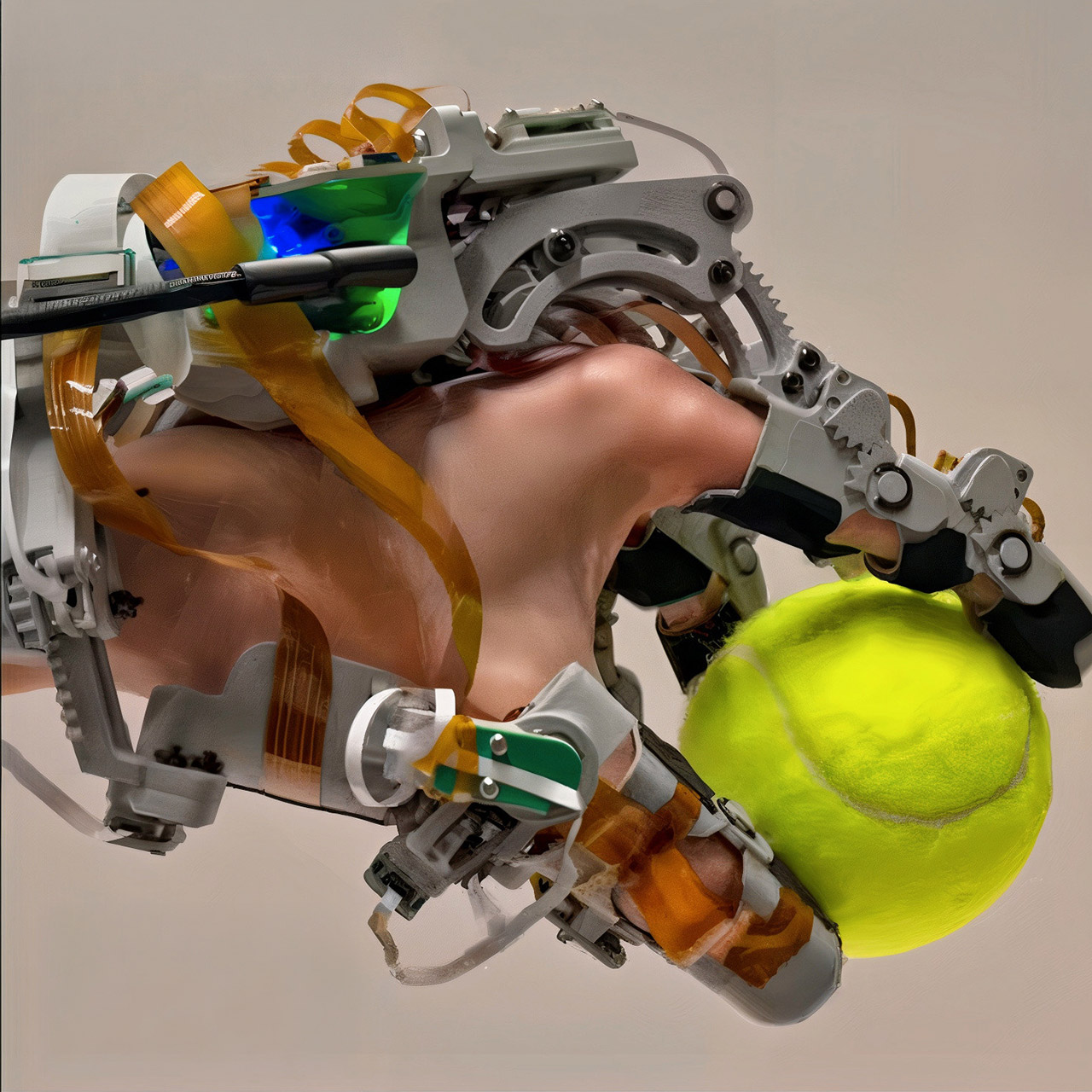
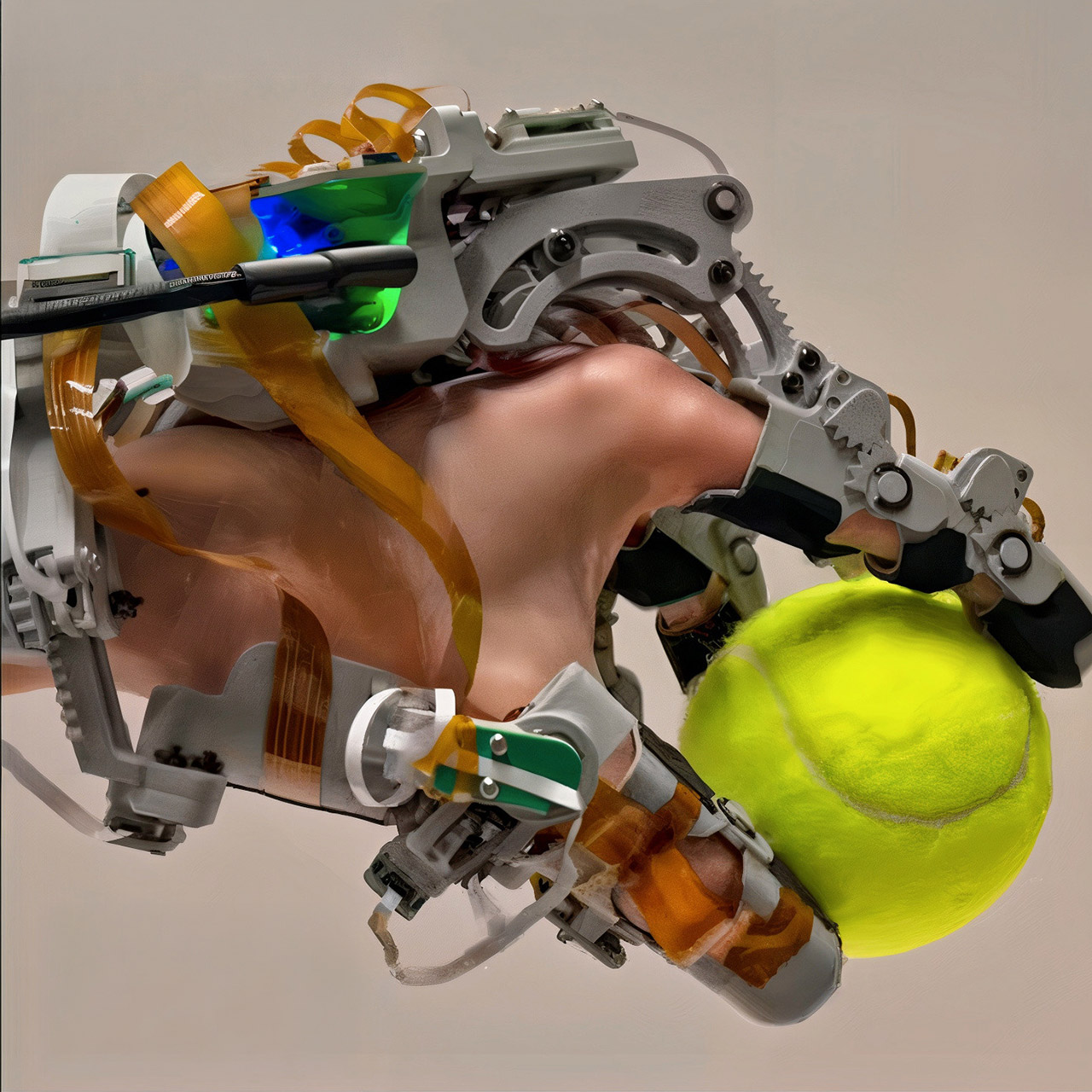
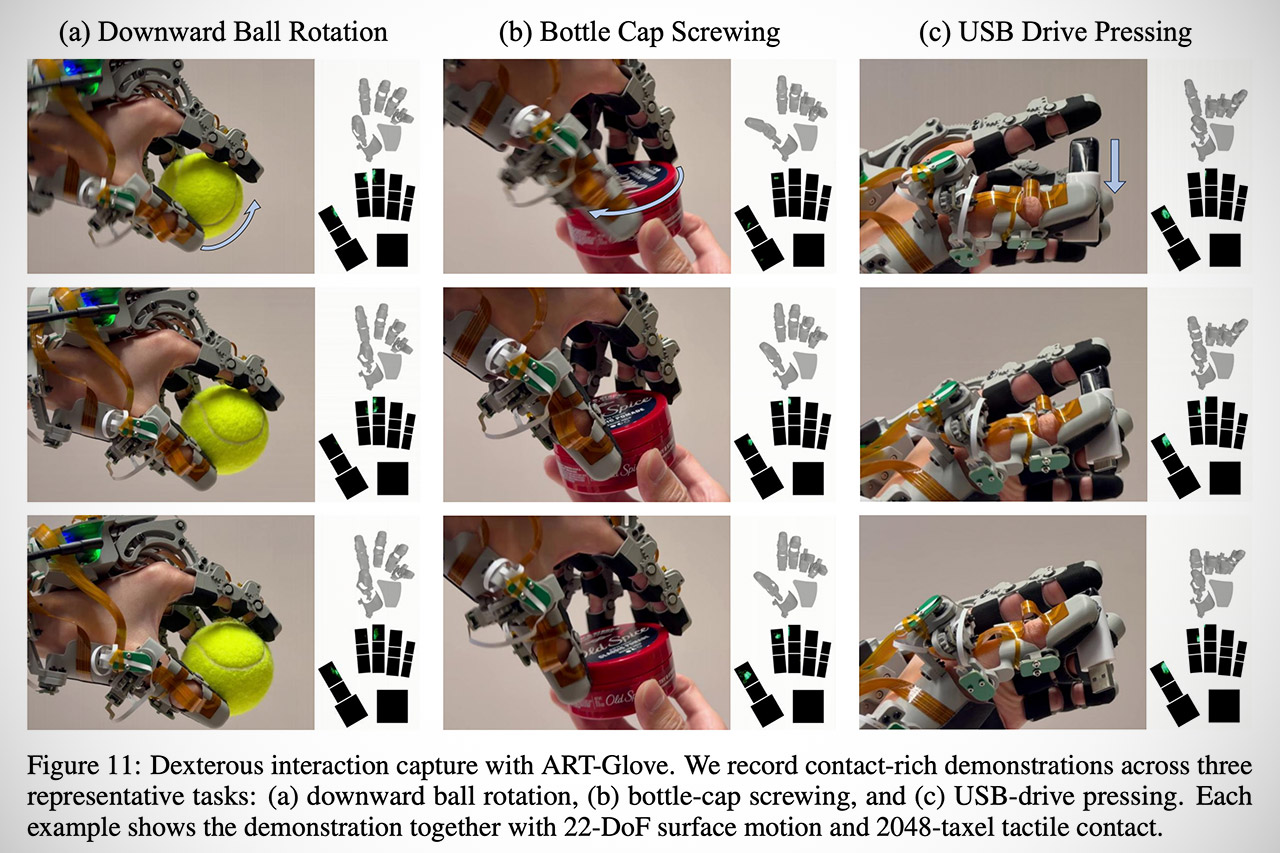
Researchers at Carnegie Mellon University built a wearable system that captures both the exact movements of a human hand and the precise locations and forces where it presses against objects. The device, called ART-Glove, or Articulated Tactile Glove, tackles a long-standing gap in robot training. Robots have grown skilled at seeing their surroundings through cameras, yet they still struggle when tasks require careful contact, variable grip force, or coordinated finger adjustments during everyday actions like turning a key or unscrewing a cap.
The majority of current models for collecting demo data result in an uncomfortable trade-off. Teleoperation setups provide robot-ready orders but frequently exclude the natural sensation of a hand, leaving you feeling like you’re in a robot. Pure video recordings keep your hand free, but contact information remains a mystery, inferred at best with limited reliability. Soft sensing gloves provide some pressure data, but their exact shape varies with each wearer, making it difficult to translate it onto a robot hand.
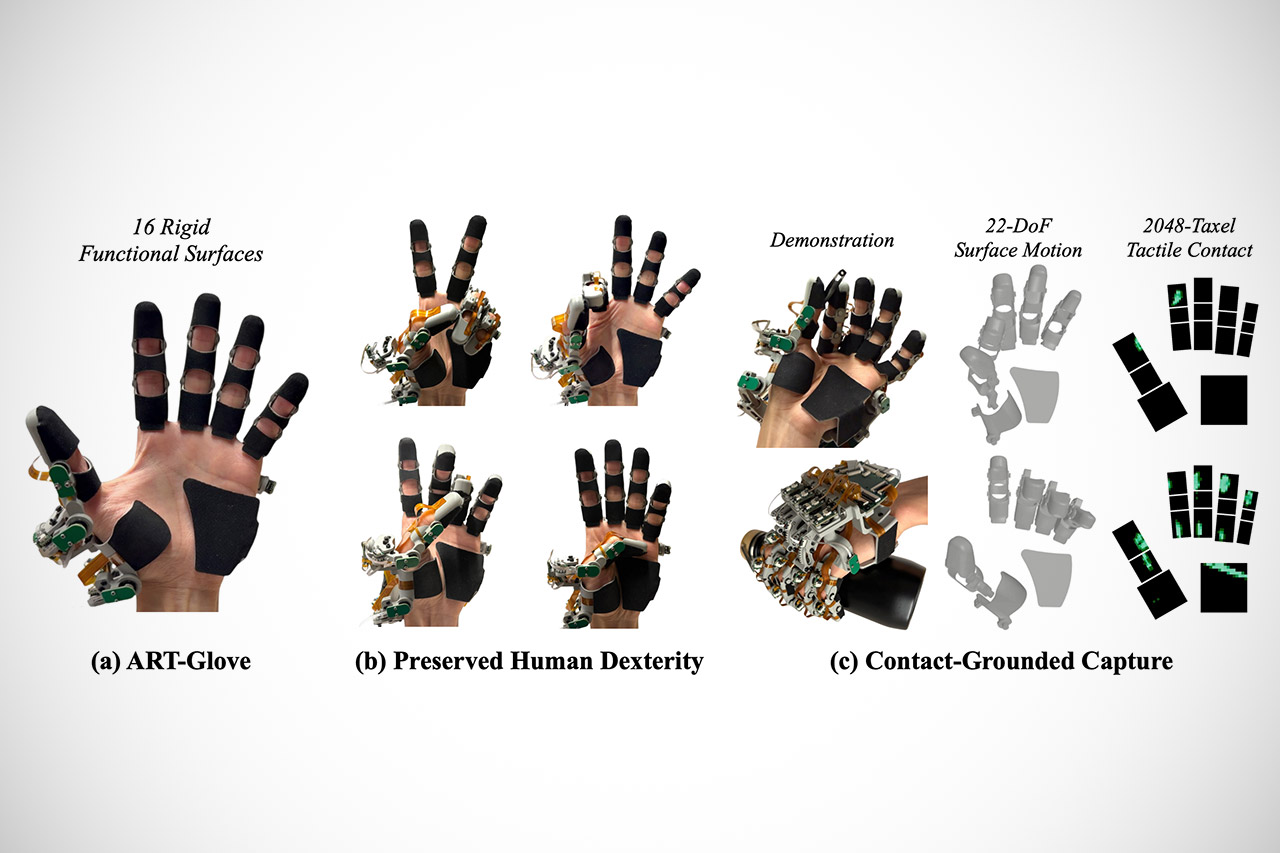
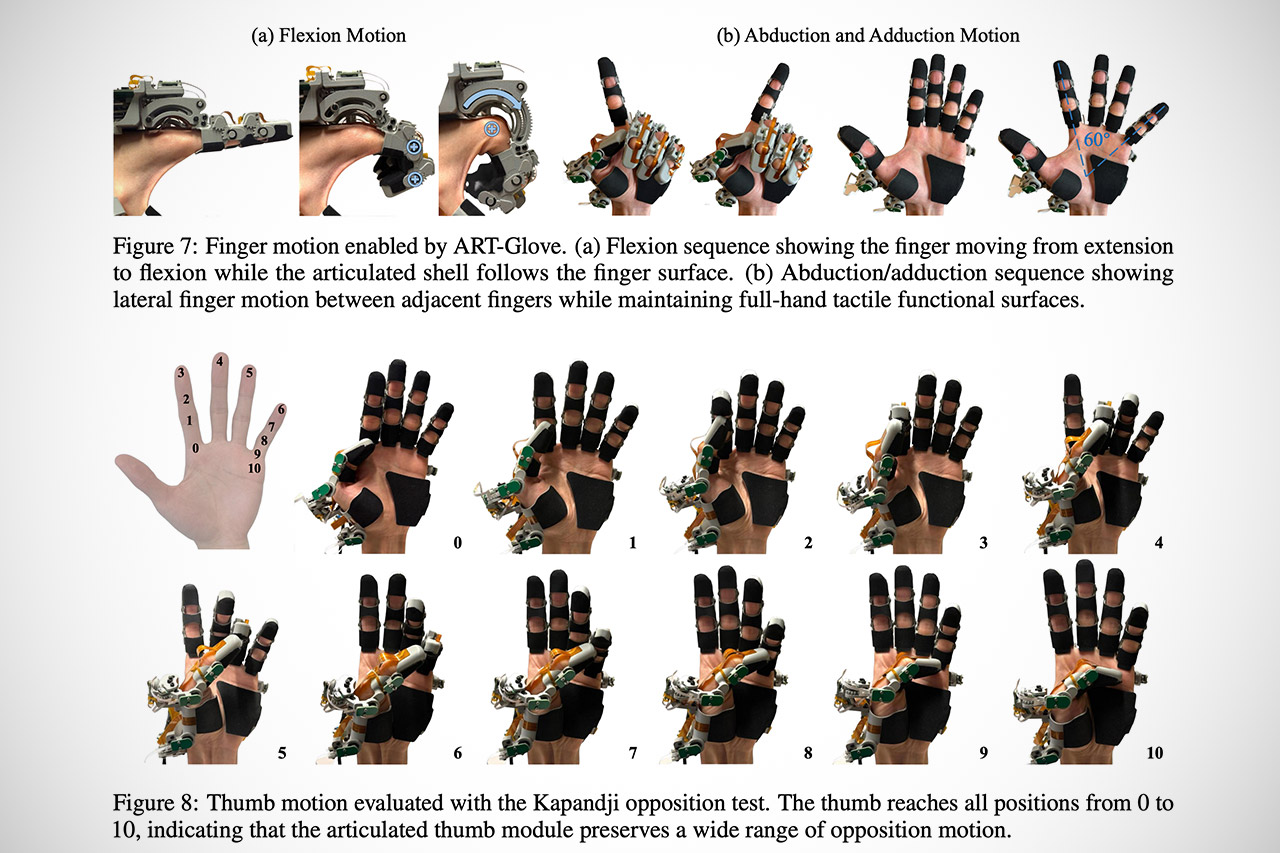
ART-Glove avoids these issues by utilizing a hybrid technique. The primary contact zones on your hand are covered by 16 hard surfaces: three on each finger, three on the thumb, and a broader one across the palm. These pieces provide a recognized geometry on the hand side of things, so any recorded touch contains explicit information about where exactly on the hand the contact occurred and at what angle, among other things. The rigid sections are linked together by 22 joints, all of which are aligned with real human hand anatomy, including multi-axis rotations at the thumb base. They’ve also managed to keep the size down while maintaining natural motion by developing three separate joint systems. Some are rather simple, consisting of shafts and sleeves with gears that transfer to encoders on the back of the hand. Others employ direct bearings or curved slots to provide tighter clearances. All of this is tracked by magnetic rotary encoders, which add no additional friction or wear points.
Each hard surface is now covered with a thin piezoresistive layer. Each of these seven flexible circuit modules contains 2048 separate pressure-sensing devices, or taxels, as there is a lot of pressure sensing going on. These sensors monitor real-time force distribution over the hand. On the back of the glove, there’s also a small STM32 microprocessor that reads both the joint encoders and the entire tactile array before synchronizing everything at 120 samples per second. You’ll get a live output stream with 22 degrees of freedom in joint motion, as well as high-resolution pressure maps.
When someone puts on the glove and completes a task, the system records the entire physical story. During a ball rotation exercise, for example, it demonstrates how the contact points vary constantly to keep the force in line with gravity. When someone screws a bottle cap, the pressure patterns begin to move and intensify as the fingers adjust their grip and torque. Pressing a USB drive into a port demonstrates a coordinated multi-finger grab followed by localized pushing force. All of this appears in its own chronology, with a reference to the specific location on the surface where contact occurred. [Source]
In every CNET TV review, I compare three or more similar TVs side by side in a dedicated, light-controlled test lab. With each review, I employ a rigorous, unbiased evaluation process that has been honed by more than two decades of TV reviews. I test TVs with a combination of scientific measurements and real-world evaluations of TV, movies and gaming content.
To ensure I can evaluate the picture quality of every TV, I connect each one to an AVPro Connect 8×8 4K HDR splitter so each one receives the same signal. I test the TVs using various lighting conditions, playing different media, including 4K HDR movies and console games, across a variety of test categories, from color to video processing to gaming to HDR.
In order to measure each TV, I use specialized equipment to grade them according to light output and color. My hardware includes a Konica Minolta CS-2000 spectroradiometer and a Murideo Six-G 4K HDR signal generator. I use Portrait Displays CalMan Ultimate software to evaluate every TV I review according to its brightness, black levels and color.
Advertisement
The Leo Bodnar Lag Tester samples three regions of the screen for latency, and these are averaged to give each TV’s lag score
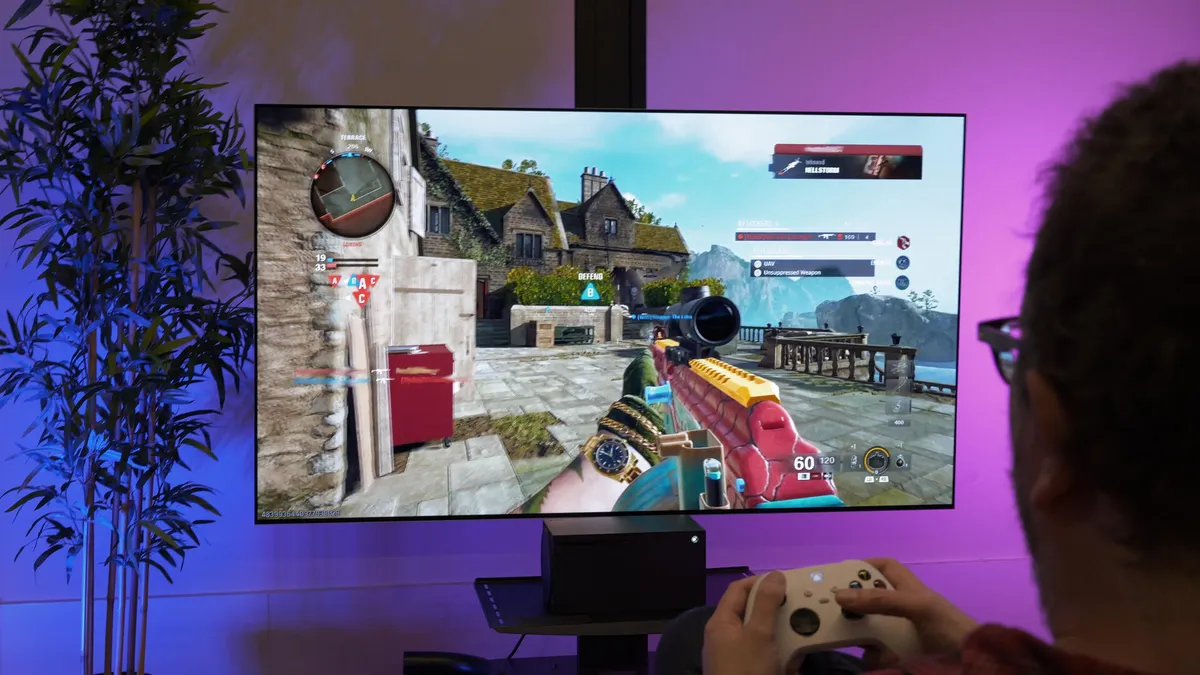
I play a variety of games from an Xbox Series X or PlayStation 5, and note the effects of gaming modes and settings as well as the 4K/120Hz and VRR input capabilities. Helpfully, the Xbox includes a 4K/120Hz and HDR compatibility test: Settings>TV and display options>4K TV details. The page will detail the HDR modes it supports (including Dolby Atmos) and whether it will support VRR — if a TV gets ticks in all the boxes it means it has the best compatibility with high-end Xbox games.
Our reviews also account for such things as features, design, smart TV performance, connectivity including HDMI inputs and gaming compatibility.
Measuring input lag (in milliseconds) is an important component of my process for testing gaming TVs.
Input lag will often be lower in game mode than in any other mode on your TV. Here are a few more gaming-specific aspects I looked at for each TV.
How to turn on game mode. In most cases, viewing in game mode isn’t automatic, so you’ll have to turn it on manually, and sometimes the gaming monitor setting can be difficult to find. Many use a picture mode called “Game” while some, like Samsung and Vizio, let you apply game mode to any setting.
Advertisement
Sarah Tew/CNET
Game mode makes a difference, but not at all frequencies. As you can see in the table above, many TVs cut lag substantially when you turn on game mode, but plenty don’t. In general, expensive TVs with elaborate video processing get more of a benefit when you engage game mode. Additionally, and as I noted above, the Boost mode on LG OLEDs only works on 60Hz and not 120Hz.
Most TV game modes are good enough for most gamers. No matter how twitchy you are, it’s going to be tough to tell the difference between 10 and 30 milliseconds of input lag. Many gamers won’t even be able to discern between having game mode on and off — it all depends on the game and your sensitivity to lag.
Turning game mode on can hurt image quality (a little). TV-makers’ menus often refer to reduced picture quality. Reduced picture quality is generally the result of turning off that video processing. In my experience, however, the differences in image quality are really subtle with console gaming, and worth the trade-off if you want to minimize lag for a great gaming experience.
4K HDR gaming lag is different from 1080p. The display resolution you play at has an impact, and since new consoles prominently feature 4K HDR output for games, I started testing for 4K HDR lag in 2018. In general, the numbers are similar to the lag with standard 1080p resolution, but as you can see from the chart above, there are exceptions.
Testing is an inexact science. I use Leo Bodnar lag testers. Here’s how they work, and how I use them. I use two of these Bodnar lag testers — one in 1080p and one in 4K HDR — which use onboard optical sensors to measure and report input lag. When plugged into an HDMI port, the Bodnars make the screen flash in three different places and you place the unit’s onboard optical sensor flush onto the screen at these points. They calculate the lag at each position and you average the three readings to get a score. You might see different lag test results from different review outlets, which may use Bodnar or another method.
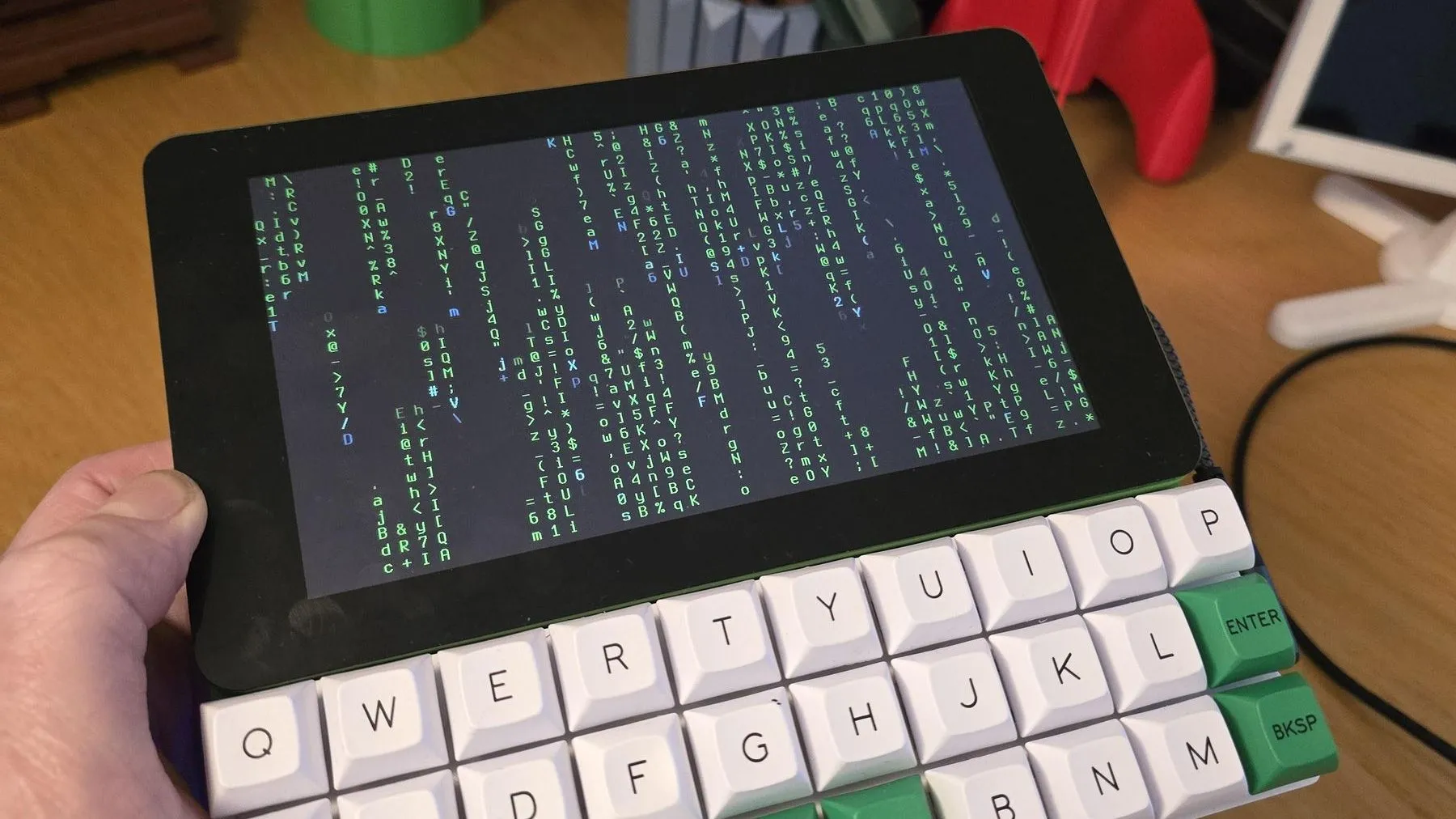
The cool thing about cyberdecks is that you get to design them to suit your personal tastes. [NickZero] wanted an ultra-minimal build, and set about putting together just that.
The build is based around a Raspberry Pi Zero 2W, which has a lighter power draw than the full-fat models at the trade-off of some processing power. Since it’s a W model, it has the benefit of wireless connectivity baked in from the factory. The Pi is paired with a Gherkin 30% layout keyboard kit, which neatly matches the 7″ Waveshare touch display in width. Power is courtesy of a juicy 4000 mAh lithium-ion cell, which is taken care of by an Adafruit Powerboost 1000 charger module. Everything is then laced up together inside a nifty 3D printed case.
It’s a simple cyberdeck, and one that’s probably quite satisfying to use when you get used to the fact that there are no number or modifier keys on the ultra-cut-down keyboard. It’s also a great example of how a bunch of off-the-shelf gear can nonetheless be assembled into quite a cohesive whole. In much the opposite way, we’ve seen some maximalist cyberdeck builds lately, too.
VSCO is making a bigger push into professional photography with the launch of Studio Pro, a new editing app designed for photographers handling large volumes of images.
The app arrives alongside a new VSCO One subscription bundle. This subscription will cost $500 per year. As a result, it puts the app in direct competition with Adobe’s creative software ecosystem, which dominates the industry.
Available now on iOS, with a macOS version due later this year, Studio Pro is aimed at photographers who regularly work on projects such as weddings, sports events, portraits and school photography. Rather than focusing on casual edits, the app is built around streamlining larger workflows.
At launch, Studio Pro includes tools for batch editing, allowing users to apply adjustments across multiple images at once. It also offers a style-matching feature that can replicate the look of a reference image across an entire shoot. Furthermore, photographers can share finished work through VSCO Galleries. This gives clients a dedicated place to view and access images.
Advertisement
VSCO says this is only the beginning. Future updates are expected to add RAW photo support, more advanced export controls, aspect ratio adjustments and additional editing tools aimed at professional users.
Advertisement
The launch is closely tied to the company’s new VSCO One subscription, which bundles together its growing collection of photography tools and services. In addition to Studio Pro, subscribers will gain access to Capture, Galleries, Workspace, Sites, AI Lab and Canvas. They will also have access to VSCO’s Freelance Photographer mentorship programme.
The company is positioning VSCO One as an alternative to what it describes as the “fragmented” workflow many photographers currently deal with. In this fragmented workflow, editing, client communication, image delivery and portfolio management often require several different platforms.
Advertisement
At $500 annually, the subscription won’t be for everyone. However, the pricing places it broadly in line with an annual Adobe Creative Cloud Pro subscription. This makes it clear who VSCO is targeting.
Most of the AI industry is betting that bigger models mean smarter machines. A new startup is betting the opposite.
Aether AI, based in San Diego, has raised a $20mn seed round to chase a different idea entirely. Its founder thinks the next leap will not come from scale. It will come from teaching machines cause and effect.
Correlation versus causation
Today’s big models learn by spotting patterns in huge piles of data. That works well in the lab. But it can wobble in the messy real world, where a statistical shortcut quietly fails.
Aether wants machines to grasp the mechanisms behind events instead. Its “causal world models” are meant to let a system reason about what would happen if it acted, before it acts. The company says this makes AI more reliable and far less data-hungry. The thesis sits squarely in the wider debate over whether AI’s progress is starting to stall.
The first target is physical AI and robotics. The logic is neat. Every move a robot makes is an intervention in the world, so errors show up at once as dropped objects or failed tasks.
Advertisement
That makes robotics a brutal test for causal reasoning. Aether’s long-term goal is a single “causal brain” that could steer many kinds of robots. It is a crowded ambition, with everyone from Google DeepMind’s world models to Jeff Bezos’s $10bn physical-AI lab chasing the same prize.
A serious pedigree
The founder gives the bet credibility. Biwei Huang is an assistant professor at UC San Diego and a known name in causal discovery. She created the open-source tools Causal-Learn and Causal-Copilot, and has published widely at the field’s top venues.
Aether also invokes the founders of modern causality, naming Judea Pearl, Bernhard Schölkopf and others as supporters of its work. The round was led by MPCi, with Inno Angel Fund, SWC Global and Unity Ventures joining.
Why it matters
Causality is one of AI’s oldest unsolved problems, and turning it into a product is hard. So the caveats matter. Aether’s early results are its own, not peer-reviewed, and $20mn is small against the billions pouring into rival labs. Its backers are mostly Asia-based funds, not the usual Silicon Valley names.
Advertisement
Still, the idea lands at a useful moment. Doubts about pure scaling are growing, and robots keep stumbling on tasks that look simple to humans. If causal models really do cut the data needed and improve reliability, they would matter well beyond robotics. That is a big “if”. But it is the kind of bet worth watching.
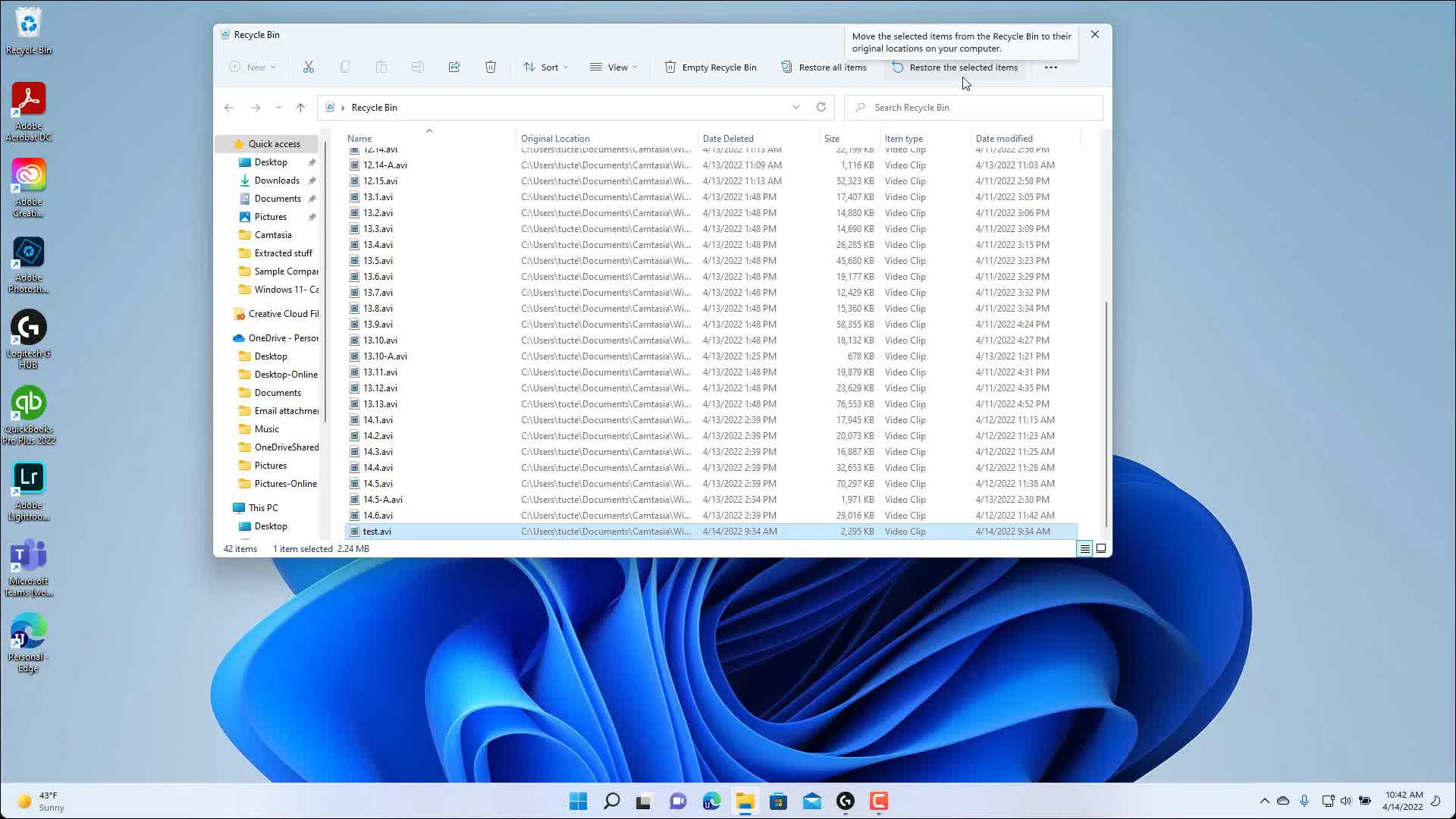
Facepalm: Microsoft has acknowledged a strange Recycle Bin bug affecting Windows 11 following this month’s Patch Tuesday update. Users have reported several other issues since the June 2026 update rolled out earlier this week, but this is the only bug Microsoft has officially confirmed.
According to Microsoft, users who have installed the KB5095051 update might encounter a strange Recycle Bin bug that replaces the names of deleted files with internal Recycle Bin filenames in specific situations. When permanently deleting a single file from the Recycle Bin, the confirmation dialog displays a cryptic internal filename, such as $Rxxxxx.ext, instead of the original filename, such as realfilename.txt.
However, the bug only affects the confirmation dialog, as the Recycle Bin window continues to display the original filename. Restoring the item also reportedly returns it to its original location with the correct filename. Despite the incorrect filename shown in the confirmation dialog, the file is still deleted as expected once the action is confirmed, meaning the bug does not cause any significant usability issues.
Microsoft says a workaround is available for affected devices, but only commercial users can deploy it for now. To obtain additional details on how to mitigate the issue, system administrators must contact Microsoft Support for Business. Everyone else will have to wait for a permanent fix, which Microsoft says will be delivered in a future Windows update.
Advertisement
Despite Microsoft’s recent emphasis on improving the Windows user experience, the operating system’s updates continue to be plagued by bugs and reliability issues. According to posts on Microsoft’s official forums, the June 2026 update has introduced a variety of annoying bugs, including problems accessing OneDrive and Dropbox. IT administrators are also reporting sluggish File Explorer performance across hundreds of PCs in their organizations.
Some HP users are reporting random BSODs after installing the update, while Lenovo users say their PCs freeze even under moderate workloads. Additionally, one IT administrator claims the update is triggering BitLocker Recovery on devices configured with local accounts and says a Microsoft support chatbot told them the only solution is to wipe the computer and reinstall Windows.
Crystal ball: The company accused of making Pokémon copycats “with guns” says it is not interested in using generative AI in its games. It argues that gamers are largely opposed to this kind of content, while noting that generative AI is likely to remain a controversial topic in the industry for a range of reasons.
The debate around AI-generated assets in games is heating up, and Pocketpair has already taken a clear stance. The Japanese studio, best known for Palworld, says it is not using generative AI in its games, arguing that potential customers are rejecting “fake” assets and other AI-generated content.
In a recent interview, Pocketpair’s Head of Publishing & Communications John Buckley said that “gamers don’t want it.” And “if the gamers don’t want it, I guess that’s it, right? Not much of a conversation to be had.”
The Palworld developer has previously faced accusations of both plagiarism and the use of generative AI in creating some of the game’s assets and creature designs. Nintendo is pursuing legal action against the studio, though the dispute has not unfolded entirely in the company’s favor so far.
Advertisement
During the interview, Buckley also said that some developers are already using generative AI in their games. However, he believes the trend is not yet widespread, and added that Pocketpair has no interest in extensively adopting the technology in any case.
Some companies are exploring chatbots and large language models to save time and reduce reliance on human creators, but growing public pushback suggests the generative AI “bubble” could eventually burst. Pocketpair already has all the in-house artists it needs, Buckley said, arguing there is no “pointless” reason to replace staff with AI systems doing the same work.
The controversy around generative AI in gaming continues to intensify. Established studios such as Crystal Dynamics have found themselves explaining the use of AI-generated assets as placeholders in the latest Tomb Raider remake. Meanwhile, Sega faced significant backlash after introducing the new Crazy Taxi game as an AI-assisted production.
Steam now requires developers to disclose whether and how they have used AI in their games. Epic Games CEO Tim Sweeney, however, has argued that Valve’s disclosure requirement is unnecessary, claiming that nearly all future games will incorporate generative AI in some form.
Advertisement
Pocketpair’s John Buckley is less convinced by Sweeney’s stance. He suggests the industry could eventually split, with some studios leaning into a heavily marketed “human-made” identity as a response to growing concerns over “AI slop” in digital storefronts. He also believes AI adoption could become a regional divide.
Developers in parts of Asia, including China and South Korea, may adopt AI more rapidly than competitors, while Western studios – and players – remain more resistant. Stellar Blade developer Shift Up has also said that generative AI could help South Korean studios compete with much larger companies in China and the US.
Alogic is bringing more touch and stylus input options to Mac with a new desktop monitor and portable displays, expanding a lineup that adds a feature Apple doesn’t offer on its own hardware yet.
The company unveiled the Aspekt Touch 27 and Folio portable displays at InfoComm 2026, expanding its lineup of touch-enabled hardware for Mac users. Both products let users interact directly with apps, documents, presentations, and creative projects through touch and stylus input.
Alogic is one of the few monitor makers offering touchscreen hardware for Macs. The company uses its own software to enable touch gestures, navigation, annotation, and drawing on macOS.
The Aspekt Touch 27 adds touchscreen input to a desktop monitor
The Aspekt Touch 27 is a smaller version of Alogic’s existing 32-inch model. The new display combines a 27-inch 4K IPS touchscreen with a 60Hz refresh rate, 600 nits of brightness, a 1000:1 contrast ratio, and support for 97% of the DCI-P3 color space, 93% Adobe RGB, and 100% sRGB.
Advertisement
Alogic pairs the display with its Active Stylus, which offers 4,096 levels of pressure sensitivity. The monitor supports 10-point multitouch input and MPP 2.0 styluses, while a magnetic holder wirelessly charges the stylus between uses.
The monitor also functions as a docking station with HDMI 2.0, DisplayPort 1.4, USB-C, Gigabit Ethernet, and a 3.5mm headphone jack. Three USB-C ports, two USB-A ports, dual 5W speakers, and up to 150W of total charging output are built into the display, including up to 90W of USB-C power delivery for a connected laptop.
The Aspekt Touch 27 is available in Silver and Space Black, and buyers can choose from a Raise Stand, a Fold Stand, or an Omni Fold Stand. The Fold Stand lowers the display into a drafting position for stylus use, while the Omni Fold Stand includes an integrated mount for an M4 Mac mini.
Folio targets portable Mac and iPad workflows
Alogic also introduced the Folio and Folio Duo portable touchscreen displays for users who need a secondary screen away from a desk. The standard Folio features a 16-inch QHD IPS touchscreen, while the Folio Duo combines two 16-inch panels into a folding design that can be used side by side or stacked vertically.
Advertisement
A fabric cover doubles as a stand and allows the displays to fold flat for travel.
The Folio Duo
Both models deliver 400 nits of brightness, a 1000:1 contrast ratio, and 100% sRGB color coverage. The displays support 10-point multitouch interaction, stylus input, and full gesture controls on both Mac and Windows.
The portable displays operate over a single USB-C connection and support up to 45W of passthrough charging. A magnetic attachment point wirelessly charges the Active Stylus. The Folio weighs about 1 kilogram, while the dual-screen Folio Duo weighs about 1.2 kilograms.
Alogic says the Folio lineup is the first portable display series to bring full gesture controls and 10-point multitouch support to both Mac and Windows. The company says users can draw, annotate, and edit content directly on screen without moving projects between a computer and tablet.
Alogic has spent years targeting users who want touch and stylus input on macOS. The Aspekt Touch 27 and Folio lineup expand those options with both desktop and portable designs.
Advertisement
The Aspekt Touch 27 starts at $1,799 and will be available beginning in July. The Folio is priced at $899, while the Folio Duo costs $1,299. Both portable displays are expected to launch around September.
The neighbourhood’s heritage charm hasn’t saved it from a growing vacancy problem
Walk down East Coast Road on a weekday afternoon, and you might notice something that doesn’t quite fit the postcard image of Katong: shuttered shopfronts, darkened interiors, and “For Rent” signs that have clearly been hanging there a while.
Katong is the area where Joo Chiat Road meets East Coast Road, and it’s known for its hipster vibes—heritage shophouses, popular cafés, and a neighbourhood energy that earned it a spot on Time Out‘s list of the world’s coolest streets in 2025.
But that reputation is increasingly at odds with what people are actually seeing on the ground.
The unexpected side of Katong finally spilt into public view when a Reddit post on r/singapore gained traction. User u/HB_SG asked a simple question: has anyone else noticed the growing number of vacant shop units around Katong?
Advertisement
“An endless parade of opening and closing”
Image Credit: u/HB_SG via Reddit
What the discussion made clear is that the vacancies aren’t new.
The mall, located at the junction of East Coast Road and Joo Chiat Road, closed for renovations in 2020 and only reopened in 2022. Yet years later, some retail spaces remain unoccupied, while others have seen a steady churn of tenants come and go with little fanfare.
One commenter described it as an “endless parade of opening and closing.” Among the apparent casualties are Zero Healthcare, which relocated its East Coast Road showroom to Parkway Parade, and fried chicken brand Frosti Fck, whose last social media activity was a Nov 2025 post and whose Google listing now shows as closed.
Vulcan Post has reached out to both businesses for further comment, but has not received a response at the time of publication.
Advertisement
The Reddit thread kept circling back to one word: rent. One Redditor summed up the prevailing sentiment bluntly: “Rents, rents, rents, rents—no vacancy tax. If rents were halved, everything will be occupied.”
Others pointed to specific examples. One commenter claimed that several shophouses along Koon Seng Road have remained vacant for years despite strong demand in the area, arguing that landlords are holding out for rents that many businesses simply cannot afford.
The issue also appears to extend beyond Katong. In other parts of the East Coast region, including Siglap, rising rents have become a growing concern for business owners. In 2025, it even pushed out several long-running businesses, including Flor Patisserie.
The frustration about retail rents has even reached Parliament. In Apr 2026, Member of Parliament Elysa Chen raised the issue in the House, asking how the government reconciles official data which suggests rent has actually fallen as a share of business costs, with what retailers on the ground are experiencing.
Advertisement
DPM and MTI Minister Gan Kim Yong acknowledged the gap in his written reply: while aggregate rental costs for F&B dropped from 26% to 17% of total business costs between 2019 and 2024, he noted that “at the local level, rental costs can vary for retailers due to attributes such as proximity to key transport nodes or estates with high population density.”
In other words, national averages may look fine, but they reveal little about what an individual business owner is paying for a shophouse in a highly sought-after neighbourhood.
ERA’s 1H 2025 shophouse market report also noted that more F&B operators were shutting down, and that a weaker rental outlook might push some landlords, particularly those with less holding power, or private equity investors looking to exit, to start accepting lower rents.
But for many, that moment hasn’t come yet.
Advertisement
Beyond just rent
The roads on Joo Chiat Road are notoriously small. /Image Credit: Vulcan Post via Google Maps
The vacant units around Katong are not the result of a single problem. Beyond rental costs, Redditors highlighted a range of factors that may be contributing to the area’s retail struggles.
Firstly, parking is a nightmare on Katong’s roads. The streets around the area are notoriously narrow—barely two car-widths in places—and roadside parking creates its own bottleneck. On weekends, cars are often caught waiting for a spot to free up, which puts people off before they’ve even stepped out of the vehicle.
Then there’s the heat. Katong’s charm is mostly outdoors, but the dense rows of shophouses create a concrete warming effect that traps heat and humidity. Browsing around on foot in the middle of the day is genuinely unpleasant for most of the year.
The layout of buildings themselves doesn’t help either. Narrow footprints, tight staircases, and without the climate-controlled comfort of a mall, browsing on foot in Singapore’s heat is already a hard sell. Moreover, bus services through the smaller back streets are also sparse, limiting how easily people can get there without a personal vehicle.
Lastly, the gradual gentrification has narrowed the appeal of Katong. Several commenters pointed out that the shop mix has drifted toward expensive, Instagram-friendly concepts—the kind of places influencers visit once for the photo, not twice for the overpriced food. When the locals themselves don’t want to patronise the local shops, the foot traffic problem starts to make a lot more sense.
Advertisement
On top of all that, these aren’t units you can just slap a fresh coat of paint on and hand to a tenant. Shophouses fall under conservation rules, meaning any renovation requires engaging a qualified person, submitting drawings to URA, getting conservation approval, and then separate BCA permits for structural work.
Shophouses along East Coast Road./ Image Credit: Singapore Realtors Inc.
This is where the broader market context matters.
ERA’s data shows that landed shophouse transactions fell to just 34 in H1 2025, totalling S$234.7 million—the lowest half-year figure since 1998, and a steep fall from the peak of 245 transactions worth S$1.8 billion in 2021. District 15, which covers Katong and Joo Chiat, saw only four transactions in that period.
Many of the landlords sitting on empty units aren’t being stubborn for no reason—they’re caught in a bind.
Advertisement
For owners who bought at high prices, the rent they collect helps determine the property’s investment returns. Accepting a significantly lower rent may reduce their yield and potentially affect how the property is valued when they refinance or sell.
That creates a difficult trade-off: some landlords may prefer to wait for a tenant willing to pay closer to their asking price rather than lock in a lower rent that changes the financial assumptions behind the investment.
The problem is that prolonged vacancies carry their own costs. Empty storefronts can weaken a street’s vibrancy, reduce foot traffic, and eventually make it harder for landlords to attract the quality tenants needed to revive the area.
The empty units are hard to ignore
What the Reddit thread captured, more than any single data point, is a lived sense of mismatch: a neighbourhood with genuine heritage value and cultural cachet that isn’t consistently translating into a viable environment for the businesses trying to operate there.
Advertisement
Whether the fix requires lower rents, a vacancy tax to nudge landlords off the sideline, better infrastructure, or pedestrianising the area altogether, locals are clearly paying attention, and the patience for empty units is wearing thin.
For now, the “For Rent” signs stay up.
Read other articles we’ve written on Singaporean businesses here.
Featured Image Credit:u/HB_SG via Reddit/ Visit Singapore
The UK’s top data and AI regulator has resigned. It is the first time it has ever happened.
John Edwards stepped down as information commissioner on Friday, with immediate effect. His exit followed a months-long workplace investigation. He said his position had become “untenable”.
What he admitted
Edwards was careful in his statement, posted on LinkedIn. He said there had been “occasions where I exercised poor judgement and made attempts at humour that were inappropriate and caused offence”. He also said he disagreed with how the investigation had been run.
Crucially, the details remain hidden. Neither the regulator nor the government has said what the conduct actually was. The probe began in February over unspecified “HR matters”, and concluded this month with a finding that there was “a case to answer”.
The job matters more than the man. The Information Commissioner’s Office oversees data protection, freedom of information and AI in Britain. It can fine companies up to £17.5mn, or 4 per cent of global turnover. It also sets the rules on how companies handle Britons’ personal data, and recently hit Reddit with a £14mn penalty over children’s data.
Advertisement
His departure is also a historic first. The office has existed since 1984, and no commissioner had ever resigned before, one data-protection lawyer noted. So Britain’s data and AI watchdog is now without a permanent chief, while a deputy keeps things running.
A regulator already under fire
The timing is awkward. Campaigners have been attacking the ICO as toothless, accusing it of brushing aside thousands of public complaints. One group called Edwards’s exit a chance to appoint “a regulator with teeth”.
The post is also about to change shape. Under new UK law, the role is being folded into a wider Information Commission, and Edwards was expected to leave later this year anyway. His abrupt resignation simply brings that reset forward, in far less flattering circumstances.
Why it matters
Edwards used his farewell to look ahead, not back. “As the AI tsunami breaks over us, we must redouble … our collective efforts to ensure safety, accountability, and trust online,” he wrote. He added that “no single organisation or country can address these challenges alone”.
Advertisement
For the tech industry, the real question is who governs AI and data in Britain next. The answer is suddenly unclear, just as governments everywhere fight over how to rule AI, and even as the EU’s own AI rulebook keeps slipping. A strong successor could sharpen enforcement. A weak one could prove the critics right. Either way, Britain has lost its data chief at an inconvenient moment.






















![Young Thug - Money On Money (feat. Future) [Official Video]](https://wordupnews.com/wp-content/uploads/2026/04/1776012320_maxresdefault-80x80.jpg)
























You must be logged in to post a comment Login