At sundown on Monday, Purim begins; a holiday rooted in survival, marking the Jewish people’s narrow escape from annihilation in ancient Persia. The story, told in the Book of Esther, is not subtle. A Persian court insider, named Haman convinces the king that the Jews must be wiped out. A young queen named Esther risks everything, steps forward, and turns the tide. Hamantaschen for everyone and don’t even think about handing me one that isn’t filled with poppy seed.
Two and a half millennia later, history has a way of sounding uncomfortably familiar.
With hostilities resuming between Israel, the United States, and the Islamic regime in Tehran, the rhetoric stopped being theoretical and the missiles started flying. As Iran’s retaliation unfolded on Sunday, a ballistic missile struck Beit Shemesh, just west of Jerusalem, and in that instant, the war was no longer a headline scrolling past. It was immediate. It was personal. I put the pen down. I stopped writing. I called family. Nine neighbours were murdered in that strike. Politics disappears when your phone starts ringing and you’re counting names.
Believe what you believe about governments and geopolitics. But no people should live under the shadow of missiles or under a regime that exports death. May the Iranian people one day live in freedom and without fear. They deserve better than this nightmare.
And yet here we are, covering Paramount swallowing Warner Bros, Qobuz drawing a line in the sand over AI, Empire Ears going dark, AMC and indie theaters fighting for oxygen. The media and hi-fi worlds keep spinning. Deals get signed. Products launch. CEOs posture. But this week is a reminder that none of it exists in a vacuum. Not the mergers. Not the music. Not the movies. Not us.
Advertisement
Paramount Wins Warner Bros While Netflix Walks
For the past few months, the future of Warner Bros. Discovery was negotiated behind closed doors; over private dinners in Los Angeles, New York, and Washington, with lawyers murmuring, investors hovering, and regulators quietly keeping score. That maneuvering is over. Paramount has secured the company, with the board approving the deal late on February 26, 2026. David Ellison stayed in the fight. Netflix’s CEO chose not to counter within the allotted window rather than ignite a bidding war.
All of it unfolded under the watchful gaze of the Trump administration, where antitrust scrutiny and political leverage made clear that no media empire moves without federal gravity. Paramount won. Netflix stepped aside. Now the real battle for your wallet begins.
Control of Warner Bros. Discovery means control of one of the deepest libraries in modern entertainment — films, franchises, cable networks, news divisions, and streaming platforms that have defined multiple generations. The dollars matter. The regulators matter. The politics matter. But beneath all of that is a larger shift: power in Hollywood is consolidating fast, and the streaming hierarchy is being rewritten in real time.
Now comes the part nobody puts in the press release. HBO Max, TNT, CNN, Warner Bros. Television, DC, and a sprawl of international assets have to be folded into a single operating strategy. Tens of thousands of jobs sit under that umbrella. Overlap will be cut. Billions in costs will be slashed. Paramount has made it clear this must turn profitable quickly and before its own board starts asking hard questions. With more than $110 billion in enterprise value and obligations tied up in this ecosystem, there is no room for sentimental restructuring.
Advertisement
Hollywood is not easing into a new era. It’s being forced into one.
Consolidation at this scale doesn’t lead to kumbaya town halls and better consumer bundles. It leads to layoffs. Platform convergence. Redundancies circled in red ink. Expect overlap to be cut aggressively and quickly. If HBO Max survives as a standalone brand under Paramount’s roof, it will be a minor miracle. The far more likely outcome is a folding into Paramount+, some Frankenstein hybrid pitched as “value.” As for the rest of the television portfolio under the umbrella; TNT, TBS, legacy cable properties, their long-term fate is anything but secure.
Advertisement. Scroll to continue reading.
And then there’s CNN. That’s the real live wire. Owning CBS News and CNN hands one studio extraordinary influence over the tone, framing, and velocity of national news coverage. That level of concentration will not go unnoticed. CNN’s ratings are soft even on a good week. Its on-air talent is expensive. Very expensive. Does Paramount maintain two separate news divisions? Do they merge them into something unified with a very prominent “C” at the beginning? No one at CNN is sleeping particularly well right now.
Advertisement
It’s difficult to imagine that decision unfolding quietly or without casualties; Bari Weiss has every reason to be smiling right now, knowing that after selling The Free Press to Paramount and stepping into control at CBS News, she now holds the professional fate of many who once lined up to attack her.
The ripple effects extend to theaters. Both Netflix and Paramount made promises during the bidding process about theatrical commitments, windowing strategies, and respect for exhibition. We’ll see. The length of theatrical runs before titles shift to streaming is now a corporate lever, not a creative one. If windows shrink below three weeks, exhibitors, especially chains like AMC are going to feel it fast. Theaters are already operating on thin margins. Compress the window and you accelerate the decline.
Then there’s physical media — the part enthusiasts still care about. As buyers of discs, many of us felt marginally safer with Paramount controlling Warner’s catalog. But let’s not kid ourselves. What was once a multi-billion-dollar category is now a thin, diminished version of itself. Outside of specialty labels like The Criterion Collection, Arrow Video, and Kino Lorber, mainstream studio releases in 2026 are lucky to hit low six figures in unit sales. Low. Six. Figures. For companies the size of Paramount and Warner, that’s a rounding error tolerated, not prioritized.
Talent is the final pressure point. Do we really believe someone like James Gunn who has been openly critical of President Trump — remains comfortably in place at DC when Ellison did not win this fight without political gravity on his side? Maybe. But Hollywood loyalty lasts exactly as long as leverage does. Don’t be shocked if Gunn finds his way back to Marvel or under the Disney umbrella where the corporate alignment is cleaner.
Advertisement
This is what monumental change actually looks like. Jobs will disappear. Platforms will merge. Newsrooms will consolidate. Theatrical windows will compress. Physical media will shrink further into boutique territory. And consumers? They won’t be the primary beneficiaries. Power has concentrated. Now we find out what that concentration costs and don’t expect the bill to be lower than what you’re paying now.
Qobuz Cracks Down on AI Content to Protect Artists
AI music is no longer some nerdy weird science experiment in a lab. It is a content factory running three shifts before its workers head out to Waffle House for eggs, grits, and fisticuffs.
Streaming platforms are getting buried under machine generated tracks. Endless ambient playlists by artists who have never seen a sunrise. Jazz trios that have never boozed it up and fought backstage over a set list. Singer songwriters with flawless pitch and the emotional range of a toaster. Upload by the truckload. Tweak the metadata. Scoop up fractions of a penny at industrial scale.
Advertisement
If that sounds familiar, it should. It is basically the subplot of Office Space. Skim a microscopic amount from each transaction and hope nobody notices until the money adds up. Except this time it is not Initech. And there are no conjugal visits. It is the global music ecosystem. And the people getting screwed over are real musicians trying to pay the rent and afford health insurance. Spotify has been playing whack a mole with this stuff for a while now and they’re not winning. When the system rewards sheer output, you get a flood. Not art. A flood. Quality gets shoved to the curb and the consumer gets stuck listening to garbage they really didn’t want to pay for.
That is the mess Qobuz is stepping into.
Earlier this month Qobuz rolled out its AI Charter, which was easy to applaud and just as easy to ignore. Instead of leaving it as a mission statement, they built a proprietary detection system to scan the catalog and flag music that is one hundred percent AI generated. Not “possibly.” Not “we think so.” Tagged. Labeled. Out in the open. Those identifiers will begin showing up across the apps in the coming months so you actually know what you are listening to.
Qobuz is also tightening the screws on fraud. Impersonation attempts. Streaming patterns that look like they were engineered in a basement server farm in Tehran. The company is expanding its detection tools so if something smells off, it does not get the benefit of the doubt. It gets flagged, refused, or removed. And those fake streams do not count toward royalty reports. Good luck getting Spotify to offer up something like that.
Advertisement
Advertisement. Scroll to continue reading.
On the editorial side, Qobuz is keeping actual humans in the driver’s seat. Real editors picking Albums of the Week. Real teams building playlists and Qobuzissimes. No content mill dumping twenty thousand tracks into the hopper and hoping the algorithm gets bored enough to promote one. The Discover page will lean on curated data from in-house teams and trusted music labels.
And here is the line that will make certain tech executives roll their eyes. Qobuz says it will not generate audio for its catalog. It will not replace human curation with AI systems and not use customer data to train external AI models. That almost feels like open rebellion against the Emperor.
Why should you care?
Advertisement
Because the money is not theoretical. A 2024 CISAC study projected that by 2028 music creators could lose around ten billion euros over five years due to AI competition and unlicensed use of their work. At the same time, generative AI companies could be pulling in billions annually from that same ecosystem. None of that sounds like a win for the artists who create real music and don’t be surprised when that becomes an even uglier fight for screenwriters, actors, and cinematographers.
The WGA and SAG have already gone on strike to fight against these practices and if you think studios undergoing acquisition and consolidation will continue to spend hundreds of millions on individual films when they can produce 10 for the same price using AI — you’re about to find out that profits matter more than quality.
For artists, this is survival. If machine output floods playlists and crowds out real musicians, visibility collapses and compensation shrinks even further. For listeners, it is about knowing whether the song you love was written by someone with rent due or generated by a prompt and a power bill.
Qobuz Deputy CEO, Georges Fornay explained that “the hyperinflation of AI content is creating distrust across the industry.” He is not wrong. When everything looks and sounds polished, authenticity becomes the differentiator.
Advertisement
Qobuz is betting some of you still care who made the music. In a business chasing endless content like it is oxygen, backing humans is slower and messier. You didn’t sign up for synthetic background noise pretending to be art so it will be interesting to see if the rest of the market follows or bends the knee.
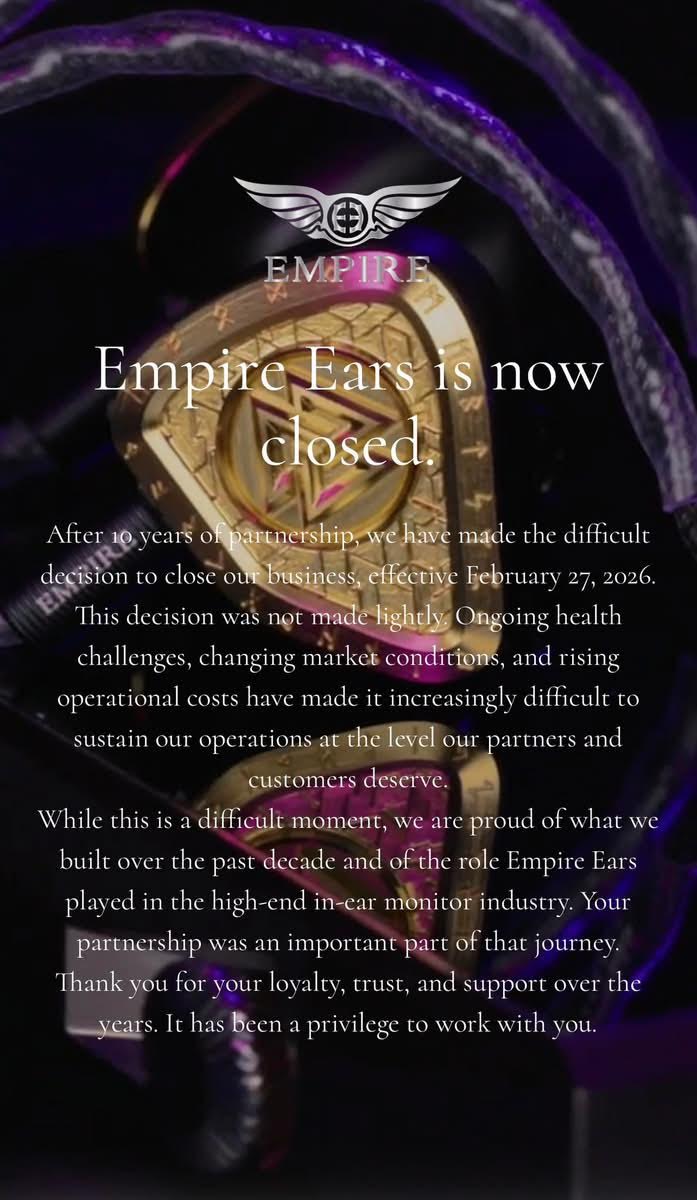
Empire Ears Shuts Down After 10 Years in the High End IEM Market
Empire Ears, a name that meant something in the boutique, high-end IEM world — is gone. After a decade of carving out a reputation for sonic excellence and obsessive craftsmanship, the brand quietly shut its doors on February 27, citing health challenges, rising costs, and an increasingly inhospitable market. For enthusiasts who watched Empire’s cables and custom monitors become fixtures on enthusiast wish lists, this is not a footnote. It’s a sign.
And let’s be honest: not all is well in the high-end wired IEM market.
Brands like FiiO, Campfire Audio, and other smaller Asian boutiques are still shipping products and carving out niches, but Empire’s departure forces a hard question: have we hit saturation with ultra-premium wired IEMs in a world that has moved on to wireless? Four-figure cables and hand-crafted shells feel increasingly like boutique curiosities next to the convenience and everyday usability of wireless. The market that once justified artisanal attention has shrunk, shifted, and in some corners evaporated.
That tension will be on full display this weekend at CanJam NYC 2026, and yes, we will be there covering it. If wired IEMs still have gas in the tank, this is where the next spark of innovation should show up: new driver tech, refreshed tuning philosophies, perhaps unexpected form factors that justify carrying wires in the age of Bluetooth dominance. We already know that one of our favorite European headphone and IEM manufacturers plans to unveil a new $1,000 wired IEM this weekend, and it will be very interesting to see how the market reacts.
Advertisement
Advertisement. Scroll to continue reading.
But the departure of Empire cannot be ignored. It underscores a larger industry truth that many in audio enthusiast circles are quietly wrestling with: excellence does not guarantee survival. Passion does not pay rent. And even the most covetable products can find themselves adrift when consumer priorities shift faster than product cycles.
Smells Like Victory
Robert Duvall died on February 15 at 95, and with him goes the kind of actor Hollywood does not turn out anymore.
Duvall did not arrive in Hollywood fully formed. He earned it the old way. He started on stage in 1952, grinding through summer stock at the Gateway Playhouse in Bellport on Long Island, taking a year off to serve in the United States Army before returning to the boards. Those early contacts opened the door to television in the 1960s, with appearances on serious dramas like The Defenders, Playhouse 90, and Armstrong Circle Theatre, where actors were expected to act, not pose.
He made his Broadway debut in Wait Until Dark in 1966. More than a decade later, already a film star, he went back to the stage for David Mamet’s American Buffalo in 1977 and earned a Drama Desk nomination. That tells you something. He did not see theater as a stepping stone. It was part of the craft.
Advertisement
His film debut came quietly but memorably as Boo Radley in To Kill a Mockingbird in 1962. No grand speech. Barely any lines. Just presence. Then the run started. Bullitt. True Grit. M*A*S*H. THX 1138. He slipped into supporting roles and made them stick. You might not have walked into the theater for Robert Duvall in those early years, but you walked out remembering him.
Everything changed with The Godfather. Tom Hagen. Quiet consigliere. The man in the room who did not need to raise his voice because he already understood the temperature. It was a supporting role that felt like a lead. Duvall did that a lot. He made space feel heavier. He made silence do the talking.
Apocalypse Now is the obvious landmark. Lieutenant Colonel Kilgore, sunburned and unhinged, delivering lines about napalm with a grin that told you everything about war and madness in a single breath. But go deeper and you see the range that defined him. The Apostle, which he wrote and directed, was raw and fearless. Tender Mercies earned him an Academy Award and showed how much power he could summon by barely moving at all. Lonesome Dove on television turned him into Augustus McCrae, all warmth and steel, reminding Hollywood that the small screen could still carry epic performances if you put the right actor in the saddle.
He was also a better dancer than anyone remembers. Watch him in Tender Mercies or The Apostle. Loose hips. Total commitment. No vanity. He moved like a man who did not care who was watching. He understood rhythm. Not just musical rhythm. Emotional rhythm. Scene rhythm. He could charm you in one beat and terrify you in the next.
Advertisement
Duvall belonged to the old guard. The Clint Eastwood school. The Al Pacino and Gene Hackman generation. Actors who showed up prepared, knew their lines, respected the craft, and did not spend their days refreshing social feeds to see how the discourse was trending. He was not shy about his political views. He did not tailor them for applause. He also did not make them the centerpiece of his career. The work came first.
That is the difference. Today too many performers treat acting like branding. The right cause. The right quote. The right viral moment. Duvall did not need any of that. He was about the scene. About the truth inside it. He could be gentle and disarming. He could be solemn and wounded. And when the role demanded it, he could be cold, manipulative, and downright evil without blinking.
Even late in his career he could walk into a scene and own it. In Thank You for Smoking, he played tobacco tycoon Captain, half mischievous uncle, half corporate warlord, dancing around the moral hypocrisy of Washington with a grin and a glass in hand.
Advertisement
Every film or television project he joined improved simply because he was in it. He raised the standard in the room. Directors trusted him. Co-stars leaned on him. Audiences believed him.
Advertisement. Scroll to continue reading.
He was not flashy. He was not desperate to be liked. He was a professional in the purest sense of the word. And in an industry that increasingly rewards noise over depth, Robert Duvall felt like something rarer each year. A craftsman. A grown up. A cut above what too often passes for acting today.
An anonymous reader quotes a report from NPR: The Trump administration will pay $1 billion to a French company to walk away from two U.S. offshore wind leases as the administration ramps up its campaign against offshore wind and other renewable energy. TotalEnergies has agreed to what’s essentially a refund of its leases for projects off the coasts of North Carolina and New York, and will invest the money in fossil fuel projects instead, the Department of Interior announced Monday.
The Trump administration has tried to halt offshore wind construction, but federal judges overturned those orders. Environmental groups denounced the TotalEnergies deal as an alternate way to block wind projects. President Donald Trump has gone all in on fossil fuels, which he says is the way to lower costs for families, increase reliability and help the U.S. maintain global leadership in artificial intelligence.
TotalEnergies pledged to not develop any new offshore wind projects in the United States. TotalEnergies CEO Patrick Pouyanne said in a statement that the company renounced offshore wind development in the United States in exchange for the reimbursement of the lease fees, “considering that the development of offshore wind projects is not in the country’s interest.” Pouyanne said the refunded lease fees will finance the construction of a liquefied natural gas plant in Texas and the development of its oil and gas activities, calling it a “more efficient use of capital” in the U.S. After it makes those investments, TotalEnergies will be reimbursed, up to the amount paid in lease purchases for offshore wind, according to the DOI.
An entire S$150 million industry is being built around fresh pet food in Singapore
For decades, the answer to feeding your pet was simple: open a bag of kibble, scoop some into a bowl, and that’s it—you were done.
Dry kibble has always dominated the global pet food market, and Singapore is no exception. It is cheap to produce, easy to store, and heavily marketed. For most pet owners, it has simply always been “the way.”
But increasingly, pet owners are asking harder questions. What exactly goes into those brown pellets? What is their nutritional value? And why do so many pets, even on premium kibble, still suffer from chronic ailments?
For a growing number of Singapore pet owners, the answer has been to ditch the bag entirely. They are turning to fresh pet food—minimally processed, human-grade meals made from real ingredients like sous vide chicken and bone broth. It costs a lot more, but they’re willing to splurge.
Advertisement
To meet the demand, a new wave of local brands has emerged, reshaping a market that, for decades, had remained largely unchanged.
Among them are PetCubes and BOM BOM: two Singapore-based fresh pet food companies that are both seeing market traction that their founders could not have anticipated when they first started out.
Taking pet nutrition to a new level
For Dr Francis Cabana, Director of Nutrition at PetCubes, the journey into pet food began far from domestic kitchens.
With a PhD in Animal Nutrition, his career has spanned zoos and rescue centres around the world, eventually bringing him to Mandai, where he worked with the Singapore Zoo. There, he began consulting for a local pet food startup—PetCubes—which would later become his full-time focus.
Advertisement
(Left): PetCubes Director of Nutrition Dr Francis Cabana; (Right): PetCubes offers gently cooked and raw meals portioned in cubes, frozen and ready to thaw before serving./ Image Credit: PetCubes
Founded in 2013, PetCubes claims to be Singapore’s first fresh pet food company, entering the market at a time when the concept was virtually unheard of.
“Back then, pet owners really only had two options: highly processed kibble or time-consuming home cooking,” he shared. “We wanted to bridge that gap with something that was both convenient and biologically appropriate.”
But being first came with challenges. Early growth was slow, and convincing pet owners and even veterinarians required extensive education.
“Every conversation was a hard-fought battle,” he said. “We were essentially teaching the market from scratch.”
Over time, however, that persistence paid off. Today, PetCubes operates its own ISO 22000 and HACCP-certified facility in Singapore and has expanded across Hong Kong and Malaysia. It has also achieved a milestone few fresh pet food brands can claim: being stocked in veterinary clinics locally.
Advertisement
BOM BOM founder Jason Wang./ Image Credit: BOM BOM
While PetCubes emerged from industry expertise, BOM BOM was born out of a deeply personal experience.
Its founder and CEO, Jason Wang, didn’t set out to start a business. In fact, he was preparing for retirement when his dog, Kyubi, began suffering from a host of chronic health issues, from digestive problems to joint conditions.
Frustrated by the lack of clear answers from conventional treatments, Jason began researching pet nutrition himself.
“What started as a personal journey quickly became a much bigger realisation,” he explained. “Many of the issues Kyubi faced were linked to diet, specifically, highly processed kibble.”
Unable to find a product that met his standards, Jason began preparing fresh meals himself. The results were dramatic: within weeks, Kyubi showed visible improvements in his digestion, skin, and energy levels, to the point where friends began asking him to prepare meals for their pets as well.
Advertisement
Eventually, the kitchen-based passion project he started in 2016 became BOM BOM, formally established in 2017.
Today, the company serves around 10,000 customers in Singapore and operates a 5,000 sq ft SFA-licensed facility in Tiong Bahru. It also has a presence in South Korea, with a 9,000 sq ft factory set up in Seoul to cater to its customers there.
The business’s growth has been largely bootstrapped, expanding at over 30% CAGR over the past decade, shared Jason.
What really goes into the bowl
BOM BOM provides personalised meal plans based on a pet’s individual micronutrient needs, age, and health condition. Their menu includes raw diets, cooked meals, raw edible bones for dental health, and even bone broth./ Image Credit: BOM BOM
The shift towards cooked pet food is driven largely by pet humanisation: the idea that pets are family members deserving of the same quality of care and nutrition as humans.
While dry kibble still dominates due to convenience and affordability, its growth has plateaued. In contrast, the fresh and cooked pet food segment—still only about 10–20% of the market, according to Jason—is expanding rapidly.
Advertisement
The fresh dog food market in Singapore was estimated to have reached about S$150 million in 2025, driven by rising pet ownership and premiumisation trends.
Inside PetCubes’ facility, fresh meals are prepared, cooked, and portioned with strict quality control./ Image Credit: PetCubes
Pet owners who have made the switch are noticing real, tangible changes in their pets’ health.
Dr Francis notes that after just three days on PetCubes, pets’ stools become smaller, darker, and less odorous—a clear sign their bodies are absorbing real nutrition instead of passing synthetic fillers.
PetCubes achieves these results through its thoughtfully crafted menu, which features 12 single-protein options ranging from rabbit and venison to crocodile and even insects.
Each meal is “gently cooked” at 75–80°C for at least 45 minutes—a low-and-slow method that eliminates pathogens while preserving delicate nutrients like vitamins, antioxidants, and proteins, which are often destroyed during the high-heat extrusion process used for kibble. The brand also offers raw options for pets that prefer an uncooked diet.
Advertisement
On the other hand, BOM BOM focuses on customised nutrition. Each meal is crafted on demand for individual pets based on age, breed, activity level, and specific health conditions.
Its smart factory rigorously checks portioning, fat content, and ingredient quality, while lab-tested produce and strict farm-to-bowl SOPs ensure freshness and safety.
This precision-led approach means pets often see measurable improvements in digestion, energy, coat health, and even chronic conditions—demonstrating the benefits of nutrition tailored to the individual rather than a one-size-fits-all formula.
Making an impression on the traditional market
As the category grows, so does competition.
Advertisement
New fresh, frozen, and freeze-dried brands are entering the market at an accelerating pace, offering pet owners a wider range of options than ever before. But perhaps the most telling sign of disruption is how traditional players are responding.
Like PetCubes, BOM BOM’s fresh meals are processed with strict quality control./ Image Credit: BOM BOM
According to Dr Francis, major kibble brands have begun adopting language like “raw-inspired” and “ancestral feeding”—a shift he sees as validation rather than competition.
“When billion-dollar companies start mimicking your messaging, it proves that the demand for less processed, natural food has truly made an impression on the traditional market,” he said.
“The disruption is happening because we’ve raised the bar on what a pet’s bowl should look like, and now the rest of the industry is trying to keep pace.”
Jason echoes a similar sentiment but adds that the next phase of growth must go deeper.
Advertisement
Right now, there are no consistent standards defining what “fresh” actually means. As a result, brands can label their products as fresh without ensuring they are truly nutrient-dense or biologically appropriate.
“The industry needs to move beyond using fresh as a marketing term. We need clearer nutritional standards, greater transparency, and better education on long-term health outcomes.”
A market still finding its feet
Image Credit: PetCubes
While both PetCubes and BOM BOM see fresh feeding as still being in its early stages, the opportunities for growth are undeniable.
In Singapore, both brands are actively expanding their presence to reach more mainstream consumers. PetCubes has strengthened its footprint in major retailers like Pet Lovers Centre, while continuing to grow its online and subscription channels.
It has already seen striking growth. “We’ve grown our revenue by over 400%,” said Dr Francis, adding that the business produces “hundreds of thousands of fresh meals” annually.
Advertisement
BOM BOM, on the other hand, is extending beyond its direct-to-consumer model with selective retail partnerships and broader e-commerce availability, ensuring pet owners can access fresh, personalised meals more conveniently.
For both brands, expansion isn’t just about sales—it’s about making science-backed or precision-led fresh nutrition widely accessible.
But challenges remain.
Fresh food comes with higher production costs, including sourcing premium, human-grade ingredients. Cold chain logistics are critical to ensure meals remain safe and nutritious, but add complexity to distribution. Shelf lives are also shorter compared to traditional kibble, which requires careful inventory management and can limit mass adoption.
Advertisement
Additionally, the need for consumer education is ongoing. Many pet owners are still unfamiliar with fresh feeding or hesitant to move away from conventional options.
Still, if current trends are anything to go by, the trajectory is clear: the demand for fresh pet food is rising, and the market is ripe for growth.
Read other articles we’ve written on Singaporean businesses here.
Featured Image Credit: @trufflewhuffle via Instagram/ BOM BOM
We spend hours testing every product or service we review, so you can be sure you’re buying the best. Find out more about how we test.
With its incredibly expressive and vibrant art direction, there’s a lot to like about extraction shooter Marathon from an aesthetic standpoint. Its own brand of brightly colored science fiction is a sight to behold, and there’s a real sense of wonder in the first few hours as you explore each of the three early maps, soaking it all in.
Review info
Platform reviewed: PC Available on: PS5, Xbox Series X|S, PC Release date: March 5, 2026
Advertisement
Developed by Bungie, the original creators of Halo, it should come as no surprise that the gunplay is well-crafted and compelling, with a strong variety of meaningfully distinct weapon types to try out. They’re great-looking, like the rest of the world, too, with striking, blocky, 3D printed designs that really help sell the distant future setting.
These strong fundamentals mean that Marathon is plenty of fun when you’re joined by two friends in a full team, where the intense player-versus-player (PvP) encounters really shine. Unfortunately, the unremittingly grindy missions and lack of compelling cosmetic rewards, not to mention the current rather threadbare content offering, seriously limit the game’s long term potential.
With a Steam player count that’s been gradually declining for weeks since the game’s initial launch, some big changes are needed if Marathon is going to be more than a sprint.
Advertisement
Starting line
(Image credit: Bungie)
I am optimistic, as many of my biggest problems with Marathon have been addressed in the time since launch. The thoroughly miserable inventory, for example, has been overhauled completely. Why did tiny stacks of three med kits and 60 ammo (items needed in bulk for practically every run) originally take up most of your highly limited slots?
I’m not entirely sure, as this would have presumably been immediately highlighted as a problem by play testers, but with their stacks increased to nine and 800, respectively, you’re no longer spending minutes staring at the screen and selling your recently obtained gear in order to ensure that you have enough space to start another match.
The difficulty of computer-controlled enemies has been rebalanced, too, with the generic hostile robots that litter each map now not needing you to pump multiple magazines into them if you’re unlucky enough to get spotted. The game still doesn’t do a great job of communicating whether a hostile bot is carrying a super-powerful shield (you seem to need to manually ping them every time in order to see that), but being able to reliably take on these threats head-on makes it much easier to move around in each game.
Advertisement
Sign up for breaking news, reviews, opinion, top tech deals, and more.
The latest major update also introduced Cryo Archive (which went live on March 20, 2026), a stellar, massive map filled with challenging combat gauntlets and countless hidden secrets to uncover.
Best bit
(Image credit: Bungie)
I’ve loved everything about Marathon’s aesthetic since its very first trailer. The maps are stunning and have a range of possible weather conditions that all look great. The Runner shells are attractive too, with distinct designs that reflect their abilities.
Advertisement
Set in a crumbling spacecraft, it’s a delight to explore and is bursting with high-end loot. It’s only available to jump into on weekends, though, which feels like Bungie artificially gating off content for no real reason other than to prevent players from finding everything that it has to offer too quickly and then simply leaving to play something else.
It’s a massive shame, especially when the three launch maps don’t have much going for them. Perimeter, the starting map, is tiny and segmented with multiple chokepoints that make running into other teams practically a guarantee. As with other extraction shooters, bullets are lethal here, and the threat of stumbling upon others is thrilling at first, but you’ll quickly learn the layout like the back of your hand. The map is so small that more experienced players like to beeline straight for the locations of key items for the earliest quests, too, forcing newcomers to contend with frustrating campers.
It wouldn’t be such a big issue if you could progress more than one quest at a time, but you can’t. They’re mostly boring fetch quests too, and dropping into a map only to discover what you need is long gone, just leaves entire matches feeling like a total waste of time.
Advertisement
Faltering pace
(Image credit: Bungie)
The other two readily available maps, Dire Marsh and Outpost, are both much better thanks to their larger sizes and more complex layouts, not to mention the fact that later missions are slightly less repetitive than the early ones. Don’t be fooled by the increased scale, though, as you’ll still encounter other teams near constantly. Marathon might be one of the most combat-heavy extraction shooters that I’ve ever played, which is fun when you’re able to coordinate with a team of friends, but invariably miserable if you choose to matchmake with randoms.
You can embody one of six Runner shells (synthetic bodies with their own distinct personalities) plus the blank-slate, solo-play-only Rook. None of the shell’s hero-like abilities are particularly imaginative (with your usual suite of movement, stealth, recon, healing, and tank powers), but they do all work well and lead to some interesting combat scenarios.
I particularly love dropping in as Vandal, the movement hero, and using her super-sprint ability to flank entire teams. It‘s incredibly effective with a meaty shotgun in hand, plus a longer-range homing energy weapon for locking on to any foes that might try to flee.
(Image credit: Bungie)
When it all comes together, the moment-to-moment action can be incredibly fun, but after almost forty hours grinding through quests, I can’t help but sit back and wonder what I’m actually doing it all for.
Advertisement
Bungie has already confirmed that your progress is going to be wiped every few months, with only cosmetic unlocks carrying over. Unfortunately, the skins are completely bland and not really worth the time investment. This is doubly true of the ones in the paid battle pass (which is stuffed with basic weapon recolors and just one simplistic Runner skin) and the measly assortment offered in the in-game store.
Even with the addition of Cryo Archive, it’s not like there are anywhere near enough maps or modes (the game launched with just one) to keep me coming back for more, and I can’t help but think other players will inevitably feel the same with time.
There’s very little here compared to even free-to-play alternatives like Arena Breakout: Infinite, which looks much less impressive but boasts significantly more to do and, importantly, doesn’t actually cost any money to get into. Hopefully, future updates will build out this beautiful-looking game with some much-needed substance before it’s too late.
Advertisement
Should I play Marathon?
Play it if…
Don’t play it if…
Accessibility features
Marathon doesn’t have a dedicated accessibility menu, but there are a few useful options in its settings menus. On PC, the game can be played with either keyboard and mouse or a controller, with the ability to rebind inputs fully on either control method.
Advertisement
There are four colorblind modes to choose from, which affect item rarity colors and the appearance of the HUD. Subtitles are enabled by default and can be customized in size, color, and background style.
How I reviewed Marathon
I played almost 40 hours of Marathon on my PC, which is a 5070 Ti-powered model from retailer Scan.
It has a compact Corsair 2000d RGB Airflow case, Asus ROG Strix B860-I motherboard, Intel Core Ultra 7 265K processor, a 2TB WD Black SN770 SSD, 32GB of DDR5 Corsair Vengeance RAM, and an Asus Nvidia 5070 Ti graphics card, which allowed me to play the game at 75 frames per second (fps) on the Highest pre-set graphics mode at native resolution on my 1080p monitor. I trust an Astro A20 X wireless gaming headset for my audio needs, including the use of its microphone when playing with friends.
Advertisement
I played the game exclusively with my usual gaming mouse and keyboard: a Razer DeathAdder V4 Pro and Cherry XTRFY K5V2.
Throughout my time with the game, I compared my experience with my hands-on testing of other extraction shooters, namely Escape from Tarkovand Arena Breakout: Infinite, in addition to the wider first-person shooter genre.
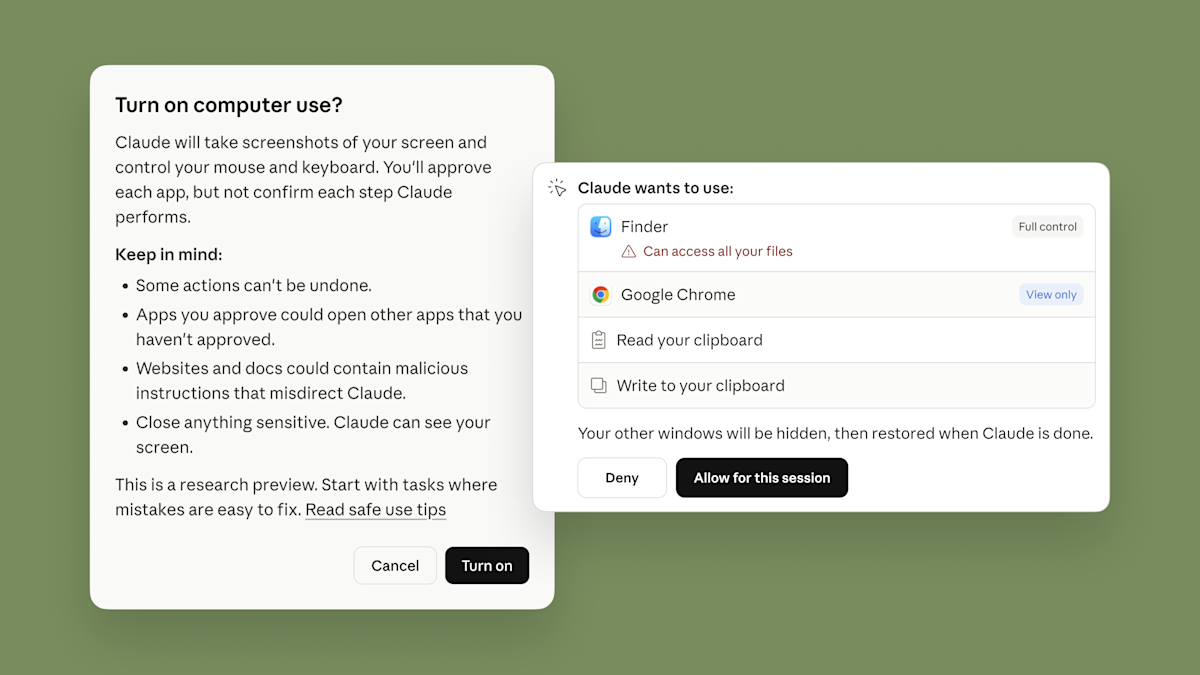
Anthropic announced today that its Claude Code and Claude Cowork tools are being updated to accomplish tasks using your computer. The latest update will see these AI resources become capable of opening files, using the browser and running dev tools.
When enabled, the Claude AI chatbot will first prioritize connectors to supported services such as the Google workplace suite or Slack, but if a connector isn’t available, it will be able to still execute an assigned task. Claude should ask for permission before taking these actions, but Anthropic still recommended not using this feature to handle sensitive information as a precaution.
Claude computer use will initially be available to Claude Pro and Claude Max subscribers on macOS. This feature is still in a research preview, so will continue to be adjusted based on Anthropic’s user feedback. It will also support use with Anthropic’s Dispatch feature, which allows a person to message the chatbot in a single continuous conversation across phone and desktop.
Claude Cowork was introduced in January. It’s an iteration of the Claude Code AI agent for programmers that is designed for more casual users.
The Association of Commercial Television and Video on Demand Services called on the EU antitrust chief to bring DMA-style regulation to set-top boxes — Apple TV also mentioned for some reason.
Apple TV targeted by TV group
The Apple TV set-top box is likely the best way to access and stream media, but that performance comes at a price. So, like other markets Apple is involved in, consumers trend toward cheaper options. However, because of Apple’s control over its ecosystem, it is often grouped in with other market leaders regardless of reported market share estimates. According to a report from Reuters, the Association of Commercial Television and Video on Demand Services in Europe (ACT) has asked EU antitrust chief Teresa Ribera to have set-top boxes and smart TVs under the DMA as gatekeepers. Continue Reading on AppleInsider | Discuss on our Forums
Mazda Motor Corporation (Mazda) announced that information belonging to its employees and business partners had been exposed in a security incident detected last December.
Mazda is one of Japan’s largest automotive manufacturers, with an annual production of 1.2 million vehicles and revenue of nearly $24 billion.
The company said the attackers exploited a vulnerability in a system related to warehouse management for parts procured from Thailand. The system did not contain any customer data. Also, the breach is limited to 692 records.
“Mazda Motor Corporation has identified traces of unauthorized external access to a management system used for warehouse operations related to parts procured from Thailand,” reads Mazda’s announcement.
Advertisement
“Following this discovery, the Company promptly reported the matter to the Personal Information Protection Commission – an external bureau of the Japanese Cabinet Office – and implemented appropriate security measures and conducted an investigation in cooperation with an external specialist organization.”
The investigation revealed that the potentially exposed information includes the following data types:
User IDs
Full names
Email addresses
Company names
Business partner IDs
Although Mazda says it has detected no misuse of that information, the company recommends that impacted individuals remain vigilant because the risk of phishing attacks and scams targeting them is significant.
Apart from notifying the authorities, Mazda also implemented additional security measures on its IT systems, including reducing internet exposure, applying security patches, increasing monitoring for suspicious activity, and introducing stricter access policies.
At the time of writing, no ransomware group has publicly claimed the attack on the Japanese company.
Advertisement
BleepingComputer has contacted Mazda to learn more about the incident, and we will update this post with an official response as soon as it reaches us.
Although a data breach was never officially confirmed by Mazda, the Clop ransomware group in November 2025 posted Mazda.com and MazdaUSA.com on its data leaks site, claiming it compromised both the Japanese automaker and its U.S. subsidiary.
Malware is getting smarter. The Red Report 2026 reveals how new threats use math to detect sandboxes and hide in plain sight.
Download our analysis of 1.1 million malicious samples to uncover the top 10 techniques and see if your security stack is blinded.
If you’ve ever run a game server or used BitTorrent, you probably know that life is easier if your router supports UPnP (Universal Plug and Play). This is a fairly old tech — created by a standards group in 1999 — that allows a program to open an incoming port into your home network. Of course, most routers let you do this manually, but outside of the Hackaday universe, most people don’t know how to log into their routers, much less how to configure an open UDP port.
I recently found myself using a temporary setup where I could not access the router directly, but I needed some open ports. That got me thinking: if a program can open a port using UPnP, why can’t I? Turns out, of course, you can. Maybe.
Caveats
The first thing, of course, is that you need your firewall open, but that’s true no matter how you open up the router. If the firewall is in the router, then you are at the mercy of the router firmware to realize that if UPnP opens something up, it needs to open the firewall, too.
You might think, “Of course it will do that.” However, I’ve found there is a lot of variation in the firmware from different vendors, and if you aren’t in control of the router, it is more likely to have buggy firmware.
Advertisement
The other caveat is that the router needs UPnP enabled; if it isn’t and you have to get into it anyway, you might as well set up port forwarding in the usual way. I was in luck. The router I was behind had UPnP turned on.
In Theory
There are several libraries aimed at working with UPnP and many of them come with simple test clients. I decided to install miniupnpd, which has the upnpc utility. You don’t have to be root to run it. In theory, it should be very simple to use. You can use -l to list all the router’s current UPnP ports. The -a option adds a port, and -d deletes it. There are a few other options, but that covers most of the common use cases.
So, to open external port 2222 to port 22 on 192.168.1.133 you should be able to say:
upnpc -e 'HaD Test' -a 192.168.1.133 22 2222 tcp 3600
The -e option lets us make up a creative title for the mapping. The 3600 is the number of seconds you need the port open. Easy, right? Well, of course not.
Advertisement
Under the Hood
UPnP covers several different areas, including IP assignment and streaming media. However, the part of it we are using is for NAT traversal. Your router identifies as an Internet Gateway Device that other UPnP-aware programs can locate.
Unfortunately, there are two versions of the gateway device specification, and there are many compatibility problems. You are also at the mercy of the vendor’s correct interpretation of the spec.
UPNP has been known to be a security risk. In 2011, a tool appeared that let some UPnP devices map ports when asked from outside your network. Easy to imagine how that could be a bad thing.
UPNP devices advertise services that others can use, and, hopefully, your router advertises that it is a gateway. The advertisement itself doesn’t tell you much. But it does let you fetch an XML document that describes the device.
There are a few strange things about the way upnpc works. First, when you do a list, you’ll get an error at the end. Apparently, that’s normal. The program simply asks for entry zero, one, two… until it gets an error (a 713 error).
However, when I tried to add an open port to this particular router, it always failed, giving me an error that implied that the port was already in use. Of course, it wasn’t.
Through experimentation, I figured out that the UPnP service on the router (the one I can’t get into) isn’t running as root. So any port number less than 1,024 is unmappable in either direction. Of course, this may not be a problem for you if you have a sane router. You could argue whether this is a bug or not, but it certainly didn’t give a good error message.
Advertisement
Testing, One, Two…
Just to do a simple test, I issued the following command. (with my firewall off, just for testing):
upnpc -e HADTEST -a 192.168.1.133 8022 8023 tcp 3600
I verified the port opening using the -l option. Then I stood up a really dumb telnet-style server on the local port (8022):
socat readline TCP-LISTEN:8022,reuseaddr,fork
From a machine on another network, I issued a telnet command to my public IP (198.37.197.21):
Advertisement
telnet 198.37.197.21 8023
Of course, I could have used 8022 for both ports, but I wanted it to be clear which argument was which. At this point, typing some things on the remote machine should show right up on the local machine, punching through the firewall.
In case you forgot, you can escape out of Telnet using Control-] and then a “q” will close the program. You can also just terminate the socat program on the local side.
More Than One Way
It is a bummer I couldn’t open up an ssh port using this method, although you can run sshd on a high port and get there that way. But it is better than nothing. Better still would have been to replace the router, but that wasn’t an option in this case.
There are other tools out there if you are interested. NAT-PMP is easy to use from Python, for example. There’s also something called PCP (not the performance co-pilot, which is something else). Many routers don’t support either of these, and we hear that implementations are often buggy, just like UPnP.
Advertisement
For the record, NAT-PMP didn’t give me a better error message, either. So the moral is this: if you can, just punch a hole in your router the old-fashioned way. But if you can’t. Linux almost always gives you another option.
After pressure from regulatory committees about fears of Chinese spies and botnets, the FCC has placed a ban on all new foreign-made consumer routers.
TP-Link may be affected by latest US ban
Regulators have become increasingly interested in routers after Chinese brands took more than 65% market share during the pandemic. US router makers like Netgear pushed back with lawsuits and lobbying, and it seems to have borne some fruit, though the result may cause problems for everyone. According to a report from Reuters, the FCC has deemed all foreign-made routers a national security concern. This seems to imply that the United States wants all routers manufactured in the country via “secure supply chains.” Continue Reading on AppleInsider | Discuss on our Forums
The controversy, detailed last week in a Substack post by an anonymous whistleblower known as “DeepDelver,” has also apparently led Insight Partners to scrub an article explaining its $32 million investment in the startup. DeepDelver, who claims to be a former client, alleged that Delve, which was valued at $300 million during its Series A funding round last year, fabricated compliance data for its customers.
The original text of the article, written by Insight Partners managing directors Teddie Wardi and Praveen Akkiraju, among others, and titled, “Scaling AI-native compliance: How Delve is saving companies time and money on compliance busywork,” remains viewable here via the Wayback Machine, an internet archive that preserves snapshots of web pages.
Delve’s co-founders Karun Kaushik and Selin Kocalar, as well as Insight Partners, did not immediately respond to TechCrunch’s request for comment.
Advertisement
On its website, Delve claims to have helped customers such as Microsoft, Chase, PayPal, American Express, and the AI search company Perplexity cut “hundreds of hours” of compliance busywork. However, it remains unclear how many of these companies are still active users of the platform.
Founded in 2023, Delve says it leverages AI to automate the process of obtaining security and regulatory certifications, including SOC 2, HIPAA, and GDPR — standards that govern data security, health information privacy, and European data protection, respectively.
In their Substack post, DeepDelver alleged that Delve “fabricated evidence of board meetings, tests, and processes that never happened,” then forced customers to “choose between adopting fake evidence or performing mostly manual work with little real automation or AI.”
Techcrunch event
Advertisement
San Francisco, CA | October 13-15, 2026
The post further alleges that Delve’s platform rubber-stamps its own reports rather than undergoing a second layer of independent auditing.
Advertisement
Delve responded to the accusations by saying it does not issue compliance reports at all, and that instead it is an “automation platform” that ingests information about compliance and then provides auditors with access to that information.
Delve also said that its customers “can opt to work with an auditor of their choosing or opt to work with one from Delve’s network of independent, accredited third-party audit firms.” Those auditors, the startup said, are “established firms used broadly across the industry, including by other compliance platforms.”
In response to the accusation that it’s providing customers with “fake evidence,” Delve countered that it’s simply offering “templates to help teams document their processes in accordance with compliance requirements, as do other compliance platforms.”
While the company is denying DeepDelver’s allegations, the disabling of the “book a demo” function and the scrubbing of Insight Partners’ investment thesis article suggest that the startup is in damage control, and that investors may be distancing themselves from the company.
Ask most truckers about their must-haves in a good semi-truck, and you might get answers like quality seats, a reliable power supply, and practical storage space. Having tires on the wheels might seem like too obvious an answer, although it seems one trucker in Canada didn’t have “make sure all the tires are still there” on their checklist. The Ontario Provincial Police recently issued a warning on social media to remind drivers that they should always check their tires before traveling after pulling over a truck on Highway 17. According to the post, the truck had driven more than 60 miles with one tire missing.
The driver of the vehicle is now facing multiple charges of unsafe operation of a vehicle as a result. According to CTV News, the unnamed 41-year-old driver was from Calgary, while the tractor and trailer were operated by a company in Steinbach. The company was also hit with charges due to the vehicle’s unsafe condition. Police took the vehicle off the road after the stop, with repairs required before it could resume service.
Advertisement
U.S. truckers can remove one tire in certain situations
However, that is assuming they have four tires on an axle to begin with. Images provided by the Ontario Provincial Police show the stopped truck did not have dual tires, leaving one rim in contact with the road. As such, it would have quickly attracted the attention of local law enforcement on either side of the border.
Advertisement
Even drivers who meticulously keep track of the condition of their tires will eventually have to replace them, and changing a truck tire is harder than you’d think. Attempting to change a semi-truck tire without knowing what you’re doing can result in injury, and so it’s best left to the professionals.


































































You must be logged in to post a comment Login