Tech
Paramount Wins Warner Bros Battle, Purim, Qobuz Goes to War on AI, Robert Duvall, and Empire Ears Goes Kaput: Editor’s Round-up

At sundown on Monday, Purim begins; a holiday rooted in survival, marking the Jewish people’s narrow escape from annihilation in ancient Persia. The story, told in the Book of Esther, is not subtle. A Persian court insider, named Haman convinces the king that the Jews must be wiped out. A young queen named Esther risks everything, steps forward, and turns the tide. Hamantaschen for everyone and don’t even think about handing me one that isn’t filled with poppy seed.


Two and a half millennia later, history has a way of sounding uncomfortably familiar.
With hostilities resuming between Israel, the United States, and the Islamic regime in Tehran, the rhetoric stopped being theoretical and the missiles started flying. As Iran’s retaliation unfolded on Sunday, a ballistic missile struck Beit Shemesh, just west of Jerusalem, and in that instant, the war was no longer a headline scrolling past. It was immediate. It was personal. I put the pen down. I stopped writing. I called family. Nine neighbours were murdered in that strike. Politics disappears when your phone starts ringing and you’re counting names.
Believe what you believe about governments and geopolitics. But no people should live under the shadow of missiles or under a regime that exports death. May the Iranian people one day live in freedom and without fear. They deserve better than this nightmare.
And yet here we are, covering Paramount swallowing Warner Bros, Qobuz drawing a line in the sand over AI, Empire Ears going dark, AMC and indie theaters fighting for oxygen. The media and hi-fi worlds keep spinning. Deals get signed. Products launch. CEOs posture. But this week is a reminder that none of it exists in a vacuum. Not the mergers. Not the music. Not the movies. Not us.
Paramount Wins Warner Bros While Netflix Walks

For the past few months, the future of Warner Bros. Discovery was negotiated behind closed doors; over private dinners in Los Angeles, New York, and Washington, with lawyers murmuring, investors hovering, and regulators quietly keeping score. That maneuvering is over. Paramount has secured the company, with the board approving the deal late on February 26, 2026. David Ellison stayed in the fight. Netflix’s CEO chose not to counter within the allotted window rather than ignite a bidding war.
All of it unfolded under the watchful gaze of the Trump administration, where antitrust scrutiny and political leverage made clear that no media empire moves without federal gravity. Paramount won. Netflix stepped aside. Now the real battle for your wallet begins.
Control of Warner Bros. Discovery means control of one of the deepest libraries in modern entertainment — films, franchises, cable networks, news divisions, and streaming platforms that have defined multiple generations. The dollars matter. The regulators matter. The politics matter. But beneath all of that is a larger shift: power in Hollywood is consolidating fast, and the streaming hierarchy is being rewritten in real time.

Now comes the part nobody puts in the press release. HBO Max, TNT, CNN, Warner Bros. Television, DC, and a sprawl of international assets have to be folded into a single operating strategy. Tens of thousands of jobs sit under that umbrella. Overlap will be cut. Billions in costs will be slashed. Paramount has made it clear this must turn profitable quickly and before its own board starts asking hard questions. With more than $110 billion in enterprise value and obligations tied up in this ecosystem, there is no room for sentimental restructuring.
Hollywood is not easing into a new era. It’s being forced into one.
Consolidation at this scale doesn’t lead to kumbaya town halls and better consumer bundles. It leads to layoffs. Platform convergence. Redundancies circled in red ink. Expect overlap to be cut aggressively and quickly. If HBO Max survives as a standalone brand under Paramount’s roof, it will be a minor miracle. The far more likely outcome is a folding into Paramount+, some Frankenstein hybrid pitched as “value.” As for the rest of the television portfolio under the umbrella; TNT, TBS, legacy cable properties, their long-term fate is anything but secure.
And then there’s CNN. That’s the real live wire. Owning CBS News and CNN hands one studio extraordinary influence over the tone, framing, and velocity of national news coverage. That level of concentration will not go unnoticed. CNN’s ratings are soft even on a good week. Its on-air talent is expensive. Very expensive. Does Paramount maintain two separate news divisions? Do they merge them into something unified with a very prominent “C” at the beginning? No one at CNN is sleeping particularly well right now.
It’s difficult to imagine that decision unfolding quietly or without casualties; Bari Weiss has every reason to be smiling right now, knowing that after selling The Free Press to Paramount and stepping into control at CBS News, she now holds the professional fate of many who once lined up to attack her.
The ripple effects extend to theaters. Both Netflix and Paramount made promises during the bidding process about theatrical commitments, windowing strategies, and respect for exhibition. We’ll see. The length of theatrical runs before titles shift to streaming is now a corporate lever, not a creative one. If windows shrink below three weeks, exhibitors, especially chains like AMC are going to feel it fast. Theaters are already operating on thin margins. Compress the window and you accelerate the decline.
Then there’s physical media — the part enthusiasts still care about. As buyers of discs, many of us felt marginally safer with Paramount controlling Warner’s catalog. But let’s not kid ourselves. What was once a multi-billion-dollar category is now a thin, diminished version of itself. Outside of specialty labels like The Criterion Collection, Arrow Video, and Kino Lorber, mainstream studio releases in 2026 are lucky to hit low six figures in unit sales. Low. Six. Figures. For companies the size of Paramount and Warner, that’s a rounding error tolerated, not prioritized.
Talent is the final pressure point. Do we really believe someone like James Gunn who has been openly critical of President Trump — remains comfortably in place at DC when Ellison did not win this fight without political gravity on his side? Maybe. But Hollywood loyalty lasts exactly as long as leverage does. Don’t be shocked if Gunn finds his way back to Marvel or under the Disney umbrella where the corporate alignment is cleaner.
This is what monumental change actually looks like. Jobs will disappear. Platforms will merge. Newsrooms will consolidate. Theatrical windows will compress. Physical media will shrink further into boutique territory. And consumers? They won’t be the primary beneficiaries. Power has concentrated. Now we find out what that concentration costs and don’t expect the bill to be lower than what you’re paying now.
Qobuz Cracks Down on AI Content to Protect Artists
AI music is no longer some nerdy weird science experiment in a lab. It is a content factory running three shifts before its workers head out to Waffle House for eggs, grits, and fisticuffs.
Streaming platforms are getting buried under machine generated tracks. Endless ambient playlists by artists who have never seen a sunrise. Jazz trios that have never boozed it up and fought backstage over a set list. Singer songwriters with flawless pitch and the emotional range of a toaster. Upload by the truckload. Tweak the metadata. Scoop up fractions of a penny at industrial scale.
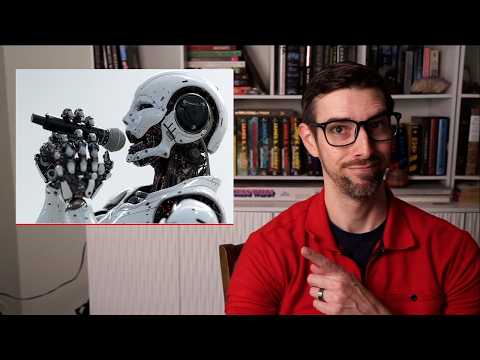
If that sounds familiar, it should. It is basically the subplot of Office Space. Skim a microscopic amount from each transaction and hope nobody notices until the money adds up. Except this time it is not Initech. And there are no conjugal visits. It is the global music ecosystem. And the people getting screwed over are real musicians trying to pay the rent and afford health insurance. Spotify has been playing whack a mole with this stuff for a while now and they’re not winning. When the system rewards sheer output, you get a flood. Not art. A flood. Quality gets shoved to the curb and the consumer gets stuck listening to garbage they really didn’t want to pay for.
That is the mess Qobuz is stepping into.
Earlier this month Qobuz rolled out its AI Charter, which was easy to applaud and just as easy to ignore. Instead of leaving it as a mission statement, they built a proprietary detection system to scan the catalog and flag music that is one hundred percent AI generated. Not “possibly.” Not “we think so.” Tagged. Labeled. Out in the open. Those identifiers will begin showing up across the apps in the coming months so you actually know what you are listening to.


Qobuz is also tightening the screws on fraud. Impersonation attempts. Streaming patterns that look like they were engineered in a basement server farm in Tehran. The company is expanding its detection tools so if something smells off, it does not get the benefit of the doubt. It gets flagged, refused, or removed. And those fake streams do not count toward royalty reports. Good luck getting Spotify to offer up something like that.
On the editorial side, Qobuz is keeping actual humans in the driver’s seat. Real editors picking Albums of the Week. Real teams building playlists and Qobuzissimes. No content mill dumping twenty thousand tracks into the hopper and hoping the algorithm gets bored enough to promote one. The Discover page will lean on curated data from in-house teams and trusted music labels.
And here is the line that will make certain tech executives roll their eyes. Qobuz says it will not generate audio for its catalog. It will not replace human curation with AI systems and not use customer data to train external AI models. That almost feels like open rebellion against the Emperor.
Why should you care?
Because the money is not theoretical. A 2024 CISAC study projected that by 2028 music creators could lose around ten billion euros over five years due to AI competition and unlicensed use of their work. At the same time, generative AI companies could be pulling in billions annually from that same ecosystem. None of that sounds like a win for the artists who create real music and don’t be surprised when that becomes an even uglier fight for screenwriters, actors, and cinematographers.
The WGA and SAG have already gone on strike to fight against these practices and if you think studios undergoing acquisition and consolidation will continue to spend hundreds of millions on individual films when they can produce 10 for the same price using AI — you’re about to find out that profits matter more than quality.
For artists, this is survival. If machine output floods playlists and crowds out real musicians, visibility collapses and compensation shrinks even further. For listeners, it is about knowing whether the song you love was written by someone with rent due or generated by a prompt and a power bill.
Qobuz Deputy CEO, Georges Fornay explained that “the hyperinflation of AI content is creating distrust across the industry.” He is not wrong. When everything looks and sounds polished, authenticity becomes the differentiator.
Qobuz is betting some of you still care who made the music. In a business chasing endless content like it is oxygen, backing humans is slower and messier. You didn’t sign up for synthetic background noise pretending to be art so it will be interesting to see if the rest of the market follows or bends the knee.
Empire Ears Shuts Down After 10 Years in the High End IEM Market
Empire Ears, a name that meant something in the boutique, high-end IEM world — is gone. After a decade of carving out a reputation for sonic excellence and obsessive craftsmanship, the brand quietly shut its doors on February 27, citing health challenges, rising costs, and an increasingly inhospitable market. For enthusiasts who watched Empire’s cables and custom monitors become fixtures on enthusiast wish lists, this is not a footnote. It’s a sign.

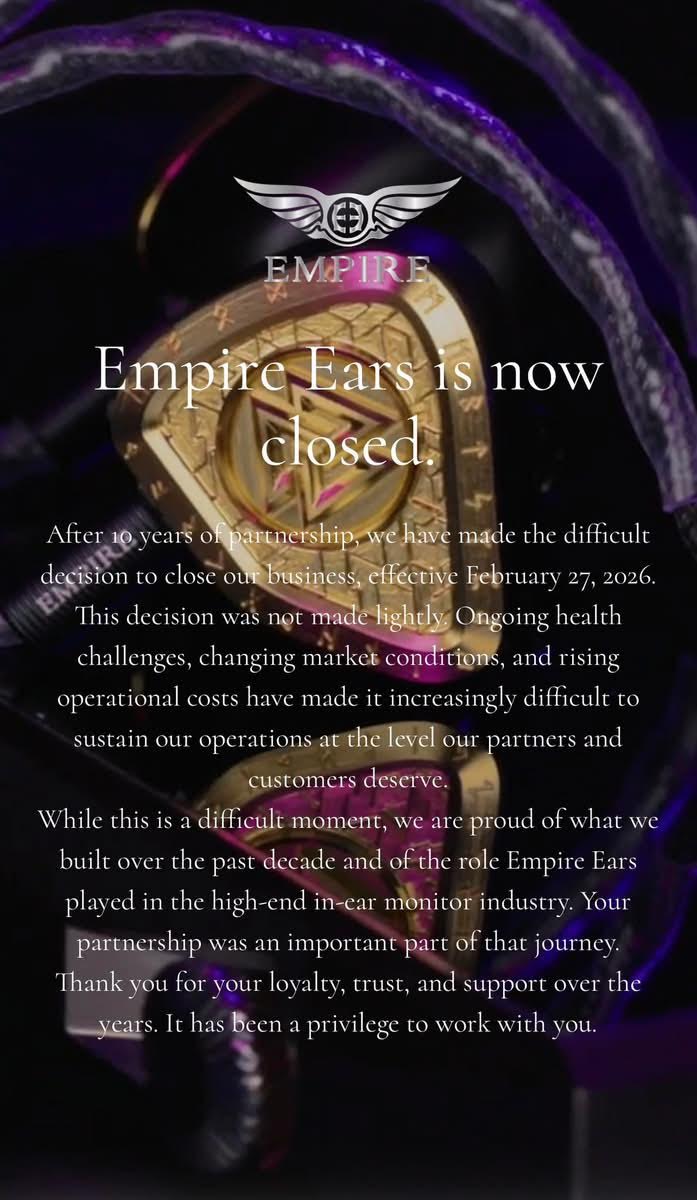
And let’s be honest: not all is well in the high-end wired IEM market.
Brands like FiiO, Campfire Audio, and other smaller Asian boutiques are still shipping products and carving out niches, but Empire’s departure forces a hard question: have we hit saturation with ultra-premium wired IEMs in a world that has moved on to wireless? Four-figure cables and hand-crafted shells feel increasingly like boutique curiosities next to the convenience and everyday usability of wireless. The market that once justified artisanal attention has shrunk, shifted, and in some corners evaporated.
That tension will be on full display this weekend at CanJam NYC 2026, and yes, we will be there covering it. If wired IEMs still have gas in the tank, this is where the next spark of innovation should show up: new driver tech, refreshed tuning philosophies, perhaps unexpected form factors that justify carrying wires in the age of Bluetooth dominance. We already know that one of our favorite European headphone and IEM manufacturers plans to unveil a new $1,000 wired IEM this weekend, and it will be very interesting to see how the market reacts.
But the departure of Empire cannot be ignored. It underscores a larger industry truth that many in audio enthusiast circles are quietly wrestling with: excellence does not guarantee survival. Passion does not pay rent. And even the most covetable products can find themselves adrift when consumer priorities shift faster than product cycles.
Smells Like Victory

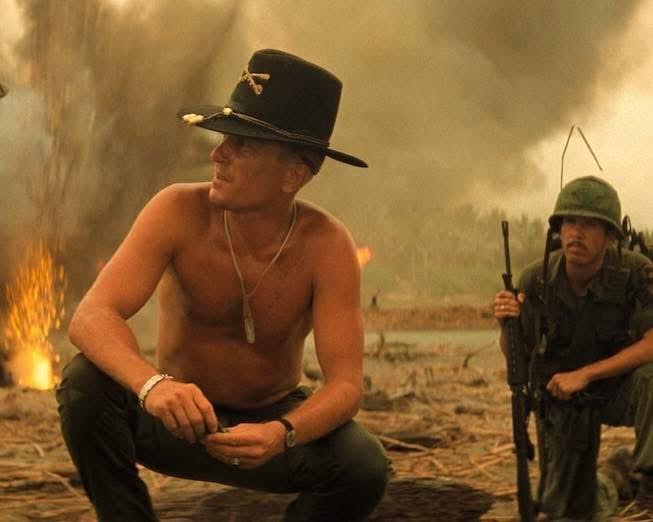
Robert Duvall died on February 15 at 95, and with him goes the kind of actor Hollywood does not turn out anymore.
Duvall did not arrive in Hollywood fully formed. He earned it the old way. He started on stage in 1952, grinding through summer stock at the Gateway Playhouse in Bellport on Long Island, taking a year off to serve in the United States Army before returning to the boards. Those early contacts opened the door to television in the 1960s, with appearances on serious dramas like The Defenders, Playhouse 90, and Armstrong Circle Theatre, where actors were expected to act, not pose.
He made his Broadway debut in Wait Until Dark in 1966. More than a decade later, already a film star, he went back to the stage for David Mamet’s American Buffalo in 1977 and earned a Drama Desk nomination. That tells you something. He did not see theater as a stepping stone. It was part of the craft.
His film debut came quietly but memorably as Boo Radley in To Kill a Mockingbird in 1962. No grand speech. Barely any lines. Just presence. Then the run started. Bullitt. True Grit. M*A*S*H. THX 1138. He slipped into supporting roles and made them stick. You might not have walked into the theater for Robert Duvall in those early years, but you walked out remembering him.
Everything changed with The Godfather. Tom Hagen. Quiet consigliere. The man in the room who did not need to raise his voice because he already understood the temperature. It was a supporting role that felt like a lead. Duvall did that a lot. He made space feel heavier. He made silence do the talking.

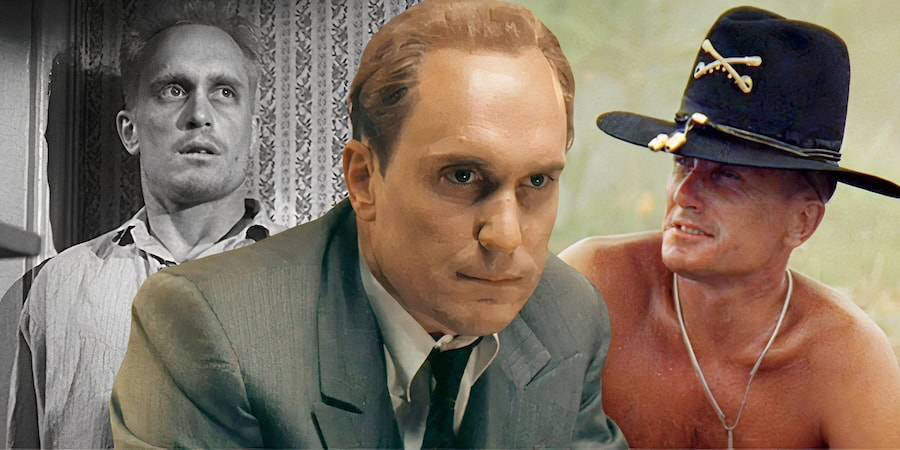
Apocalypse Now is the obvious landmark. Lieutenant Colonel Kilgore, sunburned and unhinged, delivering lines about napalm with a grin that told you everything about war and madness in a single breath. But go deeper and you see the range that defined him. The Apostle, which he wrote and directed, was raw and fearless. Tender Mercies earned him an Academy Award and showed how much power he could summon by barely moving at all. Lonesome Dove on television turned him into Augustus McCrae, all warmth and steel, reminding Hollywood that the small screen could still carry epic performances if you put the right actor in the saddle.
He was also a better dancer than anyone remembers. Watch him in Tender Mercies or The Apostle. Loose hips. Total commitment. No vanity. He moved like a man who did not care who was watching. He understood rhythm. Not just musical rhythm. Emotional rhythm. Scene rhythm. He could charm you in one beat and terrify you in the next.

Duvall belonged to the old guard. The Clint Eastwood school. The Al Pacino and Gene Hackman generation. Actors who showed up prepared, knew their lines, respected the craft, and did not spend their days refreshing social feeds to see how the discourse was trending. He was not shy about his political views. He did not tailor them for applause. He also did not make them the centerpiece of his career. The work came first.
That is the difference. Today too many performers treat acting like branding. The right cause. The right quote. The right viral moment. Duvall did not need any of that. He was about the scene. About the truth inside it. He could be gentle and disarming. He could be solemn and wounded. And when the role demanded it, he could be cold, manipulative, and downright evil without blinking.
Even late in his career he could walk into a scene and own it. In Thank You for Smoking, he played tobacco tycoon Captain, half mischievous uncle, half corporate warlord, dancing around the moral hypocrisy of Washington with a grin and a glass in hand.
Every film or television project he joined improved simply because he was in it. He raised the standard in the room. Directors trusted him. Co-stars leaned on him. Audiences believed him.
He was not flashy. He was not desperate to be liked. He was a professional in the purest sense of the word. And in an industry that increasingly rewards noise over depth, Robert Duvall felt like something rarer each year. A craftsman. A grown up. A cut above what too often passes for acting today.
We will not see many more like him.
Related Reading:
- Audiophile Excess Runs Wild In Denmark, Qobuz Fixes CarPlay, Wes Montgomery’s Timeless Groove, And The Marantz M1: Editor’s Round-Up
- Culture Wars At The Super Bowl, Meze STRADA’s Curious Tuning, Record Store Day 2026, Hi-Fi Show Overload?: Editor’s Round-Up
- Jazz Dispensary At 10, Integrators In The Keys, Wireless Headphones On The Road, Catherine O’Hara, And Sinners Leading The Pack: Editor’s Round-Up
- Steve Cropper, FiiO Air Link, Wharfedale Diamond 12.3 & Other War Stories — An Editor’s Round-Up From A Hospital Bed
You must be logged in to post a comment Login