Tech
Photovoltaics are still running after a year under Swiss trains

offbeat
Solar boss reckons challenges are regulatory, not technological
It is just over a year since a pilot project to install photovoltaics on a railway line kicked off. According to the CEO of Sun-Ways, the company behind the scheme, the challenge was not so much technical as regulatory.
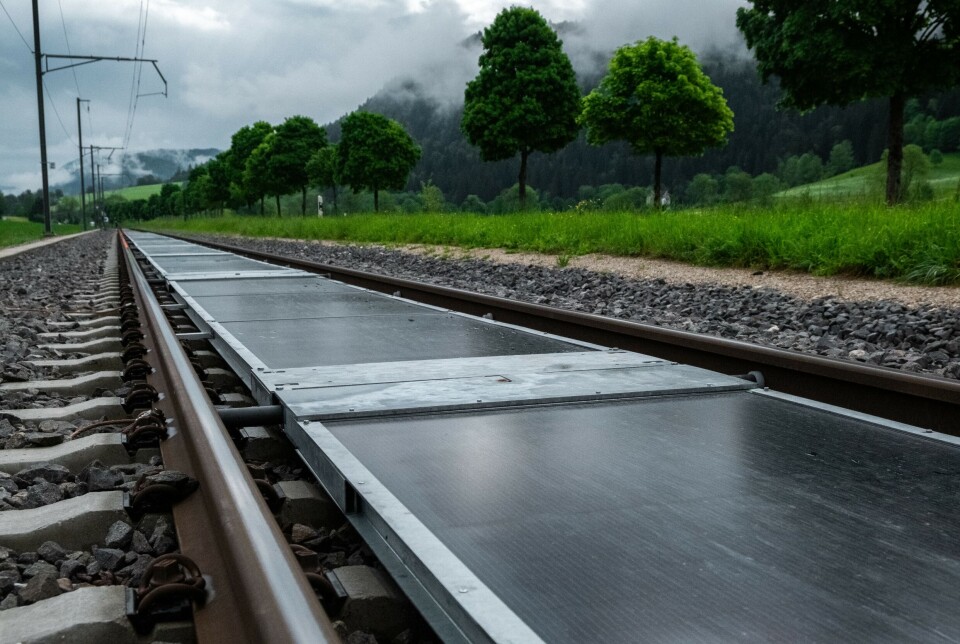
The project, a 100-meter photovoltaic installation on a railway line open to traffic, was inaugurated on April 24, 2025 in Buttes, Switzerland. It’s fair to say it went well; the 48 solar panels wedged between the tracks have generated more than 19 MWh to date.
According to the company’s CEO, Joseph Scuderi, more than 11,000 trains have passed over the solar power plant without incident. There has been no impact on railway operations or solar generation.
It’s a novel idea – use the space between rails for solar power generation. While the angle of the panels might not be ideal, the losses would be relatively minor compared to the potential gains. In Switzerland alone, Sun-Ways reckons there is a potential 1 TWh available, enough to meet 30 percent of the country’s public transport needs.
The panels themselves use anti-reflection material to avoid distracting train drivers with glare, and are resistant to micro-cracks, which could lead to a higher risk of fires.
And then there is the installation itself, which required coming up with a rail-mounted machine to deploy the panels. According to Scuderi, the company now has a machine capable of installing up to 300 solar panels per hour, over hundreds of kilometers, rather than the 100 meters of the pilot.

However, as Scuderi told The Register, “Technology wasn’t the problem.
“After all, we’re capable of sending people to the Moon…
“The real challenge is regulation. The strictest safety requirements apply in the rail sector. It took us years to obtain authorization to test our Sun-Ways solar power plant on a line open to passenger trains.”
According to a report published in April by the European Environment Agency, renewables (including solar) accounted for 25.2 percent of final energy consumption in the European Union. In the past year, renewables have accounted for 43.3 percent of generation in the UK, according to the National Grid (the UK’s power transmission network), with 6.9 percent coming from solar.
The EU’s minimum target is 42.5 percent from renewables by 2030, so sticking solar panels on the space between the rails carries a certain appeal. Scuderi told us that agreements had been made with Italy and France’s SNCF, and that talks were underway with South Korea, Spain, and Portugal.
He said, “I envisage a market launch as early as 2028, with the deployment of small Sun-Ways power plants of 10 km (10,000 m2), then an increase in capacity to reach 1000 km installed by 2035 and 10,000 km in 2040.”
It’s an ambitious plan, and might have seemed the stuff of fiction when Sun-Ways was founded in the early 2020s. Maintaining the panels, track (and track bed), and keeping the units clean enough to generate a worthwhile amount of power were obvious concerns, but the project has shown that these technical challenges can be overcome.
Indeed, equipment capable of installing 300 panels per hour beats the rate at which canopies and station buildings could be plastered with photovoltaics. That said, panels away from the line don’t share the same concerns about impacts from rail traffic or the inconvenience of track maintenance.
Scuderi told The Register, “The financial projection we have made show a LCOE [Levelized Cost of Energy] from 0.05 €/kWh to 0.09 €/kWh, depending on the amount of sunlight (southern or northern Europe).”
“And for a customer such as a railroad company,” he added, “the LCOE corresponds to the final cost of electricity, since it is not subject to taxes or fees on the public grid, as solar energy is fed directly into the traction grid.”
It is hard not to remember the initial excitement that surrounded solar roadways a decade ago, which unraveled as realities such as the weight of traffic and maintenance requirements struck home. Solar railways, however, appear to be a success thus far, with the panels requiring little maintenance and producing the expected power. The next challenge is scaling it up. ®
You must be logged in to post a comment Login