










Connect with us

Tech

Pixelpaw Labs’ Phase Delivers Mouse Precision and Controller Comfort in One Split Device

Published

on

Pixelpaw Labs Phase Mouse Controller Split Device
If you spend your days at a desk and your evenings on the couch, chances are you have two completely separate sets of gear to show for it. Pixelpaw Labs thinks that’s one too many, and the Phase is their answer to the problem, a single wireless device that handles both without asking you to compromise on either


At first glance the Phase looks like a perfectly ordinary mouse sitting on your desk, symmetrical and unremarkable in all the right ways. Give it a firm tug though and the whole thing splits cleanly down the middle along a set of nearly invisible seams held together by strong magnets. What you’re left with are two independent controllers, each packing a thumbstick, a directional pad, face buttons, and a pair of triggers on the back, ready to go the moment you sink into the couch.


abxylute M4 Snap-On Mobile Gaming Controller for Android & iPhone, Switch 1&2, Portable Bluetooth Mini…
  • Why Choose the abxylute M4 Snap-On Phone Controller?Designed exclusively for on-the-go retro gaming. Trusted by 6000+ backers on a tech-focused…
  • 【Easy Setup – Power On & Play Instantly!】We recommend attaching the magnetic stickers to a phone case for all phones, rather than using a bare…
  • 【Wide Compatibility – Android & iPhone】Compatible for Android devices, iPhones, and card-size phones (Android devices and iPhone 11/SE and…

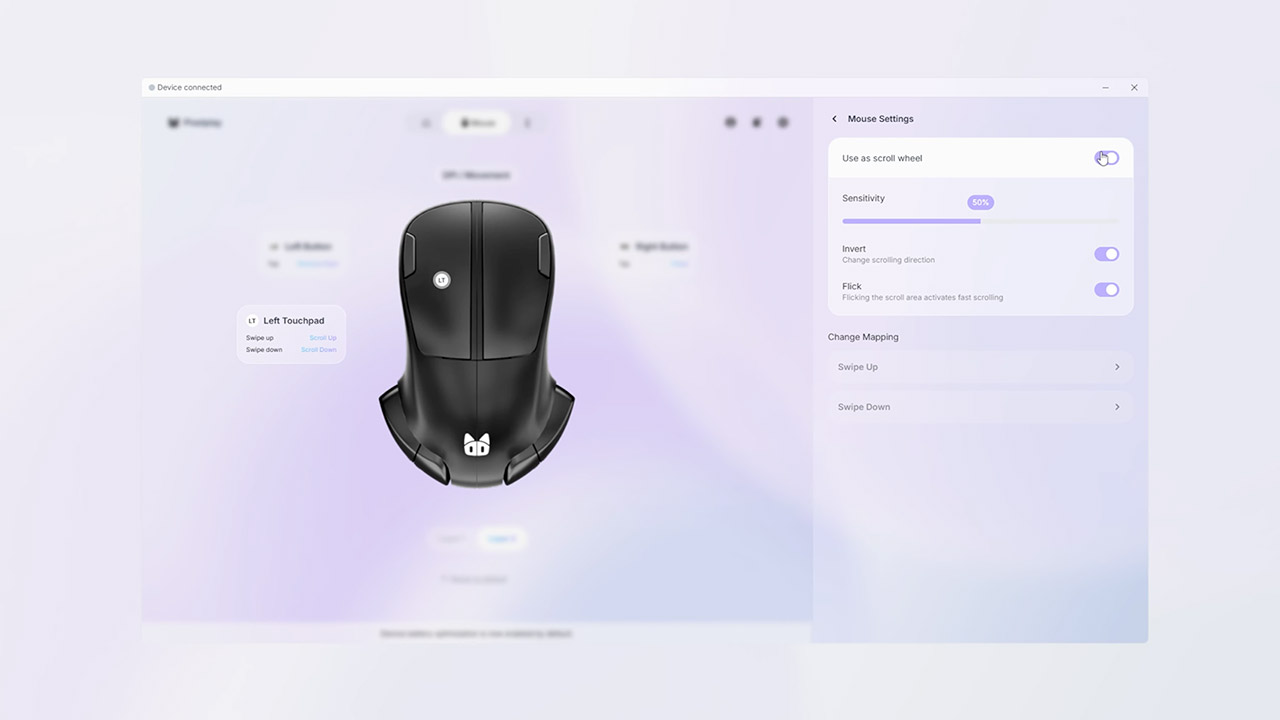
The gaming controls tuck away completely when the Phase is assembled, leaving you with something that looks and behaves like a standard desktop mouse with no hint of what’s hiding inside. The base provides plenty of stability and keeps the whole thing planted firmly on the mat. Tracking comes courtesy of a 16,000 DPI optical sensor on the right half, which should satisfy even the more demanding users. In place of a traditional scroll wheel there is a slim capacitive strip running along the left click button, letting you slide or tap through documents and web pages in a way that feels surprisingly intuitive. Two additional buttons sit at the outer corners of the primary clicks for extra functionality without making things feel busy, and the Omron switches behind the main clicks are crisp and satisfying with every press.

PixelPaw Labs Phase Mouse Controller Split Device
Split it apart and the full controller layout reveals itself, a directional pad and face buttons on one side with mirrored controls on the other. The thumbsticks feel smooth and precise thanks to Alps Alpine components, and the triggers use Hall Effect sensors which should keep them feeling just as good years down the line. Each half also has a dedicated Layer button that effectively doubles your available inputs by assigning a second function to every other control, and once you start mapping things out you might be surprised by just how much the Phase can handle.

Connectivity is equally well thought out whether you’re using it as a mouse or a controller. Bluetooth lets you pair the Phase with up to three devices at once, covering computers, phones, and tablets, and if you need the lowest possible lag there is a 2.4 gigahertz dongle option for PC. It plays nicely with just about every platform going, including Windows, macOS, Linux, Android, and iOS, with no extra adapters required. A USB-C port on the left half takes care of charging when the battery starts to run low, and with a claimed 72 hours of life on a single charge, that shouldn’t need to happen very often.

Advertisement

PixelPaw Labs Phase Mouse Controller Split Device
The free companion app PixelPlay is where things get really interesting. All eighteen buttons are fully remappable, the sensor speed is adjustable, multiple profiles can be saved, and firmware updates are handled right there in the app. Profiles switch over automatically when you connect to a new device or flip between mouse and controller mode, which means there is nothing to manually configure every time you move between setups. No extra hardware, no fuss, just slip it into your pocket or bag and you’re ready to go.

For travelers there is an optional add-on called Phasegrip that takes things a step further. The small clip attaches each half of the Phase to the edges of your smartphone, turning the whole setup into a self contained mobile gaming rig in one neat package. It extends out just like a familiar handheld controller, letting you jump straight into Steam titles or mobile games without juggling separate pieces. The bundle costs a little more, but everything stays compact enough to disappear into a backpack without a second thought.

PixelPaw Labs Phase Mouse Controller Split Device
Pixelpaw Labs has set the full retail price at $159, but getting in early makes a meaningful difference. Early backers can reserve a unit for $115 with a $20 deposit, locking in a 15% discount ahead of the Kickstarter launch. Production is set to kick off once the necessary hardware inspections, molds, and certifications are all squared away, with delivery expected sometime in late 2026 or early 2027.
[Source]

Source link

Advertisement
Continue Reading
Click to comment

Leave a Reply

Your email address will not be published. Required fields are marked *

Tech

Nanophotonics and AI for Molecular Sequencing and Single-Cell Phenotyping

Published

on

11 am PDT / 2 pm EDT / 7 pm CET

The biosphere transmits data 9 orders of magnitude faster than the technosphere. A new class of nanophotonic tools is beginning to close that gap.

In this webinar, Prof. Dionne will present VINPix: Si-photonic resonators with high-Q factors (thousands to millions), subwavelength mode volumes, and densities exceeding 10M/cm². Combined with acoustic bioprinting and AI, they may enable detection of multiomic signatures — genes, proteins, and metabolites on a single chip — at previously unattainable rates, opening new possibilities for molecular communication systems and biochemical sensing for health and sustainability.


Advertisement

Key Takeaway: 

  • Single-chip multiomics — VINPix arrays plus AI for simultaneous gene, protein, and metabolite detection
  • Field-deployed biosensing — integrated with Monterey Bay Aquarium Research Institute (MBARI) autonomous underwater robots for ocean biochemical monitoring
  • Peptide & glyco-conjugate sequencing — major histocompatibility complex (MHC)-tethered peptides, dynamic Raman spectroscopy, and computational metadynamics to identify previously unseen molecular species
  • Tumor microenvironment profiling — subcellular prediction of drug resistance, macrophage polarization, and T-cell activation states

Who Should Attend:

  • R&D engineers, data scientists, and researchers in biotech & pharma, medical diagnostics, environmental & marine science, and the semiconductor and photonics industries.

    Can’t attend live? Register for the recording.

Note that COMSOL will follow up with all registrants about this event and any related questions.

*Please see www.comsol.com/privacy for COMSOL’s Privacy Policy. Contact COMSOL at www.comsol.com/contact for more information.

Source link

Advertisement
Continue Reading

Tech

SXSW 2026 Updates: Monday Looks at the Future of News and Media

Published

on

“I never started out wanting to win 23 Grand Slams. I wanted to win the US Open, and then I made that scalable,” joked Serena Williams, managing partner of investment firm Serena Ventures, at SXSW.

Typically, panels made up of venture capitalists focus on profits and returns on investment. But with tennis legend Serena Williams as Reckitt Catalyst’s entrepreneur-in-residence, the conversation centered on how funding tech startups could drive tangible community impact. 

Another panelist included Mika Eddy, the co-founder of Malama Health, a community-based telehealth company that connects pregnant people with local doulas and remote-monitoring tech to support them during their pregnancy and postpartum. Malama, which means “care” in Hawaiian, aims to improve maternal health outcomes. 

Eddy said she was inspired to build the company after watching her OB-GYN grandmother care for patients in rural Japan while growing up.

Advertisement

“The US was truly not built for healthy outcomes for women, and particularly if you do not have privilege or a platform, oftentimes these outcomes are left to chance,” said Eddy. “We built Malama in order to help fill the gaps.”

Also on the panel was Kwamane Liddell, an emergency department nurse who founded Thrivelink to help patients across the country find the housing, medication and other vital social service resources. The company is focused on accessibility — you don’t need the internet, smartphones or reading skills to use it. For example, Thrivelink uses AI voice tech rather than relying on text, which may be harder for some patients to use. Liddell’s uncle, who had a stroke and was part of the inspiration for Thrivelink.

“People might not be able to text or type within the app, but they can say their address,” said Liddell. “So we built a telephonic AI agent that allows people to talk. Since then, we’ve helped thousands of families access healthy food.”

Health tech, venture capitalism and policy have a long, complicated history in the US. Health technology is often designed to fill gaps or address major issues left by the health care and insurance industries. Big companies in the AI revolution, such as OpenAIAmazon and Microsoft, are also building health AI tools along with startups like Malama and Thrivelink.  

Advertisement

Source link

Continue Reading

Tech

Inventor of the Jetson ONE Personal eVTOL Takes it Out for a Test Flight Along the California Coast

Published

on

Jetson ONE eVTOL California Coast Beach Test Flight
Tomasz Patan took off from his own driveway in a Jetson ONE eVTOL, heading straight out to sea. Soon, he was flying low over the cliffs of Pismo Beach, following the coastline and headed directly over the pier, and the view most certainly stole his breath away as he made his way down the shoreline, passing a beach restaurant he’d flown over many times before.


Surfers were in the sea below, and the entire coastline was laid out in all its grandeur before him. Patan later described the view as one he would never forget, as the marathon brought him from Pismo Beach to Grover Beach, where hundreds had gathered to watch him pass by. Local groups had secured for all of the essential permissions from a variety of different organizations, which required some effort but ultimately paid off.


DJI Neo, Mini Drone with 4K UHD Camera for Adults, 135g Self Flying Drone that Follows You, Palm Takeoff…
  • Due to platform compatibility issue, the DJI Fly app has been removed from Google Play. DJI Neo must be activated in the DJI Fly App, to ensure a…
  • Lightweight and Regulation Friendly – At just 135g, this drone with camera for adults 4K may be even lighter than your phone and does not require FAA…
  • Palm Takeoff & Landing, Go Controller-Free [1] – Neo takes off from your hand with just a push of a button. The safe and easy operation of this drone…

Jetson ONE eVTOL California Coast Test Flight
Without a runway or airport to worry about, he could plot the most direct route possible and just go. The flight itself was straightforward, a short hop from his house to a familiar stretch of coastline where the Pacific was doing its usual thing, waves rolling in against the rocks and sand with the hills and houses of the shoreline sitting quietly in the background. The Jetson ONE just did its thing without a hitch, unbothered by the wind or weather throughout.

Jetson ONE eVTOL California Coast Test Flight
The Jetson ONE runs on eight electric motors driving eight individual blades, all wrapped in an aluminum and carbon fiber frame that keeps the total weight down to around 254 pounds with the batteries fitted. The open cockpit can accommodate a pilot of up to 209 pounds, and from there you get roughly 20 minutes of flight time before needing to touch down again. Top speed is around 63 mph, though most flights never push anywhere near that. Control comes down to a single four axis joystick, which keeps things refreshingly simple, and the high discharge lithium ion batteries deliver plenty of power throughout. Recharging from a standard wall socket takes just a few hours, and when you’re done the whole thing folds down neatly for storage.

Jetson ONE eVTOL California Coast Test Flight
Patan began working on the Jetson ONE in 2017, and now oversees production from a separate factory. So far, they’ve received more than 650 orders totaling nearly $100 million. They are planning their first 100 deliveries for next year and are already accepting bookings for 2028. A full airframe parachute system is included as standard, which is a true lifesaver in the event of an emergency, and it also complies with all ultralight vehicle regulations, which is a good thing.

Source link

Advertisement
Continue Reading

Tech

Seniors ballot every week just to play mahjong with young S’poreans

Published

on

At Mahjong Together, generations meet over tiles, conversation, and friendly rivalry

On Sunday afternoons at Toa Payoh West Community Club, mahjong tiles clack steadily across the room as players shuffle stacks into walls and call out their moves.

At each table, four players lean forward in concentration—scanning their tiles, calculating their next move, and occasionally pausing to trade friendly jabs across the table.

But the tables here bring together a unique mix of players.

Across from a retired uncle might sit a junior college student. An auntie in her seventies might be teaching a teenager the finer points of reading discarded tiles.

Advertisement

They have gathered here for Mahjong Together, a youth-led initiative that brings seniors and young volunteers together over one of Singapore’s most recognisable games—and it’s grown so popular that seniors have to ballot every week just to get a seat.

Mahjong Together was started by a group of four students

Mahjong Together first began in 2021, started by four students from Dunman High School who wanted to do more for their community. Inspired by stories of senior isolation during the COVID-19 pandemic, they set out to create meaningful, intergenerational interaction.

Today, the programme is run by a committee of 15 youths, mostly students, who rotate annually and manage its operations, outreach, and volunteer recruitment.

Each session pairs 24 youth volunteers with 24 elderly participants for three hours of mahjong, with no money involved.

Advertisement
Image Credit: Mahjong Together

Youth volunteers (Mahjong Together currently accepts those aged 15 to 30) are recruited monthly via online sign-ups, with about 70 to 90 participants joining each month. Sessions are held most regularly on Sunday afternoons at Toa Payoh West Community Club, though they occasionally take place at other community clubs, active ageing centres, and care homes across Singapore.

What makes Mahjong Together distinctive is its simplicity.

There are no structured lessons, formal service activities, or strict agendas. Instead, the game itself becomes the bridge between generations. Four players at a table, a wall of tiles to build, and three hours of conversation and strategy create a natural space for intergenerational bonding.

Its popularity highlights the programme’s success: by 2025, sessions were frequently oversubscribed, prompting the introduction of a ballot system to give more people a fair chance to attend.

More than just a game

Seniors who have attended the sessions speak highly of the experience.

Advertisement

“I’m very happy when I get the chance to play,” said 73-year-old retiree Kong Yoke Kew in an interview with the Straits Times. He had been attending Mahjong Together at Toa Payoh West Community Club for two years. “I look forward to it every week.”

The sessions are as beneficial as they are enjoyable.

For seniors, they provide a reason to leave the house and engage with the community, helping to combat social isolation. Mahjong also doubles as a mental workout, exercising memory, pattern recognition, and strategic thinking.

Meanwhile, youth volunteers gain insight into older generations, hearing stories from decades past and perspectives rarely encountered in school. For many, that sense of connection and community keeps them coming back week after week, long after their first session.

Advertisement

Unlike structured intergenerational programmes, Mahjong Together fosters interaction naturally. Seniors and youth sit as equals at the same table, playing, exchanging tips, and sharing stories over the course of the game.

As Singapore’s population ages, the country doesn’t just need more hospitals—it needs more spaces like this, where people of different generations can meet, connect, and spend time together.

  • Find out more about Mahjong Together here.
  • Read other articles we’ve written about Singapore’s current affairs here.

Featured Image Credit: Mahjong Together

Advertisement

Source link

Continue Reading

Tech

How GoHighLevel is simplifying agency software stacks

Published

on

The average marketing agency juggles between six and 12 different software tools to manage clients: one for email, another for CRM, a third for funnels, something else for scheduling, a separate platform for reputation management, and probably a spreadsheet holding the whole thing together. Every new client means another round of logins, another integration to maintain, and another monthly bill that chips away at margins. It is a problem that gets worse the more successful you become.

This article contains affiliate links. If you make a purchase through these links, we may earn a commission at no extra cost to you.

GoHighLevel, also known as HighLevel, has spent the past few years building something that the marketing agency world has quietly been asking for: a single platform that replaces the patchwork. CRM, email marketing, SMS, funnel builder, appointment scheduling, reputation management, invoicing, and now AI-powered automation, all under one roof. The pitch is straightforward. Instead of paying for seven tools and spending half your week switching between them, you pay for one and get your evenings back.

What makes the platform interesting is not just the feature list (plenty of tools promise everything). It is the architecture. GoHighLevel was designed from the ground up for agencies managing multiple clients simultaneously. Every client gets their own sub-account with completely isolated data, branding, and workflows. On the Unlimited plan, there is no cap on how many of these sub-accounts you can create. That means your software cost stays flat whether you are managing five clients or fifty.

Advertisement

The white-label angle agencies actually care about

The 💜 of EU tech

The latest rumblings from the EU tech scene, a story from our wise ol’ founder Boris, and some questionable AI art. It’s free, every week, in your inbox. Sign up now!

The feature that tends to convert sceptical agency owners is the white-label capability. GoHighLevel lets you rebrand the entire platform: your logo, your colours, your custom domain. Clients interact with what looks and feels like your proprietary software. They never see GoHighLevel’s name.

This matters for two reasons. First, it strengthens your agency’s brand perception considerably. Clients who log into “your” platform daily develop a stickier relationship with your agency than clients who know you are just configuring someone else’s tool. Second, and more tangibly, the SaaS Pro plan ($497/month) lets you resell the platform as your own branded software product, complete with custom pricing tiers and automated client billing. Some agencies have turned this into a standalone revenue stream, effectively running a software company on top of their services business.

Advertisement

If you want to explore whether this model works for your agency, GoHighLevel offers a free trial of the SaaS Pro plan so you can test the white-label setup, client billing tools, and branded mobile app before committing.

What is actually inside the box

Rather than listing every feature (there are hundreds), here is what agencies tend to use most heavily once they are past the initial setup:

  • Unified inbox: SMS, email, phone calls, Facebook Messenger, Instagram DMs, Google Business messages, and WhatsApp conversations all land in one feed per client. No more switching tabs to check where a lead last responded.
  • Workflow automation: Visual, drag-and-drop workflows that trigger based on form fills, appointment bookings, pipeline stage changes, or custom events. These can be templated and cloned across client accounts in minutes.
  • Funnel and website builder: Drag-and-drop page builder for landing pages, full websites, and multi-step funnels. Not the most sophisticated builder on the market, but competent enough that most agencies no longer need a separate tool.
  • Reputation management: Automated review request sequences via SMS and email, centralised review monitoring across Google and Facebook, and AI-powered review responses.
  • AI Employees: A relatively new addition. Voice AI handles inbound and outbound phone calls with natural-sounding agents. Conversation AI manages chat and SMS responses in real time. Reviews AI automates reputation responses. Content AI assists with copy generation. These are billed either per usage or through an unlimited add-on at $97/month per sub-account.
  • Appointment scheduling: Built-in calendar with automated reminders via SMS and email. Supports round-robin booking across team members and integrates directly with the CRM pipeline.

The honest trade-off is depth vs. breadth. GoHighLevel’s email editor is not as polished as Mailchimp’s. Its CRM reporting does not match HubSpot’s. The landing page builder will not impress anyone coming from Webflow. But the compound value of having everything in one system, with shared data and unified automation, tends to outweigh the individual feature gaps for agencies running at scale.

The pricing that actually matters

GoHighLevel runs three tiers. The Starter plan at $97/month includes three sub-accounts, making it suitable for solo operators or agencies with a small client roster. The Unlimited plan at $297/month removes the sub-account cap entirely (unlimited clients, unlimited contacts). The SaaS Pro plan at $497/month adds white-label mobile apps, SaaS resale tools, and automated client billing infrastructure.

Annual billing brings those numbers down by roughly 20 per cent: $970/year for Starter, $2,970/year for Unlimited, and $4,970/year for SaaS Pro. For agencies that have already decided GoHighLevel fits their workflow, the annual billing option is the most cost-effective route.

Advertisement

One thing worth noting: the base subscription covers the platform, but usage-based charges sit on top. LC Phone (the built-in telephony), LC Email, and AI tool credits are all billed separately based on consumption. For most agencies, these add $50 to $200/month depending on volume, but it is worth factoring in when comparing the total cost against your current stack.

Who this is (and is not) for

GoHighLevel works best for marketing agencies that manage five or more clients, rely heavily on lead generation and nurture workflows, and want to consolidate their tech stack. It is particularly strong for agencies serving local businesses (dentists, plumbers, realtors, restaurants) where reputation management, appointment scheduling, and automated follow-ups drive client results.

It is less suited for agencies that specialise in enterprise accounts requiring deep CRM customisation, ecommerce agencies that need native Shopify or WooCommerce integrations at the Klaviyo level, or solo consultants who only need a basic email tool. If you fall into any of those categories, a more specialised platform will likely serve you better.

For everyone else, the consolidation play is compelling. Replacing a $50/month email tool, a $30/month scheduler, a $100/month CRM, a $80/month funnel builder, and a $40/month reputation tool with a single $297/month subscription is not just simpler. It is often cheaper, and the unified data layer makes your automation significantly more effective.

Advertisement

The learning curve is real (plan for two to four weeks of proper setup time), but agencies that push through the initial configuration tend to stay. GoHighLevel’s reported churn rate is notably low for a SaaS platform in this price range, which suggests that the value becomes clear once you are actually running client campaigns inside it.

Prices and features are subject to change. Please verify current details on GoHighLevel’s website before purchasing.

Source link

Advertisement
Continue Reading

Tech

Roborock Saros 20: When robot cleaning moves beyond power to real intelligence

Published

on

Robot vacuum cleaners have evolved rapidly over the past decade. Early models focused mainly on basic automation – moving around a home and cleaning floors with minimal input. But as homes become more complex, simply offering stronger suction or longer battery life is no longer enough. What homeowners increasingly want is a system that can understand its environment and make intelligent decisions about cleaning.

That shift toward smarter automation is exactly what Roborock is aiming to achieve with its latest flagship robot vacuum, the Roborock Saros 20. Designed for modern homes with mixed flooring, carpets, thresholds, and dense furniture layouts, the Saros 20 focuses less on raw hardware performance and more on real-world intelligence and navigation accuracy. The system allows the robot to adapt its cleaning behavior dynamically based on different environments and floor types.

From Powerful Robots to Intelligent Home Systems

Traditional robot vacuums often struggle in real homes. Carpets can confuse navigation systems, thresholds interrupt cleaning cycles, and cluttered rooms make mapping difficult. The Saros 20 approaches these challenges differently by combining advanced sensing technologies with adaptive hardware designed to interpret its surroundings before taking action.

Advertisement

Rather than simply executing a cleaning route, the robot continuously evaluates its environment and determines the most effective way to clean. That could mean adjusting its height for different surfaces, avoiding obstacles more precisely, or returning to areas that need additional attention.

This approach represents a shift in how robotic cleaning systems are evolving – from simple automation tools to intelligent home systems capable of strategic decision-making.

StarSight Autonomous System 2.0: Faster Mapping and Smarter Navigation

At the core of the Saros 20 is StarSight Autonomous System 2.0, Roborock’s latest navigation platform. Unlike many traditional robot vacuums that rely on laser-based LDS navigation, the Saros 20 uses a 3D Time-of-Flight (ToF) vision system with dual transmitters and solid-state sensing.

Advertisement

This system samples the environment at a much higher frequency than earlier laser-based technologies, allowing the robot to build home maps faster while maintaining high accuracy around thin furniture legs, suspended cabinets, and cluttered spaces.

The improved system also enhances positioning accuracy. According to Roborock, the Saros 20 AI obstacle recognition system can detect more than 300 types of objects and identify obstacles only a few centimetres in size. This enables the robot to avoid collisions more effectively while maintaining consistent coverage across the home.

The robot can also localize itself more precisely inside a room, allowing it to recover quickly if moved and maintain orientation even in low-light environments where traditional vision systems often struggle.

AdaptiLift Chassis 3.0: Built for Complex Homes

Advertisement

Modern homes often feature a mix of flooring surfaces, rugs, and raised thresholds that can challenge standard robot vacuums. To address this, Roborock has equipped the Saros 20 with AdaptiLift Chassis 3.0, an adaptive mobility system designed to handle difficult transitions.

The chassis can automatically raise itself to cross single-layer thresholds up to 4.5cm and double-layer thresholds up to 4.3cm, allowing the robot to move between rooms more smoothly.

Despite this capability, the Saros 20 maintains an ultra-slim 7.95cm body, enabling it to reach under beds, sofas, and low cabinets where dust often accumulates.

Smarter Edge Cleaning with VertiBeam

Advertisement

Another challenge for robot vacuums is cleaning close to walls and furniture edges. The Saros 20 introduces VertiBeam lateral obstacle avoidance, which uses vertical structured light to eliminate side blind spots.

This technology allows the robot to navigate closer to walls and irregular furniture edges while maintaining safe clearance from obstacles, improving edge cleaning performance without increasing collision risks.

While intelligence and navigation are the focus of the Saros 20, cleaning performance remains a priority. The robot is powered by Roborock’s 36,000Pa HyperForce digital motor, the strongest suction rating in the company’s lineup to date.

The system is paired with dual spinning mops with adjustable downward pressure, allowing the robot to scrub floors more effectively. A dual anti-tangle brush system also helps prevent hair buildup, making the Saros 20 particularly suitable for homes with pets.

Advertisement

Together, these features enable the robot to tackle both hard floors and carpets while maintaining consistent performance across different surfaces.

Built for the Complexity of Modern Homes

Roborock presents the Saros 20 as more than just another robot vacuum. By combining faster mapping, improved positioning accuracy, adaptive mobility, and intelligent obstacle recognition, the company is positioning the device as a next-generation autonomous cleaning system.

Instead of simply following preset routes, the Saros 20 is designed to interpret its surroundings and make smarter cleaning decisions in real time. For households with mixed flooring, complex layouts, and constantly changing environments, that level of intelligence could make robotic cleaning feel far more reliable and effortless.

Advertisement

With the Saros 20, Roborock appears to be pushing the idea that the future of home cleaning isn’t just about stronger motors or bigger batteries – it’s about robots that truly understand the homes they clean.

Source link

Advertisement
Continue Reading

Tech

Firefly is getting rebooted as an animated series

Published

on

Firefly aired for just one season in 2002 before Fox canceled it. In the 24 years since, the sci-fi show has skyrocketed in popularity and now fans are finally getting more. Nathan Fillion has announced that an animated Firefly series is currently in advanced development, Deadline first reported.

Fillion shared the news at AwesomeCon during a live taping of his podcast Once We Were Spacemen with his Firefly co-stars Gina Torres, Morena Baccarin, Summer Glau, Sean Maher, Jewel Staite and Alan Tudyk. Tudyk co-hosts the podcast, in which the duo look back at their careers and interview past coworkers. Each of the actors present at AwesomeCon are expected to voice the animated versions of their characters.

This isn’t one of those maybe one day it will happen announcements, with many steps already being taken. The animated reboot is under the direction of showrunners Tara Butters (Agent Carter, Reaper) and Marc Guggenheim (DC’s Legends of Tomorrow, Arrow) — original creator Joss Whedon is not involved, but has given his blessing. It has early concept art from ShadowMachine, an Oscar- and Emmy-winning animation studio. Fillion is producing the show through Collision33, his production company, and with 20th Television Animation. There’s even already a script in place.

According to Fillion, the one thing left is a home for the series. He and his co-stars took to Once We Were Spacemen‘s Instagram to provide more details and implore FireFly fans to show demand for the reboot.

Advertisement

Firefly took place in 2517, centuries after a universal civil war. It followed a group of people living aboard a transport ship, Serenity, flying through the galaxy. In 2005, the show got a sequel in the form of a movie, Serenity.

Source link

Continue Reading

Tech

The IPV4 We Didn’t Get

Published

on

If you have ever read science fiction, you’ve probably seen “alternate history” stories. You know, where Europeans didn’t discover the New World until the 19th century, or the ancient Egyptians stumbled upon electricity. Maybe those things happened in an alternate universe. [BillPG] has an alternate history tale for us that imagines IPv6 was shot down and a protocol called IPv4x became prominent instead.

The key idea is that in 1993, the IP-Next-Generation working group could have decided that any solution that would break the existing network wouldn’t work. There is precedent. Stereo records play on mono players and vice versa. Color TV signals play on black and white sets just as well as black and white signals play on color TVs. It would have made perfect sense.

How could this be? The idea was to make everyone who “owns” an IPv4 address the stewards of a 96-bit sub-address block. IPv4x-aware equipment extracts the entire 128-bit address. IPv4-only equipment routes the packet to the controlling IPv4 address. Wasteful? Sure. Most people don’t need 79 octillion addresses. But if everyone has that many, then why not?

The fictional timeline has DNS and DHCP, along with dial-up stacks, changing to accommodate the new addresses. Again, you had to assume some parts of the network were still IPv4-only. DNS would return both addresses, and it was up to you to pick the IPv4x address if you understood it.

Advertisement

Your ISP would probably not offer you the entire extra space. A regional router could handle all traffic for your neighborhood and then direct it to your specific 128-bit address or your pool of addresses, if you have multiple devices. No need for NAT to hide your devices, nor strange router configurations to punch traffic through.

Of course, back in the real world, we have two incompatible systems: IPv4 and IPv6. IPv6 adoption has been slow and painful. We wondered why [BillPG] wrote about this future that never was. Turns out, he’s proposed a gateway that IPv6 hosts can provide to allow access from IPv4-only networks. Pretty sneaky, but we can admire it. If reading all this makes you wonder what happened to IPv5, we wondered that, too.

Source link

Advertisement
Continue Reading

Tech

Netflix’s ‘Frankenstein’ wins three Oscars, ‘KPop Demon Hunters’ wins two

Published

on

Two Netflix films, “Frankenstein” and “KPop Demon Hunters,” won multiple Academy Awards tonight.

Director Guillermo del Toro’s reimagining of “Frankenstein” won for Best Production Design, Best Costume Design, and Best Makeup and Hairstyling, while Netflix’s most-watched movie ever “KPop Demon Hunters” won for Best Animated Feature and Best Original Song.

In recent years, films produced and distributed by streaming companies have become a steady presence at the Oscars, with “Roma,” “The Power of the Dog,” and “All Quiet on the Western Front” winning major awards. However, the biggest prize seems to remain out of reach for Netflix — Apple’s “CODA,” released near the height of the pandemic, remains the only streaming film to win Best Picture.

Host Conan O’Brien even noted the presence of Netflix co-CEO Ted Sarandos at the beginning of the ceremony, joking, “This is exciting: It’s his first time in a theater!”

Advertisement

“Frankenstein” was nominated for nine Oscars, including Best Picture and Best Supporting Actor. Netflix’s “Train Dreams” and Apple’s “F1” (which won for Best Sound) were also nominated Best Picture, but that award went to “One Battle After Another.”

Source link

Continue Reading

Tech

Hacker unveils exploit that cracks the "unbreakable" Xbox One at the silicon level

Published

on


The demonstration marks the first public, reproducible breach of the Xbox One’s hardware-level defenses, a milestone in console hacking that recalls the famous Reset Glitch Hack that compromised the Xbox 360 years earlier. But Gaasedelen’s technique goes deeper, operating below the software stack, against the boot ROM on the Xbox…
Read Entire Article
Source link

Continue Reading

Trending

Copyright © 2025