This story originally appeared on Grist and is part of the Climate Desk collaboration.
This fall, 54 million K-12 students are headed back to the classroom for another year of lessons in all the classic subjects: math, English, history, biology. But there’s another subject that’s been sneaking into school curricula: plastics.
A new report from the nonprofit Plastic Pollution Coalition documents the many ways the plastics industry has been inserting its agenda into classrooms across the US—including through lesson plans and worksheets, hands-on science experiments, and a program called “PlastiVan” that travels from city to city teaching students about “the contribution plastics make to modern life.”
Industry interests offer these resources to teachers for free or for cheap, according to the report. The materials tend to highlight the necessity of plastics while downplaying their significant downsides to human health and the environment.
Advertisement
“When that information is provided to kids, it obfuscates the true impacts of plastic pollution,” said Madison Dennis, senior policy and advocacy manager for Plastic Pollution Coalition and one of the report’s main authors. Besides harming marine life, plastics can expose people to hazardous chemicals, clog storm drains and contribute to flooding, and release planet-warming greenhouse gases. The Plastic Pollution Coalition is calling for stricter school policies against the use of industry-sponsored learning materials.
The report lays out four case studies of plastics industry “propaganda” for schoolkids. One involves the Society of Plastics Engineers, or SPE, a trade group that recently became a division of the Plastics Industry Association. SPE’s lesson plans include activities like a “plastic scavenger hunt,” which aims for students to “understand that plastics are ubiquitous and their importance to society and their personal life.” A video titled “Your Bottle Means Jobs” explains how plastics recycling supports local employment.
Another case study highlights the American Association of Chemistry Teachers, an initiative of the Dow Chemical Company. One of the association’s lesson plans teaches elementary and middle school students how to compare the strength of various types of plastic bags that can be found in a grocery store. After a brief experiment, the lesson invites them to “pretend [they] are an employee for Dow Chemical Company” and are designing a plastic bag for a customer.
While many of the materials claim to support STEM learning objectives, they do so while promoting familiar industry talking points, emphasizing the affordability and safety of plastics. Some acknowledge plastic pollution as a serious problem, but they blame irresponsible consumer behaviors and, instead of recommending less plastic be produced, propose more recycling as the primary way to address it.
Advertisement
In reality, only 9 percent of all plastics are recycled worldwide, and scientists have repeatedly warned that recycling will be unable to keep up with projected growth in plastic production. Investigativereporting has shown that industry groups knew this decades ago, but promoted recycling anyway in order to defuse growing concern over plastic pollution.
Wendy Johnson, a science education specialist at the National Center for Science Education, said the industry’s lesson plans and worksheets don’t reflect good pedagogy. Materials claiming to be aligned with state-level STEM standards don’t say which standards they support, or how they’re aligned. Lesson plans instruct students to read teachers’ notes, or list industry-specific vocab terms like “stretch blow molding” or “thermosetting.”
“By using all of these technical terms, it’s tricking people into thinking … that they’re doing science,” Johnson told Grist. What the materials really teach, she said, is “ideological perspectives about the economy,” like the desirability of cheap consumer goods.
If your vehicle is older, you might want to check this out.
Harry Howitt/Shutterstock
CarPlay has become a must-have for many drivers. It’s no surprise, since it makes life so much easier when it comes to accessing your iPhone apps in the car. Navigation, music, messages — all right there on the dashboard. And while there are more than 800 CarPlay-compatible vehicles, you might have one that isn’t on the list. But no, you don’t need to trade in your car. Some portable screens can give you CarPlay for much less. They aren’t quite as good as built-in systems, but they get the job done.
Despite all the convenience CarPlay offers, some automakers have been getting rid of it. GM, for example, has decided to phase out CarPlay and Android Auto from its EVs. Yes, many people love CarPlay. But they want you to use their own systems. It’s an understandable business move, considering that some even charge you to unlock extra features in their cars. Getting a portable CarPlay screen ends up being a good way to get around this.
Advertisement
What to look for when buying a portable CarPlay screen
Evgenia Parajanian/Getty Images
Unlike buying a new car, getting one of these portable CarPlay screens won’t cost you much. You can find many of them for under $50. Even if you pay $150 for one of these, it’s still much cheaper than a new car. Some have larger displays and will cost more, and some really cheap ones might be best to avoid — those usually have really bad touchscreens. Start by choosing the right size. Most of these range from 6 to 11 inches. Some users find large screens too distracting, so it might be worth going with a smaller one. Smaller screens are easier to fit in your car, too.
But size isn’t the only thing that matters here. There are other specs you should consider, like screen resolution. Some portable screens have very low resolution. It’s not as if any of these screens were designed for watching 4K video — they weren’t. But going with a low-resolution screen will make everything look terrible, from text to icons. Look for screens with a resolution of at least 1280×720 pixels. The audio output is also a big plus. Most of these screens have awful speakers, so be sure to choose one that supports AUX, Bluetooth or FM for playing audio. Also, make sure you’re getting wireless CarPlay instead of wired CarPlay. Not every portable screen lets you use CarPlay without a cable.
Advertisement
Extra features they can offer you
Bowonpat Sakaew/Shutterstock
Even though these portable screens are designed for CarPlay, some of them offer interesting extra features. Many models include integrated dash cameras with microSD loop recording. Others might come with a rear camera, which is nice for adding parking assistance to your old car. Also, keep an eye on how the display attaches to your dash. Some of them have very unstable mounts, and you don’t want your screen flying off as you turn a corner. And keep an eye out for screens that come with Android built in. That doesn’t matter for running CarPlay, but it lets you install apps that can run without your iPhone.
As you can see, buying one of these portable screens is an easy way to get around the lack of CarPlay. They work and are cheaper than a retrofit to your car’s built-in system. Sure, they won’t look like a factory system, but that’s fine. For the price, you’re still getting a great deal.
2027 UBS recruits told they must have AI proficiency and a willingness to learn
The bank’s AI Fluency Pathway will continue to support junior workers’ development
While thousands of jobs could be at risk, we’re starting to see shifts rather than outright displacement
Swiss investment giant UBS is now requiring all junior bankers to demonstrate AI proficiency as the skill moves from being a nice-to-have to an absolute requirement within recruiting.
The change currently applies to graduates and interns applying to the company’s 2027 intake, per the Financial Times, and it’s unclear whether UBS will broaden the requirement to all workers in the future.
As part of the new requirement, recruits will need to be able to demonstrate that they can use and experiment with AI responsibly to improve business outcomes – not just that they can use popular AI chatbots like ChatGPT.
Latest Videos FromTechRadar
Advertisement
UBS makes AI skills a must-have
AI-related questions will now become part of the bank’s recruitment interviews on top of both the existing types of questions as well as the usual requirements, like a 2:1 degree.
While the news puts additional strain on graduates who now need to invest in their own AI skills, it’s an example of how artificial intelligence isn’t replacing entry-level workers, with the bank seeing it more as a productivity booster for human staff.
UBS’ training program will also include an ‘AI Fluency Pathway’ to cover real-world banking AI use cases and responsible AI use, implying that the bank is more focused on prospective workers being able to prove a certain level of proficiency and willingness to learn – not full proficiency from the get-go.
AI’s longer-term effects on banking employment are more unpredictable, though, with an earlier Morgan Stanley report warning that 200,000 banking jobs could be lost in Europe over the next five years. That was in early 2026.
Sign up to the TechRadar Pro newsletter to get all the top news, opinion, features and guidance your business needs to succeed!
While the outlook now seems more positive that junior workers may not be at a loss, it’s clear that roles are evolving and entry-level workers could see their responsibilities shift toward AI management.
For the last two years, the advice to brands has been more or less standardized: get cited and recommended in AI, and the rest will follow.
Whether that is called GEO or AEO, the objective is the same: make sure AI can understand your brand, retrieve the right information and recommend it when a customer asks.
That was until Amazon quietly published a number in its Q2 results that starts to undercut this advice.
Advertisement
Latest Videos FromTechRadar
Max Sinclair
CEO of AI visibility scaleup Azoma.
Advertisement
Andy Jassy revealed that shoppers who click a paid Sponsored Prompt inside Alexa for Shopping convert to a sale 48% more often, and spend 21% more, than shoppers who do not.
It is Amazon’s own data rather than an independent industry benchmark, but it is one of the clearest signals yet that paid placement is becoming native to the AI shopping experience, rather than simply sitting alongside it.
That matters because AI shopping is beginning to split into two very different models: open assistants that aim to surface the best products they can find, and closed ecosystems that control the commercial environment around the recommendation.
Advertisement
For brands, those models create very different ideas of what visibility is worth.
Sign up to the TechRadar Pro newsletter to get all the top news, opinion, features and guidance your business needs to succeed!
Until recently, it was reasonable to talk about AI visibility as one thing. A brand wanted to be understood by the model, cited by the assistant and recommended when a customer asked a relevant question. That assumption becomes harder to sustain when the platform making the recommendation also has an advertising business to monetize.
Advertisement
Amazon is the clearest example. A Sponsored Prompt can appear inside the same conversational journey in which a customer is deciding what to buy. Google is moving in a similar direction, bringing advertising into increasingly conversational search and shopping experiences.
The commercial incentive is obvious. If a paid recommendation inside an AI conversation converts better than a conventional ad, platforms have a reason to put more advertising into that conversation.
Open assistants face a different calculation. Their value depends heavily on the perception that recommendations are being made because they are relevant, rather than because someone paid for them.
Advertisement
That creates a much harder balance between monetization and trust. The result is not one AI shopping channel, but multiple ecosystems developing around different commercial incentives.
Is GEO/AEO still enough?
The fundamentals behind GEO and AEO are not going anywhere. Accurate, specific and well-structured information still gives AI systems a better chance of understanding a product and deciding when it is relevant.
But there is an important distinction emerging: GEO and AEO solve the visibility problem. They do not necessarily solve the commercial problem.
Advertisement
A brand can be highly visible in an AI recommendation and still fail to convert that visibility into revenue. Equally, paid visibility cannot compensate indefinitely for poor underlying product information. An AI still needs reliable data about what a product is, who it is for and how it compares with alternatives.
The question for brands is therefore becoming bigger than simply whether they are being recommended. They need to understand how recommendation works on each platform, what happens when advertising enters the same decision-making process, and whether their visibility ultimately leads to customer acquisition.
Where does ACO fit?
This is where agentic commerce optimization, or ACO, starts to become relevant.
Advertisement
GEO and AEO are fundamentally about getting a brand understood, retrieved and surfaced by AI. ACO takes that problem into the commerce layer, where an AI is beginning to make or influence the purchasing decision.
For an agent, product content is only part of the equation. Price, availability, specifications, variants, delivery, returns and the ability to complete a transaction all matter. A product can therefore be well optimized for AI visibility and still be a poor choice for an agent if the information it needs to act is incomplete or inconsistent.
That is why ACO can be thought of through the 5Cs: Completeness, Context, Citations, Correctness and Customer Acquisition.
The first four help determine whether an AI system can confidently understand and recommend a product. The fifth asks the commercial question that visibility metrics alone cannot answer: did that recommendation create a customer?
Advertisement
ACO is therefore the operational response to the next stage of AI shopping: continuously monitoring how products appear across AI platforms and fixing the underlying content, catalogue and commerce data when those systems start to drift.
That becomes more important as platforms develop different approaches to advertising and recommendation. A brand cannot optimize for a single version of AI shopping when the underlying platforms are making different commercial bets.
What should brands do now?
The answer is not to abandon GEO or AEO in favor of another acronym. The fundamentals remain the same: accurate product information, clear structure, consistent data and content that answers the questions customers actually ask. The difference is that brands now need to monitor what happens beyond the initial recommendation.
Advertisement
Which products are AI platforms surfacing? Which competitors are gaining ground? Where is product information inaccurate or missing? How does that change between assistants? Where does paid visibility enter the journey? And, ultimately, is that visibility generating incremental customer acquisition?
Amazon’s 48% conversion figure matters because it suggests that appearing inside an AI conversation at the point of purchase intent can be commercially different from appearing alongside one. If other platforms follow, the distinction between AI visibility, paid media and commerce operations will become increasingly difficult to maintain.
The opportunity is therefore not to replace GEO or AEO, but to build on them. As AI moves from answering shopping questions to influencing purchasing decisions, visibility becomes the starting point rather than the end goal.
The brands that take advantage of this state of play will be those that combine GEO/AEO fundamentals with ACO – optimizing the five Cs and, ultimately, measuring AI not just by how often it mentions them, but by how much incremental revenue it helps generate.
This article was produced as part of TechRadar Pro Perspectives, our channel to feature the best and brightest minds in the technology industry today.
The views expressed here are those of the author and are not necessarily those of TechRadarPro or Future plc. If you are interested in contributing find out more here: https://www.techradar.com/pro/perspectives-how-to-submit
Slashdot reader DeanonymizedCoward writes: Reuters reports that the US Military is disabling ad tracking on devices, to prevent adversaries from buying publicly-available tracking data to assist in targeting troops. Military officials say that they have disabled trackers on a variety of computers and mobile devices, according to letters released on Friday by Sen. Ron Wyden, and following reports that commercially-available tracking data has been used to target troops in the Middle East….
Wyden said in a statement that it was clear that the military’s efforts “have not been effective at neutralizing this threat.” U.S. Representative Pat Harrigan, a North Carolina Republican, said that U.S. enemies “should not be able to pull out a credit card and buy information that helps them track American troops.” Rep. Harrigan remains silent as to the larger question of whether the general public should be able to pull out a credit card and buy information that helps them track anyone they please.
“The Pentagon said in an email it would respond to the lawmakers directly,” Reuters reports:
The Army said in a statement that advertising IDs had been blocked on Windows computers “since before 2021” but that Android and Apple mobile devices had only had it disabled by default “since at least February 2026….” The effort to reduce the location data generated by smartphones comes as military officials weigh increasingly strict restrictions on phone use overall. In July, Reuters reported that some deployed personnel in the Middle East could be ordered to surrender their phones amid concerns that mobile videos they were posting to the internet were helping Iran target American bases in the region.
A new streaming TV channel shows films made with genAI, reports Engadget. “Fairground AI Creator TV” is free — and supported with ads — describing its material as “AI Cinema”:
“AI-generated” can make it sound as though someone typed a sentence into a machine and came back five minutes later to find a finished movie. Fairground’s catalog shows why that description can be too simple. Take Lost Garden: The Awakening of the Lantern Knight. According to its Fairground page, creator Frank Houbre wrote the world, characters, mythology, emotional arc and screenplay himself. AI tools were used mainly for animation and visual production, with other tools helping create voices and music before the episode was assembled in conventional video-editing software.
There’s still one question, the article notes: “whether viewers actually want an AI-focused TV channel.” More than 100 AI creators have contributed to the 24-hour slate of programming, although Variety points out several of them were discovered on social media.
The channel was recently profiled in an article by the Guardian. Its headline? “‘Nightmare fodder’: Roku’s AI slop channel is even worse than expected.” (And its subheading calls it “a 24/7 channel devoted to low-quality AI content for viewers sick of watching real people move…”)
What about people who hate plot and vision and the sight of people speaking convincing dialogue that synchronises perfectly with the movement of their lips? What about the people who just want to watch an unyielding torrent of eerily weightless nightmare fodder? Well, good news. Roku has finally caught up… Early reactions were, to put it mildly, not great. The Verge compared it to eating from a trough, while Futurism called it “bottom-of-the-barrel slop”…
Advertisement
On the plus side, the channel is evidence that artificial intelligence has come on in leaps and bounds over the last couple of years… However, it is still awful. Categorically, catastrophically awful. The channel doesn’t so much offer shows as a drifting dreamscape of bad ideas rendered as horribly as possible with no thought paid to scheduling. At one point on Wednesday, a shrill high-frequency anime gave way to a long and staid German-language short about Nazi bureaucracy. After that came a sort of Gladiator ripoff that had all the dynamism of an exhibit you’d see at the fourth-best museum on a poorly planned family holiday.
Got an M4 Mac? Nvidia’s new free tool lets it offload local AI tasks to your PC, turning your home network into a shared supercomputer.
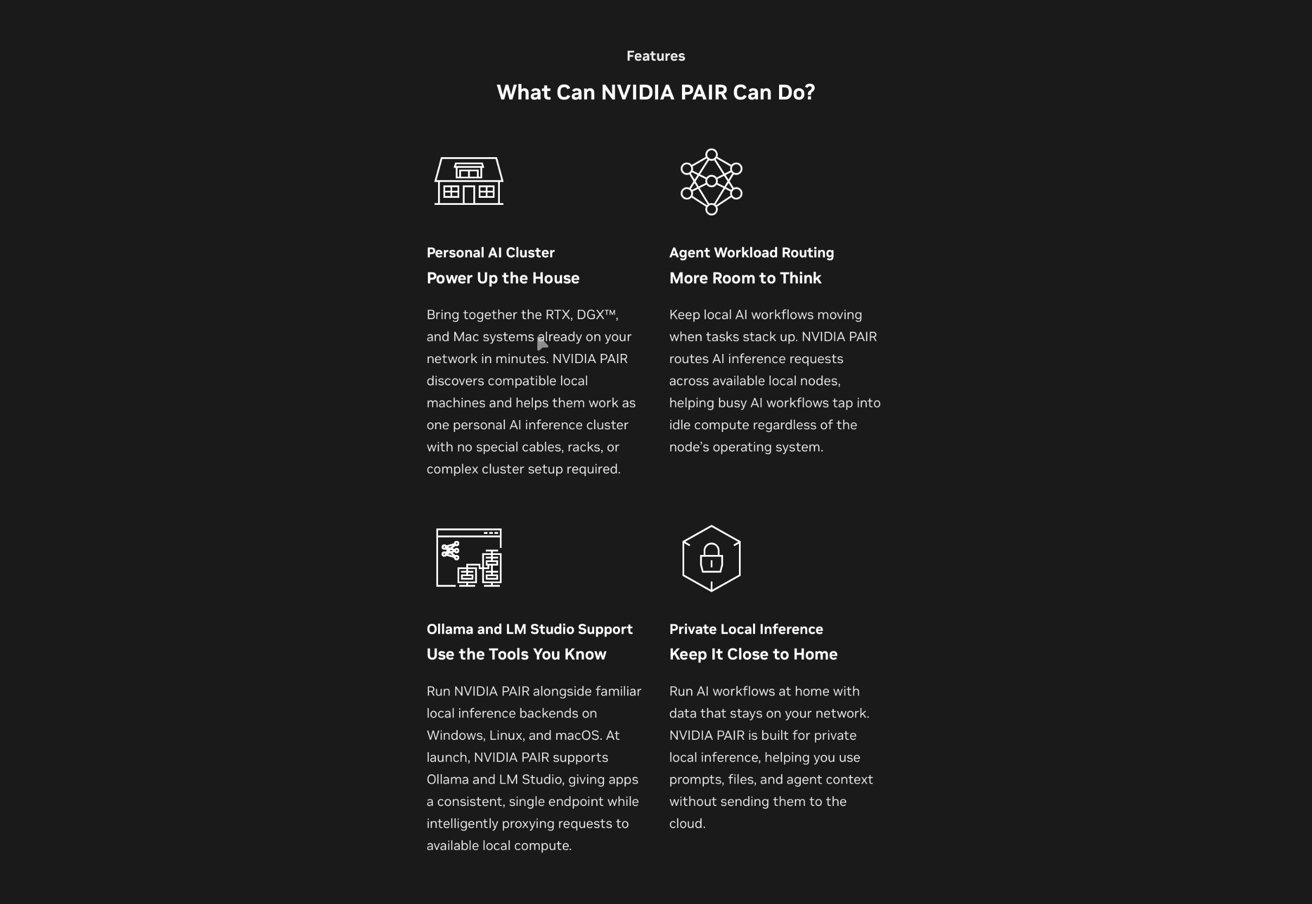
The Personal AI Router (PAIR) isn’t hardware. Instead, it’s software that connects supported Apple Silicon Macs, Nvidia RTX PCs, and DGX Spark systems.
PAIR works with Ollama and LM Studio, two tools for running AI models locally. It discovers participating computers and gives AI apps a single connection for sending requests, so users don’t have to configure each app to reach every machine.
For someone already running local AI on a Mac, PAIR could put a compatible gaming PC to work when requests pile up. An AI agent reviewing several documents, for example, could have independent requests handled on different computers.
Advertisement
Nvidia released the open-source beta on September 3.
How PAIR distributes local AI requests
PAIR chooses an available computer for each request, while Ollama or LM Studio runs the model on that machine. When a computer is busy or unavailable, the router can direct new requests elsewhere.
The computers remain separate systems, according to Nvidia’s technical FAQ. PAIR doesn’t combine their GPUs or memory, so connecting two 16GB Macs doesn’t create one 32GB memory pool for a larger model.
Adding another computer doesn’t automatically make an individual AI response faster.
Advertisement
In a performance demonstration, Nvidia ran a task divided among five AI subagents in Hermes, using Ollama and the Qwen 3.6 35B A3B model. It reported average completion times of 18 minutes on an RTX Spark laptop and 8 minutes and 48 seconds across that laptop, a DGX Spark, and an RTX 5090.
Nvidia describes the result as an unofficial demonstration specific to that configuration. The comparison didn’t include a Mac, so it doesn’t establish how much a Mac user would gain from PAIR.
Mac requirements leave M3 Ultra outside the support list
Nvidia’s system requirements list macOS Tahoe and an M4 or newer chip for Mac support. The general requirements specify at least 8GB of RAM and recommend 20GB or more of disk space.
Features of Nvidia PAIR
The cutoff leaves the M3 Ultra Mac Studio outside PAIR’s published hardware requirements. Apple introduced that Mac in March 2025 with configurations offering up to 512GB of unified memory, and its launch announcement specifically promoted running large language models locally.
Nvidia’s requirements page doesn’t explain the M4 cutoff, and the published support list doesn’t establish whether PAIR would work on an older Mac.
Advertisement
Supported Nvidia hardware includes GeForce RTX 20-series GPUs and newer, RTX Pro workstation GPUs based on the Turing architecture or newer, and DGX Spark systems. PAIR supports Windows and Linux alongside macOS.
Users need to install PAIR, pair their computers, and make the required models available through Ollama or LM Studio. Each participating machine still needs the resources to run the requested model.
Nvidia describes PAIR’s local inference as keeping prompts, files, and agent context on the user’s network. Models need to be downloaded first, but PAIR itself doesn’t require an internet connection to operate.
The injection mechanism is a small device that deploys a syringe using a spring system. That triggers a process that breaks the seal between a chamber containing citric acid and another containing baking soda. The resulting chemical reaction—basically the same one you might’ve done as a kid to make a volcano with baking soda and vinegar—creates enough carbon dioxide to push the plunger on the syringe and administer medication.
Photograph: The University of Queensland
For the study, the research team remotely controlled a cockroach to travel from its starting point through three checkpoints and administer an injection to a simulated target.
The results showed that the success rate for injections made at close range—within 150 millimeters of the target—topped out at approximately 95 percent. The success rate for the entire sequence of tasks—from departure to completion of the injection—was 72 percent.
The researchers also successfully demonstrated teamwork, where one cockroach uses a camera to locate a simulated target while another serves as the injector.
Advertisement
Although the research team has previously developed cyborg beetles capable of climbing vertical walls, they note that larger cockroaches are better-suited for carrying specialized rescue and medical equipment.
While the results of the new research are promising, the experiment didn’t replicate the complex environmental conditions found at actual disaster sites, such as debris, uneven terrain, and shifting landscapes.
Vo Doan expressed hope that, if resources can be secured to speed up research and field testing, a rescue team of cyborg insects could be deployed at actual disaster sites within five to 10 years.
“Rather than building one robot to do everything, we can harness the natural strengths of different insects and equip them for different missions,” Vo-Doan says.
Advertisement
This story was originally published inWIRED Japanand has been translated from Japanese.
N-able has released an emergency hotfix for a maximum-severity remote code execution (RCE) flaw affecting its N-central remote monitoring and management (RMM) platform.
IT departments and managed service providers (MSPs) use the N-central platform to monitor, manage, and maintain client networks and devices from a centralized web-based console.
Tracked as CVE-2026-86218, this RCE vulnerability allows threat actors without privileges to execute malicious code on unpatched N-central instances exposed online in low-complexity attacks.
N-able addressed the flaw on Saturday by releasing N-central 2026.3 Hotfix 4 and urging customers to patch as soon as possible.
Advertisement
“At this time, we have no confirmations that this vulnerability has been exploited in production environments, but unpatched systems remain at risk,” the company said.
“Customers running on-premises N-central deployments should upgrade to N-central 2026.3 HF4 immediately to protect their environment.”
While N-able has yet to confirm that the CVE-2026-86218 flaw is being targeted, cybersecurity company Huntress has flagged it as a potential zero-day, along with two high-severity vulnerabilities (tracked as CVE-2026-86206 and CVE-2026-86207, and also patched over the weekend) that can allow attackers to bypass authentication and gain full access to the vulnerable N-central platform.
“In our 9/5/26 update [..], we had said we could not rule out whether the two previous vulnerabilities released (CVE-2026-86206 and CVE-2026-86207) were the ones that were exploited in the instance seen in the patched production environment of one of our customers,” Huntress said.
Advertisement
“Because logs on the compromised N-central server had already rotated, we are also unable to say whether this new CVE was the vulnerability exploited in that case.”
“On-premises N-central users must apply HF4 immediately, as systems running HF3 remain vulnerable to this newly disclosed flaw,” Huntress warned.
One year ago, N-able released security updates for two N-central vulnerabilities (CVE-2025-8875 and CVE-2025-8876) that attackers were exploiting in the wild.
Days later, Shadowserver found that 880 N-central servers were still vulnerable to attacks exploiting the two security flaws even after CISA ordered federal agencies to patch their systems within a week and urged all security teams to also prioritize securing their systems against ongoing attacks.
Advertisement
Overall prevention scores can hide what happens after initial access. Once attackers are using valid credentials, prevention drops sharply.
The Blue Report 2026 measures defenses technique by technique across 338 million simulations run in customer production environments.
The EU’s forthcoming Quantum Act will not come with a dedicated budget. “The act is not about budget,” said Thomas Skordas, deputy director-general of the European Commission’s DG CNECT, at a European Parliament event last week, on 3rd of September.
“What the act will provide is the stimulus to make sure that we move in the right direction, that we bring people together.”
The session, hosted by the European Quantum Flagship and German Green MEP Sergey Lagodinsky, brought together representatives from the Commission, Council and Parliament, along with researchers and quantum company founders. The Commission hopes to present the legislation by the end of 2026, although that timeline could slip into next year.
Skordas described the act as an enabling framework rather than a regulation. That distinction matters in Brussels, where recent technology policies such as the AI Act and the Digital Markets Act have largely focused on imposing rules and obligations rather than bringing different parts of an industry together.
Advertisement
The clearest comment of the day concerned Europe’s quantum startups.
“We cannot afford having 78 startups all on their own,” Skordas said. “We don’t have Microsoft, we don’t have Google, we don’t have IBM. We want competition, but at some stage, we expect a little bit of consolidation.”
It is unusual for a Commission official to openly call for consolidation in an industry. But the comment also reflects a problem that has become increasingly difficult for Europe to ignore: its quantum efforts are spread across member states and different technology approaches, producing plenty of prototypes but fewer companies with the scale to build their own manufacturing capacity.
Tommaso Calarco, secretary of the EU’s high-level advisory board on quantum technologies, put it more simply.
“What do we need? We need critical mass,” he said. “And critical mass means three things: it means cash, it means speed, and it means we do things together.”
The act can address two of those three things. Cash is not one of them. Calarco was blunt about what he thinks is at stake: “This quantum act is the last train which is passing for Europe.”
Advertisement
He was also critical of how member states are working with the Commission. They “are not yet pooling their resources strategically to the extent that they should, and we cannot wait”, he said.
Europe does have one advantage that the usual argument about fragmentation can overlook.
“We’re not only buyers, but we are also suppliers,” said Cecile Perrault, executive director of the European Quantum Industry Consortium. “80% of the components that we find in quantum computers in Europe come from Europe. We have a huge advantage compared to other digital technologies there.”
That position in the supply chain is already attracting private investment. The Novo Nordisk Foundation is building an open quantum chip foundry in Copenhagen, creating the kind of manufacturing capacity the act is intended to encourage, and doing so without waiting for the legislation.
Skordas also argued that quantum computing needs to become part of a much broader technology ecosystem.
Advertisement
“We need to break silos,” he said. “Quantum has to be combined with semiconductors, photonics, the cloud industry, the end users and many other technologies that are more mature and can win new markets.”
Talent was another concern raised during the discussion. “The talent goes where the global leaders are, not only where the money is,” said Eleni Diamanti, co-founder of Welinq and a CNRS research director at Sorbonne University. That makes the talent problem closely tied to Europe’s ability to build companies that can become global leaders, rather than a separate issue.
Lagodinsky placed the debate in a broader context.
“It’s not just a competition between business models, it’s a competition between societal models,” the MEP said, “and, in this competition, technology and leadership in the realm of innovation play the role.”
The bigger question is whether that investment can produce an industry capable of competing at scale, rather than primarily supporting research. That is the problem the Quantum Act will inherit.
Advertisement
For now, it is still unclear what the act will actually contain. There is no draft text, no fixed date for its presentation, and no details yet on how the Commission plans to encourage the kind of consolidation Thomas Skordas described.
Two runways are currently closed at Miami International Airport after an Amazon-branded cargo plane overran a runway, resulting in five fatalities.
Advertisement
The leased 767, which bears the “Prime Air” brand Amazon uses for its air freight and drone operations, landed but was unable to stop before the end of the 2850-meter runway 30. The plane appears to have exited the runway and the airport grounds, crossed a road, and come to a halt in what looks like a carpark.
As it ran across grass beyond the runway, the plane’s nose pitched down into the ground, its starboard engine caught fire, and the craft sustained extensive damage.
Local authorities have confirmed that five people died, and three are severely injured.
A statement from Amazon spokesperson Kelly Nantel says the company is”heartbroken to learn that five people lost their lives in today’s incident at Miami International Airport.”
Advertisement
The statement identifies the operator of the plane as 21Air, a company that leases cargo planes and crew to its customers.
21Air CEO Keith Winters said “We are devastated by the accident involving one of our aircraft in Miami today. Our deepest condolences are with the families and loved ones of those who lost their lives. Our immediate priorities are supporting those affected, assisting the authorities, and ensuring that accurate information is communicated as it becomes available.”
At the time of writing, the crash is just over 12 hours in the past, so investigators’ work has just begun. A video purportedly showing the plane landing depicts dark storm clouds and rain around the airport. That weather could conceivably have created gusty conditions that made landing unusually challenging.
Federal records indicate the plane rolled off the Boeing production line in 1994. According to Planespotters, its first owner was Belgian carrier Sobelair, and it was later bought by carriers from Vietnam, Spain, Kenya, and Russia, before freight airline Atlas acquired it in 2015 and converted it from passenger to freight operations.
Advertisement
That’s a common fate for older planes, which passenger airlines sell at very low prices. Cargo airlines can therefore pick up well-maintained planes at very low prices, meaning they have lower borrowing or leasing costs. That cheap purchase price offsets the higher maintenance and operating costs that come with older planes.
All commercial aircraft, however, share strict airworthiness requirements.
This is the second major crash involving a 767 leased by Amazon, after the 2019 incident that saw a plane unexpectedly nose-dive. ®




































































You must be logged in to post a comment Login