Pony.ai and Uber have expanded their partnership to put more than 2,000 robotaxis on European roads, a deal that hands one of China’s autonomous-driving champions a route onto the continent’s streets through an American app and a scattering of local fleet owners.
The arrangement is divided as Pony.ai supplies the Level 4 self-driving technology and the operational know-how, Uber provides the platform, meaning booking, payments and customer service, along with its considerable market reach, and local partners own and run the actual fleets. In Zagreb, that partner is Croatia’s Verne.
Zagreb goes first, launching on the Uber platform in 2026, with four more European cities to follow in phases and a Middle East deployment also pencilled in.
It is a familiar shape for Uber, which has spent the past year signing up self-driving suppliers rather than building its own, from Wayve robotaxis in London to a growing roster of partners elsewhere.
Advertisement
The logic is asset-light and, for a Chinese firm eyeing Europe, quietly clever. By letting local partners shoulder the cost of the vehicles and much of the regulatory paperwork, Pony.ai sidesteps a good deal of the capital and compliance burden that has made robotaxi expansion so brutally expensive everywhere else.
It also plays to what Pony.ai already has. The company runs paid, fully driverless robotaxis in four Chinese cities and says it has reached city-wide breakeven unit economics in several markets, a claim few Western rivals can make with a straight face.
That track record is precisely what makes it useful to Uber, which would rather partner with a supplier that has already sweated the hard, expensive years of testing than start from scratch.
“By combining Pony.ai’s proven autonomous driving technology and operational know-how with Uber’s global mobility platform and extensive market reach, we aim to build sustained commercial operations at scale across Europe and beyond,” said Pony.ai chief executive Dr James Peng.
Advertisement
Uber and Pony.ai first joined forces in May 2025, and this fresh commitment scales that early pact up considerably. Sarfraz Maredia, who heads Uber’s autonomous mobility unit, framed Europe as the next proving ground for the tie-up.
There is a wrinkle, though, and it is a sizeable one. A Chinese self-driving system, hoovering up detailed mapping and movement data as it ferries passengers around European cities, arrives at a moment when Brussels is increasingly twitchy about Chinese technology, from electric vehicles to telecoms kit.
The data questions rather write themselves. Level 4 robotaxis are essentially rolling sensor arrays, and where all that footage and location data ends up being processed, stored and potentially accessed is precisely the sort of thing European regulators have already started asking of Chinese carmakers.
Uber, for its part, has been unusually candid about losing the self-driving race it once led. Having sold off its own autonomous unit years ago, it now positions itself as the neutral platform on which everyone else’s robots compete, and increasingly as the lobbyist writing the rulebook.
Whether European passengers will much care about the provenance of the car that pulls up is another matter entirely. For most riders, the deciding factors will be price, availability and, above all, whether the thing brakes in time.
What the deal makes plain is that the robotaxi race is no longer a purely American or Chinese affair played out on home turf.
Pony.ai’s arrival, via Uber’s app and a Croatian startup, is the moment the contest properly reaches the European kerb, and the moment Europe has to decide how comfortable it really is with whose software is doing the driving.
Joshua Kushner’s Thrive Capital has sent its first formal letter to investors, and the standout figure captures the AI era in miniature.
One of its funds has swelled to about $3.7bn in value, driven overwhelmingly by early bets on OpenAI and SpaceX. The letter, reported by Bloomberg, reads as a victory lap and a quiet hedge at the same time.
That Thrive is writing to its backers at all is notable in itself. Kushner has built one of the most secretive and sought-after firms in venture capital, so a formal letter, complete with hard marks and a candid line on concentration, is a departure that doubles as a statement of confidence.
It also lands at a moment when the whole industry is arguing about whether AI valuations reflect real value or collective hope, which makes a firm this exposed to a single name showing its workings all the more striking.
Advertisement
Thrive’s OpenAI position is practically a chronicle of the boom. The firm first backed the company in 2022 at a $29bn valuation, led a tender the following year at $86bn, and has since committed around a billion dollars more across rounds that valued OpenAI at $150bn and then $285bn.
That $3.7bn mark also owes a great deal to Thrive’s stake in Elon Musk’s SpaceX, another private giant whose valuation has climbed relentlessly.
Between them, two holdings now account for the bulk of the fund’s gains, a concentration most portfolio managers would flinch at and Thrive is presenting as vindication.
Advertisement
There is a large asterisk, though. Almost none of that value has actually been banked. The gains are unrealised marks, dependent on OpenAI’s and SpaceX’s private valuations continuing to rise, and a growing share of Thrive’s paper returns now rests on OpenAI alone.
On paper, the firm is having a spectacular decade, but in cash, far less has been settled, and paper fortunes have a habit of shrinking the moment the market that created them turns.
Which is what makes the other disclosure in the letter so telling. Thrive is selling part of its OpenAI stake, taking some chips off the table even as it insists the story is only beginning.
Trimming a winner is textbook risk management, yet it also quietly concedes the oldest truth in venture capital, which is that a mark is not money until someone else pays for it.
Advertisement
Thrive has grown into a heavyweight on the strength of these wagers. The firm now manages roughly $25bn and this year closed a record $10bn fund, its largest yet and reportedly oversubscribed, a sign that limited partners are content to keep feeding a strategy built on a handful of enormous private positions.
The letter arrives at a jittery moment for that whole model. As doubts grow about whether AI revenues can ever justify the valuations, and about whether much of the sector is a bubble waiting to deflate, funds whose fortunes hinge on a single soaring private mark start to look exposed rather than clever.
Thrive’s numbers dazzle precisely because OpenAI’s have never stopped climbing.
Advertisement
For now, it stands as one of the great venture bets of the age. Kushner backed OpenAI when it was still a curiosity and rode it to the centre of the economy.
What the letter cannot answer is what happens to a fund like this on the day OpenAI’s private valuation finally stops rising, because a return that exists only as a mark can evaporate almost as fast as it appeared.
Google has launched the Pixel 11 series in India, expanding its latest smartphone lineup with the Pixel 11, Pixel 11 Pro, Pixel 11 Pro XL, and Pixel 11 Pro Fold. The new phones bring Google’s latest Tensor G6 processor, upgraded cameras, longer battery life, and a range of new AI features powered by Gemini Nano. Alongside the Pixel 11 lineup, Google has also introduced the Pixel Watch 5 and updated Pixel Buds Pro 2 in India. The Pixel 11 series starts at ₹89,999, while the Pixel 11 Pro Fold starts at ₹1,86,999.
Pixel 11 Gets Camera and Battery Upgrades
Google has given the standard Pixel 11 a refreshed design and improved camera system. Its redesigned camera bar is more than 40 percent thinner than the previous model. The phone comes with a satin-finish frame and four color options. These include Frost, Hibiscus, Pistachio, and Obsidian. The Pixel 11 uses the Tensor G6 processor with 12GB of RAM. Users can choose between 256GB and 512GB storage.
Google says the phone offers more than 30 hours of battery life. Its upgraded 48MP main camera also captures 56 percent more light and supports up to 30x Super Res Zoom and Instant Night Sight.
Pixel 11 Pro and Pro XL Focus on Premium Features
The Pixel 11 Pro and Pixel 11 Pro XL bring several premium upgrades to Google’s latest smartphone lineup. Both models feature a refined design with an edgeless camera bar and Super Actua displays. The displays can reach up to 3,600 nits of peak brightness. They also use a new coating that Google says offers twice the scratch resistance of the previous generation.
The two phones come with a 50MP main camera and a new 48MP telephoto camera. They support up to 120x Pro Zoom and Portrait Mode at 5x zoom. Both models provide more than 30 hours of battery life. Their wired charging can reach 75 percent in about 30 minutes. They also offer faster wireless charging than before. Buyers can choose Canyon, Fog, Olive, or all-matte Obsidian finishes.
Advertisement
Pixel 11 Pro Fold Brings AI to a Foldable Phone
The Pixel 11 Pro Fold is designed to offer a large-screen experience in a slimmer foldable body. Google has reduced its thickness by nearly 1mm and its weight by almost 10 percent. The company also claims three times better durability than the previous model. The device comes with the Tensor G6 chip and 16GB of RAM.
The foldable features brighter Super Actua displays on both sides of the device. It offers more than 24 hours of battery life and can charge to around 50 percent in 30 minutes. It also supports 25W Qi2.2 wireless charging. For photography, the device offers up to 30x Super Res Zoom. Its large screen supports features such as Split Screen, Drag and Drop, and Instant View. The phone will come in an Olive finish with 512GB storage.
Pixel Watch 5 and Pixel Buds Pro 2
Google has also expanded its wearable lineup with the Pixel Watch 5. The smartwatch comes in 41mm and 45mm sizes. The 41mm model starts at Rs 42,900, while the 45mm model starts at Rs 45,900. It uses the Snapdragon W5 Gen 2 Wearable Platform. Google claims that the new watch is 20 percent faster than its predecessor. It also supports offline Gemini assistance and new health features through Google Health Guardian.
Health tracking is another major focus of the Pixel Watch 5. It offers improved sleep tracking and recovery information through Google Health Guardian. Users can also view trends in blood pressure and insulin resistance. The watch includes improved GPS tracking and new Smart Wake alarms. Google has also updated the Pixel Buds Pro 2 with better adaptive Active Noise Cancellation. The earbuds now support Gemini Voice Control, Live Translate, and Sleep Sync. A new Olive color option will also be available.
Price and Availability
The new Pixel 11 lineup starts at ₹89,999 for the standard Pixel 11. The Pixel 11 Pro and Pixel 11 Pro XL carry starting prices of ₹1,19,999 and ₹1,34,999. Meanwhile, the Pixel 11 Pro Fold starts at ₹1,86,999. Customers can pre-order the phones through the Google Store before their August 20 sale. Google has also promised seven years of software and security updates for the entire Pixel 11 family.
Google is offering several payment and support benefits with the Pixel 11 series in India. Buyers can get cashback and up to 24-month no-cost EMI through HDFC Bank and ICICI Bank. Zero-down-payment financing is also available through Bajaj Finance and IDFC FIRST Bank. The Pixel Upgrade Program offers an assured buyback value of up to 62.5 percent after nine months. Selected Pro models also include six months of Google AI Pro.
Flock Safety cameras can track license plates, car features and, on the right models, humans as well. They can also listen for disturbances such as gunshots. These camera networks have drawn scrutiny over their potential to enable casual surveillance of communities, as well as documented abuses, including police using the systems to monitor former partners or inventing pretexts for searches that result in information being shared with agencies such as ICE, as I detail in my full guide here. That’s led to protests, Flock contract cancellations and in some cases, cities blocking cameras by wrapping them in trash bags because Flock won’t take them down.
This is Flock’s largest response to these issues that I’ve seen to date, with a series of changes governing how police can use its surveillance systems. Most of these changes won’t be required until the end of the year, and some won’t affect existing contracts. Flock has also created exceptions to the new rules, leaving police and sheriff’s departments responsible for enforcing them while giving them mechanisms to continue using the cameras as they see fit.
“Flock has attempted this before, and the security measure failed because police were easily able to circumvent the system’s requirement that they input the purpose of their search,” the ACLU says. It encourages Flock to use an independent evaluator to oversee its regulations.
Representatives from Flock Safety didn’t immediately respond to a request for comment.
Loopholes abound for Flock’s new regulations
Flock is putting more responsibility on law enforcement, which is problematic.Justin Sullivan/Staff/Getty
Every new Flock rule announced seems to come with a caveat. One of the biggest changes is a reduction in the length of time Flock retains camera data — and, consequently, how long that data can be used for searches — from 30 days to seven. But Flock also says that “Existing customers will keep their current, democratically approved retention periods,” meaning most users won’t see the change for some time.
There’s also a new evidence mode that ignores the new retention period, allowing police to hold data indefinitely while pursuing active investigations of their choice.
Flock is also adding a feature called “offense filtering,” which can limit the specific Flock camera information that outside agencies have access to. This doesn’t change much because police departments can set their own limits when sharing data. As previously reported, police departments have already violated state laws by sharing information with ICE, the FBI and other agencies.
Advertisement
Another change makes Flock’s new audit assistance feature mandatory by 2027. Audit assistance flags suspicious camera use, such as repeatedly searching for the same license plate. It’s unclear how the system could differentiate between tracking a stolen car for a period of time and stalking someone. When it flags suspicious behavior, the audit assistance tool locks the user out of the system and requires an administrator review.
Another change requires users to enter a case code for every law enforcement search, in addition to the existing option to provide a reason for the search. There is an exception for emergency searches, which can still be conducted without that information but are flagged for administrator review.
So who will conduct these reviews? I asked Flock, but have not yet received a response. Based on the company’s documentation, the administrator appears to be the person designated under the agency’s contract with Flock — potentially a sheriff or police chief, including officials in positions where Flock cameras have previously been misused. That raises questions about whether the new safeguards provide meaningful independent oversight or simply place accountability back with the same agencies responsible for using the systems.
Changes like these place greater responsibility on departments to police their own use of the technology, while potentially limiting Flock Safety’s responsibility for how its surveillance systems are used. At the same time, Flock has built in several exceptions that allow departments to bypass the new requirements, with the conditions for those exceptions appearing to depend largely on individual agency policies rather than clear, uniform standards.
Advertisement
These rules apply only to law enforcement. Cities, neighborhoods and businesses that contract with Flock don’t need to follow the new regulations. Recent research has also found error rates ranging from 30% to 70% in Flock camera systems, raising broader questions about the reliability of this increasingly widespread surveillance technology.
Tyler Lacoma
Editor / Home Security and Smart Home
Tyler has worked on, lived with and tested all types of smart home and security technology for over a dozen years, explaining the latest features, privacy tricks, and top recommendations.
With degrees in Business Management, Literature and Technical Writing, Tyler takes every opportunity to play with the latest AI technology, push smart devices to their limits and occasionally throw cameras off his roof, all to find the best devices to trust in your life. He always checks with the renters (and pets) in his life to see what smart products can work for everyone, in every living situation.
Living in beautiful Bend, Oregon gives Tyler plenty of opportunities to test the latest tech in every kind of weather and temperature. But when not at work, he can be found hiking the trails, trying out a new food recipe for his loved ones, keeping up on his favorite reading, or gaming with good friends.
See full bio
Brightly is a Software-as-a-Service (SaaS) company formerly known as SchoolDude, which was acquired by Siemens in August 2022. Brightly employs over 700 people and provides asset management and maintenance software to more than 12,000 clients worldwide.
27-year-old North Carolina man Cameron Curry (also known as “Loot”) was found guilty in March of orchestrating an “extensive cyber extortion scheme” targeting his employer.
According to court documents, Curry stole sensitive documents after gaining access to the company’s payroll information and corporate data, which he later used to extort Brightly after learning that his six-month contract wouldn’t be extended.
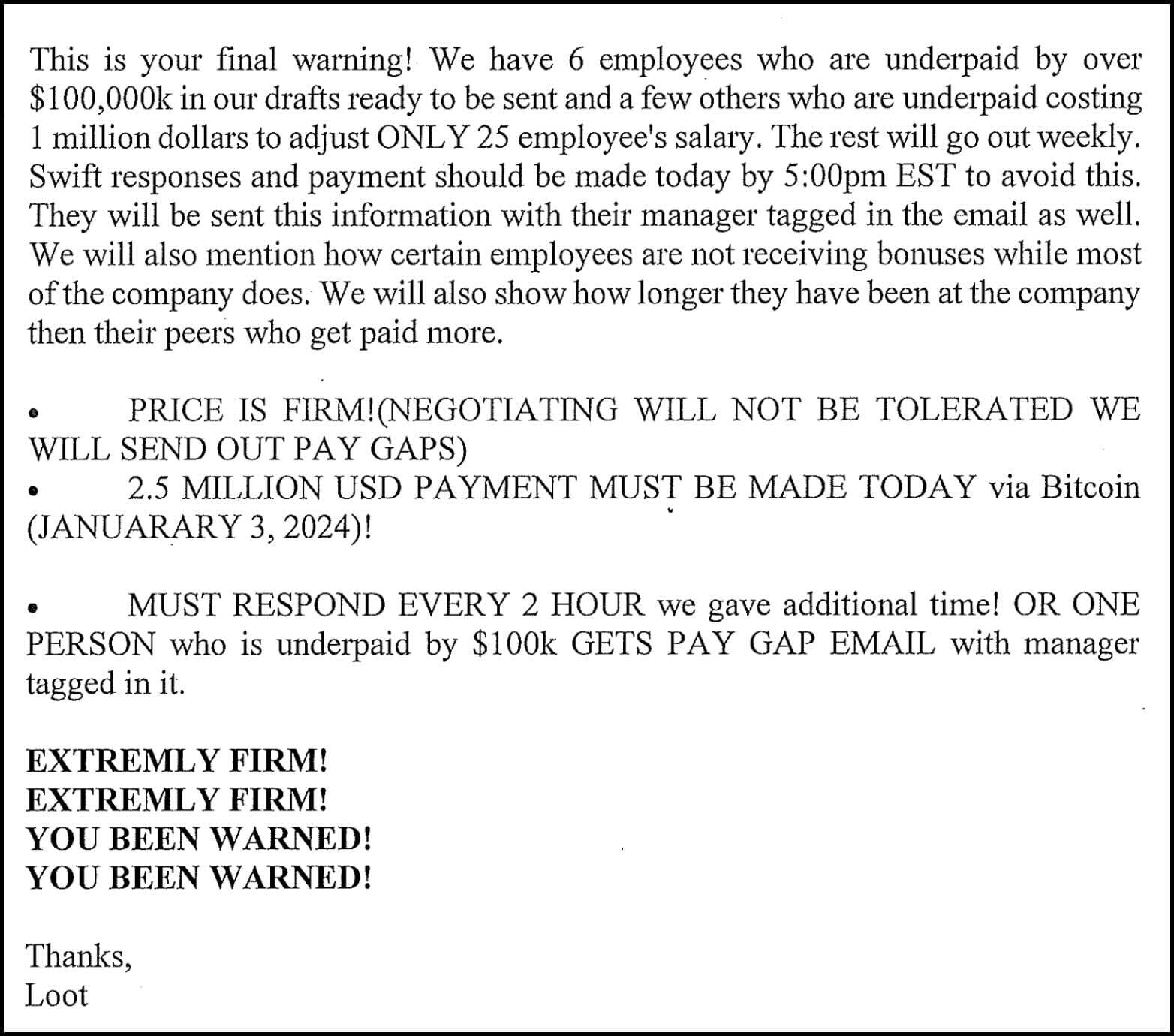
One day after his contract ended on December 10, he emailed dozens of Brightly employees using the Loot alias and the lootsoftware@outlook.com email address between December 11, 2023, and January 24, 2024, threatening to leak the stolen information unless he was paid a $2.5 million ransom in cryptocurrency.
Advertisement
“We will commence the process of disseminating salary information starting January 1, 2024 in phases to all employees and will report you to the SEC after for not reporting the breach,” Curry said in one of the extortion messages.
“If you wish to reclaim your data, we recommend doing so promptly at 2.5 million USD in order to save your company and stocks, as each subsequent month will incur a $100,000 USD increase. Discrepancies in your books are currently over 16 million USD, posing a potential risk for retention issues, a hostile work environment, resentment, and more.”
Extortion email sample (U.S. Department of Justice)
He also attached screenshots of employees’ personally identifiable information (PII), including their names, dates of birth, home addresses, and compensation information, and threatened to report Brightly to the U.S. Securities and Exchange Commission (SEC) for failing to disclose the breach.
Following Curry’s many extortion emails, Brightly paid $7,540 in Bitcoin, transferring the funds to a cryptocurrency wallet controlled by Curry.
After the company reported the incident to law enforcement, the FBI searched Curry’s residence on January 24 and seized various electronic devices containing evidence that linked him to the extortion scheme.
Advertisement
“We are aware of the U.S. Department of Justice’s (DOJ) convictions of Cameron Curry for extortion,” Brightly told BleepingComputer in March.
“We have fully cooperated with the FBI and DOJ in this matter and appreciate their investigative efforts. Given that these proceedings are pending, we defer all questions to law enforcement authorities.”
In May 2023, Brightly also disclosed a data breach (unrelated to this case) after attackers stole credentials and personal data (including names, email addresses, account passwords, phone numbers) of nearly 3 million customers and users from the database of its SchoolDude online platform.
Overall prevention scores can hide what happens after initial access. Once attackers are using valid credentials, prevention drops sharply.
The Blue Report 2026 measures defenses technique by technique across 338 million simulations run in customer production environments.
YouTube SEO strategies help your videos rank higher in search results and recommendation feeds by matching your content with viewer search terms and keeping people watching longer.
Getting views on YouTube requires more than publishing good content. You also need to help search systems understand what your video offers. YouTube processes millions of search queries every day. When you organize your metadata and improve viewer watch time, YouTube shows your content to more people. Creators who want to expand their reach often look for ways to get more YouTube views while building long-term search visibility.
Quick Take: Essential YouTube SEO Strategies
If you want fast results, focus on viewer click rates and watch time first. Metadata helps YouTube index your topic, but viewer behavior determines if your video keeps ranking.
Strategy Area
Primary Goal
Best For
Keywords & Titles
Match search intent
New videos and search traffic
Thumbnails & CTR
Increase click rates
All channels seeking views
Captions & Chapters
Improve indexing and retention
Longer tutorial content
Playlists & End Screens
Extend session watch time
Building channel authority
Prerequisites for YouTube SEO
Before optimizing individual videos, set up these basic tools and account settings:
Advertisement
A verified YouTube channel in good standing with custom thumbnail access enabled.
A list of target search phrases found using video keyword research tools.
High-resolution images and clear audio files for your uploads.
11 Expert YouTube SEO Strategies
1. Conduct Targeted Keyword Research
Keyword research reveals the exact phrases viewers type into the search bar. Start by typing your main topic into the YouTube search bar to see autocomplete suggestions. These suggestions show real queries from active users. Choose phrases with steady search demand and manageable competition. Focusing on long-tail keywords helps smaller channels rank faster before competing for broader terms.
Who it is best for: Creators launching new channels or covering technical tutorial topics.
Limitations: Keywords help YouTube index your video, but they cannot force viewers to stay if the content is unhelpful.
2. Craft Clear and Keyword-Focused Titles
Your title tells search algorithms and human viewers what your video contains. Place your primary keyword near the beginning of the title. Keep the overall length under 60 characters so text does not get cut off on mobile screens. Avoid misleading titles that promise things you do not deliver. Accurate titles build viewer trust and reduce early drop-offs.
Who it is best for: Every creator publishing search-focused content.
Advertisement
Limitations: Keyword-heavy titles can sound robotic if you do not balance keywords with natural language.
3. Write Detailed Descriptions with Timestamps
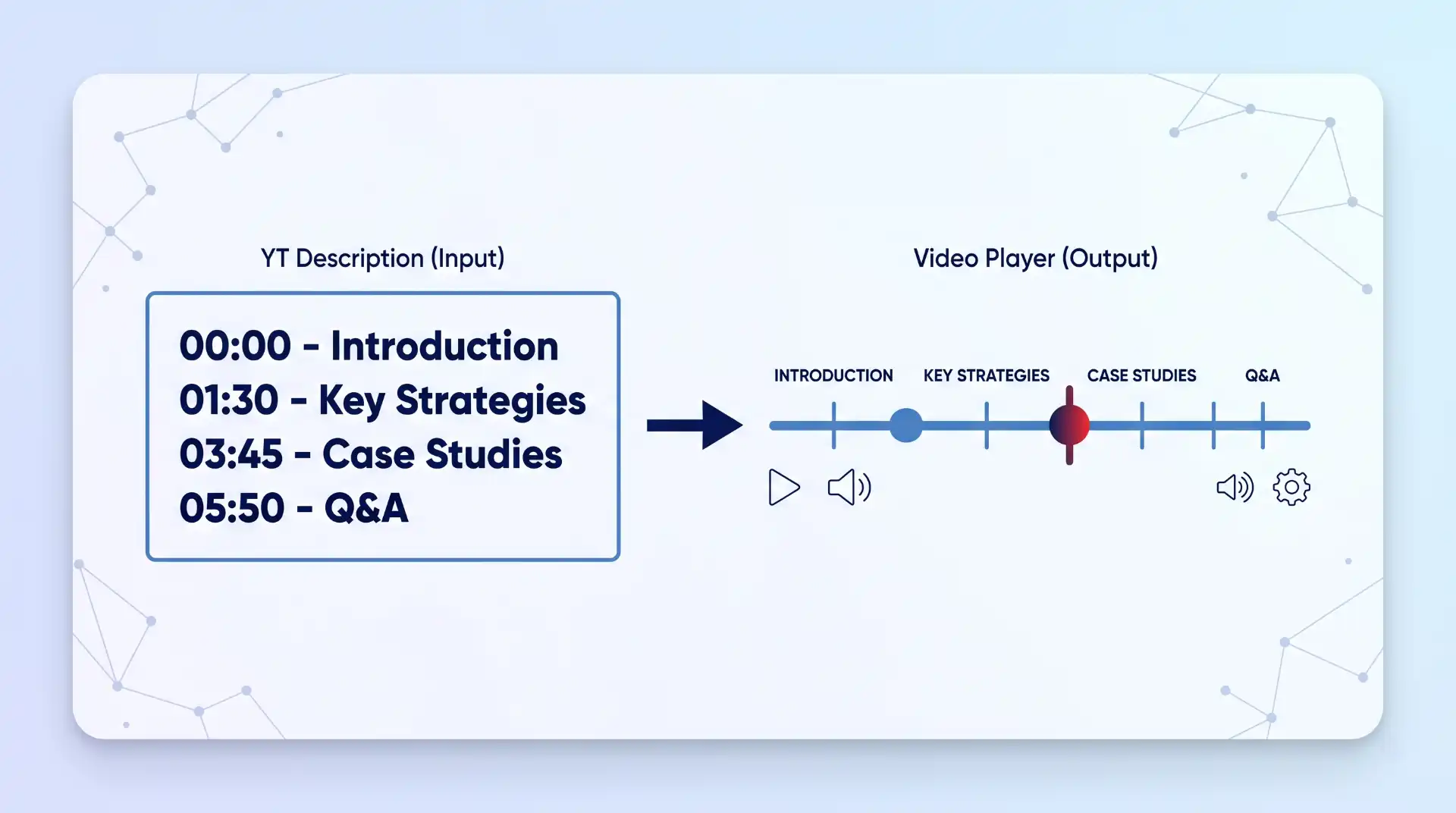
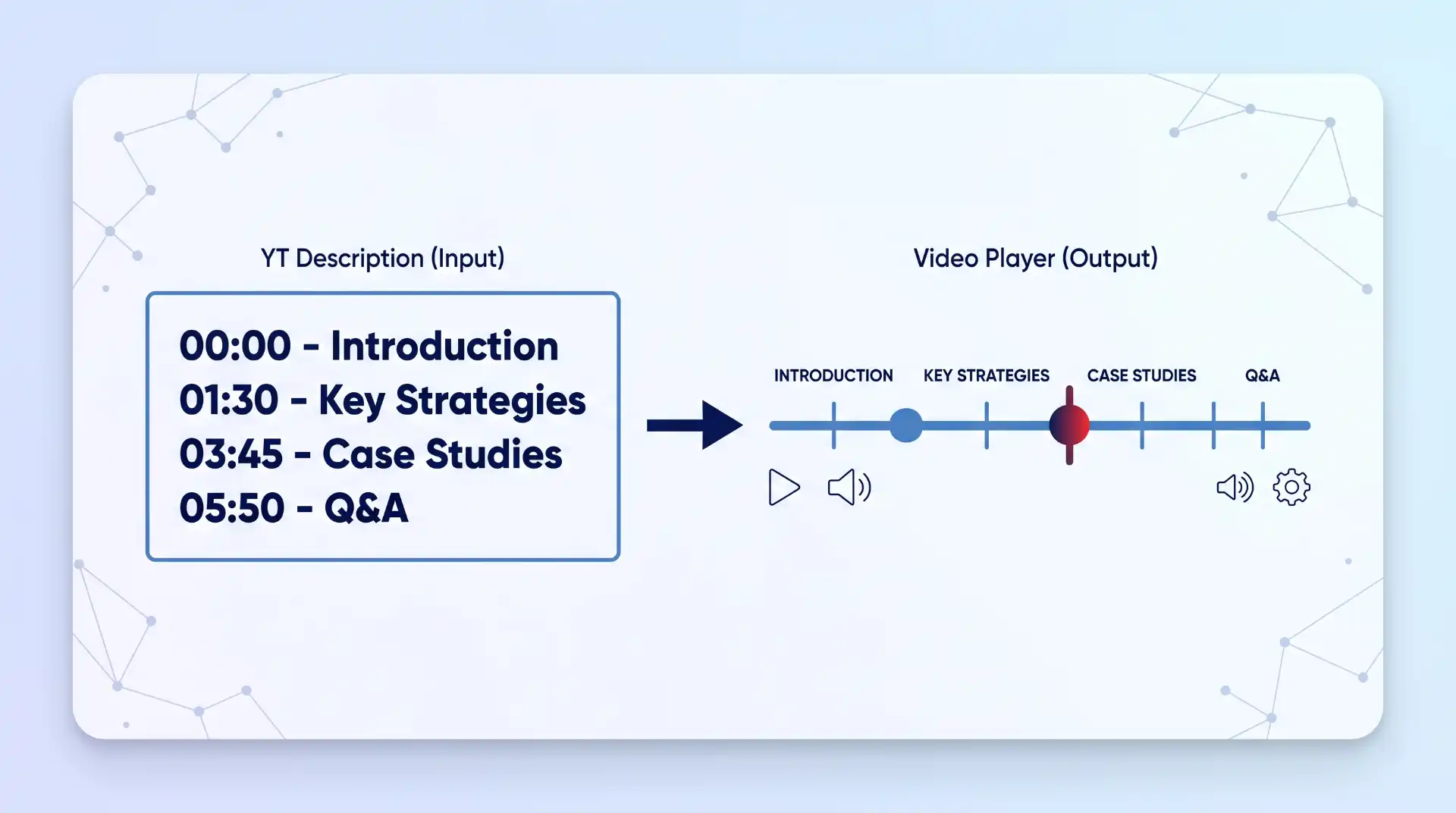
Your description gives search engines extra context about your video topic. Write a clear summary in the first two lines, as these lines appear in search previews. Include secondary keywords naturally throughout the text. Add structured timestamps following official video chapter formatting. Starting your list with 00:00 enables automatic chapter markers on the video timeline.
Who it is best for: Educational creators, product reviewers, and lengthy tutorials.
Limitations: Descriptions have a 5,000-character limit, and stuffed keywords can trigger spam penalties.
Advertisement
4. Design High-Contrast Custom Thumbnails
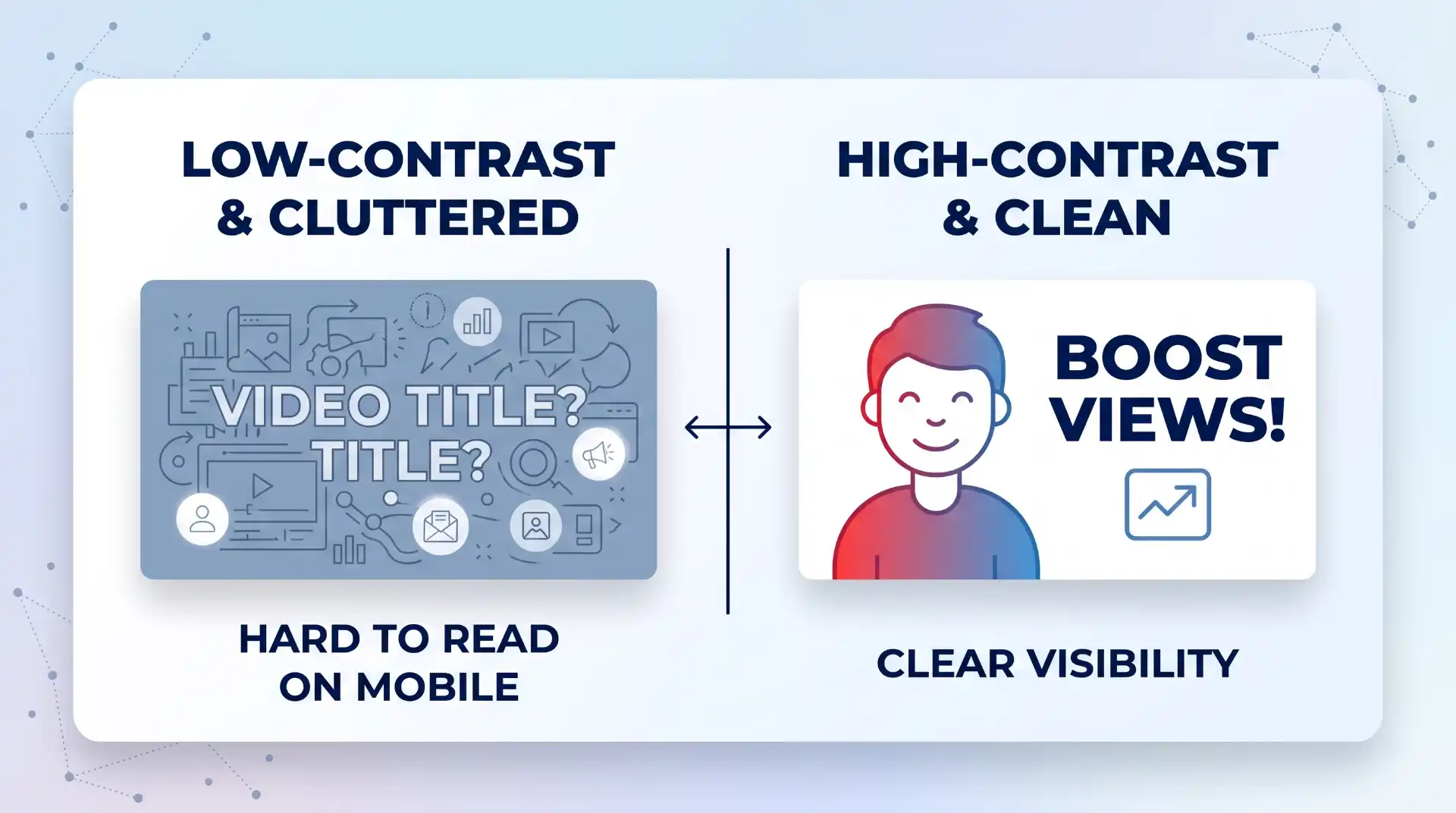
Thumbnails act as visual billboards for your content. Create custom graphics that feature bold text, high-contrast colors, and clear focal points. Review the custom thumbnail policy guidelines to keep your account in good standing. High click-through rates tell YouTube that viewers find your packaging appealing. If you want to refine your visuals, study basic thumbnail design principles to improve click rates.
Who it is best for: All creators competing in crowded search results and home feeds.
Limitations: A high click rate will not sustain video rankings if viewers leave within five seconds.
5. Upload Custom Captions and Transcripts
Captions make your content accessible to hard-of-hearing viewers and non-native speakers. YouTube reads subtitle text to index your video content accurately. Use YouTube subtitle and caption tools to upload an SRT file or correct automatic captions. Accurate transcripts ensure the system does not misinterpret spoken technical terms or brand names.
Advertisement
Who it is best for: Educational channels, global audiences, and spoken-word videos.
Limitations: Automatic captions often contain errors in technical jargon, requiring manual review.
6. Use Strategic Metadata Tags and Hashtags
Tags provide additional context when viewers search for misspelled terms or related phrases. Enter your main target phrase as the first tag, followed by broad category terms. Add two or three relevant hashtags to your video description. Avoid adding dozens of irrelevant tags, as excessive tagging dilutes topic clarity and violates platform policies.
Who it is best for: Niche topics with common misspellings or alternative names.
Advertisement
Limitations: Tags play a minor role compared to titles, thumbnails, and audience retention.
7. Optimize Audience Retention and Watch Time
Watch time measures the total minutes viewers spend watching your content. The official YouTube recommendation system documentation confirms that watch time and viewer satisfaction drive recommendations. Hook viewers in the first ten seconds by making a clear promise. Use jump cuts and graphic overlays to maintain pacing. Analyzing audience retention drop-off analytics helps you spot where viewers lose interest so you can edit future videos better.
Who it is best for: Channels trying to gain traction in recommendation feeds.
Limitations: Retention patterns vary by video length; shorter videos need higher percentage completion than long streams.
Advertisement
8. Build Backlinks and External Promotions
External links from reputable blogs, social posts, and websites send discovery signals to search engines. Embed your videos in relevant blog posts to drive external traffic. When outside sites link to your video, you gain steady views beyond YouTube search. Creators building authority often use backlinks to support their channel’s subscribers and overall video reach.
Who it is best for: Businesses, bloggers, and creators with external web properties.
Limitations: Low-quality spam links on sketchy sites can hurt traffic quality and lower retention metrics.
9. Organize Videos into Structured Playlists
Playlists group related videos together and play them sequentially. When a viewer watches multiple videos in a playlist, your total session watch time increases. Give playlists descriptive titles that contain relevant search terms. You can also feature top playlists on your channel homepage to guide new visitors toward your best work as you build a profitable channel over time.
Advertisement
Who it is best for: Multi-part tutorials, series, and channels with large content libraries.
Limitations: Overloaded playlists with unrelated videos frustrate viewers and reduce total watch time.
10. Leverage End Screens and Cards to Keep Viewers
End screens and info cards prompt viewers to watch additional content before they leave. Add an end screen in the last 20 seconds of your video to link to a relevant follow-up video. Point viewers toward content that answers their next logical question. Keeping viewers on the platform increases your overall channel session time, which search systems reward.
Who it is best for: Creators with at least five published videos on related topics.
Advertisement
Limitations: Placing cards too early in a video can cause viewers to abandon the current video prematurely.
11. Publish Consistently and Engage Early
Publishing on a predictable schedule helps viewers know when to expect new uploads. Early engagement during the first 24 hours signals viewer interest to discovery algorithms. Reply to viewer comments promptly and pin a compelling question at the top of the comment section. Consistently creating engaging content establishes long-term channel authority.
Who it is best for: Creators building an active community and loyal subscriber base.
Limitations: High upload frequency without quality control leads to viewer burnout and lower retention.
Advertisement
Priority Roadmap: How to Choose Which Strategy First
You do not need to implement all 11 strategies at once. Follow this prioritized roadmap based on your channel stage:
Stage 1 (Pre-Production & Packaging): Focus on keyword research, title crafting, and custom thumbnail design. These establish search relevance and click rates.
Stage 2 (Video Publishing & Accessibility): Add detailed descriptions with timestamps, upload custom captions, and apply focused tags.
Stage 3 (Retention & Channel Growth): Study YouTube analytics guide data to improve retention hooks, build playlists, use end screens, and apply subscriber growth strategies.
Verification: How to Track Your YouTube SEO Performance
Verify your optimization success in YouTube Studio using these specific metrics:
Impressions Click-Through Rate (CTR): Check this in Channel Analytics under the Reach tab. Aim for 5% to 10%. If CTR drops below 4%, test a new title or thumbnail.
Average View Duration (AVD): Check this under the Engagement tab. Aim to keep viewers for at least 50% of total video length.
Traffic Sources (YouTube Search): Ensure “YouTube Search” appears among your top traffic sources for search-targeted uploads.
Troubleshooting Common Ranking Problems
If your optimized video is not getting traffic, check these common failure points:
High impressions but low clicks: Your thumbnail or title does not stand out. Change the thumbnail colors or shorten the title text.
High clicks but sharp drop-off in first 15 seconds: Your title promised something the intro did not deliver. Cut long intros and deliver the main point immediately.
Zero search traffic after 30 days: Target keyword competition is too high. Change your title to target a longer, less competitive search phrase.
Where This Approach Has Limits
YouTube SEO cannot solve core video quality issues. If your audio is hard to hear or your content lacks practical value, metadata alone will not save your rankings. Additionally, YouTube search accounts for roughly 30% to 35% of total platform traffic. The remaining traffic comes from Home feed recommendations and Suggested videos, which rely more on overall retention and viewer satisfaction than keyword matching.
Key Takeaways
Keywords help YouTube understand your topic, but watch time and CTR decide your ranking position.
Keep titles under 60 characters and place target keywords near the beginning.
Use high-contrast thumbnails with bold text to improve mobile click-through rates.
Add timestamps starting with 00:00 in your description to create timeline chapters.
Review retention graphs in YouTube Studio to remove boring sections in future uploads.
Frequently Asked Questions
How long does YouTube take to rank an optimized video?
Initial indexing happens within hours of publishing. However, search rankings usually stabilize after 2 to 4 weeks as YouTube gathers viewer click and retention data.
Can updating an old title or thumbnail revive a dead video?
Yes. Changing a weak thumbnail or vague title on an old video can immediately improve its click-through rate, prompting YouTube to test it with new audiences.
Do hashtags in video descriptions improve search rankings?
Hashtags help categorize content and make videos discoverable through clickable hashtag feeds, but they have a minimal impact on main YouTube search rankings compared to titles and retention.
Are tags still important for YouTube SEO in 2026?
Tags play a minor role today. YouTube primarily uses tags to resolve common misspellings or alternative search terms related to your topic.
alternative_right shares a report from ScienceDaily: Researchers have found a clever new way to map a part of Earth’s upper atmosphere that is notoriously difficult to observe. Using orbital data from roughly 1,200 Starlink satellites, they reconstructed changes in atmospheric density about 500 kilometers above Earth. […] The resulting density patterns also showed strong consistency with observations from the European Space Agency’s SWARM satellites, which measure changes in atmospheric density along their orbital paths.
The work expands on an earlier study by the same team. In that research, scientists estimated how thermospheric density changed over time and altitude using general orbital information called Two-Line Element, or TLE, data from Starlink satellites. The new analysis adds another dimension by examining how density varies horizontally across latitude and longitude, revealing more of the thermosphere’s geographic structure.
The findings could have practical benefits as the number of objects orbiting Earth continues to grow. More accurate information about atmospheric density can improve predictions of satellite motion, helping reduce the chance of collisions between satellites and between satellites and space debris. The technique could also eventually support near-real-time measurements of atmospheric density around satellites. Such monitoring could improve space weather forecasting and contribute to safer, more dependable satellite operations in the future.
Acura chose Monterey Car Week to show its next design direction, and the Nexera Vision coupe does the talking without saying a word about production plans. Finished in a deep Matte Titanium that shifts with the light, the two-seater sits low and wide with a long stretch from the front axle to the base of the windshield.
Strong, curving surfaces extend from a pointed nose through a clean, uncluttered interior and down to a short but dynamic rear deck. The dual-hinge butterfly doors open in a single, dramatic action, up and over in a flash, and a clever active rear spoiler shoots out when needed to help keep the car grounded. The front fascia, side sills, rear diffuser, and rocker panels are all forged carbon, which shouts ‘high-performance motoring’. The wheels, measuring twenty-two inches in center-lock form, now feature carbon-ceramic Brembo brakes, a first for Acura.
BUILD AN ICONIC CAR – The LEGO Technic Fast and Furious Mitsubishi Eclipse Car (42229) building set for teen boys and girls ages 14 years old and up…
SPOT ICONIC MOVIE REFERENCES – Movie fans can discover many fun details packed throughout the model, including the custom paint design, driver…
REALISTIC FUNCTIONS – Teens can test the working steering by turning the knob on top, prop open the hood to watch the engine’s pistons move and open…
To be honest, those design elements would have been enough to set most concept cars apart, but it is the lighting system that draws people in. The ultra-thin LED elements at the car’s extremities are styled like a pointed “A,” the Acura emblem, and when turned off, they simply melt into the surface. Only when they are turned on do the glowing “arrows” of light shine straight through the surface, leaving no discernible outline. Acura refers to this phenomenon as ghost illumination, and to show that it is not a one-time thing, the next-generation RDX hybrid, due in a few years, will have the same technology.
Yasutake Tsuchida, Acura’s new Los Angeles design head, was in charge of this show-stopper, and he was keen to use the team’s 40th birthday as an opportunity to establish the brand’s direction. They created a cleaner style with more disciplined proportions, a cleaner line free of clutter, and technology that stays out of sight until you need it. The Nexera Vision is the pinnacle of that brief, a wholly pure design study that will never make it to a showroom as a sports vehicle, but wow, does every surface influence what comes next.
Advertisement
On the inside, everything revolves on the driver, as you can see just by glancing in. Fixed seats clip directly to the floor, allowing you to sit as low as possible while the steering wheel and pedals slide forward to meet you, rather than the other way around. There is only one curved screen in front of the yoke-style wheel, and only a few controls on the wheel and console. The inside design is all black and white, with a pop of bright pink on the seat bases and seatbelt undersides, which is a great touch. Lower-impact materials have been utilized throughout, which are less likely to affect the environment. This contains CircuLeather, recycled Alcantara, recycled aluminum, and much more of the sleek forged carbon. Behind the seats, there’s a small baggage tray containing samples of various materials as well as a smaller scale model of the car.
No powertrain information have been revealed (yet), but for the time being, the automobile runs on electric power and has no exhaust outlets, so you can guess what that means for future possibilities. The packaging does allow for different layouts, but Acura has stated that this specific body form will not be produced anytime soon. Some Acura enthusiasts have already noticed a link between the original Honda S2000’s low seating position and sleek cockpit, with some even considering a roadster version. Following The Quail on the 14th, the Nexera Vision will go to Pebble Beach’s Concept Lawn on the 16th.
Each year, the Mobile Industry Awards shine a spotlight on the organizations pushing the sector forward. From operators and MVNOs to wholesale providers and technology innovators, the winners and shortlisted companies are recognized for delivering better experiences, stronger services and more innovative approaches to an increasingly competitive market.
What’s striking, however, is that many of the qualities celebrated have become almost invisible to customers. In a world where connectivity has become increasingly commoditized, mobile providers are no longer defined by who has the fastest network or the cheapest tariff alone.
Instead, they reflect something far more difficult to see: the operational excellence that underpins every customer interaction.
Advertisement
Latest Videos FromTechRadar
Ross Devereux
Professional Services Director, Lifecycle Software.
Advertisement
That raises an interesting question: In 2026, what does “good” actually look like in mobile services?
For years, operators have measured success through familiar metrics. Network availability, coverage, latency and service level agreements remain critical measures of operational performance, but they only tell part of the story.
Today’s customers don’t experience mobile services through dashboards showing network uptime. They experience them through the outcomes those networks enable – whether they could activate an eSIM without friction before a flight, if changing their tariff took minutes rather than days, whether roaming worked automatically, or if resolving a billing query required multiple conversations with customer support.
Advertisement
The network may be performing flawlessly while the customer walks away frustrated. That’s because the definition of “good enough” has fundamentally changed.
Sign up to the TechRadar Pro newsletter to get all the top news, opinion, features and guidance your business needs to succeed!
Beyond network performance
Reliable connectivity remains essential, but it has become the baseline rather than the differentiator. Across many mature markets, customers now expect consistently high levels of coverage and performance. As networks continue to improve, distinctions based purely on technical capability become harder to perceive. Instead, customer expectations have expanded to encompass every digital interaction surrounding the core mobile service.
Advertisement
Consider the lifecycle of a typical customer. They discover a provider online, complete digital identity verification, activate an eSIM, manage their account through an app, receive personalized offers, adjust their plan as their circumstances change, expect seamless roaming when abroad, contact support when necessary, and increasingly interact through automated digital channels.
Each of these moments contributes to their perception of service quality, but none of them is defined solely by signal strength. This is where traditional performance metrics begin to fall short. An operator can meet every contractual SLA while still delivering a fragmented customer experience if these touchpoints fail to work together consistently.
The industry’s challenge, therefore, is no longer simply maintaining network performance, but delivering consistency across hundreds of smaller interactions that collectively shape customer trust.
Advertisement
Delivering these experiences has become considerably more difficult than many people realize. Today’s mobile services are built on highly interconnected ecosystems. Behind what appears to be a simple customer interaction may sit cloud platforms, legacy operational systems, multiple software vendors, wholesale partnerships, application programming interfaces (APIs), AI-powered decision engines, digital engagement platforms, regulatory processes and cybersecurity controls.
Every additional capability creates new opportunities to innovate, but also introduces another layer of operational complexity. The challenge is not that these technologies exist – many have significantly improved what operators can deliver – it’s understanding how they interact.
A seemingly straightforward change to a customer proposition, for example, can have implications across billing systems, customer relationship management platforms, digital applications, compliance processes, provisioning workflows and partner integrations. Organizations are increasingly operating within environments where small changes can create unexpected consequences elsewhere.
Advertisement
It’s not that operators lack capability – they often possess sophisticated technology estates and highly skilled teams. What they often lack is clarity. Without clear visibility across increasingly interconnected systems, it becomes difficult to understand where customer friction originates, which operational processes are introducing delays, or how individual technology decisions affect the overall customer experience.
This is where micromoments come in. The small interactions that, when executed well, build trust and loyalty over time. For a customer, a micromoment might be receiving a relevant offer exactly when they need it, increasing their data allowance instantly while travelling, or having a billing anomaly resolved before it becomes a complaint. These micromoments are the true measure of service quality, and they are only possible when complexity is managed effectively behind the scenes.
The result is that complexity itself becomes the barrier to delivering simplicity for customers.
Advertisement
Complexity behind the scenes
The rapid evolution of cloud-native technologies, automation and AI has transformed what is possible within telecommunications. These innovations have reduced deployment times, accelerated development cycles and opened the door to entirely new business models. They have also encouraged a narrative that launching or modernizing mobile services is becoming increasingly straightforward.
There is truth in this: many technical barriers have undoubtedly been lowered. However, there is an important distinction between making technology easier to deploy and making services easier to operate. Complexity has not disappeared; it has just moved behind the scenes.
Customers rightly expect effortless digital experiences, but delivering those experiences requires sophisticated orchestration across systems that continue to grow in scale and diversity. The providers achieving the best customer outcomes are not those avoiding complexity altogether; they are those managing it effectively enough that customers never notice it exists.
This is where modern BSS and MVNE platforms have an increasingly important role to play. The objective is not to eliminate complexity, but to manage and abstract it so that customers experience simplicity, even when the underlying operational environment is becoming more complex. By creating better coordination between systems, processes and partners, operators can deliver more consistent experiences without exposing customers to the complexity behind the scenes.
Advertisement
Operational excellence is rarely visible when everything works as intended. But the lack of it becomes apparent when organizations struggle to introduce new products, resolve customer issues quickly, adapt to changing regulation or respond confidently to evolving market demands.
In many respects, successful mobile services are defined less by the absence of complexity than by an organization’s ability to absorb it without passing it on to customers.
The new competitive advantage
As connectivity continues to mature, competition is shifting. Coverage and performance still matter, and price will always influence customer choice. Yet increasingly, these are becoming expected rather than exceptional.
Advertisement
Differentiation now comes from an organization’s ability to evolve rapidly while maintaining a consistently high-quality customer experience. That means introducing new services faster, responding more effectively to market changes, integrating emerging technologies without disrupting existing operations, maintaining compliance across increasingly complex regulatory environments and giving customers confidence that every interaction will be straightforward.
In other words, operational agility is becoming just as important as network capability. It also changes how organizations should think about investment. Rather than asking only whether infrastructure can support future services, operators must increasingly ask whether their operational architecture allows them to deliver those services consistently across every customer touchpoint.
Competitive advantage is increasingly linked not to the size of a technology estate or the number of digital capabilities an organization has, but to how effectively those components work together to create a coherent customer experience. That requires visibility, governance and a deep understanding of complexity – not because complexity is valuable in itself, but because managing it well enables simplicity for customers.
We have seen this in practice with operators that have expanded their role beyond connectivity alone by embedding mobile services into broader ecosystems of everyday value, such as retail benefits, partnerships and lifestyle services.
Advertisement
Customers are more likely to engage with brands that are present in more moments of their daily lives. Differentiation comes from creating value that customers cannot easily find elsewhere and building stronger relationships beyond the mobile service itself.
Redefining what “good” looks like
The mobile industry has spent decades asking whether networks are good enough. Today, the more relevant question is whether the services built on top of those networks are.
As customer expectations continue to rise, quality can no longer be measured solely through traditional operational metrics. It must also be judged by how seamlessly organizations bring together the many systems, partners and processes that sit behind every interaction.
Advertisement
Customers are not consciously evaluating network architectures or operational models. They are judging the experience in front of them. They notice whether joining is easy, whether changes happen instantly, whether support feels connected, whether digital journeys are intuitive and whether the service simply works when they need it.
The providers that stand out in the years ahead will therefore be those that recognize that “good enough” is no longer defined by any single metric. It is defined by the countless moments in which operational complexity either reaches the customer or, through careful design and disciplined execution, remains completely invisible.
This article was produced as part of TechRadar Pro Perspectives, our channel to feature the best and brightest minds in the technology industry today.
Advertisement
The views expressed here are those of the author and are not necessarily those of TechRadarPro or Future plc. If you are interested in contributing find out more here: https://www.techradar.com/pro/perspectives-how-to-submit
Good morning! Let’s play Connections, the NYT’s clever word game that challenges you to group answers in various categories. It can be tough, so read on if you need Connections hints.
What should you do once you’ve finished? Why, play some more word games of course. I’ve also got daily Strands hints and answers and Quordle hints and answers articles if you need help for those too, while Marc’s Wordle today page covers the original viral word game.
SPOILER WARNING: Information about NYT Connections today is below, so don’t read on if you don’t want to know the answers.
Advertisement
Latest Videos FromTechRadar
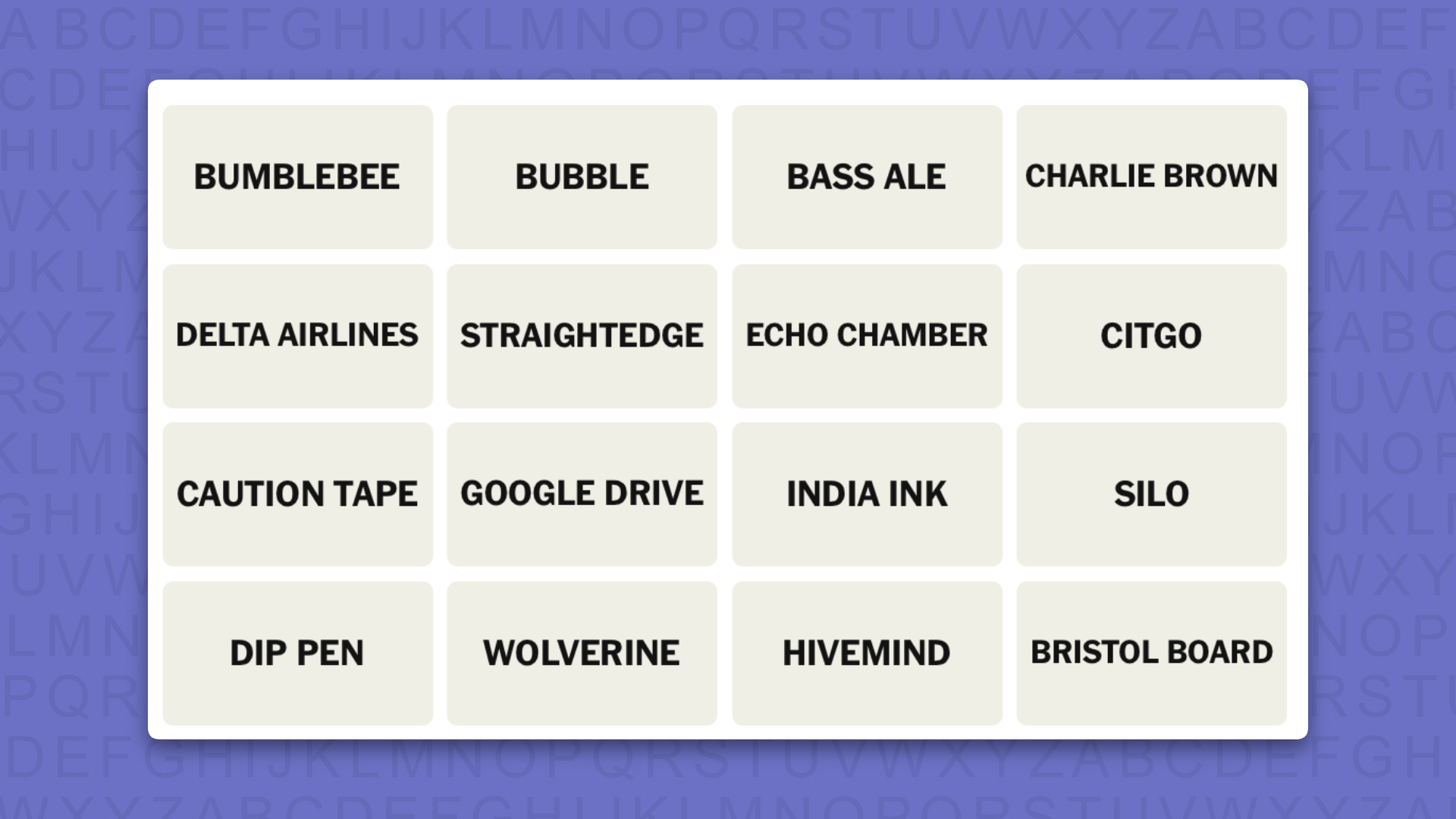
NYT Connections today (game #1160) – today’s words
(Image credit: New York Times)
Today’s NYT Connections words are…
BUMBLEBEE
BUBBLE
BASS ALE
CHARLIE BROWN
DELTA AIRLINES
STRAIGHTEDGE
ECHO CHAMBER
CITGO
CAUTION TAPE
GOOGLE DRIVE
INDIA INK
SILO
DIP PEN
WOLVERINE
HIVEMIND
BRISTOL BOARD
NYT Connections today (game #1160) – hint #1 – group hints
What are some clues for today’s NYT Connections groups?
Advertisement
YELLOW: Two colors in common
GREEN: Opinion loop
BLUE: Things a cartoonist uses
PURPLE: The shape of the brand
Need more clues?
We’re firmly in spoiler territory now, but read on if you want to know what the four theme answers are for today’s NYT Connections puzzles…
Sign up for breaking news, reviews, opinion, top tech deals, and more.
Advertisement
NYT Connections today (game #1160) – hint #2 – group answers
What are the answers for today’s NYT Connections groups?
YELLOW: BLACK-AND-YELLOW
GREEN: PLACES WHERE EVERYONE THINKS THE SAME WAYS
BLUE: COMIC BOOK ARTIST’S TOOLS
PURPLE: TRIANGLE LOGOS
Right, the answers are below, so DO NOT SCROLL ANY FURTHER IF YOU DON’T WANT TO SEE THEM.
Advertisement
NYT Connections today (game #1160) – the answers
(Image credit: New York Times)
The answers to today’s Connections, game #1160, are…
YELLOW: BLACK-AND-YELLOW: BUMBLEBEE, CAUTION TAPE, CHARLIE BROWN, WOLVERINE
GREEN: PLACES WHERE EVERYONE THINKS THE SAME WAYS: BUBBLE, ECHO CHAMBER, HIVEMIND, SILO
BLUE: COMIC BOOK ARTIST’S TOOLS: BRISTOL BOARD, DIP PEN, INDIA INK, STRAIGHTEDGE
PURPLE: TRIANGLE LOGOS: BASS ALE, CITGO, DELTA AIRLINES, GOOGLE DRIVE
My rating: Hard
My score: Fail
This is the first game of Connections I’ve lost since March 2025 and apart from BLACK-AND-YELLOW I had no idea what any of the groups were about.
Things got off to a bad start when I guessed SILO instead of CHARLIE BROWN, but after I corrected that I was utterly in the dark; I had a couple of pairs in INDIA INK and DIP PEN, and HIVEMIND and BUBBLE, but beyond that i was clueless.
What is extra annoying is that I cannot blame my loss on cultural differences and being based in the UK — especially as the relatively obscure BASS ALE is a British brand.
Advertisement
Yesterday’s NYT Connections answers (Thursday, August 13, 2026, game #1159)
YELLOW: PERSEVERE: CARRY ON, CONTINUE, MAKE IT, PERSIST
GREEN: MOVE SLOWLY (UP TO): CREEP, EASE, EDGE, INCH
BLUE: AIRLINE STATUS PERKS: CHECKED BAGS, LOUNGE, MILES, UPGRADE
PURPLE: “COLD” THINGS, IN IDIOMS: COMFORT, FEET, SHOULDER, TURKEY
What is NYT Connections?
NYT Connections is one of several increasingly popular word games made by the New York Times. It challenges you to find groups of four items that share something in common, and each group has a different difficulty level: green is easy, yellow a little harder, blue often quite tough and purple usually very difficult.
On the plus side, you don’t technically need to solve the final one, as you’ll be able to answer that one by a process of elimination. What’s more, you can make up to four mistakes, which gives you a little bit of breathing room.
It’s a little more involved than something like Wordle, however, and there are plenty of opportunities for the game to trip you up with tricks. For instance, watch out for homophones and other word games that could disguise the answers.
It’s playable for free via the NYT Games site on desktop or mobile.
The Annual Knowledge Transfer Survey 2025 shows rising innovation activity and increased industry collaboration within the Irish ecosystem.
Enterprise Ireland has published the Annual Knowledge Transfer Survey (AKTS) 2025, which explores Ireland’s publicly funded research ecosystem, its impact on the country and how knowledge is shared and engaged with.
According to the report, it was a year of strong performances across Ireland’s research and innovation spaces, which is indicative of the growing impact of publicly funded research on enterprise development, economic growth and job creation.
“The 2025 results highlight a research and innovation system that is both expanding in scale and increasing in impact,” said Joe Healy, the divisional manager of research, innovation and infrastructure, at Enterprise Ireland.
Advertisement
He added, “Total research expenditure across research performing organisations reached €953m, reflecting sustained investment and confidence in Ireland’s research base.
“This investment is delivering tangible outcomes, with 2,393 new R&D and consultancy agreements and 1,450 active industry-linked research projects demonstrating a high level of engagement between researchers and enterprise.”
Ireland’s research base remains a significant asset within the region as the €953m figure is reflective of an 8.3pc (€73m) increase on research expenditure from the previous year. This in turn highlights growing confidence in research systems and the potential to compete.
Key figures
Additional key figures include the employment of 2,467 people via research spin outs, the creation of 20 new spin out companies, 1,450 active R&D projects as of December 31st 2025, 25 new product and services launched, 118 new patent applications filed and 528 new invention disclosures.
Advertisement
Commenting on the announcement, the Minister for Enterprise, Tourism and Employment, Peter Burke TD, said, “These results demonstrate the value of connecting Ireland’s world-class research base with the ambition and innovation of Irish enterprise.
“In 2025, there were 2,393 new agreements with industry, a significant increase in patent applications and new spin-out companies employing almost 2,500 people, all showing that publicly funded research is delivering tangible benefits for the economy, supporting jobs, competitiveness and regional development.
“The strong level of engagement from Irish SMEs is particularly encouraging, highlighting how research and innovation are helping businesses of all sizes to develop new products, access new opportunities and strengthen international competitiveness.”
Don’t miss out on the knowledge you need to succeed. Sign up for the Daily Brief, Silicon Republic’s digest of need-to-know sci-tech news.








































































You must be logged in to post a comment Login