Connect with us
DAPA Banner

Tech

Prediction Markets Promised Better Information. Instead They’re Creating Powerful Incentives to Corrupt Information.

Published

on

from the did-anyone-bet-i-would-write-this? dept

There’s a concept in economics known as Goodhart’s Law, often summarized as: “When a measure becomes a target, it ceases to be a good measure.” The idea, originally about monetary policy, has proven remarkably durable across domains. When you attach high enough stakes to a single metric, people stop trying to accurately reflect reality and start trying to game the metric. Schools teach to the test. Banks shuffle risk off their balance sheets to hit capital ratios. Hospitals reclassify patients to improve their reported outcomes.

Prediction markets were supposed to be immune to this. The whole pitch — the reason people like me found them conceptually interesting for years — was that because participants are putting real money on the line, they’d have powerful incentives to seek out and act on true information. Financial stakes, the theory went, would filter out noise and bullshit and produce a hopefully decently accurate signal about the probability of real-world events. The wisdom of crowds, sharpened by the discipline of the wallet.

What most people didn’t think through was the obvious corollary: what happens when you attach $14 million in stakes to a 150-word blog post by a war correspondent, and the gamblers decide it’s cheaper to threaten the journalist than to accept they made a bad bet?

Emanuel Fabian, a military correspondent for The Times of Israel, published an extraordinary account of what happened after he filed a routine item on March 10 about an Iranian ballistic missile striking an open area outside Jerusalem. No one was injured. It was, in the context of an ongoing war, a minor event. He reported it accurately and moved on.

Advertisement

Then the Polymarket bettors found him.

It turns out that more than $14 million had been wagered on a Polymarket bet titled “Iran strikes Israel on…?” with a clause specifying that intercepted missiles wouldn’t count. Fabian’s report — confirming that a missile warhead had actually impacted the ground — was standing between a lot of gamblers and a lot of money. And so began one of the most deranged campaigns of harassment against a journalist ever (and I’ve seen some pretty crazy campaigns against journalists).

It started with polite-sounding emails. A guy named “Aviv” writing in Hebrew, suggesting Fabian’s report didn’t “reflect reality.” Then “Daniel,” a day later, with the same question and a thinly veiled threat:

“Sorry for reaching out without a prior introduction, but I assume we will get to know each other well,” he wrote, in a somewhat threatening manner.

“I have an urgent request regarding the accuracy of your report on the missile attack on March 10. I would really appreciate a response if possible. There is an inaccurate report from you about the missile attack on March 10, and it’s causing a chain of errors,” Daniel’s email continued.

Advertisement

“If you could reply to me tonight… you would be helping me, many others, and, of course, the State of Israel. And along the way, you would gain a good source.”

When Fabian didn’t comply, the messages kept coming across every possible channel — email, WhatsApp, Discord, X. Someone fabricated a fake screenshot showing Fabian had agreed to change his story (which he most certainly had not), then circulated it on social media to pressure him further. Someone he knew from another news org even contacted him to say an acquaintance was asking him to convince Fabian to alter the report — and when confronted, that acquaintance admitted he was betting on Polymarket and offered to share winnings if the other journalist could get Fabian to change the story.

And then it got genuinely terrifying. After a quiet weekend, someone calling himself “Haim” started sending WhatsApp messages shortly after midnight:

“You have exactly half an hour to correct your attempt at influence,” he wrote.

“Despite the fact that you received countless inquiries — you insist on leaving it that way.”

Advertisement

“If you do not correct this by 01:00 Israel time today, March 15, you are bringing upon yourself damage you have never imagined you would suffer,” he threatened, in a very lengthy message.

And “Haim” kept escalating:

“You have no idea how much you’ve put yourself at risk. Today is the most significant day of your career. You have two choices: either believe that we have the capabilities, and after you make us lose $900,000 we will invest no less than that to finish you. Or end this with money in your pocket, and also earn back the life you had until now.”

After I didn’t respond, as I was asleep, Haim sent me another series of messages: “You are choosing to go to war knowing that you will lose your life as you’ve grown accustomed to it — for nothing.”

On Sunday morning, he messaged me again: “You have exactly a few hours left to fix your attempt at influencing [the market]. It would be stupid of you to ignore this.”

Advertisement

In short, people who made a bad gambling bet on a prediction market are threatening to kill a war correspondent because his accurate reporting is inconvenient for their wager. They referenced his home neighborhood, his parents, his siblings. They gave him countdown timers. Someone called him pretending to be a lawyer investigating him for “market manipulation.”

“If you decide to go with your ego and not with your head, you are leaving behind dozens of wealthy people from all over the world who will know that you performed market manipulation and stole from them. They know who you are, you don’t know who they are. It took them less than 5 minutes to find out exactly where you live … how often you see your lovely parents … and exactly who your … brothers and sisters are.”

Fabian reported it all to the police. The threats stopped almost immediately after he went public.

In an interview with Charlie Warzel at The Atlantic, Fabian described the thing that should concern us all: there was a moment, however brief, where the pressure almost worked:

Warzel: Did you ever think about changing the story?

Fabian: For a split second I did. I thought maybe I could be wrong.

Advertisement

Warzel: Like, doubting your reporting? After all, you’re making those calls based on other witnesses and videos online.

Fabian: I went and checked again with the military. It was a short item, but I reviewed footage of a large explosion. I had eyewitness accounts—people in the area who saw this massive explosion. And then I thought to myself, Why am I doing this? Triple-checking this minor incident, bothering the military again over an explosion in the woods? I did the reporting, and this was the judgement call I made. I think it was accurate, and I will leave it at that. I don’t need to doubt myself about what I published, especially because this is not something that anyone normally would care about unless they had a financial stake in the outcome. As an event in this war, it is not particularly newsworthy. This missile exploded in an open area. It’s 150 words in the live blog.

Fabian held the line — but here’s a journalist who covers an active war zone, confirmed his reporting with military sources, reviewed video footage of an explosion, and still briefly questioned his own accurate reporting because a bunch of gambling addicts wouldn’t stop threatening him. And he’s self-aware enough to recognize what that means going forward:

Warzel: Do you think this fiasco will stick in the back of your mind as you continue to report on the war?

Fabian: Yes. I think it already has. Since then, whenever I report on something, I feel it in the back of my head: What if the Polymarket bettors are betting on this tweet? Or on whether I’m giving an interview about Polymarket? I’m not obsessing over it. Hopefully I won’t get threatened again. But the thought is there.

Advertisement

So much for prediction markets producing more accurate information. What they produced here was a chilling effect on a journalist who was already telling the truth.

And what guarantee do we have that the next journalist faced with similar pressure will be as willing as Fabian to tell the gamblers to fuck off?

This was always going to happen. Not the specific details — nobody could have predicted that a 150-word liveblog item about a missile in a forest would become a $14 million flashpoint — but the general shape of it was entirely predictable. We’d already seen shades of this in sports betting (which is just prediction markets for sports). Athletes have been dealing with a steadily escalating campaign of harassment from bettors who feel personally wronged when a player doesn’t perform to their parlay’s specifications.

Now scale that dynamic up from “some guy lost his parlay on a golf tournament” to “$14 million riding on whether a missile was intercepted during a shooting war,” and you can see exactly where this goes. The stakes get higher, the targets get more consequential, and the threats get more serious. Going from Venmo requests to death threats against war correspondents is an escalation, sure, but it’s an escalation along a perfectly predictable trajectory.

Advertisement

And while I opened this talking about Goodhart’s law, this is clearly worse: in the classic case, people game the metric by finding clever workarounds. They don’t usually try to put a gun to the metric’s head. But when the “metric” is a human being — a journalist, an athlete, anyone whose actions or reporting can move a market — the incentive to game the system becomes an incentive to coerce, threaten, bribe, or fabricate. It is not just (as in Goodhart’s formulation) about someone “making a measure into a target.” Someone showed up at the measure’s house and threatened its family.

Polymarket, for its part, issued a statement condemning the threats and saying it had “banned the accounts for all involved & will pass their info to the relevant authorities.” Bit late for that. The company also said, with apparently zero self-awareness, that “prediction markets depend on the integrity of independent reporting.”

They’re acknowledging that journalists are functionally the oracles their entire market depends on. Which means journalists are “targets” by design. The market’s resolution mechanism requires someone external who has no relationship to Polymarket to report accurately on real-world events, and the market’s financial incentives create enormous pressure to corrupt that reporting. The company has built a system that depends on a thing it simultaneously makes harder to do.

In short: the company that built a system on claims of more accurate information is creating powerful incentives for people to falsify it.

Advertisement

Fabian raised another point in his interview with Warzel that goes beyond the harassment and into something potentially far more worrisome:

Fabian: I think there is a big risk of journalists using insider information to place a correct bet and win. I can tell you as a military correspondent that I’m exposed to confidential information that we can’t report. Now there are ways to exploit that. It wouldn’t surprise me if others have.

He’s right to worry. Last month, an Israeli military reservist and a civilian were indicted for using classified information to place bets ahead of Israel’s war with Iran. Prediction markets create a mechanism for anyone with privileged information — journalists, military personnel, government officials — to monetize that knowledge without ever publishing it.

And the thing is, supporters of some of these markets argue that’s the whole point. Because people with insider information will bet, they believe that the markets will provide the public better information. But it also creates ridiculously perverse incentives for extraordinarily bad behavior. And the legal system is just starting to wrap its head around these things (for example, also this week, Arizona criminally charged Polymarket’s main competitor, Kalshi, with illegal gambling).

As Fabian put it, when Warzel asked whether prediction market companies actually want to combat insider trading:

Advertisement

Fabian: I don’t think they really want to combat insider trading. What I’ve heard is that those who bet on Polymarket either know the right answer or are wasting their money.

So the incentive structure of prediction markets simultaneously encourages harassment of the people whose reporting the markets depend on, creates a pipeline for insider trading by anyone with privileged information, and — as Fabian’s case demonstrates — can literally cause a journalist to momentarily doubt his own accurate reporting because the financial pressure to be wrong is so overwhelming.

I’ll admit that I was once genuinely intrigued by the concept of prediction markets. The original pitch was compelling: because people have skin in the game, real information should flow into these markets more efficiently than it flows through, say, punditry or polling. And we all know how weak punditry and polling has been of late.

In theory, this idea of “skin in the game” leading to better information makes some sense. In practice, what we’ve gotten is a bunch of speculative nonsense driven by get-rich-quick bros who, when their bets go south, feel entitled to threaten the life of a war correspondent covering missile strikes. The theory assumed that financial stakes would incentivize finding accurate information. What it failed to account for is that, for many participants, it’s easier and cheaper to try to falsify the information than to accept a loss.

Fabian’s advice for other journalists who might find themselves in this situation was to follow in his footsteps of going public:

Advertisement

Warzel: Do you have advice for other journalists who may experience this type of betting-market harassment in the future?

Fabian: Go public. Don’t let the threats force you to change anything. Be honest. I think that’s the best way. It’s a bit stupid of these people to publicly intimidate somebody who can go and instantly tell 100,000 people what these gamblers are doing. That’s my advice. Because if you were to accept money or change your reporting, who knows how these people might extort you later on. If you change your reporting, it’ll be a mess forever.

That’s good advice. But he also pointed out the obvious problem: not every journalist will say no. Not every journalist will have the resources, the platform, or the institutional backing to withstand this kind of pressure. And as prediction markets grow and attach ever-larger sums to ever-more-consequential events, the pressure will only increase.

We’ve built a system where people can wager millions on the outcomes of wars, and then express shock when they treat the people reporting on those wars as obstacles to be eliminated. We’ve created financial instruments that depend entirely on the integrity of vastly underpaid independent journalism while simultaneously giving millions of strangers a direct financial incentive to destroy that integrity.

That seems bad.

Advertisement

And the platforms facilitating all of this respond with a press statement and a few banned accounts, as if the problem is a handful of bad actors rather than the fundamental architecture of what they’ve built.

Prediction markets were supposed to be information-discovery mechanisms. When you let people bet millions of dollars on whether missiles hit their targets, what you actually get is a threat-discovery mechanism aimed at the people trying to tell the truth.

As Fabian told Warzel: “This is war, not a game.”

Unfortunately, someone went ahead and turned it into both. And poured a ton of money into it.

Advertisement

Filed Under: gambling, information, journalism, prediction markets

Companies: kalshi, polymarket

Source link

Advertisement
Continue Reading
Click to comment

You must be logged in to post a comment Login

Leave a Reply

Tech

Bluesky raises $100M Series B as new CEO takes charge

Published

on

Ten days after founder Jay Graber stepped aside as CEO, the decentralised social platform has disclosed a $100 million Series B led by Bain Capital Crypto, a round that closed last April but was never announced. The timing tells its own story.


There is a quiet irony in the fact that the person who built Bluesky shares her given name with it. Lantian Graber -“blue sky” in Mandarin, a name her mother gave her as a wish for boundless freedom, spent four years turning a Twitter research project into a platform of over 43 million users, a functioning decentralised protocol, and a genuine alternative to the platforms her users had fled. Then, on March 9, 2026, she stepped back.

The company announced on Thursday that it had raised $100 million in a Series B round led by Bain Capital Crypto, with participation from Alumni Ventures, True Ventures, Anthos Capital, Bloomberg Beta, and the Knight Foundation. The round closed in April 2025. Bluesky is only disclosing it now.

The gap between closing and announcing is itself worth pausing on. For most startups, fresh funding is a press release and a celebratory tweet. Bluesky’s choice to sit on $100 million for nearly a year, and to surface it only after a leadership transition, suggests a company more focused on building than on performing momentum. 

Advertisement

The 💜 of EU tech

The latest rumblings from the EU tech scene, a story from our wise ol’ founder Boris, and some questionable AI art. It’s free, every week, in your inbox. Sign up now!

That leadership now belongs, on an interim basis, to Toni Schneider. The former CEO of Automattic, the company behind WordPress.com, and a partner at True Ventures, Schneider had been advising Graber and the company for over a year before agreeing to step in as the board runs a permanent search.

Graber, for her part, is not going anywhere: she moves into a newly created role as chief innovation officer, focused on building out the AT Protocol, the open social infrastructure that underpins Bluesky’s ambitions.

Advertisement

The split is, by tech company standards, unusually clean. Graber’s own framing was precise: “As Bluesky matures, the company needs a seasoned operator focused on scaling and execution, while I return to what I do best: building new things.” That is not the language of a forced exit. It is the language of a founder who knows what she is good at and, more unusually, what she is not.

Graber was hired by Jack Dorsey in August 2021 to lead what was then a Twitter-funded research initiative into decentralised social media. When she incorporated the project as an independent company later that year, she inherited both an audacious technical premise and a nearly impossible PR challenge: how do you build a decentralised network for people who are, by definition, not yet there?

She managed it. By the time of its $15 million Series A, led by Blockchain Capital in October 2024, the platform had 13 million users. It now has 43 million.

The jump from $15 million to $100 million in a single round reflects more than user growth. It reflects a shift in how investors are reading the decentralised social space, and specifically, Bluesky’s position within it. Where early rounds were bets on a protocol and an idea, this one is a bet on a platform with real scale and a community with demonstrated loyalty.

Advertisement

Bain Capital Crypto’s lead role is worth noting. The firm invests across crypto and web infrastructure, and the AT Protocol, which separates a user’s identity, data, and social graph from any single application, has structural similarities to blockchain-era promises of user ownership, but with far more practical traction.

Knight Foundation’s involvement signals that the press freedom and open-internet communities continue to see Bluesky as infrastructure worth backing, not merely a product.

The money arrives at a moment when Bluesky needs to resolve a tension it has so far managed to defer: how does a platform that has built its identity around rejecting surveillance advertising and algorithmic manipulation actually make money?

The company’s stated model involves subscription services and domain registration fees, functional, but modest. It has not yet demonstrated that this can support a company of its ambitions at the scale it is reaching.

Advertisement

Schneider’s appointment is, in part, an answer to that question. Automattic navigated a similar challenge: it built a massive open-source ecosystem around WordPress and then constructed a sustainable commercial layer on top of it, largely through premium hosting and business services.

If Bluesky follows a comparable path, open protocol beneath, paid services above,it has a template. Whether social networking, with its shorter attention spans and higher churn, tolerates the same approach is not obvious.

The competitive context has shifted considerably since Bluesky’s early days as a curiosity for journalists and tech workers fleeing Elon Musk’s rebranded X. Meta’s Threads, which uses the rival ActivityPub protocol and has been gradually federating with the broader Fediverse, has grown into a formidable alternative with a user base an order of magnitude larger. X itself remains the dominant venue for real-time public discourse, despite persistent predictions of its collapse.

Bluesky’s differentiator has always been structural rather than purely social. The AT Protocol’s architecture, in which a user’s identity and social graph are portable, not locked to any single server, is meaningfully different from both X’s centralised model and Mastodon’s federated but technically demanding alternative. 

Advertisement

What is clear is that the company Graber built has survived its first real test: not the technical challenge of building a decentralised protocol, which it managed, but the organisational challenge of outgrowing its founder without losing what made it worth building in the first place. Schneider’s job is to turn that survival into something more permanent. The AT Protocol, and the 43 million people who have joined so far, will be watching.

Source link

Advertisement
Continue Reading

Tech

EIB to support four utility-scale solar projects across Ireland

Published

on

A total investment of €260m will boost clean electricity generation, reduce reliance on imported energy and support the delivery of 2030 climate targets, said the Government.

The European Investment Bank (EIB) will support the construction and operation of four new utility-scale solar photovoltaic projects across Ireland via a €100m project finance loan to Dolmen Solar Ltd, a holding company of Power Capital Renewable Energy.

The overall investment – which, in total, will be worth €260m – will see four new solar power operations developed in Clare, Wicklow, Wexford and Tipperary, generating around 367GWh of clean electricity per annum, which is equivalent to the annual consumption of roughly 79,900 households. The funding and development is also expected to create new jobs in construction, civil works, grid connections and maintenance services.

The scheme is among the largest single solar investments financed in Ireland to date and could contribute significantly to Ireland’s target of 80pc renewable electricity by 2030, as well as see out the national ambition for roughly 8GW of installed solar capacity under the Renewable Electricity Support Scheme. 

Advertisement

Ballinaclough, Co Wicklow will host a 15.5MWp solar farm, with construction expected to start this month. Tullabeg, Co Wexford will be home to the largest scheme in the portfolio – a 181.6MWp plant – and construction is planned from April. 

In Tipperary, Barnaleen-Cauteen will be the site of a 98MWp farm, and construction is expected to begin this month. Lastly, in Clare, Manusmore near Ennis is earmarked for a 99.5MWp plant, with construction also expected to commence in March.

Work on some of the projects will run into 2028. 

Commenting on the investment, the Minister for Climate, Energy and the Environment Darragh O’Brien, TD said: “Ireland is sometimes seen as an unlikely home for solar power, but projects like this show how quickly that perception is changing and how strong the investor appetite now is for Irish renewables.

Advertisement

“This is a very welcome €260m investment, spread across Clare, Tipperary, Wicklow and Wexford, which will boost clean electricity generation right across the country, reduce our reliance on imported energy and support delivery of our 2030 climate targets. The European Investment Bank is playing a key role as a long‑term partner for Ireland’s energy transition”.

The EIB vice-president Ioannis Tsakiris added: “By backing Ireland’s first solar project financed on a pure project finance basis, the EIB is helping to unlock almost 400MW of new renewable capacity that will strengthen Ireland’s energy security and cut greenhouse gas emissions.”

In February of this year, SunArc, a renewable energy company based in Carlow, announced plans to create up to 50 new jobs as a result of a €20m investment into the organisation. The company offers a ‘solar-as-a-service’ model which it said is a significant step towards accelerating Ireland’s transition to clean energy.

SunArc has stated that the solar-as-a-service model will enable businesses to access solar power and energy independence with no upfront costs, removing what it believes to be one of the biggest barriers to solar power adoption.

Advertisement

Don’t miss out on the knowledge you need to succeed. Sign up for the Daily Brief, Silicon Republic’s digest of need-to-know sci-tech news.

Source link

Advertisement
Continue Reading

Tech

Recording HDR Video With A Raspberry Pi

Published

on

The Raspberry Pi line of single-board computers can be hooked up with a wide range of compatible cameras. There are a number of first party options, but you don’t have to stick with those—there are other sensors out there with interesting capabilities, too. [Collimated Beard] has been exploring the use of the IMX585 camera sensor, exploiting its abilities to capture HDR content on the Raspberry Pi.

The IMX585 sensor from Sony is a neat part, capable of shooting at up to 3840 x 2160 resolution (4K) in high-dynamic range if so desired. Camera boards with this sensor that suit the Raspberry Pi aren’t that easy to find, but there are designs out there that you can look up if you really want one. There are also some tricks you’ll have to do to get this part working on the platform. As [Collimated Beard] explains, in the HDR modes, a lot of the standard white balance and image control algorithms don’t work, and image preview can be unusable at times due to the vagaries of the IMX585’s data format. You’ll also need to jump some hurdles with the Video4Linux2 tools to enable the full functionality of these modes.

Do all that, recompile the kernel with some tweaks and the right drivers, though, and you’ll finally be able to capture in 16-bit HDR modes. Oh, and don’t forget—you’ll need to find a way deal with the weird RAW video files this setup generates. It’s a lot of work, but that’s the price of entry to work with this sensor right now. If it helps convince you, the sample shots shared by [Collimated Beard] are pretty good.

Advertisement

If you’re looking to record some really juicy, colorful imagery with the Raspberry Pi, this is a difficult but viable way to go. We’ve seen some other hardcore Raspberry Pi camera hacks of late, too.

Advertisement

Source link

Continue Reading

Tech

Engineering Challenges and Component Strategies in Humanoid Robotics: From Prototype to Production

Published

on

More Information

Humanoid robotics is advancing rapidly, yet engineers continue to face formidable barriers in locomotion stability, real-time perception, safe human interaction, and power-constrained hardware design. As the industry approaches a projected shift from small-scale prototyping to mass commercialisation in the late 2020s, understanding the component-level decisions that affect system reliability, cost, and performance is becoming critical. This guide examines the technical landscape across sensing, motion, control, and battery subsystems — outlining the design trade-offs, modular architecture trends, and supply chain considerations that will shape the next generation of deployable humanoid platforms.


Source link

Advertisement
Continue Reading

Tech

Ex-data analyst stole company data in $2.5M extortion scheme

Published

on

Extortion hacker scammer

A North Carolina man was found guilty of extorting a D.C.-based technology company while still being employed as a data analyst contractor.

While a Justice Department press release published on Thursday doesn’t name the victim, court documents reveal that he targeted Brightly Software, a Software-as-a-Service (SaaS) company previously known as SchoolDude, which Siemens acquired in August 2022.

Brightly has been in business for more than 20 years, employs over 700 people, and provides intelligent asset management and maintenance software to over 12,000 clients worldwide, mainly in the United States, Canada, the United Kingdom, and Australia.

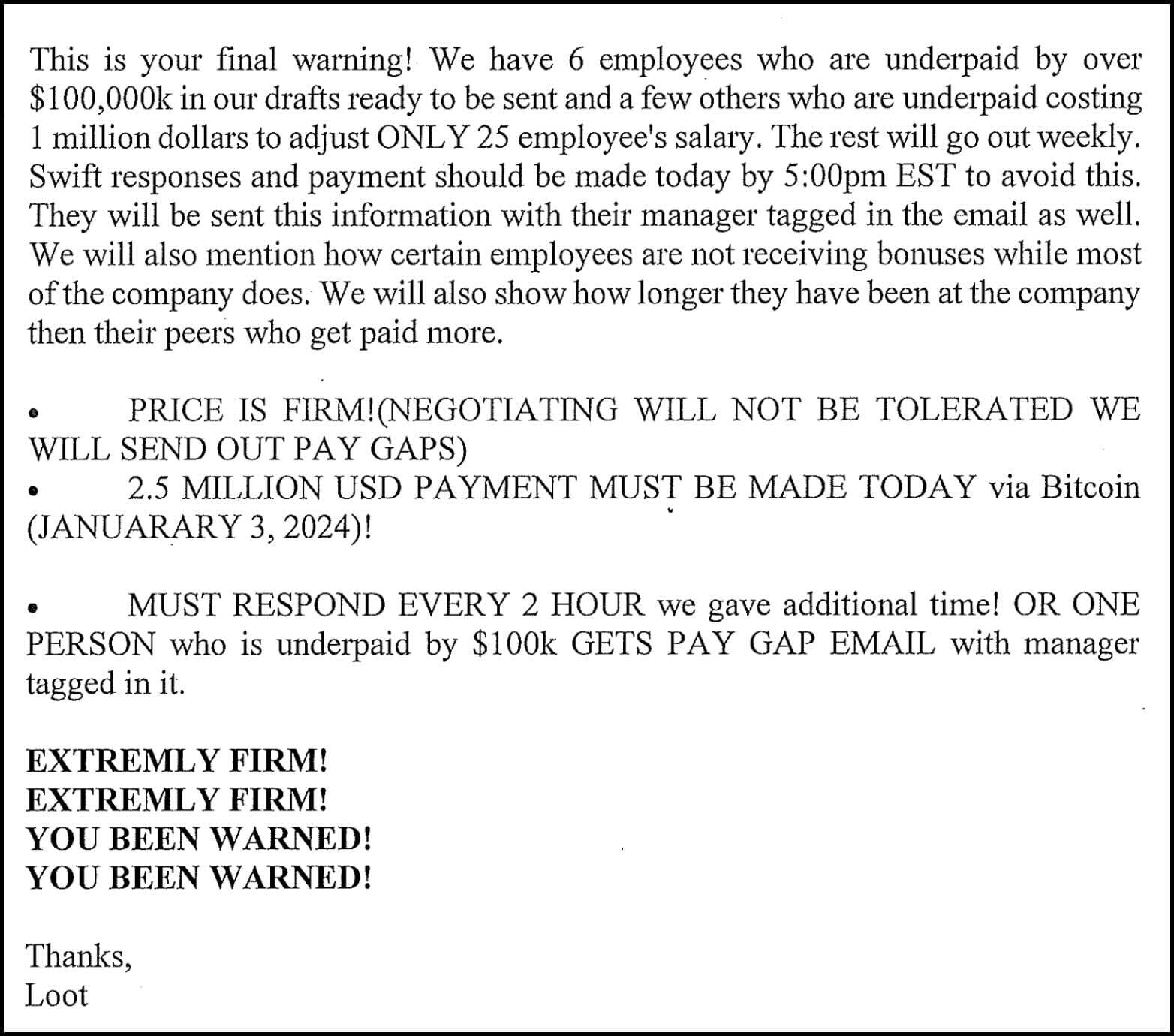
As revealed in the indictment, 27-year-old Cameron Curry (also known as “Loot”) took advantage of his access to Brightly’s payroll information and corporate data to steal sensitive documents, which he used as leverage in an extortion scheme after learning that his six-month contract wouldn’t be extended.

Advertisement

One day after his contract ended on December 10, Curry began sending over 60 extortion emails to Brightly employees using the lootsoftware@outlook.com Microsoft email address and the Loot alias, threatening to leak sensitive information stolen between August and December 2023 unless he was paid a $2.5 million ransom.

With the extortion messages, Curry also attached screenshots of spreadsheets listing the personal identification information (PII) of Brightly employees, including names, dates of birth, home addresses, and compensation information. He also threatened to report the company to the U.S. Securities and Exchange Commission (SEC) for failing to disclose the breach as required by law.

“We will commence the process of disseminating salary information starting January 1,2024 in phases to all employees and will report you to the SEC after for not reporting the breach,” Curry threatened in one of the extortion emails.

“If you wish to reclaim your data, we recommend doing so promptly at 2.5 million USD in order to save your company and stocks, as each subsequent month will incur a $100,000 USD increase. Discrepancies in your books are currently over 16 million USD, posing a potential risk for retention issues, a hostile work environment, resentment, and more.”

Advertisement
Extortion email sample
Extortion email sample (Justice Department)

​Following Curry’s numerous extortion emails, Brightly paid $7,540 in Bitcoin, which was transferred to a cryptocurrency wallet controlled by Curry.

The FBI searched Curry’s residence on January 24 after the company reported the incident and seized various electronic devices containing evidence of his extortion scheme.

Curry was released on bond in January 2024 and now faces up to 12 years in prison for six counts of transmitting or willfully causing interstate communications with the intent to extort a victim company.

Brightly also notified customers of a data breach unrelated to this case in May 2023 after attackers gained access to the database of its SchoolDude online platform and stole credentials and personal data (including names, email addresses, account passwords, phone numbers).

Information filed with the Office of the Maine Attorney General revealed that the intrusion was discovered 8 days after the attackers breached Brightly’s systems on April 20, and that the data breach affected nearly 3 million SchoolDude customers and users.

Advertisement

Malware is getting smarter. The Red Report 2026 reveals how new threats use math to detect sandboxes and hide in plain sight.

Download our analysis of 1.1 million malicious samples to uncover the top 10 techniques and see if your security stack is blinded.

Source link

Continue Reading

Tech

There’s a sneaky way to watch Wicked: For Good for $1

Published

on

Wicked: For Good, the second and final movie of the Wicked franchise, is an adaptation of the 2003 Broadway musical. Starring Ariana Grande and Cynthia Erivo, the film was released in mid-November 2025 and was a huge hit, with an impressive opening of $147M, going on to gross $532M.

Now that it has finally left theaters, Wicked: For Good is set to stream on Peacock from March 20, 2026 – and we’ve found a sneaky way to watch it for just $1.

Source link

Continue Reading

Tech

Why enterprises are replacing generic AI with tools that know their users

Published

on

The future of AI isn’t just agentic; it’s deep personalization. 

Rather than simple recommender systems that correlate user behavior to identify patterns and apply those to individual workflows, large language models (LLMs) and AI agents can analyze users directly to create deeply personalized experiences. 

It’s this kind of aggressive customization users are increasingly demanding — and the savviest enterprises who provide it (and soon) will win. 

The goal is: “Don’t try to randomize, or guess who I am. I tell you, this is what I care about,” Lijuan Qin, head of product, at Zoom AI, explains in a new Beyond the Pilot podcast.  

Advertisement

How Zoom is incorporating personalization

Zoom is one company that has adapted to this trend: Its generative assistant, AI Companion, goes beyond basic summarization, smart recordings, and after-meeting action items to opinion divergence and user alignment tracking. 

Users can customize meeting summaries based on their specific interests, and create targeted templates for follow-up emails to different personas (whether it be a salesperson or account executive). The AI assistant can then automatically populate these documents post-call. Meanwhile, a custom dictionary in Zoom AI Studio can process unique enterprise terminology and vocabulary for more relevant AI outputs, and a deep research mode can quickly deliver comprehensive analyses based on “internal expertise and external insights.”

Control is key here; the human can be “very specific [and] nail down” agent permissioning, Qin explained. They have “very clear controls” on follow-up actions, such as: Can the agent automatically send emails to specific recipients? Or will it trigger a verification step when it recognizes transcripts contain sensitive information (as dictated by the user)? 

Advertisement

Knowing that AI can go off the rails at times, human users can track agent behavior in Zoom, enable and disable features, and control data access. This can help prevent outputs that are inaccurate or off-target.  

“The most important thing is we do not assume AI is smart enough to get everything right,” Qin emphasized. 

Getting context right

In this new agentic AI age, there is essentially a “land grab for context,” Sam Witteveen, co-founder of Red Dragon AI and Beyond the Pilot host, explains in the podcast. 

“Definitely knowing your users is the big thing, right? Knowing what apps they are living in, what day-to-day tasks are they constantly doing?,” he said. “Companies realize the more they have about you, the better the [AI] memory can get, the better they can customize.”

Advertisement

Claude Cowork is one app that is “really shining” at this, Witteveen says; OpenClaw is another. Models are good enough that they can begin to make decisions for users and respond to directions like: “You know a bunch of things about me. You’ve got all this context. Go and generate the skills that are going to help me do a better job.”

“With something like OpenClaw, you can customize it in any way you want, right? You can chat with it, you can tell it, ‘Hey, at 4 o’clock I want you to do this,’” Witteveen said. 

However, token usage and security must always be taken into account, he advised. OpenClaw has been plagued by security issues since its launch. This has prompted many enterprises to uninstall the autonomous agent or outright ban its use; however, these uninstalls must be done correctly so that IT leaders don’t inadvertently delete their entire enterprise stack. 

Meanwhile, in terms of token budget, personalization can run up costs. “You need to think about the metrics you are tracking,” Witteveen said. “This is very different from product to product, but metrics around these things are gonna be key.”

Advertisement

Watch the podcast to hear more about: 

  • Why the companies that don’t experiment with AI skills right now “may be toast”

  • How Zoom built an AI companion that tracks opinion divergence — not just action items — in your meetings

  • Why the build vs. buy question just got a lot more urgent for enterprise software

  • Why “skills” may matter more than MCP for the future of enterprise AI

You can also listen and subscribe to Beyond the Pilot on Spotify, Apple or wherever you get your podcasts.

Source link

Advertisement
Continue Reading

Tech

EU Cloud Lobby Asks Regulator To Block VMware From Terminating Partner Program

Published

on

An anonymous reader quotes a report from The Register: A lobbying trade body for smaller cloud providers is asking the European Commission to impose interim measures blocking Broadcom from terminating the VMware Cloud Service Provider program, calling the decision a death sentence for some tech suppliers and an illegal squeeze on customer choice. As The Reg revealed in January, Broadcom shuttered the scheme, a move sources claimed affects hundreds of CSPs across Europe and curtails options for enterprises buying VMware software and services. The Cloud Infrastructure Service Provider in Europe (CISPE) trade group, representing nearly 50 tech suppliers, filed the complaint today with the EC Directorates-General, accusing Broadcom of bully-boy tactics, and calling for authorities to halt what it terms as “ongoing abuse.”

Francisco Mingorance, CISPE secretary general, said of the complaint: “Businesses — both cloud providers and their customers — are being irreparably damaged by Broadcom’s unfair actions, which we believe are illegal. “After imposing outrageous and unjustified price hikes immediately following the acquisition of VMware, Broadcom is now applying the ‘coup de grace’. We need urgent intervention to force them to change. The only way to stop bullies is to stand up to them.” CISPE claims that, since Broadcom completed its $69 billion takeover of VMware in October 2023, prices have risen tenfold, payment is demanded upfront, products are bundled regardless of customer need, and minimum commitments are based on potential rather than actual consumption.

The VMware Cloud Service Provider (VCSP) program officially closed in January and all transactions must be complete by March 31. After that date, only a select group of suppliers will be able to sell VMware subscriptions — either standalone or as part of a broader service. Across Europe, we’re told this equates to hundreds of businesses losing their authorization. For some, the loss of VCSP status effectively destroys their market. Those whose operations were built around VMware must now hand customers to another authorized supplier or begin the costly migration to an alternative platform. Broadcom said in a statement responding to the complaint: “Broadcom strongly disagrees with the allegations by CISPE, an organization funded by hyperscalers, which misrepresent the realities of the market. We continue to be committed to investing significantly in our European VMware Cloud Service Provider partners… helping them offer alternatives to the hyperscalers and meet the evolving needs of European businesses and organizations.”

Source link

Advertisement
Continue Reading

Tech

Masimo wins hollow victory over Apple Watch's blood oxygen sensors

Published

on

A US appeals court has found in favor of Masimo in its fight against Apple over pulse oximetry patents, but in the court that matters, a ruling makes it clear that there won’t be another ban on the Apple Watch.

Close-up of a blue smartwatch side and underside, showing braided blue band, side button, microphone hole, and glowing red health sensor lights on the rounded black back.
The dispute concerns the blood pulse oximeter in the Apple Watch

In the now six year-long legal battle between medical technology firm Masimo and Apple, this particular appeal concerns a ruling by the International Trade Commission (ITC). The ITC ruled that Apple had stolen trade secrets and violated patents with its blood pulse oximeter in the Apple Watch.
Masimo wanted a ban on the Apple Watch and in October 2023, the ITC issued an order barring Apple from importing the Apple Watch into the US, and in December denied the company’s appeal against it.
Continue Reading on AppleInsider | Discuss on our Forums

Source link

Continue Reading

Tech

Alphabet no longer has a controlling stake in its life sciences business Verily

Published

on

Alphabet’s life sciences business Verily is restructuring and raising money as a new corporate entity. Verily announced that with its $300 million investment round, it will change from an LLC to a corporation and rename itself Verily Health Inc. As a result, Alphabet now has a minority stake rather than a controlling one in the business.

Similar to every other tech business, this chapter for Verily will be focused on AI. “From research to care, our customers need solutions that bring the best of clinical and scientific rigor together with AI to deliver the next generation of healthcare – one that is as precise as it is personal,” Chairman and CEO Stephen Gillett said.

Google Life Sciences was renamed Verily in 2015, around the same time as Google also rebranded to Alphabet. It has worked on a wide range of projects over the years, such as using eye scans to predict heart disease and an opioid addiction center. In 2025, it closed its medical device division, a move that may have signaled its shift toward AI.

Source link

Advertisement
Continue Reading

Trending

Copyright © 2025