
TL;DR
UK tribunal rules Holiday Extras discriminated against a remote worker by refusing to let her keep her camera off during calls




Prentis, a new AI research lab focused on computer use models, co-founded by serial entrepreneur Ritankar Das, and tech heavyweights Reid Hoffman and Marc Pincus, is in talks to raise $100 million at a $1 billion valuation, according to two people familiar with the discussions.
Launched in April, Prentis is training models to learn how office workers navigate routine workflows across documents and systems, with the goal of building AI agents that can control computers to automate those tasks.
Prentis will ostensibly develop agents tailored to these customers’ needs, such as handling insurance claims and automating customs duty refund exceptions without needing a human to hunt down paperwork.
The startup has already signed contracts worth up to $50 million with several customers, including healthcare management service organization, a manufacturer, and goods and clothing manufactures, the two people familiar with the discussions tell TechCrunch, echoing investor materials obtained by TechCrunch that predict an estimated $75 million annualized run rate by the third quarter of this year. (Prentis’s pitch deck notes those figures reflect estimated annualized value based on a contracted fee equal to 20% of savings realized, not recognized revenue, and are “performance-dependent and subject to final execution.”)
By its own account, Prentis says its Hive-32B model outperforms rivals, including OpenAI’s GPT-5.4 and Anthropic’s Claude Opus 4.6, on two computer-use benchmarks: WindowsAgentArena, which measures end-to-end task completion on real Windows applications; and ScreenSpot-v2, which tests a model’s ability to locate the right on-screen control.
In its pitch deck, the company argues its edge comes from running a much smaller, cheaper model. In fact, it claims roughly 10 times lower cost per task than frontier APIs, saying it’s more economical to deploy across everyday workflows. TechCrunch hasn’t independently verified the company’s benchmark results.
The startup is betting that automating everyday office tasks will soon outpace coding as AI’s biggest use case, but it’s a crowded market. Anthropic, Open AI, and Mira Murati’s Thinking Machines are also working on developing AI agents for computer use, one of sources said. Anthropic has also been acquiring talent in the category directly — it bought the Seattle computer-use startup Vercept earlier this year, folding in its founders and shutting down its product.
Prentis didn’t respond to TechCrunch’s request for comment.
Ritankar Das, CEO of Prantis, is also the founder of Titan, a holding company that builds and operates AI companies. Das, now 31, was UC Berkeley’s youngest University Medalist in more than a century, graduating at 18 with a double major in bioengineering and chemical biology before earning a master’s in biomedical engineering at Oxford.
He founded Titan in 2014 after dropping out of an AI PhD program at Cambridge, where he’d been a Gates Cambridge Scholar. Das has described Titan as an intentional throwback to an old-fashioned holding-company model like Berkshire Hathaway, one that’s funded by its own exits rather than outside limited partners.
Other businesses launched and operated by Titan include AI-powered virtual care provider Tala Health, which raised a $100 million seed round last year, and Forta Health, an autism care startup that raised $55 million led by Insight Partners in 2024. Titan-founded disease prediction company Dascena was acquired by CirrusDx in 2022.
Prentis is a side project of sorts for its two other co-founders. Hoffman, the LinkedIn co-founder and Greylock partner, said last month that he was stepping down from Microsoft’s board after nearly a decade to go “founder mode” on Manas AI, an AI drug-discovery startup he’s also backing; he was an early OpenAI investor and co-founded Inflection AI with Mustafa Suleyman before Microsoft absorbed most of that team in 2024.
Pincus, the Zynga founder, now runs the investment firm Reinvent Capital with Hoffman as a senior adviser, and published a memoir, “Life at the Speed of Play,” last month.
Prentis has already hired more than 25 employees, including researchers who previously worked at OpenAI, Google DeepMind, Meta, Tencent and Alibaba, according to its website.
When you purchase through links in our articles, we may earn a small commission. This doesn’t affect our editorial independence.

The big picture: Nvidia lifted the embargo on its Vera CPU deep dive this week, and the disclosure amounts to a direct challenge to two decades of x86 datacenter design philosophy. This is the most detail the company has shared on the chip since it first appeared on the Rubin roadmap, and it confirms something I have suspected for a while: Nvidia is not treating the CPU as an attach story anymore. It is treating it as a battleground with a lot of potential dollars at play.
Vera is built around the Olympus core, the first custom CPU core Nvidia has ever brought to the datacenter and the first custom core the company has designed anywhere since the Denver and Carmel efforts of the Tegra era nearly a decade ago.
Ryan Shrout is a longtime technology analyst and industry veteran who has spent over two decades covering PC hardware, graphics, and semiconductors. He previously led technical marketing at Intel and was the founding editor of PC Perspective. He is currently President and GM at Signal65. You can follow him on X @ryanshrout.
Grace used licensed off-the-shelf Arm Neoverse V2 cores. Olympus is an Nvidia design from the ground up, a wide, high-IPC core with a 10-wide decode front end that reorders aggressively and prefetches based on patterns like graph structures in memory.
88 of those cores sit on a monolithic compute die, running 176 threads through a partitioned scheme Nvidia calls Spatial Multithreading, a deliberate departure from the opportunistic resource sharing of traditional SMT.
That monolithic choice matters. Nvidia still uses chiplets for the memory controllers and I/O, but the compute die is one piece of silicon connected by a second-generation scalable coherency fabric. The company measures bisection bandwidth across the die at roughly 3.4 terabytes per second.
The memory subsystem is LPDDR5X hardened for the datacenter with ECC and full telemetry, delivering up to 1.2 TB/s of bandwidth, roughly 3x the memory bandwidth per core and about 5x the bandwidth per watt of conventional DDR-based server designs (all based on Nvidia claims).

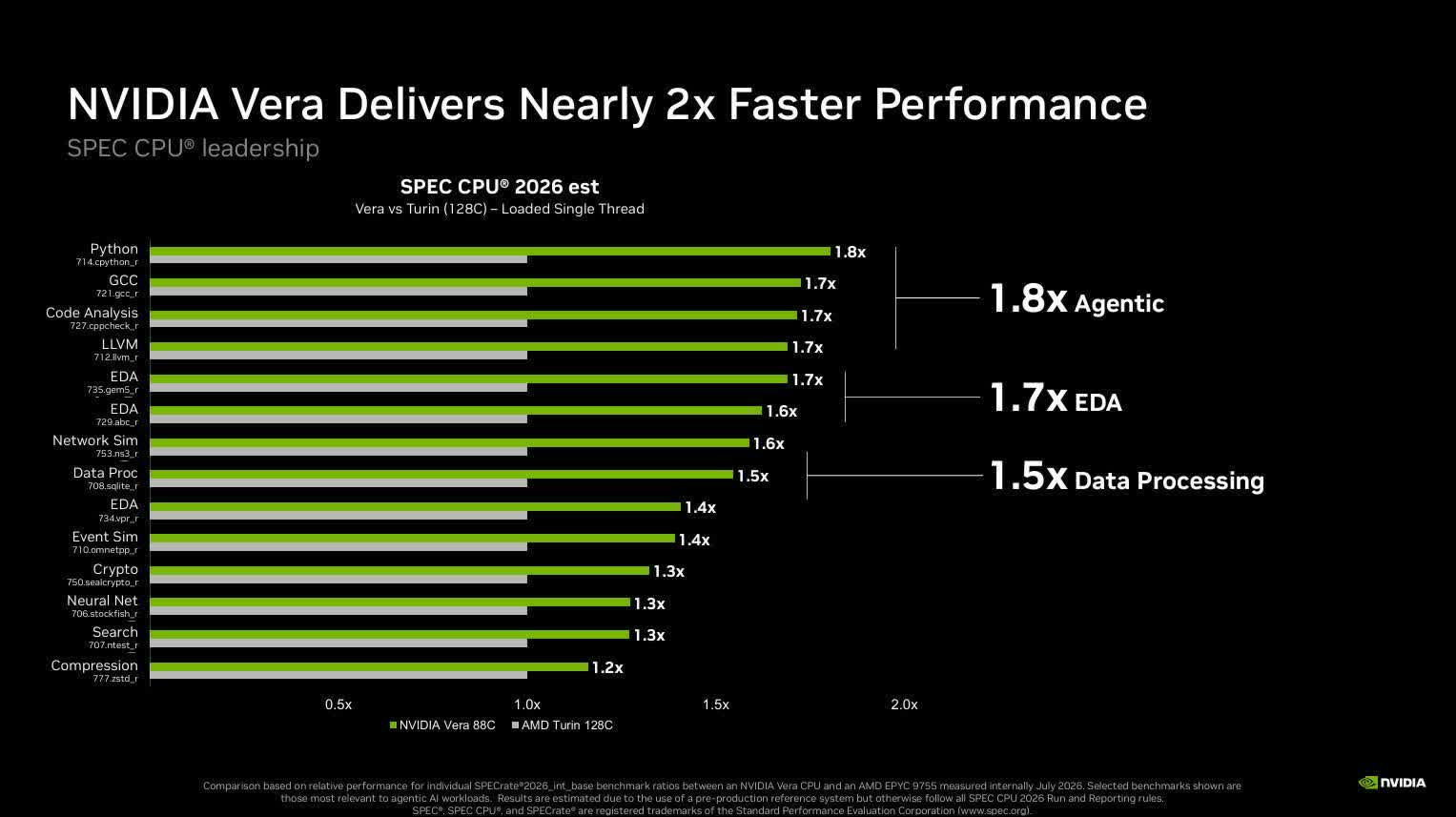
The headline claims stack up as roughly 2x faster performance from the Olympus core, 3x the core-to-core bandwidth of chiplet-based competition, and 40% lower memory latency under load through the LPDDR5X subsystem.
Vera ships in two forms: a dense liquid-cooled rack packing 256 CPUs and more than 22,000 cores, and a conventional air-cooled 2U with two sockets. Dell has committed to multiple PowerEdge systems built on it. Nvidia sizes the opportunity as a $200 billion expansion of the CPU market, which explains a lot of the recent market dynamics.
In 2014, a top Xeon carried 14 to 18 cores. Today an Epyc Turin part carries 128. Core counts grew roughly 9x over that stretch because cloud economics rewarded rentable vCPUs, while per-core performance only about doubled. Chiplets kept costs down but taxed memory bandwidth, data movement, and latency along the way.
Nvidia argues that agentic AI breaks this trade. An agent reasons on the GPU, then drops to the CPU for tool calls, SQL queries, API work, and scripting, then goes back to the GPU, sometimes hundreds of times per task. That loop is sequential.
You cannot throw more cores at a sequential loop and make it shorter. Only a faster core, fed with data faster, compresses it. The loaded-latency data Nvidia showed makes the point visually, with chiplet designs hitting a saturation wall just shy of 400 GB/s of memory traffic while Vera keeps scaling.
The company has landed on “max single-threaded CPU at scale” as the category name. It is a mouthful, and I will get to that.
The customer data is early but notable. Perplexity ran coding sandboxes on Vera and completed jobs 1.5x faster than the production Xeon fleet it runs today, with concurrent sandbox startup 1.9x faster.
The New York Stock Exchange, which processes 1.1 trillion records a day, tested Vera with the Redpanda streaming engine on HPE systems and measured 6x lower p99 latency versus Epyc Turin, and is now evaluating it as a replacement. Los Alamos National Laboratory saw 7x on an agentic workload and 3x on radiation transport and multigrid simulation codes.
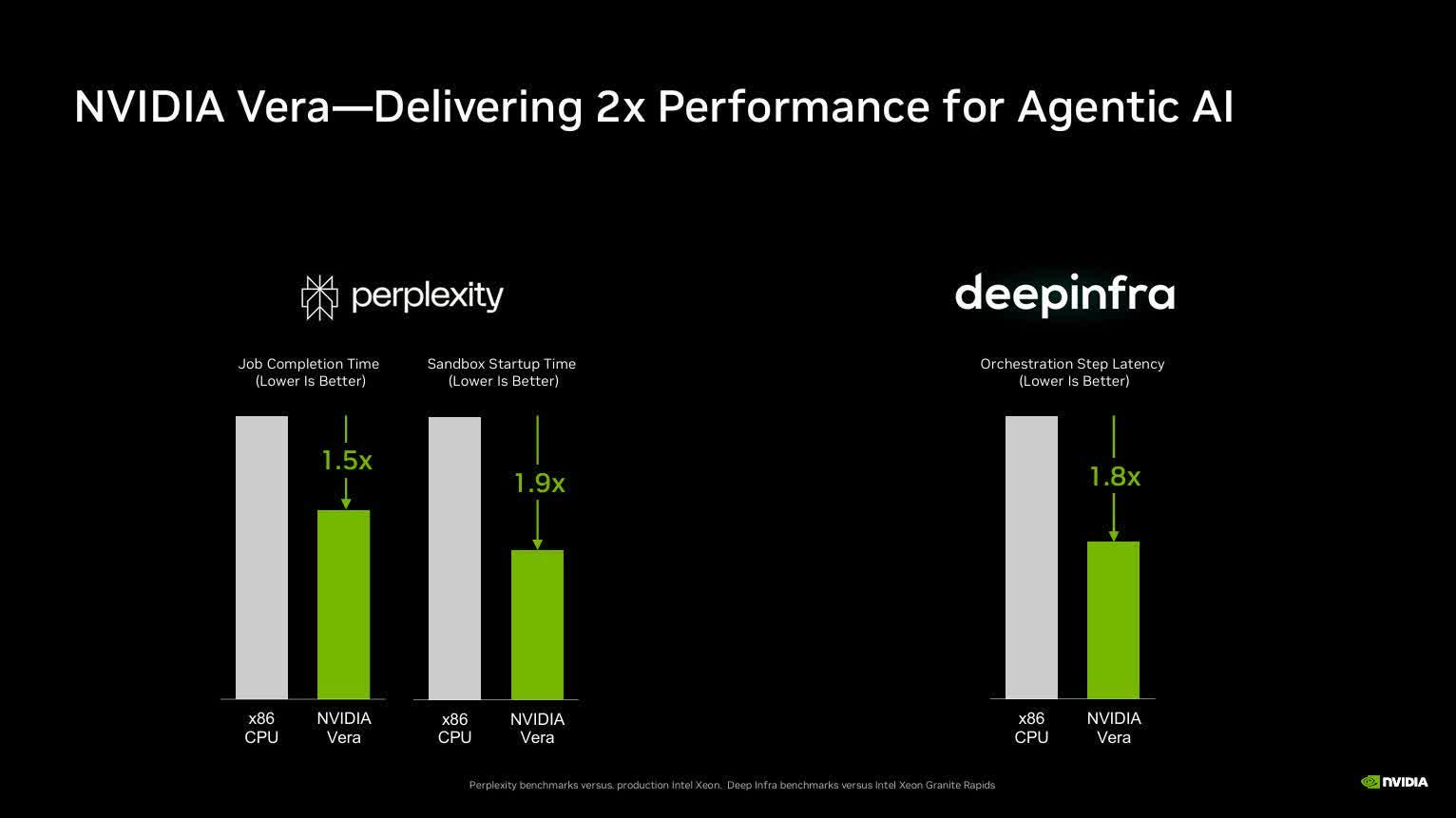
These are real workloads rather than synthetic benchmarks, which I give Nvidia credit for, and the supporting documentation puts names and configurations on most baselines. They remain vendor-supplied and worth reading closely.
The SPEC CPU 2026 numbers carry an estimated label from a pre-production reference system, and every comparison lands on Zen 5 Turin or current and older Intel silicon. The Los Alamos runs were measured against a Sapphire Rapids based supercomputer that launched in early 2023. Beating shipping parts is the right first test, but Venice and Diamond Rapids arrive within the year, and that is the fight that will settle this.
I asked the Nvidia team directly during the analyst briefing last week what actually separates an agentic CPU from a plain, very good datacenter CPU. We have had big, fast processors running back-to-back loops of VMs and containers for years. Is this genuinely a new workload class, or a fast CPU wearing new marketing?
To their credit, the team acknowledged that “agentic CPU” is the wrong label and would pigeonhole the part. The honest answer is that the fundamentals have not changed, but the rates have.
Agent pipelines hydrate and tear down environments constantly rather than occasionally. Memory pressure is continuous. Latency under load becomes the whole game, because every millisecond the CPU stalls is a millisecond a very expensive GPU sits idle. That is a real architectural argument, and the decision to spend die area on per-core speed instead of core count is a genuine philosophical break from where x86 roadmaps have been heading.
What the market needs now is independent, rigorous CPU measurement built around these agentic pipelines, run across current and next generation parts from every vendor. That is exactly the kind of work we are looking forward to diving into at Signal65.
The partner roster attached to this launch is unusually deep for a CPU announcement. OpenAI says it will deploy Vera at scale beginning in Q3, and the early adopter list also includes Anthropic, SpaceX, and Perplexity, with Los Alamos, NERSC, and TACC representing the supercomputing side.
Dell, HPE, Lenovo, Supermicro, and Bull all have Vera systems coming, backed by the full ODM bench.
The rack-scale platform is ramping just as visibly. CoreWeave was the first cloud to bring up and validate Vera Rubin NVL72 and published the first measured numbers from live hardware, a 10x gain in tokens per second per megawatt over Grace Blackwell NVL72 on DeepSeek-R1.
Google Cloud stood up the first A5X instance on Vera Rubin for the reinforcement learning startup Ineffable Intelligence, Azure and OCI have racks running, and a newly expanded Microsoft and Mistral agreement puts Vera Rubin at the center of a multibillion-dollar European buildout.
On the CPU specifically, DeepInfra, which serves nearly five trillion tokens a week, measured support for 1.6x more concurrent agents and 2.2x faster orchestration versus Granite Rapids. Nvidia counts 300 partners and more than 350 factory sites in 30 countries behind the ramp.
The timing is not subtle. This disclosure lands the day before Advancing AI opens in San Francisco, the flagship AMD event where the 256-core Zen 6 Venice generation of Epyc and the Instinct MI450 family are expected to headline the keynote from Lisa Su on Thursday. Nvidia just set the terms of the datacenter CPU conversation roughly 24 hours before its biggest rival takes the stage.
If a faster CPU returns GPUs to work sooner, the CPU price becomes a rounding error in rack TCO, and the fight shifts from dollars per core to tokens per rack. That framing is the one AMD and Intel now have to answer, and it is a very different conversation than the one that produced 128-core roadmaps.
AMD is not conceding the frame. It has already argued that rack-level performance per watt favors high-core-count Epyc, and the 256-core Venice generation will sharpen that response. Intel has Diamond Rapids coming. The hyperscalers have Graviton, Axion, and Cobalt, all designed around the scale-out economics Vera explicitly rejects.
But Nvidia is not selling a merchant CPU into a commodity socket. It is selling the CPU as the utilization lever for the most expensive assets in the AI factory. If a faster CPU returns GPUs to work sooner, the CPU price becomes a rounding error in rack TCO, and the fight shifts from dollars per core to tokens per rack.
That framing is the one AMD and Intel now have to answer, and it is a very different conversation than the one that produced 128-core roadmaps.
Nvidia has promised deeper head-to-head benchmark data against both x86 and Arm competition in the coming weeks. That data, and the independent validation that should follow it, will tell us whether Vera resets the datacenter CPU conversation or simply carves out a well-defended niche inside the Nvidia rack.

Hot on the heels of the season three finale, AMC has announced the fourth season of Anne Rice’s Interview With the Vampire. Revealed during a panel for The Vampire Lestat at San Diego Comic-Con on Friday, season 4 will be titled Anne Rice’s Queen of the Damned.
On hand for the announcement were cast members of the vampire series Sheila Atim, Jacob Anderson, Assad Zaman and Eric Bogosian, as well as executive producers Mark Johnson and Hannah Moscovitch.
They also dropped a teaser trailer for the series.
Queen of the Damned will see “our established and beloved characters confront Akasha with their world, and ours, very much hanging in the balance,” said AMC Studios President Dan McDermott in a statement.
Moscovitch will serve as showrunner for Queen of the Damned, with Johnson and Rolin Jones executive producing.
No word yet on when season 4 will air, but it will stream exclusively on AMC Plus. You can catch the first two series of Interview With the Vampire on Netflix.


When the American Academy of Pediatrics updated its guidelines around screen time for children and teenagers for the first time in 10 years this past January, many teachers and educators applauded the news. The document focused less on television and more on digital devices. It offered educators, families, pediatricians, and other stakeholders research-backed guidance on using digital devices to support children’s learning, rather than prioritize prolonged engagement.
However, many of the recommendations were not tailored to specific age groups. Recommendations like “create a family media plan” and “protect sleep” were helpful but offered few concrete steps for pre-K students.
That left early childhood educators asking what they could do for their young learners.
Unlike the physical world, digital content comes fast, in short bursts, and when kids get used to that, it has negative consequences. “Too much of this screen and things jumping in front of them, it could be damaging overall,” says Latoya Jones, a pre-K through fifth-grade media specialist in Broward County, Florida. “They are developing their cognitive processes, and if we’re teaching them to think in six-second bursts, maybe that’s not what we’re aiming for.”
When kids interact with devices rather than people, their emotional regulation can suffer, says Kristina Turner, a first-grade teacher at the Paterson, New Jersey, campus of College Achieve Public Schools, a network of three K-12 charter schools. “A lot of the students, they are quick-tempered because they’re just used to quick things. If something takes too long, their behavior starts to heighten,” she says.
For the youngest learners in particular, “it is so important that they are learning how to interact, and listen, and even advocate for themselves,” says Colleen Francisco, a kindergarten teacher at Laurel Springs School, an online school in West Chester, Pennsylvania.
“There’s beauty in students having an issue or a problem, because then an adult can support them in working through it,” she says. When kids are tethered to their screens, those opportunities don’t arise.
Clearly, the AAP guidance is well timed and much needed. But how to put that guidance into practice?
“I never want my children using screens passively,” says Devon Caldwell, a pre-K and K teacher at Canupawakpa Education in Manitoba, Canada, and an instructor at Nipissing University Schulich School of Education in Ontario. “I want to see kids’ bodies moving, their mouths talking, little hands making something.”
To that end, she prioritizes co-viewing and co-creating, using interactive teaching software approved by her and the school. When students are using a screen, “they’re always using it with a partner. Right away they’re negotiating rules, talking to each other, developing those really important skills,” she says.
For her first graders, Turner tries as much as possible to create hands-on activities instead of relying on screens. For example, she uses a whiteboard, but tries to avoid it when giving instructions. “Students have to use their listening skills so they can be able to follow directions without using a screen,” she says. “By end of school year, I’m able to give them different tasks, and they’re able to do that independently, without depending on technology.”
Tyler Brown, an English teacher at Indian River Middle School in Philadelphia, New York, encourages teachers to be thoughtful about the digital tools they share with the youngest learners. “Don’t throw [the digital tool] at everything,” he says. “Think about what you’re using it for. Think about what it’s supposed to do. Is this an enhancement of learning or is this a replacement?”
These self-directed questions can drive practical choices in the classroom. “You’re doing AT words: cat, mat, bat. You could easily have a website or a Google slide where they’re dragging those items onto the correct word,” says Brown.
“Or you could do what we’ve done in the past, which is a cut-and-glue activity,” he continues. “Why are we using screen time for something that can easily be a manipulative activity, where kids are doing things hands-on? Little kids are tactile learners, and those hands-on exercises have real value.”
Even as a teacher in an online school, Francisco is finding ways to limit screen time. “One of our assignments is taking a nature walk and writing down what you see. That is something that extends the learning off the screen,” she says.
Even math can be hands-on for early learners, she adds. “You don’t have to have anything fancy. You don’t have to buy the tools: Even just using cereal in order to practice adding and subtracting,” she says.
Jones was a kindergarten teacher before becoming a media specialist. “Anytime I had a word of the week, we used Play-Doh to build a word. Or we did those little sandboxes where they drew the word in the sand,” she says.
Big picture: Active and tactile often are better than passive and screen-based. “Could this be accomplished with blocks or Play-Doh or markers and paper? If it could be, let’s do it that way,” Caldwell says.
But teachers can only do so much in the classroom when kids are immersed in digital media at home. In support of the AAP’s call to prioritize family time over screen time, teachers may need to engage more with parents.
Pre-K and K teachers don’t have control over what kids do outside of school. “At home, a lot of my students go straight to their screens,” Turner says. To help steer her own kids and her students when they are at home, she gives parents resources. “I’m able to provide them with index cards, and you can keep them in the back seat,” she says.
When kids get in the car, “instead of reaching for an iPad, they can reach for their index cards, whether it’s math problems or sight words,” she says. “Or you can put that as a magnet on your refrigerator: If you want a snack, you got to read this word.”
When Francisco sends homework through the learning management system, “we have workbooks and other hands-on activities that support the lesson,” she says. And she encourages parents to talk to their kids, as a pedagogic exercise.
“Phonemic awareness is especially important to early-literacy learners. The learner is listening to sounds and how sounds are manipulated,” she says. “I’ve given parents additional resources so that [kids] are not reading or not listening or watching on the video. Instead, they’re doing it with their student, face to face.”
It takes some creativity and extra effort by teachers and parents to pivot kids off of screens, but experts say it’s worth the effort. Too much screen time “can negatively impact executive functioning, socio-emotional and language skills,” says Bryana Casas M.A., master teacher at Pacific Oaks Children’s School in Pasadena, California.
For those honing their interpersonal skills — a main goal in pre-K through K education — “nothing can replace relationships and face-to-face interactions between people,” she says.

UK tribunal rules Holiday Extras discriminated against a remote worker by refusing to let her keep her camera off during calls
A UK employment tribunal has ruled that forcing a remote worker with anxiety, ADHD, and autism to turn on her camera during a video training session amounted to disability discrimination. Laura Tait, a home-based travel consultant at Holiday Extras, was awarded compensation after the Croydon tribunal found the company failed to make reasonable adjustments for her conditions. The ruling does not ban camera-on policies outright, but it establishes that employers must consider individual accommodations for disabled workers who find video calls distressing.
Tait joined Holiday Extras in June 2021 as a remote consultant selling travel insurance, a role in which voice calls accounted for roughly three-quarters of customer interactions. By 2022, she had informed managers that work-induced stress was triggering repeated absences and that she could manage her anxiety more effectively through live chat and email channels. She requested that two or three days each week be allocated to text-based work instead of phone or video calls.
The company offered temporary adjustments during periods of phased return but refused to guarantee a permanent shift in her workload, arguing that voice calls were the core business function and that changes would be unfair to other staff. On August 24, 2023, during a remote training session, Tait asked to keep her camera off because she felt “super anxious,” but was told to start with it on and see how she managed. She was unable to cope and had to leave the session.

The 💜 of EU tech
The latest rumblings from the EU tech scene, a story from our wise ol’ founder Boris, and some questionable AI art. It’s free, every week, in your inbox. Sign up now!
Tait went on sick leave in October 2023 and has not returned. The tribunal found that Holiday Extras failed to make several reasonable adjustments, including allowing her to join meetings with her camera off and permanently increasing her share of chat and email shifts. It concluded that accommodating Tait would have had minimal impact on more than 50 other travel consultants and that the company’s refusal left her at a substantial disadvantage.
Employment lawyers cautioned that the decision does not mean all camera-on policies are automatically unlawful, since it turned on Holiday Extras’ specific failure to adjust for a worker whose combined disabilities made video calls particularly burdensome. The case arrives as courts on both sides of the Atlantic increasingly scrutinise how workplace policies interact with disability protections, from camera requirements in remote meetings to AI systems that penalise workers on medical leave. Compensation will be decided at a later hearing.

President Donald Trump is escalating the fight over European Union antitrust penalties against Apple, Google, and other U.S. tech companies by opening a trade investigation that could lead to new tariffs.
Trump announced the investigation in a social media post after the European Commission fined Google 890 million euros on July 23 for violating the Digital Markets Act.
The fine included 460 million euros, or about $517 million, for favoring Google services in search results and 430 million euros, or about $483 million, for restricting how businesses direct Google Play users to alternative purchasing options.
“The United States of America is not a PIGGYBANK’ for Europe, nor will we allow it to be,” Trump wrote. He accused the EU of unfairly taking money from American companies and said its penalties should be reversed.
Trump predicted that the investigation would result in a “substantial tariff” against the EU. He didn’t identify a tariff rate, affected products, or a timetable for completing the investigation.
Section 301 of the Trade Act of 1974 allows the U.S. trade representative to investigate foreign government practices considered unjustifiable, unreasonable, or discriminatory and harmful to American commerce. A finding against the EU could support tariffs or other trade restrictions.
The US-based investigation obviously can’t overturn European Commission decisions or erase fines imposed under EU law. Apple and Google must separately challenge those penalties through the European legal system.
The announcement comes three days after 25 Republican lawmakers urged Trump to use Section 301 against the EU’s Digital Markets Act and Digital Services Act.
The lawmakers argued that the rules disproportionately burden American technology companies and give foreign competitors easier access to the U.S. market. European officials maintain that the regulations apply according to companies’ size and market power rather than their nationality.
Trump also threatened to use Section 301 on September 5, 2025, if foreign governments continued imposing fines and regulations that he said discriminated against American technology companies.
Although the July 23 Google fine immediately preceded Trump’s announcement, he also named Apple, Meta, Amazon, and other U.S. companies in his criticism of European regulators.
The European Commission fined Apple 500 million euros on April 23, 2025, after finding that its App Store rules restricted developers from directing customers to offers outside Apple’s payment system.
Apple appealed the fine on July 7, 2025, arguing that the Commission’s demands went beyond what the Digital Markets Act requires and dictated how Apple must operate the App Store.
The company has said it spent hundreds of thousands of engineering hours and made dozens of product and policy changes to comply with the law. Apple has also accused the Commission of repeatedly changing its expectations during the compliance process.
European regulators say the anti-steering rules give consumers access to competing offers and prevent gatekeepers from using control of an app store to disadvantage rivals. The Commission has designated services operated by Apple, Alphabet, Amazon, Meta, Microsoft, and ByteDance as gatekeepers under the DMA.
The disagreement is no longer limited to whether individual App Store or Google Play rules comply with European law. Trump is attempting to treat the EU’s regulatory system itself as a discriminatory trade practice, potentially connecting technology enforcement to tariffs on unrelated European goods.
Section 301 gives the administration a mechanism to investigate the EU and impose trade penalties if U.S. officials find that European regulations burden American commerce. The investigation marks a meaningful escalation, but it won’t determine whether Apple or Google violated European law.
Tariffs are collected from U.S. importers, which may absorb the cost or pass some of it to businesses and consumers. Any duties covering products outside the technology industry could therefore affect companies that had no role in the EU’s enforcement decisions.
The investigation, reported by The Associated Press, also follows a broader expansion of Section 301 action by the Trump administration. New tariffs on imports from more than 60 countries took effect July 23 over alleged failures to enforce bans on goods produced through forced labor.
For Apple, the investigation adds federal trade pressure to a dispute it is already fighting through European courts. It may raise the political and economic cost of future EU penalties, but only European regulators or judges can withdraw or overturn the existing fine.

Earlier this year, I picked up a rather unfortunate habit: vaping. More specifically, I started smoking flavored vapes manufactured in China’s so-called “Vape Valley” and sold throughout the United States.
Flavored nicotine vapes are largely illegal in the US, yet convenience stores and tobacco shops across the country have generated billions of dollars in sales from these products in recent years, despite periodic law enforcement seizures and efforts by the Food and Drug Administration to keep them off the market. More recently, Chinese manufacturers have found a new way to sidestep the law, escaping regulatory oversight altogether.
Like many people, I assumed the only addictive chemical in these products was synthetic nicotine, which vape manufacturers have used for years to avoid FDA oversight. But after Congress closed that loophole in 2022—expanding regulation beyond tobacco-derived nicotine—Chinese manufactures began filling their vapes with little-studied chemicals that mimic nicotine’s effects, known as nicotine analogs.
Because current regulations still narrowly define what counts as nicotine, Chinese companies have been able to sell nicotine analog vapes in the US without having to worry about federal tobacco rules, which generally require companies to submit new products to the FDA for scientific review before they can be legally marketed.
“This is just like whack-a-mole, these companies will do everything they can to circumvent regulation,” says Robert Jackler, an emeritus professor of head and neck surgery at Stanford University and the founder of an interdisciplinary research group studying the impacts of tobacco advertising.
The effects of nicotine analogs on humans haven’t been extensively researched, but animal studies have found that one of the most popular variants, 6-methyl-nicotine, could be more potent and addictive than regular nicotine. Vapes containing nicotine analogs may also expose users to other mysterious chemicals. One 2024 study found that some manufacturers were selling nicotine analog vapes that contained additional unlabeled ingredients, including artificial sweeteners and cooling agents with unknown inhalation risks. “What’s on the label has very little relationship to what’s in it,” says Jackler.
Researchers first documented the emergence of vapes containing 6-methyl-nicotine and other nicotine analogs in the US market about three years ago. But the chemical compounds themselves are nothing new—tobacco companies have been researching them since as far back as the 1970s.
A 2005 review of millions of previously secret internal industry documents found Big Tobacco had long explored nicotine-like compounds as replacements for nicotine, in part because they believed they could help circumvent potential regulation.
But US tobacco companies never wound up marketing mainstream products containing any of these nicotine-like chemicals. Instead, they surfaced decades later in disposable vapes made by Chinese manufacturers, which have proven extremely adept at finding new ways to keep selling their wares in the United States.
Chinese vape companies “are extremely creative, they are extremely smart,” says Rich Marianos, a former official with the US Bureau of Alcohol, Tobacco, Firearms and Explosives who is now executive director of the Tobacco Law Enforcement Network, an advocacy group that does not publicly disclose its funding.
“The Chinese have been flooding the American market with illegal vape products designed to target children for years. These fake nicotine products appear to be a new scheme to trick American consumers into putting illicit, potentially dangerous chemicals into their body,” Tim Sheehy, a Republican senator from Montana, said in a statement to WIRED. “The Trump Administration has made cracking down on these unregulated Chinese products a priority, and I hope they continue to sound the alarm on this problem.”
But Jeckler notes that the Trump administration has effectively dismantled the Centers for Disease Control and Prevention office responsible for the agency’s tobacco prevention programs and significantly reduced the size of the FDA’s Center for Tobacco Products. That means much of the effort to regulate nicotine analogs has fallen to the states. Jackler says he’s aware of four states—California, Nebraska, Indiana, and Tennessee—that have expanded their definitions of tobacco products to explicitly include nicotine-like chemicals. But there is still no comprehensive federal law that treats these substances the same way as tobacco-derived or synthetic nicotine.

Community-led open source project hosting site Codeberg has formally announced that projects whose code is largely or fully machine-generated through LLMs and other ‘AI’ tools will no longer be welcome. This follows on the heels of a similar ban on cryptocurrency-related projects.
The community vote was on two issues, the first being the notion that scraping of project code for the use in LLMs should be forbidden, which was a motion that easily passed. The second motion was on disallowing projects whose code was substantially generated by LLMs like Claude, OpenAI Codex, and similar. This motion passed with 358 in favor versus 144 against.
In the earlier linked blog post the reasoning behind especially this second issue is expanded upon, covering not only ‘license whitewashing’, but also the direct and indirect hardware costs, with the expanding ‘AI’ datacenter hyperscaling having massively increased hardware costs for Codeberg over the past years, as the costs have been largely externalized.
Also covered is also the aspect of these LLM-based tools destroying the OSS community, which is something that is backed up by recent studies. Even if we ignore that such LLM-tools are destroying the cognitive abilities of its users, there’s an argument to be made that if LLM-scraping is disallowed, then it’s consistent to also not allow LLM-generated code.
In the Terms of Use you can see these changes, both for LLMs and for cryptocurrency projects.
Thanks to [mk-fg] for the tip.


Enterprises deployed AI agents ahead of the controls needed to manage them — and they did it knowingly. That is the central finding across the five parallel surveys VentureBeat Research fielded in June, spanning every layer of the agentic stack. Now those enterprises are retrofitting to catch up with their own standards, and they are budgeting for it: In each of the five control layers we measured, 57 to 68% of enterprises plan to switch vendors or add new ones within 12 months, and roughly a third, depending on the layer, plan to move within the quarter.
VentureBeat Research measured the five controls an enterprise has to build before it can trust an agent: identity, evaluation, cost telemetry, the context layer, and orchestration. Identity governs which agent is allowed to do what, under whose credentials. Evaluation determines whether the agent’s work is any good. Cost telemetry tracks what each agent costs to run. The context layer supplies the business data and definitions agents draw on when they answer. And the orchestration control plane coordinates multi-step agent work. Each of our five reports measures one of those controls.
Most deployed “agents” are chatbots wearing the label. Seventy-one percent of enterprises said a quarter or fewer of their deployed “agents” can complete multi-step work on their own; only 10% said true agents are the majority of what they run. These respondents are positioned to know: 81% recommend or decide AI purchases at their companies. A single-prompt chatbot with a human reading every answer needs none of the controls the other four reports measure. A true multi-step agent needs all of them — and most enterprises can’t say which one they’ve deployed. (Full findings: Agentic Orchestration report.)
Autonomy is outrunning trust in the evaluations that gate it. Two-thirds of enterprises either already allow an agent to push a code or system change to production on automated evaluation results alone, with no human review, or are actively engineering toward that within 12 months. Only 5% fully trust the evaluations that would make that call — and half of enterprises shipped an agent that passed internal evaluations and then caused a customer-facing failure in the past year. Before removing human review from any workflow, test evaluations against production outcomes rather than internal benchmarks. (Full findings: Agent Reliability & Evals report.)
Companies that let agents share credentials get hit more often. Sixty-nine percent of companies let at least some of their agents share credentials — multiple agents operating under one API key or service account. Organizations that allow credential sharing anywhere experienced a security incident or near-miss at a 63.5% rate (47 of 74), against 40.9% (nine of 22) at companies where every agent has its own scoped identity. The fix is scoped identity for every agent, starting with the ones that touch production systems. (Full findings: Agentic Security & Identity report.)
The most expensive hardware in the building runs at half capacity or less. More than eight in 10 enterprises that run their own GPUs reported utilization of 50% or less, and only 44% rigorously track what their AI compute actually costs and returns. The number worth chasing first isn’t more GPUs — it’s the utilization and per-workload cost of the ones already running. (Full findings: AI Infrastructure & Compute report.)
Agents answer confidently from data nobody governs. Fifty-seven percent of enterprises traced a confident, wrong agent answer in the past six months to their own missing or inconsistent business context — wrong metrics, stale definitions, absent documents — and most saw it happen more than once. Governing the definitions agents answer from — metrics and entities first — has to come before scaling the agents that depend on them. (Full findings: Context Layers / RAG report.)
No layer has an entrenched incumbent: The defaults today are the built-in tools that ship with the big AI platforms enterprises already use. Switching intent runs highest in orchestration itself, where 68% plan to adopt, add, or replace platforms within 12 months and 34% within the quarter. Our surveys did not ask which direction that money moves — toward the platforms’ built-in tools or toward the specialists challenging them — and that open question is the next four quarters of this market.
About this research
VentureBeat Research fielded five parallel surveys in June 2026 under its VB Pulse program: Agentic Orchestration (101 respondents), Agent Reliability & Evals (157), Agentic Security & Identity (107), AI Infrastructure & Compute (107), and Context Layers / RAG (101) — 573 qualified respondents in total, all at organizations with 100 or more employees. Samples are self-selected, and some findings should be read directionally; each report carries its full methodology note. What the pattern supports more strongly than any single percentage is the direction: every survey, independently, points the same way. VentureBeat produces both this research and VB Transform, the conference where these reports debuted.


Security
Stop the spread (of online recruiting and propaganda)
Europol and its partners’ investigators flagged 4,340 “horrific” URLs for removal over several weeks in June and July as part of an ongoing crackdown on The Com (short for community), a loosely knit network of online groups whose young members participate in a range of illicit activities. These range from hacking, swatting, and digital extortion to real-life shootings, stabbings, and other physical violence.
Europol’s recent Referral Action Days, aimed at disrupting The Com’s online ecosystem and stopping the spread of its propaganda, is part of the larger Project Compass operation. Project Compass began in 2025, and its partner law-enforcement agencies span the US, UK, and EU member states.
Investigators from Belgium, Finland, Hungary, Ireland, Luxembourg, the Netherlands, Portugal, Spain, and Sweden participated in the Referral Action Days during June and July.
Various groups linked to The Com post content online to recruit members and groom young victims using social media, gaming platforms, and messaging apps.
“The more extreme and harmful the content a user or group can produce or extort, the higher their status within the online community,” according to Europol. “These acts are often livestreamed on social media platforms, where online bystanders cheer them on, and later saved and disseminated.”
The URLs flagged for removal during this latest push to disrupt The Com’s recruiting activities included “violent videos and images depicting self-harm, suicide, child sexual abuse material (CSAM), animal cruelty, and violent attacks,” the international cops said.
This, the European cops say, includes so-called blood walls, which are paintings made with blood that display the extorter’s alias and group affiliation, and cut-signs, where the victims are forced to carve the extorter’s name into their bodies.
It also includes videos of street attacks and arson, plus manuals on how to commit these violent attacks, along with instructions on grooming and extorting vulnerable minors, and conducting doxxing and swatting.
Europol says its European Counter Terrorism Centre has received “hundreds” of requests from member states and others over the past two years to help investigate crimes linked to The Com. It describes the online network as a “global threat, particularly concerning minors as both victims and perpetrators.”
Last year, both the UK and US issued similar warnings about a subset of The Com that recruits children and teens for contract shootings, kidnappings, and other real-life violent crimes. In July 2025, the FBI said that In Real Life (IRL) Com had become increasingly brazen in its swat-for-hire and violence-as-a-service solicitations.
The FBI’s alert followed a similar notice from the UK National Crime Agency about a “deeply concerning” trend of The Com recruiting teenage boys to commit a range of criminal acts, from cyber fraud and ransomware to child sexual abuse.®

Will Elon Musk actually face legal consequences for illegally paying voters in an attempt to interfere in an election? We’re at least one step closer to finding out.
Back during the 2024 Presidential election, he got away with offering $1 million to a “random” (not actually random) voter who would sign his petition in an effort to get out the vote for Donald Trump in Pennsylvania.
He then tried to run back that strategy a few months later during a special election for judges in Wisconsin. It didn’t work out so well for him. It flopped so badly that Musk said he would no longer get so invested in elections any more. Who knows if he’ll keep that promise. Probably not.
And now the Wisconsin Elections Commission has decided that the whole “we’ll pay you to sign this petition” nonsense likely violates the law.
The motion approved by the elections commission said it found probable cause that Musk broke Wisconsin law by making a social media post offering $1 million to people who voted in the Supreme Court election “in order to induce them to vote in that election.”
[….]
Three Wisconsin voters received checks from Musk, including two who got them in person at the Green Bay rally. Two weeks before the election, Musk’s political action committee, America PAC, offered $100 to voters who signed a petition in opposition to “activist judges,” or referred someone to sign it.
And, before you rush out to claim that it was clearly a partisan/biased decision, turns out it really wasn’t. The commission is equally split between Republicans and Democrats:
The Wisconsin Elections Commission, consisting of three Democrats and three Republicans, voted 5-1 in closed session on Thursday to refer the complaints to the district attorney, the commission’s spokesperson, Emilee Miklas, said.
Brown County District Attorney David Lasee, a Republican, did not immediately return a message seeking comment Tuesday.
Of course, it is an open question as to whether or not Lasee will actually do anything about this. Some groups are pushing him to act on the referral. And they called out that Lasee had put a stop to other “get out the vote” campaigns, warning them that their actions (offering food, water, and rides to the polls) could violate election bribery laws. Here’s Kristin Lyerly from the Committee to Protect Healthcare:
“The commission did their job. Now it’s time for District Attorney Lasee to do his,” she added. “This isn’t about political outcomes. It’s about whether the law applies to everyone or just everyone except the richest man in the world.”
Others argued the law should be applied fairly, pointing to an April 2024 incident where Lasee warned local get out the vote organizers that an event they planned risked violating state election bribery law.
The event offered food, water and rides to the polls — as well as cash prizes for social media influencers who got the most people out to vote. The groups canceled the effort after receiving a letter from Lasee questioning its legality.
“When the district attorney’s office believed local organizations may have crossed a legal line, it acted quickly,” said community organizer Christina Thor. “Our community deserves to see that same standard applied today. The same urgency, the same scrutiny, and the same commitment to applying that law fairly.”
So, here we have a very clear opportunity to see whether the law is applied equally to Musk, or whether yet another law enforcement official decides that there can be no consequences for rampant law-breaking.
Should this move forward, I guarantee you that Musk and his hordes of cult-like fans will insist that this prosecution is political. But, again, that seems like bullshit. At some point, those who break the law with impunity have to be held accountable for their actions.
One of the most frustrating things about the last decade has been watching the rich and powerful face zero consequences for doing many, many terrible things — a pattern that breeds exactly the kind of toxic cynicism that lets everyone else assume that the rules don’t apply to themselves either. This is a chance to take a stand and prove that wrong. Those actions should have consequences, and screaming “political prosecution” when it’s clearly not should never be a literal get out of jail free card.
Filed Under: bribery, consequences, david lasee, elections, elon musk, wisconsin




Ripple Payments Joins MiCA With 14 Firms, Does It Mean Anything For XRP?


The House | The City of London can help the new chancellor deliver growth in every postcode


Weekend Open Thread: Brooks Brothers


Democrats look to World Cup watch parties to register thousands of voters


Grayscale Files For Worldcoin ETF, WLD Registers Sharp Rise


Sail Virtually Aboard The “Itanic” With IA-64 Emulator


Unregistered fitter used Gas Safe logo on business flyers

Turtle Beach Command Series KB7 review: a nifty screen-equipped gaming keyboard

New Jersey voter registration controversy explained: How 6,600 noncitizens got on the rolls, and what happens next


Big Money Is Entering XRP


Kaspersky exposes OkoBot’s 20-module crypto wallet attack

Johnny Depp’s R-Rated Gothic Cult Classic Gets New Release Ahead of Sydney Sweeney Remake


Durham County Council to send out electoral registration emails


Ethics, other provisions in crypto Clarity Act to be further discussed


MiCA Licensing Faces Delays as ESMA Adds 14 CASPs to Register


Chip Stocks Enter Bear Market After Moonshot Ai Unveils Kimi K3 Model

Shanghai science forum photos show China’s AI and robotics advances in rivalry with US


Watch Flock Safety CEO Garrett Langley discuss the future of surveillance at TechCrunch Disrupt 2026


Circle’s President Sold Over 360,000 Shares, The Filings Explain Why


Subway Sandwich Computers Get a Second Life as Gaming Machines


You must be logged in to post a comment Login