Tech
Privacy, Speed, Limits & Cost

A reputable free VPN can be enough when its privacy practices and usage limits fit your needs. Paying generally buys more capacity, server choice, simultaneous connections, support, and advanced features, but it does not automatically make a VPN more private, secure, or faster.
The useful comparison is therefore not simply “$0 versus subscription.” You need to separate privacy evidence from product limits, distinguish an explicit speed restriction from congestion, and compare what a paid plan actually costs rather than relying on its advertised monthly equivalent.
Free VPN vs Paid VPN: What Actually Changes?
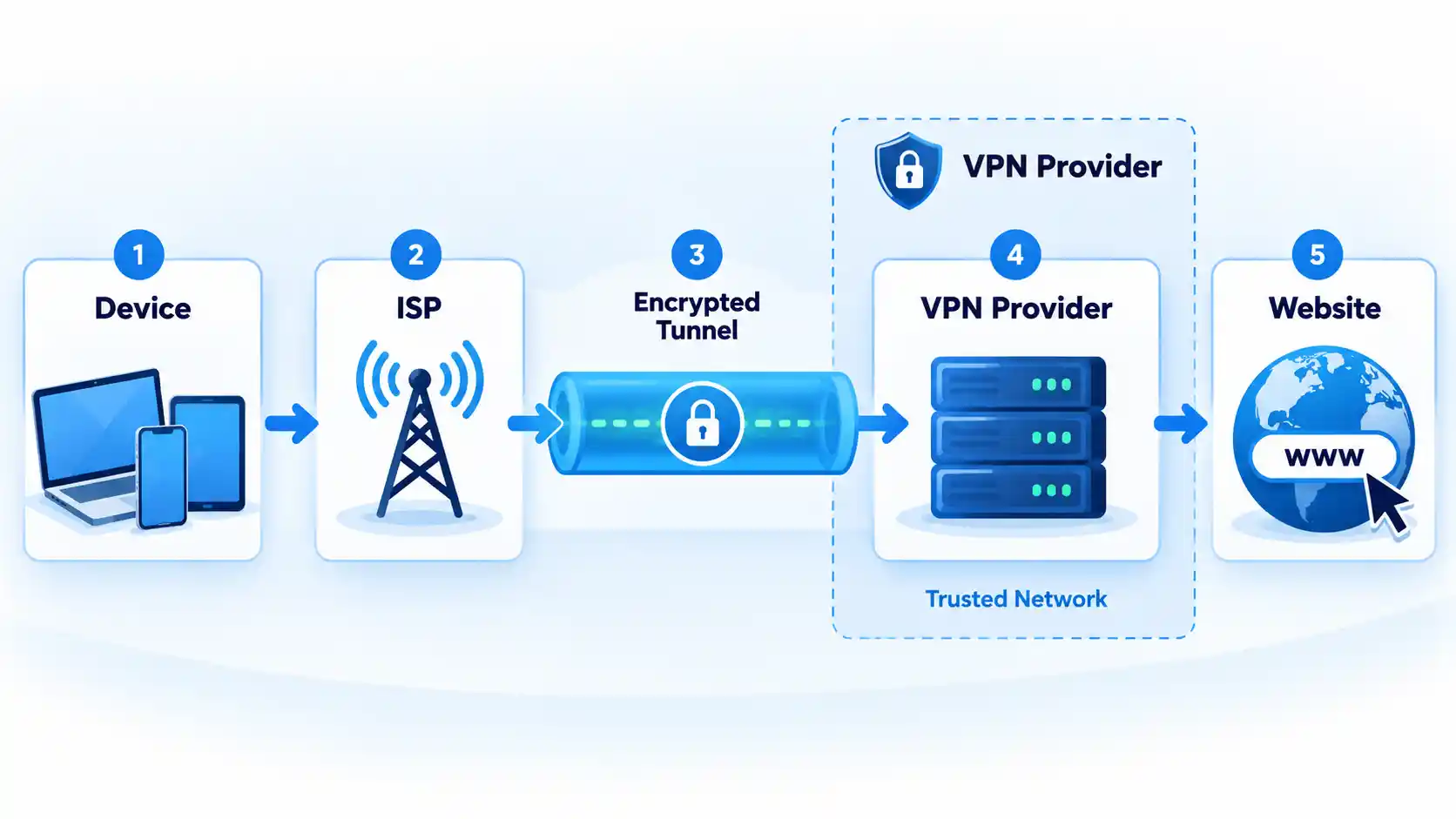
A virtual private network, or VPN, creates an encrypted tunnel between your device and a VPN server when the service and protocol are configured to provide that protection. Free and paid tiers from the same provider can use the same core VPN technology, while differing substantially in capacity, location choice, connection limits, and additional features.
Proton VPN is a useful example. Proton states that its free plan uses the same security level and no-logs policy as its paid plans, without a data, time, or routine speed limit. Its paid tiers add capabilities including broader server choice, more simultaneous devices, paid-plan streaming support, BitTorrent support, and advanced features. Proton’s free-versus-paid plan documentation also states that the free tier is limited to one device at a time.
That distinction matters because a free tier from an established provider is not necessarily a technically weaker VPN. Its main compromises may instead be data allowance, location control, device count, server availability, support, or premium functions.
Free VPN vs paid VPN at a glance
| Feature | Free VPN | Paid VPN |
|---|---|---|
| Subscription cost | No recurring subscription charge | Monthly, annual, or multi-year payment |
| Core VPN security | Can match the paid tier on documented freemium services | Provider-dependent; payment itself does not prove stronger security |
| Data allowance | May be unlimited or capped | Often removes a free-tier data cap |
| Server choice | Often restricted | Usually broader within the same provider |
| Simultaneous devices | Provider-dependent | May increase the connection allowance |
| Privacy | Depends on the provider, policy, implementation, and supporting evidence | Depends on the provider, policy, implementation, and supporting evidence |
| Performance | Can be affected by a smaller server pool, congestion, or plan restrictions | May provide more server choice or capacity, but faster performance is not guaranteed |
| Advanced features | Often limited | More likely to include additional routing, P2P, filtering, or support options |
There is no universal winner in that table. A free tier with unlimited data can be entirely adequate for one person, while someone who needs several simultaneous connections, precise exit locations, or paid-only features may encounter its limits immediately.
Privacy: Paying Does Not Automatically Make a VPN Trustworthy
Price is a poor shortcut for privacy. When a VPN is active, traffic is routed through infrastructure operated by the VPN provider, so the provider occupies a position of significant trust.
The U.S. Federal Trade Commission explains that a VPN can shift trust away from the local network or internet provider and toward the VPN operator. It also warns that VPN apps may request sensitive permissions, may share information with third parties, and do not make users completely anonymous. Although that guidance was published in 2018, its basic trust model remains applicable. The FTC’s VPN privacy guidance recommends examining the operator and its practices rather than relying on privacy marketing alone.

Recent research also shows why implementation matters. Work presented at USENIX Security 2026 describes observed VPN failure modes including real-IP leakage during tunnel failures, Domain Name System (DNS) queries escaping the tunnel, cleartext traffic, insecure configuration delivery, and advertising-ID exfiltration in the apps and providers studied. The USENIX Security 2026 presentation supports evaluating technical behavior rather than assuming that a paid label establishes security.
When a provider says it keeps “no logs,” check what that statement covers. A no-logs policy can address browsing activity and VPN-session information while the service still retains limited operational account data needed to administer an account or enforce a plan.
Windscribe provides a concrete example. It says a free account can retain a username, hashed password, an email address if supplied, the total bandwidth used during the current period, and a timestamp of last activity. It separately says it does not retain visited sites, DNS queries, the user’s real IP address, or traffic-linked session logs. Windscribe’s free-plan disclosure shows why operational records and browsing-activity logs should not be treated as the same thing.
Independent assessments can strengthen a provider’s claim, but they have a defined scope and date. Proton says its no-logs infrastructure completed a fifth consecutive annual third-party audit in 2026. Proton’s published audit history links the 2026 assessment and earlier reports. That is more useful evidence than an unsupported slogan, but it is not a permanent guarantee about every future app version or security failure.
Whether a VPN is free or paid, examine the provider’s privacy policy, ownership, requested application permissions, independent assessments where available, and the specificity of its technical claims. A subscription receipt is not privacy evidence.
Free VPN Limits: Data, Servers, Devices, and Features
The word “limit” can describe several different restrictions. A data cap limits how much traffic you can use during a period. A device limit controls concurrent connections. A server restriction limits the locations or infrastructure available to the account. None of those automatically means that every connection is deliberately slowed.
Windscribe uses a data-cap model. Its current free-plan page states that an account receives 2 GB per month without a confirmed email address or 10 GB per month with one, and that the free account can be used across unlimited personal devices. Its free server selection is smaller than the paid network. Windscribe documents the allowance and free-tier restrictions.
Windscribe’s current pages do not agree on the exact number of free countries: its main free-plan page lists 10, while a May 2026 support article says 11. Because the provider’s own documentation conflicts, the exact country count is not used here.
Proton takes a different approach. Its free plan has no monthly data ceiling, while paid service expands location choice, increases the connection allowance to as many as 10 devices on eligible paid plans, and adds features unavailable to free users. Proton’s VPN privacy policy says the free service generally has no speed restrictions but reserves the right to impose restrictions in cases of excessive consumption to maintain service quality on free servers.
The practical difference becomes clearer when you consider real workloads. A monthly allowance can be consumed by video, operating-system downloads, cloud synchronization, application updates, or other background traffic even when browsing itself is light. An unlimited-data plan avoids that particular constraint but can still restrict server selection, concurrent devices, or premium functionality.
Different services impose those restrictions in different combinations, so compare free VPN data allowances, device limits, and server restrictions rather than assuming every free tier makes the same compromise.
Speed: Why Paying Can Help Without Guaranteeing a Faster VPN
A paid tier can have a practical performance advantage when it provides access to more servers, additional locations, or infrastructure unavailable to free users. That does not establish a fixed speed difference between free and paid VPNs.
Throughput is the amount of data transferred over time. Latency is the delay between sending network traffic and receiving a response. Both can change because of server distance, congestion, protocol choice, internet routing, Wi-Fi conditions, packet loss, device processing limits, and the underlying connection.
A free plan can introduce another constraint. If free users share a smaller server pool, congestion can become more noticeable when demand rises. A provider can also impose an explicit free-tier speed restriction. Those are different mechanisms: congestion varies with load, while throttling deliberately limits performance according to a rule.
Proton is a useful counterexample to the blanket claim that free VPNs are always throttled. Its current documentation says it imposes no routine speed limit on Proton VPN Free, although free servers can have more users and its privacy policy reserves an excessive-consumption restriction. Paid plans provide broader server access and are marketed as offering faster performance. That supports a narrower conclusion: paying can give you more performance options, but it does not guarantee a particular speed.
No first-hand speed measurements were supplied for this article, so there is no defensible universal percentage showing how much faster a paid VPN is.
If performance is poor, price alone does not identify the cause. Server load, distance, protocol selection, local Wi-Fi, packet loss, routing, Maximum Transmission Unit (MTU) problems, and device processing can produce similar symptoms. VPN slowdown troubleshooting is therefore more useful than upgrading blindly when the problem has not been isolated.
Cost: Compare the Real Bill, Not Just the Monthly Headline
A free VPN has no subscription charge, but paid VPN pricing still requires careful comparison because providers use different billing structures.
Mullvad uses a simple model. In February 2026, it stated that its price remains €5 per month regardless of how long a customer pays for. Mullvad’s pricing statement makes the payment term and monthly rate relatively straightforward.
Windscribe illustrates a different structure. Its May 2026 pricing documentation lists Pro at $9 per month or $69 per year and describes Build-A-Plan as having a $3 minimum purchase. Windscribe’s current pricing explanation shows how monthly, annual, and configurable plans can coexist within one service.
Those prices should not be read as a direct cheapest-provider ranking because they use different currencies, products, and billing structures. Instead, use them to identify what needs checking before you buy:
- the amount charged at checkout;
- how long that payment covers;
- whether the advertised monthly figure requires annual or multi-year prepayment;
- the renewal price after any introductory period;
- whether tax is additional;
- and whether the plan includes services you do not need.
Some VPN pricing pages are also localized by region, currency, or promotion. Treat any quoted price as a dated snapshot and verify the checkout terms before purchasing.
When a Free VPN Is Enough
A reputable free plan can be sufficient when its documented restrictions do not interfere with what you need to do. Examples include light or occasional use, one device on a service with a one-device limit, or routine browsing where you do not need a specific exit location.
The data model matters. Proton’s unlimited allowance removes the need to monitor a monthly data meter, while Windscribe can accommodate multiple personal devices but applies a monthly data allowance to its standard free accounts.
The important qualification is reputable. A free application that provides little information about its operator, funding model, privacy practices, permissions, or technical controls should not be treated as equivalent to a documented freemium service merely because both cost $0.
A free VPN becomes a poor fit when you repeatedly exhaust its data allowance, cannot select a required location, exceed its connection limit, or need a feature reserved for paying accounts. At that point, the relevant question is whether paying removes a constraint you actually encounter.
When Paying for a VPN Is Worth It
A paid VPN is easier to justify when its additional capacity solves a specific problem. That can include sustained high-volume use, several simultaneous devices, access to particular server locations, broader P2P support, advanced routing options, or customer support unavailable on the free tier.
Paying can also reduce recurring friction. If you repeatedly disconnect one device to connect another, exhaust a monthly allowance, or cannot access a suitable server location, a paid plan may remove those constraints.
Do not pay solely because a product is described as “premium.” Identify the limitation you need removed, verify that the paid tier actually removes it, and compare the billing terms with alternatives.
Once a paid service fits your requirements better, compare VPN privacy evidence, device limits, protocols, features, and subscription terms rather than treating payment itself as the deciding factor.
Choose this if: you have verified the provider’s privacy practices and its data allowance, server access, location control, and connection limits already cover your normal use.
Avoid this if: you repeatedly hit a data cap, need unavailable locations, exceed its connection allowance, or require paid-only functions.
Main trade-off: no subscription charge in exchange for provider-specific limits on capacity, choice, or features. Choose this if: you need sustained usage, broader server choice, more simultaneous devices, additional routing or P2P functions, or support that a suitable free tier does not provide.
Avoid this if: the subscription adds features you will not use or you are relying on price alone as proof of privacy, security, or speed.
Main trade-off: greater capacity and flexibility in return for an ongoing charge and, on some plans, a longer prepaid commitment.
Which option should you choose?
Choose a free VPN
Choose a paid VPN
Start with provider trust, then compare your data volume, device count, required locations, performance needs, and additional features. If a reputable free tier satisfies those requirements, paying may add little practical value. If one of its restrictions repeatedly interferes with normal use, a well-vetted paid plan is usually the more practical choice.
You must be logged in to post a comment Login