Tech
PSB iQ2 Speaker Review: Brilliant Sounding Wireless Speakers with a Fatal Flaw?

I’ve been a fan of PSB Speakers since I first auditioned the brand’s M4U 2 headphones back in 2013. Over its 50-plus years of operation, the Canadian outfit has consistently shown a knack for squeezing big sound into small packages. Never was that more apparent than in 2023’s Alpha iQ, a surprisingly versatile pair of powered bookshelves that pull more dynamism and musical expression out of a four-inch woofer and micro-tweeter than they have any right to.
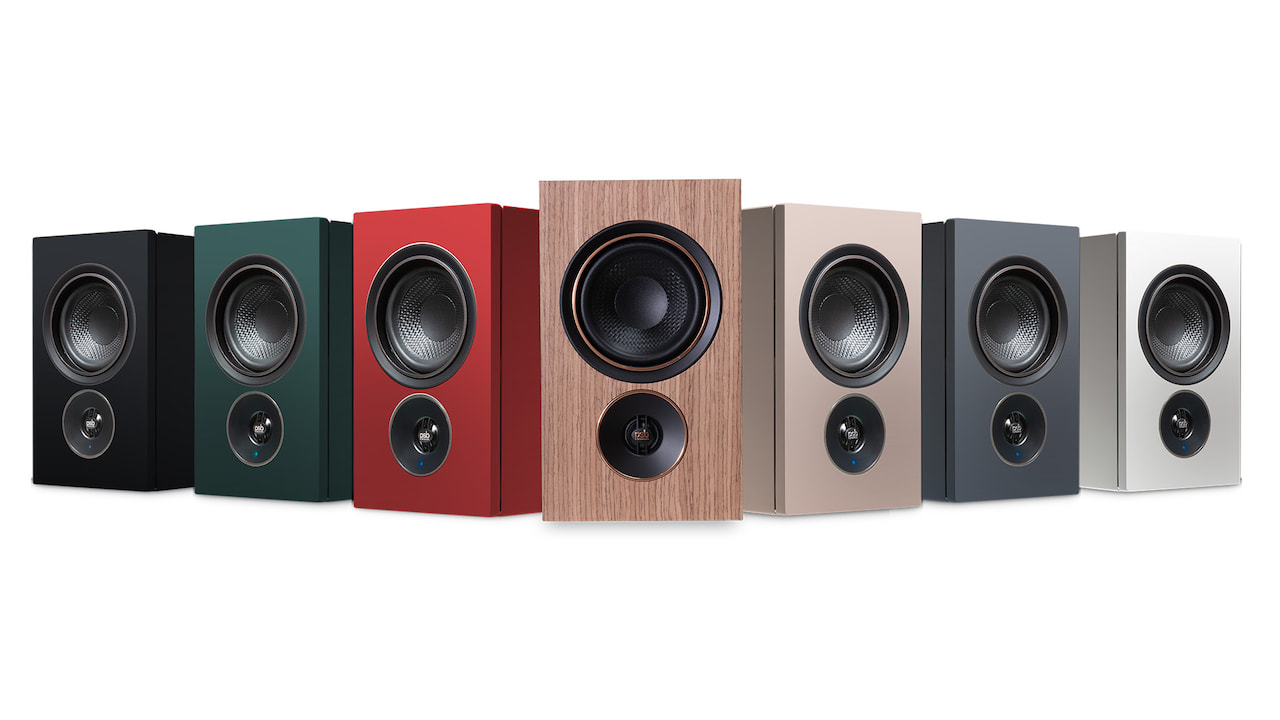
The follow-up iQ1 and iQ2 stand firmly on the Alpha’s shoulders, offering similarly potent musicality and connectivity packed into miniature cabinets, with a woofer-tweeter stack swap that always throws my brain for a loop. The new pairs also share the Alpha’s flair for stylish minimalism, especially the pricier iQ2, which adds upgrades such as a wireless connection between the speakers and a more refined veneer in colors like Ember Red and Sandstone Beige.

While the iQ’s hardware is all PSB, daily operation relies heavily on BluOS’s powerful software, which handles virtually all controls and audio settings, provides access to more than 20 streaming services, and even supports multiroom audio with rock-solid stability. Unfortunately, I can’t say the same for the iQ2’s HDMI eARC TV connection, which proved doggedly inconsistent throughout my review. The iQ2 worked great for other use cases, but without a stable way to connect seamlessly to a TV in today’s market, the package falls well short of its promise.
Related Reviews:
Setup: Long Haul Connection

Setting up the iQ2 isn’t a major hassle for tech-savvy users, but it’s not the push-button start you’ll get from multi-room setups like Sonos, recent app issues notwithstanding. PSB’s quick guide lays out a three-step process that includes simply plugging in the speakers and downloading the BluOS app for Wi-Fi setup, but the online manual hints that Ethernet is the best option where available. As if that were an omen, the iQ2 balked at my network’s 5 GHz Wi-Fi band during an AirPlay connection, leading to multiple stallouts.
Swapping to my split-off 2.4 GHz band fixed the issue, prompting an update and a paint-drying 20 minutes or so of total connection time between the speakers. The process included blasting surprisingly loud music from the primary speaker, which houses the connection hub, to designate it as the right or left channel, but I appreciate the ability to swap the orientation as needed. Users with particularly troublesome rooms should note that the iQ2 doesn’t offer dedicated calibration.
Controls and Usability: HDMI Issues
There’s also a learning curve for those new to BluOS, or even those like me who’ve been away for a few years. For example, going into the Players tab to find the iQ2’s settings unlocks basic playback controls and options like adding a subwoofer, but there’s no way to select an input. For that, you’ll need to consult the Music tab, which includes all physical inputs, input settings such as allowing the speakers to switch automatically when a signal is detected, and access to BluOS’s 20-plus streaming services and internet radio.
It feels overengineered for a pair of speakers, but that’s because the BluOS ecosystem is designed to let you group the iQ2 with more than 60 other compatible players throughout your home from brands like NAD, DALI, and Bluesound. The app is stable and thoughtful, with features such as haptic volume control, but I wish PSB included a physical remote for quicker access to inputs and other settings. Call me old-fashioned. You do get a few controls on top of the primary speaker, including play/pause, volume, and two programmable presets.
Controls aside, the iQ2’s hardware troubles were the real frustration. HDMI eARC is designed to provide a seamless, high-resolution connection between your TV and speakers, but the iQ2’s implementation was a mess. I experienced audio cutouts across multiple TVs, including instances where the TV recognized the speakers as a source but played no sound. PSB Speakers’ PR team told me this is a known issue and pointed to a firmware fix, but it didn’t work for my review pair.
Design & Features: Elegant Minimalism


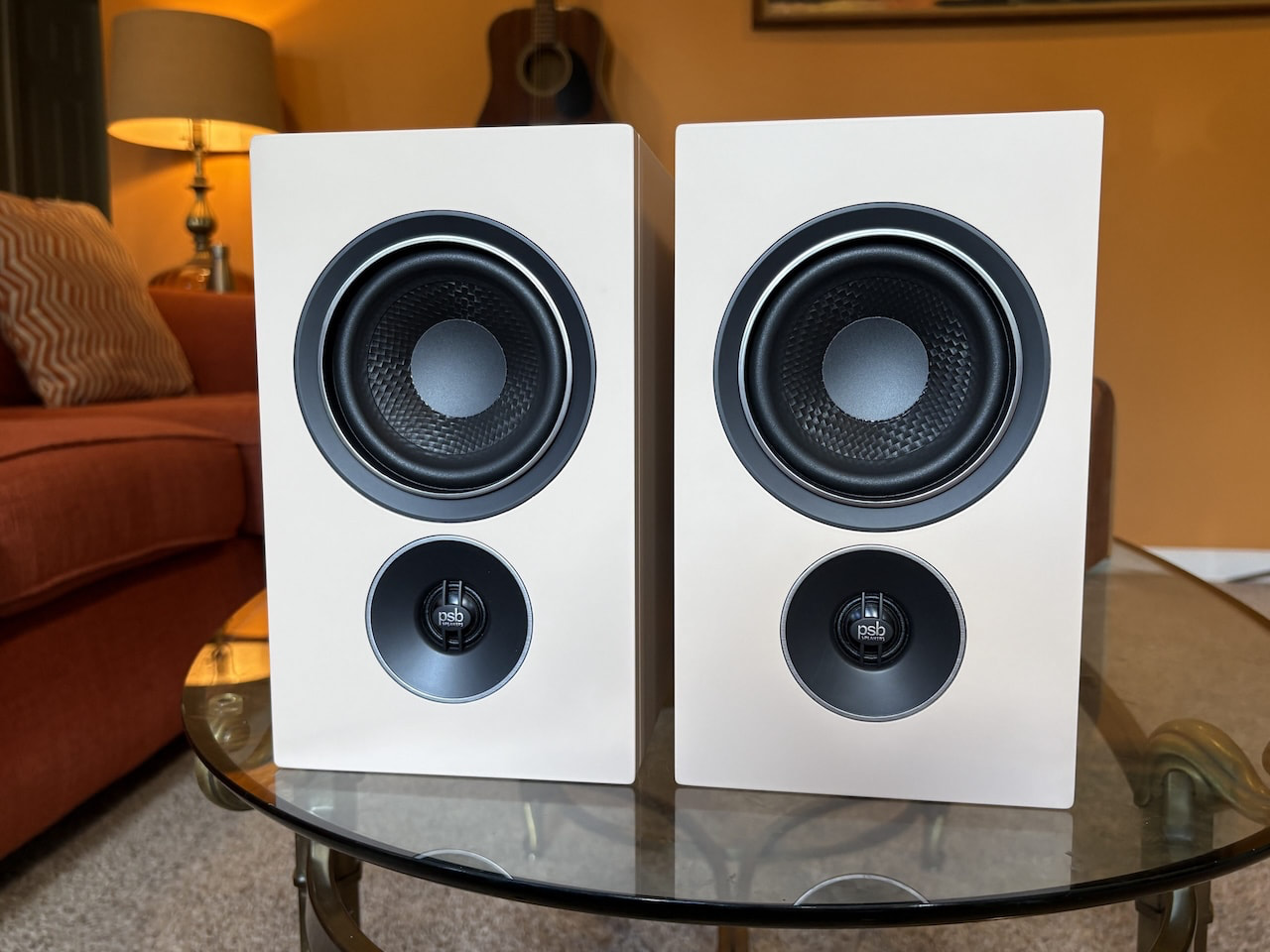
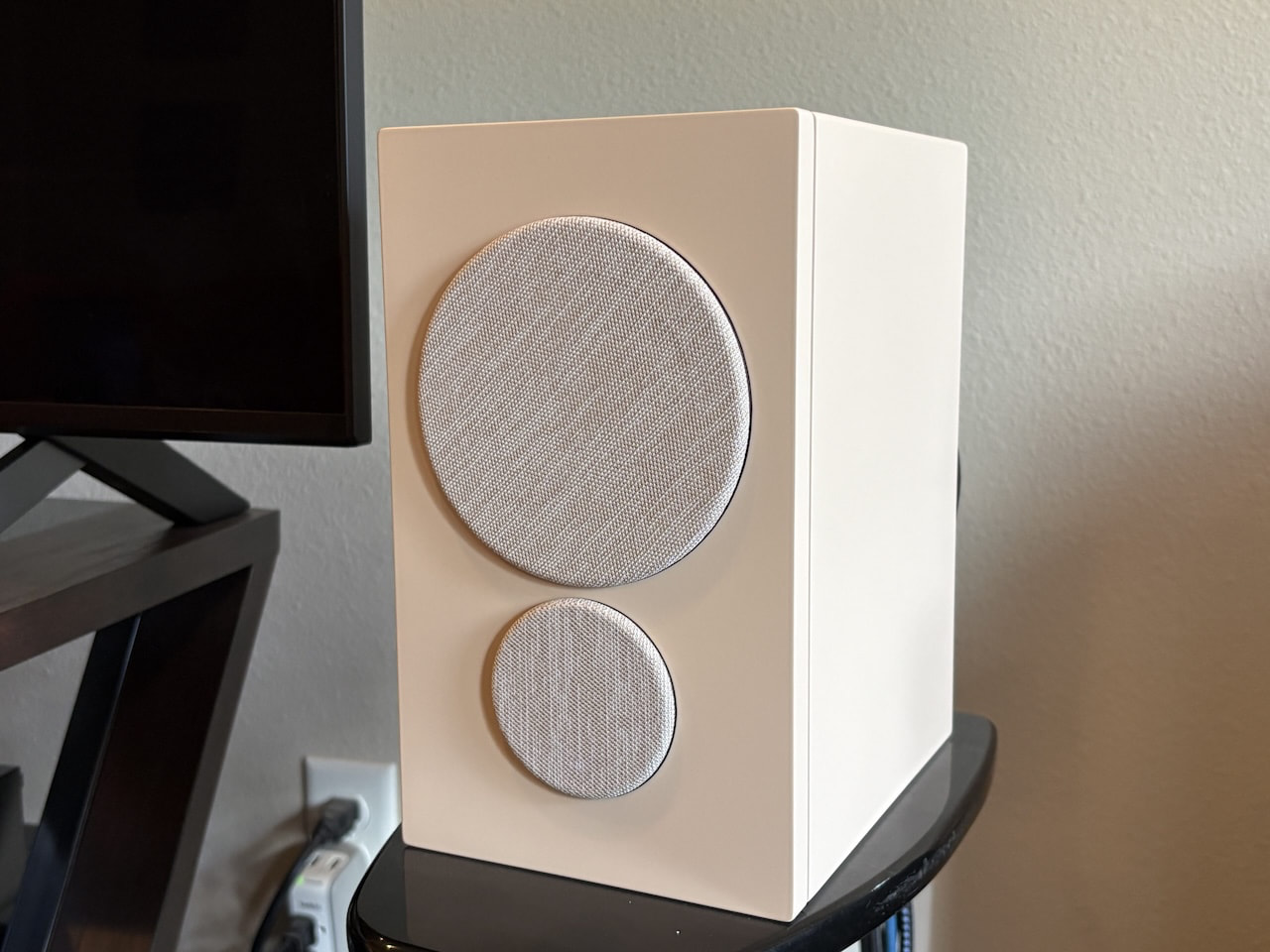
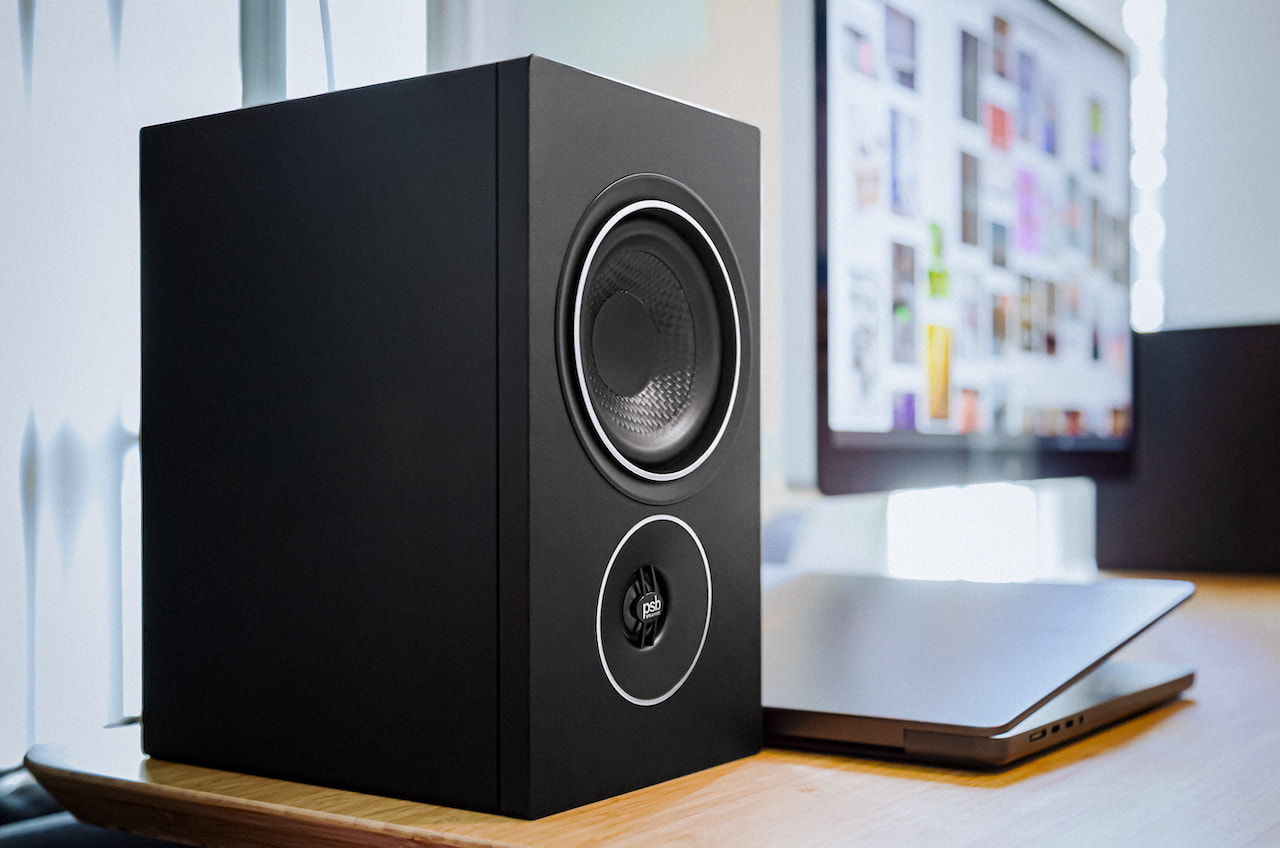
The iQ2 make a great first impression, especially in the Sandstone color I reviewed, looking both stylish and understated. The cabinets feel well built, and their fingerprint-resistant veneers ensure that the refined aesthetic holds up. There’s solid heft to the compact cubes, though at under 10 inches tall, they looked almost comically small against the 75-inch Micro RGB TV I first paired them with, especially with their little magnetic hats that serve as acoustic grilles.
That said, the iQ2’s wireless connection means they can easily adapt to larger screen sizes, and there’s nothing comical about their 270 watts of Class D amplification. That works out to 90 watts for each speaker’s four-inch polypropylene mid-bass driver and 45 watts for each 0.75-inch aluminum-dome tweeter. PSB claims a frequency response of 65 Hz to 20 kHz, and the speakers dive toward that lower number with more authority than their size suggests.
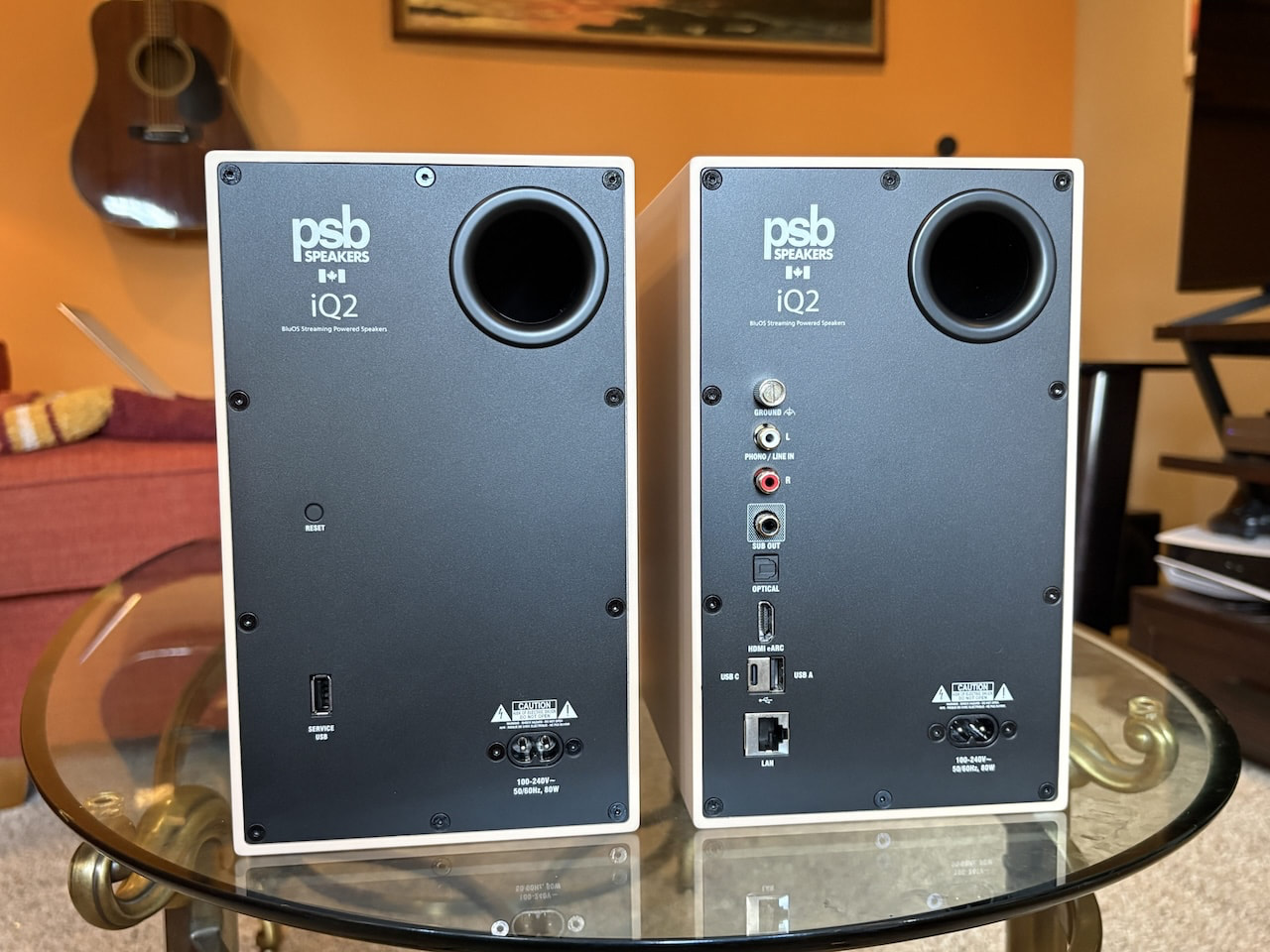
A column of inputs on the back of the Primary speaker includes HDMI eARC, optical, USB-C playback, USB-A for external drives, a dual line-in/MM phono RCA input adjustable in the app, Ethernet, and a subwoofer output.
Streaming support includes Spotify Connect, TIDAL Connect, Qobuz Connect, and Apple AirPlay 2. You’ll find many more options in the BluOS app, including Deezer, Napster, and iHeartRadio, to name a few, but not Apple Music. Other streaming options include access to internet radio stations, local network files at up to 24-bit/192 kHz, and Bluetooth with aptX Adaptive.
Listening: Mighty Minis
I started testing the iQ2 via lossless Spotify Connect and was quickly reminded why PSB holds a special place in my mind’s cluttered library of audio brands. A bit like Canadians themselves, the iQ2 are unassuming at first, but digging deeper reveals an effective mix of confidence and depth. Their sound signature is clean, smooth, and effortlessly natural, with accurate stereo imaging and more bass than you’d expect from micro speakers.
With the iQ2 playing in the background as my pre-toddler arrived home from daycare, I was constantly distracted by their penchant for drawing out instrumental timbres, from satiny brass and woodwinds to gritty electric guitars and poppy percussion. They do a good job of leaning into different genres, with enough finesse to give each instrument its own space, from the dual vocals in Too Short’s “Money in the Ghetto” to the cacophonous horns in The Beatles’ “Good Morning.”
The warm midrange can make more laid-back mixes sound a little flat, but its keener topside adds some excitement to higher-register instruments and effects without feeling sharp or brittle. The sweet yet pointed treble makes easy work of speedy transients like the reverberating synths in Sweet Spirit’s “Baby When I Close My Eyes,” fluttering the effect back and forth across the stereo image with a deft touch that stands out more readily than in options like SVS’s Prime Wireless Pro.
Bass is firm and well-rounded, if not particularly revelatory, until you remember the size of the drivers, which outflex just about any four-inch woofers I’ve encountered, including options like U-Turn’s more rugged-sounding Ethos speakers. Even some larger 5.25-inch drivers provide less mid-bass punch. It’s enough groove to be tantalizing, but if you’re after raw emotional power, you’ll need a subwoofer. As usual, my SVS 3000 Micro was a great pairing, firming up the lowest frequencies with richer musicality and some sledgehammer punch while opening more space in the upper registers.
Turning to vinyl with my Orbit Theory turntable, the speakers showed off solid detail and dynamics on my go-to albums, such as Brubeck’s Take Five. Paul Desmond’s buzzy sax in “Blue Rondo” was rendered with keen precision, pulling out most of his breathy overtones. Joe Morello’s stick work had an expressive touch in moments such as his multitone tom play during the title song’s drum solo. I was less impressed when moving to the iQ2’s internal MM phono stage, which was both quieter and less precise than the Theory’s internal preamp, though that seems to be a common issue with powered speakers in this class. You can often do better with an external preamp.
Moving to TV and films, when the HDMI eARC port was working, the iQ2 proved more than up to the task of providing exciting sound effects at the sides of the stereo image and clear dialogue at the center, elevating the subtle diction in well-mixed productions like House of the Dragon. Again, the speakers brought a natural liveliness to effects such as stone hallways and bridges, crackling fires, and the woody creak of the show’s many oversized doors.

The Bottom Line
On paper, the PSB iQ models, especially the iQ1, provide a ton of value. You’ll spend a lot more to get the pricier iQ2’s wireless connection and fancier cabinets, but both models offer impressive connectivity and features matched by surprisingly good performance, especially in smaller rooms.
If not for the HDMI eARC issues I encountered, either pair would be a top pick for those after a compact system with connectivity to spare, not to mention the ability to group it with other systems in the BluOS family. As it stands, I can’t recommend the iQ1 or iQ2 until PSB Speakers can ensure simple, reliable connections for all your components.
For those seeking alternatives to the cheaper iQ1, I recommend SVS’s steadfast Prime Wireless Pro, which offers well-rounded sound and great connectivity in sleek, piano-gloss cabinets. If your budget is more in line with the iQ2, KEF’s LSX II provides similarly stylish design and colorways, along with even better sound performance. Neither pair offers multiroom capabilities, however, so if that’s important, you may need to look elsewhere or wait for PSB to provide a real fix.
Pros:
- Smooth and natural tonal balance
- Good instrumental separation
- Powerful bass for their size
- Stylish, well-built cabinets in multiple colors
- Loads of connectivity options
- BluOS multi-room audio support
Cons
- Setup and basic control could be simpler
- HDMI eARC cutouts are a mess
- Upgraded cabinets and wireless connection are pricey
- May need a subwoofer for larger rooms
- No included remote
Our Ratings
★★★★★★★★★★ Sound Quality
★★★★★★★★★★ Build Quality
★★★★★★★★★★ Usability
★★★★★★★★★★ Value
You must be logged in to post a comment Login