Tech
Q Acoustics 3040c Gives Small Rooms a Proper Floorstander Without Evicting the Furniture

For listeners with smaller rooms, loudspeaker shopping often comes down to two mildly absurd choices: buy standmounts and discover the stands consume nearly as much floor space as towers, or buy full-size floorstanders and watch your living room get annexed by MDF.
Q Acoustics has finally inserted something between those two choices.
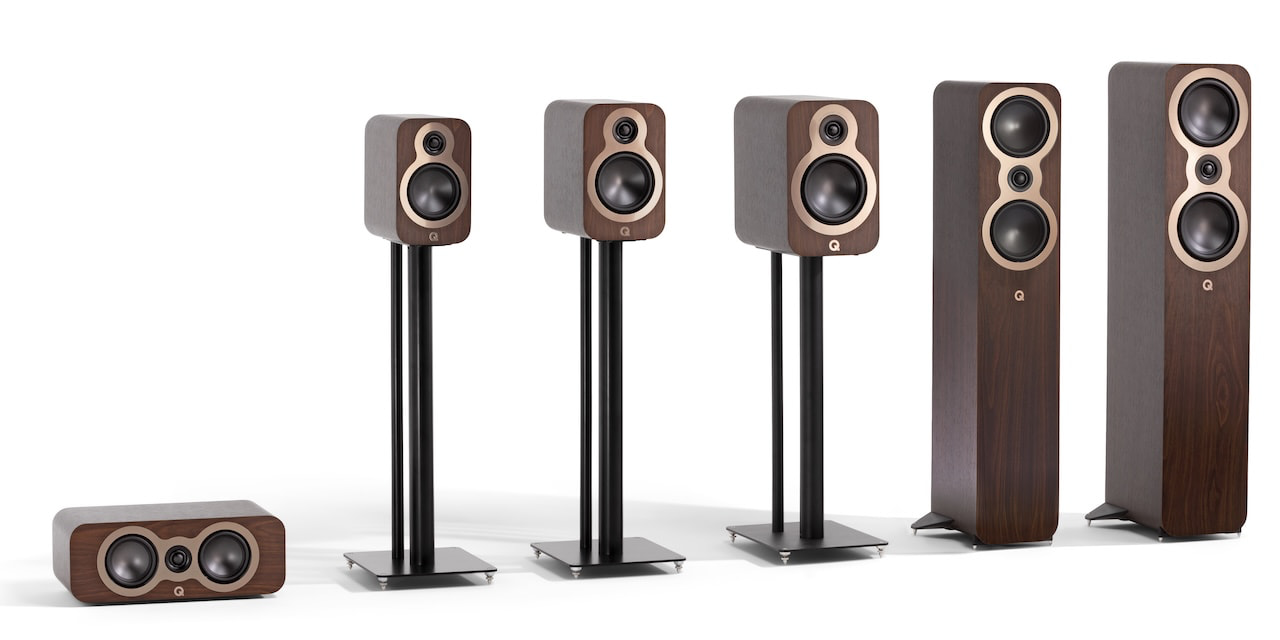
The new Q Acoustics 3040c is a compact floorstanding loudspeaker designed to deliver more scale and bass extension than the 3030c standmount without the size and visual presence of the larger 3050c. Priced at £599, €899 or $1,099 per pair, it becomes the sixth passive loudspeaker in the 3000c range and completes a lineup that now covers everything from desktop and bedroom systems to multichannel home theaters.

There is, however, an interesting wrinkle for American buyers: the 3040c costs only $100 less than the larger 3050c.
This is not the floorstander to buy because it saves a pile of money. It is the one to consider because it saves space.
Related Reviews:
The Missing 3000c Model

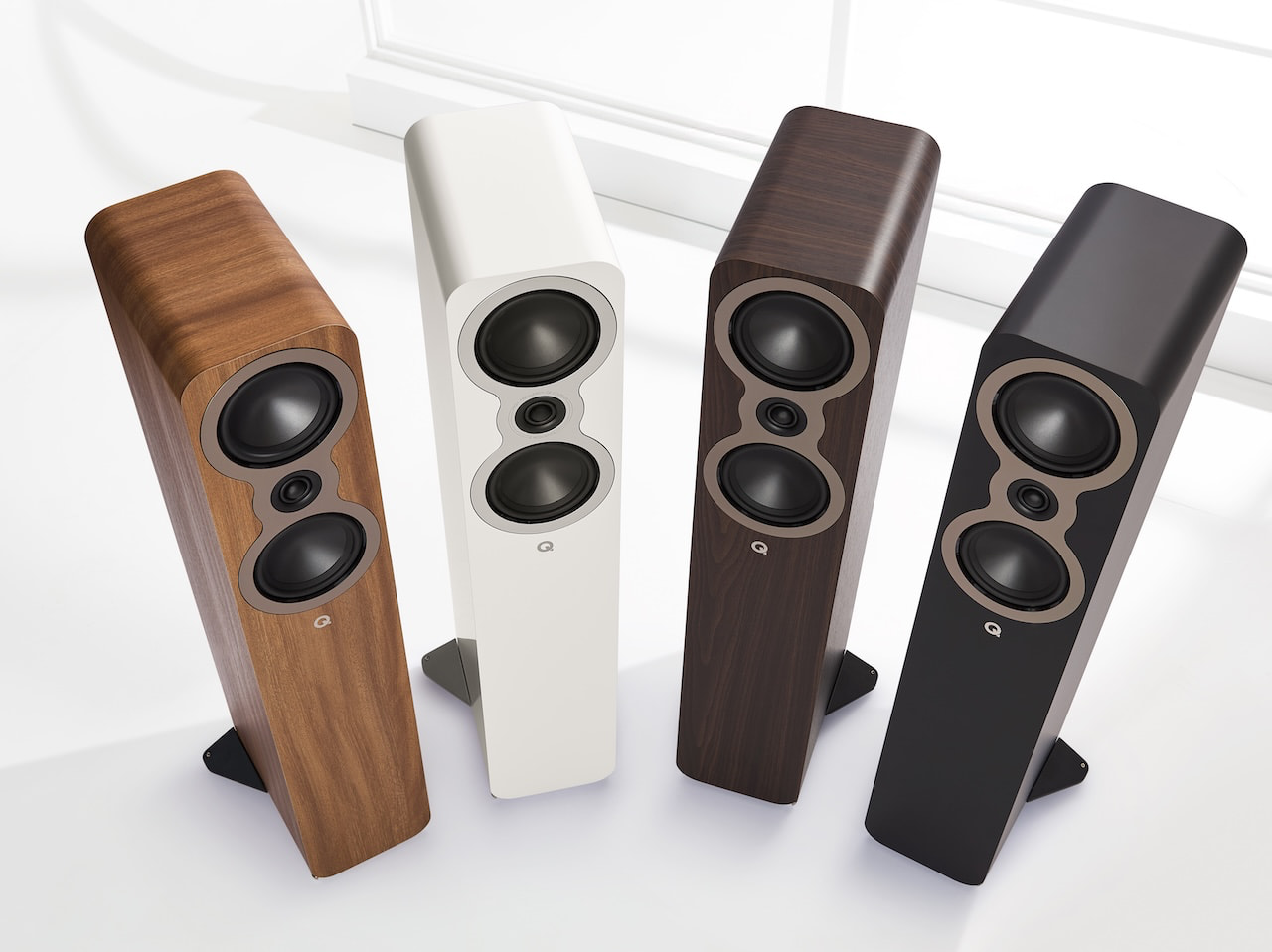
When Q Acoustics introduced the 3000c Series in 2024, the range included three bookshelf or standmount models, one large floorstander and a center-channel speaker. The original lineup incorporated technology developed for the more expensive 5000 and Concept Series, including C3 Continuous Curved Cone midrange and bass drivers, mechanically isolated tweeters, P2P cabinet bracing and HPE pressure equalization in the floorstanding model.
What it did not include was a smaller tower.
The 3040c fills the rather obvious gap between the $699 per pair 3030c and $1,199 per pair 3050c. According to Q Acoustics, customer feedback indicated demand for a more compact and agile floorstander that could deliver greater scale than a bookshelf speaker without overwhelming tighter living spaces.
That makes sense. A standmounted 3030c may have a smaller enclosure, but once suitable stands are added, its practical footprint is not necessarily much smaller. The 3040c places everything into one cabinet, moves the tweeter closer to seated ear height and extends the claimed low-frequency response to 43 Hz.
It also means there is no stand shopping, no filling hollow metal columns with sand and no discovering that the attractive stands cost almost as much as the loudspeakers.
Twin C3 Drivers


The two-way 3040c uses a pair of 4.75-inch C3 Continuous Curved Cone midrange and bass drivers positioned above and below a 0.9-inch tweeter.
Q Acoustics originally introduced its C3 driver architecture with the 5000 Series. The cone profile combines the bass performance of a conventional straight cone with the midrange control and dispersion characteristics of a flared design. The goal is tighter low-frequency performance, reduced distortion and smoother integration with the tweeter.
The 3040c’s tweeter is hermetically sealed and mechanically isolated from the front baffle. Separating it from pressure changes and vibration generated by the two larger drivers is designed to reduce distortion and prevent the midrange and bass drivers from coloring the treble.
That approach originated higher up the Q Acoustics food chain in the Concept and 5000 Series before migrating into the more affordable 3000c models. The company has not merely installed another woofer in a stretched 3020c cabinet and headed to the pub.
Bracing and Pressure Control
Compact towers present their own cabinet problems. Their tall internal volume can encourage standing waves and pressure buildup, neither of which does imaging, bass definition or tonal accuracy any favors.
Q Acoustics addresses that with P2P Point to Point bracing in the areas of the enclosure most susceptible to low-frequency vibration. The 3040c also uses HPE Helmholtz Pressure Equalizer tubes to reduce internal pressure and suppress standing waves, technology previously reserved for the 3050c within the 3000c range.
The rear-ported cabinet includes the low-profile terminal panel introduced with the 5000 Series. Its recessed binding posts help keep speaker cables from protruding excessively behind the cabinet, although “close to the wall” should not be confused with “pressed against it.” Rear ports still need room to work.
A solid aluminum stabilizer extends from the base and includes spikes that can be adjusted from above. Including the stabilizer and spikes, each 3040c measures 37.1 inches high, 11.2 inches wide and 11.1 inches deep, with a weight of 32.1 pounds.
Four finishes are available: Satin Black, Satin White, Pin Oak and Claro Walnut.
What Might It Sound Like?
We have not heard the 3040c, so any declarations about its sonic performance will have to wait until a review pair arrives.
We do, however, have considerable experience with the technology surrounding it.
Our review of the 3020c found it more transparent, detailed and dynamically alert than the softer-sounding 3000i models it replaced. It also proved more revealing of amplifier quality and tonal balance than its affordable price might suggest.
The 5000 Series demonstrated how much flexibility exists within the same basic driver platform. The 5040 offered a leaner, more neutral and highly detailed presentation, while the larger 5050 delivered greater bass weight, warmth and room-filling impact.
That history gives us a useful framework, but not a verdict. The cabinet volume, crossover and twin-driver configuration will determine whether the 3040c leans toward the speed and clarity of the smaller 3000c models or adopts some of the additional tonal weight of the 3050c.
On paper, its 88 dB sensitivity, 6-ohm nominal impedance and 4-ohm minimum should make it compatible with a broad range of integrated amplifiers and A/V receivers. Q Acoustics recommends between 25 and 120 watts per channel.
A competent 50 to 100-watt amplifier should be a sensible starting point, but our experience with the 3020c and 5000 Series suggests that amplifier character will matter. Buyers using brighter or leaner electronics should audition the combination rather than assuming every box with binding posts will produce the same result.

Stereo and Home Theater
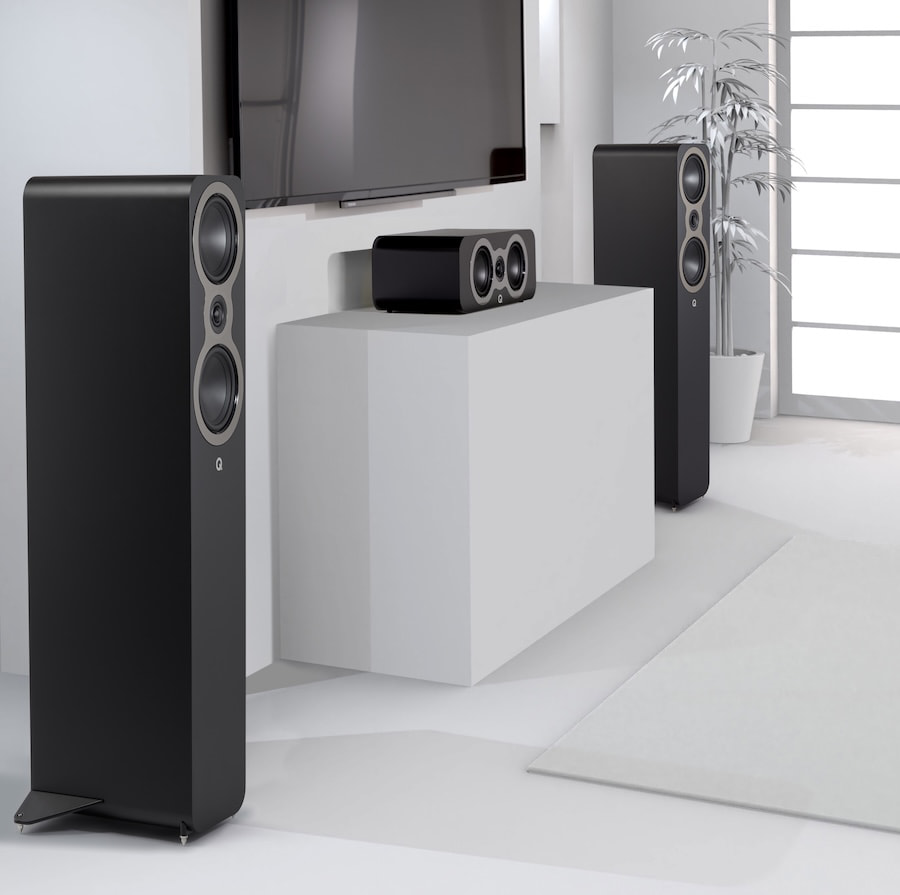
The 3040c could be particularly useful as the front left and right channels in a compact home theater, paired with the 3090c center speaker and one of the smaller 3000c models for surround duty.
Its claimed 43 Hz extension is respectable for a tower this size and may be sufficient for music in a small or medium-sized room. It does not eliminate the need for a subwoofer when reproducing deep electronic bass, pipe organ recordings or movie soundtracks with meaningful low-frequency effects.
The existing 3060S remains Q Acoustics’ slimline subwoofer option for the range, although larger rooms and more ambitious home theaters may benefit from something with greater output and deeper extension.
Specifications:
| Specification | Q Acoustics 3040c |
|---|---|
| Design | Two-way floorstanding loudspeaker |
| Midrange and bass drivers | 2 x 4.75-inch C3 Continuous Curved Cone |
| Tweeter | 0.9-inch mechanically isolated |
| Frequency response | 43 Hz to 30 kHz at -6 dB |
| Sensitivity | 88 dB |
| Nominal impedance | 6 ohms |
| Minimum impedance | 4 ohms |
| Recommended amplifier power | 25 to 120 watts |
| Crossover frequency | 2.4 kHz |
| Effective cabinet volume | 26.8 liters |
| Dimensions | 37.1 x 11.2 x 11.1 inches |
| Weight | 32.1 pounds each |
Who Is This For?
The Q Acoustics 3040c makes the most sense for listeners who want the scale and convenience of a floorstanding loudspeaker but have a smaller living room, den, apartment or dedicated listening space. It also deserves consideration from 3030c buyers who would otherwise need to purchase stands and might prefer a cleaner, more integrated installation.
Home theater users looking for compact front channels that visually and acoustically match the rest of the 3000c family are another obvious audience.
Who Should Look Elsewhere?
Listeners with larger rooms, a preference for high playback levels or a need for greater low-frequency weight should consider the 3050c, 5040 or 5050.
American buyers with enough room for the 3050c face the most difficult decision. At only $100 more, the larger tower may offer greater scale and bass capability for very little additional money. The 3040c has to win that argument through placement flexibility, proportions and room compatibility rather than price.
Q Acoustics 3000c Series Pricing
Stereo loudspeaker prices are per pair. The 3090c center channel and 3060S subwoofer are priced individually.
- Q Acoustics 3010c compact bookshelf: £249 / €379 / $399
- Q Acoustics 3020c bookshelf: £299 / €499 / $549
- Q Acoustics 3030c standmount: £399 / €629 / $699
- Q Acoustics 3040c compact floorstander: £599 / €899 / $1,099
- Q Acoustics 3050c large floorstander: £749 / €1,099 / $1,199
- Q Acoustics 3090c center channel: £229 / €379 / $399
- Q Acoustics 3060S subwoofer: £399 / €499 / $549
The Bottom Line
The Q Acoustics 3040c is not merely a discounted 3050c. It is a space-specific alternative for listeners who want more than a standmount can provide but do not need a large tower looming beside the television.
That makes it more useful than a last-minute addition designed to fill an empty position in the catalog. The 3000c Series already offers some of the strongest value in the affordable loudspeaker category, and the 3040c addresses a legitimate gap without stripping away the driver and cabinet technology that made the rest of the range successful.
The pricing is particularly attractive in the United Kingdom and Europe. In the United States, the narrow gap between the 3040c and 3050c makes room size the deciding factor.
Smaller can be smarter. It just is not automatically cheaper.
You must be logged in to post a comment Login