Tech
Qualcomm Snapdragon Sound Elite Gen 2 Could Make Bluetooth the Backup Plan

Wireless headphones have become dramatically better, but the basic connection problem has not disappeared. Bluetooth remains convenient and power-efficient, yet higher-resolution lossless playback still runs into bandwidth, codec compatibility and battery-life limitations that become harder to ignore as headphones themselves get more sophisticated.
Qualcomm thinks the next step involves adding something Bluetooth headphones have traditionally avoided: Wi-Fi. Its new Snapdragon Sound Elite Gen 2 platform integrates micro-power Wi-Fi 6E, Qualcomm XPAN, aptX Lossless, substantially more AI processing and a fifth generation of Adaptive ANC into a platform designed for future headphones, earbuds, open-ear products, audio glasses and other wearables.
We recently examined whether wireless headphones really need 24-bit/192kHz lossless audio, along with HiFiMAN’s Arya WiFi and HE1000 WiFi, which already demonstrated both the sonic potential and battery-life consequences of moving serious headphone playback onto Wi-Fi.
Qualcomm would clearly prefer that tradeoff to become considerably less painful.
What Is Snapdragon Sound Elite Gen 2?

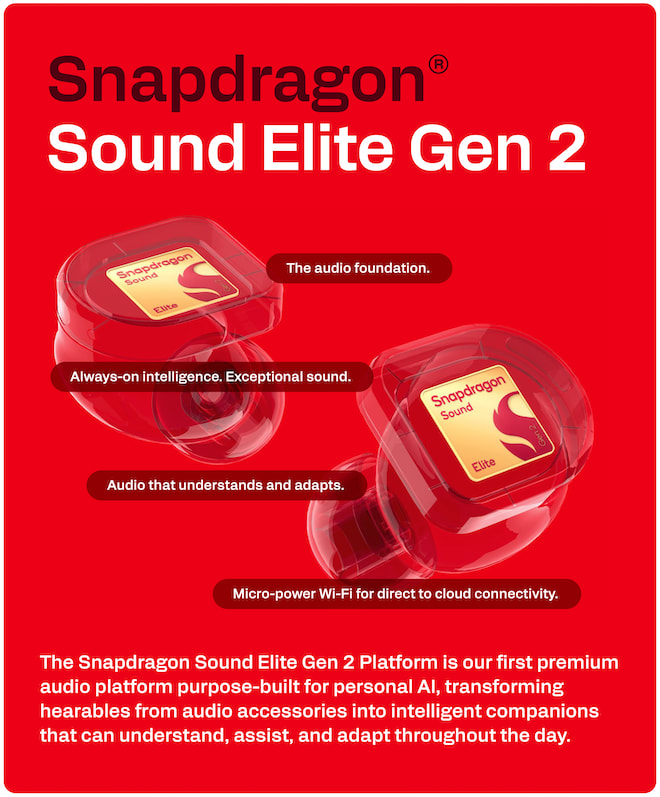
Snapdragon Sound Elite Gen 2 is not a headphone or wireless codec. It is an integrated hardware and software platform that manufacturers can build into future audio products, combining audio processing, wireless connectivity, AI acceleration, sensing and voice processing in one architecture.
The biggest audio development is integrated micro-power Wi-Fi 6E, supporting the 2.4GHz, 5GHz and 6GHz bands. Combined with Qualcomm’s XPAN technology, the platform can deliver lossless music streaming at up to 192kHz over Wi-Fi, while also extending wireless range beyond what conventional Bluetooth connections can provide.
Bluetooth is not disappearing. Qualcomm still includes aptX Lossless, and products will continue to use Bluetooth where its lower power consumption and universal convenience make more sense.
The interesting part is that future headphones could potentially move between Bluetooth and Wi-Fi depending on what you are doing rather than forcing one connection technology to handle everything.
Why Does This Matter?
We have already seen how messy premium wireless audio can become.
The Bowers & Wilkins Px8 S2 supports aptX Lossless and aptX Adaptive, but Apple hardware does not support either codec natively. The Sennheiser HDB 630 attacks the problem with its BTD 700 USB Type-C transmitter, while HiFiMAN’s Arya WiFi and HE1000 WiFi largely sidestep Bluetooth bandwidth limitations by using Wi-Fi as their primary high-quality connection.
All three approaches work, but none qualifies as completely frictionless.
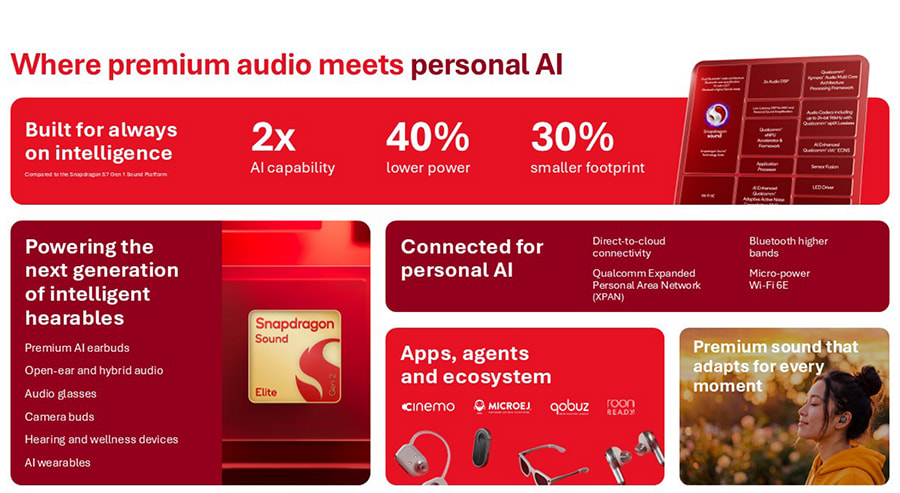
Snapdragon Sound Elite Gen 2 could give manufacturers a more integrated route to Wi-Fi playback without requiring them to engineer the entire connectivity architecture themselves. Qualcomm also says the platform is up to 30% smaller than its Snapdragon S7 Gen 1 design and can use up to 40% less power in the Wi-Fi-connected idle scenario used for its internal comparison. Those are Qualcomm claims, and the company notes that actual implementations will vary.
That qualification matters. Audiophiles have heard enough miraculous battery-life predictions to know where the charger is kept.

ANC, AI and Earbuds That No Longer Need Your Phone for Everything
Qualcomm is also giving manufacturers considerably more processing power. Elite Gen 2 provides up to 128 GOPS of AI acceleration, twice the peak AI capability Qualcomm cites for Snapdragon S7 Gen 1, along with fifth-generation Adaptive ANC and enhanced cVc voice processing.
Those resources can be used for adaptive noise cancellation, voice capture, transparency modes, real-time translation, personalized hearing and contextual audio processing.
More unusually, the integrated Wi-Fi connection can provide direct cloud connectivity, allowing future earbuds or glasses to communicate with online services without routing every interaction through a smartphone. Qualcomm is packaging those capabilities under Snapdragon Sound Apps & Agents.
The target products extend well beyond conventional ANC headphones. Qualcomm specifically lists earbuds, open-ear designs, audio glasses, hearing devices and even camera-equipped earbuds, because apparently putting cameras into glasses was merely the opening act.
What Products Will Use It?
None that consumers can buy yet.
Cleer demonstrated an early audio, vision and AI concept at Snapdragon Summit 2026, but Qualcomm has not announced it as a commercial product. Qualcomm also said HP is developing a product based on the Snapdragon Sound Elite platform and that it has been working with Bose on potential future applications, without announcing specific Bose hardware.
That means the real test comes when manufacturers start shipping finished products.
Qualcomm can provide Wi-Fi, XPAN, lossless playback, AI processing and better ANC tools, but manufacturers still have to build headphones that sound good, remain comfortable, deliver acceptable battery life and do not require a flowchart to connect to your phone.
The Bottom Line
Could This Actually Change Wireless Headphones?
Potentially, yes, because the important development is not AI whispering restaurant recommendations into your ears, but the possibility that Bluetooth stops being the only practical wireless pipeline for premium headphones.
Wi-Fi could handle higher-bandwidth lossless audio, longer-range playback and cloud connectivity while Bluetooth remains available for lower-power everyday use. If Qualcomm can make that transition seamless and manufacturers can preserve battery life, wireless headphones could finally move beyond the codec compromises we have been discussing for years.
The headphone industry has spent a decade trying to squeeze increasingly ambitious audio through Bluetooth.
Qualcomm’s answer may be surprisingly simple: stop asking Bluetooth to do everything.
For more information: qualcomm.com\
You must be logged in to post a comment Login