Security teams log 54% of successful attacks and alert on just 14%. The rest move through your environment unseen.
The Picus whitepaper shows how breach and attack simulation tests your SIEM and EDR rules so threats stop slipping by detection.
More four-year-olds are enrolled in state-funded preschools than ever before, but the quality and availability of preschool programs have experts concerned about creating a system of haves and have-nots.
“If providing high-quality preschool education to all 3- and 4-year-olds were a race, some states are nearing the finish line, others have stumbled and fallen behind, and a few have yet to leave the starting line,” an annual report from the National Institute of Early Education Research states.
With the amount of funding and quality varying by state, it means that access for families in states that aren’t investing still widely varies.
The report, titled “State of Preschool: 2025 Yearbook,” breaks down the annual spending, quality and enrollment numbers across early childhood education programs in the U.S. The latest found states hit an all-time high for both spending and enrollment, but the quality of the programs remains a concern.
“We’re trying to make sure states are also thinking about quality,” Allison Friedman-Krauss, an associate research professor at NIEER, says. “Right now, it’s more about access. And we don’t want them to forget about quality.”
The report found funding peaked at nearly $14.4 billion, though that was largely driven by a handful of states: $4.1 billion in California alone, along with $1.2 billion in New Jersey and $1 billion in New York. Those three states accounted for nearly half (45 percent) of all state pre-K spending.
More than two dozen states also increased their preschool spending, which can go toward things like improving teacher-to-student rations and improving teacher compensation, the latter which has long been a concern.
While states still increased their spending on pre-K this year, the rate at which states are investing is slowing down. Adjusted for inflation, each state spent an average of $45 more per child than the 2023-2024 year. However, last year’s increase in spending was 16 times as large.
New Jersey, Oregon and the District of Columbia gave more than $15,000 in state funding per child enrolled in preschool. Six other states (California, Connecticut, Delaware, Michigan, New Mexico, and Washington) spent more than $10,000 per child enrolled in pre-K. Twenty eight states overall spent more funding per child, adjusted for inflation, than past years.
NEWSLETTERS
Sign up for EdSurge newsletters for timely news, insights and analysis.
Seventeen states spent less on preschool in 2024-2025 than they did in 2023-2024, when adjusted for inflation. The researchers attributed the spending decline in part to overall state deficits and falling enrollment across many states.
However, that’s not always the case. New Jersey had a budget deficit but invested an additional $100 million into expanding preschool programs for all.
Pointing toward this, Steve Barnett, director of NIEER, argues that it’s all about state priorities: “That’s a conscious decision to say we’re going to spend less,” he says. “And you have to ask if the declining enrollment – even if not intentional – is a way to reduce spending [in the sector]. As opposed to, ‘Maybe we should work on getting parents to enroll their kid.’”
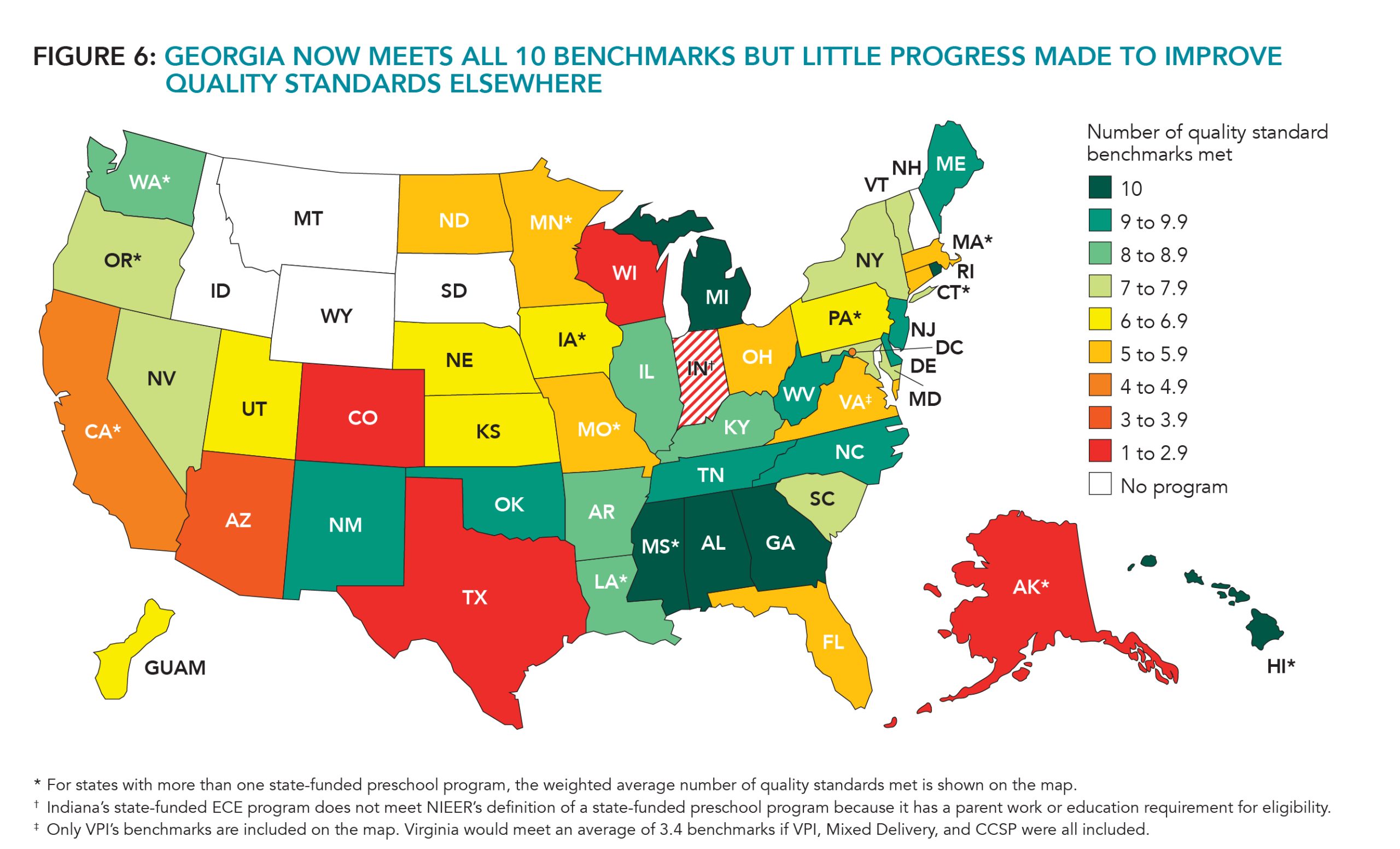
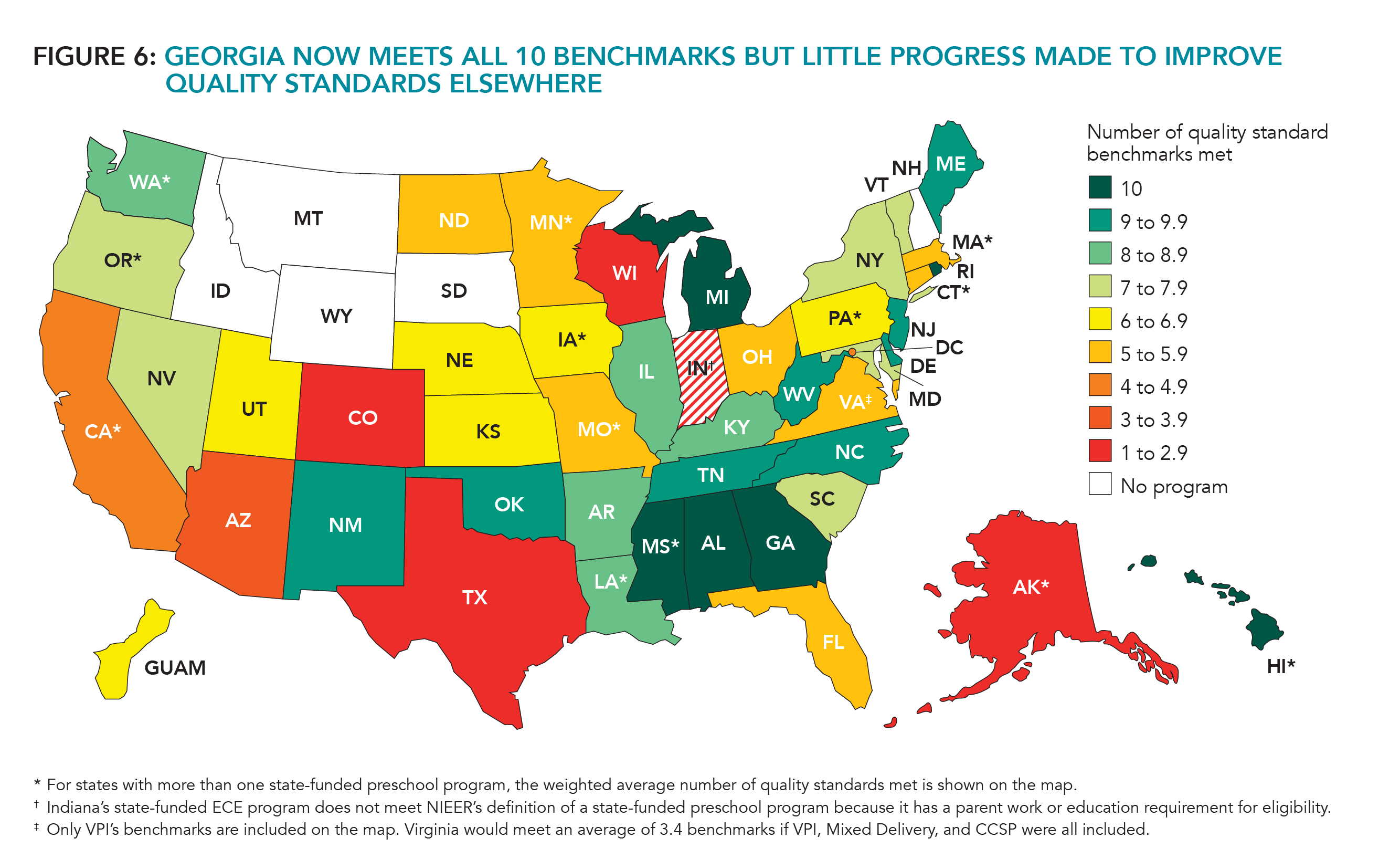
The boost in funding did not always correlate to better early childhood education programs. Only six states met all of NIEER’s 10 quality standards benchmarks, which includes a maximum class size of 20 students, a requirement that teachers have bachelor’s degrees and a classroom ratio of at least one staff member for every 10 students.
Only a few states are providing high quality preschool programming, despite boosted investments, according to a new report.
Source: NIEER
States looking to enhance preschool quality should focus on class size and teacher pay, Barnett argues.
Teacher pay and class sizes account for most of the money, and once states have improved those, other metrics, like curriculum supports and health screenings, are easier to pay for later, he adds.
But changes won’t happen overnight.
“It does take time. You can’t just wave a magic wand and have classroom size and teachers’ pay magically fixed,” Barnett says.
NIEER’s Friedman-Krauss, pointed to Alabama and Georgia as examples of slowly, but surely, increasing preschool quality. Georgia hit all 10 quality benchmarks this year. Friedman-Krauss credits the improvement to a $97.6 million investment by the state, which helped lower classroom size from 22 to 20 and increased teacher pay.
“We make a big deal of it because it’s serving most of the 4-year-old [children] and hitting all the benchmarks,” Barnett says. “It’s a state that lost them and came back even stronger; that’s a good sign.”
Enrollment, similarly to funding, reached an all-time high nationally last year, with 1.8 million children during the 2024-2025 school year. But roughly half of that comes from four states: California, Texas, New York and Florida.
Notably, a dozen states had more than half of their four-year-olds in state-funded preschool programs, with the District of Columbia topping the list: 94 percent of four-year-olds were enrolled in their state programs. California’s enrollment gains were buoyed in part due to the state’s universal pre-K promise.

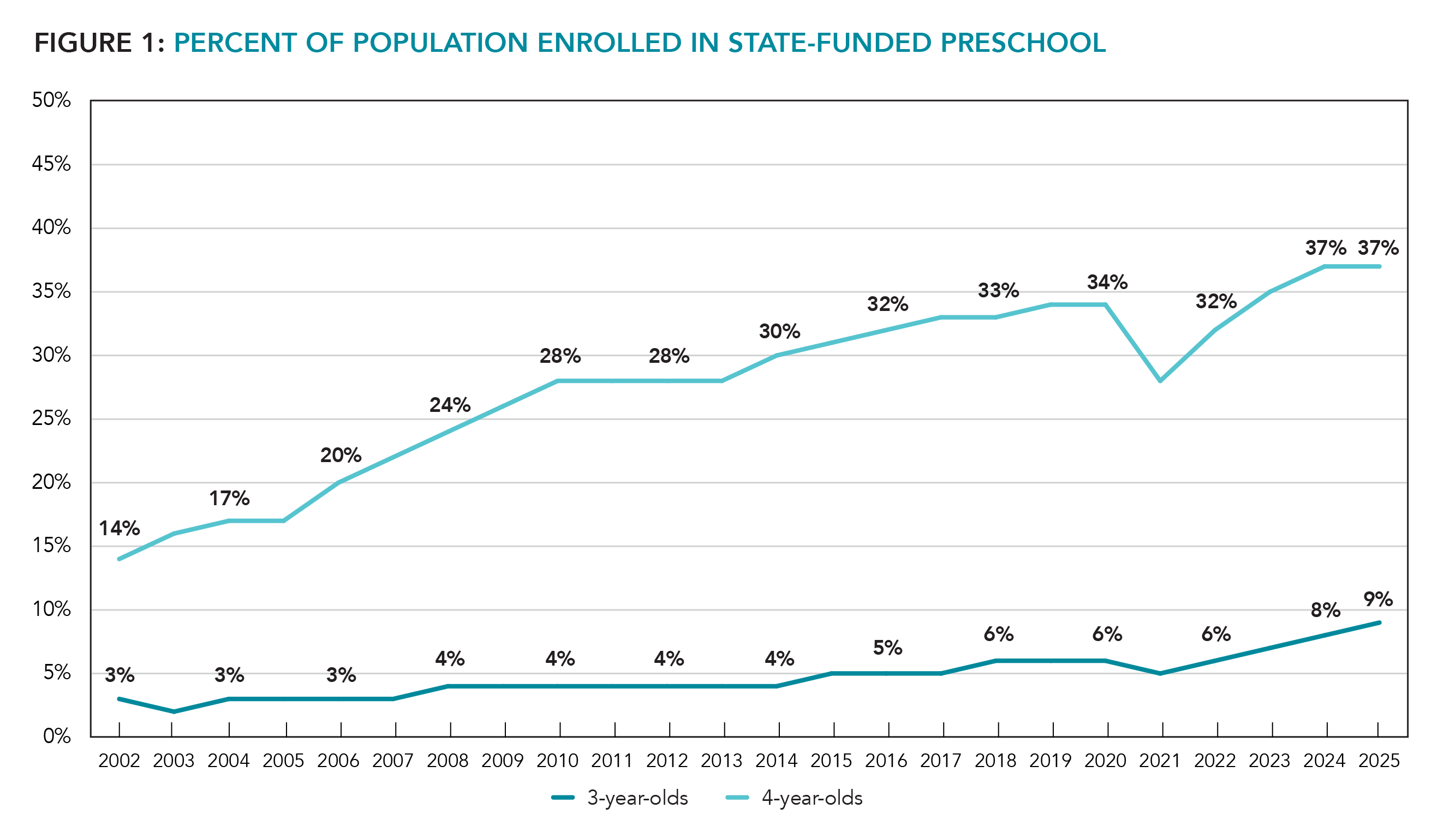
While four-year-old students are enrolling more in preschool programs, three-year-olds continue to lag behind.

Source: NIEER
However, twenty states enrolled fewer preschoolers in 2024-2025 than the prior year. Some could blame the dip on declining birth rates. But when adjusted by population percentage, 21 states still saw a dip.
For some states, the enrollment decline was steep. Indeed, six states (Arizona, Florida, New York, Ohio, Oklahoma, and Wisconsin) decreased enrollment by more than 1,000 children.
Three-year-old students made up only 9 percent enrollment across the nation, up from 5 percent a decade earlier. Some states are acting to counter this. For example, Illinois and New Jersey are both focusing on expanding preschool programs for three-year-olds, Friedman-Krauss says. However, she and Barnett expect a slow mass adoption of three-year-olds in state-funded programs.
“I think there will be more attention paid to that group – how much more, that’s the hard part,” Barnett says. “Nine percent is better than when we started, but it’s very lumpy. It’s still 0 percent in lots of places.”
Nintendo is also releasing Switch 2 versions of the older Xenoblade games
There’s a brand-new Xenoblade game coming to the Switch 2 in 2027. It’s called Xenoblade Genesis and it was revealed at the latest Nintendo Direct livestream. We even got a juicy trailer with plenty of gameplay and a detailed look at the world.
To that end, it looks like a brand new story in a brand new world. We don’t know too much about this story, other than that the protagonist is enrolled in some type of magic school (which reminds me of Final Fantasy VIII.)
Nintendo promises more details on Xenoblade Genesis as we get closer to 2027. However, this wasn’t the only Xenoblade-adjacent announcement the company made. All three mainline Xenoblade Chronicles games are getting dedicated Switch 2 editions.
The ridiculously-named Xenoblade Chronicles: Definitive Edition – Nintendo Switch 2 Edition is available for purchase right now and costs $64. This offers 4K resolution on TVs and full HD in handheld mode, along with new content like high-speed vehicles for traversal, additional voiceovers, updated equipment designs and a whole lot more. There’s an upgrade pack available for people who already own the Switch version of the game.
Xenoblade Chronicles 2 – Nintendo Switch 2 Edition arrives on July 30 and Xenoblade Chronicles 3 – Nintendo Switch 2 Edition is coming on December 3. Xenoblade Chronicles X, which is set in a different universe to the mainline games, already got a Switch 2 edition earlier this year.
For the uninitiated, Xenoblade games tend to be big, sprawling open-world action RPGs. The first one came out for the Wii all the way back in 2010.
Final Fantasy Resonance is the first game in the series to employ the popular modern-retro art style.
Square Enix has spent the last few years giving all sorts of games the lavish HD-2D treatment, from classic titles reimagined to brand new franchises. But for whatever reason it’s only now getting round to Final Fantasy.
Final Fantasy Resonance can proudly call itself the first HD-2D Final Fantasy game, and it’s not a remake like the recent Dragon Quest ones, but rather a new(ish) series entry based on the first story arc of mobile game Final Fantasy Brave Exvius. “Far from just a direct port, it has been refined and extensively rebuilt as a full-fledged console-quality RPG experience” Square Enix wrote in a press release.
The publisher promises that Resonance will be a celebration of both the classic and modern eras of Final Fantasy, featuring all the series hallmarks. Expect turn-based combat with a contemporary twist, airships, plenty of chocobos, and appearances from the likes of Cloud Strife and Final Fantasy X‘s Tidus.
That shiny HD pixel art is really the big draw here, though, and if you’ve been hoping for Final Fantasy’s answer to the Octopath Traveler series, this might just be it. Final Fantasy Resonance launches on October 22, 2026, for PlayStation 5, PC, Switch, Switch 2 and Xbox Series X/S
Microsoft removed 73 repositories across its Azure, microsoft, Azure-Samples, and MicrosoftDocs organizations on GitHub, disrupting continuous integration pipelines.
The incident occurred on June 5, and it was contained within just 105 seconds. The company told BleepingComputer that the repositories were removed due to concerns that they distributed “potential malicious content.”
Multiple researchers confirmed that the repos were pulled after a compromise during a Miasma/Shai-Hulud supply-chain campaign.
The OpenSourceMalware platform notes that the ‘durabletask’ – a repository in Microsoft’s Azure organization on GitHub, was compromised in May, indicating that an incomplete cleanup allowed the threat actor to return with a new compromise. However, this has not been confirmed.
Immediately after removing the repositories, a message was displayed explaining that the action was taken by the GitHub Staff “due to a violation of GitHub’s terms of service.”
A Microsoft representative responded to user concerns in a community discussion, stating that the repositories were disabled because of “an internal management issue” and that an investigation was underway.
The most significant immediate effect of this incident was disabling access to ‘Azure/functions-action,’ a GitHub Action used by many developers to deploy Azure Functions.
Workflows referencing it stopped working because there was nothing in the specified repository to resolve the action, causing an outage and confusion.
At the time of writing, though, all repositories have been restored and are considered clean and safe to use.
However, the OpenSourceMalware platform notes that the ‘durabletask’package on the Python Package Index (PyPI), had been compromised in May when the threat actor pushed three malicious versions (1.4.1, 1.4.2, 1.4.3).
In a statement for BleepingComputer, a Microsoft spokesperson explained that the company “temporarily removed some repositories as we investigated potential malicious content.”
While all repositories have been restored, Microsoft “notified a small number of customers who may have pulled down content from the affected repositories.”
“We will continue to investigate, and if anything further is identified that requires customer action, we will reach out directly through our established support channels,” a Microsoft spokesperson told us.
Security engineer Adnan Khan said that the June 5th incident affecting Microsoft repositories appeared to be part of the Miasma malware campaign that infected 32 of Red Hat’s npm packages.
In a report this week, software supply chain management company Cloudsmith concluded that Microsoft’s Azure environment on GitHub and the ‘durabletask’ repository were compromised via Miasma, which targeted AI coding tools (e.g., Claude Code, Gemini CLI, VS Code, Cursor).
The hacker pivoted from Red Hat’s npm packages to Microsoft’s resources on GitHub.
“The worm initially struck the @redhat-cloud-services npm namespace by compromising a Red Hat employee’s GitHub account. By pushing unreviewed orphan commits to internal repos, the threat actors injected a minimal workflow that requested GitHub’s OIDC tokens,” the researchers said.
Supply-chain attacks continue to target open-source ecosystems. Yesterday, application security company Socket reported that it spotted a new Shai-Hulud attack over the weekend that relied on a new delivery mechanism.
StepSecurity published a separate report focusing on a Shai-Hulud attack impacting Pythagora-io/gpt-pilot, a popular open-source AI developer tool with more than 33,700 GitHub stars and over 3,500 forks.
Software developers should consider locking their project dependencies, adding multi-day time delays to fetch new package updates, and testing new builds on isolated environments.
Security teams log 54% of successful attacks and alert on just 14%. The rest move through your environment unseen.
The Picus whitepaper shows how breach and attack simulation tests your SIEM and EDR rules so threats stop slipping by detection.

Golden Analytics, the AI-native analytics startup founded by former Tableau product chief Francois Ajenstat, added $14 million to its seed financing round just two months after emerging from stealth, bringing its total seed funding to $21 million.
The additional funding, announced Tuesday, was led by Insight Partners, with existing backers NEA and Madrona re-upping. It coincides with the public beta launch of Golden’s product, which Ajenstat said has drawn early-access requests from about 1,000 companies, about one in six of them in the Fortune 500.
Golden Analytics is an AI-powered business intelligence tool. It connects to data stored in cloud warehouses or in uploaded files, analyzes it, and produces charts, dashboards and written summaries. Users can query the data in plain language or build visualizations themselves, and a control Ajenstat calls a “slider of autonomy” sets how much of the work the software does automatically.
Ajenstat said the addition of Insight alongside Madrona and NEA brings additional grounding in AI and analytics, and described the extension as validation of the company’s momentum. Ganesh Bell, a managing director at Insight, will take a seat on Golden’s board, Ajenstat said. Golden is also working with George Mathew, another Insight managing director and the former president of Alteryx.
The new capital will go toward engineering and go-to-market hires, Ajenstat said, with sales ramping up sooner than he had planned given the early demand. Golden has increased its team to seven people from four at April launch.
Its engineers are all based in the Seattle area, where said the company operates in person, while sales staff will be hired closer to customers.
Golden also disclosed pricing for the first time. The platform has two tiers, a Team plan at $24 per user per month billed annually and a custom-priced Enterprise plan.
Ajenstat said the cost of the underlying AI models is included rather than billed separately, a deliberate break from rivals that pass token costs on to customers. He compared the approach to the steady decline in cloud storage prices, betting that model costs will keep falling.
Early customers include Carta, the equity-management company, whose insights director, Ashley Neville, said in the announcement that Golden gave the firm “the confidence to move on from legacy contracts.”
The new Siri AI was the star of the show at Apple’s Worldwide Developer Conference (WWDC) this year, and while iOS 27 isn’t bringing major changes, it’s still got many small features that could improve everyday usage for iPhone users.
Here is a non-exhaustive list of features that Apple didn’t talk about on stage:


When you purchase through links in our articles, we may earn a small commission. This doesn’t affect our editorial independence.
A longevity startup has dosed its first patient with a drug to reverse age-related sight loss.
Life Biosciences is testing its ER-100 drug, which the company claims has restored vision in monkeys, for safety and side effects in a study of around 18 adults over the next year.
It will be targeting patients with glaucoma and NAION, two conditions that cause damage to crucial cells in the optic nerve, which transmits visual information from the back of the eye to the brain. ER-100 is designed to rejuvenate those cells so that they work again and restore sight.
It is the first-ever cellular rejuvenation therapy using this technology to receive FDA clearance to enter human clinical trials, and hence the first chance to test whether the technology can “ameliorate human disease,” according to Life Biosciences cofounder and professor of Genetics at Harvard Medical School, David Sinclair.
Aging biology—understanding how the body’s cells and functions deteriorate over time—is at the root of longevity science. ER-100 is the focus of major interest across biotech for its potential to reverse cellular aging. Life Biosciences, based in Boston, says it is developing applications for its technology to tackle a host of age-related diseases in a variety of organs, like fatty liver disease.
“Our research has suggested that aging is driven in large part by the loss of epigenetic information, not irreversible damage. This clinical study represents the first opportunity to test whether restoring that information can ameliorate human disease,” Sinclair said.
Researchers say mysterious, seconds-long GPS interference bursts detected across Europe appear to come from Russian EKS early-warning satellites, making this “a rare example of human-made GPS interference coming from space,” reports Ars Technica. The signals may be tests of space-based jamming capability, short satellite communications, or something else, but experts say they raise troubling questions about whether GPS disruption could eventually be weaponized on a continental scale. From the report: The discovery came from an investigation detailed in a June 2 preprint paper by Todd Humphreys and his student Zach Clements at The University of Texas at Austin, along with Argyris Krizise at Stanford University in California. By sifting through public data from ground-based stations with global navigation satellite system (GNSS) receivers, they identified a pattern of high-powered interference lasting less than 10 seconds each time but simultaneously detectable by ground stations across Europe from Norway to Spain to Poland, and even reaching as far west as Greenland and Canada.
By analyzing the ground station data from January 2019 to April 2026, the researchers found 75 days with at least one widespread GNSS interference event overlapping with the GPS L1 frequency band centered on 1575.42 megahertz. That represents the main band used for signal transmission by the US-made GPS satellite constellation and GNSS constellations from other countries. Such interference patterns happened mostly on Tuesdays, Wednesdays, and Thursdays during business hours in Europe, Humphreys told the YouTube channel Veritasium. Because such “continental-scale” interference was simultaneously affecting GPS receivers across Europe and beyond, Humphreys and his colleagues calculated that the source had to be at least 1,200 kilometers above the Earth.
[…] In the Veritasium video, Humphreys speculated that the Russians may have been testing the satellites’ GPS interference capabilities only briefly on a neighboring frequency adjacent to the typical GPS band. “And then in the eventual future when there is a hot conflict, they go ahead and tune their transmitter down to the GPS band, but it’s much more damaging now that it lies right on that band,” he said. Incidentally, the raw data also revealed a second interference burst from the Russian satellites in a lower-frequency band used by China’s BeiDou navigation system. “I can no longer say this is accidental with confidence,” Humphreys told Veritasium. He also described the Russian satellites’ quiet demonstration as a “massive escalation in the electronic warfare background conflict that is going on right now.” Richard Bowden, division head of assured and resilient PNT at the multinational technology company GMV in Spain, wrote in a LinkedIn comment: “These signals are, without a doubt, intentional and placed on or around GNSS signals, and have the potential to disrupt legitimate use of GNSS services. But from our side at least, we can’t be sure they are intentionally malicious or intended as an EW [electronic warfare] weapon.”
Just over a week ago, Meta’s AI-powered chat assistant unwittingly gave hackers access to thousands of Instagram accounts, including high-profile ones such as makeup retailer Sephora and the top noncommissioned officer of the US Space Force, as well as Barack Obama’s White House account.
The exact number was later revealed in a regulatory filing with the Maine attorney general’s office. The total stands at 20,225 compromised accounts (30 of whom were Maine residents).
The hack, reported by 404 Media last week, was easy to pull off against account holders who had not enabled two-factor authentication. Hackers simply asked the AI-powered bot to change the email address for a targeted account to their own. Once that was granted, the hackers requested a password reset, prompting the AI to send a code to their personal email address. After hackers verified the password reset, they were able to take control of the account.
An edited step-by-step video of the process even appeared on X, showing how the hackers used a VPN to make it seem they were in the target’s location. At no point did the hackers even need the user’s email address or original password.
In an incident notification letter to Maine Attorney General Aaron Frey, dated June 5, Meta acknowledged “a vulnerability in the AI-assisted account recovery system for Instagram … that was exploited by unauthorized third parties to perform password resets on Instagram user accounts.”
After the exploit was made public, many Instagram users reported on Reddit and X that their accounts had been hacked, though the breadth of the hack wasn’t clear at the time. A Meta spokesperson posted on X that the exploit was fixed as of June 1, shortly after initial reports.
The problem is almost entirely due to Meta’s customer support now being run by AI. The tech giant made the switch back in March, saying it would enable “24/7 help for account issues like updating your password and settings for your profile.”
But with the AI chatbot handling the whole process, humans couldn’t step in when suspicious activity began. That allowed hackers to carry out the social engineering-style attack and pull it off multiple times before anyone noticed.
Affected accounts were forcibly logged out for all users and email addresses were restored. Users were then told to reset their passwords and reauthenticate their logins. Meta says that once the accounts are secured, a second notice will be sent to remind people to turn on two-factor authentication to prevent future attacks.
Meta has not yet responded to a request for comment.
The social engineering exploit had one major limitation: It did not work on accounts with multifactor authentication. Those accounts either already had the code in their authentication app of choice or received it by text. Without the MFA setting, the one-time reset code appears to be sent to an email address of choice, thereby letting hackers just, well, have it.
The best way to protect yourself is to enable multifactor authentication, which is available on all of Meta’s platforms. It won’t protect you 100% of the time, but it’s a lot better than a password by itself, and it would’ve protected against this particular exploit entirely.
There are other things you can do to beef up account security, including using passkeys where available and a private email address to make your account credentials harder to find.
GitHub has disabled 73 of Microsoft’s repositories after a threat actor allegedly used credentials stolen a month ago to break in and plant an infostealer.
The news was confirmed by security firm Cloudsmith and community-driven malware analysis site OpenSourceMalware, which revealed that in mid-May 2026, someone (most likely TeamPCP) used stolen Microsoft’s GitHub Actions secrets to publish malicious PyPI packages. While these were quickly yanked from the platform, it seems that Microsoft never rotated the secrets used in this attack.
Now, it would appear that the same threat actor used the same credentials to compromise 73 new repositories, spanning four GitHub organizations: Azure, Azure-Samples, microsoft, and MicrosoftDocs. The Azure org bore the brunt, losing 49 repos, essentially everything the Functions team ships.
The key difference is that this time it wasn’t the Mini Shai-Hulud worm that was being distributed, but rather the Miasma worm, a spin-off that emerged after TeamPCP open-sourced Mini Shai-Hulud.
The researchers are saying that the practical fallout was quite significant, as some libraries run inside other people’s pipelines. For example, every workflow referencing Azure/functions-action@v1 stopped resolving.
Microsoft spokesperson Ben Hope told TechCrunch the company has “temporarily removed some repositories as we investigated potential malicious content.”
“Some of these repos have been restored after review, while others may remain offline while work continues,” Hope added. “As part of our investigation, we notified a small number of customers who may have pulled down content from the affected repositories. We will continue to investigate, and if anything further is identified that requires customer action, we will reach out directly through our established support channels.”
Microsoft could not say how many customers the incident affected, but it is safe to assume that it is in the tens of thousands, if not more.

The best antivirus for all budgets
Follow TechRadar on Google News and add us as a preferred source to get our expert news, reviews, and opinion in your feeds.
Unlike most years, Apple’s WWDC 2026 carried more weight than usual, not just because it was Tim Cook’s final keynote as CEO, but also because it represented Apple’s chance at redemption after missing deadlines, mounting questions, and criticism about its ability to keep pace in the AI race.
Fortunately, Apple answered many of those questions on June 8, 2026, unveiling an upgraded AI-powered Siri alongside a range of new Apple Intelligence features, while also raising a few fresh questions. WWDC was packed with announcements across six operating systems that underpin Apple’s ecosystem of devices.
Here’s a quick roundup of everything that the company announced during its WWDC 2026 keynote.
| Topic | What Apple Announced |
| Operating Systems | iOS 27, iPadOS 27, macOS Golden Gate, watchOS 27, visionOS 27, and tvOS 27. |
| Design Changes | A refreshed design language brings greater visual consistency across Apple’s platforms. |
| Siri AI | Rebuilt Siri powered by Apple Foundation Models and Google Gemini, with deeper integration across apps and system features. |
| Apple Intelligence | New AI features for writing, productivity, communication, and contextual assistance tools. |
| iOS 27 | New customization options, AI-powered features, and system-wide improvements for speed and efficiency. |
| iPadOS 27 | Improved multitasking, productivity features, Apple Intelligence integrations, with new Siri AI. |
| macOS Golden Gate | New continuity features, productivity tools, and Siri AI. |
| watchOS 27 | Health, fitness, and personalization updates, along with the new Siri AI experience. |
| visionOS 27 | New spatial computing features, app capabilities, and ecosystem integrations. |
| tvOS 27 | Updates focus on entertainment, home integration, and user experience improvements. |
In line with the early rumors, iOS 27 is indeed a Snow Leopard-style software update that fixes all the underlying machinery.

The result is an update that feels faster and brings several quality-of-life improvements for iPhone users, including up to 30% faster app launches and up to 70% quicker photos loading times (after you’ve shot them), and, the most important one for me, up to 80% AirDrop transfers.
And it’s not like iOS 27 only focuses on the new or recent iPhone models. Even if you’ve been holding on to an older iPhone that supports iOS 27, a rebuilt CPU scheduler will make it feel genuinely more responsive in day-to-day use.
Addressing the legibility issues with Liquid Glass, Apple has added a new transparency slider that lets you dial it anywhere from ultra-clear to fully tinted. App icons have also been sharpened with additional refraction layers, and toolbars and sidebars (within apps) have been cleaned up for a more uniform look.

Apple’s Safari web browser adds topic-based tab organization and a built-in Notify Me feature (for product restocks and price drops).
System-wide Search has been rebuilt from scratch. It now comes with a new index that loads on update, delivering faster and more reliable results across apps like iOS, Mail, and Photos. Mail gets a new ranking system that surfaces more relevant results.
Apple Maps gets an AI-powered Flyover that shows cities in a three-dimensional birds-eye view, with detailed and labeled environments including landmarks and buildings. The Passwords app now autonomously navigates to vulnerable sites and upgrades weak passwords.

The Health app gets perimenopause and menopause support for Cycle Tracking, with notifications for deviations. Apple Photos now offers a new slideshow maker, along with three new Apple Intelligence powered editing tools: Spatial Reframing (the one I’m most curious about), Extend, and upgraded Clean Up.
You might have missed it, but Apple also announced a new way of creating Shortcuts. Instead of learning how to create them, you can simply describe a Shortcut in plain language, and iOS 27 will create one for you. That’s a win for most iPhone users I know, who never touched Shortcuts before.
iCloud Shared Albums now support full-resolution sharing with Windows and Android users, while CarPlay gets video app support.

I’ve been wanting a custom EQ for AirPods for longer than I care to admit, and iOS 27 finally delivers it, and with iOS 27, I’ve got that as well. The AirPods Pro 3 also get GymKit heart rate syncing through the iPhone. Apple’s Home app also gets consolidated notifications, powered by Apple Intelligence.
The European Union (EU) has been a major regulatory driver behind all the child safety and parental control announcements you’re seeing from different companies, and Apple’s new child safety and parental control features, including Ask to Browse, Communication Safety enhancements, and Declared Age Range API are built around protecting younger users.

With a child account enabled, users need explicit real-time parental permission before accessing a new website via Safari. Communication Safety now blocks graphic violence and gore in shared images and videos. Developers can request a child’s broad age bracket via the child account without asking for an exact birth date.
Other features include mandatory contact approvals, category-specific time allowances, Screen Time dashboard overhaul, and a simplified child account setup.
Apple’s latest iPhone operating system doesn’t drop any old iPhones, including all the models in the iPhone 11 lineup. Apple Intelligence still required an iPhone 15 Pro or newer model, while the most advanced on-device AI features require the A19 Pro chipset (including the new Siri tone and updated dictation flows).
Version
Date / Timeline
Developer beta
June 8, 2026 (live now)
Public beta
July 2026
Stable release
Fall 2026 (expected mid-September)
The old Siri, at least in my experience, wasn’t all that bad. It showed up and performed well for tasks like setting alarms, general knowledge questions, enabling/disabling location services, etc.
But when Google’s Gemini and third-party assistants like ChatGPT, Perplexity, and Claude raised the bar, Siri started to feel like it was stuck in the slow lane.

Apple’s new Siri AI fixes that. Built on Apple’s Foundation Models and Google’s Gemini tech, the new AI assistant now operates at the operating system level. This means that Siri can now access your Messages, Mail, Photos, and the on-screen content, in real-time, without switching apps.
WWDC 2026 demos showed Siri surfacing specific photos with filtered faces without opening the Photos app, building a multi-stop navigation route by identifying a beach arch from an on-screen photo, and pulling up something a contact mentioned in a week-old message.

Siri AI can also write, edit, and proofread your mails, messages, or notes (similar to Writing Tools). What I find more interesting is that the assistant can match the tone of the conversation, drafting messages to your manager differently than the ones to your friends or family.
There’s a new dedicated Siri app that stores your conversation history and syncs it across all your devices.

With all the fancy bells and whistles, Siri AI (beta, opt-in) launches in English this fall across all the operating systems except tvOS 27. While it remains free with a daily usage allowance, features relying on server processing, including image generation and others, will have daily limits, with higher limits for iCloud+ users.
It’s worth noting here that Siri AI won’t be available in the EU on iOS and iPadOS, while it won’t be available in China entirely.
While Siri AI has already made many headlines, Apple Intelligence has received multiple upgrades this time, enough that it finally feels like a platform rather than a feature list.

To begin with, Image Playground now generates photorealistic images alongside its existing illustration styles and supports more aspect ratios and platforms than it did with iOS 26. Genmoji has also been overhauled, creating faster and significantly more expressive emojis.
For the first time, Visual Intelligence expands beyond the iPhone. iPads get it integrated into the screenshot experience, while Macs get a dedicated keyboard shortcut for selecting anything on the screen and sending it directly to Siri. Vision Pro users can now look at anything around them and ask Siri about it.

The Camera on iPhone gets a new dedicated Siri mode that lets you tap the shutter button and ask questions about what you’re looking at; it’s Apple’s answer to Google’s Gemini Live. Using the feature, you can get nutritional information about your meal, split bills through Apple Cash, and identify real-world objects.
Messages now offers one-tap suggestions based on conversation context. So, tasks like creating a reminder, setting a note, and taking an action are all possible without leaving the thread. Call Context now generates AI summaries of incoming calls before you decide whether to answer.

Apple Intelligence is also doing meaningful work on accessibility. VoiceOver now offers richer descriptions of images, while users can press the Action Button to ask Siri about what the camera is seeing (with detailed responses no less). Voice Control lets you describe interface elements without memorizing exact names, while Accessibility Reader adds summarization and translation.
iPadOS 26 sure made your iPad feel like a real computer, but I’d say it’s the iPadOS 27 that makes it feel like a polished one, thanks to all the meaningful productivity improvements across the board.

With iPadOS 27, you no longer have to swipe to access the Menu Bar; you can place it permanently on the screen. That’s a second or two saved every time you switch between apps. iPhone apps can also be resized when running on iPad, closing an awkward display gap for users whose favorite apps never got a proper iPad version.
External drive performance gets a significant boost and file browsing and transfers are up to 5x faster than iPadOS 26, putting iPad on par with Finder on Mac.
Siri AI is now available on compatible iPads with full capability, along with Safari’s topic-based tab organization, Notify me, AI-powered editing features in the Photos apps, and full-resolution iCloud Shared Albums with Android and Windows users.

Unlike iOS 27, iPadOS 27 drops support for several older iPad models, including the first-generation 11-inch iPad Pro, third-generation 12.9-inch iPad Pro, iPad Air 3, iPad mini 5, iPad 8, and earlier. If you’re rocking any of those, it’s time to think about an upgrade.
Developer beta is now available for iPad users, while public beta arrives in July. The stable build ships this fall.
| Devices | iPadOS 27 | Apple Intelligence |
| iPad Pro M4 or later | Yes | Yes (advanced AI on M4 with 12GB+) |
| iPad Pro 11-inch (2nd gen+), iPad Pro 12.9-inch (4th gen+), iPad Air (4th gen+) | Yes | M1 or later only |
| iPad mini (A17 Pro) | Yes | Yes |
| iPad mini (6th gen), iPad (9th gen or later) | Yes | No |
| iPad 8 and earlier, iPad Air 3 and earlier | No | No |
This year’s Mac release is called macOS Golden Gate, which is a reference to the strait connecting San Francisco Bay to the Pacific Ocean, but also a symbolic threshold. macOS 27 entirely drops support for Intel-based Macs, closing the door on old architecture for good.

In terms of design, macOS Golden Gate gets its soul back with colored sidebar icons, edge-to-edge sidebars, and a uniform toolbar across apps. It also gets the Liquid Glass transparency slider.
In terms of functionality, Apple’s latest macOS version brings Siri AI integration directly into Spotlight search, letting you start a rich, multi-turn conversation from anywhere on your desktop. Visual Intelligence comes to Mac for the first time, while control-clicking an image or file now surfaces Siri as a native option in the context menu.
All the other iOS 27 performance changes apply to Mac, including faster app launches, faster Search, all the new Apple Intelligence features, and Siri AI. The most advanced on-device AI features require an M3 Mac or later with at least 12GB of unified memory.

| Device | macOS Golden Gate | Advanced on-device AI |
| Any Mac with M3 chip or later | Yes | Yes (12GB RAM required) |
| Any Mac with M1 or M2 chip | Yes | No |
| Intel-based Mac (any model) | No | No |
macOS 27 also follows the same schedule as iOS 27 and iPadOS 27: developer beta is already available, public beta ships July, while the stable build arrives in September 2026.
Apple also announced improvements for other operating systems, including watchOS 27, visionOS 27, and tvOS 27.
This is the part where Apple raises more questions than it answers. The latest watchOS 27 makes the biggest compatibility cut in the device’s history, and I mean that. If you own a Series 9, Series 10, Ultra 2, or SE 3, you’re in the clear.

However, if you want to access new Apple Intelligence features, you’ll require a Series 10 or newer, which is where the compatibility cut hurts the most.
Supported Apple Watch models get a redesigned Dynamic App Grid with five Siri-suggested app shortcuts (on the home screen), a new tap gesture that opens the Smart Stack, and a Find My app that merges Find Devices, Find Items, and Find People into one. Siri AI also arrives on the smartwatch with full conversational capability.
Devices
watchOS 27
Apple Intelligence
Apple Watch Series 10, 11, Ultra 2, Ultra 3
Yes
Yes
Apple Watch SE 3
Yes
Yes (requires Apple Intelligence iPhone nearby)
Apple Watch Series 9
Yes
No
Apple Watch SE 2, Series 6, 7, 8, Ultra 1
No
No
visionOS 27 gets Siri AI as a floating 3D orb (with a wave-like animation) that you can place and position anywhere in your virtual environment. You can just look at it and start talking to Siri, without speaking out the “Hey Siri” wake phrase.

Visual Intelligence now works on physical objects in your immediate surroundings. Panoramas can be converted into full spatial environments for immersive personal use. While app windows get a subtle curvature for a natural spatial feel, Wi-Fi connections are up to 3x faster on the mixed reality headset.
And yes, Siri AI is available on Vision Pro in the EU.
tvOS 27 got the shortest shrift of any platform at WWDC 2026, but the version still gets a redesigned Podcasts app, smoother app launch animations, Hi-Res Lossless audio in Apple Music, faster AirPlay connectivity, and on-device HomeKit Secure Video processing.
Two models don’t make the cut: the Apple TV HD from 2015 and the Apple TV 4K first generation from 2017. The new update requires Apple TV 4K second generation or later.
It’s worth mentioning that WWDC 2026 was Tim Cook’s last keynote as Apple’s CEO. He will step down from the position on August 31, 2026, after being there for 14 years, handing over the company to John Ternus on September 1, 2026.
In a way, there couldn’t have been a more fitting farewell keynote for the executive, as it was truly where Apple redeemed its position as the side runner to one who is back in the lead in the on-device AI capabilities race.
Weekend Open Thread: Evereve – Corporette.com
French Open 2026 results: Alexander Zverev beats Rafael Jodar and will play Jakub Mensik in semi-finals
Jensen Huang Approves Samsung, SK Hynix, and Micron for NVIDIA (NVDA) HBM4 Memory Supply
Trump Taps Housing Chief Bill Pulte as Acting Intelligence Director After Gabbard Exit
Republicans balk at Trump’s attempt to appoint a MAGA enforcer to lead National Intelligence
Anatomy of the June crypto crash: Fed, Iran, Saylor
Senator Cynthia Lummis Calls CLARITY Act the Most Consequential Financial Legislation of This Generation
The Pain Points Taking a Fragile Tech Rally Down a Notch
The Best Mystery Series of All Time Is Surging on Streaming 30 Years After It Ended
Microsoft unveils seven homegrown AI models in new bid for ‘long term self-sufficiency’
LBank Surpasses 25 Million Users Worldwide as AFA Partnership Continues to Drive Global Growth
Microsoft launches MXC, an OS-level sandbox for AI agents, with OpenAI and Nvidia already on board
Alexander Zverev wins the French Open to finally earn a 1st Grand Slam title
PagerDuty, Inc. (PD) Presents at Bank of America 2026 Global Technology Conference Transcript
Suspicious Polyfill login prompts pop up on Toshiba, Muji websites
Trump’s AI Ownership Plan Could Benefit Anthropic at OpenAI’s Expense
(VIDEO) Justin Bieber Delivers Surprise Happy Birthday Serenade to Diners at Los Angeles Mexican Restaurant
Meta steals a tactic from Tesla and builds data centers in tents
RCS Messages Between iPhone and Android Get End-to-End Encryption With iOS 26.5
Asia stocks rise past US-Iran jitters; Nikkei hits record high on stimulus cheer
You must be logged in to post a comment Login