Tech
Questyle M18i Max Review: More Than a Dongle DAC

The Questyle M18i Max is a compact USB DAC and headphone amplifier designed to solve a familiar problem for listeners using a phone, tablet, or computer: how to get genuinely high-quality headphone performance without adding a traditional desktop stack. Questyle has built its reputation around current-mode amplification, a technology the company has used across its home and portable products for years, and the M18i Max brings that approach to a far more portable package.
The focus here is different from much of the current portable audio market. Many dongle DACs are inexpensive, tiny, and designed primarily for convenience. Questyle takes a more ambitious approach. At $399, the M18i Max is larger, more powerful, and more expensive, but it also attempts to deliver the kind of refinement normally associated with a dedicated desktop component.
The M18i Max is not intended to be a disposable dongle or merely a replacement for a missing headphone jack. It is designed as a serious source component, with the power, connectivity, and sound quality to serve as the center of a portable headphone system.
Related Reading:
Design & Build Quality

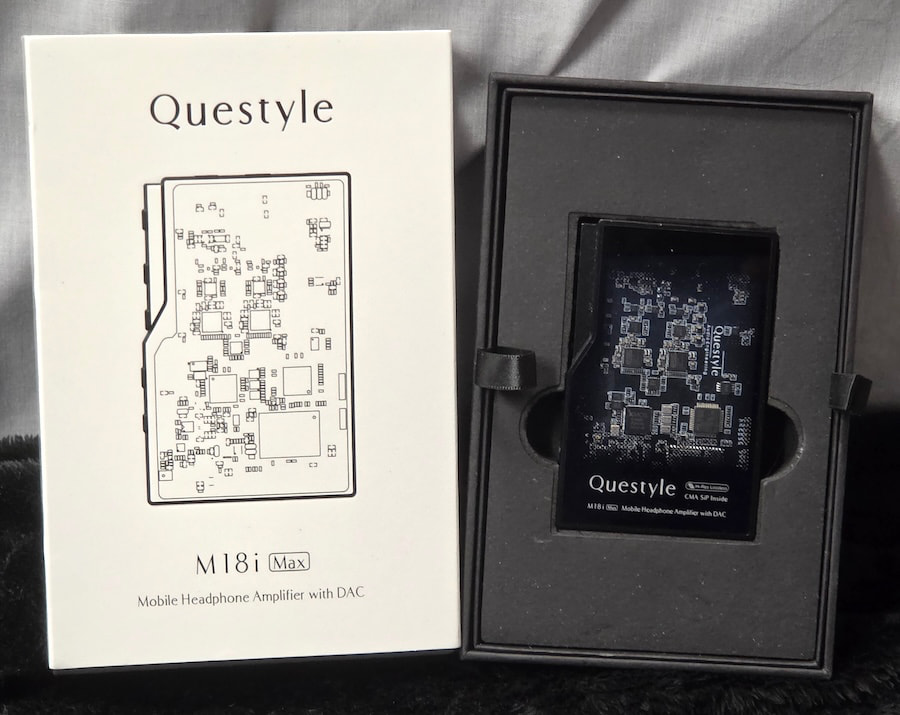
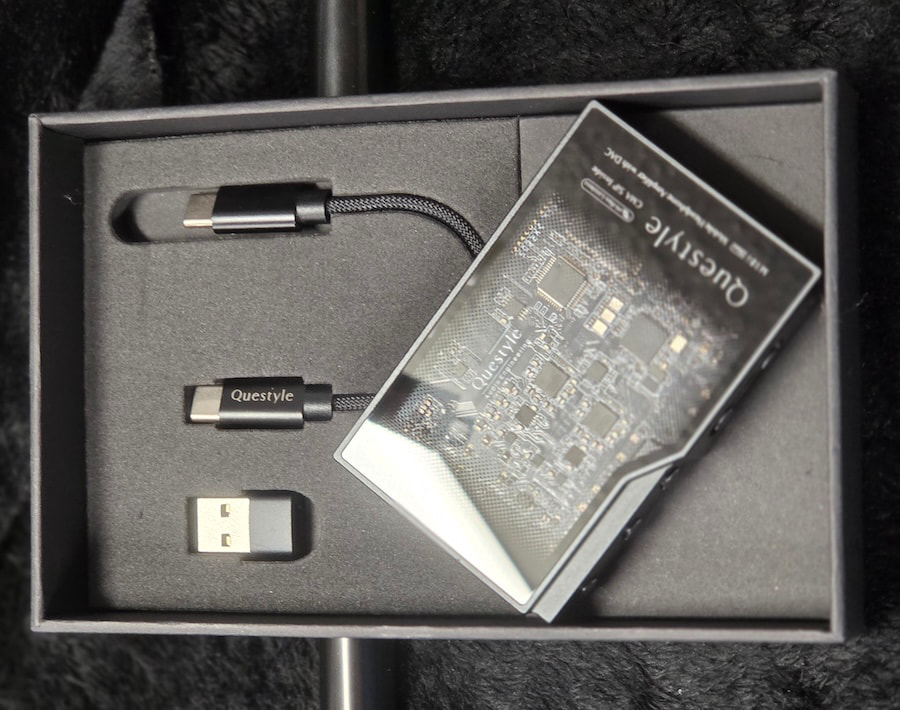
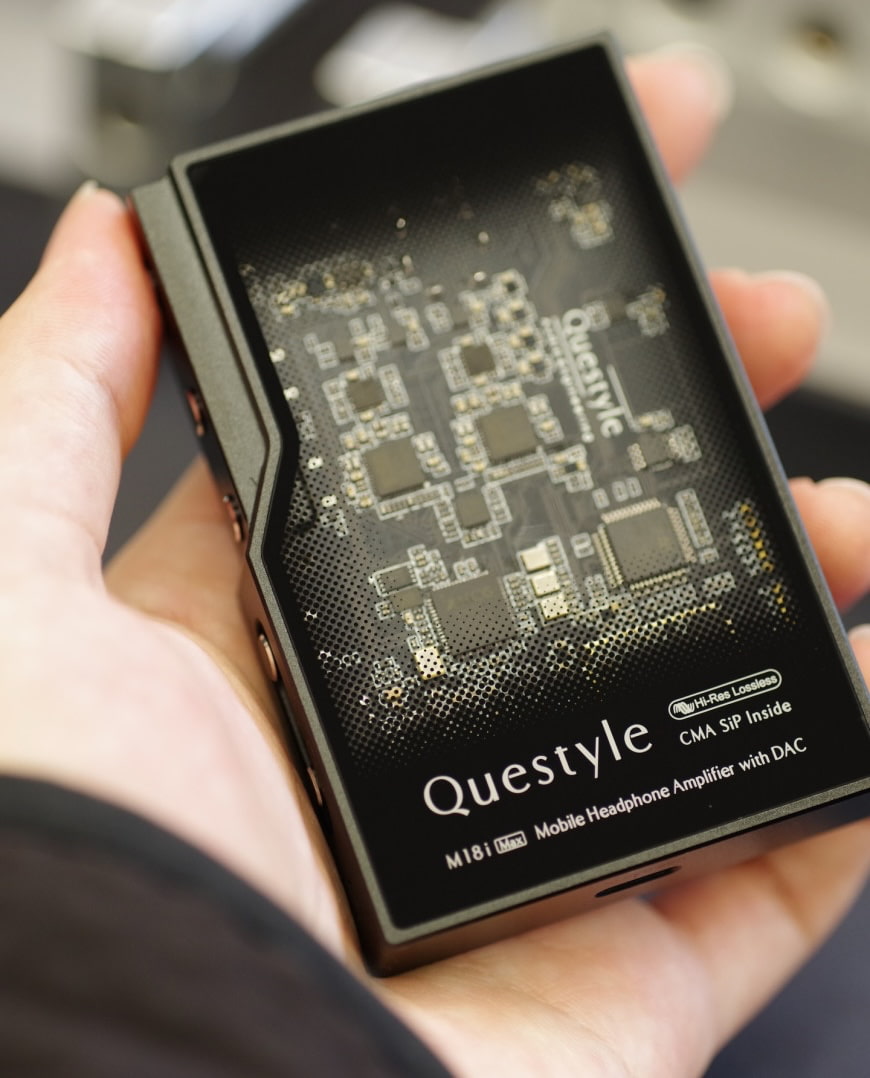
The M18i Max uses a compact aluminum chassis and glass faces with a well-machined look. Buttons down the side are machined as well, and are both well-fitted and tactile. Ports are precisely fitted into the aluminum frame, with no play or slop, giving the unit a very premium feel. The design is understated, relying on the visibility of the components through the glass rear face to generate visual interest.
Size-wise, the M18i Max splits the difference between a dongle and something like the Cayin CU9 at roughly 4 inches tall, 2 inches wide, and ½ inch thick. Sporting an 1,800 mAh internal battery also removes it from the category of typical dongles. As a result, the weight is also a bit more than most dongles at 100 grams. That additional size and weight is a trade-off for longer battery life and greater potency. The M18i Max is designed to provide greater output capability than a basic dongle.
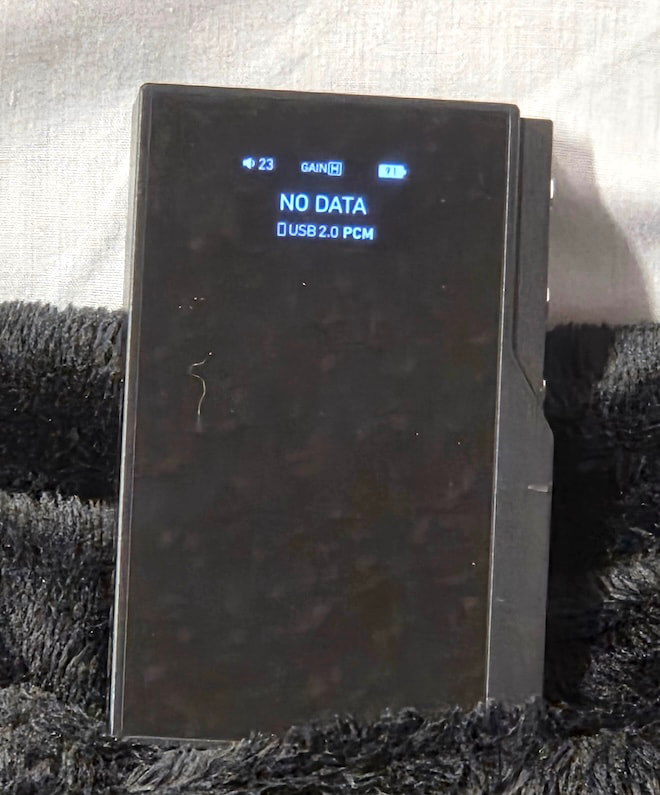
The color display provides useful information, including volume, sample rate, output status, and playback format, although my aging eyes would have preferred about a four-point larger font. That may seem like a small detail, but it is helpful when switching between phones, tablets, and computers, where software volume controls are not always obvious. The screen also makes the M18i Max feel more like a complete audio component and less like an adapter hanging from the bottom of a phone.
The independent volume control allows precise adjustment directly from the unit rather than relying entirely on the source device. This also allows the source device volume to be set at 100% where software volume controls might otherwise affect sound quality before passing the signal off to the M18i Max. Listeners accustomed to a traditional analog knob may initially find the button-style interface less immediate, but the controls are logical after a short period of use.
Internals

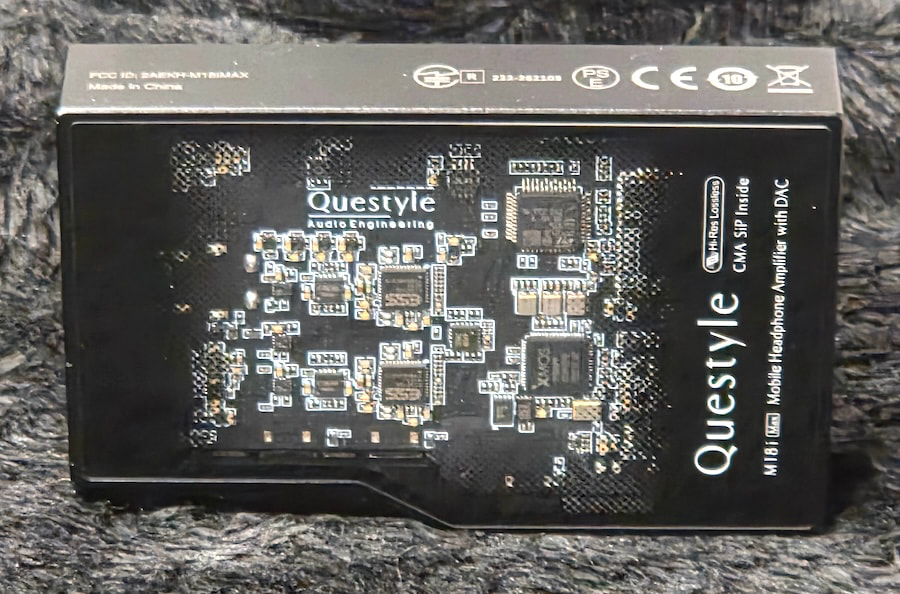
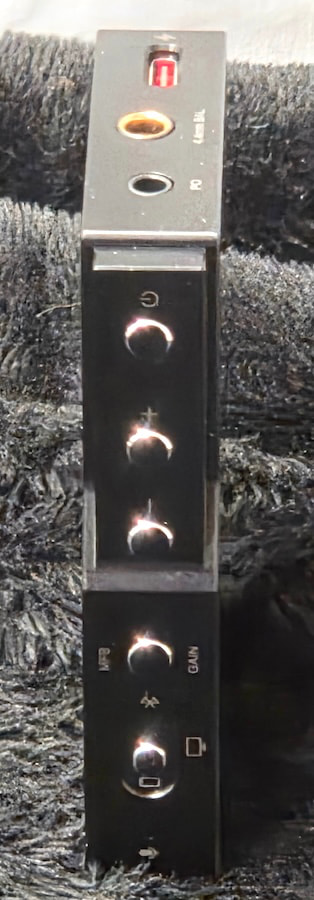
Inputs include USB as well as Bluetooth 5.4, with support for Bluetooth LE, LDAC, aptX HD, aptX Adaptive, and SBC. It is also worth noting that most, if not all, Questyle products in the current lineup are MFi-certified, so they will work equally well with Apple and Android products. A switch on the side of the unit allows listeners to control the operating mode and whether the device should charge from the source, so phone batteries can be protected while the M18i Max can still charge directly from a laptop. A separate USB charging port also puts the unit into phone mode when connected to a USB source and the power port is connected.
The DAC section uses two ES9219Q chips that provide dual-mono processing to further reduce noise and improve channel separation. The design supports high-resolution PCM up to 384 kHz/32-bit and DSD256 playback, well beyond the requirements of most of my music library and many streaming services.


The M18i Max uses two of Questyle’s proprietary SiP amplifier modules containing four patented Current Mode Amplification circuits. These SiPs, as Questyle calls them, are designed to provide high bandwidth, low distortion, and strong control over connected headphones. Books have been written on the topic of current-mode versus voltage-mode amplification, but it is hard to deny that Questyle has found a way to make it work. The company specifies distortion as low as 0.0002% under an actual 300-ohm load, along with a peak output current of 1.5A.
This is more than adequate power for headphones like the HEDD D1 or Sennheiser HD 650, while still providing enough finesse to handle sensitive in-ears like the Campfire Andromeda or Beyerdynamic DT 70. The one limitation is large planar headphones, with inefficient models like the Fostex T50RP and HiFiMAN HE6 acting as current sponges and draining the resources of the M18i Max quickly. The M18i Max closes the gap between portable and desktop performance, but it does not eliminate the distinction entirely.

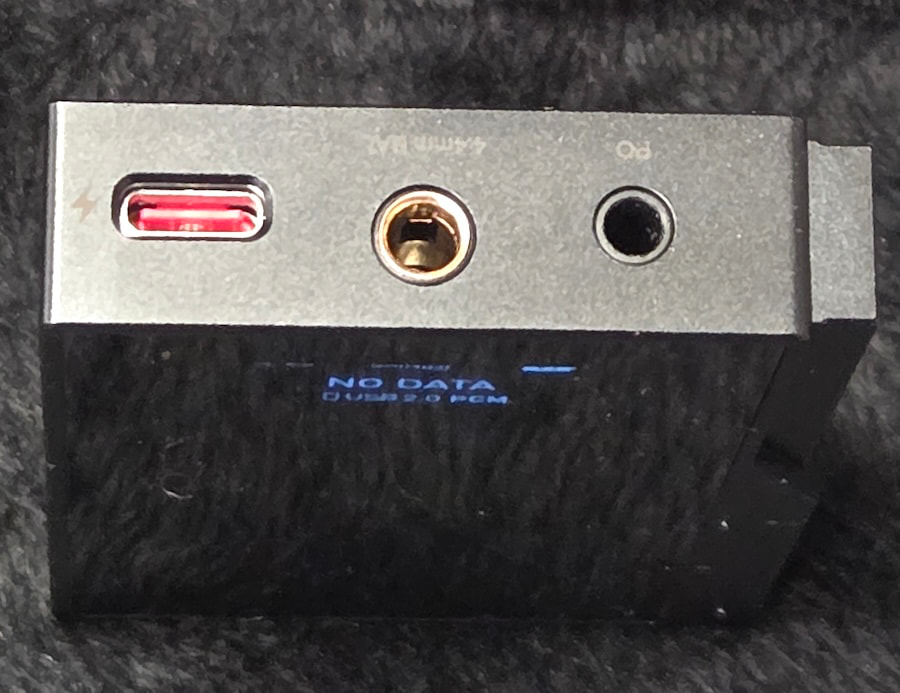
The M18i Max includes both 3.5mm single-ended and 4.4mm balanced outputs. The balanced connection is the preferred output for demanding headphones or listeners who want the greatest amount of headroom.
Listening
The first thing that stands out about the M18i Max is its sense of control. It does not radically alter the tonal balance of a connected headphone, but it gives the impression that the driver is being managed more effectively.
Bass is tight and well-defined, with good extension into the sub-bass region. Kick drums have a clear leading edge, and electric bass lines remain easy to follow in busy arrangements. The M18i Max does not add a large bass lift, which will disappoint listeners expecting a warmer or more obviously colored presentation. What it provides instead is authority and separation.
Sub-bass information is easier to recognize with the M18i Max than through the headphone outputs of many phones and laptops. Electronic music benefits from the additional depth, but the improvement is equally apparent with acoustic recordings, where the lower registers of piano, double bass, or organ need room to develop.
The additional power is most obvious with full-size headphones. The M18i Max maintains its composure when the music becomes dense or the volume rises, and it avoids the sense of strain that can appear when a small amplifier is pushed beyond its comfort zone.
The midrange is clean and transparent. Vocals are well-centered, and small differences in recording technique are easy to hear. Male voices have weight without sounding thick, while female vocals retain texture and air without becoming artificially forward. Acoustic guitars have good body and string definition, and piano notes carry enough harmonic information to sound natural rather than mechanical.
The M18i Max is not warm in the traditional sense. It does not soften the edges of a bright headphone or add much coloration to a neutral one. That makes it a good match for listeners who want to preserve the character of their headphones, although those already using an aggressive or analytical model may prefer a warmer amplifier.
Treble is extended and detailed without sounding excessively sharpened. Cymbals have convincing attack and decay, and low-level information in recordings is easier to follow. The M18i Max offers a largely effortless presentation in the upper registers, particularly with demanding headphones, but it does not turn detail into an excuse for brightness.
Poor recordings remain poor. Compressed pop material can still sound flat and congested, and bright masters can become tiring with already-forward headphones. The M18i Max is resolving enough to expose those flaws, although it generally avoids adding harshness of its own.
The soundstage is more open than what most phones and computers can provide from their internal outputs. Width improves first, with depth and image layering becoming more apparent as the quality of the headphones increases.
Instrument placement is stable, and complex recordings remain organized at higher listening levels. Orchestral recordings benefit from the improved separation. Placing the orchestra is relatively straightforward, and individual sections retain their identity rather than blending into a single mass.
Small jazz ensembles are handled especially well, with enough space around the instruments to make the recording feel less congested. Live recordings also benefit from the additional control, particularly when crowd noise, room ambience, and the performers occupy overlapping parts of the mix.
The 4.4mm balanced output provides the strongest performance. It offers more headroom and a greater sense of ease, particularly with full-size headphones. The 3.5mm output remains very capable with IEMs and efficient portable headphones, but the balanced connection allows the M18i Max to show more of its potential.

Headphone & IEM Pairing
The M18i Max is a flexible match for a wide range of headphones. It works especially well with neutral and slightly warm models, providing enough clarity and control to keep warmer headphones from sounding sluggish while avoiding the exaggerated brightness that can make neutral models difficult to tolerate.
With sensitive IEMs, the quiet background and low output impedance are important advantages. The M18i Max preserves the character of the earphones rather than imposing a strong tonal signature of its own.
The extra power becomes more valuable with full-size dynamic headphones and planar models. The M18i Max provides better headroom and a more effortless presentation than most conventional dongle DACs, particularly through its balanced output.
Listeners should still maintain realistic expectations. “Powerful for a portable DAC” and “powerful enough for every headphone” are not the same thing. The M18i Max is capable, but the most inefficient headphones will still be better served by a dedicated desktop amplifier.

Portability & Everyday Use
The M18i Max is straightforward to use with computers and most modern mobile devices. It can function as a high-quality USB audio output for streaming services, local music libraries, and high-resolution playback software.
Battery life is an important consideration because the M18i Max is more sophisticated than a basic dongle DAC. The display, amplification stages, and higher output capability all require power, and the unit can draw more from a connected phone than a simpler adapter.
That is not a reason to reject the product, but it does make the M18i Max better suited to deliberate listening than casual, all-day use. A small power bank may be useful for longer sessions away from a wall outlet.
There is also the question of portability. The M18i Max is compact compared with a desktop stack but relatively large compared with inexpensive dongle DACs. It may hang awkwardly from a phone in a pocket, especially with larger headphone cables attached.
The M18i Max is aimed at the listener who is willing to accept some inconvenience in exchange for stronger performance. That is a reasonable trade, but it is still a trade. The unit is more portable than a desktop system but less convenient than a simple phone adapter.

What Could Be Better
The price is the most obvious concern. The M18i Max costs considerably more than many competent USB DACs, and listeners using efficient IEMs may not immediately hear enough of an improvement to justify the difference.
Battery consumption is another consideration. The M18i Max is not as carefree as a simple passive adapter, and phone users will need to account for the additional drain during extended sessions.
The unit can also be more complicated than some listeners need. High-resolution format support, multiple output modes, a display, and a powerful amplifier are useful features, but not everyone needs a miniature audio laboratory attached to a smartphone.
Its physical size is another compromise. The M18i Max is very portable compared with a desktop stack, but listeners looking for the smallest possible solution will find less expensive and more convenient options.
Finally, the M18i Max’s clean and controlled sound will not suit every system. Listeners looking for warmth, tube-like coloration, or a more forgiving presentation may prefer a DAC and amplifier with a more obvious sonic personality.

The Bottom Line
The Questyle M18i Max occupies an interesting middle ground. It is considerably more substantial than a conventional dongle DAC, but still small enough to travel without turning your phone into a science project. Its real advantage is Questyle’s Current Mode Amplification combined with dual-mono ES9219Q DACs, a dedicated 1,800 mAh battery, Bluetooth 5.4, and both 3.5mm and 4.4mm outputs.
That combination matters more than chasing another decoding format. The M18i Max can drive sensitive IEMs quietly, provide considerably more authority with full-size headphones, and operate from its own battery rather than treating your phone as a power supply. It still has limits with genuinely inefficient planar headphones, so anyone expecting a pocket-sized replacement for a powerful desktop amplifier is buying the wrong product.
What is missing? There is no PEQ, meaningful DSP suite, or app-based control, which competitors from FiiO and others increasingly offer at this price. The display and physical controls keep operation straightforward, but listeners who want to endlessly tweak filters, EQ curves, and presets will find the M18i Max rather old-school.
That is also part of its appeal. The M18i Max is for someone who already owns very good headphones or IEMs and wants to hear more of what they can do without carrying a desktop rig. At $399, it is overkill for inexpensive earbuds and harder to justify for anyone primarily interested in convenience. For the listener who values sound quality, low noise, strong headphone control, and genuine portability more than software features, however, the M18i Max makes a very persuasive case.
Pros:
- Excellent control and low noise with both full-size headphones and sensitive IEMs
- Current Mode Amplification delivers strong dynamics, separation, and composure
- Clean, transparent tonal balance without excessive brightness
- Dual-mono DAC architecture with 3.5mm and 4.4mm outputs
- Dedicated battery reduces dependence on the source device
Cons:
- Expensive compared with conventional dongle DACs
- Larger and heavier than most portable USB DACs
- No PEQ, advanced DSP, or app-based control
- Can still struggle with very inefficient planar headphones
- Overkill for listeners using inexpensive or easy-to-drive earphones
Our Ratings:
★★★★★★★★★★ Sound Quality
★★★★★★★★★★ Build Quality
★★★★★★★★★★ Portability
★★★★★★★★★★ Value
You must be logged in to post a comment Login