Tech
Rare Soft X-Ray Flash Gives Scientists a Clear View of a Star’s First Explosive Moment
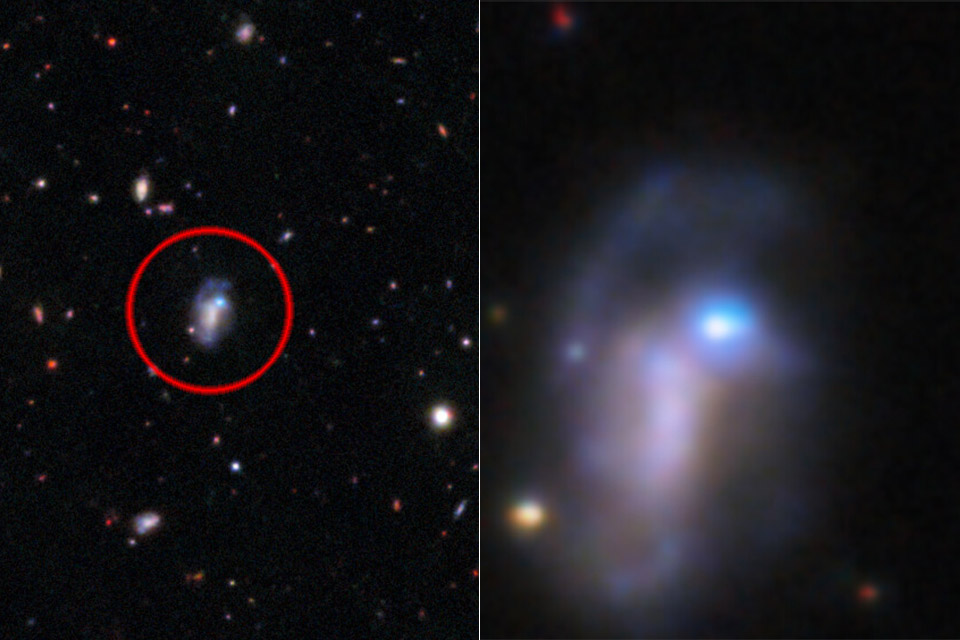
Soft X-rays from a galaxy about 500 million light-years away triggered an urgent worldwide search in March 2026. The Einstein Probe satellite, built by the Chinese Academy of Sciences with the European Space Agency, recorded a brief pulse of these X-rays and labeled the event EP260321a. Ground telescopes responded within an hour and quickly found a supernova growing brighter by the minute. Researchers later named the explosion SN 2026gzf.


Two astronomy teams were diving into the same region, utilizing a range of NSF NOIRLab resources. One, led by Brendan O’Connor of Carnegie Mellon University, and the other by Jillian Rastinejad of the University of Maryland, reached the same conclusion after evaluating the data. Their early observations suggested that the explosion began with a shock breakout. A shock breakout occurs when an immensely powerful shockwave from a collapsing core smashes through the star’s surface, allowing the supernova to shine. This isn’t uncommon in supernovae, but they’re difficult to detect because they only endure a few seconds to a few hours. To put it in context, there has only been one validated x-ray shock in the last 20 years, and scientists were certain this was the real deal. EP260321a is a once-in-a-lifetime scientific discovery.


LEGO Icons NASA Artemis Space Launch System – DIY Rocket Model Building Set for Adults, Ages 18+ – Gifts…
- NASA rocket model kit – Launch into a creative project with the LEGO Icons NASA Artemis Space Launch System model building project for adult space…
- What’s in the box? – This creative building set includes everything you need to craft a multistage rocket with 2 solid-fuel boosters, an Orion…
- Features and Functions – This NASA-themed rocket model features retractable launch tower umbilicals, rocket support and crew bridge, detachable…

People looking over the data discovered that SN 2026gzf is a broad-lined Type Ic supernova. These explosions are typically extremely intense, resulting in streams of material that travel at the speed of light. They are frequently accompanied by a gamma ray burst, which is one of the most tremendous energy outputs ever observed. Unfortunately, in this case, the teams were unable to identify a gamma ray burst, its high-speed jet, or even the afterglow. O’Connor hypothesized that the jet was likely muted by the star’s surface or surrounding material before breaking loose. Even though the explosion was quite intense, the resulting x-ray flare was exceptionally mild for something linked with a broad-lined Type Ic supernova.
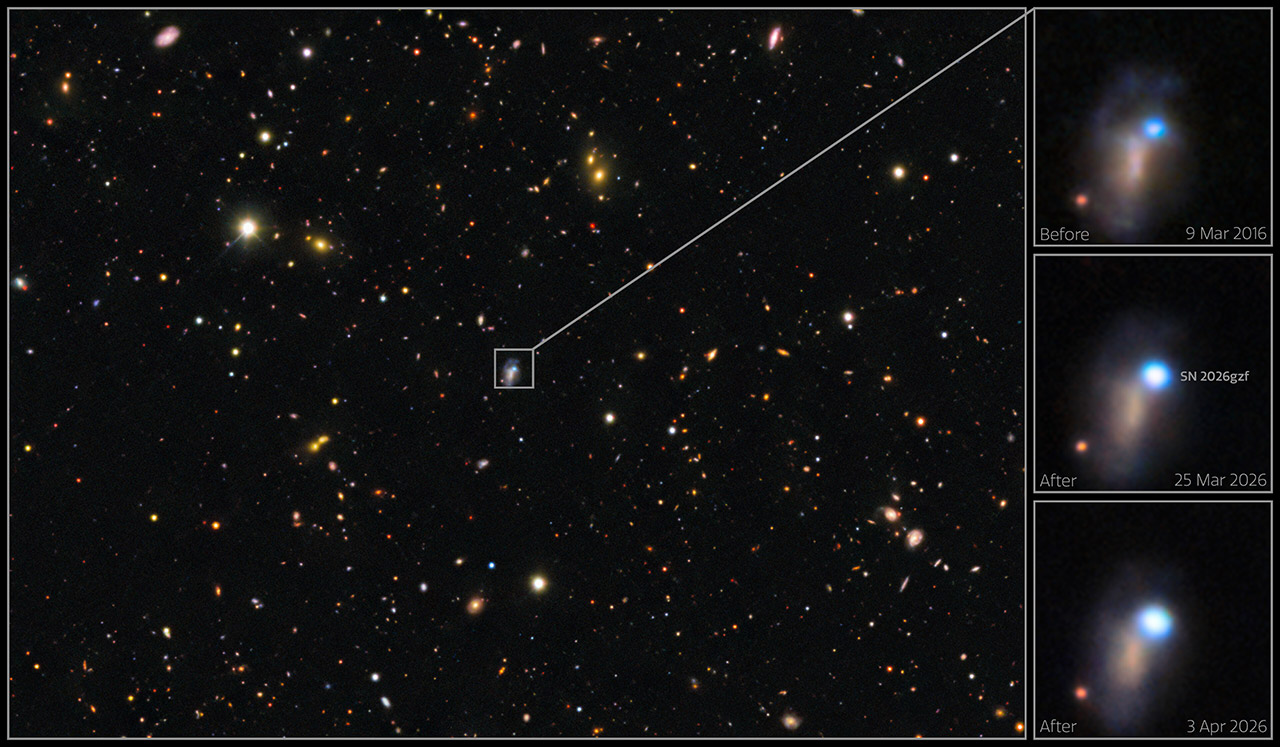
Over a decade earlier, the Dark Energy Camera on the Víctor M Blanco 4-meter Telescope captured images of a blue source in the same position. That was intriguing since it implied that the star was already fairly active before collapsing. DECam later captured several further photographs, revealing that the supernova was becoming increasingly strong. Meanwhile, the NSF-DOE Vera C. Rubin Observatory produced multiband observations of the event in its COSMOS Deep Meiling field, revealing information on the star’s behavior before to the explosion. The DESI on the Nicholas U. Mayall 4-meter Telescope captured a succession of spectra that helped determine the type of supernova and tracked the light as it spread.

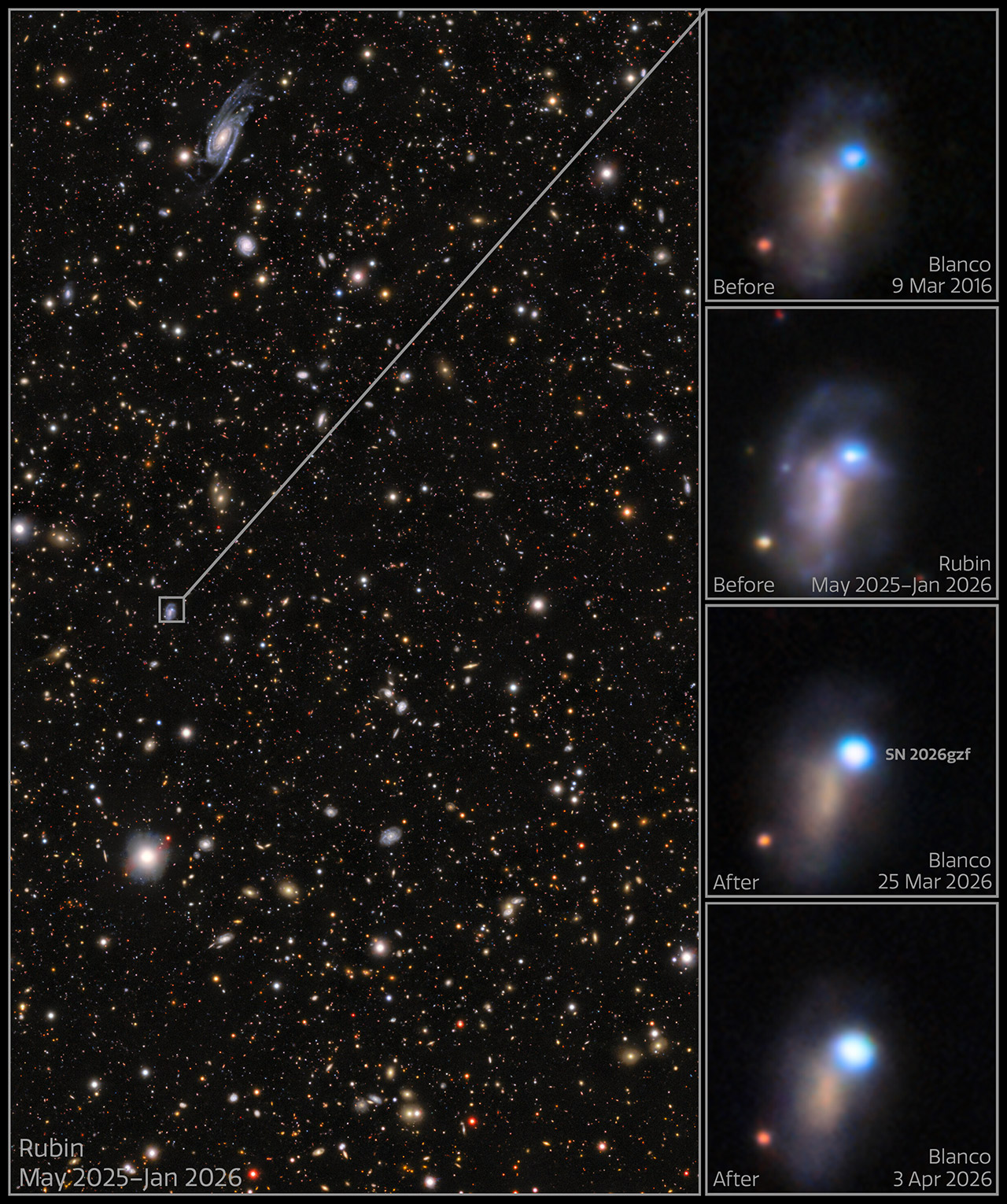
Rastinejad’s team employed both Gemini telescopes, as well as the Gemini Multi-Object Spectrographs and the Goodman spectrograph on the SOAR 4.1-meter Telescope, to gain a comprehensive look at the event at all wavelengths. They examined the data and concluded that the star that went supernova was a Wolf-Rayet star. Born with nearly twenty times the mass of the sun, it had already depleted all of its hydrogen and blown off all of its helium in a series of frenzied explosions. The residual core was largely carbon and oxygen, and the mass loss episodes left behind a variety of material shells: a small tight one near to the star that provided the soft X-ray signal, and a larger one further away that created the supernova’s visible brightness.
[Source]

You must be logged in to post a comment Login