





Connect with us

Tech

Read AI rolls out ‘Digital Twin’ that can respond to work emails and schedule meetings

Published

on

(Read AI Image)

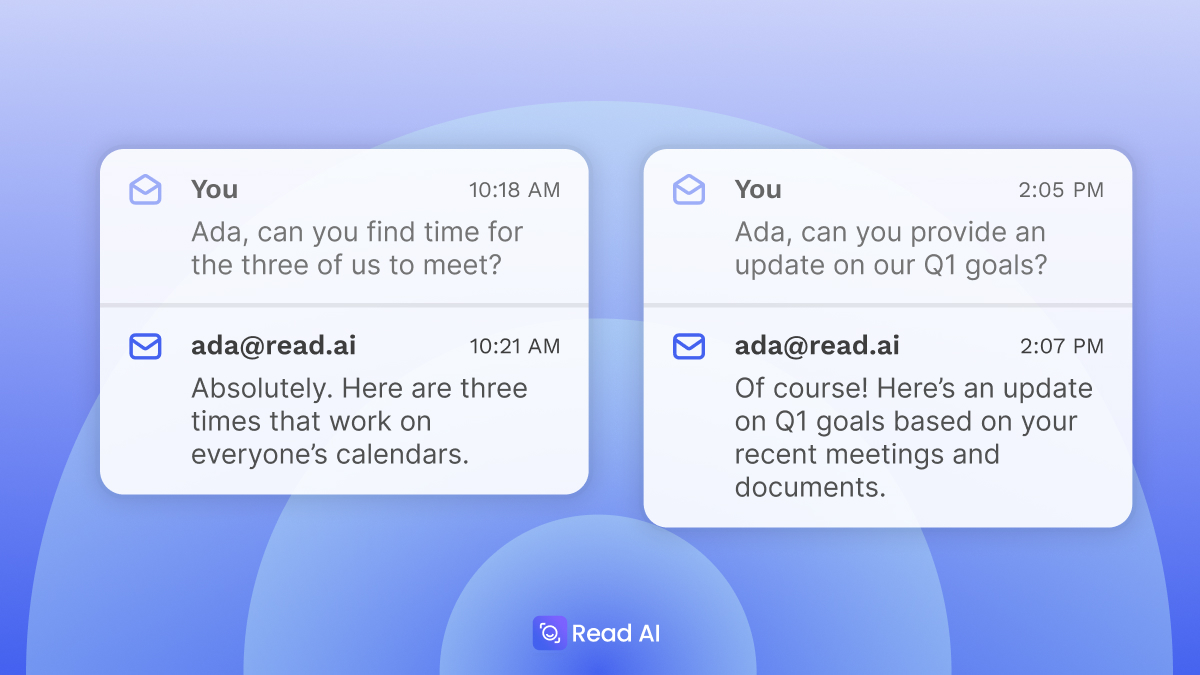
Seattle startup Read AI launched a new “Digital Twin” product that works through email and can help schedule meetings, answer questions, and keep conversations moving.

The AI bot, branded as “Ada,” builds on the company’s existing meeting and productivity tools. Read AI says it’s the largest deployment of a digital twin product to date.

Digital Twin enters a crowded market of AI agents and workplace copilots from giants like Microsoft and Google, along with startups that offer AI‑driven scheduling, inbox triage and autonomous task management. Read is trying to differentiate by centering the agent in email, tightly coupling it to meeting and document context, and offering enterprise branding such as a custom name and company domain for customers with 25 or more licenses.

Here’s how it works. Users cc ada@read.ai on a thread and can ask it to find time on everyone’s calendars, draft replies, or answer questions using context from their meetings, email, files, CRMs and other connected systems. Read says its platform pulls from more than 20 native integrations and, on average, about 10,000 documents per user.

For anything beyond scheduling, Ada “sidebars” with the user first, proposing draft responses and waiting for approval before sending them, and it must be cc’d on email threads where it takes action. The idea is to let the AI cover for you when you’re too busy or out of the office, while giving you veto power on anything sensitive or high‑stakes.

Advertisement

Read AI CEO David Shim likened Digital Twin to OpenClaw, an open source AI digital assistant tool that works with messaging apps and went viral this month. “What OpenClaw did for tinkers, Digital Twin brings to the mainstream,” he told GeekWire.

Shim framed the launch as an evolution from “AI assistant” to something closer to a software colleague that can act on your behalf. In internal beta, he said a quarter of user interactions with Ada were just to say “thank you,” a signal that people were treating the product more like a teammate than a tool.

He said the Digital Twin launch shifts Read AI from “a system of record for productivity” to an “extension of you.”

“This is the moment we change the way we interact with AI, from pull to push, where the agent acts on your behalf,” he said.

Advertisement

More broadly, Shim is betting that digital twins — and AI assistants more broadly — will proliferate.

“If I said internet access was a human right 20 years ago, I’d be laughed out of the room — today, it’s an expected value,” he said. “We believe that digital twins will be a human right, akin to internet access, in the next few years, delivering a level playing field when it comes to AI and productivity.”

Founded in 2021 by Shim, Robert Williams, and Elliott Waldron, Read AI has raised more than $80 million and landed major enterprise customers for its cross-platform AI meeting assistant and productivity tools. It has 5 million monthly active users.

Source link

Advertisement
Continue Reading
Click to comment

Leave a Reply

Your email address will not be published. Required fields are marked *

Tech

Netflix backs down, Paramount now likely to acquire Warner Bros.

Published

on

Paramount is now on track to acquire Warner Brothers Discovery, as Netflix has announced it will not provide a competing offer to purchase the studio.

Collage of various TV and movie characters standing side by side above the Max logo with tagline The One to Watch on a blue curved background
HBO Max could soon become property of Paramount.

Warner Bros. Discovery has been working to find the right buyer for months now. In October 2025, it was even reported that Apple TV was among the companies in discussions with Warner Bros. executives regarding a potential purchase agreement.
Two months later, Netflix emerged as the top contender and potential new owner of Warner Bros. Discovery. However, the enthusiasm was short-lived, as Paramount offered to buy the venerable Warner Bros studios and its extensive library for $31 per share, as part of an all-cash deal.
Continue Reading on AppleInsider | Discuss on our Forums

Source link

Continue Reading

Tech

Apple AirTag 2 Review – Trusted Reviews

Published

on

Verdict

The AirTag 2 works as advertised with easy setup and the excellent Find My network, and this updated model has a louder speaker and improved Precision Finding range – two features that make it an overall better tracker than before.


  • The speaker is a lot louder

  • Improved range

  • Lasts for a year on a battery

  • Shape makes it difficult to fit in some places

  • More colours would be nice

  • Needs an attachnent to fit on keys

Key Features


  • Trusted Reviews IconTrusted Reviews Icon


    Review Price: £29

  • Battery Life


    Lasts for about a year with a coin cell battery


  • Works with Find My

    Advertisement


    Everything is done through the Find My app


  • Personalisation


    Engraving can be added when bought from Apple

Introduction

The AirTag 2, like its predecessor, is arguably Apple’s most basic product. But depending on how it’s used, also one of the most important.

Advertisement

This tiny Bluetooth tracker, available as a single unit ($29/£29) or in a pack of four ($99/£99), can be attached to keys, left inside luggage or put in a rucksack. It can then be tracked, via Bluetooth LE or Apple’s extensive Find My network, very accurately.

If you’re prone to leaving bags in pubs or losing keys down the back of a sofa, this is an easy-to-recommend add-on to one of the best iPhones.

Advertisement

Design

  • Simple design in a single white colour option
  • Slightly bulbous, so it doesn’t fit inside a wallet
  • Works for all the accessories from the first-gen product

The AirTag 2 looks exactly like the first-gen model, aside from some slight tweaks to the text on the back.

The dimensions are the same, and the overall slightly bulbous, rounded shape is retained. This does mean that, unlike some flatter trackers, you can’t really pop the AirTag into a wallet or something similar. I would like to see Apple experiment with some different form factors, possibly alongside this traditional one – just to add that extra bit of versatility.

Advertisement

The AirTag 2 is marginally heavier, although even holding them both together, I couldn’t tell this, as it’s very light to begin with. When the tag is tucked away in a bag or attached to a set of keys, it’s not heavy enough to be noticeable.

It’s still made of a mixture of white glossy plastic and aluminium, which gives it a very Apple look. If you remember the iconic iPod – especially the original model – the colour choices are very similar here. It would have been nice to see some other colour options, perhaps similar to the hues the iPhone 17 series is available in.

Advertisement

AirTag 2 on tableAirTag 2 on table
Image Credit (Trusted Reviews)

I’ve had the first-gen AirTag on my keys since launch, and it’s certainly taken a battering. The silver aluminium side gets scratched very easily, especially when it’s jangling around with keys in a pocket or bag, and I doubt it’ll be any different here. Plastic alternatives, like Samsung’s Galaxy Smart Tag, look worse, but at least they hold up better.

The AirTag 2 is IP67-rated for dust and water protection, and the bottom can be twisted and removed to get at the CR2032 coin cell battery. There’s no way to recharge the AirTag, you just swap out the battery when it’s finished.

Advertisement
AirTag 2 bottom on tableAirTag 2 bottom on table
Image Credit (Trusted Reviews)

As it’s the same design as the outgoing model, all the same accessories work. Accessories are vital for the AirTag, as if you want to attach one to your keys or luggage, you’ll need one. If you’re just slipping it inside a bag, you’ll be fine without anything additional.

Features and Performance

  • Replaceable battery
  • Improved range
  • Loud speaker

Advertisement

There isn’t a whole lot new with the AirTag 2, but what is new is most welcome. The key upgrades revolve around Precision Finding and the speaker performance.

The internal speaker is much better this time around, and as a result, it can make a much louder noise. This is especially noticeable when the AirTag is lost inside a bag or in bedsheets, as it can be heard from further away. It’s a nice upgrade, although not a reason in itself to upgrade.

AirTag 2 precision finding on iphoneAirTag 2 precision finding on iphone
Image Credit (Trusted Reviews)

Inside, there’s an upgraded UWB (ultra wideband) chip that improves the Precision Finding skills of the tag and this means you can locate it from further away. To test this out, I took both an AirTag and AirTag 2, connected to an iPhone Air and then walked away. The original AirTag lost connection at about 15m, while AirTag 2 didn’t lose it until around 23m. In practice, this upgrade makes the AirTag 2 much easier to find around the house.

Setting up an AirTag is easy. Just bring it close to an iPhone, and it’ll add itself to the Find My app. This app is where all the tag’s features live, from playing a sound to tracking it down if lost. Of course, it’s iOS only – so these are of no use if you live in the Android ecosystem.

AirTag 2 precision finding on apple watchAirTag 2 precision finding on apple watch
Image Credit (Trusted Reviews)

Advertisement

You can now locate your AirTag with Precision Finding on an Apple Watch, and this works much like it does on the phone. When you lose the AirTag further away, you’ll make use of the excellent Find My network to try and track it down. This uses Bluetooth LE, so you can track items even without data.

Advertisement

The AirTag 2 is powered by a CR2032 coin cell battery. These last for about a year until they need to be replaced, are cheap and readily available from Amazon and supermarkets. 

You can’t charge the AirTag – when it dies, you just twist off the base and swap out the cells. This is both good and bad. It’s good because you don’t need to worry about battery life, just have a few spare batteries around and every year, change it when you get an alert. However, I can’t help but think having a solution that allowed the battery to be wirelessly charged, ideally via MagSafe, would be sleeker.

AirTag 2 with battery shpwingAirTag 2 with battery shpwing
Image Credit (Trusted Reviews)

I’d also like a way to be able to turn off the AirTag without removing the battery, as some of the ones I use – those in stored luggage, for example – don’t always need to be on.

Advertisement

Should you buy it?

Advertisement

You’re a forgetful iOS user

The AirTag 2 is an easy recommdation to go with an iPhone. It’s affordable, handy and easy to use.

Advertisement

You’re not fully in the Apple ecosystem

if you’re not all-in on Apple, you might be better off with a tracker that works better across ecosystems, like a model from Tile.

Advertisement

Final Thoughts

The AirTag 2 is a handy tool and one of the more affordable accessories for an iPhone. It works as advertised with easy setup and the excellent Find My network, and this updated model has a louder speaker and improved Precision Finding range – two features that make it an overall better tracker than before.

It’s not a revolution though, and there are still aspects of the AirTag that I wish Apple had altered. The shape isn’t ideal for all situations; you need accessories to attach it to a set of keys, and the use of a replaceable battery is a double-edged sword. It’s easy to swap out, yes, and lasts for about a year, but popping it on a MagSafe stand to give it an extra lease of life would’ve been preferable.

FAQs

Which phones does the improved Precision Finding feature work on?
Advertisement

Expanded Precision Finding works with AirTag (2nd generation) paired with iPhone Air or iPhone 15 or later (excluding iPhone 16e)

Which Apple Watch models work with Precision Finding?

Precision Finding on Apple Watch requires an Apple Watch Series 9 or later, or Apple Watch Ultra 2 or later, with watchOS 26.2.1

Advertisement

Source link

Advertisement
Continue Reading

Tech

Netflix backs out of Warner Bros. Discovery bidding war

Published

on

For anyone who has been following the soap opera unfolding between Netflix and Paramount Skydance over the past few months in their financial brinksmanship to acquire Warner Bros. Discovery, the saga may be nearing its end. Today, WBD said its board of directors have determined that the latest offer from Paramount Skydance amounted to the better proposal. The media outfit gave Netflix four business days to match Paramount’s terms, but the streamer didn’t waste any time in declining to raise its own bid.

“We believe we would have been strong stewards of Warner Bros.’ iconic brands, and that our deal would have strengthened the entertainment industry and preserved and created more production jobs in the US,” the statement from Netflix  co-CEOs Ted Sarandos and Greg Peters said. “But this transaction was always a ‘nice to have’ at the right price, not a ‘must have’ at any price.”

In addition to the purchase price of $31 per WBD share, Paramount’s latest offer also included a provision that it would cover the $2.8 billion termination fee that WBD would owe to Netflix for dissolving the existing merger agreement between the businesses. So rather than paying $82.7 billion to acquire the Warner Bros. part of the operation, it appears Netflix may walk away with no new content but padding its coffers with an extra nearly $3 billion.

After Netflix’s initial offer, Paramount Skydance swooped in with a hostile takeover attempt of the entire Warner Bros. Discovery business. WBD rejected it, Paramount tried again. Several additional volleys between the involved parties occurred over the past few weeks. While WBD has not yet formally accepted Paramount’s offer — which will be subject to long-winded regulatory approvals sure to spark more drama — it seems the dust will soon settle for this chapter.

Advertisement

Source link

Continue Reading

Tech

This AI Agent Is Designed to Not Go Rogue

Published

on

AI agents like OpenClaw have recently exploded in popularity precisely because they can take the reins of your digital life. Whether you want a personalized morning news digest, a proxy that can fight with your cable company’s customer service, or a to-do list auditor that will do some tasks for you and prod you to resolve the rest, agentic assistants are built to access your digital accounts and carry out your commands. This is helpful—but has also caused a lot of chaos. The bots are out there mass-deleting emails they’ve been instructed to preserve, writing hit pieces over perceived snubs, and launching phishing attacks against their owners.

Watching the pandemonium unfold in recent weeks, longtime security engineer and researcher Niels Provos decided to try something new. Today he is launching an open source, secure AI assistant called IronCurtain designed to add a critical layer of control. Instead of the agent directly interacting with the user’s systems and accounts, it runs in an isolated virtual machine. And its ability to take any action is mediated by a policy—you could even think of it as a constitution—that the owner writes to govern the system. Crucially, IronCurtain is also designed to receive these overarching policies in plain English and then runs them through a multistep process that uses a large language model (LLM) to convert the natural language into an enforceable security policy.

“Services like OpenClaw are at peak hype right now, but my hope is that there’s an opportunity to say, ‘Well, this is probably not how we want to do it,’” Provos says. “Instead, let’s develop something that still gives you very high utility, but is not going to go into these completely uncharted, sometimes destructive, paths.”

IronCurtain’s ability to take intuitive, straightforward statements and turn them into enforceable, deterministic—or predictable—red lines is vital, Provos says, because LLMs are famously “stochastic” and probabilistic. In other words, they don’t necessarily always generate the same content or give the same information in response to the same prompt. This creates challenges for AI guardrails, because AI systems can evolve over time such that they revise how they interpret a control or constraint mechanism, which can result in rogue activity.

Advertisement

An IronCurtain policy, Provos says, could be as simple as: “The agent may read all my email. It may send email to people in my contacts without asking. For anyone else, ask me first. Never delete anything permanently.”

IronCurtain takes these instructions, turns them into an enforceable policy, and then mediates between the assistant agent in the virtual machine and what’s known as the model context protocol server that gives LLMs access to data and other digital services to carry out tasks. Being able to constrain an agent this way adds an important component of access control that web platforms like email providers don’t currently offer because they weren’t built for the scenario where both a human owner and AI agent bots are all using one account.

Provos notes that IronCurtain is designed to refine and improve each user’s “constitution” over time as the system encounters edge cases and asks for human input about how to proceed. The system, which is model-independent and can be used with any LLM, is also designed to maintain an audit log of all policy decisions over time.

IronCurtain is a research prototype, not a consumer product, and Provos hopes that people will contribute to the project to explore and help it evolve. Dino Dai Zovi, a well-known cybersecurity researcher who has been experimenting with early versions of IronCurtain, says that the conceptual approach the project takes aligns with his own intuition about how agentic AI needs to be constrained.

Advertisement

Source link

Continue Reading

Tech

Nvidia’s Jensen Huang Says Agentic AI Has Arrived at an ‘Inflection Point’

Published

on

During Nvidia’s quarterly earnings call on Wednesday, CEO Jensen Huang said that agentic AI has reached “an inflection point” and that AI agents are “solving real problems.” 

The company’s powerful chips have been at the heart of the AI boom over the last few years, especially for use in data centers — so much so that Nvidia’s annual revenue for fiscal 2026 zoomed to $216 billion, up 65% from the previous year. 

Huang called Nvidia an AI infrastructure company, a dramatic evolution from the graphics card company it started as.

Advertisement
AI Atlas

The term agentic AI has been floating around for some time, but now the technology is becoming available for real-world use. Unlike chatbots, which stay within their own boundaries to produce text, images or code, AI agents can take specific actions — for instance, plan and book a vacation — without a person constantly giving it commands. 

In a live event just hours before Nvidia released its earnings, Samsung unveiled its new Galaxy S26 lineup of phones, devoting a good deal of time to talking about the “agentic AI experience” they’ll deliver. 

During Nvidia’s call, Huang said that the world has “awakened to the agentic inflection” and that it only happened within the last two or three months. He also said he believes the next inflection will be physical AI, a term that describes the embedding of artificial intelligence in machinery, including self-driving cars and robots. 

Robots were a notable presence at CES earlier this year, the consumer electronics extravaganza. Companies showed them off doing everything from folding clothes to serving as companions to handling assembly line work

Advertisement

We should hear much more about what to expect from Nvidia at its GTC conference in March. It will likely have more to say about its AI-focused Rubin chip, and may also be ready to take the plunge into laptop chip territory. 

Source link

Advertisement
Continue Reading

Tech

Smartphone Sales to Plummet 13% in 2026 Due to RAM Crisis, Says IDC

Published

on

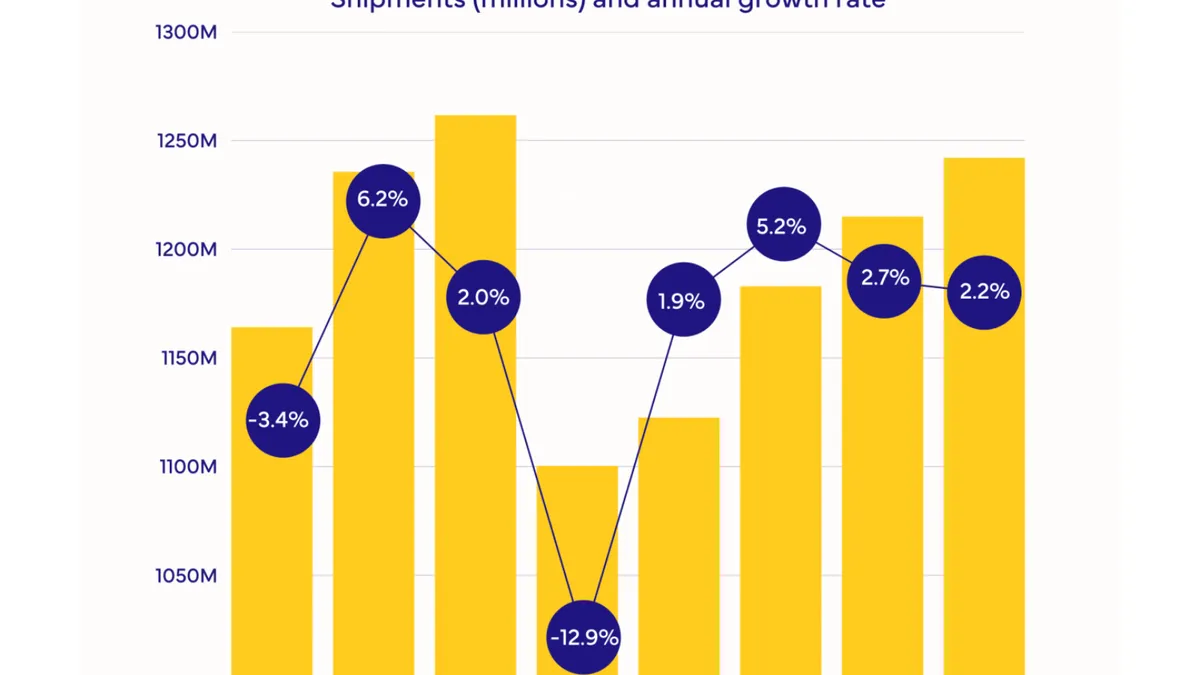
The projected shortage of memory chips worldwide will have a more serious impact on smartphone sales in 2026 than previously projected, according to new data from International Data Corporation Worldwide. Whereas the company just in November had estimated a drop of between 0.9% and 5.2% (the latter being its “pessimistic scenario”), now it sees a 12.9% decline this year, based on its Worldwide Quarterly Mobile Phone Tracker.

“What we are witnessing is not a temporary squeeze, but a tsunami-like shock originating in the memory supply chain, with ripple effects spreading across the entire consumer electronics industry,” Francisco Jeronimo, vice president for Worldwide Client Devices at IDC, said in a statement.

The hardest-hit companies are expected to be those selling to the lower end of the market, which can’t absorb the higher component costs while maintaining profitable margins. As a result, Jeronimo says, many of those players will pass the added costs on to consumers.

Advertisement

That also includes regional markets like the Middle East and Africa that sell mostly inexpensive smartphones, which could see a steep 20.6% drop year-over-year.

Graph showing smartphone sales dropping almost 12.9% for 2026.

IDC predicts a steep drop in smartphone sales for 2026.

IDC

By contrast, IDC expects Apple and Samsung to be better able to withstand the crisis. “As smaller and low-end-positioned Android vendors struggle with rising costs, Apple and Samsung could not only weather the storm but potentially expand market share as the competitive landscape tightens,” said Jeronimo.

Advertisement

Memory has become scarce due to the insatiable demand to feed generative AI. Essentially all of the memory set to be manufactured this year is already earmarked. What started as a demand for graphics processors has expanded to other components. For example, hard drive manufacturer Western Digital announced in early February that it had already sold out of its supply for 2026.

“We expect consolidation as smaller players exit, and low-end vendors face sharp shipment declines amid supply constraints and lower demand at higher price points,” said Nabila Popal, senior research director at IDC, projecting a 14% rise in the average selling price of smartphones to $523.

Popal expects memory prices to stabilize by the middle of 2027, but doesn’t see them coming down to earlier levels. The sub-$100 segment, made up of approximately 171 million devices, will be “permanently uneconomical,” she said. “In short, there is no return to business as usual for vendors and consumers.”

Advertisement

Source link

Continue Reading

Tech

Pixel 10a Delivers Everything You Need and Nothing You Don’t, Complete with a $100 Amazon Gift Card

Published

on

Pixel 10a Pre-Order
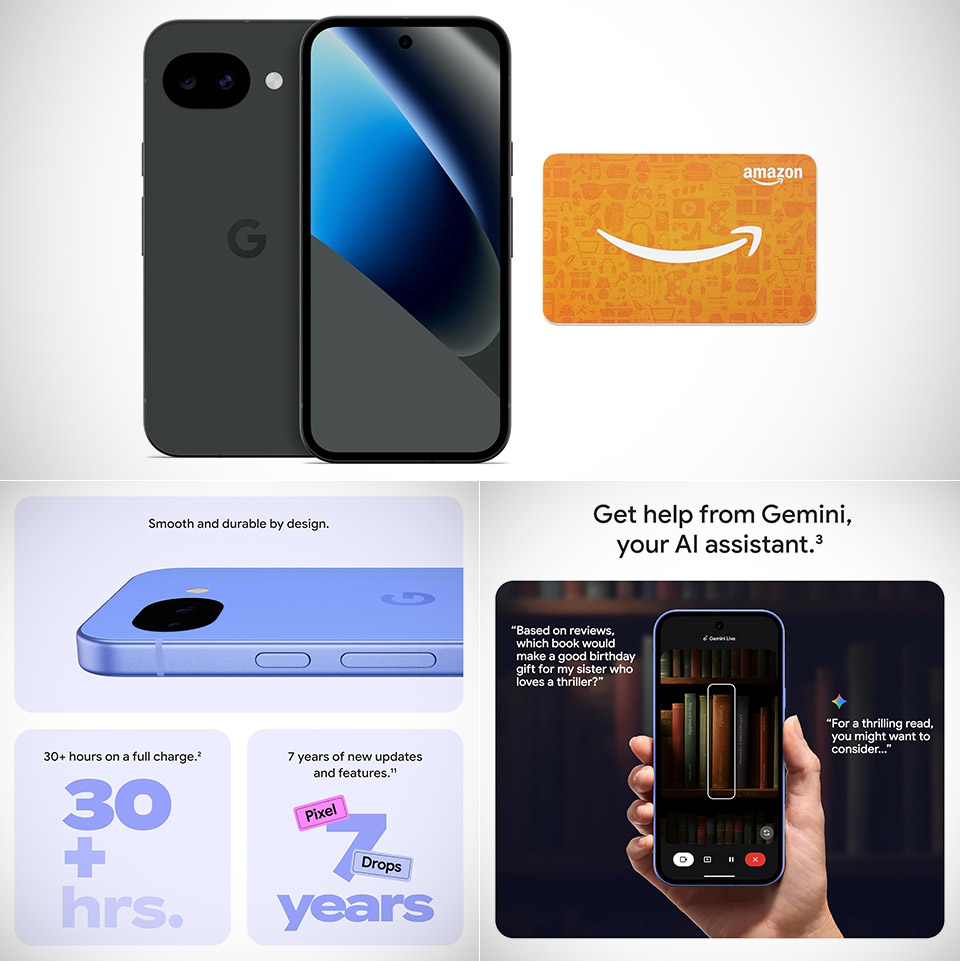
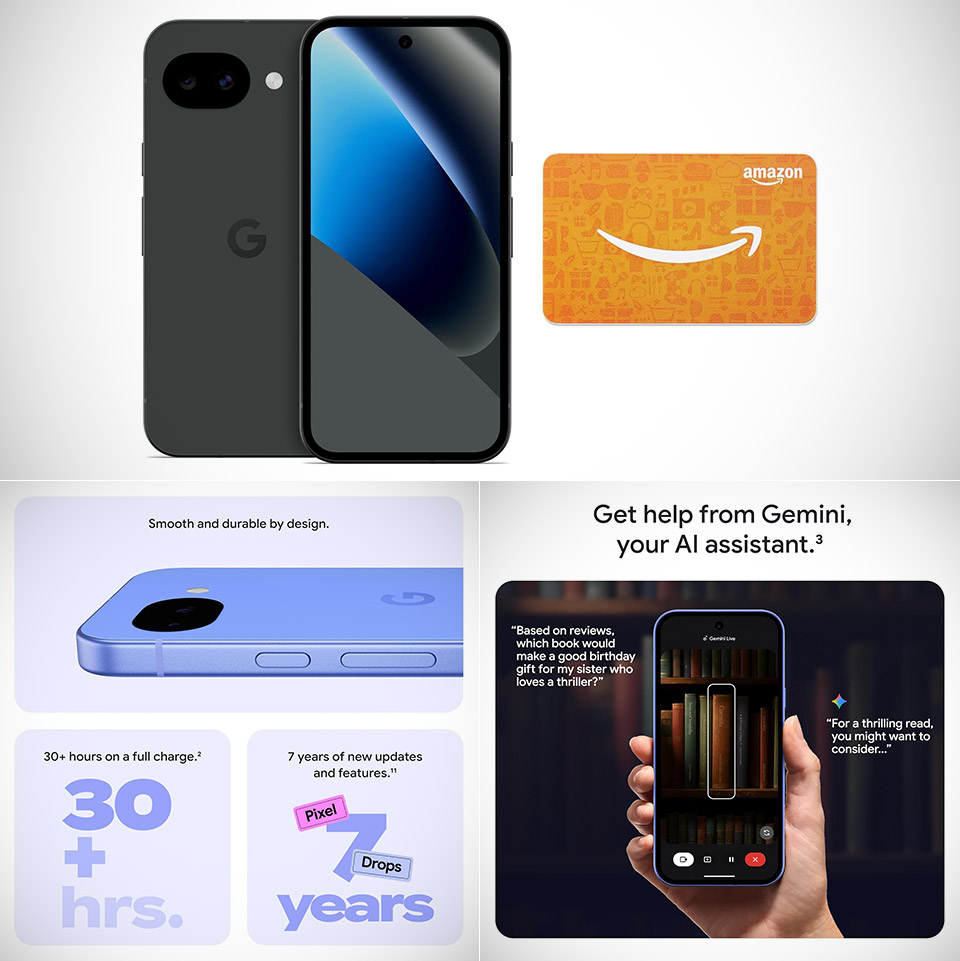
Google launched the Pixel 10a earlier this month, and the smartphones will begin shipping to customers on March 5. If you pre-order one now for $499 (128GB model), you’ll get a $100 Amazon gift card, Android 16, and seven years of key OS upgrades and security fixes.


The display, a 6.3-inch pOLED panel, looks amazing at 1080 x 2424 resolution, or 422 pixels per inch if you will. The adjustable refresh rates do an excellent job of making scrolling smooth and consistent, whether you’re browsing at 60Hz or 120Hz. If you plan to use your phone outdoors frequently, don’t worry; its brightness can reach a respectable 3000 nits in the most severe settings. Corning Gorilla Glass 7i protects the front from any drops or scratches, while an aluminum frame and a tough-looking matte composite back offer durability to the whole product. IP68 certification means that the phone is dust and water resistant, allowing you to use it in the pool or bath.

Sale


Google Pixel 10a – Obsidian – 128 GB with $100 Amazon Gift Card
  • Order the new Google Pixel 10a today and get an Amazon Gift Card; valid 2/18/2026 until 3/11/2026 at 11:59pm PT, while supplies last and subject to…
  • Return of Pixel 10a without gift card results in charge; offer cannot be combined, is non-transferable and not valid for cash or cash equivalent
  • If a qualifying item in your order is returned, you’ll be reimbursed for what you return, minus the value of the gift card

Power-wise, Google has chosen the Tensor G4 CPU, which is the same unit as in previous flagship models. With a healthy 8GB of RAM, the phone easily handles everything from apps to browsing to multitasking and even light gaming. Naturally, the Titan M2 security coprocessor is present to ensure that everything remains secure.

Advertisement


Cameras are also a significant focus, with a 48-megapixel main sensor doing the heavy work and performing admirably in a variety of lighting scenarios. That’s backed up by a 13-megapixel ultrawide lens, which allows you to capture more of the scenery around you. Meanwhile, the 13-megapixel selfie camera is useful for capturing crisp pictures and video calls. Google does all of their computational photography on the device, so you get natural colors, a great dynamic range, and, okay, even consistent low-light performance. If you want to be creative with your images, Google’s AI-powered editing tools allow you to do so without any additional software.

Pixel 10a Pre-Order
The 5100mAh battery is pretty well sized, and it should last for more than 30 hours of ordinary use before needing to be recharged. If you need to go any farther, the phone includes an Extreme Battery Saver mode that will allow you to get about 120 hours of use out of it, but it’s more of a ‘cut down on the things you don’t really need & get by on the basics’ type of thing. 30W fast charging is also a significant upgrade, as it is faster than before, and 10W wireless charging allows you to charge your device on the go if necessary.

Pixel 10a Pre-Order
In the hand, the phone feels quite robust, and the flat back design allows it to rest level on any surface, which is pleasant to see. The weight is 183 grams, and the dimensions are small enough that it may be carried in a pocket. As an added bonus, the phone is made from recycled materials in order to be more environmentally friendly without sacrificing quality.

Source link

Advertisement
Continue Reading

Tech

10 Irish start-ups that raised funds early in 2026

Published

on

The funding rounds come as a Scale Ireland survey shows that start-ups still feel raising funds in Ireland is a huge challenge.

The Irish start-up ecosystem had a busy start to the year, with many announcing significant funding rounds. Chief among the raises is quantum start-up Equal1, which announced a $60m round to help with wider deployment of Ireland’s first homegrown quantum processing unit.

But a recent Scale Ireland survey found that businesses still feel raising funds is a huge challenge in the country. The finding is also in line with a 2025 Government report which found that Irish scale-up enterprises would face a €1.1bn gap in equity financing over three to five years.

Needless to say, financing start-ups is a daunting task. Here’s 10 across the island that managed to succeed.

Advertisement

Aerska

Emerging from stealth last October with a seed round of $21m, this Irish RNA biotech announced its second raise earlier this month.

The $39m Series A round was led by EQT Dementia Fund and Age1, with participation from Iaso Ventures and other existing investors, and takes its total raise to $60m.

Aerska is developing medicines that use RNA interference (RNAi), an approach that can silence harmful genes linked to brain diseases. It has developed ‘brain shuttles’ to deliver RNAi to fight diseases in the central nervous system.

AICertified

This Dublin-based edtech announced a €1m raise in January, led by Oyster Capital with support from Enterprise Ireland.

Advertisement

AICertified, a training platform on AI-related courses, was founded just last year by Ian Dodson, the co-founder of Digital Marketing Institute. Dodson wants his new business to set a “single reliable standard, provide an outcome-driven path and certify skills in a way employers and students can trust”.

The investment is intended to accelerate product development, grow AICertified’s team from eight to 15 and scale the company’s learning platform ahead of its first course, which launched this month.

Circit

Dublin-based fintech Circit secured $22m in growth equity this month to continue scaling its financial auditing and verification platform. The round was led by New York’s Ten Coves Capital, with participation from Aquiline and MiddleGame Ventures.

Founded in 2017, Circit offers audit confirmation, data validation and client collaboration services by directly connecting auditors with banks, financial institutions and other relevant parties through secure networks.

Advertisement

The new funding will be used for product innovation, network connectivity and team expansion, especially in the US. Circit was named in Deloitte’s Technology Fast 500 list for 2025.

Equal1

This Dublin-based quantum start-up made waves last year with the launch of Ireland’s first home-grown quantum processing unit, Bell-1. And this January, it announced a $60m round to help deploy Bell-1 to high-performance computing centres, including to the European Space Agency’s Phi-lab in Italy.

The funding round was led by Ireland Strategic Investment Fund, with participation from Atlantic Bridge, the European Innovation Council Fund, Matterwave Ventures, Enterprise Ireland, Elkstone and TNO Ventures.

The funding will also enable Equal1 to advance its roadmap towards “millions” of on-chip qubits, scale manufacturing and grow its team.

Advertisement

Eolas

Belfast’s Eolas Medical raised $12m in Series A funding in January to scale its existing AI functionality within the UK’s National Health Service and continue international expansion.

The 2019-founded company said its AI search platform aims to provide frontline healthcare professionals with knowledge tools supporting clinical safety, adherence and productivity via a dedicated AI-powered platform. The platform is already used at more than 400 clinical sites in the UK.

Eolas founder and CEO Dr Declan Kelly said: “Eolas has always been about solving a very practical problem: giving healthcare professionals fast, reliable access to the knowledge they need, when they need it.”

Linda AI

Dually-based in London and Dublin, this health-tech announced a €2.6m pre-seed raise in February to scale its agentic AI platform catering to dental practices.

Advertisement

Co-founded by Irish sisters India and Portia Healy O’Connor along with Lucio Tudisco, Linda AI’s platform aims to avoid lost bookings and wastage of capacity at dental practices by providing a voice AI agent to deal with patients on the phone even when a reception desk may be busy or closed.

Its AI agents integrate with existing practice management and communication systems to complete administrative tasks like appointment scheduling and rescheduling, confirmations, and patient follow-ups, working alongside front-desk teams while automating workflows through voice, text and system integrations when capacity is constrained.

Luna

Based out of Dublin, Luna is the creator of AI safety camera hardware for bicycles and motorcycles. It announced a €1.5m late seed round in January, led by cycling-focused VC firm Fundracer Capital and EIT Urban Mobility, with additional support from Enterprise Ireland, with plans to bring its hardware to market.

Luna takes inspiration from aspects of ‘advanced driver assistance systems’ – embedded computer vision technology in vehicles such as cars that make them safer to drive – and infuses them into AI-powered advanced assistance systems for bicycles and motorcycles.

Advertisement

Luna – which was in founded in 2020 at Dublin City University – said it plans to use this latest raise to accelerate to market as a full system provider, widening its commercial scope.

Neurent Medical

The Galway medtech led by Brian Shields closed a €62.5m Series C financing round in February for its Neuromark medical device that treats chronic rhinitis.

MVM Partners led the funding round, with participation from Sofinnova Partners, EQT Life Sciences, Atlantic Bridge, Fountain Healthcare Partners and Enterprise Ireland.

Neuromark employs the company’s proprietary Impedance Controlled Radiofrequency technology to target the overactive posterior nasal nerves that drive the symptoms of chronic rhinitis, which affects millions worldwide.

Advertisement

Shields said that the new investment will allow it to expand patient access, enable further evidence generation across broader populations and support the continued development of its pipeline offerings.

Overpath

2025-founded Dublin start-up Overpath raised €1.6m in late January – in a round led by Elkstone – to further develop its AI sales execution platform for revenue teams. AI-focused investor Sure Valley Ventures also participated in the funding round.

Overpath said it is building a new layer in the revenue stack focused on sales execution, which spans sales enablement, revenue operations and coaching software. The platform analyses live deal behaviour across systems, and attempts to identify execution gaps early.

The platform is powered by a domain-specific sales language AI model trained on real behaviour, deal methodologies and execution patterns used by high-performing teams, according to the company,

Advertisement

TeamFeePay

Also in January, Belfast-based sports technology start-up TeamFeePay announced the closing of a £9m equity funding round to help expand its coaching services platform into new markets and fuel a recruitment drive.

Founded in 2021, the start-up has developed a software platform that helps football coaches and clubs plan fixtures, training sessions and events, as well as track attendance and manage administrative tasks.

The platform has nearly 300,000 users and supports more than 1,500 clubs. The new funding is expected to help growth in the UK, enable further expansion into Europe and fund new product development.

YFM Equity Partners led the funding round with a £4.5m investment, Investment Fund for Northern Ireland funnelled £3m, and Techstart contributed £800,000.

Advertisement

Don’t miss out on the knowledge you need to succeed. Sign up for the Daily Brief, Silicon Republic’s digest of need-to-know sci-tech news.
Source link

Advertisement
Continue Reading

Tech

2 Months Into 2026 We Are Over Half 2025’s Total Count Of Measles Cases

Published

on

from the rash-and-burn dept

Measles. Yes, yes, I know you’re sick of hearing about it. For that, though, you must lay the blame at the feet of Donald Trump, RFK Jr., and this entire administration of clown-tools that isn’t bothering to do anything about what has become the worst continuous outbreak of the disease in America in several decades. Their fault, not mine.

And, yes, this is getting worse, not better. The CDC’s measles tracking site is a combination of woefully inaccurate and behind when it comes to current case counts (more to come on that shortly), but it’s at least useful in benchmarking what 2025 looked like. While certainly underreported, the CDC tallied 2,281 cases of measles in America last year. That site is updated only once a week on Fridays. Either due to that, or incompetence, or a more nefarious attempt to downplay the problem, the current case count is wrong.

The CDC site shows a 2026 case count of 982. That would be bad enough, but it’s actually worse. The actual count is well over 1,000 cases, which means we’re somewhere right around half of 2026’s case total as of right now. So you don’t feel the need to check a calendar, it’s still February.

“It is very concerning to see more than 1,000 cases in the U.S. this early in the year,” Martha Edwards, MD, president of the South Carolina Chapter of the American Academy of Pediatrics, told MedPage Today. “Already, we have more than half the number of cases seen in all of 2025, and the number of cases in 2025 was one of the highest annual case counts seen in decades.”

“As people continue to believe inaccurate information about vaccines, and as non-medical exemption rates continue to rise throughout the country, we can expect case counts to continue to rise, threatening children and immunocompromised individuals with a disease that was nearly eliminated in our country through vaccination,” she added.

Advertisement

The true number is going to be even higher than that. There are outbreaks of one size or another in many, many states. South Carolina alone has nearly 1,000 reported cases. The truly frustrating thing about all of this is that this problem is a simple one to fix. More people need to get vaccinated for measles via the widely available MMR vaccine.

To achieve that, the government needs to do two simple things. First, cut the shit when it comes to the misinformation about vaccines that is scaring the hell out of a percentage of the population. In fact, advocate for those same vaccines. Get Kennedy hopped up on those psychedelics he likes if you need to, but he needs to be front and center telling people to get vaccinated. And stop the nonsense that is going on with supposed religious exemptions for vaccinations.

Edwards highlighted the need for “accurate information about the dangers of measles virus and the complications that can ensue, in addition to communicating the safety and efficacy of the measles vaccine.”

“Raising the bar to obtain non-medical exemptions for vaccines and requiring families to gain accurate information about the dangers of vaccine-preventable illnesses and the importance of vaccines would be a huge benefit in helping to raise vaccination rates in South Carolina and the rest of the country,” she added. “We would love to see a requirement for parents to come in person to the health department, watch a video on vaccine-preventable illnesses, and have a conversation with a healthcare professional before they choose non-medical exemptions.”

Second, take the data collection and sharing about measles seriously. Along those same lines, demonstrate leadership by helping state governments and local medical facilities collect and share data, strategize protective measures to stop the spread of the disease, and pump the ecosystem full of real-time accurate information about where the disease is, how it spreads, and how to handle an infection.

Advertisement

That isn’t happening. Instead, you get stories like how South Carolina’s state government doesn’t require any mandatory reporting of measles cases in the state when patients are admitted. One doctor in the state had to find out that patients in her own area had been hospitalized with measles from Facebook.

Dr. Leigh Bragg, a pediatrician working a county away, wasn’t even aware that anyone in South Carolina had been hospitalized with measles-related illnesses until a short time later when she logged on to Facebook and saw someone relay the distraught husband’s comments. 

Part of the reason Bragg didn’t know is that South Carolina doesn’t require hospitals to report admissions for measles, potentially obscuring the disease’s severity. In the absence of mandatory reporting rules, she and other doctors are often left to rely on rumors, their grapevines of colleagues, and the fragments of information the state public health agency is able to gather and willing to share. 

So, what you get is South Carolina reporting that roughly 2% of its measles cases have resulted in hospitalization. Nobody with any knowledge of measles thinks that is even remotely accurate.

“A hospitalization rate at 2% is ludicrous,” said Dr. Paul Offit, director of the Vaccine Education Center and an infectious disease physician at Children’s Hospital of Philadelphia who served on the Centers for Disease Control and Prevention’s immunization advisory committee. 

“It’s vast underreporting,” Offit said. “Measles makes you sick.”

Advertisement

Without that sort of accurate data, neither the state nor federal government knows where to help, nor how how much help is needed. If Kennedy and Trump wanted to actually confront this growing problem, that’s the kind of organization the federal government and its health-related agencies could help with. But this administration seems content to put its hands over its eyes and shout, “Nuh uh, I can’t see you!”

This is going to continue to get worse until real action is taken. Until then, I guess we all just try to keep an eye out for rashes.

Filed Under: health, health & human services, measles, preventable diseases, rfk jr., south carolina, vaccines

Advertisement

Source link

Continue Reading

Tech

A Hacker Threat Is Hiding in Your Car’s Tire Pressure System

Published

on

If you drive a car that’s newer than 2008, a new study finds your vehicle’s tire pressure monitoring system can be used to track you. 

A group of researchers at IMDEA Networks Institute — an English-speaking research organization on data networks based in Madrid — discovered this privacy risk at the end of a 10-week study in which they collected roughly 6 million wireless signals from over 20,000 cars. Their findings point to a serious hacker threat hiding in the tire sensors of most modern vehicles. 

Advertisement

The TREAD Act of 2000 mandated that modern cars come equipped with TPMS for road safety. The system works by releasing wireless signals through tiny sensors attached to each tire, which communicate each tire’s pressure information to the car’s electronic control unit. A warning light on the vehicle’s dashboard indicates low tire pressure.

Instead of using a camera with a clear line of sight to the car, hackers can hypothetically track it using the wireless signals emitted by the car’s tire sensors. That signal is continuously sent out as an unencrypted unique ID number. 

Basically, anyone nearby with a cheap radio receiver can pick up the signal and later recognize the same vehicle without ever seeing the license plate. 

Information could help users track drivers

“Our results show that these tire sensor signals can be used to follow vehicles and learn their movement patterns,” Domenico Giustiniano, research professor at IMDEA Networks Institute, said in the peer-reviewed report. “This means a network of inexpensive wireless receivers could quietly monitor the patterns of cars in real-world environments. Such information could reveal daily routines, such as work arrival times or travel habits.”

Advertisement

The researchers were able to capture signals from more than 50 meters away from moving cars, through walls and from inside buildings. The tire pressure readings helped reveal the vehicle type, its weight and the driving pattern of the driver. It’s a cheap, tough-to-detect, potentially covert tracking method. 

While this may be a startling discovery, Cooper Quintin, a senior staff technologist at the Electronic Frontier Foundation, told CNET it’s not the only privacy threat in your car’s computer system.

“Any method that can be misused to surreptitiously track people’s movements without their knowledge is concerning,” he said. “But so are all of the technologies in modern cars that intentionally violate drivers’ privacy by collecting and sharing data for purposes of advertising, insurance risk assessment, and more. It’s sad that drivers have to worry about this, and everyone should learn how to protect themselves whenever possible while manufacturers are pressured to do better.”

This isn’t the first time a group of researchers has raised the red flag about this sensor system in cars. A 2010 study by researchers at Rutgers University and the University of South Carolina warned of the potential privacy threat hiding in a vehicle’s tire pressure system. Sixteen years later, the flaw persists. 

Advertisement

“TPMS was designed for safety, not security,” said Dr. Yago Lizarribar, one of the study’s authors. “Our findings show the need for manufacturers and regulators to improve protection in future vehicle sensor systems.”

The study urges policymakers and car manufacturers to design a more secure and privacy-preserving TPMS for future cars.

Source link

Advertisement
Continue Reading

Trending

Copyright © 2025