Tech
Researchers Create Microscopic Drones That Rise on Sound Alone


Researchers at EPFL’s MicroBioRobotic Systems laboratory have built ultralight flying machines that carry no motors, batteries, or electronics. Hollow cavities printed into their structures turn ordinary sound waves into focused jets of air. Those jets provide the thrust that lifts the devices off a surface and keeps them aloft.


The idea begins with a classic physics demonstration: blow across the mouth of a bottle and watch the air trapped within begin to vibrate. When you strike the correct pitch, the vibration intensifies sufficiently to generate a distinct tone. The phenomenon is known as Helmholtz resonance. A team of EPFL researchers applied the same method to form small polymer cavities. When they did, they discovered that the resonance causes air to be forced out one end of the cavity far more powerfully than it is sucked back in the other, resulting in a continuous jet of air that gently but persistently nudges the entire construction in a specific direction.
Sale


DJI Neo, Mini Drone with 4K UHD Camera for Adults, 135g Self Flying Drone that Follows You, Palm Takeoff…
- Due to platform compatibility issue, the DJI Fly app has been removed from Google Play. DJI Neo must be activated in the DJI Fly App, to ensure a…
- Lightweight and Regulation Friendly – At just 135g, this drone with camera for adults 4K may be even lighter than your phone and does not require FAA…
- Palm Takeoff & Landing, Go Controller-Free [1] – Neo takes off from your hand with just a push of a button. The safe and easy operation of this drone…
Everything, from the micro flying objects to the larger versions, is constructed using additive manufacturing, which is essentially a fancy word for 3D printing, and the tiny ones, like the larger counterparts, were created using two-photon polymerization. This is a highly high-resolution method that allows you to create structures that are only a few millimeters wide and weigh next to nothing, simply a few micrograms. As a result, the finished items have a lot of empty space and very little actual material.

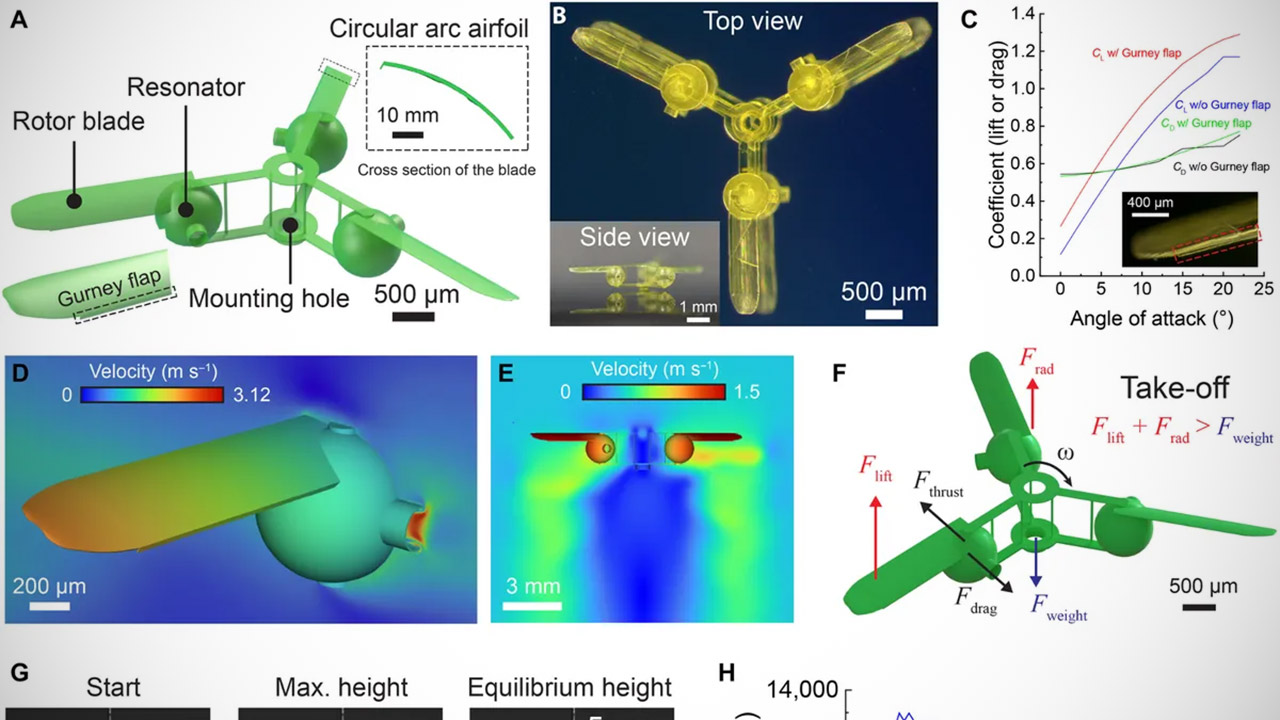
Two different designs have already gone to the skies. The first one resembles a little rocket, with three chambers directed directly down toward the ground. When an ultrasonic field of 40 kilohertz is concentrated on the object, each cavity spits forth a jet of air, and presto!The entire contraption begins to ascend like a small rocket. The thing weighs 150 micrograms and has enough power to hover at nearly a five-to-one thrust-to-weight ratio. In certain lab testing, the device was able to climb a few millimeters into the air before settling into a steady hover with an upward force that properly matched its weight.
The second design adds a variation to the same basic concept. This one has thin blades linked to its chambers. Each resonator is positioned at the base of a curved blade and points rearward. When the matching ultrasonic frequency is detected, the jets begin spinning the entire assembly at a pace of more than 13,000 revolutions per minute. The rotating blades, like those on a helicopter rotor, provide aerodynamic lift, allowing it to stay afloat. In fact, this form of the gadget is slightly more reliable at remaining steady and level because the rotating mass itself is sufficient to prevent tilting.
The control system is also really neat. The concept is that separate cavities can be set to various frequencies. Changing the frequency of the sound input is sufficient to activate only the chosen set of resonators, allowing you to utilize the same external speaker or ultrasonic array to propel, turn, or even stop the item. When the crew tested several of their boats at centimeter scale, they used auditory tones. In one boat, a resonator was utilized to propel it forward and some side-mounted resonators to steer it. All the operator had to do to steer the boat was switch the frequencies, and it would turn around in response. In some later tests, the boats even carried their own little transducers and batteries along for the ride, allowing them to follow programd paths without any external assistance.

One of the most brilliant aspects of this technology is that it operates almost completely silently. Because the only moving parts are the air molecules themselves, the machines make barely a sound when powered by ultrasound, and even when they don’t, the jets themselves make almost no noise at all, at least not enough for human ears to detect.
[Source]
You must be logged in to post a comment Login