Tech
Residential vs Datacenter Proxies: Key Differences

Residential and datacenter proxies do the same basic job of routing traffic through another IP address, but the defining difference is where that exit IP comes from. Datacenter proxies use hosted infrastructure, while residential proxies use addresses associated with consumer internet connections, which can affect performance, availability, cost, targeting, sourcing, and how destinations classify the traffic.
Quick Take
Choose by workload rather than assuming one proxy type is universally better. Datacenter proxies are generally simpler and more predictable when hosted IP space already meets the requirement, while residential proxies make more sense when residential-origin IPs or residential location coverage are specifically needed.
Residential vs Datacenter Proxies at a Glance
The defining difference is the source and classification of the exit IP. The other differences below are common operational patterns rather than guarantees that apply to every provider or workload.
Residential vs datacenter proxy comparison
| Feature | Datacenter Proxy | Residential Proxy |
|---|---|---|
| Exit IP source | Hosted or datacenter infrastructure | Consumer or residential ISP connection |
| Infrastructure | Usually operates on centrally hosted server infrastructure | Often uses a distributed pool of residential connections or devices |
| Performance consistency | Often more predictable because the infrastructure is centrally hosted | Can vary more as residential exit availability and network conditions change |
| Common billing pattern | May be sold per IP, fixed allocation, package, or bandwidth depending on the product | Rotating residential services are commonly billed by transferred bandwidth |
| Session behavior | Can be static, shared, dedicated, or rotating depending on the service | Can rotate between requests or support sticky sessions depending on the service |
| Location availability | Depends on the provider’s hosted infrastructure and available IP inventory | Can provide broad residential location pools, but targeting depth is provider-specific |
| Destination treatment | Some destinations may classify or treat datacenter address ranges differently | Residential IP classification can resemble ordinary consumer traffic more closely, but does not guarantee access |
| Sourcing concern | Focus is mainly on ownership, reputation, allocation, and provider control of hosted IP space | How residential participants or devices enter the network is an additional procurement concern |
| Typical fit | Workloads that value predictable infrastructure, stable endpoints, throughput, and simpler operation | Workloads that specifically require residential-origin IPs or residential location coverage |
Those differences describe tendencies rather than a universal performance ranking. Current provider documentation shows that network source, allocation, rotation, protocol, targeting, and billing can overlap in several combinations.
What Is a Datacenter Proxy?
A datacenter proxy routes traffic through an IP address associated with hosted server infrastructure rather than a normal household internet connection. The proxy may run in a data center, cloud environment, or another provider-controlled hosting network.
The basic route is:
Your application → datacenter proxy → destination
Current Oxylabs datacenter proxy documentation shows a hosted proxy gateway with assigned proxy IPs and both rotating and specific-port access. That is one implementation, but it illustrates why datacenter services are commonly suited to repeatable server-based workloads.
Datacenter does not mean dedicated. A datacenter service can expose shared, dedicated, static, or rotating behavior depending on the provider and product. Those allocation and session choices are separate from the source of the IP itself.
What Is a Residential Proxy?
A residential proxy uses an exit IP associated with a consumer internet service provider (ISP) connection. In many rotating residential networks, the customer’s request enters a provider gateway and exits through an available residential connection before reaching the destination.
The route can look like this:
Your application → residential proxy gateway → residential exit → destination
Oxylabs residential proxy documentation describes its residential service as using IP addresses provided by ISPs and associated with physical devices. That is provider-specific documentation, so it should not be treated as proof that every residential proxy network uses the same sourcing model.
Residential networks can also be more dynamic than centrally hosted proxy infrastructure. Rayobyte’s current residential testing documentation says exit availability, performance, and IP retention can change over time and recommends testing with the real target and configuration.
The Architecture Difference
The clearest way to understand the categories is to follow where the final connection to the destination originates.
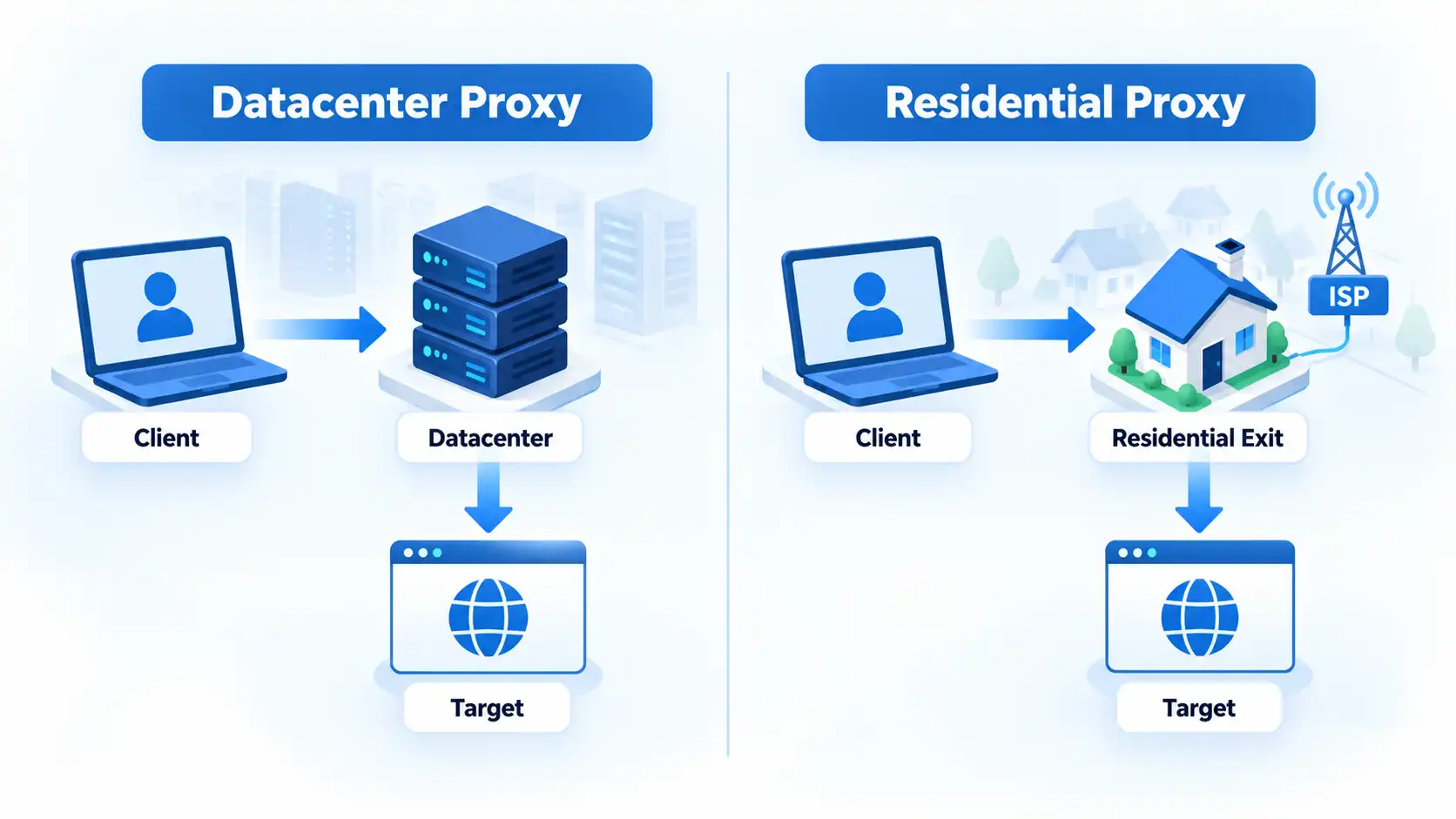

With a datacenter proxy, the exit belongs to hosted infrastructure. With a residential proxy network, the exit is associated with a consumer ISP connection drawn from the provider’s available pool.
This difference can affect how an IP is classified by destination systems, where exits are available, how long a particular IP remains usable, and how consistently the network behaves.
It does not determine everything. Protocol support, request patterns, authentication, session settings, account behavior, browser characteristics, IP reputation, and the destination’s own controls can matter independently.
IP reputation means the historical or risk classification associated with a particular address. A residential address with poor reputation is not automatically more suitable than a well-managed datacenter address simply because one is labeled residential.
The Differences That Matter in Practice
Performance consistency
Datacenter proxies are generally easier to operate when predictable hosted infrastructure is the main requirement. The provider controls the server environment rather than depending on a changing pool of residential exits.
That does not mean every datacenter proxy is faster than every residential proxy. Provider quality, routing distance, congestion, target behavior, and configuration can dominate an individual test. Rayobyte’s current residential guidance explicitly notes that residential availability, performance, and IP retention can change over time.
Cost and billing
Datacenter and residential products are often packaged differently, but the billing model is provider-specific. For example, Rayobyte currently says its static datacenter products include unlimited bandwidth while residential and rotating datacenter products use bandwidth- or usage-based pricing. Its residential service is billed by bandwidth rather than by a fixed number of IPs.
The practical comparison is therefore the cost of the workload you actually plan to run, not a universal assumption that one category is always billed by IP and the other by bandwidth.
How destinations treat the IP
A destination can use IP intelligence and reputation data to identify whether an address is associated with hosting infrastructure, consumer broadband, or another network type. A residential exit may therefore look more like ordinary consumer traffic at the network-classification level.
That does not make residential traffic invisible or guarantee that requests will succeed. Rayobyte’s current testing documentation specifically notes that websites can evaluate request frequency, browser behavior, headers, cookies, account activity, and their own anti-automation controls in addition to the IP address.
Universal claims such as “residential proxies never get blocked” or “datacenter proxies always fail on protected sites” are therefore not supported.
Geographic targeting
Residential networks can be useful when a workload genuinely depends on traffic exiting from a particular consumer location. Some providers expose country, region, city, postal, ASN, or other filters, but targeting depth varies by product.
Oxylabs, for example, currently documents broad residential geo-targeting while its datacenter products use location availability tied to assigned IP inventory. Rayobyte likewise notes that residential targeting becomes less available as location and other criteria become more specific.
Location precision should therefore be verified for the specific service rather than inferred from the words residential or datacenter.
Availability and session persistence
A hosted datacenter IP can remain stable when the product is designed for static use. Residential pools can be more dynamic because an exit may go offline or otherwise become unavailable.
Residential services often provide sticky sessions, which attempt to keep the same exit IP for a defined period rather than changing it on every request. Oxylabs currently documents both rotating sessions and sticky sessions for its residential service, while Rayobyte notes that an individual residential exit can still become unavailable during a session.
Operational complexity
A residential pool can introduce more variables to monitor, including exit availability, session persistence, targeting, bandwidth consumption, and sourcing practices.
A datacenter deployment can be simpler when a fixed or controlled set of hosted IPs already satisfies the workload. The least complex option that meets the actual requirement is usually easier to test, budget, and troubleshoot.
Static, Rotating, Shared and Dedicated Are Separate Choices
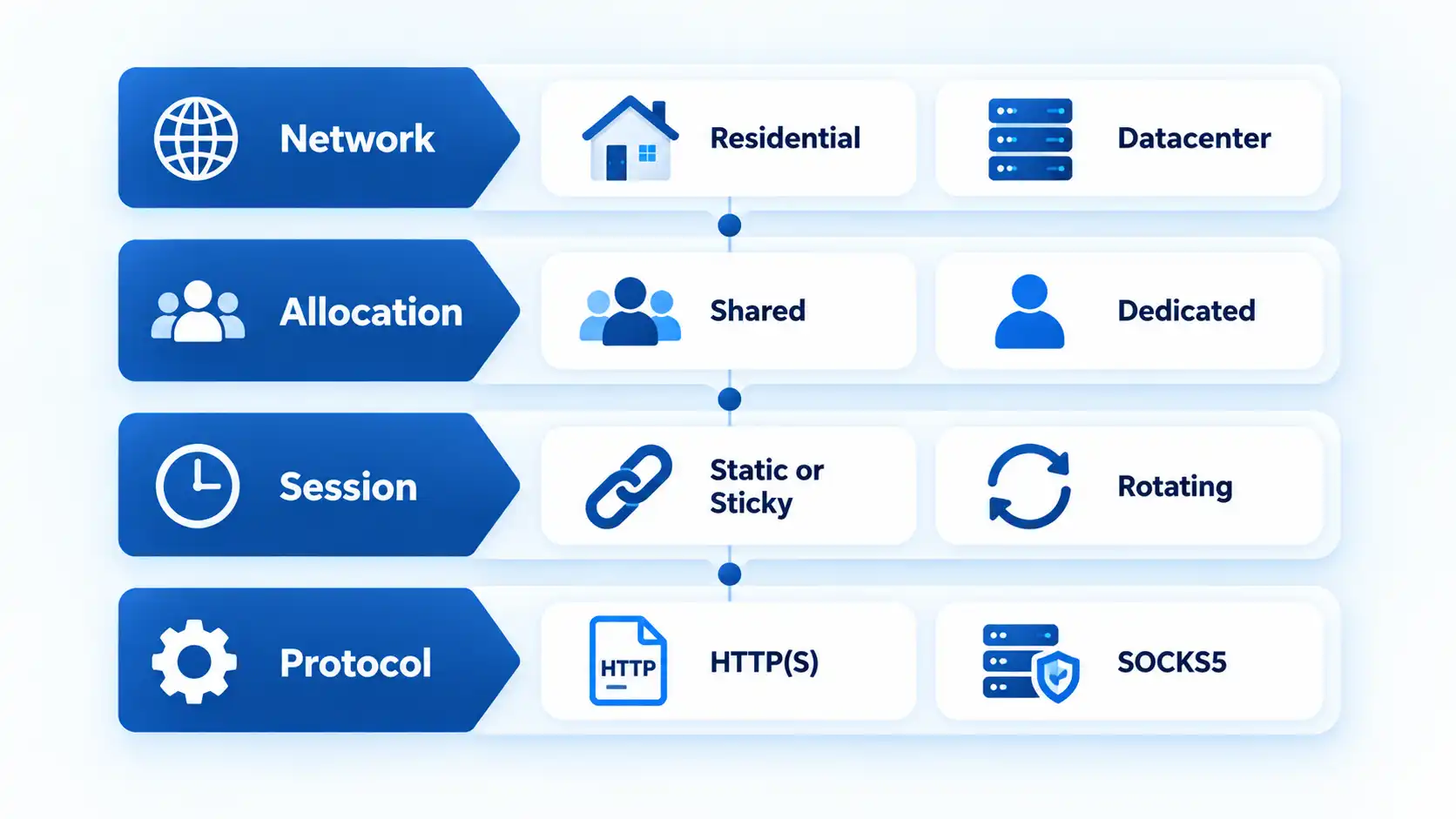
One of the most common classification mistakes is assuming that residential means rotating and datacenter means static. Those labels describe different properties.
Info
Residential versus datacenter describes where the exit IP comes from. Static versus rotating describes whether the exit changes, while shared versus dedicated describes how the allocation is used. These dimensions can be combined in different ways.
Rayobyte currently lists static datacenter, rotating datacenter, residential, static ISP, and rotating ISP products. Its documentation also distinguishes dedicated datacenter and static ISP allocations from rotating products. This shows why rotation should not be used as a synonym for residential. Rayobyte’s current proxy FAQ documents these product distinctions.
The same applies to static vs rotating proxies: session behavior should be evaluated separately from the network that supplied the exit IP.
Where ISP Proxies Fit
ISP proxies complicate the residential-versus-datacenter split because they can combine traits of both. In common industry usage, an ISP proxy uses an address associated with an internet service provider while the proxy infrastructure itself may run on hosted hardware.
Oxylabs’ current ISP versus datacenter explanation says both categories can run on data-center hardware while differing in how the addresses are sourced and registered. That is vendor terminology rather than a universal standards definition, so exact labels can vary between providers.
A comparison of ISP, residential, and datacenter proxies should therefore examine both address classification and the infrastructure behind the service.
When Datacenter Proxies Make More Sense
Datacenter proxies are a strong fit when hosted IP infrastructure already satisfies the technical requirement and there is no specific need for residential-origin traffic.
Examples include:
- repeatable quality-assurance checks against systems you are authorized to test;
- monitoring public endpoints from known locations;
- public-data workloads where the destination accepts the relevant datacenter ranges;
- applications that benefit from stable or dedicated proxy addresses;
- workloads where predictable hosted infrastructure and straightforward capacity planning matter more than residential IP classification.
The failure mode matters too. If the destination treats particular hosting ranges differently or the workload genuinely requires a residential network context, simply adding more datacenter IPs may not address the constraint.
If hosted infrastructure is appropriate, choosing a datacenter proxy provider still involves factors such as location coverage, allocation type, protocol support, IP reputation, billing terms, and workload requirements. The linked page is useful as adjacent purchasing coverage, but its visible update date is December 18, 2022, so it is not used here as evidence for current provider capabilities.
When Residential Proxies Make More Sense
Residential proxies make more sense when the residential origin of the exit traffic is itself part of the requirement rather than simply a feature that sounds more advanced.
Examples include authorized location-sensitive testing, ad or content verification, market research that must reflect residential network locations, and public-data workflows where the destination behaves materially differently for residential and hosted IP ranges.
For data-collection workloads, the role of residential proxies for scraping depends on the target, location requirements, session behavior, throughput needs, and network sourcing. Residential classification should not be treated as permission to access data or as a guarantee that a target will accept the traffic.
Residential infrastructure can also introduce drawbacks. Exit nodes can be less predictable, bandwidth-based billing may matter more for high-volume workloads, session continuity can require sticky-session controls, and buyers need to understand where residential capacity comes from.
Residential Proxy Sourcing and Consent Matter
A residential exit can involve another person’s internet connection or device, so network sourcing deserves scrutiny alongside technical performance.
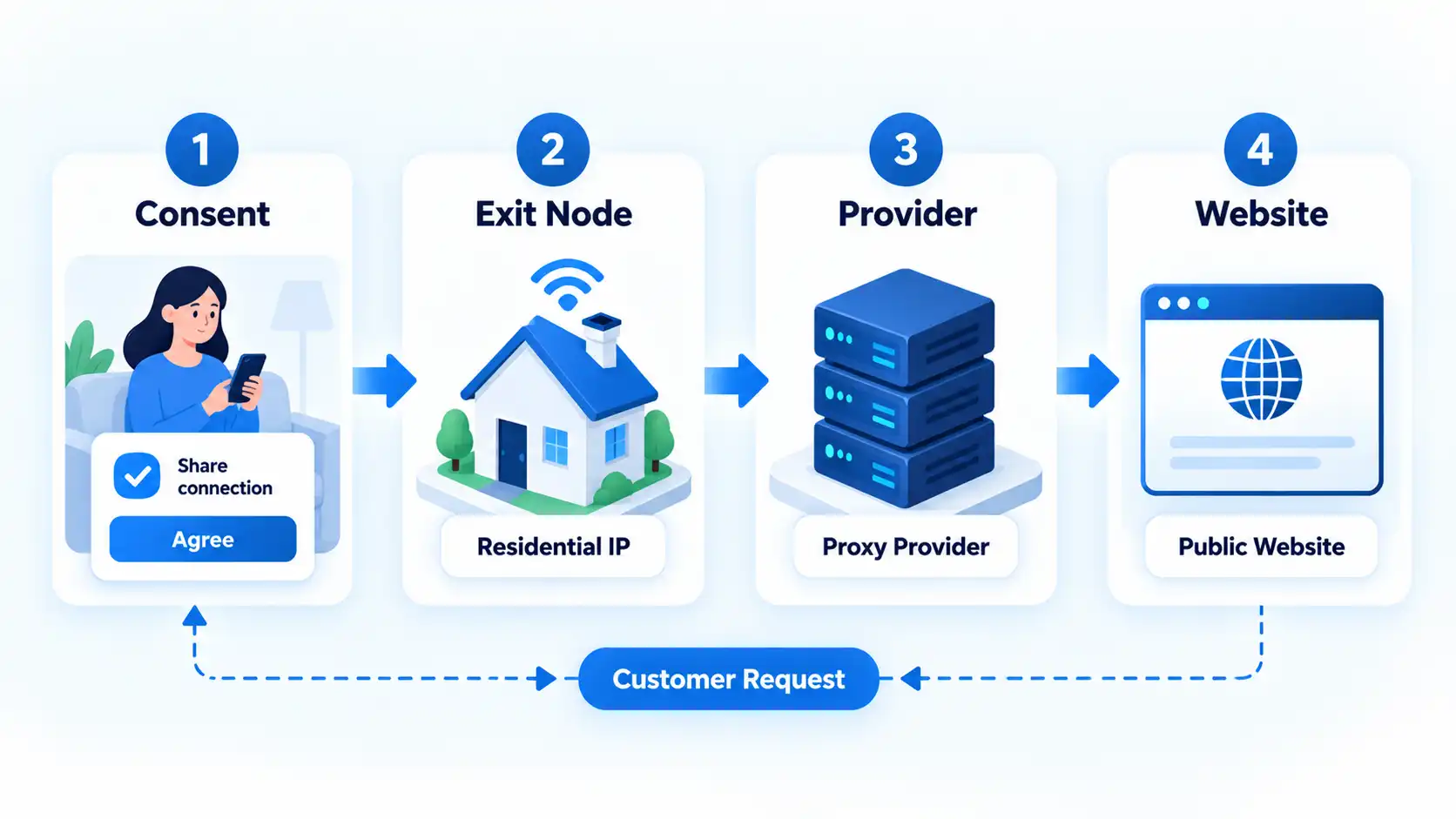
A buyer should ask how people or devices become part of the residential network, what participants are told, whether participation is optional, how they can leave the network, and whether the provider documents its sourcing process.
Bright Data’s residential IP sourcing documentation, for example, says its own partner model requires opt-in, a clear consent screen, opt-out, participation terms, and other controls. Those statements describe Bright Data’s declared process and should not be generalized to every residential proxy network.
This is why residential proxy sourcing and consent should be part of procurement alongside price, locations, protocols, and performance.
Proxy type also does not determine whether a particular use is lawful or permitted. Authorization, applicable law, contract terms, the type of data involved, and the user’s conduct remain separate questions.
How to Choose Between Them
The useful question is not which proxy category is universally better, but what the workload actually requires. Work through the constraints before paying for complexity that provides no practical benefit.
- Start with the required network source. If hosted IP space works, there may be no technical reason to introduce a residential pool. If the workload specifically requires residential-origin traffic, that changes the choice.
- Define the location requirement. Decide whether country-level routing is sufficient or whether finer geographic selection is genuinely necessary.
- Define session stability. Determine whether requests can rotate freely or whether the same exit should persist across a session.
- Estimate traffic and throughput. Compare the provider’s billing model with the amount of data and number of connections the workload is expected to use.
- Check sourcing and reputation. For residential services, investigate how the network is acquired. For either category, assess the reputation and suitability of the IP inventory.
- Test the real workload at small scale. Verify connection behavior, latency, location accuracy, session persistence, and destination compatibility before committing to a larger allocation.
Which option should you choose?
Datacenter proxy
Choose this if: hosted IP infrastructure meets the requirement and you value stable endpoints, predictable operation, throughput, or simpler capacity planning.
Avoid this if: the workload specifically requires residential network classification or the destination treats the relevant datacenter ranges in a way that prevents the authorized task.
Main trade-off: hosted infrastructure can be easier to operate, but its IP space may be more readily classified as datacenter traffic.
Residential proxy
Choose this if: the workload genuinely requires residential-origin IP characteristics, residential location coverage, or testing from consumer-network contexts.
Avoid this if: hosted infrastructure already meets the requirement and the added variability, bandwidth cost, sourcing review, or session complexity provides no practical benefit.
Main trade-off: residential network characteristics can suit some location-sensitive or destination-sensitive workloads, but exit availability and operating complexity may be less predictable.
Bottom Line
Datacenter and residential proxies are not two quality levels of the same product. They are different network-source models with different operational consequences.
Datacenter proxies are often the simpler choice when controlled hosted infrastructure already satisfies the task. Residential proxies are justified when residential-origin traffic or residential location coverage is a real requirement. In either case, session behavior, IP reputation, location support, protocols, pricing, sourcing, and the destination itself can matter as much as the category name.
You must be logged in to post a comment Login