Tech
Routing, Privacy, Trust and Key Differences

A VPN and Tor can both hide your normal public IP address from websites, but they use fundamentally different trust and routing models. A conventional VPN sends covered traffic through one provider-controlled endpoint, while Tor sends traffic through multiple relays so no single ordinary relay normally knows both where the connection originated and which destination it ultimately reaches.
Here, Tor means the Tor network as most people use it through Tor Browser. It does not mean the separate Tor VPN Beta, which the Tor Project currently describes as testing software that should not be relied on for sensitive activity.
Quick Take
- A VPN concentrates an important part of the connection’s trust in one VPN provider. Tor deliberately distributes route knowledge across multiple relays.
- Both can replace the public IP address a normal website sees, but Tor Browser also includes browser-level protections designed to reduce fingerprinting and tracking.
- A conventional VPN is commonly designed to cover broader device or application traffic, while Tor Browser protects its browser traffic by default and other applications require appropriate Tor configuration.
- Neither tool guarantees anonymity if you sign in to identifying accounts, reveal personal information, use a compromised device, or face an adversary outside the technology’s threat model.
VPN vs Tor at a Glance
The easiest way to compare VPN and Tor is to separate routing, trust, browser privacy, and application coverage. Neither option is universally better because they solve overlapping but different privacy problems.
| Feature | VPN | Tor / Tor Browser |
|---|---|---|
| Routing path | Covered traffic is routed through a VPN endpoint operated by the chosen provider or organization. | Traffic is routed through multiple Tor relays before reaching an ordinary internet destination. |
| Trust model | Places substantial routing trust in the VPN operator. | Distributes route knowledge across relays so one ordinary relay does not know the complete path. |
| Public IP seen by website | Normally the VPN server’s public IP for traffic exiting through the VPN. | Normally the Tor exit relay’s public IP for ordinary websites. |
| What the local ISP sees | For covered traffic, typically a connection to VPN infrastructure rather than the final tunneled destination. | When connecting directly to Tor, normally a connection to Tor nodes rather than the final destination. |
| Browser fingerprinting defenses | A VPN tunnel does not provide them by itself. | Tor Browser includes defenses intended to make users harder to distinguish by browser configuration. |
| Typical traffic scope | Can cover broad device or application traffic according to VPN routing policy. | Tor Browser covers its browser traffic by default; other compatible applications require appropriate Tor configuration. |
| Performance profile | Uses an additional VPN route and endpoint; performance depends on server, route, protocol, and network conditions. | Can add latency because traffic passes through multiple volunteer relays and is affected by network load and route conditions. |
| Onion-service support | Not a normal VPN function. | Tor Browser can access onion services through the Tor network. |
| Primary privacy model | Encrypted client-to-VPN transport plus an alternate network exit under a chosen provider. | Distributed onion routing plus Tor Browser privacy defenses. |
The table shows why “which one hides my IP?” is too narrow a comparison. Both can change the address a destination sees, but the more consequential difference is which parties can observe the user, the route, and the destination.
The Biggest Difference Is Where You Place Trust
A conventional VPN primarily changes the network intermediary you rely on. Your device establishes an encrypted tunnel to a VPN server, and covered traffic exits through that provider’s infrastructure before continuing toward its destination.
Cloudflare’s VPN explanation describes the client-to-server encrypted tunnel and the VPN server’s role as the network endpoint visible to destinations. The useful privacy question is therefore not whether a VPN removes trust, but whether you are comfortable placing that routing role with the VPN operator.
Tor takes a different approach. The Tor Project explains that ordinary Tor traffic passes through multiple relays, with layered encryption and different information available at each position. Its comparison with one-hop proxy services says Tor normally routes traffic through at least three servers before the destination.
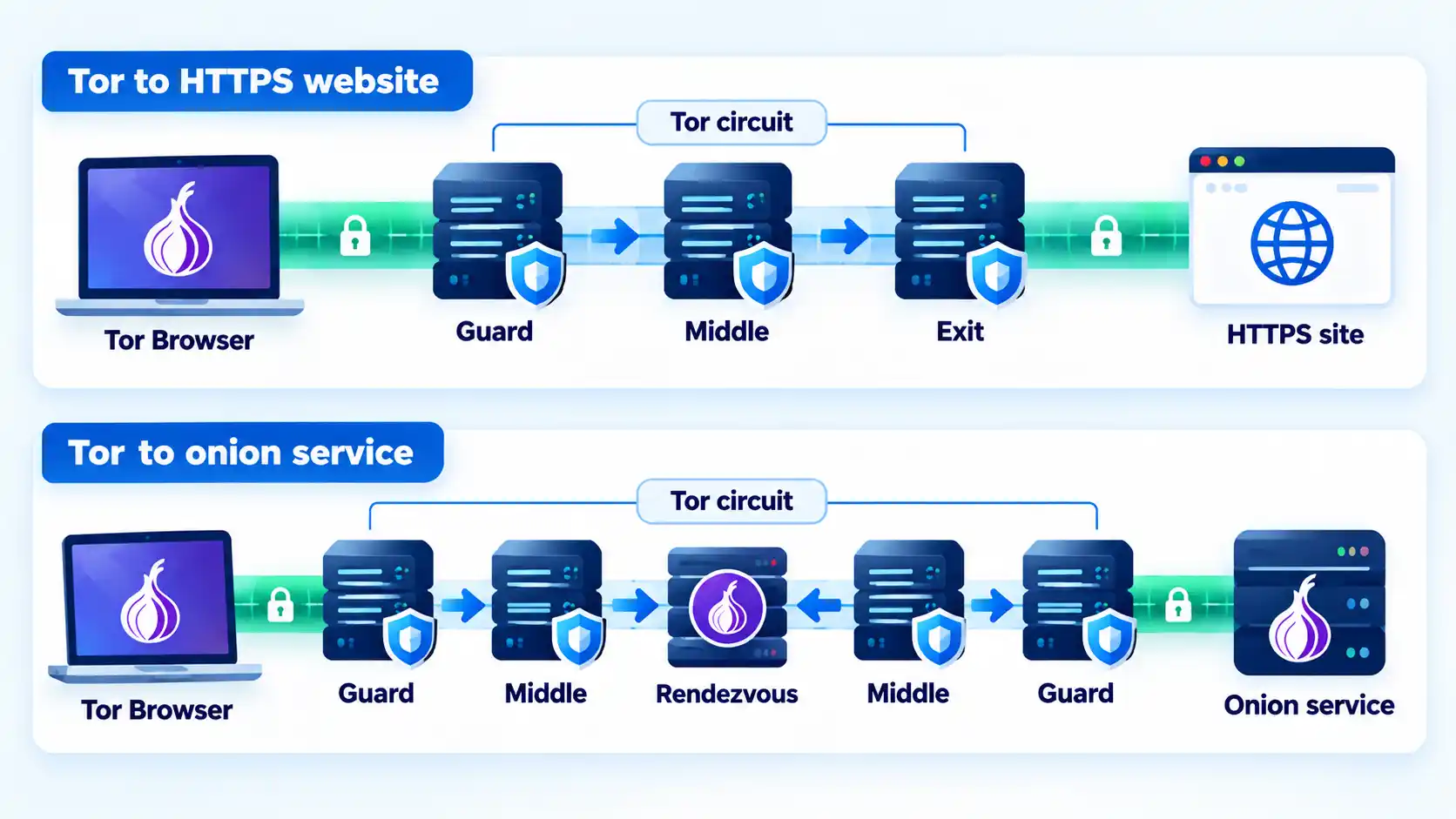
For an ordinary web circuit, the first relay is the guard or entry relay. It receives the user’s connection but does not know the final destination. A middle relay connects adjacent parts of the circuit. The exit relay connects to the ordinary public internet but does not receive the user’s original public IP as the source of that exit-side connection.
The Tor client also negotiates separate encryption keys for each hop. The Tor Project’s technical overview of Tor circuits explains that each relay knows only its adjacent hops rather than the complete route.
Info
A VPN concentrates an important part of the route in one provider. Tor deliberately distributes route knowledge across multiple relays. That does not make Tor invulnerable, but it removes the ordinary requirement that one routing intermediary know both the incoming user connection and the final destination.
If you are comparing single-intermediary routing models, the distinction between a proxy and a VPN provides useful context. Tor differs from both by deliberately distributing the route across multiple relays.
What Your ISP, VPN Provider, Tor Relays and Websites Can See
Privacy claims make more sense when you identify the observer instead of asking whether traffic is simply “hidden.”
With a VPN
Your internet service provider still carries the connection to the VPN infrastructure. For traffic actually routed through the VPN, the ISP sees that VPN connection rather than directly carrying each covered connection to its final website.
The VPN operator occupies the next major trust position because traffic reaches its infrastructure before exiting toward internet destinations. A website normally sees the VPN server’s public IP address for traffic leaving through that endpoint.
HTTPS remains a separate protection layer. A VPN tunnel can end at the VPN server while an HTTPS connection remains encrypted between your browser or application and the website.
With Tor
The Tor Project says that when you connect directly to Tor, a local internet provider or other local observer can normally tell that you are communicating with Tor nodes but does not receive the final browsing destination from the normal Tor route. Websites instead see a connection coming from the Tor network rather than from your normal public IP. Tor’s protection overview explains this separation through its multi-hop routing model.
The guard relay sees the incoming client IP because it receives the connection. The exit side knows which ordinary internet destination it connects to. The design goal is that one ordinary relay does not receive both pieces of information as part of normal circuit operation.
This is why statements such as “Tor relays cannot see anything” are inaccurate. Each relay has information required for its role; the protection comes from separating those roles.
A useful follow-up distinction is what your ISP can see with Tor or a VPN, because local-network visibility and destination-side visibility are different parts of the same connection.
Privacy Is Not the Same as Anonymity
Neither VPN routing nor Tor routing prevents you from identifying yourself voluntarily.
If you sign in to an email account connected to your real identity, the service can still associate the session with that account. The same applies if you submit your name, phone number, address, payment details, or other identifying information.
The Tor Project makes this boundary explicit. Its Tor Browser safety guidance says perfect anonymity cannot be guaranteed and explains that signing into a website or supplying personal information identifies you to that service even though Tor may still hide your normal network location.
A conventional VPN has another limitation: its network tunnel does not automatically change the browser environment. Cookies, signed-in sessions, extensions, fonts, screen characteristics, and other browser signals can remain available to websites even when your public IP changes.
IP privacy is therefore only one part of online identifiability.
Tor Browser Adds Protections a VPN Tunnel Does Not
Browser fingerprinting combines observable browser and device characteristics that can help distinguish one browser from others. Signals may include operating-system information, fonts, browser capabilities, extensions, screen characteristics, cookies, and other state.
A VPN tunnel does not standardize those properties. Its primary function is network tunneling and routing.
Tor Browser is designed around a broader browser-privacy model. Tor Project documentation says the browser is modified to prevent or reduce several forms of identifying leakage and to make Tor users look more alike.
The distinction is important enough that the Tor Project strongly recommends against using ordinary browsers as substitutes for Tor Browser. Its current guidance specifically warns about real-IP exposure through DNS or WebRTC, fingerprinting through operating-system details, fonts and plugins, and persistent tracking state such as cookies and cache.
This does not mean Tor Browser makes every user indistinguishable under every circumstance. It means its privacy model includes browser-level defenses that a VPN tunnel by itself does not provide.
The same distinction explains why Tor Browser and private browsing should not be treated as equivalent simply because both can limit some browsing state.
Where Encryption Starts and Stops
Both VPN and Tor comparisons become misleading when “encrypted” is treated as one uninterrupted property from the device to every destination.
VPN encryption
A conventional VPN protects covered traffic inside its tunnel between the VPN client and VPN endpoint. After that point, the application’s own protocol determines what protection continues toward the destination. For ordinary modern web browsing, HTTPS can independently protect the browser-to-website session even though the VPN tunnel itself ends at the VPN server.
Tor and ordinary websites
Tor applies layers of encryption inside its relay circuit, but an ordinary website reached through an exit relay still relies on destination-side encryption such as HTTPS to protect application data on the public-internet side of the route.
The Tor Project’s Tor and HTTPS explanation treats the two protections separately. Tor changes network routing and conceals the user’s normal public IP from the destination, while HTTPS protects data exchanged with an HTTPS website.

Onion services use a different path
An onion service does not use the same public-internet exit pattern. The Tor Project’s onion-service documentation explains that both the client and service establish Tor circuits and meet through a rendezvous point, while onion-service traffic is encrypted between the client and onion host.
A `.onion` service is therefore not simply an ordinary website viewed through a Tor exit. The service connection remains inside Tor rather than emerging through a public exit relay to reach an ordinary public web server.
Tor Distributes Trust, but It Still Has Limits
Tor’s distributed design prevents one ordinary relay from simply receiving the complete source-and-destination relationship, but that is not the same as protection against every possible observer.
The Tor Project explicitly documents traffic-correlation and timing attacks as a remaining limitation. An observer capable of seeing both the user’s side of a connection and the relevant destination or exit side may compare timing patterns. Tor’s documentation on remaining attacks states that Tor does not defend against an observer that can see both ends of the communication channel.
That limitation does not make the relay architecture meaningless. It defines the threat model. Tor still prevents ordinary single relays, destination websites, and local network observers from automatically receiving the complete source-to-destination relationship.
Tor can also lose anonymity through application behavior rather than a break in onion routing. The Tor Project notes that circuits may carry multiple TCP connections, so mixing anonymous and identifying traffic or using applications carelessly can create additional correlation risks.
The more detailed architecture behind Tor guards, middle relays, exit nodes, and onion routing explains why these protections and limitations follow from the network design.
VPN vs Tor for Speed and Everyday Compatibility
A VPN and Tor both alter the normal network path, but they do so differently.
A conventional VPN generally sends covered traffic through one VPN endpoint before forwarding it toward the destination. Real performance depends on factors such as server location, congestion, protocol, route quality, device limits, and the underlying internet connection. If a VPN is unusually slow, VPN slowdown diagnosis works best by comparing the same connection with the VPN off and on before changing several settings at once.
Tor routes traffic through multiple volunteer relays. The Tor Project says Tor Browser can sometimes feel slower because traffic passes through relays in different locations and performance depends on network load and latency. It also notes that users may not always notice a meaningful speed difference.
The distinction matters most for workloads that are sensitive to latency. Interactive voice, video, gaming, and similar applications may react more strongly to additional delay than ordinary page loading, although actual results depend on route and network conditions.
Application coverage also differs. Many VPN clients are designed to route broad device traffic according to their routing policy. Tor Browser is configured for safe web browsing through Tor by default. Core Tor can be used by other compatible applications, but the Tor Project says it has not researched safe anonymity configurations for every program and recommends Tor Browser for normal browsing.
Tor should therefore not be reduced to “a slower VPN.” Its extra relays and application constraints follow from a different privacy architecture.
Should You Use a VPN and Tor Together?
Not by default.
Combining two privacy technologies does not automatically create stronger privacy. It changes which parties occupy different positions in the connection, introduces additional configuration, and can create new failure modes.
The Tor Project’s current Tor Browser known-issues guidance says VPNs tend to interfere with Tor and does not recommend using VPN and Tor together unless the user is advanced and understands how to configure both without compromising privacy.
There is therefore no general rule that stacking the technologies provides “double anonymity.” Whether a combined design changes privacy in a useful way depends on the exact routing arrangement, threat model, VPN operator, and configuration.
This comparison does not provide VPN-over-Tor or Tor-over-VPN configuration instructions. Those designs require a more specific threat model than the general comparison here.
Which option should you choose?
VPN
Choose this if: you want broader device or application traffic routed through an encrypted client-to-server tunnel, ordinary application compatibility matters, and you are prepared to place substantial routing trust in the VPN provider or organization operating the endpoint.
Avoid this if: your main privacy requirement is to avoid relying on one routing operator that occupies both the incoming client side and the outbound destination side of the VPN path.
Main trade-off: broad traffic coverage and simpler application compatibility come with a concentrated provider trust relationship, while the VPN tunnel itself does not provide Tor Browser’s anti-fingerprinting defenses.
Tor / Tor Browser
Choose this if: distributing route knowledge across multiple relays matters to your threat model, browser-level anti-fingerprinting protections are important, or you need access to onion services without relying on one VPN operator for the full route.
Avoid this if: your primary requirement is straightforward coverage for arbitrary device applications or a workflow that depends heavily on low latency and does not fit Tor’s application model.
Main trade-off: Tor reduces reliance on a single routing intermediary but introduces a multi-relay route, application constraints, and an anonymity model that still depends on how you use Tor Browser and what information you reveal.
Bottom Line
VPN and Tor overlap in one visible result: either can cause a normal website to see an address other than your ordinary public IP. Their privacy architectures are otherwise substantially different.
A conventional VPN gives you an encrypted path to one VPN endpoint and asks you to trust the operator occupying that position. Tor distributes route knowledge across multiple relays and, when used through Tor Browser, adds browser-level privacy defenses that a VPN tunnel alone does not provide. The useful choice depends on your threat model, application needs, tolerance for latency, and whether concentrating or distributing network trust better matches the problem you are trying to solve.
You must be logged in to post a comment Login