Connect with us
DAPA Banner
DAPA Coin
DAPA
COIN PAYMENT ASSET
PRIVACY · BLOCKDAG · HOMOMORPHIC ENCRYPTION · RUST
ElGamal Encrypted MINE DAPA
🚫 GENESIS SOLD OUT
DAPAPAY COMING

Tech

Running on Steam in a literal sense

Published

on

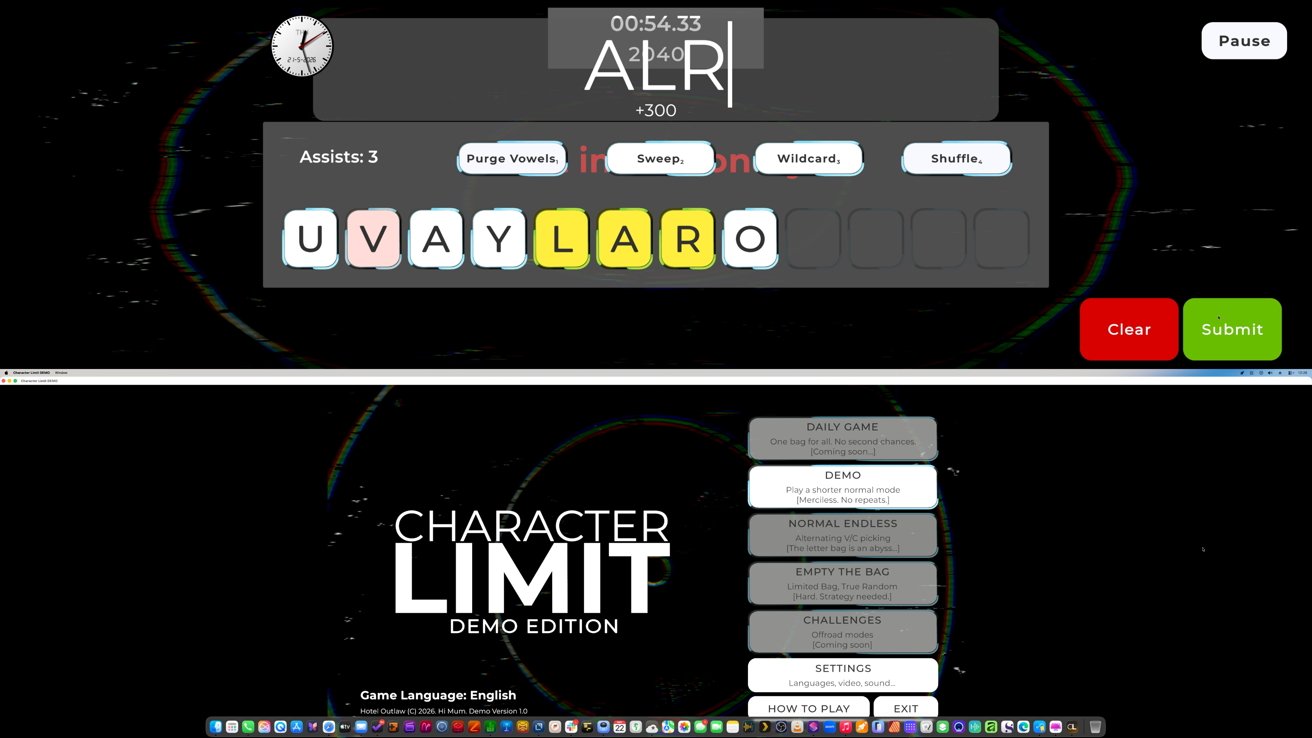
I slipped under the wire and got a demo of “Character Limit” submitted to Steam just in time. Now for the stressful part: It’s live in Steam Next Fest.

In April, the development of Character Limit had reached a point where it could be tested by actual players. It did fantastically well at Dreamhack Birmingham, and I had also started doing testing on iPhone and iPad with Testflight.

However, later that month, registration for something known as Steam Next Fest was coming to a close. It’s a promotional festival held a few times a year, focused on getting players to try out demos for games that have yet to be released.

Since I want the game to be completed long before the busy fall iPhone season, that meant the next Next Fest I could take part in was in the middle of June. I figured there was plenty of time to get the Dreamhack demo to a better and more robust state, so it could be downloaded to players’ computers to try out.

Advertisement

But, since WWDC was also happening the week before Next Fest, that meant I would face a busy time here at AppleInsider, which would impact any development.

So, the decision was made to leave the Testflight build ticking along on iPhone, and to return to it when the game is in a much better place. Instead, I allocated my time to focus just on the Mac and PC demo.

It was both a very good and very stupid decision.

Fixing the demo

Getting the demo working as perfectly as possible for Next Fest wasn’t just to ensure the game got more promotion through a major digital storefront. It also forced me into shoring up the demo so it could be used by the actual public.

Advertisement

So far, the game was made with my hardware and setups in mind. To make it work for practically any player in the world, I had to make sure anything that would break or be an edge case was handled gracefully, since any combination of hardware would be thrown at it.

Cue a few weeks of fixing bugs in number distribution, making an actual tutorial screen, and localization foibles that I had missed before.

It was then sent to some colleagues and friends for testing. And I’m glad that I did.

An edge case I didn't consider, and the fix. Image credit: William Gallagher

An edge case I didn’t consider, and the fix. Image credit: William Gallagher

Advertisement

William Gallagher of this very site tried the game demo out. Partly because I had to work out how Xcode notarization worked, which was tricky but not difficult.

It turns out that William has an insane display ratio because he uses an ultrawide screen. Due to the way the game functioned, playing full-screen meant you missed the bottom and top sections of the interface.

For a word game, it helps if you can see the letters you’re turning into words. Or even just see the Quit button on the main menu.

This was fixed quickly by making a floating section of the interface that was the correct aspect ratio, that would be visible in the middle of the screen when viewed by an ultrawide. All the content of the game would then be put into that box, similarly anchored to the center.

Advertisement

This worked surprisingly well and was practically the last stumbling block for the demo itself.

While not everything has been fixed, it’s just got enough “done” to be usable as a proper demo.

As a consequence, I have many changes to transfer from the demo into the full game. It’s work I would’ve had to do anyway before release, so doing it all now rather than later was a good move.

Steam pains

While making the game and working with Apple’s Notarization system is one battle, Steam is quite another.

Advertisement

The tricky process of setting up a Steam page for the game has already been done. While you can set up a separate store page for a demo, you could also just add the demo download button to the main sales page.

There are reasons to go either way, but I went with the one main sales page approach. Partly because it would focus traffic onto that one page, partly from laziness.

However, for some reason, Steam requires you to submit effectively everything you would need for the separate store page for the demo, even if it doesn’t exist. That includes the text for the page, which I had to write.

Other elements make sense, like platform specifications, capsule art images, and the name, since they would be used elsewhere.

Advertisement

Then it came time to upload the demo, which led to a multitude of problems.

The first issue was administrative, as I previously had to transfer the game from one Steamworks account to another, due to having signed up wrongly to begin with.

A personal account and one owned by a limited company differ in many ways, which meant a second account had to be made and the store listing transferred over.

It turns out that you can transfer the game as one listing, but the demo is a separate listing and doesn’t necessarily get transferred over with the main title. I spent so long failing at uploading the demo because of this missing element, and then I had to wait most of a week for it to transfer.

Advertisement
Screenshot of a desktop backup application window showing job configuration fields, source and destination file paths, options for filters and encryption, and buttons for saving or cancelling the backup job

There’s a graphical SteamPipe interface for Windows, but you’re stuck with the Terminal on macOS for some reason…

The second problem is Steam’s uploading system. There is an option to do so from the website, but there’s no documentation explaining how to use it properly, so it was a no-go.

The usual way is a SteamPipe upload, using the Steam SDK. This is a process that involves a ton of work, including installing a command-line version of Steam, constructing a build and an upload script, and then setting the launch options.

I understand fully that this is a system designed more for the big developers with massive teams and people who truly know what they’re doing. For a first-time indie, this is massively intimidating.

Advertisement

That is, until you realize that the SDK download includes a graphical interface that does a lot of the heavy lifting for you. Except it’s Windows-only and not available on the Mac.

I had a Windows PC nearby, so it wasn’t a difficult procedure. But it is disheartening that there’s not a macOS graphical interface available from Valve.

After getting the game demo uploaded, both it and the store details were submitted for review. The demo was apparently fine and dandy, but the store section was not.

Apparently, while you’re encouraged to make the images of the capsule art be different so that players can tell the demo apart from the main game, you also cannot add more words to the art other than your game name.

Advertisement

They objected to me using the words “Demo Edition” in the art. Also, my logo was being covered by a demo corner banner that wasn’t really mentioned previously.

Sure, my mistake for not fully understanding. It meant some tweaks and a few more days of waiting for a re-review and eventually being accepted.

On June 9, the second day of WWDC, Steam’s email confirmed that the store page met its requirements, and that the demo could be published. That evening, Character Limit became available to play in demo form on Steam.

Happiness and trepidation

I have written before about how Steam is a big deal for me. As a gamer with a Steam account value that could buy a reasonably priced car at current prices, I am very familiar with Steam,a nd have used it for many, many years.

Advertisement

Registering and having a Steam listing for something that I made was an emotional experience. Just that hit hard.

I didn’t expect putting the demo live to hit even harder.

I can now open my Steam library on my Mac and see “Character Limit Demo” on the long list of (mostly unplayed) games. I can now click it and open the game on my Mac or my PC.

Seeing it on there did actually make me weep a little bit. A stupid little game that I have been noodling on for most of a year is now in an application I regularly open up.

Advertisement
Steam desktop client window showing the Character Limit game page, with dark interface, game banner at top, community tabs, play button, and navigation sidebar listing various games on the left

Seeing the demo in Steam was a big deal.

It’s probably a feeling that authors get when they see their work on Amazon or in their local bookstore. Except it’s a game and I can’t walk into a physical location and hold the game in amazement.

After walking around the block for some air, I checked it ran OK, and it does.

This was an extremely big and happy moment for me. But it was cut short with the daunting realization that this isn’t the finish line.

Advertisement

The rest of the game has to be put into place for the final version. Research into more languages and modes for future updates, too.

Then there’s the ever-continuing slog of marketing and promotion before the game’s release. That’s an inevitability.

But, more immediately, there’s the fear that the demo will not be well received by anyone. The last thing anyone creating anything needs is for people to complain about your baby, even if it’s entirely justified.

Writing on the Internet for over a decade certainly gives you a thick skin for criticism of your words. But this is a level of apprehension and worry that I’ve not had to deal with in a very long time.

Advertisement

That’s not even taking into account the eventual battle to get the finished product in the App Store. That’s next.

Here’s hoping Gabe Newell’s money-generator audience is somewhat kind during this week’s all-important Steam Next Fest.

Source link

Advertisement
Continue Reading
Click to comment

You must be logged in to post a comment Login

Leave a Reply

Tech

Trump’s ‘Made In the USA’ Phone Is Just a Reskinned HTC U24 Pro

Published

on

Longtime Slashdot reader necro81 writes: The heavily promoted, $499 T1 “Trump Phone” was originally said to be “Made in the USA” and ship in September 2025. Later, that was downgraded to “Assembled in the USA.” Given the Trump Organization’s lack of engineering or supply chain expertise, many assumed the “T1” would just be a private-label phone made by someone else. After a number of delays, the first phones are finally shipping.

iFixit has performed a teardown and concluded that the T1 is a just gold-painted 2024 HTC U24 Pro — a device from a Taiwanese company, probably using mainland China design and supply chains. In collaboration with NBC News, the iFixit team examined both phones using CT scans, side-by-side teardowns, and even reassembled a working T1 using a U24 Pro main board. As for “assembled in the USA,” that may be true, in the same sense that your phone’s repairman can “assemble” a phone from a handful of subassemblies sourced from someone else. Or it may have been assembled in Guangdong, China like the other U24 Pros.

iFixit sums it up: “What you have is not an ‘American-Proud Design,’ but a phone designed in China, made in China, with the vast majority of parts sourced from China. I’m failing to find any stirring of American pride within me. I’ve certainly felt it before, so I can confirm that it is absent at this time.” Quinn Nelson of Snazzy Labs on YouTube also published a comprehensive video of his experience ordering, unboxing, and tearing down the phone. “From pre-order emails landing in Gmail spam thanks to botched DMARC records, to paying for the $47.45 Trump Mobile 47 Plan over the phone, the entire buying experience was a disaster worthy of its own review,” writes Nelson.

Source link

Advertisement
Continue Reading

Tech

How Lorong AI is shaping Singapore’s AI ecosystem

Published

on

[This is a sponsored article with the Singapore Government Partnerships Office.]

Singapore’s push in artificial intelligence (AI) has accelerated in recent years, with adoption expected to contribute billions to the economy.

To unlock this potential, the government is creating spaces that bring together industry, researchers, and public sector players to collaborate, innovate and share knowledge. 

One such initiative is Lorong AI, launched in Jan 2025 by the Ministry of Digital Development and Information (MDDI). The hub provides a collaborative space for practitioners across sectors to connect, exchange ideas, and partner on AI projects.

Advertisement

Lorong AI has been operating as a pilot initiative at a WeWork co-working space at Cross Street over the past year. There is an activity held almost every day of the week, and in Feb 2026, Lorong AI expanded its operations to a larger space at Vidacity in one-north. 

This expansion comes at a pivotal time, as Deputy Prime Minister Gan Kim Yong recently announced on Mar 2, 2026 that Kampong AI—Singapore’s first AI park combining work and living spaces—will be developed at one-north by 2028.

Vulcan Post went down to the new Lorong AI site at one-north to find out more about how Lorong AI is trying to bring people in the industry, as well as other sectors, together. 

Lorong AI was inspired by large tech hubs overseas

Speaking to Vulcan Post, Edmund Zhou, director-in-charge of Lorong AI, shared that the idea for the hub came about following a visit by MDDI officers to large tech centres like Silicon Valley and Dubai’s Area 2071, a few years ago. 

Advertisement

What they observed at these hubs was not just the presence of capital or talent, but people running into each other, conversations spilling beyond scheduled meetings, and communities forming around shared problems. Natural partnerships emerged from purposeful and incidental interactions.

Neural Networking at Lorong AI./ Image Credit: Lorong AI

This gave inspiration to open a place in Singapore where ideas and collaborations on AI can flow as freely as “conversations down an alley.” The name “Lorong AI” was chosen to reflect this vision—a local flavour for a space where people could gather to find out “what the word on the street is” about AI.

“If you are a practitioner, you can easily relate to some of the interesting things happening here,” Zhou said. “And if you are someone looking to explore, adopt, or just learn more about AI, this can also be a place for you.” 

Lorong AI’s events can attract hundreds

AI Wednesdays on Agents and Governance./ Image Credit: Lorong AI

Lorong AI started with trialling weekly ‘AI Wednesdays’ in 2024, before opening it up to the general public. 

AI Wednesdays was created for public officers, and led by scientists, engineers, and researchers, covering various topics from technical deep dives on model development to discussions on emerging industry trends. 

As the scope of engagement grew, programmes like ‘Co-working Mondays,’ ‘AI ToolsDays,’ ‘ThursTalks’ and ‘Fri-DIYs’—were added to the programming for the week, with the latest addition of ‘Out of Lorong Experiences’ and ‘Gotong Royong.’ 

Advertisement

“No two days are the same, as with every week,” said Assistant Director of MDDI, Muhammad Zahari bin Abu Talib, who is also one of the MDDI officers who oversees Lorong AI’s daily operations. 

Of course, participant demographics expanded as well. Lorong AI now sees practitioners, industry players, and curious newcomers all coming together to learn from each other and explore potential collaborations. 

The Co-Creation Playbook: Prompt-to-Partnership with Figma./ Image Credit: Lorong AI

Although Lorong AI’s initial WeWork space at Cross Street could only seat 70 people, talks by industry leaders from companies like OpenAI, Manus and Figma frequently attract over 100 attendees, far exceeding its capacity.

While the team invites companies to share their insights with the community, they draw firm lines to ensure the collaborative space isn’t used as a channel for product promotion. This keeps the focus on genuine knowledge-sharing and partnership-building.

The importance of face-to-face interactions

At Lorong AI’s newest one-north space, the team foresees more exciting events, workshops, and hackathons to come with its larger 140-person seating space.

Advertisement

It is intentionally designed as an open-concept space, which encourages informal conversations in which anyone can chime in, catalysing future collaborations. 

OpenAI Codex Hackathon./ Image Credit: Lorong AI

Small, tangible details—like member lanyards or a board showing who’s around—make it easier to spot each other and start talking. With so much AI talent in one place, those casual interactions can quietly grow into new ideas and unexpected partnerships.

While it may seem ironic for a tech-driven initiative to emphasise physical space, the team believes that face-to-face interaction is essential for building the trust that drives partnerships. “If it’s purely virtual, a lot of things seem a little bit more transactional, and then the communication somehow lacks a little bit of the human touch,” Zhou noted. 

In addition, if an individual ever needs help in any area, the Lorong AI team would suggest companies or individuals with expertise and link them up.

From conversations to concrete outcomes

In 2025 alone, Lorong AI saw 4,000 attendees across its events. It now has over 260 paying members, about two-thirds of whom are AI practitioners, with the remainder comprising researchers and curious newcomers working on products or programmes.

Advertisement

Besides locals, there have been transient visitors from overseas, who, on their pit stops in Singapore, give talks at Lorong AI’s programmes. 

Prof Torsten Hoefler’s sharing on AI for Climate Sciences./ Image Credit: Lorong AI

Impressively, more than 14 collaborations have sprouted from discussions at Lorong AI. The team’s goal is simple: “We are trying to increase the number of collisions through both engineered interactions via events and incidental interactions through co-working.”

For example, Zhou shared that a group of members who were comparing AI models ended up collaborating and publishing a research paper together. The paper, co-authored by responsible AI and cybersecurity experts, focused on detecting and disrupting hostile AI agents. 

Another instance saw an individual with a limited AI background come into Lorong AI, thinking of ways to launch a business. Through involvement in the community, they acquired the skills and knowledge needed to develop an AI coach for physical fitness.

Lorong AI as a foundational piece of the bigger AI puzzle

ThursTalks sharing on Personalised Computing with Hui Chien./ Image Credit: Lorong AI

Loy Hui Chien, one of the first distinguished contributors, shared that having a space like Lorong AI is vital to the AI scene in Singapore. 

As someone who doesn’t work in the technology space, he has found the community at Lorong AI to be pivotal to his AI journey, from self-learning fundamentals to building a research agent that can curate sources and produce reports in minutes. 

Advertisement

Especially for a small country like Singapore, we can do more with (more) synergy fostered amongst the AI community in spaces like Lorong AI.

Loy Hui Chien

Zhou, who has been closely involved in the initiative, sees it as a reinforcing loop: the more value participants derive from the space, the more like-minded individuals it attracts.

As Singapore positions itself in the global AI race, Lorong AI aims to play a role in building the collaborative networks that will drive the nation’s AI future.

Lorong AI will play a contributing role [to support Singapore’s AI landscape]. What we hear from people who come is that they appreciate having a community they can turn to.

Edmund Zhou

Advertisement

This vision of creating collaborative spaces extends beyond Lorong AI to initiatives like the upcoming Kampong AI, further cementing Singapore’s commitment to partnership-driven AI development.

In a domain defined by algorithms and automation, Lorong AI is betting that the real differentiator may still be something fundamentally human: the power of conversation.

You can find out more about Lorong AI here, and sign up for programmes through this link

Inspired by Lorong AI’s community-driven approach? Beyond project guidance, the Singapore Government Partnerships Office has launched a new SG Partnerships Fund to support citizen-led initiatives at different stages of development.

Advertisement

Featured Image Credit: Lorong AI

Source link

Advertisement
Continue Reading

Tech

How to run Minecraft: Bedrock Edition on Mac

Published

on

Playing Minecraft is better with Bedrock, but it’s not directly available for macOS. Here’s how to get around the limitation and improve your building experience.

Minecraft is one of the longest-running online games that is still actively being played by a lot of people. Originally playable since 2009 and officially released in 2011, it has stood the test of time.

However, while it has been improved over the years, Mac gamers have missed out on one important update: Bedrock Edition. It’s a version that is available on many other platforms, but never made its way to macOS.

Though you can continue using the original Java version on Mac, it is possible to get Bedrock working. It takes a little work, a GitHub project, and buying the game from the Google Play Store.

Advertisement

What is Minecraft Bedrock?

The original version of Minecraft was made in Java, which enabled it to be easily ported to multiple platforms without much trouble. It’s also a version that is very easily modded by the community, without necessarily requiring permission from Microsoft beforehand.

However, the Java edition has a key issue, in that it’s not natively built for any specific platforms. It wasn’t really intended to build a game as complex as Minecraft at all.

As an interpreted language, Java has to be compiled into an intermediate “bytecode” format before being run by a Java Virtual Machine. This just-in-time interpretation means that processing performance is impacted directly compared to a compiled native version.

There is also the issue of the earliest iterations of Minecraft being developed by Markus “Notch” Persson, and later by his studio, Mojang. Eventually, Microsoft got involved with its purchase of the studio in 2014.

Advertisement
Man in glasses onstage beside large screen showing Minecraft city scene with tall blocky buildings, trees, villagers, and cloudy sky, suggesting a presentation about the game or technology

Tim Cook introduced Minecraft on Apple TV in 2016. It survived until 2018.

Since it was made by Notch alone at first, it meant that there were elements of code that he would be able to manage, but a team of developers would struggle with. After years of development, there was enough technical debt to prompt a rethink by those managing the game.

Cue the development of a C++ version, which started off with a demo of Pocket Edition in 2011. Over time, the codebase was expanded and improved upon, until it was rebranded as Bedrock Edition in 2022.

With that change, it became a more widely available version, including a release for Windows. The change also made it possible to create versions of Minecraft for other platforms, and for the games to more easily communicate with each other between different platforms.

Advertisement

The change also meant Microsoft could incorporate an in-game store, monetizing their expensive acquisition, as well as other elements.

Working around the limits

While there’s Minecraft: Bedrock Edition for Windows, Xbox, PlayStation, Nintendo Switch, Android, and iOS, there is not a specific macOS version. You also can’t use the workaround of buying the iOS version and trying the iPadOS game in macOS, as that has been disabled.

There’s nothing wrong with sticking to the Java edition of Minecraft on your Mac, but there are ways to use the Bedrock edition. Just not by officially buying a macOS app.

A legitimate way of doing it is through using Windows on your Mac. Software like Parallels will let you run the Windows version of Minecraft Bedrock, but you again get that dreaded performance penalty.

Advertisement
Three Minecraft launcher windows on a brown abstract background, showing installation instructions, a Microsoft account sign in screen, and an error message with green and red buttons

Phases of installing the Minecraft Launcher

There’s also the possibility of sideloading an iOS or iPadOS version, but we’d rather not anger Apple with that method.

Another way is to use the Linux Minecraft Launcher. There’s a build available for macOS, which works using the Android version of the game.

If you happen to have a Google account with Minecraft Bedrock already on it, you can use that. If not, you will have to pay for it from the Google Play Store.

Advertisement

This can be a bit tricky if you don’t have an Android device on the account. By running the launcher and trying to download the game without the purchased version on your Google account, it will come up as a device under the Google Play Store.

How to run Minecraft Bedrock Edition on a Mac using Linux Minecraft Launcher

  • Download the macOS launcher from GitHub.
  • Open the DMG. Drag the Minecraft Bedrock Launcher to the Applications folder shortcut. After the transfer, you can close the installer and unmount the DMG.
  • Open Minecraft Bedrock Launcher. If you’re blocked from opening, head to System Settings then Privacy & Security, then next to the blocked app warning, click Open Anyway.
  • On the Linux Minecraft Launcher changelog, click Continue.
  • Log into the Google account associated with the Android game’s purchase. You will be asked to create a password to save the credentials, then click Save & Complete Login.
  • Click Download And Play.

Once completed, the game will run in a window, which you can make larger from the edges. There are also video settings available, both in a menu at the top and in the game’s settings.

Minecraft game window open on a computer desktop, showing the title screen with a grassy field, flowers, villagers, and a copper golem-like figure in the center with Start Game button

You should see this if installing the Minecraft launcher goes correctly.

Feel free to push things like the draw distance and frame rate up, as well as the resolution. It’s arguably one of the best features of Bedrock edition over Java, and you can use it to the fullest on your Mac desktop.

Now, go mine some redstone.

Advertisement

Source link

Continue Reading

Tech

Nuvei confirm plans to acquire Payoneer in deal valued at $2.75bn

Published

on

The deal will give Nuvei greater market access across an increasingly complex, cross-border landscape.

Payment platform Nuvei has confirmed plans to acquire Payoneer Global in a deal valued at roughly $2.75bn. The organisation previously confirmed that it had entered into “advanced talks” with Payoneer and that a future deal was likely. 

As part of the deal, which is now a definitive agreement, Nuvei will acquire all of the issued and outstanding shares of common stock of Payoneer Global Inc. for $7.40 per share in cash, representing a total transaction equity value of approximately $2.75 bn.

The acquisition combines Nuvei’s payment processing business with Payoneer’s cross-border payments solution, which according to Nuvei is needed in increasingly complex local and cross-border markets. In combining Nuvei’s payment capabilities with Payoneer’s cross-border payouts, the organisations aim to build a unified financial structure.

Advertisement

A key element of the deal is Payoneer’s established regulatory footprint which creates access to several global jurisdictions, particularly as the company holds multiple licenses and authorisations, including licensing for online payment services in mainland China and authorisation in principle as a cross-border payment aggregator in India.

Commenting on the announcement, Phil Fayer, the chair and CEO of Nuvei said, “The acquisition of Payoneer marks a defining step in Nuvei’s evolution into a global financial infrastructure leader. By combining complementary capabilities, we can offer businesses a more complete platform to accept payments, send funds, issue cards, manage treasury and FX needs and access embedded financial services at scale.”

John Caplan, the CEO of Payoneer, added, “For two decades, Payoneer has earned the trust of millions of businesses in markets where trust takes years to build. We have transformed our business with extraordinary results and our combination with Nuvei will extend what we can offer customers. Together, we will reach more businesses, in more markets, with a more complete platform.”

The transaction has already been approved by the boards of directors at both Nuvei and Payoneer and the deal is expected to close in mid-2027, subject to customary closing conditions.

Advertisement

Don’t miss out on the knowledge you need to succeed. Sign up for the Daily Brief, Silicon Republic’s digest of need-to-know sci-tech news.

Source link

Advertisement
Continue Reading

Tech

How William Heronemus Kickstarted Wind Energy

Published

on

A half century ago, a scrappy crew at the University of Massachusetts Amherst erected a wind turbine on Orchard Hill, the highest point on campus. It was a frugal production, cobbled together from the rear axle of a Ford truck, a donated generator and microcontroller, a steam pipe, and various handcrafted steel and fiberglass parts, including its 4.5-meter blades.

The team of UMass engineering grad students, faculty advisors, and one precocious undergrad built it to prove that wind energy could keep rural homes toasty in New England’s frigid winters, as a way of trimming U.S. oil dependence—a national imperative in the aftermath of the 1973–1974 energy crisis. To illustrate the point, they also assembled a modular home there on Orchard Hill, and outfitted it with heaters that would be powered by the turbine.

Nine men standing and sitting on scaffolding that holds up the rotor and blades of a wind turbine In 1975 and 1976, a crew from the University of Massachusetts Amherst designed and constructed the 25-kilowatt wind turbine that kick-started the U.S. wind industry. Sandy Butterfield

It worked—too well. “We had to open up the doors in the dead of winter. It was just too damn hot,” recalls Michael Edds, who designed the turbine’s electrical system and served as the project’s first resident engineer. Fittingly, they dubbed the turbine the “Wind Furnace.”

Advertisement

The turbine maxed out at 25 kilowatts—puny compared to modern machines that generate up to 26 megawatts, but more than most energy experts expected from wind technology in November 1976. Back then, wind power still conjured up images of quaint Dutch mills and creaky prairie water pumpers. Crafty engineers would soon show that wind power could be so much more. And it all began with the brilliant, commanding, and often polarizing UMass professor leading the Wind Furnace project: William Heronemus.

A retired U.S. Navy captain, Heronemus had joined the UMass faculty in 1967. He’d earned Bronze Stars for valor in World War II, designed and built nuclear submarines, and liaised with the British Royal Navy on the Polaris missile. UMass had recruited Heronemus to do ocean engineering, but the energy crisis and his growing misgivings about nuclear power shifted his attention to renewable energy.

A man in a suit jacket leaning over a map that\u2019s rolled out on a table Heronemus, photographed circa 1973, publicly advocated for the buildout of wind turbines, both onshore and off, at immense scale. Robert S. Cox Special Collections and University Archives Research Center/UMass Amherst Libraries

By 1972, Heronemus was advancing detailed designs to deploy wind turbines at immense scale. That year, at the Marine Technology Society’s annual gathering in Washington, D.C., he presented schemes for building thousands of them across the Great Plains as well as a vast grid of massive floating turbines transecting New England’s continental shelf. Wind power, he contended, could generate nearly a fifth of U.S. electricity needs by the year 2000. Never mind that the technology for such an enormous buildout had yet to be commercialized. Espousing grand schemes made Heronemus a quixotic figure.

He also vigorously attacked the commercialization of nuclear power, creating enemies within electric utilities and U.S. government agencies that saw nuclear technology as the future. They didn’t appreciate his claims that a cleaner energy future via wind was ready to be tapped, and that the push for nuclear power and its radiological risks was unnecessary. As author and energy analyst Peter Asmus put it in his 2000 book, Reaping the Wind: “William Heronemus was a dangerous man suggesting an audacious departure from the status quo.”

Advertisement

Modular home and wind turbine on a grassy hill on a sunny day The UMass Amherst wind turbine generated most of the energy to heat a modular home through the cold, windy winters on Orchard Hill. Solar thermal panels provided some heat during windless periods. Robert S. Cox Special Collections and University Archives Research Center/UMass Amherst Libraries

What happened on Orchard Hill in 1976 marked Heronemus’s turn from provocateur to changemaker. The success of the experimental turbine set off waves of technological and industrial developments that forever changed the energy landscape. Within a few years, the students he trained and the entrepreneurs he inspired were building the world’s first modern wind farms and leading the Great California Wind Rush—the market that turned wind craft into an industry that’s still growing fast half a century later.

Globally, annual wind generation more than tripled between 2015 and 2025, according to data from Ember Energy, a think tank based in London. It will best nuclear’s global output by the end of this year, Ember predicts. And it all started with Heronemus, says Robert Thresher, longtime former director of wind research at the National Renewable Energy Laboratory (NREL) in Golden, Colo. (a U.S. Department of Energy lab rebranded late last year as the National Laboratory of the Rockies). “In my mind he was the father of the people that went out and really made the industry what it is today,” he says.

William Heronemus and the History of Wind Power

I got to know Captain Heronemus posthumously, interviewing his contemporaries and sifting through boxes delivered to the UMass Amherst archival research center’s 25th-floor reading room. During three visits there since 2023, I have discovered clues to his life, thinking, and research process amid the writings where he pitched his big ideas to the world. His papers include proposals to governments, utilities, and deep-pocketed philanthropists and investors, including Jane Fonda and Goldman-Sachs. Papers reveal the internationalism and commitment to service that took Heronemus on renewable-energy consulting trips to Pakistan, Cuba, Côte d’Ivoire, and beyond. Records show meetings with corporate powerhouses like Boeing and Grumman Aerospace and calls on politicians, including the senator and presidential hopeful Ted Kennedy. Postcards from former students exude gratitude.

Man sits in a chair at his desk, leaning back and holding his eye glasses Heronemus sits with a mock-up of a multirotor turbine in his cramped office in Marston Hall, UMass Amherst’s main engineering building. Robert S. Cox Special Collections and University Archives Research Center/UMass Amherst Libraries

I learned that Heronemus turned his attention from ocean engineering to energy a few years after arriving at UMass, when he saw the growing string of nuclear power plants going up along the Connecticut River, which flows past Amherst en route to Long Island Sound. The U.S. government had picked nuclear power as an antidote to the 1970s oil crises, and Northeast utilities had jumped in big. But Heronemus and other UMass engineers worried that the riverside reactors’ waste heat would threaten the river’s ecosystem and bounty.

Advertisement

The advent of cooling towers to blow off heat into the air addressed the thermal pollution concern but created another: water depletion. (Nuclear plants consume about 60 million gallons of water per day, per reactor, on average.) And Heronemus perceived other nuclear power liabilities, stemming from his experience with nuclear propulsion on Navy ships. As a design engineer and head of construction and repair for a shipyard, he valued the military’s zero-accident standard for reactors but also knew the high cost of adhering to it. He argued that building expanded versions of the Navy’s pressurized water reactors to power cities and factories couldn’t be both safe and economical.

Hand-drawn sketch of three wind turbine rotors mounted on a single freestanding pole In 1971, Heronemus designed an offshore turbine with three rotors, but the first big multirotor prototype wouldn’t be built for another four decades. Robert S. Cox Special Collections and University Archives Research Center/UMass Amherst Libraries

He predicted—accurately, as it turned out—that costs would rise sharply as the nuclear industry addressed safety and environmental concerns. “Each plant costs more than its predecessor. The shipyards involved with nuclear reactors came to that conclusion years ago,” he wrote in a 1973 research proposal. He also argued that the risks inherent in nuclear reactors and their radioactive waste were unnecessary given Earth’s abundant solar and wind energy resources. He broadcast those views wherever and whenever he could: before congressional committees, at U.S. Atomic Energy Commission hearings, at academic conferences, in media interviews, and even at Rotary Club luncheons.

At a 1973 licensing hearing for the proposed 820-MW Shoreham Nuclear Power Plant on Long Island, N.Y., for example, Heronemus called affordable nuclear energy a “myth.” He detailed, in its stead, a floating wind power system that could be moored off Long Island and sized to deliver more than four times as much electricity as the Shoreham plant. Each of the 640 floating platforms would carry six rotors and crank out up to 12 MW, some of which would power electrolyzers to generate hydrogen. The hydrogen would be fed to power plants or fuel cells to produce electricity when the wind wasn’t blowing. This seemingly futuristic idea drew on his Navy experience with water-splitting electrolyzers, which supplied the oxygen that enabled subs to remain submerged for months at a time, and NASA’s use of hydrogen fuel cells to power the Apollo missions.

More than five decades later, his vision for offshore wind power is big business. Floating platforms are now widely accepted as the future of offshore wind, as necessity pushes the industry to build in deeper waters. Testing began on the first floating electrolysis platforms in 2023, and multirotor turbine prototypes are in development in China, Norway and Scotland.

Advertisement

The UMass Amherst Wind Turbine Legacy

Photos in the UMass archives invariably capture Heronemus in jacket and tie, usually standing bolt straight. That commanding affect, plus his World War II veteran pedigree, Cold War engineering credentials, and his informed, pugnacious attacks made him a hard target for his adversaries in the nuclear establishment. He certainly wasn’t your typical antinuclear activist.

A man in a suit standing very straight outsider a modular home Wielding his Cold War engineering credentials and often dressed in a suit and tie, Heronemus fought hard against nuclear energy, arguing that wind was a far safer and cost-competitive resource.Robert S. Cox Special Collections and University Archives Research Center/UMass Amherst Libraries

But brutal candor in public settings probably won him as many enemies as friends. Consider his presentation at the IEEE Power and Energy Society’s 1974 winter meeting, where Heronemus suggested scrapping the utilities’ then nuclear-focused research arm, the Electric Power Research Institute. That stance no doubt created discomfort for the engineers in attendance who were involved in EPRI projects, or who aspired to be.

It’s hard to say whether Heronemus’s campaign slowed nuclear development. The industry was already struggling with cost overruns when, in 1979, a reactor at Three Mile Island in Pennsylvania partially melted down and slammed the brakes on further expansion.


What is certain is that Heronemus spurred investment in wind power. When he started talking up wind in the early ’70s, even fellow travelers in the fledgling renewable energy movement were writing it off. As future White House science advisor John Holdren opined in a 1971 Sierra Club book: “There are few places in the world where the wind is strong enough and steady enough to make harnessing it for the large-scale production of power at all interesting.”

Advertisement

Hand-drawn sketch of a bridge-like structure across a highway containing five wind turbines that resemble giant fans Heronemus dreamed up networks of wind turbines over and along highways after driving down the Garden State Parkway to a conference in Cape May, New Jersey. Ellen Heronemus

Heronemus countered the naysayers by quickly forging expert consensus around wind power’s immense potential, playing a key role as the sole wind expert on a 1972 federal panel on renewable energy. That joint National Science Foundation–NASA panel concluded that, in fact, wind could meet up to 19 percent of projected U.S. power demand by the year 2000.

Congress listened, sort of. After most Persian Gulf states restricted oil shipments to the United States in 1973, congressional appropriators dedicated US $1.8 million to wind-power research and development for 1974—up from zero—and by 1976 it had bumped that to $22 million. (For comparison, Congress gave nuclear power $714 million in 1976.)

Hand-drawn sketch of a massive structure built over the length of a highway holding wind turbines that resemble giant fans Heronemus’s vision for a massive highway wind-power scheme was inspired in part by the wind-power advocate Percy Thomas, who in the 1940s and 1950s “talked a lot about how fresh New Jersey winds are,” he told the New York Times in 1974. “I got to thinking about what Thomas had said and how wind energy could be captured there.” Ellen Heronemus

The bulk of the funding for wind power flowed to big aerospace firms and to NASA, financing an ultimately fruitless attempt to leap straight to megawatt-scale wind turbines. UMass struggled to grab a slice of the leftovers to pursue Heronemus’s offshore wind system. Professors and students who worked with Heronemus told me they felt they’d been blackballed as payback for his activism and antagonism.

UMass finally caught a funding break when Heronemus dialed back his ambitions and proposed the 25-kW unit for Orchard Hill. A $130,000 federal grant landed in early 1975, and $150,000 more the following year. It was a “trivial” sum, according to team member Sandy Butterfield, who would later become chief engineer for wind-turbine testing at NREL. “They gave us just enough to fail,” says Butterfield.

Advertisement

A crane in the midst of vertically erecting a wind turbine on a single pole    A crane erects the “Wind Furnace” in November 1976. Sandy Butterfield

But the project triumphed, resulting in Wind Furnace 1, or WF-1 (pronounced “woof one”). The young engineers behind it credit their success to the confidence, sense of mission, and structure that Heronemus gave them. The self-described “hippies” called Heronemus “the Captain” out of both affection and respect.

As team member Edds puts it: “What showed in his demeanor and his actions was discipline, and it sort of rubbed off on us. We didn’t always dress like the Captain, but we knew we had to be disciplined, to be prepared, and just do the job.”

From Helicopter Rotor to Wind Turbine

Team WF-1 got a quick start, thanks to earlier, privately financed work by a couple of doctoral students, including Forrest “Woody” Stoddard. Stoddard had been designing helicopter rotors for the U.S. Air Force when Heronemus invited him to come work on wind power in 1972. Stoddard set about adapting helicopter-rotor theory to the closely related wind rotors, and his aerodynamics modeling proved essential to the engineering of the entire machine.

Six men squat around a turbine blade that\u2019s wrapped in plastic Woody Stoddard [far right, in hat] designed the fiberglass blades with Ted Van Dusen. The team assembled the blades in a campus shop, and when it was time to squeegee epoxy from the blades, it was all hands on deck. Robert S. Cox Special Collections and University Archives Research Center/UMass Amherst Libraries

As WF-1’s de facto chief designer, Stoddard likely supported the team’s early choice to mimic a helicopter’s ability to “pitch” its blades. To fly forward, a helicopter continuously adjusts the lift created by each blade, turning the airfoil on its long axis to reduce lift as it swings past the front of the aircraft. Doing so tilts the nose down and moves the vehicle forward. In WF-1’s case, blades pitched to regulate torque, helping get the rotor spinning in low winds and then easing off to protect the machine in dangerously high winds.

Advertisement

Repurposing a truck axle to mechanically couple WF-1’s rotor and generator was one of several design elements borrowed from engineers at McGill University in Montreal. Production of WF-1’s fiberglass blades got started at UMass in 1974 under the direction of doctoral student Ted Van Dusen. A competitive rower, he had a side hustle making ultralight composite boats—a trade that had stalled his doctoral work at MIT but was an accelerant for WF-1.

The federal funds in 1975 allowed Heronemus to really spin up the project and recruit a squad of students to engineer the balance of WF-1’s components. They made good use of the UMass engineering machine shop and received guidance from faculty, including mechanical engineering professors Duane Cromack and Jon McGowan. But it was the dozen or so students who really cranked out the parts.

Most were master’s students, like Butterfield, who designed the blade-pitching mechanics. Edds, the team’s only electrical engineer, had come to UMass to learn ocean engineering, only to be diverted into handling WF-1’s generator. Louis Manfredi, another ocean engineering student, teamed up with master’s student Jim Sexton on the nacelle housing the generator and drivetrain. Fred Antoon adapted the truck axle. Brian Kuhn did drawings.

Chains and moving parts inside the rotor of a wind turbine WF-1 contained a mechanism that pitched its blades to regulate torque in response to wind speed, a feature that became an industry standard.Sandy Butterfield

An 18-year-old freshman, Dan Handman, came aboard and soon made himself indispensable. When he approached Heronemus to introduce himself, Heronemus handed him three months’ worth of anemometer readings punched into recording paper, and told him to turn it into 15-minute averages. Figuring there had to be a more efficient method for analyzing wind speeds, Handman asked around and found a wind-averaging machine from an earlier student project. A month or so later, he’d installed it in a cabinet near Heronemus’s office and wired it to an anemometer on Orchard Hill.

Advertisement

Handman’s primary role on WF-1 was setting up its computerized control system, which tracked wind speed and sent commands to Butterfield’s pitch mechanism. The controls also tracked the generator’s speed and adjusted the current to its rotor windings, in accordance with calculations by Edds. Tweaking the current ensured that power demand from the electric heaters installed in the home below didn’t stop the rotor in weak winds.

A man in a harness standing at the top of a wind turbine on a single pole, high in the air Sandy Butterfield, part of the 1970s “UMass Mafia” team that built WF-1, became a wind-power entrepreneur and a top engineer at the National Renewable Energy Laboratory in Golden, Colo. Sandy Butterfield

The finished WF-1 really cranked up the heat, some of which was stored by heating water in tanks in the modular house’s basement, to be circulated through baseboards in windless periods. It turned out WF-1 was unusually efficient at capturing wind energy because its rotor could change speed with the wind, keeping the blades close to an aerodynamic optimum.

This varying rotor speed meant that the frequency of the electric power WF-1 produced also varied. Turbines linked to power lines must strive for the opposite—a steady output that synchronizes with the grid’s frequency—primarily 50 or 60 hertz. But it suited the home’s low-tech heating scheme just fine. (Electronic converters let today’s turbines have it all by ingesting a variable wave and outputting a new wave that’s synced to the grid.)

The Great California Wind Rush

In 1977, with WF-1’s success in hand, Heronemus projected that 3 million homes like the one on Orchard Hill could soon slash U.S. heating oil demand by 90 million barrels a year. That never happened, but an industry was born, starting with a Burlington, Mass. startup called US Windpower—the first “credible” U.S. turbine manufacturer, according to Thresher, who is now an emeritus researcher at the National Laboratory of the Rockies.

Advertisement

Five wind turbines mounted on freestanding poles on farmland Belgian-made WindMaster turbines erected at Altamont Pass signaled the internationalism of the California wind rush. UMass team member Woody Stoddard conducted engineering analyses of many early designs deployed there.Bettman/Getty Images

Boston-area entrepreneurs Russell Wolfe and Stanley Charren launched US Windpower with Stoddard and Van Dusen after visiting Heronemus in 1974 and liking what they heard. They adapted WF-1’s design to make it suitable for grid-connected operation, building and breaking prototypes before erecting the world’s first grid-connected wind farm in 1980—20 turbines on a mountain in New Hampshire. California’s water authority placed an order for 100 MW of wind power, and in 1981 US Windpower began installing hundreds of turbines in Altamont Pass, east of San Francisco.

As more firms jumped to California, drawn by state government incentives, WF-1’s creators and the next cohort of UMass grads assumed important roles in the nascent market. Seven joined Energy Sciences, a startup cofounded by Butterfield. More joined U.S. Windpower. Stoddard left that company to start a consulting firm and ended up advising some of Denmark’s modern wind pioneers, which rapidly expanded thanks to the California market. Those early Danish firms made relatively simple, sturdy machines that subsequently scaled up and dominated globally for several decades — until China embraced wind power.

The California wind power boom peaked in 1986, after which energy prices collapsed and incentives faded. Most manufacturers were bankrupted by equipment failures and financial challenges, making the 1990s a tough time for wind power’s pioneers. Many UMass wind engineers, like Butterfield, joined Thresher’s operation at NREL, culling everything they could from the California experience.

“An entire generation of U.S. wind engineers got their graduate training, at least in part, using the Wind Furnace.”—Harold Wallace

Advertisement

There, Heronemus’s protégés became known as the “UMass Mafia.” Thresher says it attests to the crew’s impact: “There were others. But that UMass Mafia were really leaders in the field. I think that’s the heritage we got from Bill Heronemus. Those people were so impactful and the education they got [with Heronemus] was the key.” What Heronemus began at the university became the UMass Wind Energy Center, which has awarded over 300 graduate degrees.

WF-1 now rests in the Smithsonian Institution’s collections in Washington, D.C. It earned its place there, as Smithsonian’s only modern wind turbine, because it represents wind energy’s revival, according to Harold Wallace, Smithsonian’s curator for electricity collections. “An entire generation of U.S. wind engineers got their graduate training, at least in part, using the Wind Furnace,” he says.

Heronemus didn’t get to witness the production of the massive offshore machines that he foresaw. He lost his long fight with cancer in November 2002, at the age of 82, even as former students and family members were racing to patent his multirotor and floating turbine designs.

Had he lived longer, the Captain would almost certainly have railed against current U.S. energy policy. The U.S. government has never backed wind power as generously as he’d hoped. Wind supplied 10 percent of U.S. generation last year—that’s half the share in Europe—with offshore turbines providing only a tiny sliver. Federal support for wind power has been in a stop-go cycle since Ronald Reagan’s administration, and it’s hit a low again under President Donald Trump, who has vowed to stop wind power cold. As Trump boasted to oil executives in January: “We have not approved one windmill since I’ve been in office, and we’re going to keep it that way.”

Advertisement

Under Trump, stop-work orders have disrupted offshore projects from Massachusetts to Virginia, contributing to a nearly $600 million loss in 2025 for GE Vernova’s wind business. GE Vernova is the only major wind turbine manufacturer remaining in the United States, and it too can be traced back to Heronemus via a US Windpower patent.

In stark contrast, European and Asian countries have been going big on offshore wind and are now developing floating wind farms to push into deeper waters. China might be the one to finally conjure up Heronemus’s favored wind design: floating platforms bearing massive multirotor machines. In 2024, Zhongshan-based turbine maker Ming Yang Smart Energy Group deployed a two-rotor offshore prototype. The company says its next iteration will generate a whopping 50 MW—a twin-headed beast that would be the world’s most powerful wind machine.

That will be a bittersweet moment for the U.S. wind industry and Captain William Heronemus’s UMass Mafia, for whom such massive machines are a dream come true. Joanne Carroll, a retired member of the UMass Mafia, says she remembers the very moment, her freshman year, when Heronemus’s dream became hers. While he was lecturing in Introduction to Engineering about the hidden costs of coal-fired power, Heronemus walked to the window and said: “‘But out there there’s wind, and you can harvest that energy,’” Carroll recalled. “And I remember thinking: That’s what I want to do with my life.”

The author would like to give special thanks to UMass professor emeritus James Manwell for his assistance with this story.

Advertisement

From Your Site Articles

Related Articles Around the Web

Source link

Advertisement
Continue Reading

Tech

Qobuz Is the Anti-Spotify Music Streamer You’ve Been Waiting For

Published

on

When Dan Mackta, Qobuz’s New York–based managing director, was looking for musicians to endorse the music streaming service after its US launch in 2019, he tapped up a friend—the manager of the Flaming Lips. It was mid-pandemic levels of tricky.

“I flew to Oklahoma to shoot with Wayne Coyne,” Mackta says. “He shows up wearing one of those helmets, with the ventilation system to protect you, a metallic puffer jacket and big silver moon boots.” They couldn’t hear a word Coyne said in the helmet, so the frontman went home and shot the promo video himself: “How to pronounce this weird word ‘ko-buzz.’”

The Qobuz questions after “How do you say it?” are likely “Can I transfer my music library across?” and “Does it have everything?” The answers: yes and almost. Case in point: I recently switched to Qobuz, after nearly 20 years with Spotify. (Emotional.) I used a third-party service called Soundizz to transfer my songs; it took half an afternoon to port, with a more than 90 percent hit rate for my playlists.

One Million Club

I’m not alone, according to Mackta, who landed at Qobuz after years at major and indie record labels—2025 was a banner year for the 19-year-old company. Twelve months ago, Qobuz had around 500,000 subscribers. The French streamer had grown steadily since 2007, targeting “people who already knew what hi-res music was” with its 100 million–plus catalog of lossless CD-quality and 24-bit music.

Advertisement

The first winds of change arrived with Liz Pelly’s January 2025 book Mood Machine, which criticized Spotify’s business practices, featuring interviews with former employees and artists calling for fairer industry economics. As Mackta puts it, “This is not a music company; music was just a means to an end.” It renewed the scuttlebutt amongst artists about low payouts, and Qobuz’s daily US trial numbers started to pick up.

In mid-October, free-tier users started posting the ICE recruitment ads they saw on Spotify, which went viral on TikTok and Instagram Reels. “The day that story broke was our biggest day ever in the US,” Mackta says. Qobuz saw another spike in numbers, plateauing until Spotify’s own marketing convinced more people to switch in early December. “The second best day was Spotify Wrapped,” he says. Qobuz hoovered up everyone from audiophiles and “conscious consumers” responding to boycotts like Death to Spotify and Indivisible, to K-pop superfans searching for high-quality downloads.

Qobuz now has 1.2 million active monthly users, and its streaming revenue shot up 45.7 percent in 2025, compared to 8.8 percent growth in overall paid music streaming. Around a third of its revenue now comes from the US, its biggest market. Those are still teeny numbers next to Spotify (293 million paid subscribers) and Apple Music (more than 100 million). “For us to say we’re gonna compete with Apple or Amazon,” Mackta says, “we might as well say we’re trying to launch a rocket.” Qobuz’s goal is to reach 1 percent of the paid streaming market; under its French CEO Denis Thébaud, it expects to reach profitability by March 2027.

Higher Payouts

For years, Qobuz had popped up in posts by artists bemoaning being paid “a quarter of a cent per stream” on big platforms versus “a much higher number” on Qobuz. Wading into digital payment structures to labels and rights holders can get murky, with low transparency, vague payout ranges and, same as it ever was, conflicts between labels and artists. But in multiple evaluations and artist anecdotes, Qobuz has the highest pay-per-stream, edging out rival hi-res music service Tidal and, in some cases, paying out five to six times as much as Spotify.

Advertisement

An average per-stream rate is an artificial metric, which doesn’t reflect how everyone gets paid. But in March 2025, the company released that all-important number, verified by an independent auditor: Qobuz pays an average of $0.01873 per stream, or $18.73 per 1,000 streams. “We knew we had the best number so we thought we’ll just lay it down,” Mackta says. “Anyone else want to tell us what theirs is? They don’t.” Spotify’s average per-stream range is around $0.003 to $0.005 per stream, or $3 to $5 per 1,000 streams.

Source link

Continue Reading

Tech

Ultra Compact M5StickC Plus Delivers a Fake Windows XP Boot on Hardware You Can Hold in One Hand

Published

on

M5StickC Plus Windows XP Mini Computer
Small enough to disappear into a pocket or clip onto a keychain, the M5StickC Plus from M5Stack feels more like a finished gadget than a bare development board. Its bright orange plastic shell measures just 48 by 24 by 13.5 millimeters and weighs under 17 grams with the internal battery installed. A 1.14-inch color TFT screen sits on the front, surrounded by two programmable buttons and an M5 logo on the side. Flip it over and the back carries clear pin labels plus a Grove expansion port that accepts a wide range of cheap add-on modules.


A 120mah lithium battery powers the device, and it can be charged using the USB-C connector. Real-world battery life varies based on screen brightness and wireless usage, but most users can get a few hours out of it before needing to charge it again. The device wakes up like a flash, literally, only a couple of seconds after you press the reset button, and shuts down just as rapidly once you hold it down for six seconds, so unintentional shutdowns are uncommon.

Sale


KAMRUI Essenx E1 Mini PC Computer, AMD Athlon Gold 3150U (Beats i3-10110U/N95), 8GB RAM 256GB SSD, Mini…
  • Next-Gen Performance in a Compact Powerhouse: Meet the KAMRUI Essenx E1 Mini PC—powered by the AMD Athlon Gold 3150U processor (2 cores / 4 threads…
  • High-Speed Memory & 2TB Expansion: Equipped with 8GB High-Frequency DDR4 RAM and a fast 256GB M.2 SSD. Features one M.2 2280 slots (Support M…
  • Dual 4K Display Support – The Essenx E1 Mini Desktop PC delivers what most entry-level mini PCs can’t: simultaneous output via HDMI…

At the heart of things is an ESP32-PICO-D4 CPU, which can run at up to 240mhz and includes WiFi and Bluetooth. You have 4MB of flash memory and half a megabyte of RAM to deal with, so whether you’re scripting basic tasks or working on anything more ambitious, you’ll have enough of power to get the job done. There are also lots of extras built in, including a six-axis motion sensor, a microphone, a real-time clock, a red LED, an infrared transmitter, and a passive buzzer that can produce brief little songs.

Advertisement

M5StickC Plus Windows XP Mini Computer
One of the cool things about this board is that the programming won’t be too difficult for newbies to the game, as you can simply drag and drop blocks around with the free UiFlow tools, which is a quick way to start. More experienced developers can use the Arduino IDE, PlatformIO, or Espressif’s native ESP-IDF environment to create regular C or MicroPython code as usual. The upload happens via the same USB-C cable used to charge the battery, and no extra drivers are required; simply install the normal FTDI virtual COM port package.

M5StickC Plus Windows XP Mini Computer
We can’t forget about the self-contained sketch that takes the small screen through the entire Windows XP launch routine. The iconic startup logo appears first, followed by a short loading animation and the famous startup tones played by the buzzer. Then the desktop appears, replete with a start bar and a My computer icon, and pressing a button causes a blue screen error, after which the device “reboots” back to the desktop and plays the iconic Windows XP sound. All of the graphics and animations were reduced to small little data arrays that fit into the board’s limited memory, and the little color screen is realistic enough to make you double take.

M5StickC Plus Windows XP Mini Computer
This is still a visual and aural display, rather than a comprehensive operating system, because the ESP32 just cycles through a collection of recorded images and tones in response to button presses or timers. What’s truly telling is how much attention to detail the inventor has put in; it demonstrates what you can cram into even the most basic of hardware when you set your mind to it. While it’s nice to see nostalgia demos like this, the M5Stack is capable of much more. Some people use it as a portable network tester, scanning WiFi networks and pretending to be another device. Others will connect it to a watch strap and write some code to create a custom wearable that displays information such as step counts or heart rate from add-on sensors.

M5StickC Plus Windows XP Mini Computer
The reason it’s so simple to add to is that the Grove connectors in the entire M5Stack world follow the same standard, so all you need is a single wire to connect the stick to a module that provides more display power, motors, a camera, or a radio transmitter. The best aspect is that no soldering is required, so prototypes may be assembled in minutes rather than hours. You can get one for roughly $30, or a little less if you’re purchasing on a larger marketplace.

Source link

Continue Reading

Tech

The Rotary Mouse reimagines the way we scroll through content

Published

on

Evolving Rodents: An upcoming crowdfunding campaign aims to introduce a novel approach to mouse interaction. The Rotary Mouse replaces the traditional scroll wheel with a rotating mechanism, which, according to its developers, is designed to feel as natural as possible.

The Rotary Mouse from Airra Labs will debut on Kickstarter at a significant discount and with free shipping to early backers. The company says there is real demand for the product, despite its unconventional design.

The campaign is scheduled to open on June 17. The device replaces the traditional vertical scroll wheel with a built-in rotary mechanism, which it claims delivers up to 2.5x faster scrolling compared to a standard mouse. The company also says the system is smoother and more natural than conventional scrolling wheels.

While the rotary design may appear unfamiliar, it is intended to improve scrolling performance and ergonomics. The wheel includes tactile feedback and supports both traditional vertical scrolling and a counterclockwise rotation mode. Additional features include a range-of-motion function designed to reduce finger strain.

Advertisement

Airra Labs argues that the mouse wheel has remained largely unchanged for the past 30 years. Users still flick small wheels to browse web pages, documents, spreadsheets, source code, and more. In recent years, some mice have adopted “infinite scroll” modes, but the company describes them as slow, repetitive, and difficult to control.

Indeed, using the wheel on my Logitech G502 Hero felt weird and cumbersome at first, but I have since adapted my scrolling habits and I don’t plan on changing anytime soon.

The Rotary Mouse is intended to reduce scrolling strain and make content navigation significantly faster. Airra claims the rotary wheel can outperform infinite scrolling by offering more precise control across different use cases, including video editing, software development, spreadsheets, document work, and long-form web browsing. The wheel can also function as a miniature steering control for driving simulators.

Advertisement

The project appears to be ready for production, but Airra is turning to crowdfunding to cover costs such as injection molding, certification, packaging, and warranty support. The company says mass production is expensive and requires additional operational expertise.

The Rotary Mouse is expected to be priced between $49 and $109. However, early crowdfunding backers will receive a discount of up to 65% off the final retail price. The wireless mouse supports a DPI range of 800 to 1600, suggesting it may have limited appeal among competitive gamers.

Source link

Advertisement
Continue Reading

Tech

A Chinese Rocket Breaks Apart Dangerously Close To the Starlink Constellation

Published

on

A Chinese Zhuque-2E rocket’s upper stage broke apart shortly after last week’s June 9 launch, likely creating 100 to 150 pieces of debris in a busy region of low-Earth orbit crossed by the ISS and lower-altitude Starlink satellites. Most fragments should reenter within months because of atmospheric drag, but experts say the incident adds to a worsening trend as China leaves more large rocket bodies in orbit while expanding its launch rate. Ars Technica reports: The US Space Force confirmed the breakup event in a post on space-track.org, a website used by the military to distribute orbit data to the public. “The tracked pieces are being incorporated into routine conjunction assessment to support spaceflight safety,” the Space Force wrote in an advisory. “There are currently no threats to human spaceflight. Analysis is ongoing.” So far, the Space Force has not added any of the debris fragments to the official catalog of human-made space objects.

[…] The bad news is that the Zhuque-2E’s breakup is the latest chapter in China’s growing contribution to the space junk problem. After decades of leaving spent rocket bodies in orbit, launch operators in most countries now reserve enough fuel to steer their upper stages back to Earth for controlled reentries. Rocket bodies attributed to Russia and the former Soviet Union account for the bulk of the launch-related debris in long-lived orbits, followed by China and the United States. But the Russian and American numbers are declining or holding steady, while the mass of Chinese rocket bodies in these long-lived orbits has grown by more than 150 percent in the past five years, according to a new analysis by Space Domain Awareness expert Jim Shell. The increase comes as China ramps up launches of its own megaconstellations designed to compete with SpaceX’s Starlink.

Rocket bodies are the most concerning sources of space debris because they are typically fairly large in size and mass, often with residual propellant and high-pressure gases that can trigger an explosion. There is no way to maneuver or dispose of them if left abandoned in orbit after releasing their payloads. McKnight characterized the recent breakup of the Zhuque-2E rocket as a “slight space safety issue,” but the trend is not good. China’s Long March 6A rocket has an especially bad track record, including two explosions that littered a higher-altitude low-Earth orbit with more than 1,000 debris fragments, where they will remain for decades or centuries. “Three of the top four breakup events in LEO are of Chinese origin, with two of these events being from Chinese (rocket body) explosions in the last four years,” McKnight said.

Source link

Advertisement
Continue Reading

Tech

Intel CPUs with Nvidia RTX integrated graphics are targeting an early 2028 release

Published

on

Something to look forward to: Competition in the APU market could intensify when Intel and Nvidia reveal the fruits of their announced collaboration against AMD. While no official timeline has been confirmed, reports suggest users could get a first look at Intel-Nvidia chips within the next 18 months.

Tech journalist Erdi Özüağ reports that Intel’s current roadmap targets the first quarter of 2028 for its initial x86 processors with Nvidia RTX graphics, with a possible reveal at CES. The long-anticipated chips are expected to challenge AMD’s high-end mobile APUs and bolster both companies’ broader platform ambitions.

Intel’s plans are likely still in flux this far out, but its current roadmap puts the chips in early 2028 barring delays. Intel and Nvidia officially confirmed they were developing these chips in September 2025, though specific details have been scarce since.

What is known is that the x86 SoCs will combine Intel CPU cores with Nvidia RTX GPU chiplets – likely using a high-bandwidth interconnect – across a range of devices. Reports suggest Serpent Lake will pair Intel’s Titan Lake CPU cores with a GPU based on Nvidia’s next-generation Rubin architecture.

Advertisement

The chip is rumored to be fabricated on TSMC’s N3P process node and is expected to support LPDDR6 memory, providing the bandwidth necessary for both high-end gaming and AI workloads. Its primary target appears to be AMD’s Strix Halo APUs in the high-end laptop segment.

Intel and Nvidia’s partnership could also shake up the mobile gaming market. AMD’s Hawk Point, Strix Point, and Strix Halo chips have powered the category in devices like the Steam Deck, Asus ROG Xbox Ally, and Lenovo Legion Go. More recently, however, MSI’s Claw 8 EX AI+ marked the debut of Intel’s Arc G3 Extreme – a Panther Lake design built on the 18A process node – giving Intel a foothold in the handheld gaming space. The chip also supports Intel’s XeSS upscaling technology.

Özüağ also reports that Apple’s negotiations with Intel over the use of its 18A foundry node are progressing, with the Cupertino company looking to reduce its dependence on TSMC and respond to political pressure to expand domestic manufacturing.

Initial shipments are not expected before the second or third quarter of 2027, and all plans remain subject to Intel’s ability to improve yield, performance, and cost competitiveness on its 18A process.

Advertisement

Source link

Continue Reading

Trending

Copyright © 2025