Tech
Rush Fifty Something, The Pitt, and Abdullah Ibrahim | Editor’s Round Up

Billy Joel insisted that Vienna waits for you. HIGH END Vienna 2026 apparently did not get the memo. He just never had to cover a European hi-fi show that crammed four days of product launches, meetings, €100,000 loudspeakers, and breathless claims of “redefining the category” into an industrial conference center with the emotional warmth of airport security.
eCoustics came out of HIGH END Vienna 2026 with more than 55 articles and videos from the show floor and the increasingly chaotic world around it. Chris Boylan was a machine in Vienna and worked like a dog, covering the show from the inside while the rest of us held down the digital fort from afar.
Robert Silva and I kept the news and analysis moving remotely, chasing launches, press material, photos, pricing, and the inevitable claims that some very expensive box had finally delivered more pleasure than a properly pounded Wiener schnitzel and a cold Grüner Veltliner.
The summer calendar is apparently not interested in letting anyone recover. T.H.E. Show SoCal, CanJam London, and CanJam SoCal are still ahead, and there is more Vienna analysis to come once we separate the genuinely important launches from the usual expensive furniture with binding posts.
But first, a short trip across the border to Germany, because Rush Fifty Something has Anika Nilles behind the kit, and this is the sort of continental segue Basil Fawlty would have ruined before the first cymbal crash.
Rush Fifty Something: Beyond the Professor
Some people are going to hate Rush Fifty Something. Good. Grief is not a veto on the living.
Neil Peart died on January 7, 2020, at 67, after a private three-and-a-half-year battle with glioblastoma. He was not simply Rush’s drummer. He was its primary lyricist, its intellectual and spiritual center, and the man fans affectionately called The Professor. The idea of Geddy Lee and Alex Lifeson returning to a stage without him once seemed unthinkable. For a lot of people, it probably still does.

My late Bubie and ZsaZsa were survivors of Auschwitz and Bergen-Belsen. In the family history passed down to me, their paths crossed with Geddy Lee’s parents during the war and again in the displaced-persons world that followed liberation. That was never some abstract footnote from another continent. It was part of the emotional geography of growing up Jewish in Toronto’s Bathurst Manor, where survival, silence, stubbornness, and starting over in Canada were not concepts.
Geddy’s parents had met in the forced-labor system around Starachowice before both were sent to Auschwitz. They were separated there. His mother was later transferred to Bergen-Belsen, while his father survived a succession of camps and went looking for her after liberation. He found her at the Bergen-Belsen displaced persons camp; they married there and eventually came to Canada. Their son grew up to become Geddy Lee.
So no, my attachment to Rush was never accidental. Canada’s greatest rock trio came from the same Toronto, the same postwar Jewish immigrant world, and the same understanding that survival was not the end of the story. It was the beginning of one.
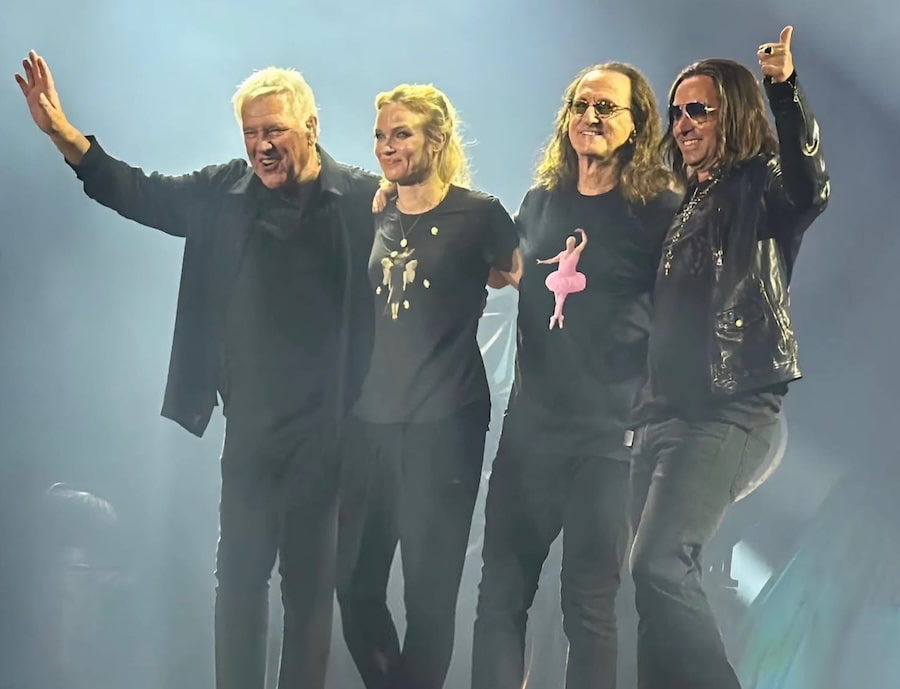
That is why this tour matters. Rush Fifty Something is not an attempt to replace Neil Peart, because that would be both impossible and insulting. It is Geddy and Alex deciding that the music, the friendship, and the audience are still worth carrying forward. Anika Nilles has been handed one of the most impossible jobs in rock music: not becoming The Professor, but walking into a room full of people who still miss him and making the case for what comes next.
So how did she do? By every credible account so far, Anika Nilles exceeded expectations and then drove over them in a German-engineered Leopard tank.
For the inevitable haters: do you honestly believe Geddy and Lerxst, two men who have spent five decades obsessing over arrangements, tones, transitions, dynamics, and whether a single note is sitting correctly inside a 7/8 passage, would have picked just anyone to sit behind Neil Peart-inspired kit? This is Rush, not a casino tribute act with a guy named “Derek” who learned “Tom Sawyer” from YouTube between shifts at Guitar Center. Don’t let him date your sister.


Nilles had already played with Jeff Beck in 2022. That is not a participation trophy. Beck did not hire people because they could execute a flashy fill and look comfortable under stage lights. She walked into the Kia Forum in Inglewood, one of the most intimidating rooms in rock, facing a crowd that knows every ghost note, every fill, every cymbal placement, and every microscopic deviation from the gospel according to Peart.
And she crushed it.
The most impressive part was not that she could play the parts. Plenty of drummers can play the parts. She understood the feel, the tension, the odd little pushes and pulls that make Rush sound like Rush rather than a prog-rock transcription exercise. She did not try to impersonate Neil Peart, because that would have been embarrassing for everyone involved. She honored the architecture and brought her own power, confidence, and musical intelligence to it.
As for Gershon, let’s be honest. Geddy is still musically locked in. The bass playing remains ridiculous, the keyboard work is sharp, and the instincts are intact. But the voice is older, because Geddy Lee is older. There are moments where he has to work harder for the range and force that once came as naturally as breathing. That is not a betrayal. It is biology.
Nilles, by comparison, looked and sounded fearless. On the evidence of the opening shows, she was not merely good enough for Rush. She may have been the most startling thing on that stage.
The Pitt: Television Still Knows How to Hurt

The past few weeks have been a brutal mix of highs and lows.
On the high side, the eCoustics team did remarkable work covering HIGH END Vienna 2026.
The low has been far more personal. My father-in-law and my father, who has fought a long and courageous battle with Parkinson’s disease, have been in different hospitals in different parts of the country. One is doing better, though not completely out of the woods. The other has reached the point where the fight becomes something else entirely.
It has been a lot to carry behind the scenes. Parkinson’s is a vicious disease. It takes its time, strips away things in small increments, and asks families to keep adapting while pretending this is somehow a normal way to live. Watching it happen to someone you love feels profoundly unfair.
Which brings me to one piece of advice: never start a new television series on an iPad at an airport gate at 11 p.m. on a Sunday night, especially when that series is The Pitt.
Created by R. Scott Gemmill and starring Noah Wyle as Dr. Michael “Robby” Robinavitch, The Pitt is set inside the fictional Pittsburgh Trauma Medical Center, where every episode covers roughly an hour of one punishing 15-hour emergency-room shift. That sounds like a clever formal device until you are five episodes in and realize the show has eliminated every escape hatch television usually provides.
There is no reset button. No comforting cut to the next day. No swelling score telling you exactly when to feel something. The alarms, overhead pages, clipped conversations, machines, blood, exhaustion, and occasional dead silence become the soundtrack.
Patients do not exist to teach a tidy lesson before the credits roll. They arrive scared, angry, dying, already dead, or simply caught in the machinery of an American healthcare system that appears designed by people who have never waited six hours under fluorescent lighting for someone to tell them whether a child is going to make it through the night.
That is why The Pitt feels so much more intense than most medical television, even if it is not a documentary. Family members who actually work in emergency rooms and operating rooms have pointed out that some of its largest, brightest, save-the-patient-now interventions are television medicine: in real life, an open craniotomy for a traumatic brain bleed is not something you casually perform under trauma-bay lights while somebody yells for more O-negative. When possible, that patient is headed upstairs to an operating room with an actual surgical team.
Those adjustments are television, not fraud. The show still understands the thing most medical dramas miss: the pace, the interruptions, the emotional whiplash, and the brutal requirement to move from one patient’s worst moment to the next person waiting for help.
It forces you to stay in the room. It makes you wait with families, listen to doctors explain things they do not want to explain, and watch nurses carry on because there are still twelve other people who need them. The cumulative amount of death is a lot to handle. Even for me. It is paperwork, exhaustion, panic, unfinished sentences, and the terrible realization that the rest of the world keeps moving while yours has stopped.
Abdullah Ibrahim Was South Africa’s Musical Soul

Abdullah Ibrahim was one of South Africa’s great musical souls: a pianist, composer, exile, survivor, and quiet revolutionary whose music carried Cape Town, District Six, church hymns, marabi, Ellington, Monk, and the long shadow of apartheid without ever turning into a lecture.
My love of his music comes from a deeper and somewhat inexplicable connection to South Africa: childhood friends, memories that stuck, and a strange, enduring longing for Cape Town that will never entirely go away. A plate filled with biltong that should never be consumed alone. Ibrahim’s music always felt like part of that pull. Not postcard South Africa. Something more complicated, bruised, beautiful, spiritual, and alive.
Born Adolph Johannes Brand in Cape Town in 1934 and first known internationally as Dollar Brand, Ibrahim helped shape modern South African jazz with the Jazz Epistles before leaving a country that made it very difficult for Black genius to breathe. Duke Ellington helped open the international door, but Ibrahim walked through it on his own terms. He died in Germany on June 15 at age 91, leaving South Africa without one of its most essential cultural voices.
His music could be spare, spiritual, defiant, tender, and deeply South African in ways that did not need translation. “Mannenberg” became an anti-apartheid anthem for a reason; it sounds like a people refusing to disappear. Start with Jazz Epistle Verse One, Duke Ellington Presents the Dollar Brand Trio, African Piano, Mannenberg Is Where It’s Happening, Water from an Ancient Well, Cape Town Flowers, and Senzo. That is not homework. That is a map.
You must be logged in to post a comment Login