Tech
Rush Fly By Night Mobile Fidelity 45 RPM Vinyl Review: The Moment Rush Became Rush

Rush did not really become Rush on their 1974 debut. That record gave us “Working Man,” landed them a deal with Mercury Records, and proved that three young musicians from Toronto could make enough noise for Americans to pay attention, but Fly By Night is where you can hear the future taking shape.
More specifically, part of that future arrived in a Ford Pinto carrying a tall, skinny drummer with short hair and a rather unconventional method of transporting his drums. Neil Peart showed up for his July 1974 audition with his kit packed in garbage bags, which probably did not scream future Rock and Roll Hall of Famer to Alex Lifeson.
Then he sat down and played.
Peart officially joined Rush on July 29, 1974, shortly before the band began its first U.S. tour. Geddy Lee and Lifeson had already started moving toward more progressive material, but finding a drummer capable of following them there was another matter entirely.
The first thing they jammed with Peart at his audition was “Anthem.” Lee later recalled that Peart was so good that auditioning the drummer who followed him became almost painfully academic, while Lifeson remembered being struck by how active his playing was and how hard he hit the drums.
From the opening attack of “Anthem” on Fly By Night, you can hear it.
There is still plenty of Led Zeppelin and Cream in Rush’s bloodstream at this stage. Lee and Lifeson had spent their formative years learning Cream songs, and Zeppelin’s impact on the early band was hardly subtle, but Peart helped push those influences into something increasingly difficult to mistake for anybody else.
His drumming was more aggressive, intricate, and compositionally involved than what Rush had attempted on the debut. Just as importantly, his arrival encouraged Lee and Lifeson to think differently about how songs could be constructed.
The transformation is immediate. They no longer sound like some very talented guys who might still be rehearsing in a rec hall basement somewhere around Willowdale.
They are beginning to sound like Rush.
Related Reading:


Enter The Professor
It is almost impossible to discuss Fly By Night without turning part of the conversation into a Neil Peart story because his arrival changed far more than the drum parts.
Peart would become one of the greatest rock drummers of his generation, but reducing his contribution to his playing ability misses half of what made him so important to Rush. He was private and introverted by nature, a voracious reader, intellectually curious to an almost intimidating degree, and unusually articulate when he decided he had something worth saying.
Lee and Lifeson quickly discovered something else useful about their new drummer: he liked words.
They did not particularly enjoy writing lyrics, and Peart did. He eventually became Rush’s principal lyricist, immediately expanding the band’s universe beyond much of the conventional rock subject matter heard on the debut.
Peart wrote the lyrics for six of the eight songs on Fly By Night. “Best I Can” and “In the End” originated before he joined, which makes the album an especially interesting transitional document because pieces of the previous Rush exist alongside material pointing directly toward what followed.
“Beneath, Between & Behind” was the first lyric Peart wrote for the band. “Rivendell,” inspired by Tolkien, could hardly be further removed from the lyrical world of “Need Some Love,” while the title track drew from Peart’s own experience leaving Canada for England when he was eighteen.
Fantasy, literature, travel, individualism, philosophy and eventually science fiction were entering the building. Rush suddenly had considerably more to talk about.
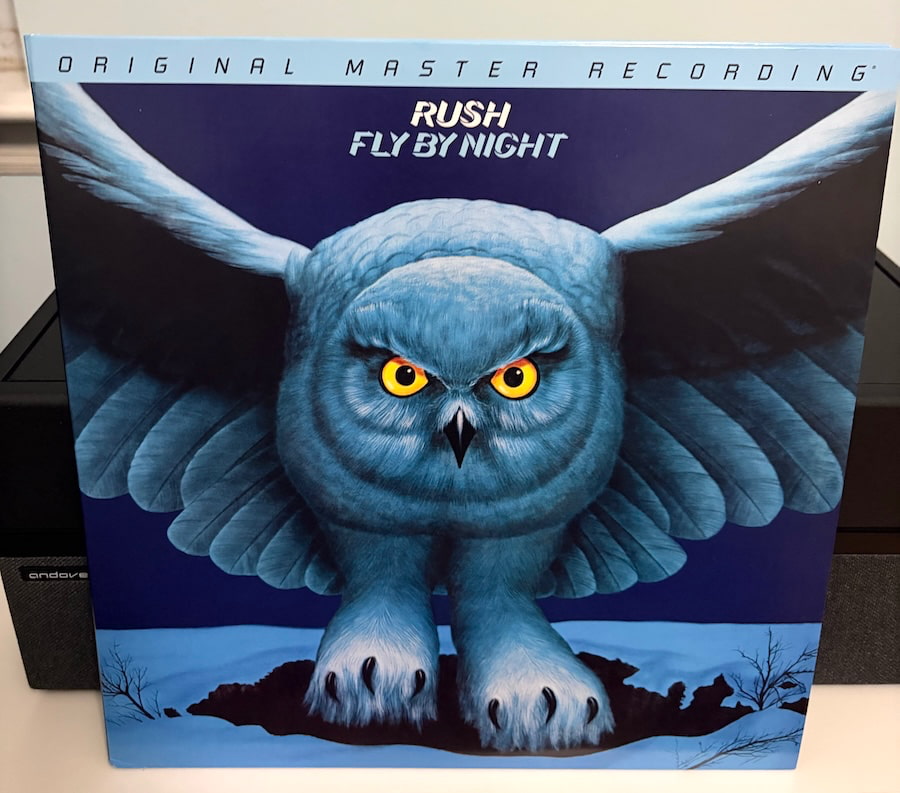

Still Zeppelin And Cream But Becoming Rush
It would be revisionist nonsense to pretend that Fly By Night emerged fully formed as the classic Rush sound. The heavy blues and British hard rock influences remain obvious, particularly the impact of Led Zeppelin and Cream that helped shape Lee and Lifeson long before Peart appeared.
What changes is what Rush begin doing with those ingredients.
Peart’s rhythmic vocabulary gives Lifeson more room to fracture riffs, change direction, and think beyond straightforward hard rock arrangements. Lee’s bass playing becomes more active because it has a drummer capable of meeting him practically anywhere, and the three musicians begin functioning less like guitar, bass, and drums occupying separate lanes and more like three lead players somehow negotiating the same piece of road.
That interplay would eventually become one of the defining characteristics of Rush.
You can hear its beginnings all over Fly By Night. The music becomes tighter even as the arrangements become more ambitious, and the band sounds considerably more confident taking risks that might have collapsed with a less capable rhythm section.
Peart did not erase their influences overnight. He helped provide the foundation that allowed Rush to stop merely reflecting them.
By-Tor Opens The Door
Nothing on Fly By Night points toward the next decade more clearly than “By-Tor and the Snow Dog.”
The 8:37 four-part composition grew from an inside joke involving two dogs belonging to manager Ray Danniels, but Peart transformed that silliness into a good-versus-evil fantasy populated by Prince By-Tor, the Snow Dog, the River Styx, battles, and enough sword-waving imagery to frighten an FM program director.
Lifeson later described it as the first time Rush attempted a multipart piece of music. That makes it far more important than its wonderfully ridiculous origins suggest.
The basic idea would rapidly expand.
Caress of Steel followed later in 1975 with “The Necromancer” and the nearly twenty-minute “The Fountain of Lamneth.” Then came the side-long title suite on 2112, followed by “Cygnus X-1” and “Xanadu” on A Farewell to Kings and the even more elaborate material on Hemispheres.
“For my money, “Xanadu” remains one of the greatest songs Rush ever recorded. At more than eleven minutes, it is atmospheric, thunderous, technically ridiculous, and gives all three musicians enough room to demonstrate precisely why nobody ever needed a fourth member.
It is also easy to draw the line backward from “Xanadu” to “By-Tor.” The latter sounds like three young musicians realizing they can stretch a rock song into something larger; the former sounds like three masters who know exactly how to control the scale, dynamics, pacing, and drama of a long-form composition.
Watching Anika Nilles play “Xanadu” with Lee and Lifeson on the 2026 Fifty Something tour brought all the feels for me. Hearing those opening swells again and watching another extraordinary drummer navigate Peart’s parts was a reminder that this particular branch of the Rush family tree began more than five decades earlier with songs like “By-Tor.”
It Almost Went Down The Tubes
There is an important wrinkle in the story because Rush’s march toward progressive rock was hardly greeted by record company executives throwing rose petals at their feet.
Fly By Night gave the band confidence to push further, and Caress of Steel pushed much further. Perhaps too far, at least commercially.
Released only seven months after Fly By Night, Caress of Steel devoted much of its running time to “The Necromancer” and “The Fountain of Lamneth.” Those extended pieces offered little help to conventional radio programmers, audiences did not respond the way the band expected, and the resulting tour became grim enough that Rush jokingly called it the Down the Tubes Tour.
The joke had teeth.
Peart later recalled that Caress of Steel had not actually sold dramatically fewer copies than the preceding records, but Mercury was in turmoil and three albums selling roughly 100,000 copies each did not exactly make Rush untouchable. Lee and Lifeson have both described how disappointing and confusing the response was, with the band genuinely concerned about where things were headed.
The record company subsequently advised Rush not to make another concept album.
Rush responded by making 2112.
That decision might be the most Rush thing Rush ever did.
Instead of retreating toward three-minute singles, the band opened its next album with a seven-part science-fiction suite lasting more than twenty minutes. 2112 became their commercial breakthrough and effectively earned Lee, Lifeson, and Peart the freedom to chart their own course for the rest of their career.
The progression matters when listening to Fly By Night. “By-Tor” was not just some eccentric deep cut about two dogs given mythological identities after somebody had a laugh on the road; it was the first significant step down a musical path that nearly destroyed their career before becoming the reason they had one.
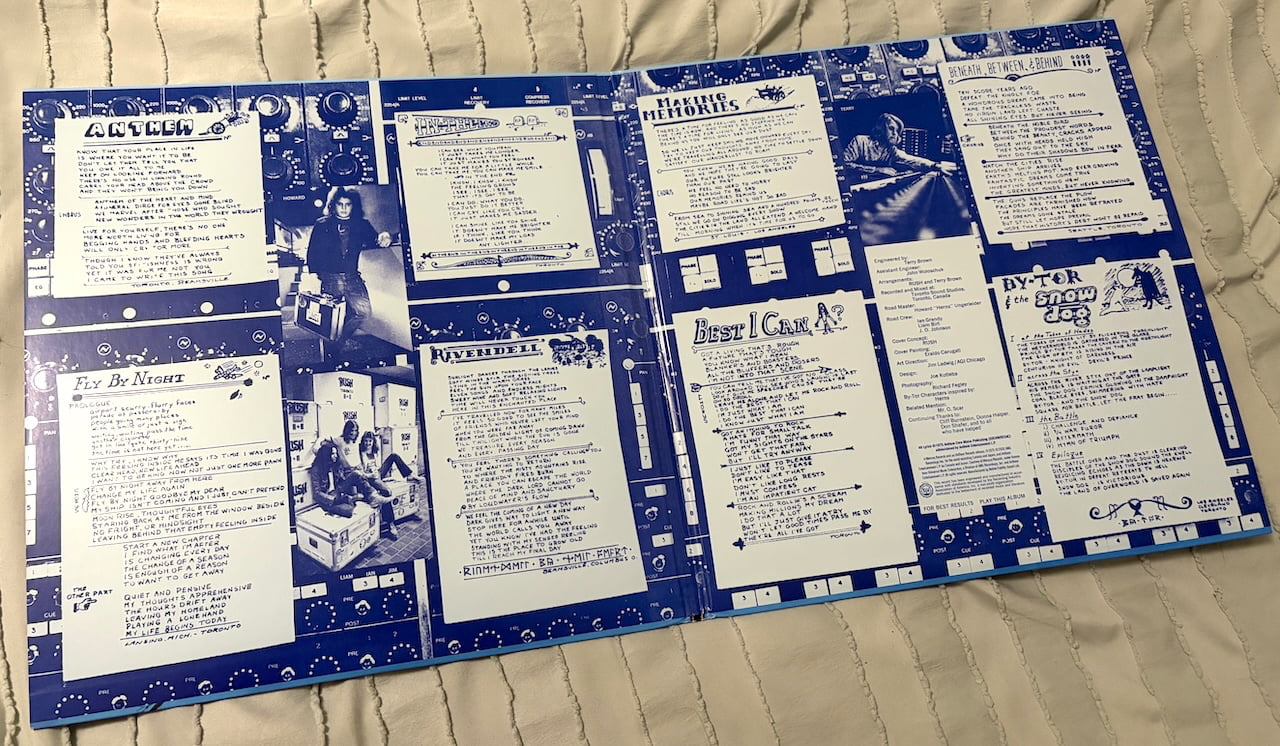

Rivendell And The Other Side Of Peart
“Rivendell” demonstrates that Peart’s impact was not simply about longer songs, heavier drumming, or fitting more notes into every available square inch.
Inspired by J.R.R. Tolkien, the song strips away most of the force heard elsewhere on Fly By Night. There is no percussion, the presentation is largely acoustic, and its almost pastoral quality provided Rush with an early opportunity to explore texture and mood instead of simply seeing how hard they could hit the listener.
The literary direction is unmistakable.
Peart’s reading habits would continue to influence his lyrics for decades, but Fly By Night is where listeners first encountered just how broad his frame of reference could become. Fantasy and mythology were part of it, but they were never the entire picture.
The title track proves that.
“Fly By Night” grew from Peart’s experience leaving Canada as a young man for England, giving the album something personal and autobiographical alongside the fantasy. That combination of internal reflection and enormous fictional landscapes would become another Peart trademark.
One minute Rush could be contemplating Rivendell. A few years later they would be flying into a black hole.
Perfectly normal Canadian behavior.

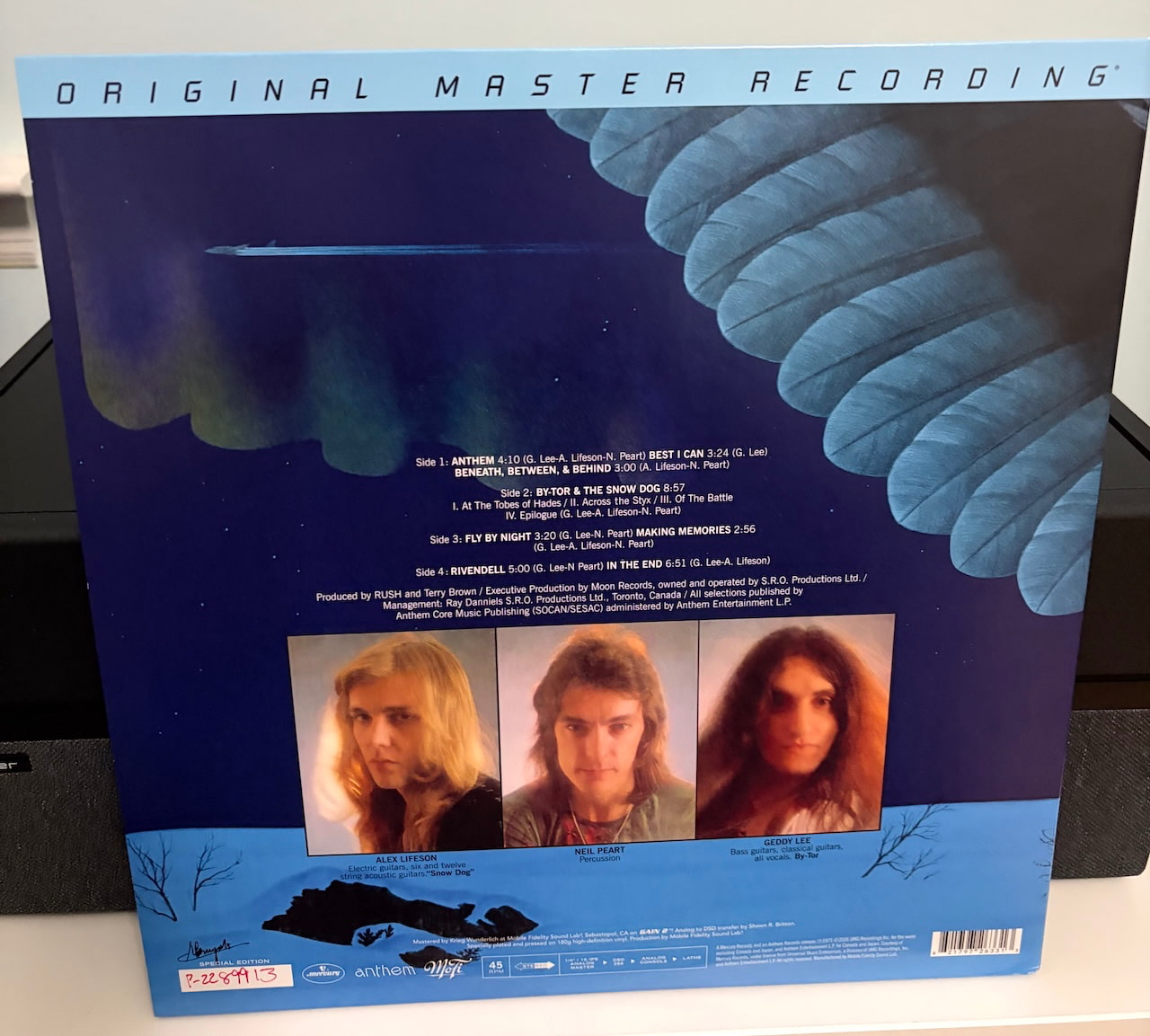
The Mobile Fidelity Edition
Mobile Fidelity Sound Lab has now returned to Fly By Night as part of its Rush reissue campaign covering the band’s studio catalog from 1974 through 1985.
The numbered edition spreads the album across two 180-gram LPs cut at 45 RPM and carries a $59.99 price. Mobile Fidelity says Krieg Wunderlich mastered the release using the original 1/4-inch, 15 IPS analog master with the following chain:
1/4-inch 15 IPS analog master → DSD 256 → analog console → lathe
The records are pressed at Fidelity Record Pressing and packaged in a Stoughton gatefold jacket with a bonus photo print.
So no, this is not an AAA release.
The debut certainly benefited from Mobile Fidelity’s treatment. My review copy of the 45 RPM Rush offered considerably greater tonal weight, bass impact, and overall substance than the other pressings in my collection, even if no mastering engineer was going to magically turn the album into Moving Pictures or even Power Windows.
Fly By Night presents a much more interesting challenge.
Neil Peart is the first thing you notice, and on this pressing his impact is impossible to miss.
His drumming hits harder on this pressing, but sheer impact is only part of it. There is considerably more definition around his playing, and the increased clarity makes his precision much easier to follow. That matters on Fly By Night because Peart is already doing things rhythmically that separate this band from the one that recorded the debut. MoFi does not make the performance sound artificially larger; it simply makes it easier to hear how much Peart had changed the foundation underneath Lee and Lifeson.
That added clarity also benefits Alex Lifeson. His guitar playing has more edge and presence, with greater separation from Lee’s bass and Peart’s drums. There is more information around the notes, particularly when the arrangements get busier, and that gives the album a degree of scale and control that I have not always heard from other versions.
“By-Tor and the Snow Dog” benefits enormously. The different sections have more presence, the transitions feel more deliberate, and the instrumental passages carry considerably more weight. You can hear the three musicians beginning to understand what they could accomplish when nobody was telling them that a rock song needed to be four minutes long and finished before the radio programmer reached for the phone.
It is not “Xanadu.”
That song, especially on a really capable system, can become absolutely enormous in the room. The opening atmosphere, Lifeson’s guitar, Lee’s bass and keyboards, and Peart’s percussion build into something almost physical. All three musicians get to demonstrate what they had become by A Farewell to Kings, and it remains one of my favorite Rush tracks, period. Knowing that Mobile Fidelity has an UltraDisc One-Step edition of that album coming has me more than a little curious about what they are going to do with it.
But Fly By Night is the beginning of that journey, and the MoFi pressing does a very good job of making the connection clearer.
“Rivendell,” however, remains “Rivendell.”
The additional resolution does not suddenly push Geddy forward in the mix. If anything, greater clarity makes me wish somebody had turned up his microphone or asked him to remove the Cott Black Cherry from his mouth before Terry Brown hit record. Considering that Pancer’s on Bathurst was already feeding Toronto and had its own connection to Rush, I can picture the entire scenario rather too easily.
Swallow, Gershon. Swallow.
That quirk aside, Mobile Fidelity has done a really solid job with Fly By Night. There is more weight, greater definition, stronger instrumental separation, and enough additional clarity to reveal just how quickly Rush were evolving once Peart joined the band. Most importantly, none of that comes at the expense of the energy that makes the album work.
The $59.99 asking price is not insignificant, especially if you already own multiple copies, but this is not one of those audiophile reissues where you have to convince yourself that the triangle sounded slightly more dimensional at 2:47.
The improvement is easy to hear.
For Rush fans with a good analog setup, the Mobile Fidelity 45 RPM edition of Fly By Night is definitely worth buying. It gives Peart’s arrival the weight and precision it deserves, gives Lifeson’s guitar more bite, and lets “By-Tor” stretch its legs without pretending this 1975 recording is something it was never meant to be.
Call it a definite two-four from The Beer Store.
None of that fancy LCBO stuff.
Our Ratings
★★★★★★★★★★ Music
★★★★★★★★★★ Sound
★★★★★★★★★★ Packaging
You must be logged in to post a comment Login