Tech
Rush’s 1974 Debut on Mobile Fidelity 45 RPM Vinyl: Does MoFi Finally Give It Some Muscle?

I have seen Rush 19 times and own every album in multiple pressings, which either qualifies me as a fan or suggests that someone should have intervened years ago. Probably both. But I have never placed the band’s self titled 1974 debut anywhere near the top of their catalog.
“Finding My Way,” “What You’re Doing,” and especially “Working Man” absolutely earned their places in Rush history, but Rush was the sound of three young Toronto musicians still figuring out exactly what they wanted to become. They were already very good at being loud, but they were not yet Rush in the form that would dominate the next decade.
More than 52 years later, Mobile Fidelity Sound Lab has returned to the album for a numbered 180 gram 45 RPM 2LP edition priced at $59.99. It is the first 45 RPM vinyl release of the album, and after comparing it with the other copies in my collection, I am comfortable saying something I did not necessarily expect going in: this version wipes the floor with them.
Not because Mobile Fidelity has somehow transformed Rush into Moving Pictures. The songs are still the songs, John Rutsey is still behind the drum kit, and nobody secretly discovered a missing synthesizer track or 17 minute science fiction suite in the vault. What MoFi has done is give this rather lean recording something my other pressings have always lacked which was actual tonal weight.
Related Reading:
Before The Professor


The timing could hardly be more appropriate. Geddy Lee and Alex Lifeson are back on the road in 2026 with the Fifty Something tour, accompanied by German drummer Anika Nilles, who has accepted the rather unenviable job of sitting behind the kit where Neil Peart once established one of rock music’s most intimidating standards.
Peart, who died on January 7, 2020 at the age of 67, would have turned 74 on September 12, 2026. But as every Rush fan already knows, and anyone spending $60 on this particular record really ought to know, the Professor does not appear anywhere on the band’s debut. That chair belonged to John Rutsey.
Rush officially released Rush in March 1974 on its own Moon Records label. Only about 3,500 copies of the initial Canadian pressing were manufactured before “Working Man” found an enthusiastic supporter in WMMS Cleveland DJ Donna Halper. Mercury subsequently picked up the album for wider distribution, and Rush suddenly had something resembling an actual career.


The recording itself was hardly the product of unlimited studio budgets. Early sessions were produced by Dave Stock at Eastern Sound in Toronto, where the band booked inexpensive late night studio time because they were paying for everything themselves. Unhappy with those initial results, Lee, Lifeson, and Rutsey moved to Toronto Sound Studios and produced the subsequent sessions themselves. Terry Brown handled the remix, while Gilbert Kong mastered the original album at Masterdisk in New York.
Nobody should approach Rush expecting the sonic polish or studio architecture that would define the band later in the decade. They were barely able to afford the room, never mind construct the kind of widescreen progressive rock spectacle that would arrive a few albums later.
Before Rush Became Rush
The musical transformation that occurred after this album remains difficult to overstate. The debut is rooted heavily in blues based hard rock, with plenty of Led Zeppelin and Cream in its bloodstream, and only occasional hints of the band Rush would become.
Fly By Night became the hinge. Rutsey left the band in July 1974, and Peart arrived just before Rush’s first U.S. tour. Along with a completely different approach to drumming, he assumed primary lyric writing duties and pushed Lee and Lifeson toward something more literary, ambitious, and structurally adventurous.
From there cameCaress of Steel, 2112, A Farewell to Kings, Hemispheres, Permanent Waves, Moving Pictures, Signals, Grace Under Pressure, and Power Windows. It was an extraordinary evolution from bar band hard rock into something almost nobody else could duplicate, which leaves the debut in a slightly strange position. It is historically indispensable without being remotely indispensable musically.
“Working Man” obviously transcends the album. Its heavy, lumbering riff and working class directness made it the song that broke Rush in the United States, and it remained part of the band’s live vocabulary decades later. “Finding My Way” has the swagger and guitar attack of a young band that already knew it could play, while “What You’re Doing” locks Lee, Lifeson, and Rutsey into one of the record’s most convincing grooves.
Elsewhere, things become less essential. “Need Some Love” and “Take a Friend” are perfectly competent early 1970s hard rock songs, but nobody was sitting through “La Villa Strangiato” in 1978 thinking, “This is nice, but when are they going to play ‘Need Some Love’?”
“In the Mood” is catchy, direct, and unmistakably from a band whose lyrical universe had not yet expanded to Cygnus X-1. “Here Again” slows everything down and gives Lifeson considerably more room to stretch out, while “Before and After” may be the most revealing deep cut because its quieter opening and gradual transition into heavier material provide an early glimpse of the dynamic contrasts Rush would soon explore much more aggressively.
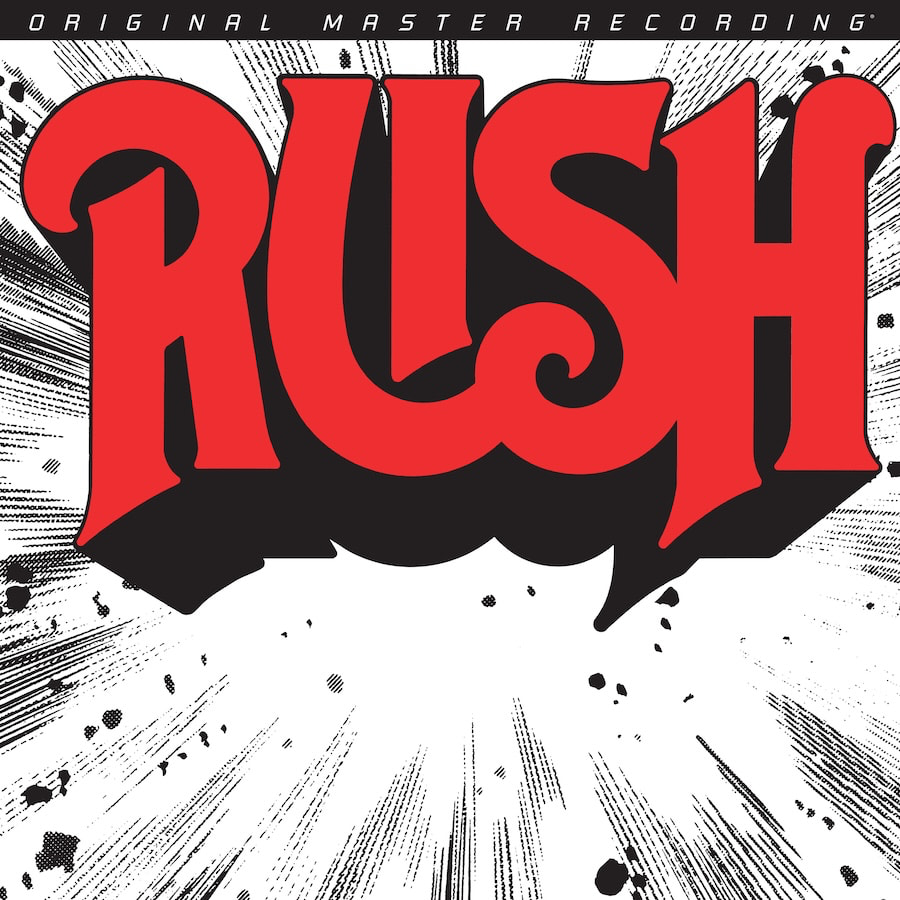

The Mobile Fidelity Edition
The technical details matter because this is not an AAA release. Mobile Fidelity says its numbered 180 gram 45 RPM 2LP edition was sourced from the original analog master tapes and mastered by Krieg Wunderlich using the following chain:
1/4 inch, 15 IPS Dolby A analog master → DSD 256 → analog console → lathe
The records are pressed at Fidelity Record Pressing and housed in a Stoughton gatefold jacket. This is also the first time Rush has been issued as a 45 RPM vinyl release.
Anyone still fighting the Great MoFi Digital War can adjust their blood pressure accordingly. There is a DSD 256 stage, and there is also an exceptionally good sounding record sitting on my turntable. The latter strikes me as the more useful thing to discuss.
The physical presentation is superb. Both records in my review sample were pristine, perfectly centered, and exceptionally quiet. The jacket feels substantial, the inner sleeves are high quality, and the entire package feels like a premium release rather than a standard record with an audiophile sticker attached to the shrink wrap.

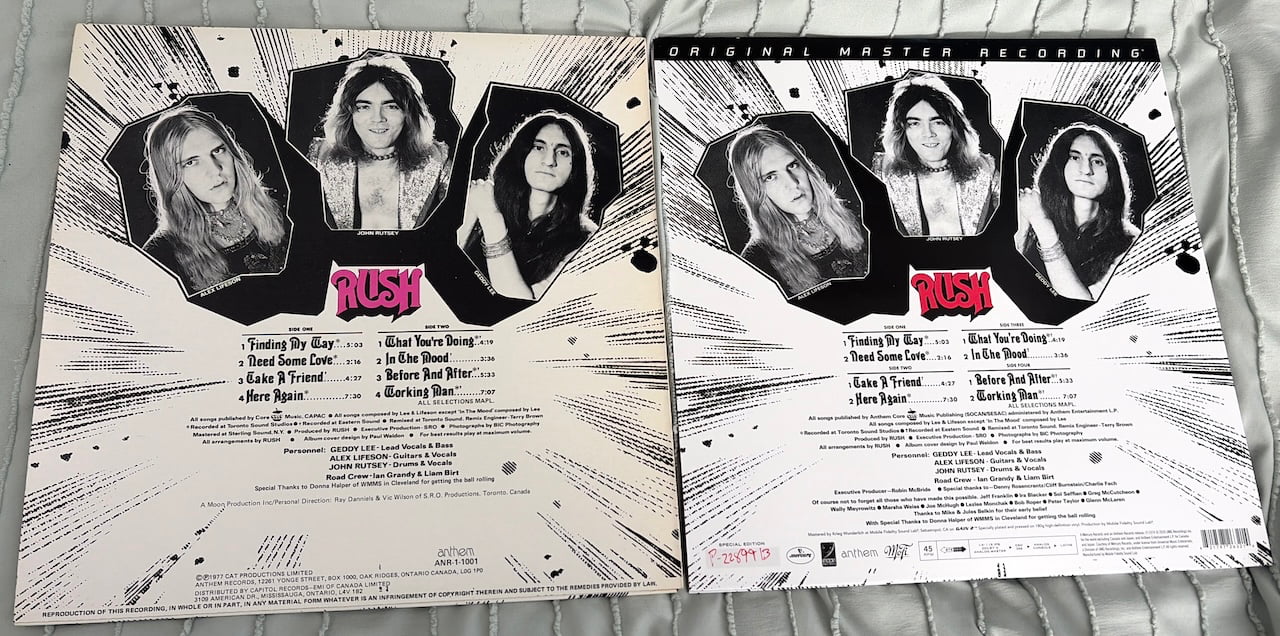
How Does It Sound?
My biggest complaint with every other copy of Rush that I own has always been the same: it sounds thin. Not unlistenable and not painfully bright, but lacking the tonal density and physical impact that three musicians playing this kind of music should possess.
The MoFi changes that immediately. Geddy Lee’s bass has considerably more mass and definition, giving the entire album a stronger foundation. Instead of merely following the guitar, the bass becomes an equal participant in the mix and gives songs like “Finding My Way” and “What You’re Doing” far greater physical momentum.
Lee’s vocals also benefit. There is still plenty of youthful Gary Weinrib in the upper registers, and Mobile Fidelity has not performed an exorcism, but the presentation is less strident than on my other copies. His voice has more body through the middle and does not leap forward with quite the same wiry edge, which makes the album considerably easier to listen to at realistic levels.
The percussion also gains substantially more heft. Rutsey’s kick drum and toms carry more weight, and the rhythmic foundation feels less lightweight without becoming artificially bloated. That is important because Rutsey was a perfectly capable rock drummer. History has simply handed him the cruelest possible comparison.
Rutsey And The Man Who Came Next
Listening to this MoFi edition actually increased my appreciation for John Rutsey. He plays hard, stays locked to Lee, and gives Lifeson enough space to move around without turning every fill into an announcement. His drumming suits the directness of the material, and there are moments where the three musicians sound remarkably tight considering how quickly much of the album was recorded.
And then you remember who joined the band next.
That comparison is unavoidable, but it is also useful because the difference was not merely one of technical ability. Neil Peart changed the motion of Rush. Rutsey drives these songs like a very good hard rock drummer, while Peart approached the material with greater power, precision, complexity, and forward momentum.
When Rush revisited early material with Peart behind the kit, the music acquired a completely different center of gravity. Rutsey played the songs very well; Peart would eventually reshape what people thought a Rush song could even be.
That is not a criticism of Rutsey. There might not have been five drummers on the planet who would have enjoyed being measured against the Professor during his prime.
And What About Lerxst?
Alex Lifeson, Lerxst for those keeping score at home, benefits from the improved clarity, but his guitar does not suddenly dominate the presentation. That surprised me because on this pressing, Lifeson often feels positioned slightly behind Lee’s vocal and bass guitar, particularly through the middle of the soundstage.
His guitar remains extremely clean and easy to follow, with better texture around distorted chords and more definition when he moves into lead work, but the mastering does not push him aggressively forward. The effect works because this is not an album built around enormous spatial depth or studio trickery. Giving Lee’s bass additional authority while preserving the guitar’s separation makes the trio sound more substantial without pretending the source recording is something it was never meant to be.

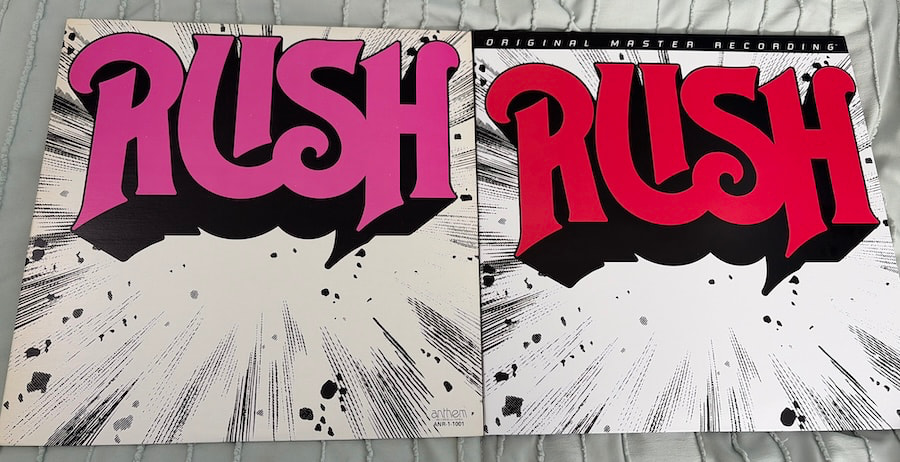
Worth The Money?
Sixty dollars for a 52 year old album that I already own more than once is not a rational purchasing decision. Neither is seeing the same band 19 times, so we passed rational several exits ago somewhere outside of the 416.
The more relevant question is whether Mobile Fidelity has produced a version of Rush that offers a meaningful improvement over more ordinary pressings, and the answer is yes. The fuller bass response, less aggressive presentation of Lee’s vocals, stronger percussion, cleaner instrumental separation, silent surfaces, excellent centering, and first rate packaging combine to make this easily the most enjoyable version of the album in my collection.
That does not suddenly elevate the debut into the upper tier of Rush albums for me. Musically, it still sits near the bottom because the gulf between this record and what Lee, Lifeson, and Peart would accomplish from 2112 through Power Windows is enormous.
That is also part of what makes listening to the debut so fascinating. You are not hearing a legendary progressive rock band operating at full power; you are hearing three young musicians standing at the edge of becoming one.
For the first time on one of my vinyl copies, they finally sound as heavy as they probably did in the room.
Our Ratings
★★★★★★★★★★ Album
★★★★★★★★★★ Sound Quality
★★★★★★★★★★ Pressing Quality
You must be logged in to post a comment Login