Tech
Samsung 2026 Q-Series Soundbars: Wireless Dolby Atmos, Q-Symphony and SpaceFit for TV and Movies

Samsung isn’t chasing the soundbar market; it has effectively been running it for 12 straight years alongside two decades of dominance in global TV sales. The company’s 2026 Q-Series soundbars, the HW-Q990H, HW-Q900H, HW-Q800H, and HW-QS90H, build on that position, with the flagship Q990H and QS90H first previewed at CES 2026 and now joined by the full lineup. Following its latest OLED, Neo QLED, MiniLED, and Frame TV announcements, Samsung is tightening its grip on the TV and home audio ecosystem in one move.
Our Editor at Large Chris Boylan got to spend some quality time with the QS90H and Q990H at Samsung’s US headquarters last month and was impressed by what he saw (and heard).
Samsung Q-Series Soundbars


Samsung’s 2026 Q Series soundbars are aimed at anyone who wants a cinematic experience without dealing with an AVR or a room full of wired speakers. The focus here is scale and flexibility, delivering immersive sound that adapts to different room sizes and listening habits without requiring a dedicated home theater setup.
Q Series Soundbar Features
Here are some key features shared across Samsung’s 2026 Q Series soundbars:
AI Dynamic Bass Control: Designed to deliver deeper, more controlled low frequencies with reduced distortion, while supporting high resolution audio up to 24-bit/96kHz.
Active Voice Amplifier Pro: This feature analyzes background noise in real time and adjusts dialogue levels accordingly, helping voices cut through without constantly reaching for the remote.
Wireless Dolby Atmos: Although Q-Series soundbars provide a Dolby Atmos-compatible HDMI-eARC connection, there is a wireless connection option. The soundbars are compatible with Dolby Atmos delivered over Wi-Fi from select streaming sources.
Pro Tip: Samsung’s Wireless Dolby Atmos is not the same as Dolby Atmos Flex Connect.
Eclipsa Audio: Samsung’s Q-Series SoundBars incorporate Eclipsa Audio, an open immersive surround sound format developed by Samsung in partnership with Google and other companies. Similar to Dolby Atmos, Eclipsa Audio expands on traditional surround sound with the addition of height information. With Eclipsa Audio-encoded content, sound can come from all around and above the listener. This enables a more enveloping and immersive listening experience with sound emanating from all three dimensions, just like in real life. Eclipsa Audio is currently the only immersive surround sound format supported on YouTube.
Sound Elevation: Designed to align audio with what you’re seeing on screen, this feature directs sound upward so dialogue appears to come from the characters, not the soundbar sitting below the TV.
Auto Volume: Helps keep levels consistent across channels, apps, and sources, reducing those sudden jumps that usually send you scrambling for the remote.
Q-Symphony: This feature allows Q Series soundbars to work with compatible Samsung TVs and Wi Fi speakers as a single, integrated system. It can pair with up to five Samsung audio devices, creating a more flexible home theater setup while adjusting performance based on speaker placement in the room.
SpaceFit Sound Pro: Samsung’s built-in room calibration system uses the soundbar’s onboard microphones to analyze your space and adjust playback accordingly. It can update settings automatically over time, or recalibrate when the soundbar is moved, helping maintain consistent performance without manual tweaking.
Voice Assistants and Control: Q Series soundbars support voice control via Alexa, Google Assistant, and Bixby. For those who prefer buttons, onboard controls and the upcoming Samsung Sound app handle the basics, and there’s even a dedicated Spotify Connect button. Notably, a traditional remote is not included.
HW-Q990H

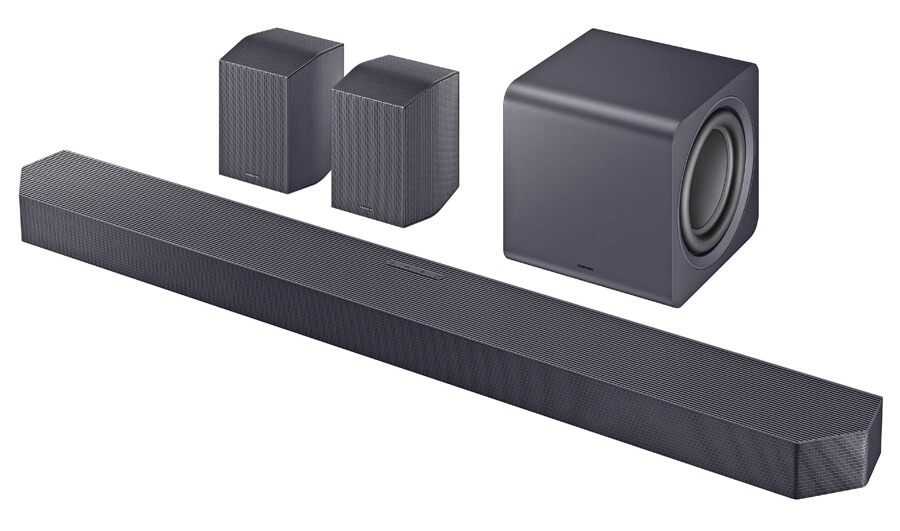
The HW-Q990H is Samsung’s Q Series flagship and its most ambitious soundbar to date. It uses an 11.1.4 channel layout with three front channels, two side firing, two wide firing, and four rear channels, along with four upfiring channels split between the front and rear. The included compact subwoofer features a dual 8-inch driver design aimed at delivering serious low end without overwhelming the room.
Height effects are handled by the upfiring channels in both the bar itself and the included rear speakers, while next generation AI tuning adjusts output in real time based on both the room and the content. The goal is to deliver a level of immersion that approaches a full home theater system, without the rack of gear or the wiring that usually comes with it. Just as important, Samsung is focusing on features that address everyday soundbar frustrations rather than piling on gimmicks.
The Q990H supports Dolby Atmos and DTS-X as well as Eclipsa Audio immersive surround sound.
The main soundbar measures 48.5 inches wide, 2.8 inches high, and 5.5 inches deep, making it a solid match for 50-inch and larger TVs. It can be placed on a shelf or wall mounted.
Per editor at Large, Chris Boylan, the HW-Q990H offered a cinematic sound on DTS-X and Dolby Atmos soundtracks like “Blade Runner” and “F1” with nice immersion and surprisingly solid bass reproduction, considering the compact size of the included subwoofer.
HW-Q900H

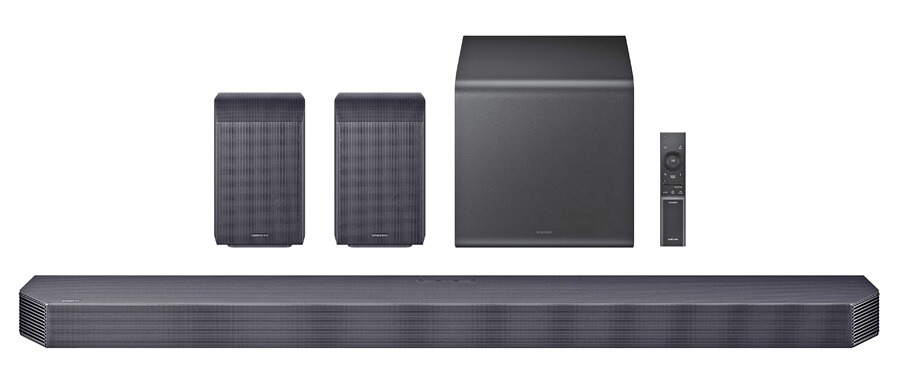
The HW-Q900H is a step down from the Q990H but still brings a substantial feature set. It uses a 9.1.4 channel layout with three front channels, two side firing, two wide firing, and two rear channels, along with four upfiring height channels split between the front and rear. The system also includes a compact active subwoofer with a dual 8 inch driver design intended to deliver strong low end without overwhelming the room.
Unlike the flagship, the Q900H supports Dolby and Eclipsa Audio formats but does not include DTS compatibility.
The main soundbar measures 43.71 inches wide, 2.8 inches high, and 4.73 inches deep, making it a good fit for a wide range of TVs. It can be placed on a shelf or wall mounted.
HW-Q800H


The HW-Q800H is a more streamlined option in the lineup, built around a 5.1.2 channel configuration with three front channels, two side firing, and two upfiring height channels, paired with a wireless subwoofer.
Like the Q900H, it supports Dolby and Eclipsa Audio formats but does not include DTS compatibility.
The soundbar measures 43.71 inches wide, 2.8 inches high, and 4.72 inches deep, making it an easy fit for most TV setups. It can be placed on a shelf or wall mounted.
HW-QS90H

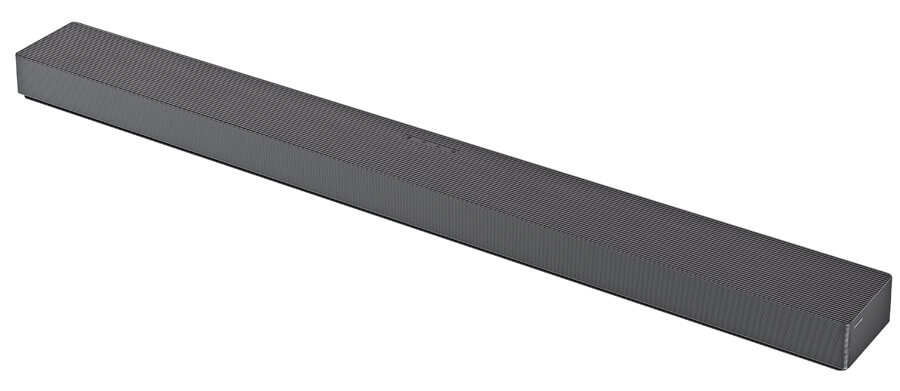
The Samsung HW-QS90H takes a different approach, trading modular expansion for simplicity. It features a self contained 7.1.2 channel design with 13 drivers, including nine wide range speakers, eliminating the need for separate surrounds or a dedicated subwoofer.
The unit features a “Convertible Fit” design which uses an internal gyroscope to detect whether it is installed horizontally (like on a credenza) or vertically (like mounted on a wall) and automatically adjusts its driver array to accommodate these different placements. The result is a soundbar that adapts to the room rather than forcing the room to adapt to it, which makes a lot more sense as living spaces get tighter.
The QS90H uses a built-in Quad Bass Woofer system, designed to deliver meaningful low frequency impact from a single enclosure, keeping floor space clear and setup straightforward.
The QS90H supports both Dolby and DTS formats as well as Eclipsa Audio.
It measures 49.02 inches wide, 2.71 inches high, and 4.92 inches deep, and can be placed on a shelf or wall mounted.
Our Editor at Large Chris Boylan tested the QS90H with several 4K Blu-rays and clips from a Kaleidescape Strato E 4K media player including “Blade Runner, “Baby Driver,” “F1” and “Spider-Man: Into the Spiderverse.” He found that the bar did a convincing job drawing the viewer into the action, when mounted on a wall below the company’s S90H OLED TV. Surround sound virtualization was effective at giving the illusion of sound coming from behind the viewing position and bass was solid for a one-piece unit though he did miss the bass extension you get with a separate dedicated subwoofer. Boylan confirmed that the bar could decode both Dolby Atmos and Eclipsa Audio (DTS-X is also supported).
Comparison
| Samsung Model | HW-Q990H | HW-Q900H | HW-Q800H | HW-QS90H |
| Product Type | Soundbar System | Soundbar System | Soundbar System | Soundbar |
| Price | $1,999.99 | $1,499.99 (Coming Soon) | $1,099.99 | $999.99 (Coming Soon) |
| Number of Channels | 11.1.4 | 9.1.4 | 5.1.2 | 7.1.2 |
| Primary Channels | 3 Front (Left, center, right)
2 Side-Firing 2 Wide-Firing |
3 Front (Left, center, right) · 2 Side-Firing 2 Wide-Firing |
3 Front (Left, center, right)
2 Side-Firing |
3 Front (Left, center, right) ·
2 Side-Firing |
| Subwoofer Channel | 1 | 1 | 1 | N/A |
| Up- firing Channels | 2 Front 2 Rear |
2 Front 2 Rear |
2 Up- firing | 2 Up- firing |
| HDMI ARC | Yes (eARC) | Yes (eARC) | Yes (eARC) | Yes (eARC) |
| Dolby Atmos™ | Yes | Yes | Yes | Yes |
| DTS:X | Yes | No | No | Yes |
| Remote Controller | Yes | Yes | Yes | Yes |
| Q-Symphony compatible | Yes | Yes | Yes | Yes |
| Surround Sound Expansion | Yes | Yes | Yes | Yes |
| Game Mode Pro | Yes | Yes | Yes | Yes |
| AVA Pro | Yes | Yes | Yes | Yes |
| Connecitivity | Wi-Fi
Bluetooth Version: 5.3 Voice Assistants Works with: Google cast, Airplay HDMI IN: 2 HDMI OUT: 1 Optical In: 1 USB: N/A Spotify Roon Ready |
Wi-Fi
Bluetooth Version: 5.3 Voice Assistants Works with: Google cast, Airplay HDMI IN: 1 HDMI OUT: 1 HDMI CEC Optical In: 1 USB: N/A Spotify Connect Roon Ready |
Wi-Fi
Bluetooth Voice Assistants Works with: Google cast, Airplay HDMI IN: 1 HDMI CEC Optical In: 1 USB: N/A Spotify Connect Roon Ready |
Wi-Fi
Bluetooth Version: 5.3 Voice Assistants Works with: Google cast, Airplay HDMI IN: 1 HDMI OUT: 1 HDMI CEC Optical In: 1 USB: N/A Spotify Connect Roon Ready |
| Audio Formats/AV Decoding | Dolby Atmos™ Dolby TrueHD Dolby Digital Plus Dolby 5.1ch DTS:X DTS 5.1ch DTS-HD HRA AAC OGG FLAC WAV ALAC AIFF |
Dolby Atmos™ Dolby TrueHD Dolby Digital Plus Dolby 5.1ch DTS 5.1ch: No DTS-HD HRA: No DTS-HD MA: No DTS Express: No MP3 AAC OGG FLAC WAV ALAC AIFF |
Dolby Atmos™ Dolby TrueHD Dolby Digital Plus Dolby 5.1ch DTS:X: No DTS 5.1ch: No DTS-HD HRA: No DTS-HD MA: No DTS Express: No MP3 OGG FLAC WAV ALAC AIFF |
Dolby Atmos™
Dolby TrueHD Dolby Digital Plus Dolby 5.1ch DTS:X DTS 5.1ch DTS-HD HRA DTS-HD MA DTS Express MP3 AAC OGG FLAC WAV ALAC: Yes AIFF: Yes |
| Sound Modes | Surround Sound Expansion
Game Mode Pro Adaptive Sound DTS:X Bass Boost: No Night Mode Voice-enhance mode |
Surround Sound Expansion Game Mode Pro Adaptive Sound DTS:X: No Bass Boost: No Voice-enhance mode |
Game Mode Pro
Adaptive Sound: Yes Bass Boost: No Night Mode Voice-enhance mode |
Game Mode Pro
Adaptive Sound: Yes DTS:X Bass Boost: No Night Mode Voice-enhance mode |
| Video Compatibilty | 4K Video Pass: 120Hz
HDR: HDR 10+ |
4K Video Pass: 120Hz
HDR: HDR 10+ |
4K Video Pass: 60Hz HDR: HDR 10+ |
4K Video Pass: 60Hz
HDR: HDR 10+ |
| Dimensions (WHD) | Soundbar 48.50 x 2.8 x 5.43
Subwoofer: 9.80 x 9.91 x 9.80 Rear Speaker: 5.10 x 7.93 x 5.53 |
Soundbar 43.71 x 2.38 x 4.72 Subwoofer: 9.80 x 9.91 x 9.80 Rear Speaker: 5.10 x 7.93 x 5.53 |
Soundbar43.71 x 2.38 x 4.72 Subwoofer: 9.80 x 9.91 x 9.80 Rear Speaker: N/A |
Soundbar: 49.02 x 2.71 x 4.92 |
| Weight (lbs) | Soundbar: 16.08
Subwoofer: 18.28 Rear Speaker: 7.49 |
Soundbar: 11.68
Subwoofer: 15.87 Rear Speaker: 6.83 |
Soundbar: 11.24
Subwoofer: 15.87 Rear Speaker: N/A |
Soundbar: 14.75 |
| Package Contents | Soundbar Subwoofer Rear Speaker Kit HDMI Cable (HDMI 2.1) Wall Mount Kit Rubber Foot Remote Controller Battery for Remote Controller |
Soundbar
Subwoofer Rear Speaker Kit HDMI Cable (HDMI 2.1) Wall Mount Kit Rubber Foot Remote Controller |
Soundbar
Subwoofer Rear Speaker Kit: No HDMI Cable(HDMI 2.1) Wall Mount Kit Ruber Foot Remote Controller Battery for Remote Controller |
Soundbar
Subwoofer: No Rear Speaker Kit: No HDMI Cabl (HDMI 2.1) Wall Mount Kit Rubber Foot Remote Controller |
The Bottom Line
Samsung didn’t reinvent the soundbar in 2026, but it didn’t need to. What it’s doing here is doubling down on the formula that put it on top in the first place: tight integration with its TVs, flexible system scaling, and fewer wires without completely sacrificing immersion.
What’s new or at least more refined is the range itself. You now have a clearer ladder from the full surround Q990H, to the more compact Q900H and Q800H, all the way down to the one-piece QS90H, which ditches the usual box of extras and goes all in on a single enclosure. The QS90H in particular stands out because it tries to solve the biggest real world problem: people want better sound, but they don’t want more stuff in the room.
What still makes Samsung unique is ecosystem control. Q-Symphony, SpaceFit, and Wireless Dolby Atmos aren’t just features, they are leverage. Pair these with a recent Samsung TV and you get the full experience. Use another brand and you leave performance and functionality on the table. That’s not a bug, it’s the strategy.
What’s missing is just as important. DTS support is inconsistent across the lineup, which is hard to ignore for anyone with a physical media library. But they do offer Eclipsa Audio decoding, which may matter in time as more content creators create immersive audio content in that format on YouTube. There’s also still a reliance on Samsung’s ecosystem to unlock everything, which won’t sit well with buyers who mix and match brands.
So who is this for? Anyone building a TV-first home theater who wants strong, immersive sound without the complexity of separates. If you already own a Samsung TV, the case is easy. If you don’t, these are still competitive soundbars, but the real value only shows up when you stay inside the walled garden.
Pricing & Availability
HW-Q990H – $1,999.99 at Samsung
HW-Q900H – $1,499.99 (Coming Soon)
HW-Q800H – $1,099.99 at Samsung
HW-QS90H – $999.99 (Coming Soon)
You must be logged in to post a comment Login