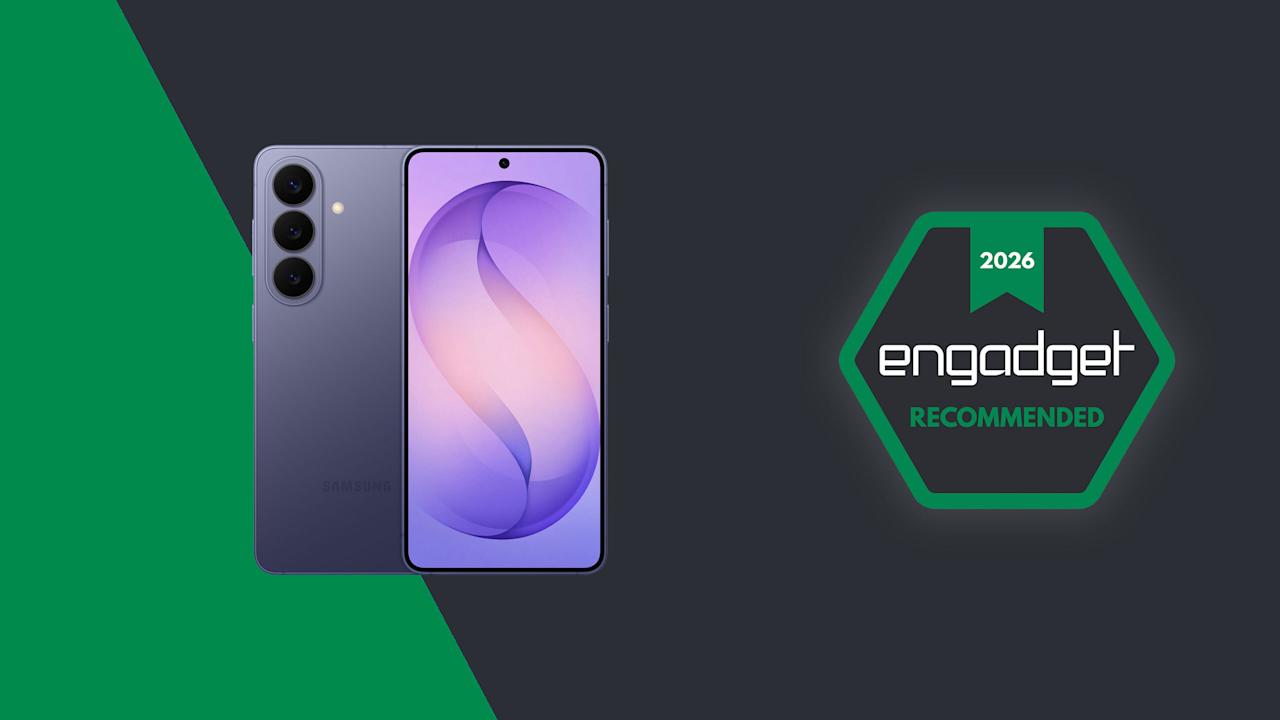
It’s already smartphone season. Samsung’s annual deluge encompasses three new phones for 2026: the frontier-pushing S26 Ultra ($1,300) with its innovative Privacy Screen, the S26 ($899) and the S26+ ($999). The smaller flagships, yet again, are iterative versions of what came before, with the major differences centering on bigger batteries and brighter screens.
I’m getting waves of deja vu as I review the Galaxy S26, because at times I was writing exactly what I wrote last year — including the part about it being a little too similar to what came before.
Samsung/Engadget
Samsung’s smallest flagship phone is a solid if safe addition to the Galaxy series. However, it’s far too similar to its predecessors.
Advertisement
Pros
Bigger battery
A flagship phone that isn’t huge
More AI assistant options
Cons
Too similar to last year’s S25
Cameras could be improved
Perplexity integration is limited
Hardware
Image by Mat Smith for Engadget
Let’s focus on the changes. The Galaxy S26’s screen size is a little bigger than its predecessor’s; 6.3 inches, up from 6.2 inches on the S25. However, it still has the same FHD+ (2,340 x 1,080) resolution. Given the slight size difference, there’s no particular drop in sharpness. The screen can also go slightly brighter, topping out at 3,000 nits, which is always welcome — especially when Samsung has increased the battery to 4,300mAh from the S25’s 4,000mAh. (The S25 already impressed us with its battery longevity.)
The design, however, is largely unchanged. The camera trio now sits on a unified circular island and, well, that’s all I really have to say. Once again, it’s premium Samsung hardware, but otherwise I’d just be reiterating what I said last year… and our review from the year before that.
Advertisement
Inside, Samsung increased the base RAM to 12GB and the storage to 256GB on the S26, doubling the space found on the S25. With the S26’s processor, Samsung split the device into two different builds depending on region. In the US, you’ll get the Snapdragon 8 Elite Gen 5 for Galaxy, like the S26 Ultra. Elsewhere, including my review device in the UK, the S26 and (S26+) have the in-house Exynos 2600.
Samsung’s Exynos 2600 SoC is its first 2nm chip and should offer power-efficiency improvements over larger alternatives. This year’s S26 didn’t struggle with any of the games I played or video-editing tasks. Samsung says its new chip delivers around 50 percent better performance across single- and multicore tasks. The Exynos 2600 includes a new Xclipse 960 GPU, which casubtlenuan deliver double the graphical performance of the Exynos 2500.
On Geekbench 6, the Exynos S26 scored 3151 on single-core tests and 10,664 on multicore tests (not far behind the Snapdragon-powered S26 Ultra). Similarly, the GPU score (24425) didn’t lag far behind — all pleasant surprises. There is a but coming.
Comparing battery rundown tests between a Snapdragon S26 and my Exynos version revealed a gap. Watching a looped video at 50 percent brightness, the Exynos iteration lasted almost 28 hours, while the Snapdragon 8 Elite S26 lasted nearly 30 hours. Sure, that’s great longevity regardless of which S26 model you get. But this year’s flagship does have a bigger battery, so why is the Exynos-powered version only matching last year’s phone?
Advertisement
Cameras
Image by Mat Smith for Engadget
Not much has changed in the composition (or resolution) of the camera trio: there’s a 50-megapixel main, a 12MP ultrawide and a 10MP telephoto. That means that any improvements in photos and video are subtle, to put it kindly.
It’s hard to discern the improvements this year without really scrutinizing dark shots and zooming right in. The S26 does seem a little faster at capturing bursts and high-res video. And while I prefer the no-nonsense shooting of the Pixel 10a, the S26 offers a little more versatility with its zoom and ultrawide cameras. Cropped zoom, for example, lets you get closer to subjects beyond the 3X optical zoom, though more detail is lost than with the S26 Ultra and its larger resolution sensors.
Image by Mat Smith for Engadget
Once you’ve taken the shot, Samsung’s bundle of AI tools can take over. Photo Assist attempts to corral all of these editing features into one place, offering quick ways to reduce reflections or edit out photobombers. You can now use natural language text prompts to guide your photo editing.
For example, I attempted to adjust the lighting more evenly on a photo of me taken outdoors with a flash. I could do it with my rudimentary photo-editing skills, but Samsung’s tools are fast and, crucially, very easy to use. It’s a feature where natural language interfaces really make sense.
Advertisement
With the front-facing camera, Samsung has added its Object Aware Engine, promising better, more accurate rendering of skin tones and hair, as well as an improved portrait mode. But again, I noticed marginal differences. The S26 seemed to have better color accuracy than its predecessor, resulting in slightly warmer selfies.
For videos, Samsung Super Steady mode is now more versatile, maintaining a consistent horizontal lock no matter how much you move around. As I mentioned during my hands-on, it’s an interesting addition, the kind of feature you typically see on action cams and gimbals. It works well, too, although the footage does pick up a bit of focus-pumping as it fights to stabilize everything.
Rounding out the new additions is an Autoframing mode that crops in on your tracked subject as they move around. There’s a degree of auto-detection for faces and pets, but you can tap to apply tracking to anything, to which it locks on well. It works particularly well with tripods, but there is a slight floating effect as the S26 tries to keep up with the phone’s movement. I also noticed warping at the edge of the lens when the camera app kept my subject centered in the frame.
Software
Image by Mat Smith for Engadget
Samsung’s S26 launch event suggested this was the era of agentic AI, with assistants now positioned to connect the dots between tasks themselves. We’re not quite there, though.
Advertisement
The company has slightly expanded many of the features introduced last year. Now Brief is capable of pulling data from more apps to generate more comprehensive daily summaries, but I mostly saw the usual suspects: weather, calendar reminders and not much else.
Across the S26, a new Now Nudge feature will suggest actions with an unobtrusive icon, based on what’s happening on screen, such as sharing contact numbers with someone or suggesting calendar times while dealing with work emails.
Perplexity is an interesting addition. The S26 series is in a curious spot where it has hooks into no fewer than three AI assistants: Gemini, Bixby (bless its heart) and now Perplexity.
You do have to install the Perplexity app (and log in to use it), but you can then choose to make it your primary AI assistant. Odd things are missing: Samsung said Perplexity integration would work across the phone, including its own Browser app — something I was excited to test. Perplexity’s own browser, Comet, has a slick feature that lets it browse and summarize multiple tabs. I was in the middle of deciding where to eat during my recent trip to Barcelona, so I thought this was a great use case. However, that feature isn’t available in Samsung’s browser for now. According to Perplexity, Samsung will “integrate Perplexity’s APIs into the Samsung Browser, with agentic browser capabilities.”
Advertisement
Voice commands of “Hey Plex” also went unanswered. I found I had to manually grant permissions to the Perplexity app for it to work like Google’s Gemini. This could just be teething issues with a pre-release device and software, but Perplexity, for now, doesn’t offer enough utility beyond what I was already used to with Gemini.
Wrap-up
Image by Mat Smith for Engadget
The Galaxy S26 is a solid phone, with upgraded battery capacity and more base storage. Whether you get the Exynos or the Snapdragon S26, there’s fortunately no performance gulf as has happened in the past. However, the shorter battery life is a disappointing discovery from Samsung’s first 2nm chip.
For Samsung’s smallest flagships over the last three years, it’s all been very samey. Is the company now focused on its true flagship Ultra phone and foldables to generate buzz and make things exciting? That’s what it feels like. There’s nothing wrong with this safe, solid Android phone, but you could pick up last year’s S25 and get an experience that’s 99 percent the same for $99 less.
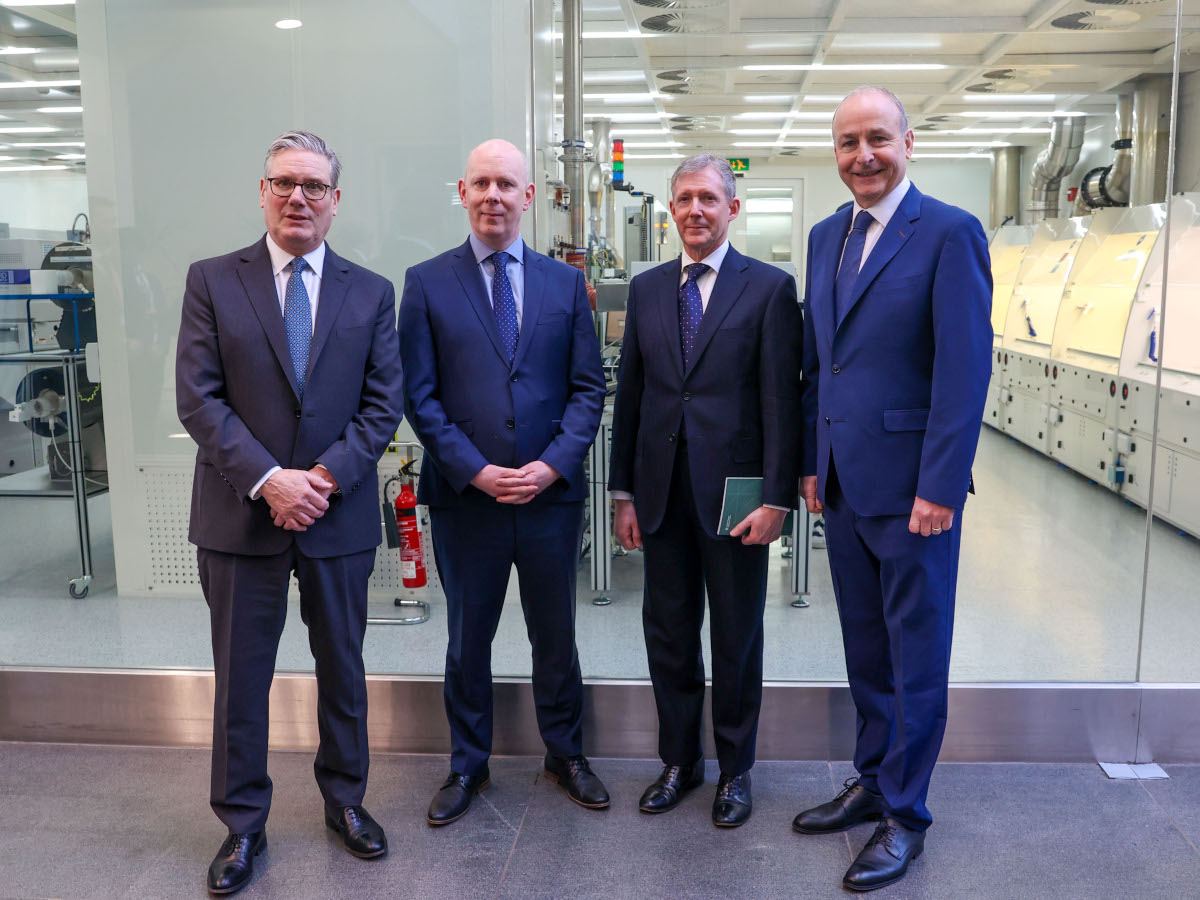
The agreement coincides with the second UK-Ireland Summit taking place in Cork.
UK Research and Innovation (UKRI), which is the UK’s national funding agency for research and innovation and Research Ireland, which is Ireland’s national competitive research and innovation development agency, have announced a memorandum of understanding (MoU).
The MoU is designed to support the current partnership and will coincide with the second UK-Ireland Summit taking place in Cork. The initiative will enable further collaboration on research areas that are critical to technological innovation and economic growth.
It will also support researchers in a number of key areas, such as telecommunications, advanced materials, quantum technologies and a new creative industries programme which will be launched later this year.
Advertisement
Furthermore, via the MoU, there will be continued collaboration between the existing lead agency agreement between the UKRI Engineering and Physical Sciences Research Council and Research Ireland.
Commenting on the announcement, Research Ireland’s CEO, Dr Diarmuid O’Brien, said, “Research Ireland is delighted to agree this MoU with UKRI, which paves the way for both an extension and expansion of our partnership arrangements. The MoU is aligned with our strategy, launched earlier this month,which is structured around the three interconnected impact themes of talent, economy and society.
“We look forward to the research collaboration, knowledge exchange, capacity-building and other cooperative activities that will be facilitated by the agreement.”
UKRI international champion and AHRC executive chair professor Christopher Smith, added, “From the creative industries, design and advanced communications to vaccines and biomedical research, collaborations between the UK and Ireland are addressing the major challenges and opportunities of our time.
Advertisement
“This Memorandum of Understanding deepens the already strong ties between the UK and Ireland’s research and innovation sectors, enhancing our ability to work together to advance our knowledge and deliver growth for the benefit of everyone in society.”
Don’t miss out on the knowledge you need to succeed. Sign up for the Daily Brief, Silicon Republic’s digest of need-to-know sci-tech news.
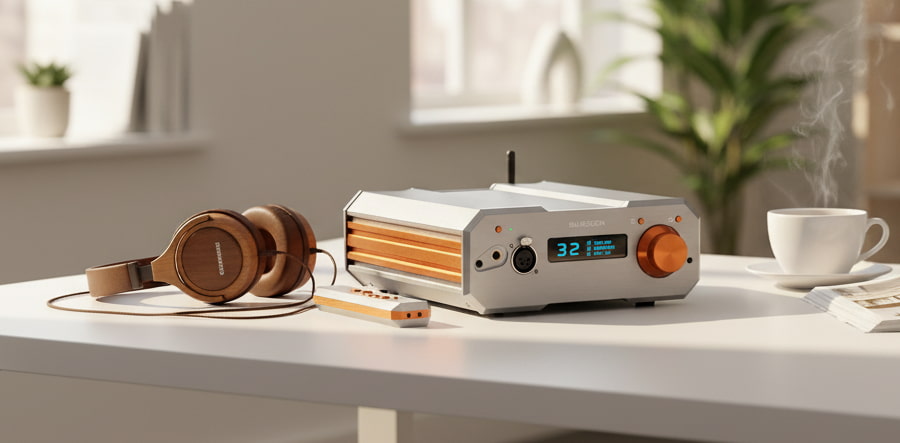
Burson Audio has been building serious headphone amplifiers since the early days of the Head-Fi revolution, long before personal audio became the center of gravity for the hi-fi industry. The Australian company earned its reputation the old-fashioned way: powerful Class A designs, fully discrete circuitry, and desktop components that deliver clean power, expansive soundstages, and connectivity options that make them easy to integrate into modern listening chains.
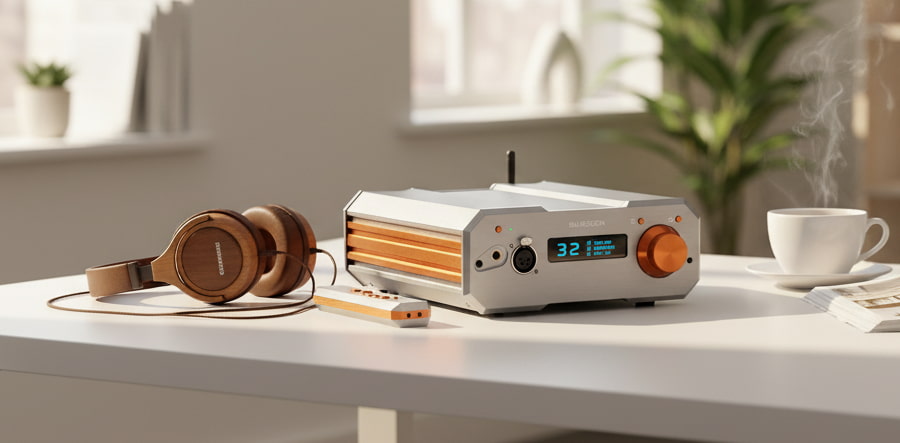
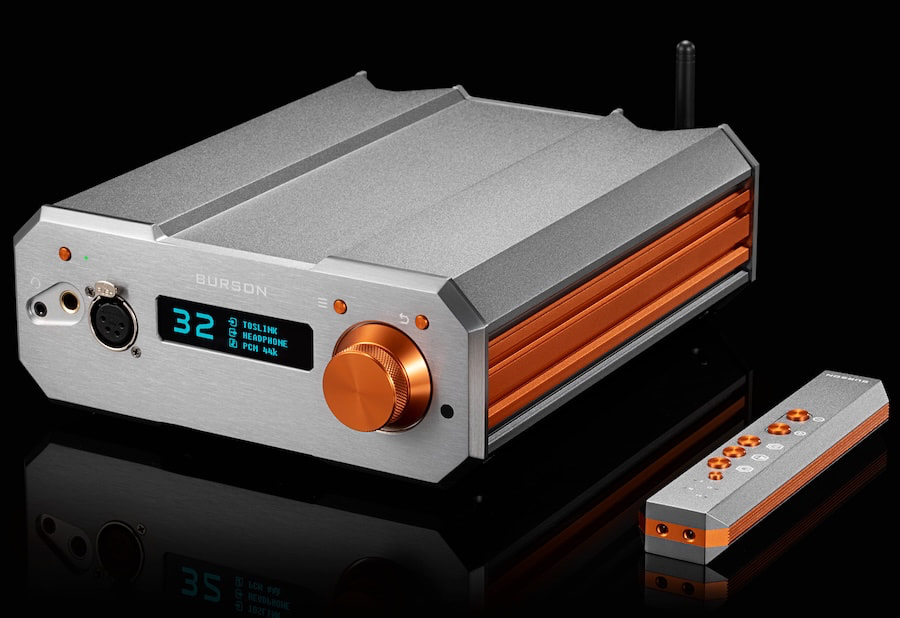
Now Burson Audio is expanding its lineup with the new Stellar Series, a range of compact Class A desktop components designed to bring more of the company’s flagship engineering to a slightly more approachable tier. The first model, the Conductor Stellar (Standard Edition), combines a high-resolution DAC, Class A headphone amplifier, and desktop preamp into a single chassis priced at $1,799.
Positioned between Burson’s entry-level Playmate 3 ($599 at Apos Audio) and the flagship Grand Tourer range, the Stellar line pulls key elements from the company’s top-tier Voyager Series; Class A muscle, discrete circuit architecture, and the unmistakable Burson house sound—while packaging it all into a more compact and accessible platform.
The timing also makes sense. We recently reviewed the Burson Audio Conductor GT4, and it remains one of the finest desktop DAC/headphone amplifier combinations currently available, delivering the kind of effortless power and wide open presentation that has long defined Burson’s approach to personal audio.
Advertisement
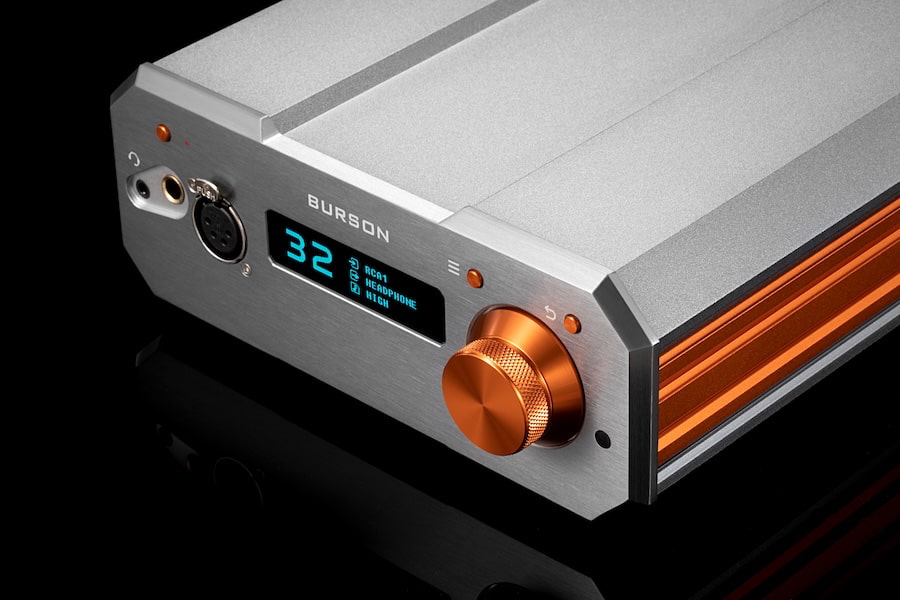
Burson Conductor Stellar
Burson Conductor Stellar: Class A Headphone Amp, DAC and Preamp
At the center of the Burson Audio Conductor Stellar is the ESS9039PRO DAC, paired with Burson’s fully discrete output stage and Max Current power supply architecture. Burson rates the unit at 8 watts of pure Class A output, which is substantial for a desktop headphone amplifier and enough on paper to handle a wide range of headphones, from more sensitive in-ear monitors to far more demanding full-size designs.
The headphone amplifier section has a 0.5-ohm output impedance, which should help it maintain better control with a broad range of headphone loads, while the pre-out and DAC-out stages are rated at 1 ohm and 20 ohms respectively.
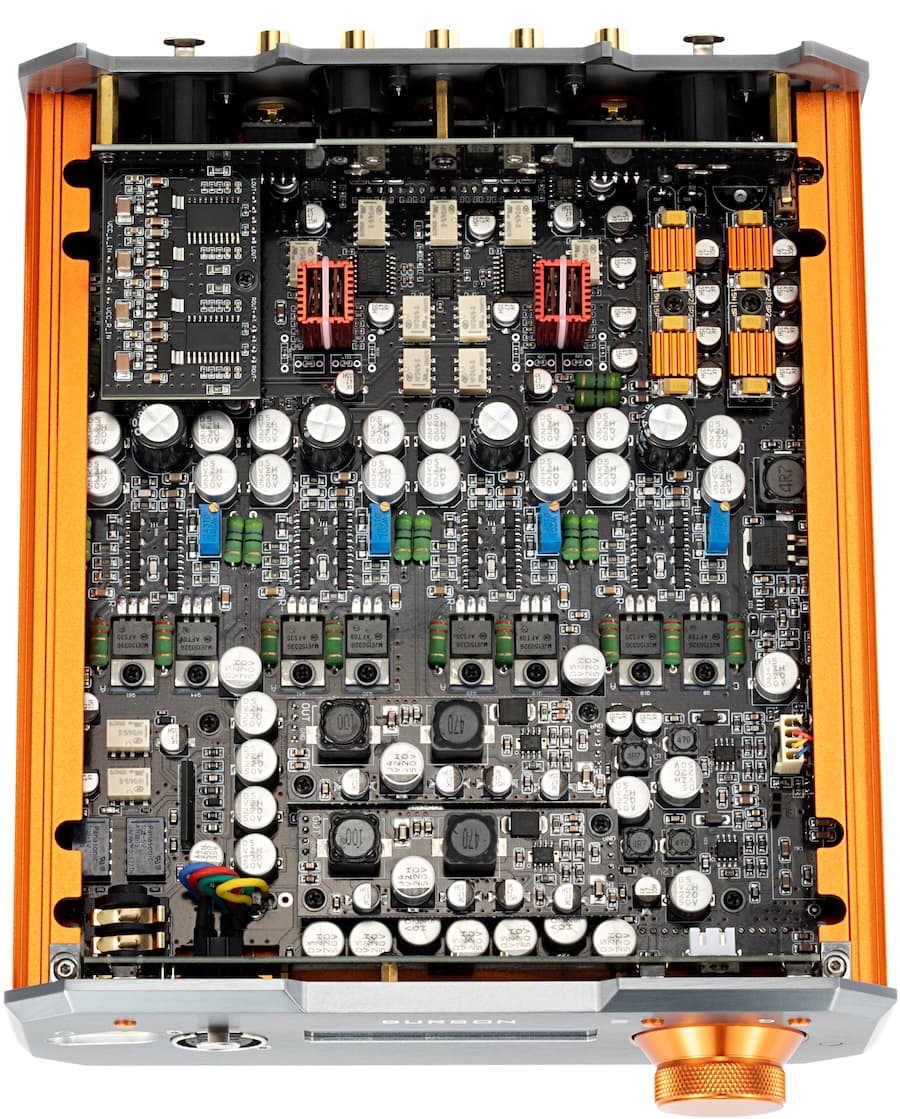
Burson is also using a transistor-based amplification stage built around four Onsemi MJE15032 transistors per channel. Those output devices are configured for high Class A bias, which is consistent with Burson’s long-running design approach in the headphone category.
The company also says the Conductor Stellar includes a dedicated low-noise amplification module for IEMs, aimed at reducing hiss with high-sensitivity earphones. Supporting that is the new Silent Power Module 2, built around the LT3045 voltage regulator, which Burson specifies at 0.8 µV RMS noise. In practical terms, the goal here is lower background noise and cleaner low-level detail, especially with sensitive headphones or lower listening volumes.
Advertisement
From a connectivity standpoint, the Burson Audio Conductor Stellar is built as an all-in-one desktop control center. Digital inputs include USB-C, optical Toslink, and coaxial SPDIF, with USB handled by an XMOS platform supporting up to DSD512 and PCM up to 32-bit/768kHz. Coaxial and optical inputs support up to 24-bit/192kHz. Wireless playback is handled by Bluetooth 5.0 using the Qualcomm CSR8675 chipset, with support for LDAC, aptX HD, and AAC. It is also listed as Roon Tested.
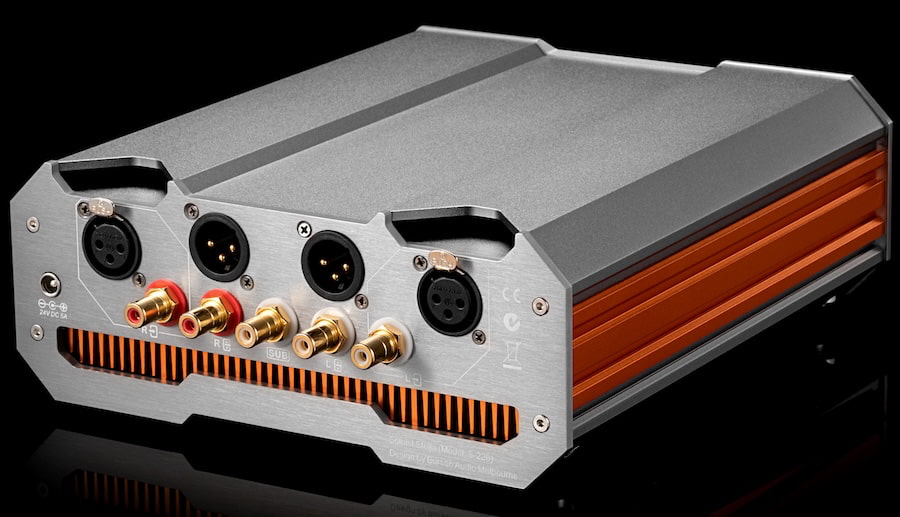
On the output side, users get balanced XLR and single-ended RCA preamp outputs, balanced XLR and single-ended RCA line outputs, plus headphone connections in 4-pin XLR, 6.35mm, and 3.5mm formats.
Burson’s published measurements point to a design focused on low noise and wide bandwidth. Physically, the unit measures 210 x 200 x 75 mm or 8.3 x 7.9 x 2.9 inches, and weighs about 5 kg or 11 pounds, which makes it compact by desktop Class A standards, though not exactly featherweight. Class A and “small desktop box” usually have a tense relationship. Physics always sends the bill.
Advertisement. Scroll to continue reading.
Advertisement
The Three Versions Explained
The Standard version is the entry point into the Stellar range. It ships with NE5532 IC op-amps, the SP01 power module, and a 24V/5A power supply, and it does not include a remote control. This is the version aimed at buyers who may want to experiment later with Burson’s upgrade path rather than paying for everything upfront.
The Deluxe version moves things up with V7 Vivid Pro op-amps, the SP02 power module, Burson’s Super Charger 5A external power supply, and an included remote control. Based on Burson’s own positioning, this is the model intended for buyers who want a more fully optimized setup straight out of the box without stepping all the way to the top trim.
The Max version sits at the top of the range and includes the V7 Vivid Pro op-amps, SP02, and remote as well, but replaces the Super Charger with Burson’s Fusion Core power solution. That makes it the most fully loaded version in the Stellar lineup and the one aimed at users who want the highest-spec factory configuration without adding upgrades later.
All three versions share the same core platform, inputs, outputs, chassis dimensions, and overall functionality. The main differences come down to the op-amp configuration, power supply implementation, and whether a remote is included.
The Bottom Line
At $1,800 for the Standard version, the Burson Audio Conductor Stellar lands in a price tier where most competitors force you to start making trade-offs. Some offer excellent amplification but limited connectivity. Others focus on DAC performance but lack the power to properly drive demanding headphones. Burson is trying to avoid those compromises by delivering a true Class A desktop amplifier with 8 watts of output, a flagship-grade ESS9039PRO DAC, balanced and single-ended connectivity, Bluetooth with LDAC, and a dedicated low-noise IEM stage in one chassis.
Advertisement
The other differentiator is upgradability. Burson’s modular op-amp design and multiple versions mean users can start with the Standard configuration and evolve the system over time rather than replacing the entire unit. That approach remains relatively rare in this category.
Who is it for? Headphone listeners building a serious desktop system who want enough power to drive virtually any headphone, flexible digital connectivity, and a path for future upgrades without jumping immediately into the $3,000–$5,000 range.
What’s missing? Network streaming and a built-in display interface beyond the basics, both of which are appearing more often in this category.
Still, when you look at the landscape, it becomes clear where the Stellar fits. Getting this level of Class A power, connectivity, and upgrade flexibility from competitors such as Schiit Audio, Feliks Audio, Ferrum Audio, or Chord Electronics typically requires multiple components or a significantly larger investment. Burson’s pitch is simple: put most of it in one box, keep it upgradeable, and deliver the kind of clean Class A power the company has been known for since the early days of Head-Fi.
Burson Audio has spent nearly two decades building some of the most powerful and flexible desktop headphone amplifiers in the personal audio space. With the new Soloist Stellar, the Australian manufacturer is focusing on something that many desktop amplifiers still struggle to balance: delivering enough Class A power for demanding full size headphones while also providing the low noise precision required for modern wired in-ear monitors. And in case you might have missed it — wired IEMs are having a bit of a moment.
Priced at $1,500 for the Standard version, the Soloist Stellar is a pure headphone amplifier and preamplifier with no onboard DAC. That design choice is deliberate. Many headphone enthusiasts already own a DAC they prefer, and separating the amplification stage allows Burson to concentrate entirely on clean power delivery, ultra low noise operation, and flexible connectivity for a wide range of headphone and desktop systems.
The Soloist Stellar continues Burson’s long running approach of fully discrete Class A amplification, powered by the company’s Max Current power supply architecture and supported by Silent Power modules for lower electrical noise. The amplifier is rated at up to 8 watts of Class A output, which places it firmly in the category of desktop amplifiers capable of driving everything from efficient dynamic headphones to more demanding planar magnetic designs.
But the real story with the Soloist Stellar is how Burson is addressing the different requirements of wired IEM listeners. Sensitive in ear monitors often reveal noise and gain issues that remain hidden with full size headphones. To address this, Burson added a dedicated IEM amplification module built around dual TPA6120A2 amplifier chips. These chips are known for extremely low distortion—around 0.00014 percent THD+N—along with a very high 1300 V per microsecond slew rate and wide bandwidth. The goal is simple: maintain a pitch black background and precise micro detail even when using highly sensitive earphones.
Advertisement
Volume control is handled by a dual PGA2320 analog resistor ladder system, which allows for extremely accurate channel matching and low distortion. Unlike traditional potentiometers or digital attenuation systems, this approach maintains full signal resolution even at lower listening levels. That matters particularly for IEM listeners who often operate in the lower range of an amplifier’s volume control.
Burson also allows users to fine tune the amplifier through swappable dual op amp stages. Owners can experiment with Burson’s V7 Vivid or V7 Classic op amps, or even compatible third party options, depending on their preferred tonal balance. The Standard version is designed as the starting point for those who enjoy upgrading, while the Deluxe version includes V7 Vivid Pro op amps, Silent Power Level 2 modules, the Super Charger 5A power supply, and a remote control.
For users who want to push the amplifier even further, Burson also offers the Fusion Core upgrade, a GaN based power supply capable of delivering up to 360 watts of ultra low noise DC power to the amplifier stage.
What the Soloist Stellar Offers
From a system integration standpoint, the Burson Audio Soloist Stellar is designed to function as both a high performance headphone amplifier and a desktop preamplifier.
Advertisement
It accepts balanced XLR and single ended RCA inputs, along with a microphone bypass input designed for gaming headsets. Output connections include balanced XLR and single ended RCA preamp outputs, plus a dedicated mono subwoofer output for integration into desktop speaker systems.
For headphone users, Burson provides three connection options: balanced XLR, 6.35 mm single ended, and 3.5 mm outputs. The amplifier also separates its gain and output structure into high power, medium power, and dedicated IEM modes, giving users more flexibility when switching between different types of headphones.
This approach reflects the reality of modern personal audio systems. A listener might move between high impedance dynamic headphones, planar magnetics, and sensitive IEMs in the same setup, each of which places very different demands on the amplifier.
Advertisement. Scroll to continue reading.
Advertisement
Unlimited Power?
Burson specifies the Soloist Stellar with an input impedance of 40 kΩ, making it compatible with a wide range of DACs and source components. Frequency response is listed at ±1 dB from 0 to 55 kHz, while total harmonic distortion is rated at below 0.0015%.
Channel separation is particularly strong, with 143 dB at 1 kHz and 138 dB at 20 kHz, and the amplifier’s THD+N is specified at 0.0005% at 1 kHz at full scale. Signal to noise ratio varies depending on output mode, reaching 120 dB in the dedicated IEM output stage, which is one of the key areas where the design aims to serve sensitive in ear monitors.
Output impedance is kept very low at 0.5 ohms for the headphone amplifier, helping maintain good damping and compatibility across different headphone loads. The preamp outputs are rated at 1 ohm and 20 ohms, depending on the output stage being used.
Power output scales depending on the headphone impedance and output mode. At 16 ohms, the amplifier can deliver up to 8 watts balanced or 4 watts single ended in its high output mode. At 32 ohms, output drops slightly to 5 watts balanced and 2.5 watts single ended. Even at 300 ohms, the Burson Audio Soloist Stellar can still produce 500 milliwatts balanced or 260 milliwatts single ended, which is enough to drive many high impedance headphones.
Advertisement
The medium and IEM modes reduce output accordingly to maintain lower noise and better control with sensitive earphones.
Physically, the Soloist Stellar measures 210 × 200 × 75 mm (8.3 × 7.9 × 2.9 inches) and weighs about 5 kilograms (11 pounds). That mass reflects the thermal and power demands of a compact Class A amplifier, which runs hotter by design than most desktop headphone amps. In our experience with Burson’s previous models, adequate ventilation is essential, as these amplifiers can run noticeably warm during extended listening sessions.
The Bottom Line
Unlike the Conductor Stellar, which combines a DAC, headphone amplifier, and preamp into a single desktop hub, the Burson Audio Soloist Stellar is focused entirely on pure amplification. There’s no DAC inside, which allows Burson to dedicate the design to delivering high current Class A power, extremely low noise performance, and greater flexibility for users who already own a DAC they like.
What makes the Soloist Stellar stand out is how it balances two very different needs. It offers up to 8 watts of Class A power for demanding full size headphones, while also including a dedicated low noise IEM amplification stagedesigned to avoid hiss and preserve fine detail with highly sensitive earphones. That combination is still surprisingly rare in desktop headphone amplifiers.
Advertisement
The Burson Audio Soloist Stellar is aimed at headphone enthusiasts who want a powerful standalone amplifier that can anchor a serious desktop system, especially those who rotate between full size headphones and wired IEMs. Add in the ability to swap op amps and upgrade the power supply, and it becomes a platform that can evolve over time rather than something that needs replacing when the rest of the system changes.
If you are stuck choosing between the 14-inch MacBook Pro and the 16-inch MacBook Pro with the M5 Max, you now have one more thing to consider, aside from size. The question was always there whether the M5 Max was being held back by the smaller chassis. Now that the test results for both these machines are out, the answer appears to be a resounding yes.
How much performance loss are we talking about?
The folks at Notebookcheck ran the same tests on both 14-inch and 16-inch MacBook Pros powered by top-of-the-line M5 Max chips with 40 GPU cores, and the results were insightful.
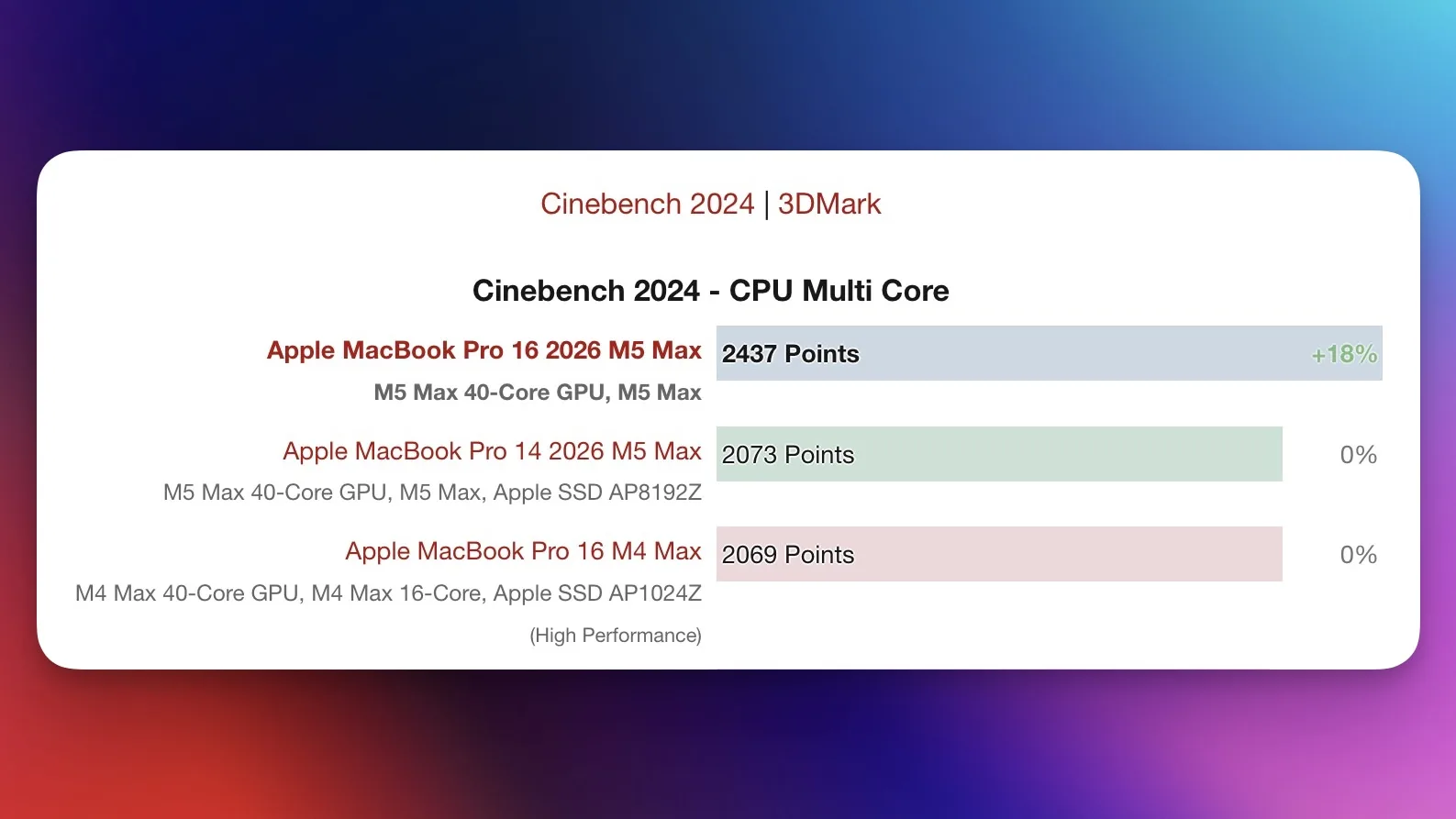
Initial benchmarks reveal an 18% improvement in multi-core performance in the MacBook Pro 16 over the MacBook Pro 14. What makes this more impressive is that the 16-inch MacBook Pro achieves this in Automatic mode. Switching to High Power mode will offer even better sustained performance over longer sessions.
Notebookcheck
GPU performance tells a similar story. The MacBook Pro 16-inch scores 12% higher than the 14-inch model in the 3DMark Steel Nomad test. More importantly, the GPU performance was stable under sustained workloads, while the 14-inch model dropped by as much as 25% during the same test.
Why is the bigger laptop performing so much better?
It comes down to heat and power draw. The M5 Max is a powerful chip that consumes a lot of power. During benchmarks, the MacBook Pro 16 pulled 78 watts through its CPU cores, significantly more than the 14-inch model.
Advertisement
It’s because the smaller laptop simply doesn’t have the space to manage that kind of heat effectively. With less room for cooling, the MacBook Pro 14 throttles the chip to protect it, which is what causes the performance drops.
The 16-inch MacBook Pro features a larger chassis, improved airflow, and higher thermal headroom capacity, allowing the M5 Max to sustain peak performance with minimal throttling.
So, should you go for the MacBook Pro 14 or the 16?
If you are a creative professional who needs the M5 Max for demanding tasks, such as video editing or 3D rendering, the MacBook Pro 16 is clearly the better choice. The chip has more thermal headroom in the larger body, and it shows.
That said, if your workload requires this level of power, I would recommend waiting for the Mac Studio with the M5 Max, as it will likely deliver better sustained performance at a lower cost. If your work doesn’t require you to travel much, that would be a better machine in every way than the laptop.
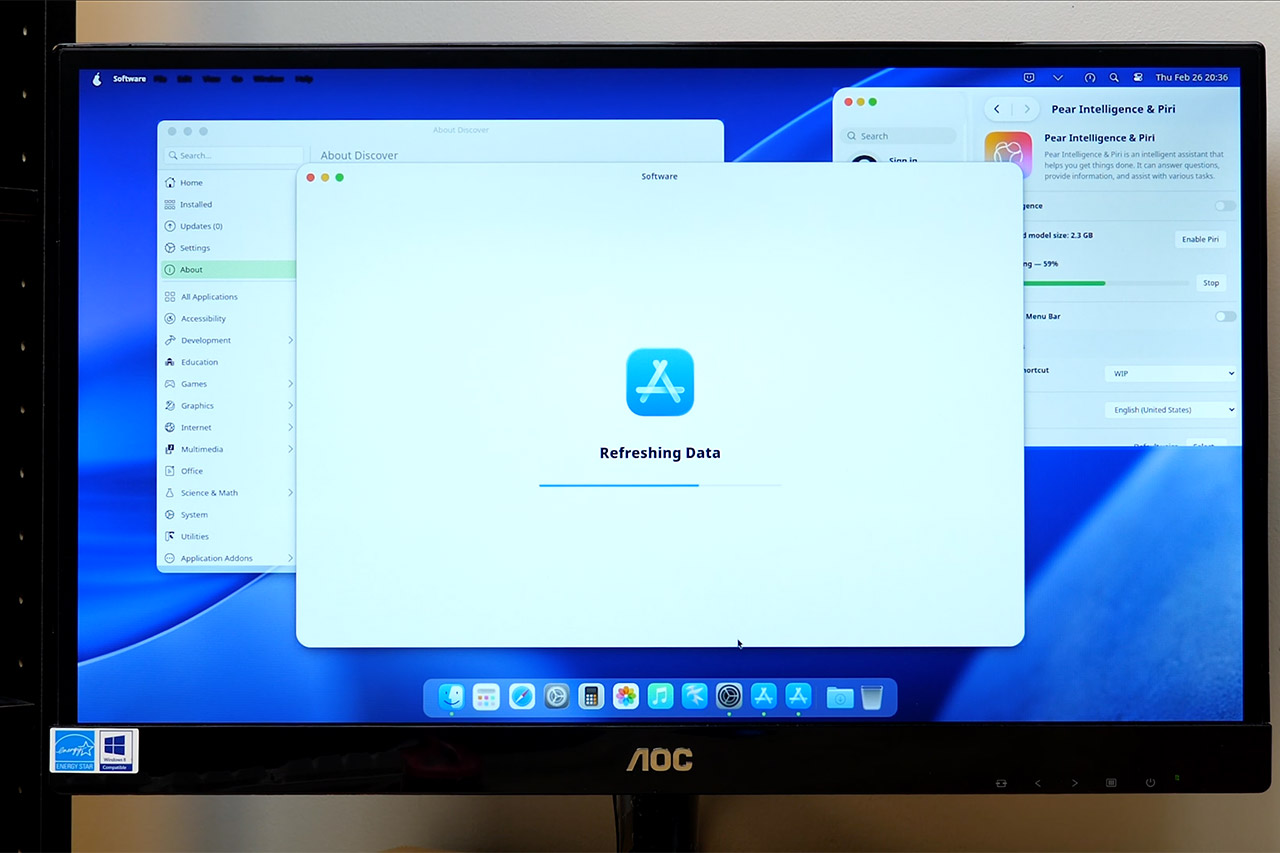
Old laptops have a habit of ending up in a drawer the moment manufacturers stop supporting them, left to gather dust while modern software demands more than they can comfortably give. PearOS exists to change that. It’s a free operating system that breathes new life into neglected hardware, bringing a Mac-like experience complete with a familiar menu bar, a clean dock, and smooth gestures to machines that most people had written off. The latest release, built on Arch Linux and going by the name NiceC0re, is designed to make everyday tasks feel effortless on exactly the kind of hardware that usually gets left behind.
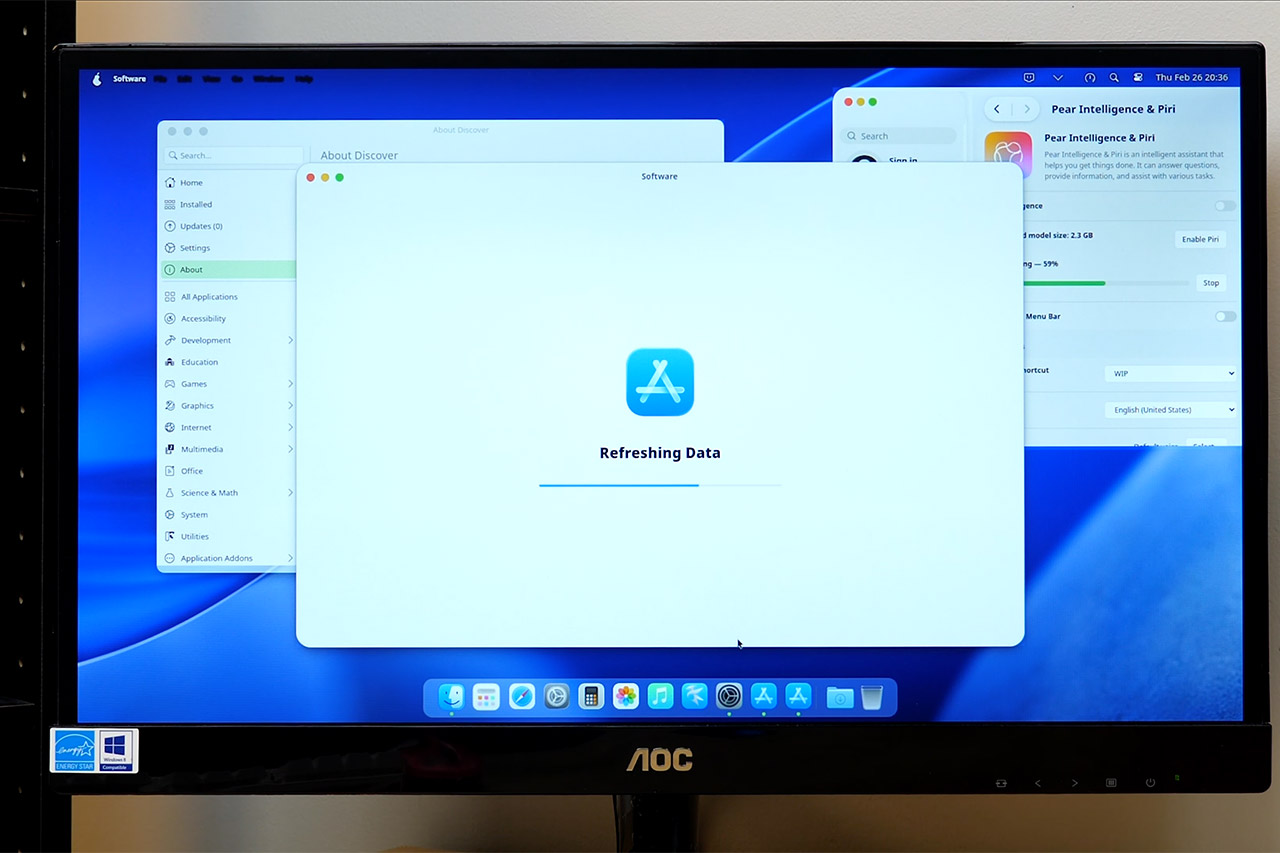
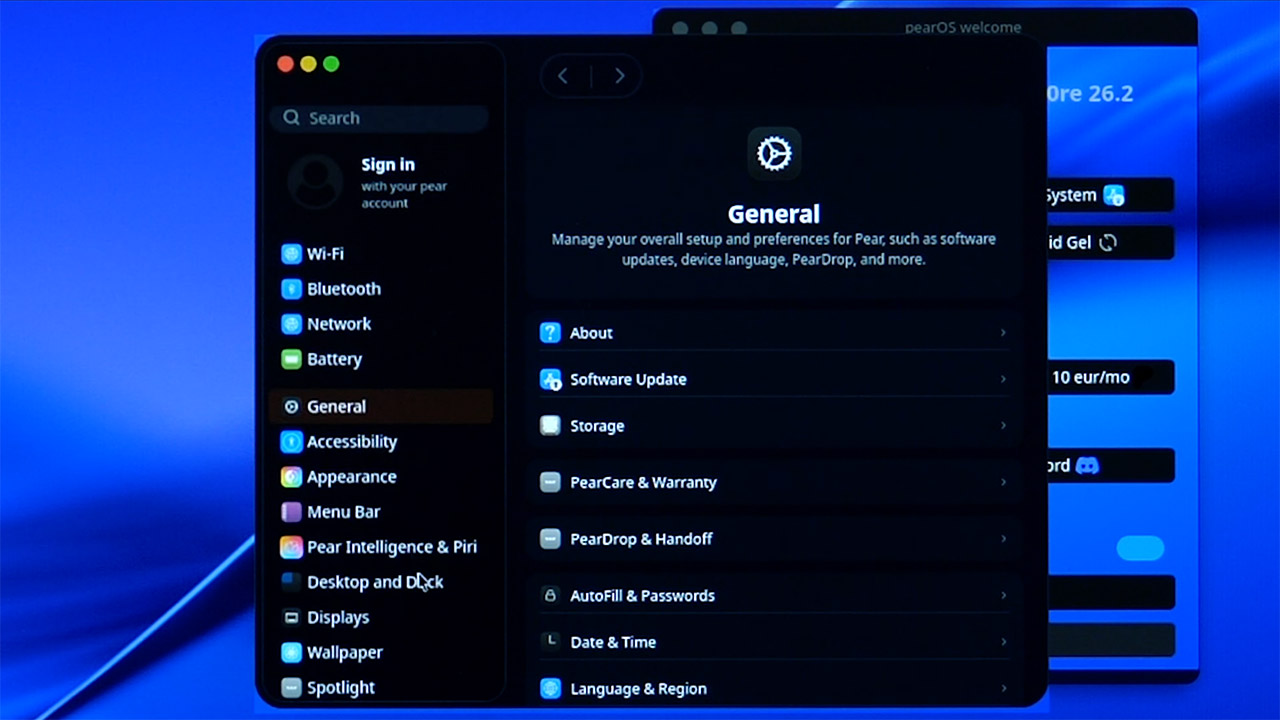
Fire it up for the first time and the Mac influences are impossible to miss. A top menu bar greets you with a stylish pear emblem in place of the Apple logo, and the dock below bounces and magnifies icons in exactly the way you would expect. The full screen app launcher is a dead ringer for Launchpad, complete with categories and smooth animations, and the search tool does a convincing impression of Spotlight, pulling up files, apps, and settings in a matter of seconds. The attention to detail goes well beyond the surface level too. The cursor grows larger when you shake it, discreet pop-up indicators let you know when your microphone or screen sharing is active, and countless other small touches will feel instantly familiar to anyone who has spent time on a Mac. PearOS has clearly set out to recreate that experience as faithfully as possible, just without the price tag that usually comes with it.
HELLO, MACBOOK NEO — Ready for whatever your day brings, MacBook Neo flies through everyday tasks and apps. Choose from four stunning colors in a…
THE MOST COLORFUL MACBOOK LINEUP EVER — Choose from Silver, Blush, Citrus, or Indigo — each with a color-coordinated keyboard to complete the…
POWER FOR EVERYDAY TASKS — Ready the moment you open it, MacBook Neo with the A18 Pro chip delivers the performance and AI capabilities you need to…
The settings menu is laid out in clean, organized columns that anyone who has used a recent version of macOS will navigate without a second thought, with display, sound, and network options all sitting exactly where you would expect them. A few corners are still being tidied up, with certain sections marked as coming soon, but the essentials including brightness, volume, night mode, and power all work exactly as they should. The file manager, PearFinder, rounds things out nicely, taking the bones of a typical Linux tool and wrapping it in a polished new interface complete with the sidebar and preview window.
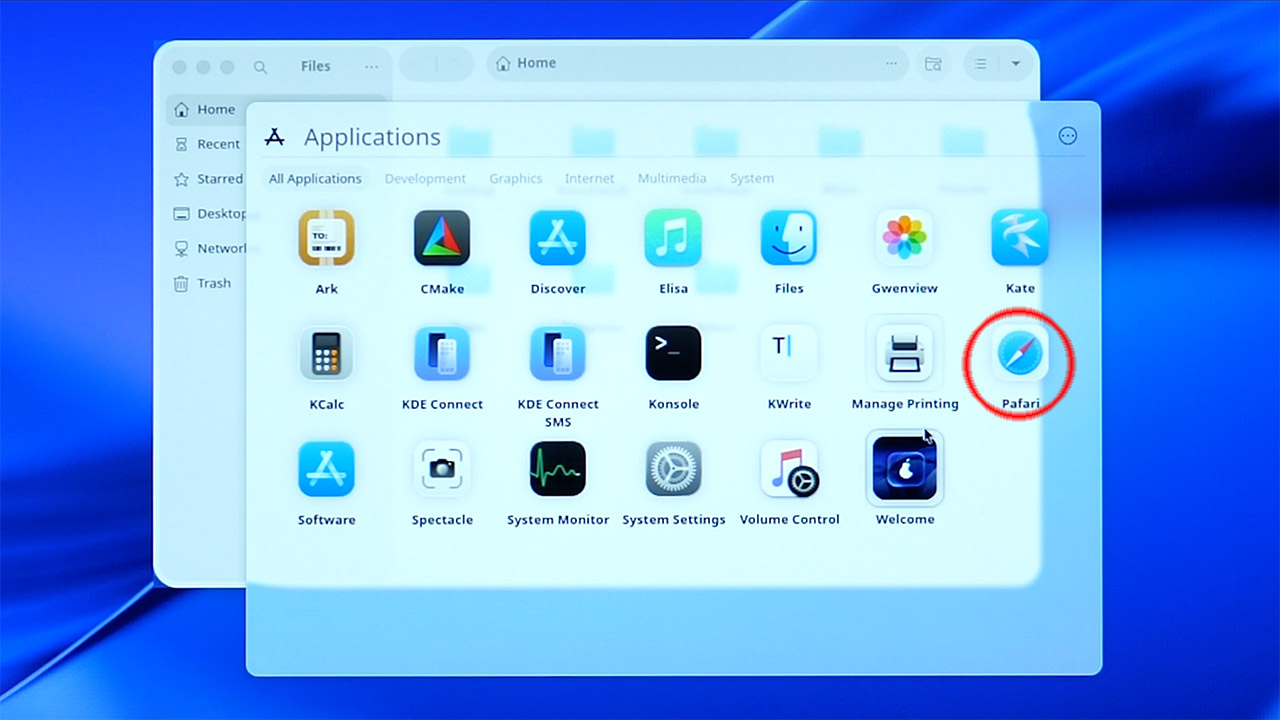
There is also a browser called Pafari that gets about as close to Safari as you reasonably can without outright copying it, complete with clean tabs, a minimal address bar, and all the usual trimmings. Music playback, photo viewing, and screen capture come preinstalled and ready to go as well, all running on familiar Linux foundations but dressed up with Mac-style icons and fonts that tie the whole experience together.
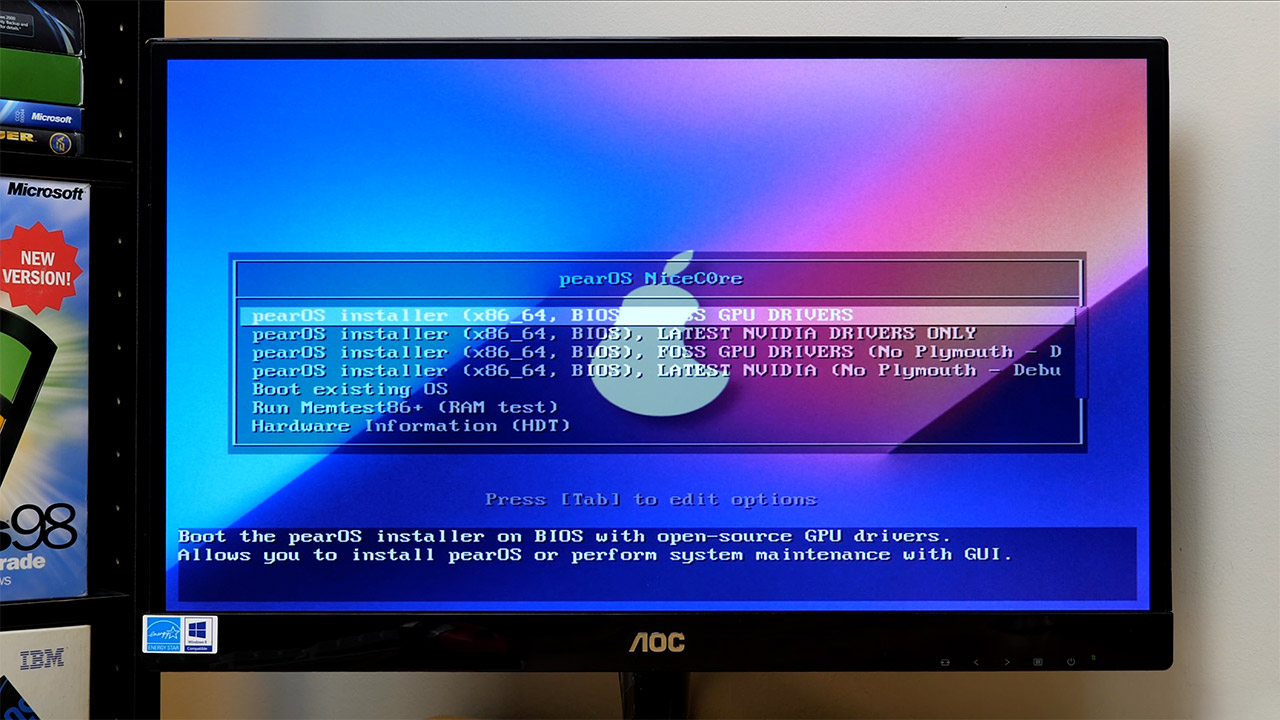
Getting started is straightforward enough. Download the roughly three gigabyte file from the PearOS website, burn it to a USB drive, and boot up your laptop. The custom installer is built with modern web technology and walks you through each step in plain, clear language, so prior Linux experience is not a requirement. You will need to make a couple of decisions along the way, including which graphics driver to use and whether to go with the latest NVIDIA option or an open source alternative. It is also worth noting that a full wipe of the hard drive is required, so backing up your data beforehand and having a dedicated machine or virtual setup in mind is strongly recommended. After that the installer takes care of the rest, and the whole process should be wrapped up in under an hour on most systems.
Looking for the most recent Wordle answer? Click here for today’s Wordle hints, as well as our daily answers and hints for The New York Times Mini Crossword, Connections, Connections: Sports Edition and Strands puzzles.
As the Chinese AI market heats up, Alibaba could launch Qwen for enterprise this week, while Kimi-maker Moonshot looks set to raise at an $18bn valuation.
The Chinese players continue their bid to compete with the likes of OpenAI and Anthropic, launching their own agentic tools and apps. Now Alibaba looks set to launch its Qwen-based enterprise offering for organisations this week.
In recent weeks the OpenClaw craze in China led all the major players to launch OpenClaw-based apps. Alibaba, Baidu, ByteDance, Tencent and MiniMax all released OpenClaw-powered apps. At the same time, state officials in the country have moved to curb usage of such apps amid growing cybersecurity concerns.
Given the recent success of Claude Cowork, it is little surprise that major players like Alibaba are looking to launch enterprise agentic models that promise an added security layer to an enterprise market hungry for agentic AI that supports real world tasks. US AI giants such as Anthropic, with its Cowork offering, and OpenAI don’t provide their services commercially in China.
Advertisement
In February Alibaba launched Qwen 3.5 with “visual agentic abilities”, but reports suggest this week will see a specific offering for enterprise customers, who will of course have security front of mind.
Sources told Bloomberg the newly created enterprise AI tool will support companies in operating computers, browsers and cloud servers, with “built-in features to safeguard data security”.
And there is also no shortage of appetite in China when it comes to funding their AI players. Moonshot, the company behind the Kimi chatbot is currently in discussions to raise some $1bn in its current fundraising round, which would value the start-up at $18bn, having been valued at $4.3bn in late 2025. Existing investors include the likes of Tencent and Alibaba Group.
Elsewhere TikTok parent ByteDance is facing challenges, with Reuters reporting that it has had to pause the global launch of its latest video-generation model, Seedance 2.0, after copyright disputes with some of the big Hollywood studios and streaming platforms.
Advertisement
ByteDance had promised to “strengthen current safeguards” against intellectual property theft after Disney threatened legal action over videos generated by Seedance 2.0.
Don’t miss out on the knowledge you need to succeed. Sign up for the Daily Brief, Silicon Republic’s digest of need-to-know sci-tech news.
In 2010, Warren Buffett and Bill Gates launched a disarmingly simple campaign they called the Giving Pledge: a public commitment, open to the world’s wealthiest people, to give away more than half their fortune during their lifetime or upon their death. The moment seemed to call for it. Tech was minting billionaires faster than any industry in history, and the question of how those fortunes would impact society was just beginning to take shape. “We’re talking trillions over time,” Buffett told Charlie Rose that year. The trillions materialized. The giving, less so.
The numbers are no longer shocking to anyone paying attention. The top 1% of American households now hold roughly as much wealth as the bottom 90% combined — the highest concentration the Federal Reserve has recorded since it began tracking wealth distribution in 1989. Globally, billionaire wealth has grown 81% since 2020, reaching a whopping $18.3 trillion, while one in four people worldwide don’t regularly have enough to eat.
This is the world in which a small group of extraordinarily wealthy people are now debating whether to honor — or walk away from — a voluntary and unenforceable promise to give away half of what they have.
The Giving Pledge’s numbers, reported Sunday by the New York Times, trace a steady decline. In its first five years, 113 families signed the Pledge. Then 72 over the next five, 43 in the five after that, and just four in all of 2024. The roster includes Sam Altman, Mark Zuckerberg and Priscilla Chan, and Elon Musk — some of the most powerful people in the world, and yet, in Peter Thiel’s words to the Times, it is a club that’s “really run out of energy . . .I don’t know if the branding is outright negative,” Thiel told the outlet, “but it feels way less important for people to join.”
Advertisement
The language of doing good in Silicon Valley has been wearing thin for years. Back in 2016, the HBO series “Silicon Valley” was so relentless in mocking the industry — its characters forever insisting they were “making the world a better place” while chasing valuations — that it reportedly changed actual corporate behavior. One of the show’s writers, Clay Tarver, told The New Yorker that year: “I’ve been told that, at some of the big companies, the P.R. departments have ordered their employees to stop saying ‘We’re making the world a better place,’ specifically because we have made fun of that phrase so mercilessly.”
It was an hilarious joke. The trouble is the idealism being satirized was also, at least partly, real — and what replaced it isn’t so funny. Veteran tech investor Roger McNamee, in the same piece, recalled asking Silicon Valley creator Mike Judge what he was really going for. Judge’s answer: “I think Silicon Valley is immersed in a titanic battle between the hippie value system of the Steve Jobs generation and the Ayn Randian libertarian values of the Peter Thiel generation.”
McNamee’s own read on things was less diplomatic: “Some of us actually, as naïve as it sounds, came here to make the world a better place. And we did not succeed. We made some things better, we made some things worse, and in the meantime the libertarians took over, and they do not give a damn about right or wrong. They are here to make money.”
Techcrunch event
Advertisement
San Francisco, CA | October 13-15, 2026
A decade later, the libertarians McNamee was describing have moved well beyond Silicon Valley. Some are now in the Cabinet.
Advertisement
Not everyone agrees on what “giving back” even means. To the libertarian wing of tech — and it’s an increasingly significant wing — the entire framework is wrong. Building companies, creating jobs, and driving innovation are the real contributions, and the pressure to layer philanthropy on top of them is, at best, a social convention and, at worst, a shakedown dressed up as virtue.
Few figures captures the current mood quite like Thiel, who, notably, never signed the Pledge himself and is no fan of Bill Gates (among other things, he has reportedly called Gates an “awful, awful person“). In fact, Thiel tells the Times he has privately encouraged around a dozen signers to undo their commitments and has even gently pushed those already wavering to make their exits official. “Most of the ones I’ve talked to have at least expressed regret about signing it,” Thiel said, calling the Giving Pledge an “Epstein-adjacent, fake Boomer club.”
He has urged Musk to unsign, for example, arguing his money would otherwise go “to left-wing nonprofits that will be chosen by” Gates. When Coinbase CEO Brian Armstrong quietly let his letter disappear from the Pledge website in mid-2024 without a word of public explanation, Thiel sent him a congratulatory note.
But Thiel also told the Times something worth a harder look: that those who stay on the Pledge’s public roster feel “sort of blackmailed” — too exposed to public opinion to formally renounce a non-binding promise to give away vast sums of money.
Advertisement
It’s a claim that’s difficult to square with the public behavior of some of the people Thiel has in mind. Musk has shown little interest in managing public perception, and at this point, a majority of Americans already view him unfavorably. Zuckerberg spent nearly a decade facing some of the most sustained regulatory and public hostility any tech exec has endured and came out the other side more sure of himself, not less.
A different picture is meanwhile taking shape on the ground. GoFundMe reported that fundraisers for basic necessities — rent, groceries, housing, fuel — surged 17% last year. “Work,” “home,” “food,” “bill,” and “care” were among the top keywords in campaigns that year. When the 43-day federal shutdown halted food stamp distribution this past fall, related campaigns jumped sixfold. “Life is getting more expensive and folks are struggling,” the company’s CEO told CBS News, “so they are reaching out to friends and family to see if they can help them through.”
Whether these trends are connected to decisions made in philanthropy boardrooms is a matter of debate, but they’re happening at the same time, and the timing is hard to ignore.
It’s worth separating the fate of the Pledge from the fate of philanthropy more broadly. Some of the wealthiest people in tech are still giving; they’re just doing it on their own terms, through their own vehicles, toward their own chosen ends. At the start of 2026, Chan Zuckerberg Initiative (CZI) cut about 70 jobs — 8% of its workforce — as part of a move away from education and social justice causes toward its Biohub network, a group of nonprofit, biology-focused research institutes operating across several cities. “Biohub is going to be the main focus of our philanthropy going forward,” Zuckerberg said last November.
Advertisement
The CZI cuts look, at least on paper, less like the couple is retreating from philanthropy than recalibrating their approach. The Zuckerbergs have, after all, committed through the Pledge to give away 99% of their lifetime wealth.
Not everyone is redefining the terms, either. Gates announced last year that he’d give away virtually all his remaining wealth through the Gates Foundation over the next two decades — more than $200 billion — with the foundation closing permanently on December 31, 2045. Invoking Carnegie’s old line that “the man who dies thus rich dies disgraced,” he wrote that he was determined not to die rich.
It’s happened before, this standoff between concentrated wealth and everyone else. The last time wealth concentrated at anything like these levels — the original Gilded Age, the 1890s through the early 1900s — the correction didn’t come from philanthropists. It came from trust-busting, the federal income tax, the estate tax, and eventually the New Deal. It arrived as policy that was driven by political pressure too powerful to be ignored. The institutions that forced that correction — a functional Congress, a free press, an empowered regulatory state — look considerably different today.
What isn’t in dispute is the pace of change. These fortunes have been built in years, not generations, at the same moment the safety net is being cut. The wealth gained by the world’s billionaires in 2025 alone would have been enough to give every person on earth $250 and still leave billionaires more than $500 billion richer, according to Oxfam’s 2026 global inequality report.
Advertisement
The Giving Pledge was always, as Buffett said from the start, just a “moral pledge” — no enforcement, no consequences, no one to answer to but yourself. That it once carried weight says something about the era that produced it. That Thiel now frames staying on the list as a form of coercion — and that the Times found that argument worth reporting at length — says something about the one we’re in right now.
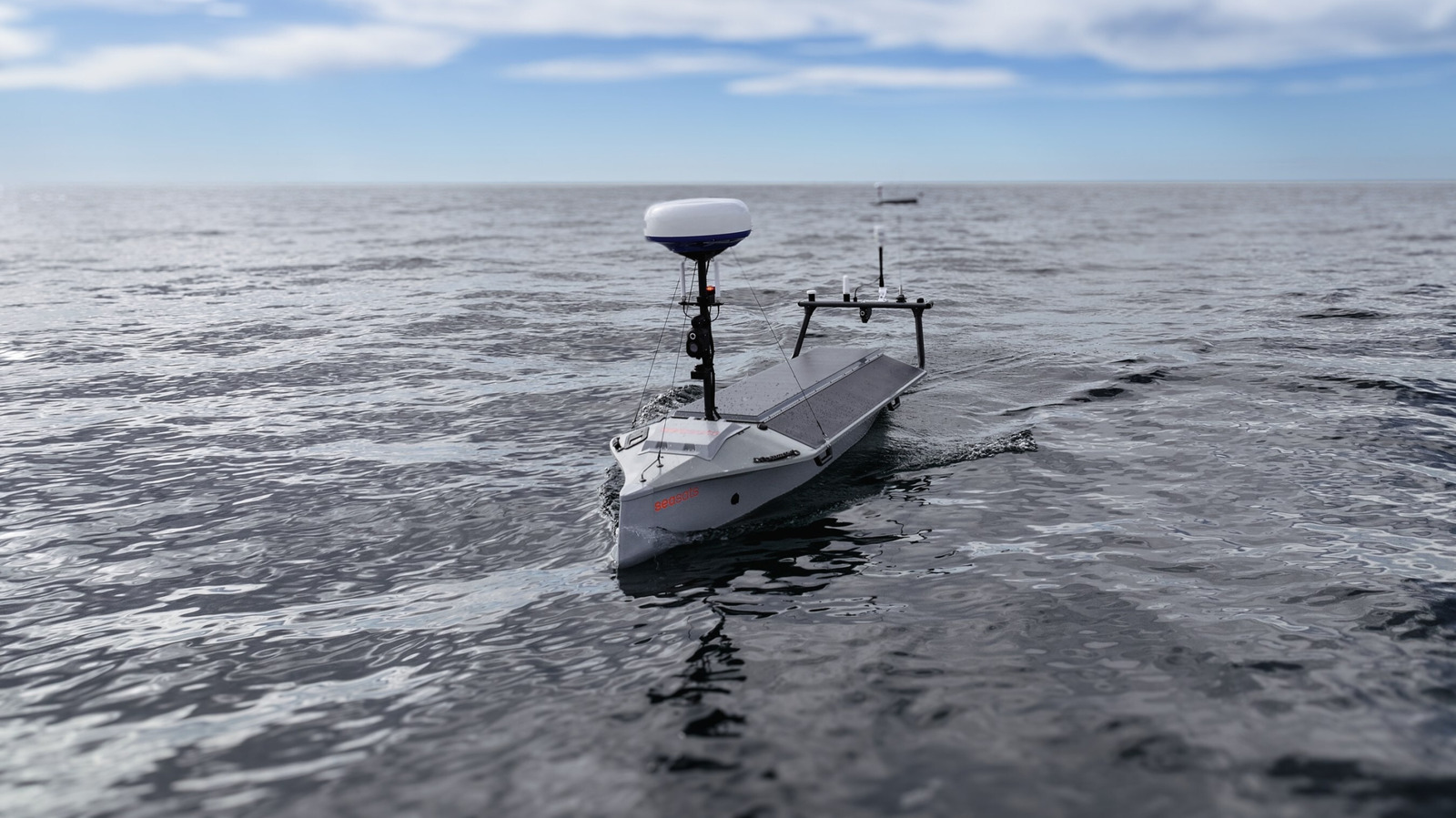
The U.S. Navy is fully on board the autonomous surface vessel (ASV) wagon as it moves toward having half of its surface fleet be unmanned by 2045. In 2025, it launched an autonomous 180-foot warship, known as the USX-1 Defiant. In February 2026, its new Lightfish drone hit the open ocean. The unmanned solar-powered Lightfish is built by Seasats, a private company based in San Diego, California.
Seasat’s Lightfish is a 305-pound drone designed for general-purpose activities such as surveying, research, and security patrols. With the U.S. Navy, it will be used in missions to constantly gather intelligence through surveillance and reconnaissance along shorelines, in harbors, and even in the open ocean. With a top speed of 5 knots (5.75 mph), it can conduct a wide range of maritime domain awareness missions, including port and coastal security, drug trafficking, illegal fishing, and other threats.
Advertisement
The Lightfish, which measures just 11.4 feet x 3.4 feet, can survive up to six months or 8,000 nautical miles at sea without human intervention. It has a payload of 66 pounds and can be deployed at a moment’s notice by one or two people. Additionally, it can be easily hauled in the back of a truck or placed aboard almost any aircraft. The Lightfish joins other sea-faring drones, including an unmanned underwater drone that the German Navy tested in 2025.
Advertisement
The Lightfish’s specifications
Lightfish is equipped with a bevy of high-tech equipment (including collision avoidance, onboard Artificial Intelligence, and GPS-denied navigation), five high-definition cameras, and redundant communication systems including LTE, Iridium SBD, Iridium Certus, and Starlink. The drone’s solar-electric power system has a supplemental built-in methanol fuel cell that can supply 11 or 28kWh of power. The ASV has an Electric Drive Torqeedo 1103 with a weedless propeller equal to a 3-hp outboard motor. Additionally, its weighted keel allows it to right itself in conditions up to Sea State 6, where waves can reach heights of 20 feet.
Lightfish is meant strictly for surveillance and recon, unlike other privately-built USVs like the Cardona Marine Group, Inc.’s Sea-Predator-7, which is equipped with an array of munitions to deal lethal damage. The drone has a modular construction for easier maintenance and better customization, and most payloads can be swapped in minutes. With such a technologically advanced unit, one might think it would take a specialist to operate it. Not so. Seasats claims that its browser-based controls allow anyone to learn to navigate this ASV within five days.
Seasats’ other two ASVs are the Quickfish and Heavyfish. The former has a top speed over 35 knots (40.28 mph), making it ideal for fast-response tactical operations. But it can only last a month without intervention, and its 1,450-pound weight (and 450-pound payload) requires a trailer to move and launch. Heavyfish weighs 9,000 pounds (with a 1,000-pound payload) and requires an even larger vehicle to move and a crane to get into the water. It too can last six months at sea, and has a top speed of 12 knots (13.81 mph).
Advertisement
The Lightfish has proved its long-distance capabilities
In June 2024, a Lightfish drone traveled some 2,500 miles from San Diego to Joint Base Pearl Harbor Hickam in Hawaii. The 73-day trip was so successful that the team decided to send it on to Japan, but it was put out of commission by a typhoon along the way. An improperly sealed exhaust vent cover was to blame, allowing water into the hull.
Advertisement
Lightfish performed the same run a second time to prove itself, again starting at the company’s headquarters in San Diego. After a stopover in Hawaii for a demonstration, it continued past Wake Island and Guam, and took part in another demo in Okinawa. It finally arrived in Japan on July 30, 2025, with the successful trans-Pacific trip covering 7,500 miles in 150 days.
In early February 2026, the U.S. Sixth Fleet — specifically, Commander Task Force (CTF) 66 — successfully tested Lightfish during Exercise Cutlass Express 2026 in the Western Indian Ocean. It was launched from the Seychelles Navy’s SCG auxiliary Saya De Malha (A605). Combined with upcoming drones like Lockheed Martin’s Lamprey multi-mission autonomous undersea vehicle, the Lightfish could make the seas much safer for the U.S. and its allies.