The Galaxy S26 lineup runs on a customized version of Qualcomm’s latest Snapdragon 8 Elite Gen 5 SoC. Compared to last year’s Snapdragon 8 Gen 4, the new silicon delivers a 19% uplift in CPU performance, a 24% gain in GPU power, and a 39% boost in AI acceleration via… Read Entire Article Source link
AMD and Meta have signed what they describe as a “strategic” partnership aimed at expanding large-scale computing capacity and continuing to bankroll Mark Zuckerberg’s long-running AGI ambitions. Central to the deal is a massive 6 gigawatts of total GPU capacity, which AMD will deploy in custom-built data center racks for… Read Entire Article Source link
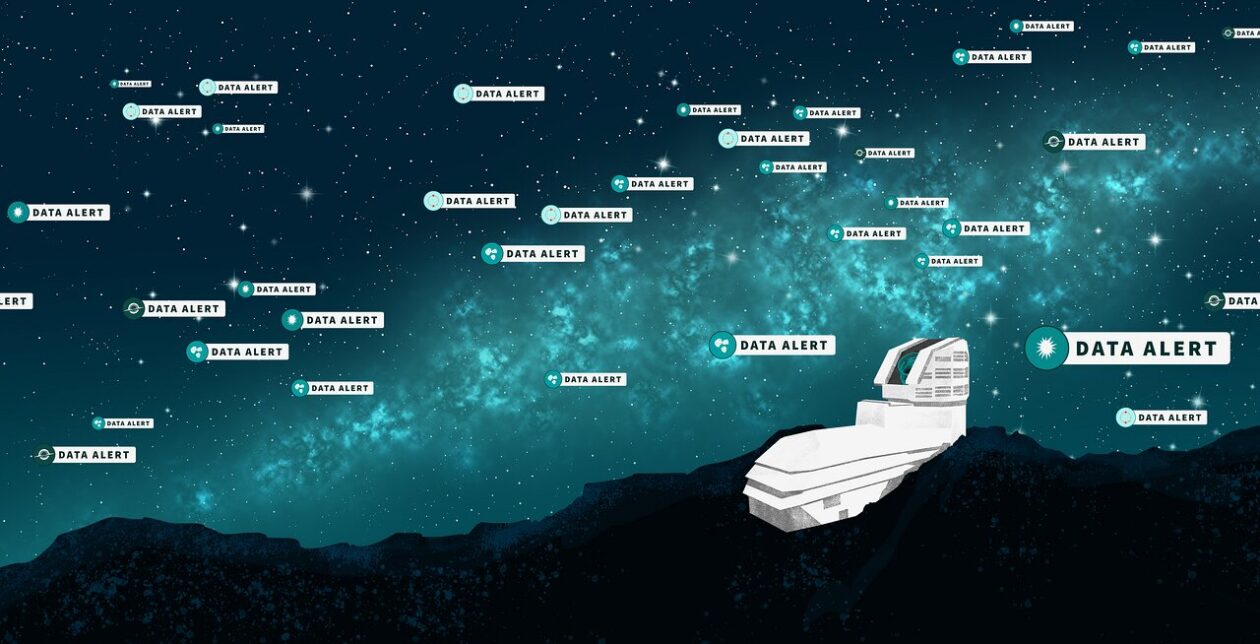
Each night, the Vera C. Rubin Observatory issues thousands of alerts about changes in the night sky. (NOIRLab / NSF / DOE-SC Illustration)
An astronomical alert system developed at the University of Washington started off with a bang this week, sending out 800,000 notifications about moving asteroids, exploding stars and other celestial changes detected by the Vera C. Rubin Observatory in Chile.
Tuesday night’s surge was just the first wave of alerts. Eventually, the Alert Production Pipeline is expected to produce up to 7 million alerts per night. Astronomers around the globe will use the system to sift through the torrent of data, zeroing in on events ranging from newly detected asteroids to supernovas, variable stars and active galactic nuclei.
“Rubin’s alert system was designed to allow anyone to identify interesting astronomical events with enough notice to rapidly obtain time-critical follow-up observations,” Eric Bellm, a UW astronomer who leads the Alert Production Pipeline Group for the Rubin Observatory, said today in a news release. “Rubin will survey the sky at an unprecedented scale and allow us to find the most rare and unusual objects in the universe. We can’t wait to see the exciting science that comes from these data.”
Processing trillions of bytes of raw data is no easy task. For the past decade, the University of Washington’s Institute for Data Intensive Research in Astrophysics and Cosmology, also known as the DIRAC Institute, has been working with other teams across the country to figure out how to manage the observatory’s astronomical riches.
Advertisement
“Enabling real-time discovery on such a massive data stream has required years of technical innovation in image processing algorithms, databases and data orchestration,” Bellm said. “We’re thrilled to continue the UW’s legacy of excellence in data-driven science.”
Rubin’s data processing system is designed to compare pixels in new imagery with previous pictures of the same patch of sky. Each change in the image — for example, a shift in the location of a moving asteroid, or a change in the brightness of a supernova — triggers an alert within two minutes of image capture.
“The scale and speed of the alerts are unprecedented,” said Hsin-Fang Chiang, who is leading operations for data processing at the SLAC National Accelerator Laboratory’s U.S. Data Facility. “After generating hundreds of thousands of test alerts in the last few months, we are now able to say, within minutes, with each image, ‘here is everything’ and ‘go.’ ”
Software agents known as brokers use machine learning algorithms to filter the alerts for research teams and observatories. The official brokers for Rubin data include ALeRCE, AMPEL, ANTARES, Babamul, Fink, Lasair, Pitt-Google, SNAPS, and POI Broker. Using these tools, astronomers can set hyper-specific criteria — for example, to show alerts for events that are brighter than 21st magnitude, that have been detected less than six days ago, and that are also associated with two previous detections.
Advertisement
Thanks to the alert system, other observatories will be able to follow up on Rubin’s data and confirm astronomical discoveries. And through collaborations with citizen-science initiatives like Zooniverse, anyone with access to a computer will be able to join in as well.
One thing some people hate about voice control is that you need to have a process always running, listening for the wake word. If your system isn’t totally locally-hosted, that can raise some privacy eyebrows. Perhaps that’s part of what inspired [SpannerSpencer] to create this 24th century solution: a Comm Badge straight out of Star Trek: The Next Generationhe uses to control his smart home.
This hack is as slick as it is simple. The shiny comm badge is actually metal, purchased from an online vendor that surely pays all appropriate license fees to Paramount. It was designed for magnetic mounting, and you know what else has a magnet to stick it to things? The M5StickC PLUS2, a handy ESP32 dev kit. Since the M5Stick is worn under the shirt, its magnet attached to the comm badge, some features (like the touchscreen) are unused, but that’s okay. You use what you have, and we can’t argue with how easy the hardware side of this hack comes together.
[Spanner] reports that taps to the comm badge are easily detected by the onboard accelerometer, and that the M5Stick’s microphone has no trouble picking up his voice. If the voice recordings are slightly muffled by his shirt, the Groq transcription API being used doesn’t seem to notice. From Groq, those transcriptions are sent to [Spanner]’s Home Assistant as natural language commands. Code for the com-badge portion is available via GitHub; presumably if you’re the kind of person who wants this, you either have HA set up or can figure out how.
Advertisement
It seems worth pointing out that the computer in Star Trek: TNG did have a wake word: “computer”. On the other hand it seemed the badges were used to interface with it just as much as the wake word on screen, so this use case is still show accurate. You can watch it in the demo video below, but alas, at no point does his Home Assistant talk back. We can only hope he’s trained a text-to-speech model to sound like Majel Barrett-Roddenberry. At least it gives the proper “beep” when receiving a command.
This would pair very nicely with the LCARS dashboard we featured in January.
Structurally, there’s nothing too wild going on here. It’s a wood-framed climbing structure that stands 10 meters long and 2.5 meters high, and can be covered in lots of climbing holds. It’s the electronic side of things where it gets fun. An Arduino Due is installed to run the show, hooked up with a small TFT display and some buttons for control. It’s then hooked up to control a whole bunch of LEDs and some buttons which are scattered all across the wall. It’s also paired with an Arduino Nano which runs sound feedback, and a 433 MHz remote for controlling the system at a distance.
[Superbender] uses the lighting for fun interactive games. One example is called Hot Lava, where after each climbing pass, more holds are forbidden until you can’t make the run anymore. Chase the Blues is another fun game, where you have to climb towards a given hold, at which point it moves and you have to scamper to the next one.
Samsung took over San Francisco’s Palace of Fine Arts on February 25 for Galaxy Unpacked 2026 — and left little to the imagination. Three new phones, a new pair of earbuds, and a pile of AI features. Here’s the full breakdown.
Nadeem Sarwar / Digital Trends
The Galaxy S26 series arrives with familiar naming
The S26, S26+, and S26 Ultra all share a rounder, more cohesive design this year — which sounds minor until you remember the Ultra used to look like it came from a completely different product line.
Pick one up, and you notice the difference straight away — it sits better in the hand, feels less aggressive in the pocket. Under the hood, all three run on a slightly overclocked version of Qualcomm’s Snapdragon 8 Elite Gen 5 (denoted by the “For Galaxy” branding).
Tom Bedford / Digital Trends
Samsung also quietly killed off the 128GB base model this year; every S26 model now starts at 256GB, and nobody is disappointed about that. What people are disappointed about is the price — both the S26 and S26+ crept up by $100 this cycle.
S26 Ultra: The Privacy Screen nobody knew they needed
The Ultra’s headline feature is a Privacy Display that darkens the screen from side angles and blurs sensitive notifications when someone nearby is clearly being nosy. In my opinion, it is one of the most useful innovations from Samsung in a while, and future Android flagships (even MacBooks) are likely to copy it.
The camera system gets a bump too, with wider apertures on the 200MP main and 5x telephoto sensors, but the selfie camera remains the same old tiny 12MP shooter.
Advertisement
Tom Bedford / Digital Trends
Third-generation Galaxy AI features are cool, too
Now Brief gives you a personalized morning snapshot — weather, calendar, reminders — before you’ve unlocked your phone. Now Nudge surfaces relevant actions based on whatever’s on your screen.
Google jumped in too: Gemini-powered Scam Detection silently handles spam calls so you never have to, and Circle to Search can now identify multiple objects at once, like scanning a full outfit instead of a single item.
Tom Bedford / Digital Trends
Galaxy Buds 4 and Buds 4 Pro
Samsung released two models — the standard Buds 4 and the Buds 4 Pro. The Pro is the one doing the heavy lifting, with adaptive ANC, improved spatial audio, and that upgraded call clarity. The base Buds 4 keep things simpler and more affordable, but still get the core Galaxy AI treatment.
Nadeem Sarwar / Digital Trends
All S26 models and the Buds 4 are available for pre-order now.
Bridgerton season 4 part 2 ending explained: do Benedict and Sophie get married, post-credits surprise, shock death and predictions for season 5 of the hit Netflix show
WARNING: spoilers for Bridgerton season 4 part 2 ahead.
I was pretty annoyed that Netflix decided to split another of its hit shows into two parts, but I think the payoff in Bridgerton season 4 part 2 is worth it.
When we last left them, Benedict (Luke Thompson) had asked Sophie (Yerin Ha) to be his mistress, which went down like a sack of spuds.
Advertisement
Elsewhere, Violet (Ruth Gemmell) began dating Lord Anderson (Daniel Francis) in secret, Lady Araminta (Katie Leung) moved in next door to the Bridgertons, and Lady Danbury (Adjoa Andoh) tried and failed to take leave from the ton, thanks to Queen Charlotte (Golda Rosheuvel).
Luckily, the Bridgerton season 4 part 2 ending gives us resolutions to all of the above, and might gently point us in the direction of who will be the star of the already confirmed season 5.
Advertisement
Do Benedict and Sophie end up marrying in season 4 part 2?
Bridgerton Season 4 | Part 2 Official Trailer | Netflix – YouTube
Yes! Thankfully, Sophie immediately rejects Benedict’s offer of being a mistress, demeaning him for asking something of her that would push her even further down the social scale. There’s a lot of back and forth from Benedict insisting that this is the only way they could be together, and Sophie refusing it.
One thing leads to another and the pair end up in bed together — oops, they’re only human — leading Sophie to try and seek employment as a maid elsewhere. She asks Violet for a letter of introduction to another family, who becomes suspicious of why Sophie wants to leave so suddenly… and what she’s hiding.
Sign up for breaking news, reviews, opinion, top tech deals, and more.
Advertisement
Almost everyone in the town is convinced that Benedict has a secret woman, it’s just a case of working out who. Violet begins to dig deeper into Sophie’s past, sending her maid out to try and gather information. Another maid informs her that she used to work with Sophie’s mother, leading Violent and Lady Danbury to guess Sophie is illegitimate.
Violet also enlists Anthony’s (Johnathan Bailey) help to try and talk Benedict out of his fascination with Sophie. Anthony reminds him of the shame and scandal he would bring to the Bridgerton name, ruining the prospects for his younger siblings while effectively sending himself into social exile. Benedict is ready to retreat to the country cottage where he spent time with Sophie in part 1, but Violet is completely against the idea.
Where it all began. (Image credit: Netflix)
From there, it all kicks off. Benedict is beside himself that Sophie is to leave the Bridgeton house, but she’s missed the main opportunity that she was planning to go for. However, another opportunity comes up: help a family move overseas to the States, if she’s prepared to get on a boat in three days’ time.
At Hyacinth’s (Florence Hunt) recital, Benedict spots Violet and Lord Anderson together, furiously taking his mother aside to call out her hypocrisy over him and Sophie. Benedict reminds Violet that she taught her kids to follow love wherever it takes them, and after realizing that he’s indeed in love with Sophie, Violet does whatever she can to help him.
At this point, even approval for Queen Charlotte would only get Benedict off the social hook so far, leading him and Violet to plan his countryside escape. This is just before Sophie plans to leave for the Americas… but instead is thrown in jail by Araminta.
Why? Araminta is convinced that Sophie stole her diamond shoe clips, and also wants to punish her for impersonating nobility at Violet’s ball in episode 1. Benedict and Violet catch wind of what’s happened thanks to their maids, sweeping in to get Sophie out on bail just before she’s sentenced. The judge pleads for the ladies to sort their issues out between them, but Araminta doubles down on her cruelness.
At the Bridgerton house, Violet finally accepts that Benedict wants to marry Sophie. Before the, ahem, bathtub scene, Sophie reveals to Benedict that she’s the illegitimate daughter of the Earl of Penwood, with Benedict sure that he would have provided for her in his will.
Advertisement
With the help of Eloise (Claudia Jessie), Sophie sneaks into the old Penwood house to find her dad’s will, uncovering that the Araminta was being paid £4,000 for every year she kept Sophie in the house. On top of that, the Earl had split an equal dowry between Sophie, Posy (Isabella Wei) and Rosamund (Michelle Mao), with Sophie’s portion hijacked by Araminta to secure Rosamund’s engagement.
New lady in waiting Alice Mondrich (Emma Naomi) manages to get the two sparring sides into a room at the end of season ball thrown by Queen Charlotte, and they hash it out. Both sides threaten to take down the other if they are exposed, with Violet rationing that they come up with a mutually beneficial story that works for them all. By the time Queen Charlotte is called in, Sophie is presented as a cousin of Rosamund and Posy’s, officially becoming part of the Penwood family.
You’ll have to wait until after the episode 8 credits to see their wedding, with Benedict asking Sophie for her hand later at the ball.
Advertisement
So where does this leave the other Penwoods?
Moments before disaster. (Image credit: Netflix)
Unsurprisingly, Rosamund’s offer of engagement is immediately retracted when it’s discovered that she doesn’t have as much money to offer as first thought. However, Posy has a suitor of her own, with Eloise encouraging her to go after her heart rather than her mother’s wishes. It’s hinted that Posy’s romance could be what saves the Penwoods from complete social ridicule.
Then there’s the return of Cressida Cowper (Jessica Madsen), who is now the new Lady Penwood. She’s taken up residence in Araminta’s old house, and is at risk of being shunned in her reintroduction to the social circle. She tries to enlist the help of Penelope (Nicola Coughlan) but this doesn’t go as planned, with Penelope using Cressida’s ball to announce that she’s “hanging up her pen”.
What do you mean there’s no more Lady Whistledown?
My two fave besties. (Image credit: Netflix)
Well, in a manner of speaking. After coming under some scrutiny and the power of being known as Lady Whistledown getting to her, Penelope gets the Queen’s permission to take her passion for writing in a different direction. As episode 8 draws to a close, we learn that she’s instead writing a novel.
Advertisement
However, somebody else has resumed Lady Whistledown’s newsletters, and we’ve got no idea who it is.
What about Francesca?
My heart is broken. (Image credit: Netflix)
Sadly, Francesca (Hannah Dodd) has the most upsetting storyline of the bunch. After failing to reach her pinnacle in part 1, the pressure of giving John (Victor Alli) a child and being a respectable wife is getting too much for her. To top if off, his carefree cousin Michaela (Masali Baduza) constantly spending time with John after turning up at their house unannounced is getting her down.
Then, tragedy. At the end of episode 6, John dies in his sleep from a brain aneurysm, with episode 7 dedicated to his funeral. In the scenes beforehand, Francesca and Michaela became unexpected friends once they opened up to each other, and are on hand to get each other through the process as unsteady allies.
Advertisement
While Francesca feels obliged to grieve in the proper way, Michaela allows her to see things differently, commemorating John’s spirit with a lively family celebration. Michaela later takes off and leaves without word.
At Benedict and Sophie’s wedding, Francesca admits that she’s “had her one love” when asked if she’d ever marry again.
What about Violet?
Violet and Lord Anderson (Image credit: Netflix)
Violet and Lord Anderson continue to see each other, with Violet desperate for her children not to find out. Anderson gives her the option to ease off or to make things official, leading to their engagement in episode 6.
Advertisement
However, this doesn’t last for long. While Violet has Agatha’s (Adjoa Andoh) blessing, she starts to have doubts about what she really wants, with all her attention diverted to Francesca.
At the last ball of the season, Anderson again claims his intensions to marry her — he wants to build a life with Violet, not just be a bit on the side. Violet refuses to go ahead with the engagement. She’s rather continue to see him while she discovers who she is as a single woman, but as their interests don’t align, they part ways.
Does Agatha get to leave?
Thick as thieves. (Image credit: Netflix)
Yes she does! Queen Charlotte’s ball is thrown in honor of Agatha, having agreed to let her leave after Agatha successfully installed Alice in her place. The Queen is tearful, but ultimately accepts what she didn’t before.
Advertisement
We don’t yet know how long Agatha will be gone for, but it could affect season 5.
Season 5 predictions
These two will no longer be at the forefront. (Image credit: Netflix)
With Benedict and Sophie set to take a back seat, Eloise is the obvious choice to take over the leading role. She’s had a much quieter outing in season 4 part 2, after failing to avoid Violet’s matchmaking efforts in part 1.
Benedict and Eloise were Violet’s priorities for the season, and now the former has been successful, there’s only one left. However, we could be thrown a complete curveball, as returning cast are as of yet unconfirmed.
Advertisement
The books also suggest Francesca and Michaela (who was originally Michael) will begin a romantic relationship, but this is also unconfirmed for the show.
We also need to find out who the new Lady Whistledown is, though this isn’t a guarantee either.
And of course, you can also follow TechRadar on YouTube and TikTok for news, reviews, unboxings in video form, and get regular updates from us on WhatsApp too.
Over the last few centuries, behavioral psychologists have documented all kinds of ways of modifying our actions and the actions of various animals. From the famous Skinner boxes to many modern video game mechanics, animals and humans alike can learn through the addition or subtraction of various rewards and punishments. And it doesn’t only impact simple actions either; [Everything is Hacked] took this idea to the extreme, using painful electric shocks to teach himself to avoid making blunders while playing chess.
This positive punishment system uses a medical device called transcutaneous electrical nerve stimulation (TENS) to deliver an electric shock to the skin. The electrical jolt is routed through a custom-built, conductive chess board where each square is isolated from the others and controlled by its own relay. The pieces are conductive as well, so if one is placed on a square where it shouldn’t go a relay will switch on to quickly provide the behavioral modification. The control logic is provided by a Raspberry Pi running the Stockfish chess engine, and it keeps track of the locations of the positions of all the pieces by using MX switches in the base of each square on the board.
This project took [Everything is Hacked] over a year to get into a working condition, including having to rebuild the entire project twice after mishaps with baggage handling at an airline. But he was able to demo the board to the Open Sauce tech festival and even took it to his local park to play chess with the local hustlers. Unfortunately, he reports that he spent more time reworking and rewiring his board over that year than he did improving his chess game, so unfortunately he still hasn’t been able to win any of his money back yet. Perhaps combining this project with a chess-playing robot would help.
Instagram is widely used for sharing photos, videos, and Reels. Many people check others’ profiles out of curiosity. If you have ever opened someone’s profile multiple times, you might wonder if they can see it. The clear answer is no; Instagram does not show who viewed a profile or how many times it was viewed.
Instagram does not share this information with users. Whether you open someone’s profile one time or visit it many times, they will not be notified. There is no Instagram feature that shows profile visitors or the number of visits. Profile views are kept completely private.
Does Instagram Show Profile Visitors?
Instagram does not show who viewed your profile. There is no option or feature that provides a list of profile visitors. Unlike LinkedIn, which lets users see who has viewed their profile, Instagram keeps profile visits private.
Although profile views are private on Instagram, some actions are visible to others. If you like someone’s post, they can see your username. If you leave a comment, it appears publicly under their post. When you watch someone’s Story, your name appears on their viewers’ list. However, just opening and viewing their profile does not notify them.
Advertisement
What About Professional Accounts?
If someone uses a professional account on Instagram, they have access to Insights. Insights provide useful data like reach, engagement, and total profile visits. However, this data only displays numbers. It does not show the names of people who have visited the profile. Even with a Creator or Business account, the profile’s visitors are not disclosed.
Furthermore, the third-party apps often advertise features that claim to show who viewed your Instagram profile. However, Instagram keeps profile visits private and does not share this information with outside apps. Because of this, such apps cannot be trusted. They might steal your data or affect the security of your account. It is always safer to rely solely on Instagram’s official features.
One of Mars’ most perplexing geological mysteries, formations that like enormous spiderwebs spread out across the landscape, can now be seen up close in the most recent set of photos taken by NASA’s Curiosity rover. It has been traveling through an interesting section of Mount Sharp inside Gale Crater for the past six months. It’s made up of low, intersecting ridges that are about three to six feet high, with sandy depressions scooped out between them.
When viewed from orbit, the pattern gives the distinct appearance of enormous spiderwebs spanning miles across the Martian landscape, but up close, the story becomes much more intriguing. These “boxwork” structures show a history of water that has persisted for much longer than most models had predicted. Using its Mastcam, the rover was able to take some incredibly vivid panoramas and close-ups of the ridges. One picture dated September 26, 2025, provides an incredibly clear view of the network of elevated lines and depressions. The team was rather taken aback when Curiosity discovered pea-sized nodules scattered throughout the ridge walls and in the hollows, which are evidence of previous water activity.
Feed a passion for science and technology – Kids can learn more about the challenges of space exploration with this LEGO Technic NASA Mars Rover…
Conduct a test flight – This advanced building kit for kids ages 10 and up includes a buildable toy version of NASA’s Ingenuity helicopter, which…
AR brings the mission to life – The accompanying augmented reality app experience lets kids dive into the details of the rover and its mission
The experts believe that this explains the boxwork: long ago, groundwater passed through bedrock fissures, depositing minerals that created strong ridges in particular regions. The depressions that give the appearance of a web were left behind as the wind worked on the softer rock. The black lines that crisscrossed the formations were already very obvious from orbital photographs; a theory from back in 2014 proposed that these were central cracks where the minerals had congregated. That theory is strengthened by Curiosity’s careful examination, which revealed that the lines are in fact fractures.
The thing that truly grabs your attention is that the boxwork is located quite high on Mount Sharp, indicating that the ancient groundwater table must have reached fairly high levels. This implies that water was present on Mars for a far longer period of time before the planet dried up and froze. Microbial life would have had a longer period of livable conditions if it had ever existed. The investigation’s mission scientist, Dr. Tina Seeger of Rice University, cited this elevation and said that groundwater high enough to create these characteristics indicates that life-supporting conditions may have existed for a much longer than the orbital data alone would indicate.
A coordinated campaign targeting software developers with job-themed lures is using malicious repositories posing as legitimate Next.js projects and technical assessment materials, including recruiting coding tests.
The attacker’s goal is to achieve remote code execution (RCE) on developer machines, exfiltrate sensitive data, and introduce additional payloads on compromised systems.
Multiple execution triggers
Next.js is a popular JavaScript framework used for building web applications. It runs on top of React and uses Node.js for the backend.
The Microsoft Defender team says that the attacker created fake web app projects built with Next.js and disguised them as coding projects to share with developers during job interviews or technical assessments.
The researchers initially identified a repository hosted on the Bitbucket cloud-based Git-based code hosting and collaboration service. However, they discovered multiple repositories that shared code structure, loader logic, and naming patterns.
Advertisement
When the target clones the repository and opens it locally, following a standard workflow, they trigger malicious JavaScript that executes automatically when launching the app.
The script downloads additional malicious code (a JavaScript backdoor) from the attacker’s server and executes it directly in memory with the running Node.js process, allowing remote code execution on the machine.
Overview of the attack chain Source: Microsoft
To increase the infection rate, the attackers embedded multiple execution triggers within the malicious repositories, Microsoft explained. These are summarized as follows:
VS Code trigger – A .vscode/tasks.json file set with runOn: “folderOpen” executes a Node script as soon as the project folder is opened (and trusted).
Dev server trigger – When the developer runs npm run dev, a trojanized asset (e.g., a modified JS library) decodes a hidden URL, fetches a loader from a remote server, and executes it in memory.
Backend startup trigger – On server start, a backend module decodes a base64 endpoint from .env, sends process.env to the attacker, receives JavaScript in response, and executes it using new Function().
The infection process drops a JavaScript payload (Stage 1) that profiles the host and registers with a command-and-control (C2) endpoint, polling the server at fixed intervals.
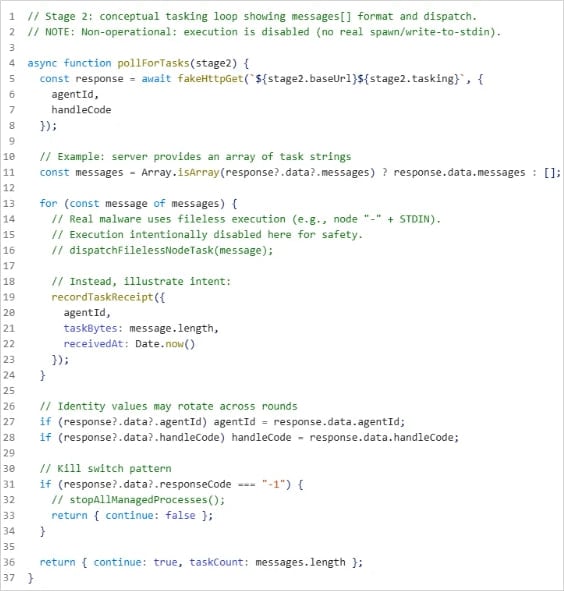
The infection then upgrades to a tasking controller (Stage 2) that connects to a separate C2 server, checks for tasks, executes supplied JavaScript in memory, and tracks spawned processes. The payload also supports file enumeration, directory browsing, and staged file exfiltration.
Stage 2’s server polling function Source: Microsoft
Microsoft found that the campaign involved multiple repositories that shared naming conventions, loader structure, and staging infrastructure, indicating a coordinated effort rather than a one-off attack.
Aside from the technical analysis, the researchers did not provide any details about the attacker or the extent of the operation.
Advertisement
The tech giant advises that developers should treat standard workflows as the high-risk attack surfaces they really are and take appropriate precautions.
The recommended mitigations include enforcing VS Code Workspace Trust/Restricted Mode, using Attack Surface Reduction (ASR) rules, and monitoring risky sign-ins with Entra ID Protection.
Secrets stored on developer endpoints should be minimized, and short-lived tokens with the least required privileges should be used where possible.
Modern IT infrastructure moves faster than manual workflows can handle.
In this new Tines guide, learn how your team can reduce hidden manual delays, improve reliability through automated response, and build and scale intelligent workflows on top of tools you already use.
































.jpg)