Tech
Samsung R95H Micro RGB TV Review: The RGB LED Difference

The Samsung R95H is one of many TVs to arrive in 2026 that use RGB backlighting to create images. Similar to the Sony Bravia 7 II, along with new models from Hisense, TCL, and LG, these replace the standard white or blue mini-LED modules in an LCD TV’s backlight array with micro-sized red, green and blue LEDs that can be independently controlled. The main benefit to RGB backlighting is expanded BT.2020 color space coverage, though there are other advantages, such as minimized backlight blooming and improved off-axis picture uniformity.
Samsung calls its take on the tech Micro RGB, and the Samsung R95H is its flagship Micro RGB model for 2026. Back in April, I had an opportunity to do hands-on testing of a pre-release 65-inch R95H at Samsung’s New Jersey headquarters, but the company later sent us a 65-inch production version so we could do a complete review.

What is it?
The Samsung R95H is the top model in the company’s Micro RGB TV lineup, sitting above the Samsung R85H series. For 2026, Samsung also offers new Neo QLED models that use a standard mini-LED backlight, and its 2025 flagship Samsung QN90F Mini LED series carries over as well. Samsung R95H series TVs are available in 65, 75, and 85-inch screen sizes. Launch prices were $3,199.99, $4,499.99, and $6,499.99, respectively, though they have since dropped to $2,999.99, $4,299.99 and $5,999.99 (all MSRP; check retailers for current pricing).
Along with RGB backlighting, R95H series TVs include a Glare Free screen similar to the one found in the company’s 2025 flagship mini-LED and OLED models and the new Samsung S95H OLED TV. This provides a light-diffusing matte finish that’s very effective in eliminating screen reflections even when viewing in bright rooms with multiple lighting sources.
Samsung’s Micro RGB AI Engine Pro processor uses AI to upconvert standard HD video to 4K resolution with enhanced color and expanded dynamic range. It also handles the backlight’s local dimming to improve contrast and black levels and reduce artifacts such as haloing and blooming. AI Motion Enhancer Pro works to eliminate motion blur in sports and movies with fast action, and there’s an AI Customization Mode that can intelligently optimize picture settings based on the type of content you’re viewing.
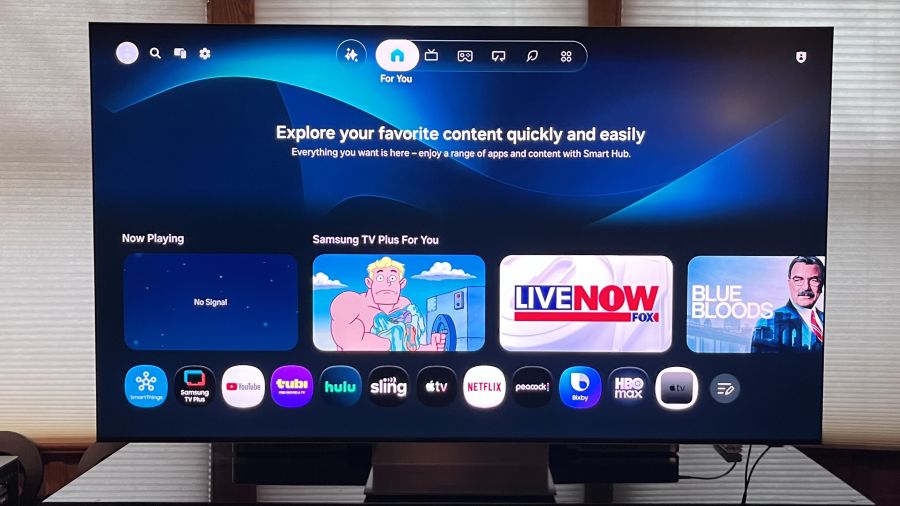
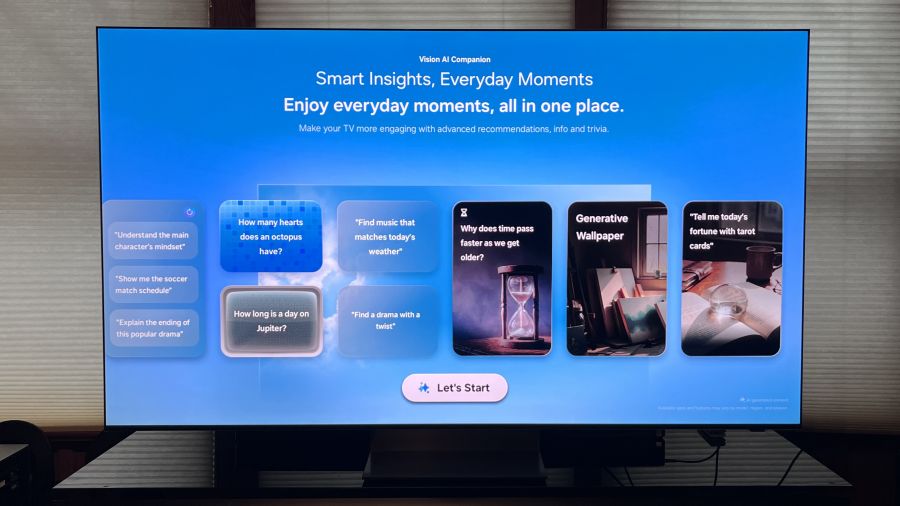
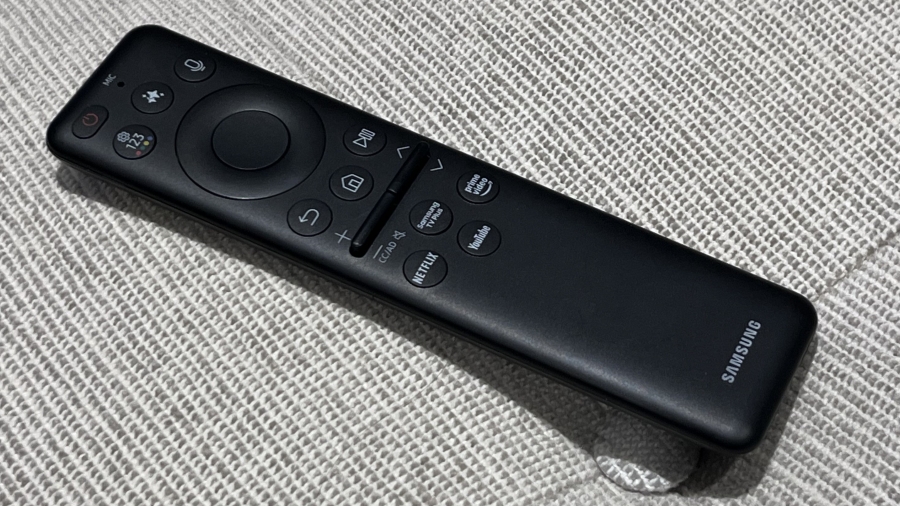
AI also gets top billing in Samsung’s updated Tizen Smart TV interface, which repositions tabs from the side to the top of the screen. The new layout is cleaner and more-user friendly, and it features a Vision AI Companion tab that lets you explore all manner of topics via Copilot or Perplexity using either the TV’s built-in far-field mic, or the one located in the TV’s Solar Cell Bluetooth remote control. The compact remote is small and only provides a limited number of controls, with the design reflecting Samsung’s emphasis on the Tizen interface, and voice commands in particular, for controlling most functions.
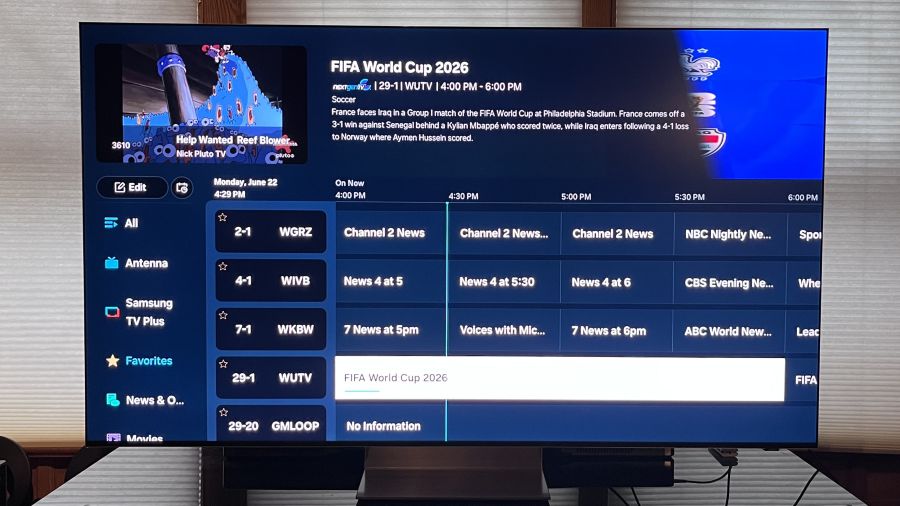
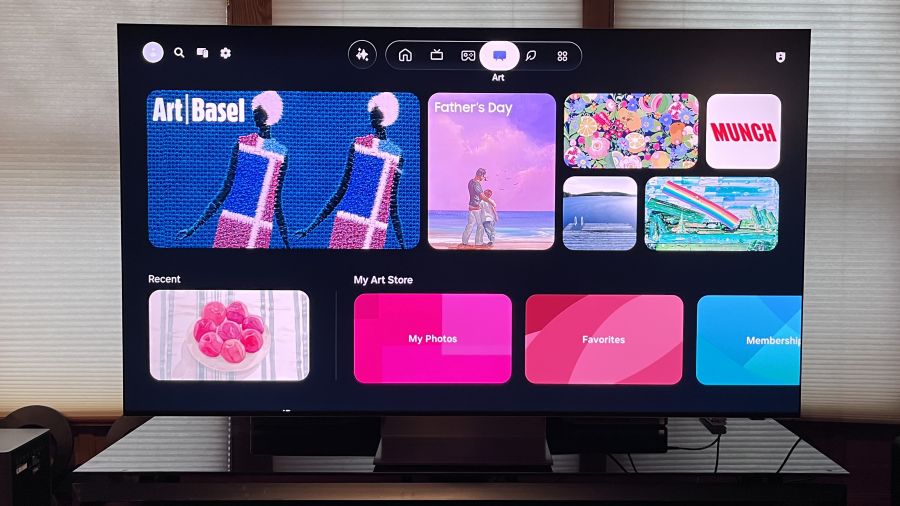
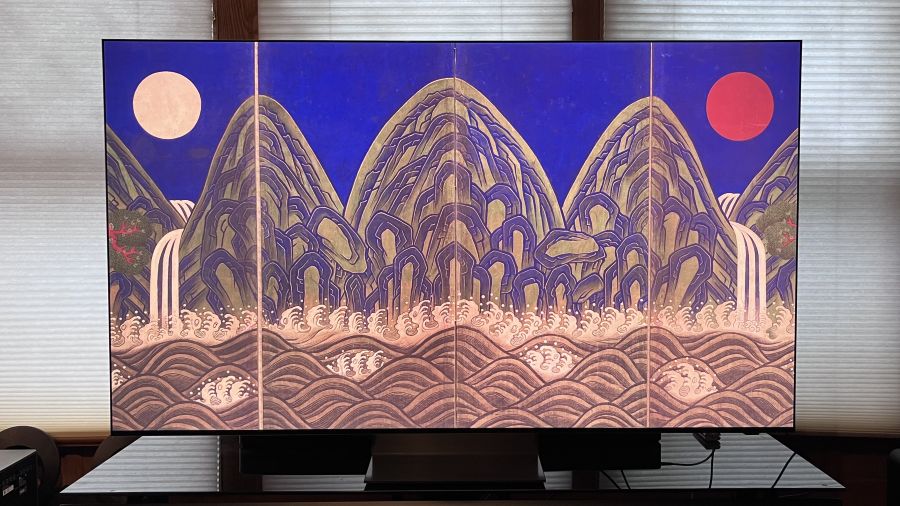
Other Tizen features include Generative Wallpaper for creating custom screensavers using AI, and access to the subscription-based Samsung Art Store that was previously limited to the company’s The Frame lifestyle TVs. Selecting the Live tab at the top of the screen presents an option to view a time-based grid guide for browsing Samsung TV Plus free streaming channels, and there’s also an option to display only local broadcast channels pulled in via a connected antenna. Unlike competitor LG, Samsung still includes an ATSC 3.0 (Next Gen TV) tuner on its flagship TVs (including the R95H) so you can tune in both ATSC 1.0 and ATSC 3.0 local OTA stations for free.
Gaming features on the R95H series include 4K/165Hz support, Freesync Premium Pro and HDR10+ gaming. Samsung’s Gaming Hub portal features Xbox, NVIDIA, GeForce Now, Luna, Blacknut, Antstream, Boosteroid and other cloud-based gaming apps, and it now also features personalized recommendations.
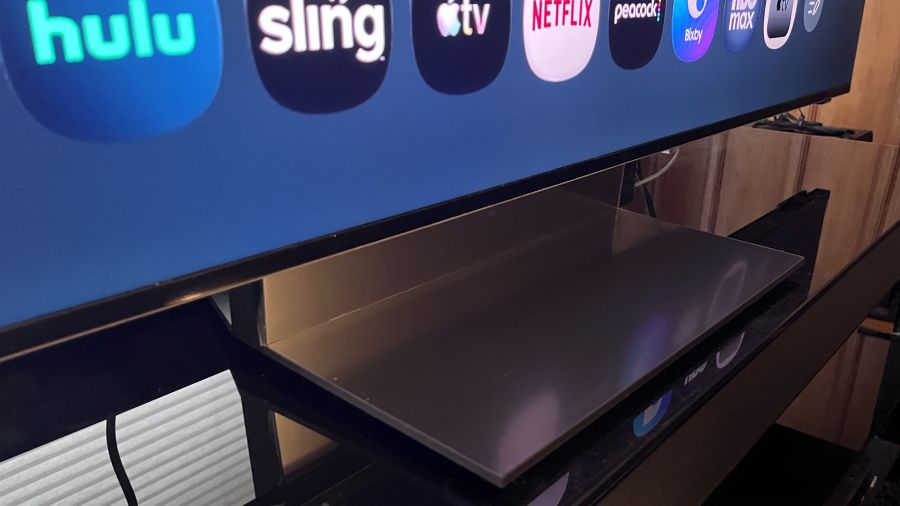
R95H series TVs feature a Space Graphite-colored Infinity Air stand that, combined with the four-side Bezel-less screen, gives the display a floating effect. Connections located on a side-mounted panel on the rear include four HDMI 2.1 ports, an optical digital audio output and an antenna input for the TV’s ATSC 3.0 tuner. Additionally, there are two USB type-A, Ethernet and Ex-Link (RS-232C) ports. The R95H is also Wireless One Connect Ready, which gives you the option for a wireless 165Hz connection using Samsung’s Wireless One Connect Box (not included).
On the audio front, a 4.2.2-channel speaker array powered by 70 Watts of on-board amplification delivers Dolby Atmos audio, Object Tracking Sound+ delivers precise positioning of sound effects to match the onscreen action and a Q-Symphony feature combines the TV’s speaker output with that of a compatible Samsung soundbar (if you’re into that). A new feature, Active Voice Amplifier Pro, taps the AI capabilities of the TV’s Micro RGB AI Engine Pro processor to identify voices in movie and TV soundtracks and amplifies them to enhance dialogue clarity.
Setup & Viewing Impressions
I used Portrait Display’s Calman Color Calibration software to run a basic set of measurements on the Samsung R95H. Aside from disabling the TV’s Brightness Optimization (located in the Power & Energy Saving menu) auto brightness feature, measurements were made using the default Filmmaker Mode and Standard picture presets.
Peak HDR brightness measured on a white 10% window pattern in Filmmaker Mode was 2,039 nits and 642 nits on a 100% (fullscreen) white pattern. In Standard mode, the results on the same tests were 1,908 nits and 790 nits, respectively.
To give some perspective on those results, when I measured the Sony Bravia 7 II True RGB TV, peak HDR brightness was 1,800 nits for 10% and 701 nits (fullscreen). In Standard mode, the Sony results were 1,554 nits on a 10% pattern and 626 nits for fullscreen. Bottom line: Samsung’s flagship RGB TV has higher peak HDR brightness than the Sony (which, at $2,599 list for the 65-inch model, is a bit less expensive option than the Samsung).
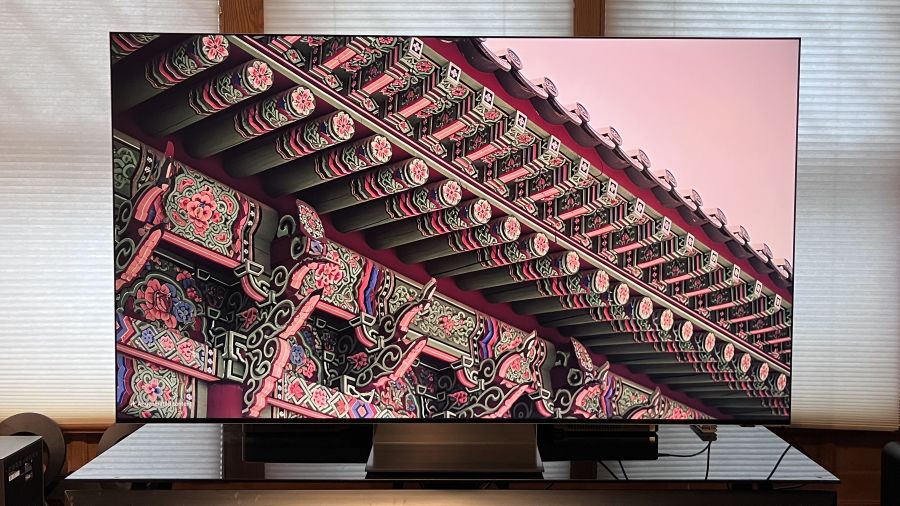
In SDR (standard dynamic range) tests, the Samsung R95H measured 235 nits on a 10% pattern and 145 nits on a fullscreen pattern in Filmmaker Mode. In Standard mode, the results were 726 nits for 10% and 583 nits for fullscreen. Those Standard mode results are excellent, and they indicate that the R95H will be a great TV for daytime sports viewing.
For color measurements, the Samsung R95H’s color gamut coverage in Filmmaker Mode measured 93.3% for BT.2020 and 147.9% for DCI-P3 – both excellent results. Once again for comparison’s sake, the Sony BRAVIA 7 II’s BT.2020 color gamut coverage in Cinema Mode measured 88.5%.
In other measurements, the Samsung R95H’s Delta-E (the margin of error between the test pattern source and what’s displayed on-screen) in Filmmaker Mode averaged 6.2 for grayscale and 3.0 for color. That grayscale result is slightly higher than the 3.0 Delta-E considered to be the threshold for what’s indistinguishable from perfect to the human eye, though I was able to reduce it to 1.4 through calibration using the Samsung’s 2-point white balance adjustment. (A 20-point white balance adjustment is also available.)
The Samsung’s input lag, which I measured using a Bodnar 4K input lag meter with Game mode enabled, was 10.7ms. That’s a slightly higher level than previous Samsung TVs I’ve tested, though still it’s low compared to many other TVs.
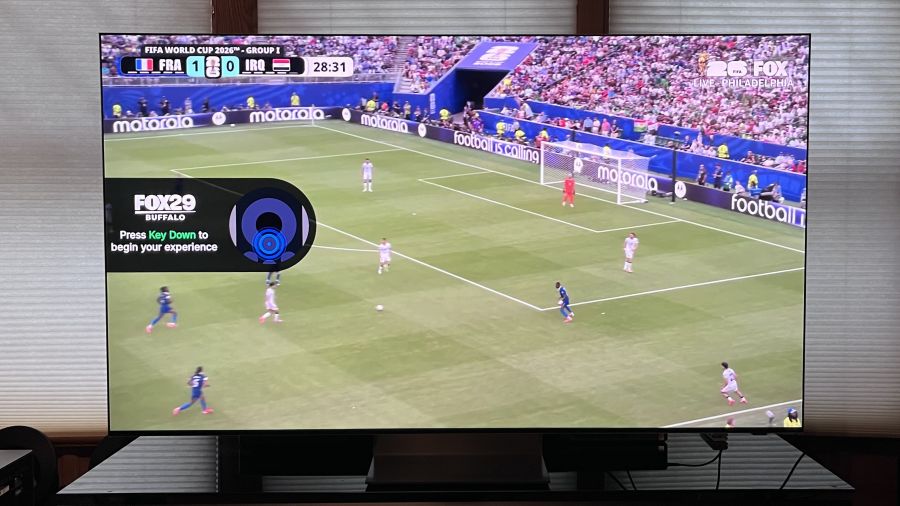
As usual, I started out my subjective evaluation using the Spears & Munsil Ultra HD Benchmark disc played on an Oppo UDP-103 4K Blu-ray player. The disc’s dots pattern, which is used to test off-axis performance, revealed color and contrast to be impressively uniform when viewed at off-center seats. The starfield test clips showed the TV’s local dimming to be effective at all levels (there is no off setting for local dimming on the Samsung, so it is always active). I was surprised to see that the TV’s brightness uniformity was less impressive than its off-axis uniformity when viewing fullscreen gray patterns at various brightness levels, but that didn’t turn out to be an issue when viewing regular TV shows and movies.
Watching the disc’s demonstration reel, images of nature showed excellent contrast and rich color, and the picture was impressively clean and noise-free. There was also very minimal backlight blooming visible on the high-contrast images of animals and objects against a black background, and micro-contrast in the nighttime cityscapes was as good as I’ve seen on a non-OLED TV.
Watched on 4K Blu-ray, a scene from the James Bond film No Time to Die where 007 walks across a rocky hillside cemetery showed minimal judder and motion blur as the camera tracked his motion – not surprising given the combination of Samsung’s typically excellent motion processing and the TV’s high 165Hz refresh rate.
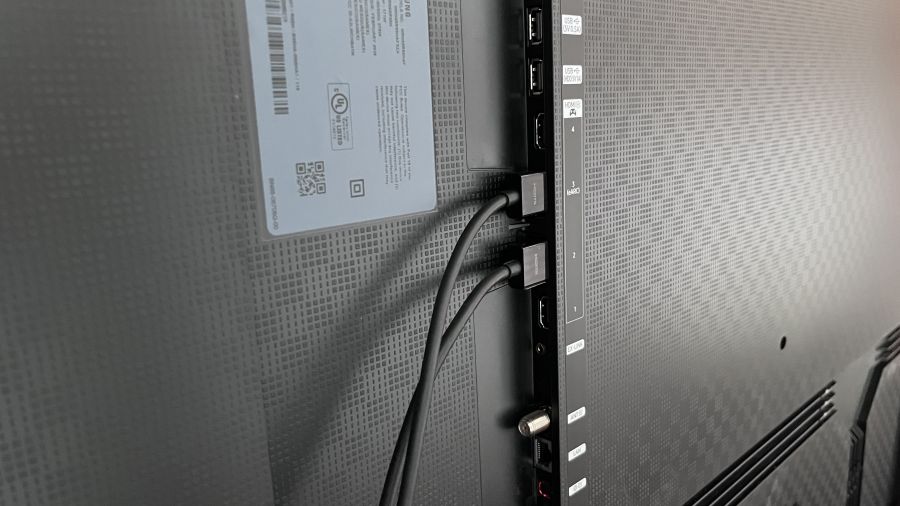
The R95H’s impressive motion handling was also evident when I watched a Canada versus South Africa World Cup Soccer match broadcast via my local FOX TV network. The first half got off to a lively start, with both teams quickly turning over plays, and the Samsung Micro RGB rendered the ball as a consistently solid-looking circle as it traversed the field. New Samsung TVs for 2026 feature an AI Soccer Mode designed to specifically optimize the picture for soccer games, but I found that it made colors look neon-level bright and garish when active. The Standard picture mode looked better to me for sports, though it also made the faces of some players look overly pink. For sports, I ultimately settled on the Movie preset, which delivered a sufficiently bright picture with accurate-looking color.
With the more muted Movie preset active, the yellow and green uniforms of the South Africa team players still looked eye-catchingly vivid, and so did the red jerseys of the Canada team fans that seemed to constitute the bulk of the game’s audience. Importantly, the TV’s Glare Free screen was effective enough that turning on my room’s overhead lights didn’t impact picture quality at all while watching, and that extended to movies, which retained contrast and black detail during bright room viewing.
Stanley Kubrick’s 2001: A Space Odyssey is a movie that strongly benefitted from the 4K/HDR treatment it received when the 4K Blu-ray version was released back in 2018. Watching the “The Blue Danube” sequence where the space shuttle docks at the space station, the deep blacks of space and pinpoint lights of stars displayed powerful contrast on the Samsung R95H, and there was plenty of detail visible in the shots of earth and closeups of the space ships. Even more impressive knowing that this movie came out over a year before we landed on the moon and all of these effects of space and earth were done the old-fashioned way, with practical effects.
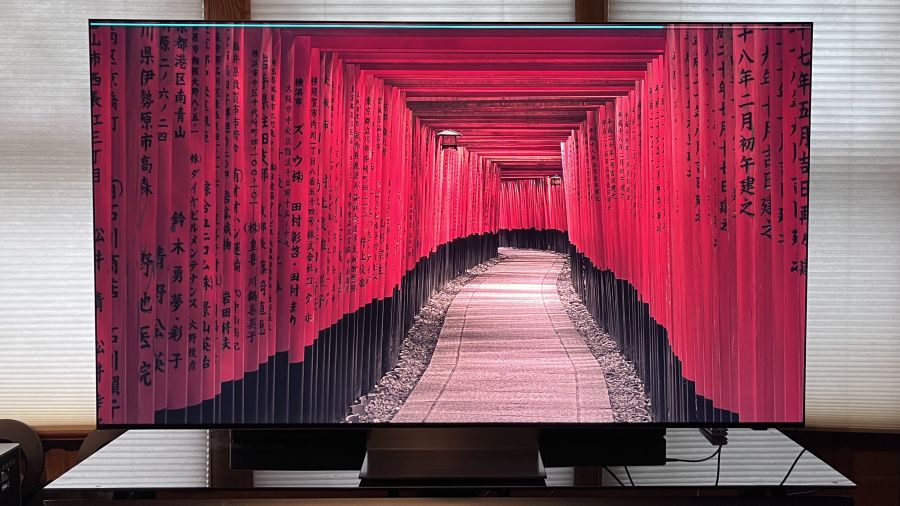
Curious to see how the TV’s Auto HDR Remastering Pro feature would handle HDR upconversion, I switched that feature on and off while watching my regular Blu-ray disc version of 2001. While Samsung’s upconversion definitely made the picture brighter, with more powerful contrast, it also blew out highlight detail and made colors look oversaturated. It would have been helpful to have some type of control to vary the level of HDR remastering applied, but that feature sadly provides only on and off settings.
I would be remiss if I didn’t comment on how the R95H handled Season 3, episode 1, Salt and Sea, Fire and Blood, of the returning House of the Dragon on HBO Max. I found that the picture looked too dark in Filmmaker Mode, but switching to Movie mode and boosting the Shadow Detail slider a few notches in the Expert Settings menu went a long way to improve things. Roughly half of the episode is a protracted naval battle and, post-adjustment, the 4K/HDR picture looked considerably more immersive and 3D-like.
The Bottom Line
At its discounted $2,999.99 price, the 65-inch Samsung R95H is still expensive for a TV, even one with an advanced RGB backlight. But the R95H offers a number of advantages over its competition, and when you take those into account, it could easily sway your favor to this Samsung Micro RGB model when shopping for a new TV.
The most obvious advantage is Samsung’s extended color space coverage. At 93.3% for BT.2020, that’s about as good as new TVs get, and it easily exceeds that of flagship OLED TVs on the market, Samsung’s S95H included. The R95H is also impressively bright for both HDR and SDR viewing, and its Glare Free screen makes it a strong option for viewing in bright rooms.
Samsung’s Tizen is superior to most other smart TV platforms, including Google TV, in my opinion, even if you don’t bother to take advantage of its powerful new AI features or the category-leading Samsung Art Store. The R95H is also an exceptional gaming TV, with 4K/165Hz support across its four HDMI 2.1 ports and Samsung’s Gaming Hub portal for cloud-based gaming.
Where the R95H could be considered to fall short is its lack of support for the forthcoming Dolby Vision 2 format, but then again, Samsung never supported Dolby Vision HDR in the first place, choosing the open HDR10+ dynamic HDR standard instead. The bottom line is that the Samsung R95H is an excellent overall TV with a fantastic picture and great features – it easily lives up to the RGB hype.
Pros:
- High brightness
- Refined local dimming
- Extend color space coverage
- Very good off-axis uniformity and color
- Detailed upscaling
- Glare Free screen
- Elegant design with Infinity Air stand
Cons:
- Pricey
- No Dolby Vision HDR support
- High grayscale error in Filmmaker Mode
Our Ratings:
★★★★★★★★★★ Picture Quality
★★★★★★★★★★ Design
★★★★★★★★★★ Usability
★★★★★★★★★★ Sound Quality
★★★★★★★★★★ Features
★★★★★★★★★★ Value
You must be logged in to post a comment Login