Tech
Samsung S90H vs. S95H vs. S85H OLED TVs: What’s New? What’s Different?

At a media workshop at Samsung’s US headquarters last month, we got to spend some quality time with Samsung’s new 2026 OLED TVs, including the S90H and S95H flagship. Both sets offer impressive performance but they do differ in some important ways like peak brightness and color gamut coverage. In fact, both TVs feature the same video processor and 165Hz native OLED panels, but they’re tuned for different performance levels with the S95H offering much higher peak brightness, making it better suited for bright room viewing.
Bot the S90H and S95H also feature the latest version of Samsung’s Glare Free screen treatment which reduces the reflection of ambient room light. Meanwhile, Samsung’s S85H OLED comes with a more traditional glossy screen with a 120 Hz native OLED panel.

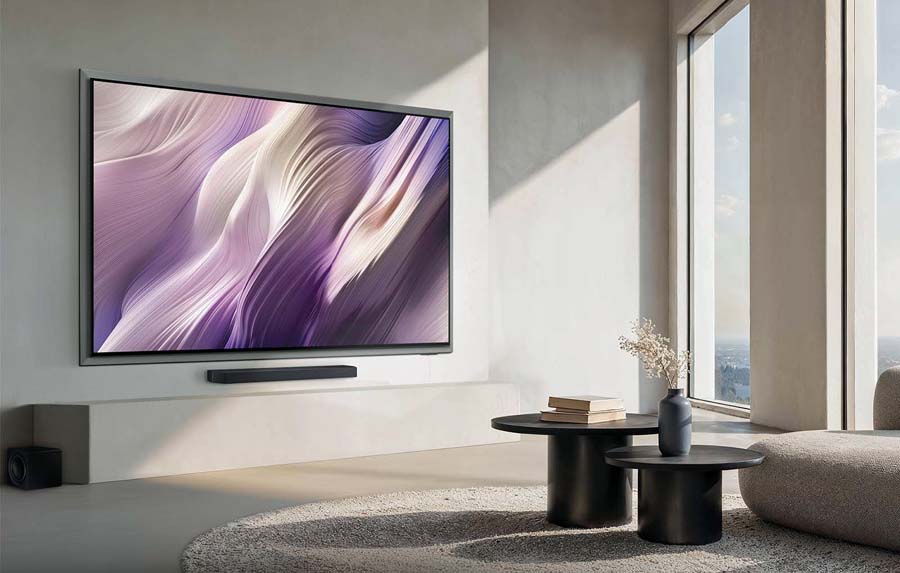
One thing that varies significantly on the S90H and S95H is the cosmetic design. The S95H sports a new “Float Layer” industrial design which features an integrated (non-removable) picture frame around the edges of the panel. The set also comes with an innovative flush wall-mount bracket that allows the TV to sit completely flat against the wall. The design makes the S95H look more like artwork when not in active use. But unlike Samsung’s “The Frame” and “The Frame Pro” TVs, the outer frame itself is neither replaceable nor customizable.
Museum Quality TV?
For the first time on an OLED TV, Samsung has given owners of the S95H access to the Samsung Art Store, a curated collection of artwork which can be displayed on the set when you’re not actively using it to watch video. Although “given” is an odd word to use here. While customers can access up to 30 different pieces of art per month for free, access to the full art store with over 5,000 pieces of art incurs a subscription fee, currently $5.00/month or $50/year.
Compared to last year’s flagship S95F, the S95H does away with the separate One Connect box which had moved all the inputs and outputs to a separate component, connected to the TV by a proprietary cable. This year, all of the inputs and outputs on the set are integrated into the side of the TV itself, but in a discrete manner in which they are not visible when the TV is mounted to the wall using the included flush wall-mount hardware.

Customers who want a simpler installation for the S95H can purchase a wireless One Connect dongle which plugs into a proprietary port in the back of the TV. This allows you to connect all your video source and components to a separate wireless One Connect box, located up to 30 feet away from the TV. With this option, the only cord the S95H needs is a power cord. And, since all of the HDMI ports on the TV and on the OneConnect box are accessible, technically you can connect up to 8 separate sources via HDMI 2.1 if you use the wireless OneConnect box. That’s a lot of ports!

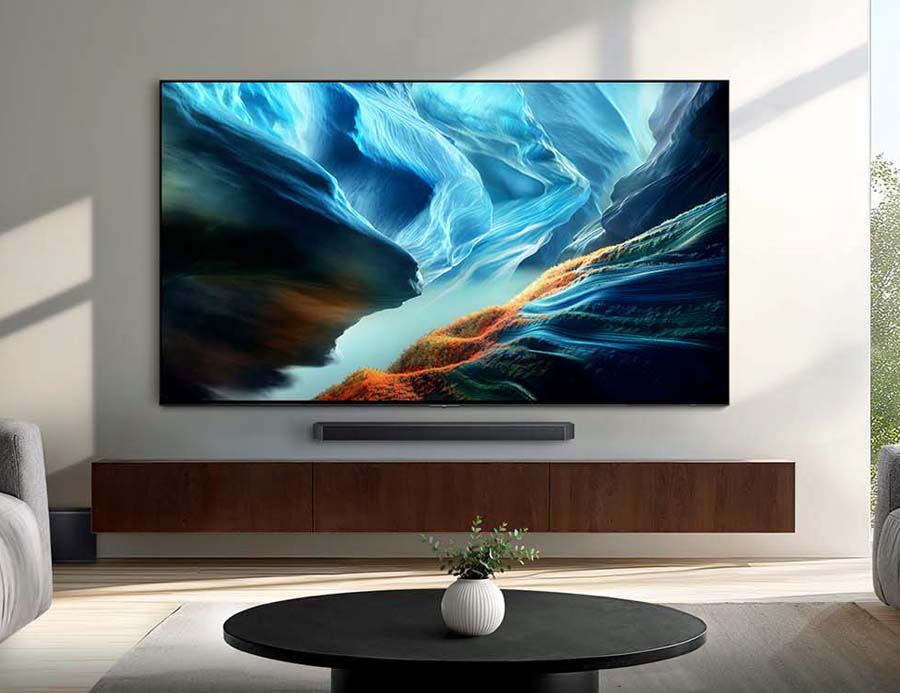
Meanwhile the S90H offers a more traditional cosmetic design, with a thin black bezel and all input and output ports recessed into the side/back of the TV. Unlike last year’s S90F, the S90H now includes Samsung’s Glare Free screen treatment which reduces reflections from ambient room lighting. If you prefer a glossy type of screen, Samsung offers the S85H OLED TV without the Glare Free coating.

QD or Not QD?
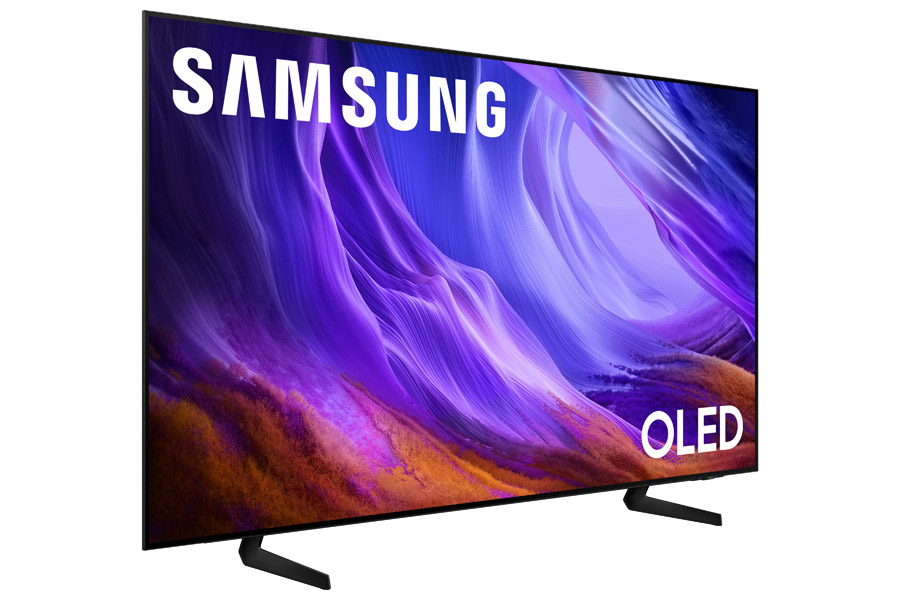
In terms of underlying panel differences, Samsung is once again using different panels within a specific model line, depending on screen size. Some use a QD-OLED (Quantum Dot Organic Light-Emitting Diode) panel from Samsung Display, while others use a WOLED (White Organic Light-Emitting Diode) from LG Display. Both offer exceptional black levels thanks to self-emissive pixels, as well as excellent off-axis viewing and freedom from artifacts like Dirty Screen Effect, blooming and haloing around bright objects. QD-OLED panels generally have a slightly wider color gamut than WOLED panels, though this isn’t normally evident while viewing real world content on Blu-ray, streaming or even UHD Blu-ray Disc.
From what we could see (and measure) the 65-inch S95H seems to be using the latest QD-OLED panel from Samsung Display. BT.2020 color gamut tests came in at around 88.4% of BT.2020, which is consistent with a QD-OLED panel. If Samsung takes the same strategy as last year, then we expect that the 55-inch and 77-inch screen sizes of the S95H will also use a QD-OLED panel (at least in the United States), while the 83-inch screen size will use a WOLED panel. The S85H will use a W-OLED panel in all screen sizes.
It gets a little trickier with the S90H. Last year, the “90” model (S90F) used a QD-OLED panel in select screen sizes (55, 65 and 77 inches), but the measurements we made on the S90H in a 65-inch screen size suggest that this new model actually uses a WOLED panel. While it can reach 98.6% of the P3 color standard, it only manages to reproduce 74.77% of the BT.2020 color gamut. And while this isn’t a serious limitation on most of today’s content, it does suggest that the underlying panel is actually WOLED, not QD-OLED.
This may be subject to change, particularly outside the North American market. And we can only report on the actual sample that we viewed and measured at the workshop. Production samples may differ.


Samsung Vision AI – The Next Generation
All of Samsung’s 2026 MiniLED, Micro RGB and OLED TVs are taking full advantage of Artificial Intelligence, both in picture processing and in the overall end user experience. More than simple recommendations about what else to watch, Samsung’s Vision AI allows you to interact with your TV with normal language questions and get not only content recommendations but also natural answers to these questions. You can even get real time language translations in a number of different languages via on-screen subtitles (on select content).
Both the S90H and S95H use Samsung’s NQ4 AI Gen3 Processor, the same processor from last year’s flagship OLED TV. This brings several AI-based picture enhancement options to bear, including 4K AI Upscaling Pro to improve the look of lower-resolution content, AI Motion Enhancer Pro, and an Adaptive Picture function that uses AI to optimize the image based on the content being viewed. This assures that sports programs will have blur-free fast motion while movies will preserve a more cinematic look.
In honor of this year’s World Cup, Samsung is offering a new AI Soccer mode which accentuates the green grass of a soccer pitch and enhances the detail and clarity of the moving soccer ball while also giving the crowd noise a more spacious sound effect. We saw a demo of this and have to say it was pretty effective at making you feel like you’re actually at a match, but without any pesky football hooligans.
One UI Tizen FTW
All three of Samsung’s 2026 OLED TVs include the latest version of Samsung’s Tizen Operating System. This platform offers all of the major streaming apps and is one of the better user interfaces when it comes to finding and presenting content without excessive advertising. In our use, we found the menu navigation and apps to be smooth and zippy, and the AI-enhanced search found content from a variety of streaming apps and sources as expected. Samsung says they will provide free upgrades to the O/S for up to 7 years, so customers will get enhanced operation and new features over time without having to buy a new TV every year.
As with Samsung’s 2025 TVs, the S85H, S90H and S95H support HDR10 and HDR10+ HDR options, but not Dolby Vision. They do support Dolby Atmos audio as well as Samsung’s new Eclipsa Audio immersive audio format (but not DTS).
Thoughts on Performance
We spend several hours with both the S90H and S95H using a Kaleidescape Strato E movie player loaded with challenging content as well as a few UHD Blu-ray Discs. Initial tests showed that both the S90H and S95H offer excellent color saturation and detail. Black levels in a darkened room were exceptionally inky, and still pretty strong when we turned on the lights. Unlike the first generation of Samsung’s Glare Free screen treatment, the latest version manages to nearly eliminate light reflections on the screen without sacrificing black levels too drastically.


Skin tones were particularly well represented on both sets as evidenced by test clips on Spears and Munsil’s UHD Benchmark discs. And using 4K/HDR content mastered for 4,000 nits of peak brightness (like the film “Alpha”), we could see that both sets’ on-board HDR Tone Mapping did a great job adjusting the HDR scale so that bright specular highlights were maintained as well as dark shadow details, even when both appeared on screen at the same time.

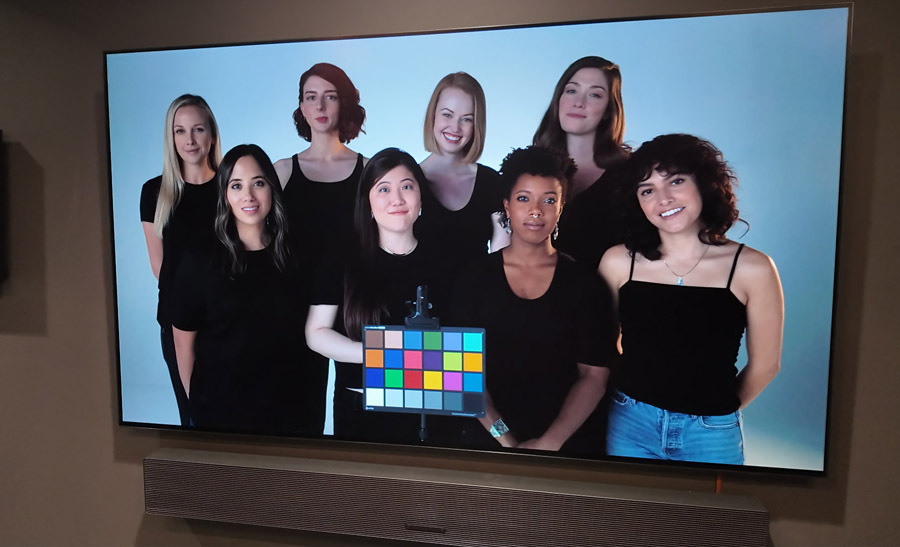
The S95H provided a more punchy and dynamic image overall, thanks to its higher peak brightness, though this advantage was less obvious when we dimmed the lights.
S90F vs. S95H, By the Numbers
Using the latest version of CalMAN software on the S95H, we measured a peak brightness of 2,553 nits in a 10% field white window in Standard mode and 1,072 nits in Filmmaker mode. The brightness measurement in Standard mode is exceptionally high for an OLED TV and about 25% higher than last year’s S95F. And the lower brightness in Filmmaker mode seems to be consistent with recent OLED TVs from both LG and Panasonic, each of which is targeting a closer visual match to the broadcast reference monitors in use in the film industry to master theatrical content for home. Meanwhile the S90H peaked at 1,190 nits, again using a 10% window in Standard mode and 1,295 nits in Filmmaker mode.
In terms of color gamut, both sets were able to reproduce close to 100% of the P3 color standard (99.9% on S95H, 98.6% on S90H), but they differed a bit on the BT.2020 color gamut tests, as we mentioned earlier. The S95H was able to hit 88.4% of BT.2020 while the S90H only managed to hit 74.77% of BT.2020 in the CalMAN tests. This leads us to believe that the S95H is using a QD-OLED panel while the S90H may be using a WOLED panel. Does this matter in real life? Maybe not. Most content on streaming and even on UHD Blu-ray Disc stays within the P3 color space, which both sets are more than capable of reproducing,
In terms of overall color accuracy, we measured the average “Delta E” (color variation from reference) at under 3 for grayscale and under 2 for color on both sets, both in Filmmaker mode. Specifically the S95H averaged 2.9 dE for grayscale and 1.6 for color dE. The S90H actually turned in slightly better out-of-the-box measurements with an average dE for grayscale of 2.8 and an average dE for color of 1.1. These are both impressive measurements for out-of-the-box settings and it’s likely that even better results could likely be attained with a full calibration.
Overall, both sets offered solid performance for an OLED TV. Or really for any display. Whether you’re gaming, streaming, watching HD Blu-ray Discs or 4K UHD Blu-rays, or 4K/HDR movies on Kaleidescape, you’ll be in for a visual treat with either of these sets.
Check out Al Griffin’s S95H hands-on review for additional measurements, specs and details.
Specs and pricing of the S85H OLED TV are also included below with the S90H and S95H details, but we have not yet spent any hands-on time with the S85H.
55-inch: $2,499.99
2026 Samsung Model
S95H
S90H
S85H
Product Type
OLED TV
OLED TV
OLED TV
Screen Sizes (inches)
55, 65, 77, 83
42, 48, 55, 65, 77, 83
48, 55, 65, 77, 83
Price
65-inch: $3,399.99
77-inch: $4,499.99
83-inch: $6,499.99
42-inch: $1,399.99
48-inch: $1,599.99
55-inch: $1,999.99
65-inch: $2,699.99
77-inch: $3,699.99
83-inch: $5,299.9948-inch: $1,199.99
55-inch: $1,499.99
65-inch: $1,999.99
77-inch: $2,799.99
83-inch: $4,499.99
Refresh Rate
165Hz (VRR Support)
165Hz (VRR Support)
120Hz (VRR Support)
Lighting Technology:
Self-illuminating pixels
Self-illuminating pixels
Self-illuminating pixels
Display Resolution
4K (3,840 x 2,160)
4K (3,840 x 2,160)
4K (3,840 x 2,160)
Anti Reflection
Glare Free
Glare Free
Glare Free
Viewing Angle
Ultra Viewing Angle
Ultra Viewing Angle
Ultra Viewing Angle
Dimming Technology
Individual Pixel Control
Individual Pixel Control
Individual Pixel Control
Processor
NQ4 AI Gen3 Processor
NQ4 AI Gen3 Processor
NQ4 AI Gen2 Processor
Upscaling
4K AI Upscaling Pro
4K AI Upscaling Pro
4K AI Upscaling
Variable Refresh Rate (VRR)
Yes
Yes
Yes
Motion Handling
Motion Xcelerator 165Hz
Motion Xcelerator 165Hz
Motion Xcelerator 120Hz
DLG (Dual Line Gate):
N/A
N/A
NA
Contrast Enhancer
Real Depth Enhancer
Real Depth Enhancer
Real Depth Enhancer
Contrast Booster
Yes
Yes
Yes
AI Motion Enhancer:
Pro
Pro
No
Color
Perceptual Color Mapping
Perceptual Color Mapping
Perceptual Color Mapping
Color Booster
Pro
Pro
Pro
HDR (High Dynamic Range)
OLED HDR Pro
83″- 55″: OLED HDR +
48″- 42″: OLED HDROLED HDR
HDR10+
Yes (Adaptive/Gaming/Advanced)
Yes (Adaptive/Gaming/Advanced)
Yes (Adaptive/Gaming/Advanced)
Auto HDR Remastering
Yes
Yes
No
Adaptive Picture
AI Optimized / AI Customization
AI Optimized / AI Customization
AI Optimized / AI Customization
Supersize Picture Enhancer
No
No
No
Audio
Speaker Type: 4.2.2CH
Output Power (W): 70W
Dolby Atmos
Object Tracking OTS+
Q-Symphony:
Active Voice Amplifier (AVA) Pro
Adaptive Sound: Pro
Bluetooth Audio
360 AudioSpeaker Type: 83″-48″: 2.1CH, 42″: 2CH
Output Power (W): 83″-48″,40W,42″: 20W
Object Tracking: OTS Lite
Q-Symphony:
Active Voice Amplifier (AVA) Pro
Adaptive Sound: Pro
Bluetooth Audio
360 AudioSpeaker Type: 2CH
Output Power (W): 20W
Dolby Atmos
Object Tracking Sound (OTS): OTS Lite
Q-Symphony
Active Voice Amplifier (AVA): AVA Pro
Adaptive Sound: Pro
Bluetooth Audio
360 Audio
TV Design
FloatLayer
4 Bezel-less
Front Color: Slate Black
Stand Type: Round Feet
Stand Color: Black
Adjustable Stand: N/ALaserSLim
4 Bezel-less
Front Color: Graphite Black
Stand Type83″ – 48″: Simple Plus Blade 42″: Simple Blade
Stand Color: 83″- 48″: Space Titan
42″: Black
Adjustable Stand: 83″-48″: N/A
42″: Yes83″ – 55″: Contour 48″: LaserSlim
4 Bezel-lessFront Color: Graphite Black
Stand Type: 83″ – 55″: Simple Linear. 48″: Simple Blade Wide
Stand Color: Black
Adjustable Stand: 83″-55″: N/A, 48″: Yes
Connectivity
Wi-Fi 6E
Bluetooth (BT5.3)
One Connect Box: N/A
4 x HDMI
HDMI Maximum Input Rate: 4K 165Hz (for HDMI 1/2/3/4)
HDMI Audio Return Channel: eARC
HDMI-CEC:
3 x USB-A Ports
1 x Ethernet (LAN):
1 x Digital Audio Out (Optical):
1 z RF Connection: Y
1 x RS-232C InputWi-Fi 6E
Bluetooth (BT5.3)
One Connect Box: N/A
4 x HDMI
HDMI Maximum Input Rate: 4K 165Hz (for HDMI 1/2/3/4)
HDMI Audio Return Channel: eARC
HDMI-CEC:
3 x USB-A Ports
1 x Ethernet (LAN):
1 x Digital Audio Out (Optical):
1 z RF Connection: Y
1 x RS-232C InputWi-Fi 6E
Bluetooth (BT5.3)
One Connect Box: N/A
4 x HDMI
HDMI Maximum Input Rate: 4K 120Hz (for HDMI 1/2/3/4)
HDMI Audio Return Channel: eARC
HDMI-CEC:
2 x USB-A Ports
1 x Ethernet (LAN):
1 x Digital Audio Out (Optical):
1 z RF Connection: Y
1 x RS-232C Input
Samsung Vision AI
Vision AI Companion:
AI Soccer Mode:
AI Sound Controller: Pro
Live Translate
Generative Wallpaper:
Multi AI Agents (Copilot & Perplexity)
Pet & Family Care:
Home Insight: Vision AI Companion:
AI Soccer Mode:
AI Sound Controller: Pro1
Live Translate
Generative Wallpaper:
Multi AI Agents (Copilot & Perplexity)
Pet & Family Care:
Home Insight: AI Soccer Mode:
AI Sound Controller:
Live Translate
Multi AI Agents (Copilot & Perplexity)
Pet & Family Care:
TV Art Features
Art Mode: N/A
Art Store: YesArt Mode: N/A
Art Store: YesArt Mode: N/A
Art Store: N/A
Operating System
One UI Tizen
One UI Tizen
One UI Tizen
Free Ad-Supported TV:
Samsung TV Plus
Samsung TV Plus
Samsung TV Plus
Smart Home Connectivity
SmartThings
Matter, IoT-Sensor Functionality
Quick RemoteSmartThings
Matter, IoT-Sensor Functionality
Quick RemoteSmartThings
Matter, IoT-Sensor Functionality
Quick Remote
Smart Assistants (Built-In)
Bixby, Alexa
Bixby, Alexa
Bixby, Alexa
Smart Assistants (Works with):
Google Assistant
Google Assistant
Google Assistant
Far-Field Voice Interactions
Yes
Yes
Yes
Web Browser
Yes
Yes
Yes
Samsung Health
Yes
Yes
Yes
Multi-Device Experience:
Mobile to TV
TV initiates mirroring
Sound Mirroring
Wireless TV OnMobile to TV
TV initiates mirroring
Sound Mirroring
Wireless TV OnMobile to TV
TV initiates mirroring
Sound Mirroring
Wireless TV On
Multi-View
Up to 2 videos
Up to 2 videos
Up to 2 videos
Buds Auto Switch
Yes
Yes
Yes
Works with Apple AirPlay
Yes
Yes
Yes
Works with Google Cast:
Yes
Yes
Yes
Daily+
Yes
Yes
Yes
Now Brief
Yes Voice/User Detection
Yes Voice/User Detection
Yes Voice/User Detection
Workout Tracker
Yes
Yes
Yes
Karaoke Mic
Yes
Yes
Yes
Multi-Control
Yes
Yes
Yes
Storage Share:
Yes
Yes
Yes
Gaming Support
Gaming Hub:
Cloud Gaming:-Xbox, NVIDIA GeForce Now, Luna, Blacknut, Antstream, Boosteroid
AI Auto Game Mode
ALLM (Auto Low Latency Mode)
Game Motion Plus
Super Ultra Wide Game View
Game Bar
Mini Map Zoom
AMD FreeSync: Freesync Premium™ Pro
NVIDIA G-SYNC
HGiG
Hue Sync:Gaming Hub:
Cloud Gaming:-Xbox, NVIDIA GeForce Now, Luna, Blacknut, Antstream, Boosteroid
AI Auto Game Mode
ALLM (Auto Low Latency Mode)
Game Motion Plus
Super Ultra Wide Game View
Game Bar
Mini Map Zoom
83″- 48″: AMD FreeSync: Freesync Premium™ Pro
42″: Freesync Premium™
NVIDIA G-SYNC
HGiG
Hue Sync:Gaming Hub:
Cloud Gaming:-Xbox, NVIDIA GeForce Now, Luna, Blacknut, Antstream, Boosteroid
AI Auto Game Mode
ALLM (Auto Low Latency Mode)
Game Motion Plus
Super Ultra Wide Game View
Game Bar
Mini Map ZoomAMD FreeSync: Premium™
NVIDIA G-SYNC
HGiG
Hue Sync:
Security
Knox Vault: N/A
Knox Security: YesKnox Vault: N/A
Knox Security: YesKnox Vault: N/A
Knox Security: Yes
Power
Power Supply (V): AC110-120V~ 50/60Hz
Stand-by Power Consumption (W): 0.5
Typical Power Consumption (W) 83″: 236W 77″: 192W 65″: 145W 55″: 127W
Max Power
Consumption (W):
83″: 650W 77″: 770W 65″: 600W 55″: 470W Eco Sensor
Auto Power Saving
Auto Power OffPower Supply (V): AC110-120V~ 50/60Hz
Stand-by Power Consumption (W): 0.5
Eco Sensor: Yes
Auto Power Saving:
Auto Power OffPower Supply (V): AC110-120V~ 50/60Hz
Stand-by Power Consumption (W): 0.5
Eco Sensor: Yes
Auto Power Saving:
Auto Power Off
Included Accessories
Remote Control: BT SolarCell™ Remote TM2660H
Power Cable
Slim Fit Wall-mount SupportRemote Control: BT SolarCell™ Remote TM2660H
Power Cable
Slim Fit Wall-mount SupportRemote Control: BT SolarCell™ Remote TM2660H
Power Cable
Slim Fit Wall-mount Support
Sizes and U.S. Pricing of Samsung’s 2026 OLED TVs:
S95H OLED TV
- 55-inch S95H: $2,499.99
- 65-inch S95H: $3,399.99
- 77-inch S95H: $4,499.99
- 83-inch S95H: $6,499.99
S90H OLED TV
S85H OLED TV
The Bottom Line
With Samsung’s 2026 line-up of OLED TVs, it’s clear that the company is still committed to this category, even as they continue to enhance their LCD TV line-up with both Mini LED and Micro RGB backlighting. The 165 Hz OLED panel, impressive peak brightness, advanced AI processing, deep black levels and accurate color reproduction should appeal to those who want exceptional picture performance without the requirement to turn out the room lights or close the drapes.
Samsung’s industrial design has always had its share of fans and detractors. Incorporating a picture frame into the chassis of the S95H will likely appeal to those who want their TVs to pass as artwork when not in use, but it may be a sticking point for those who want a more traditional thin bezel design. For those who like the idea of the Frame TV but want something with higher picture performance, we believe the S95H will offer a compelling choice.
We also believe moving away from the required One Connect box on the S95F by including the input/output ports on the S95H TV itself and offering a wireless One Connect option for those who want to move the cables to a separate box is a great move. This makes the S95H even easier to install than its predecessor with more options for the consumer and custom installer.
For those who appreciate the wider color gamut reproduction of a QD-OLED panel but dislike the matte finish of Samsung’s Glare Free screen treatment or aren’t fans of the framed design of the S95H, Samsung isn’t really offering an alternative this year. Whether this turns out to be a misstep or just a trivial checklist item remains to be seen.
But what we’ve seen so far of the Samsung OLED line suggests that the flagship S95H will likely be one of the top performing TVs of the year.
Related Reading:
Check Out Samsung’s 2026 Lineup of MiniLED TVs: Pricing, Specs and Details
2026 Samsung S95H OLED TV Hands-on Review: Museum Quality OLED?
You must be logged in to post a comment Login