Hackers associated with the Russian threat group Sandworm have been targeting system administrators and IT professionals through fake job offers since at least May.
A report from the Ukrainian Computer Emergency Response Team (CERT) details a social engineering campaign attributed to UAC-0145, which is believed to be a sub-cluster of Sandworm (APT44). In the campaign, the threat actor targets victims while posing as IT companies and recruiters.
The agency says that the attacker studies the targets’ resumes uploaded on job sites and then initiates direct contact.
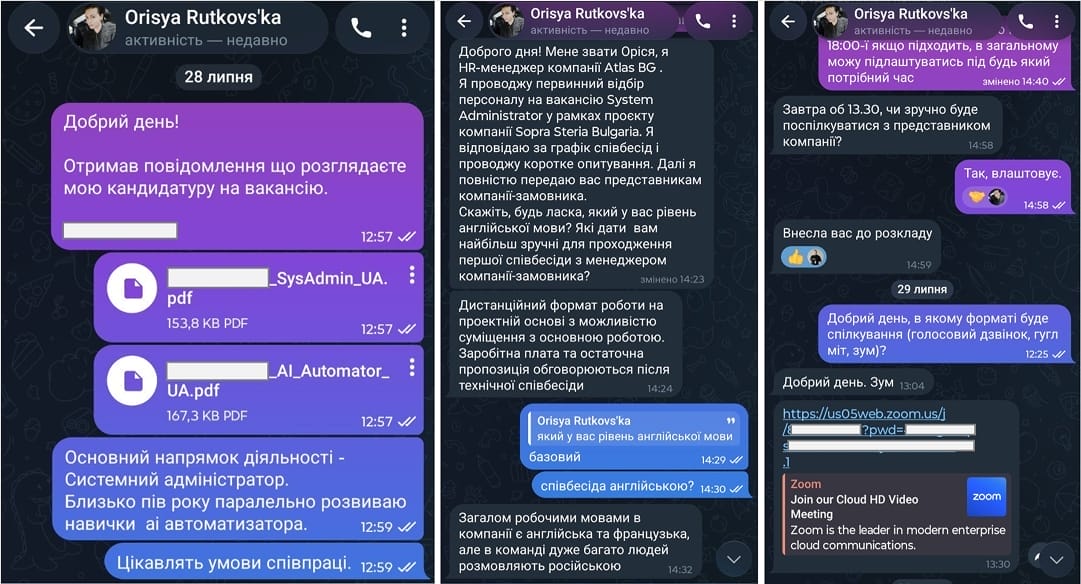
Conversations are then moved to Telegram to arrange a video interview over Zoom. During the interview, which is conducted in English, the candidates receive mock technical assignments that require them to connect to a corporate VPN.
Conversations with a supposed recruiter Source: CERT-UA
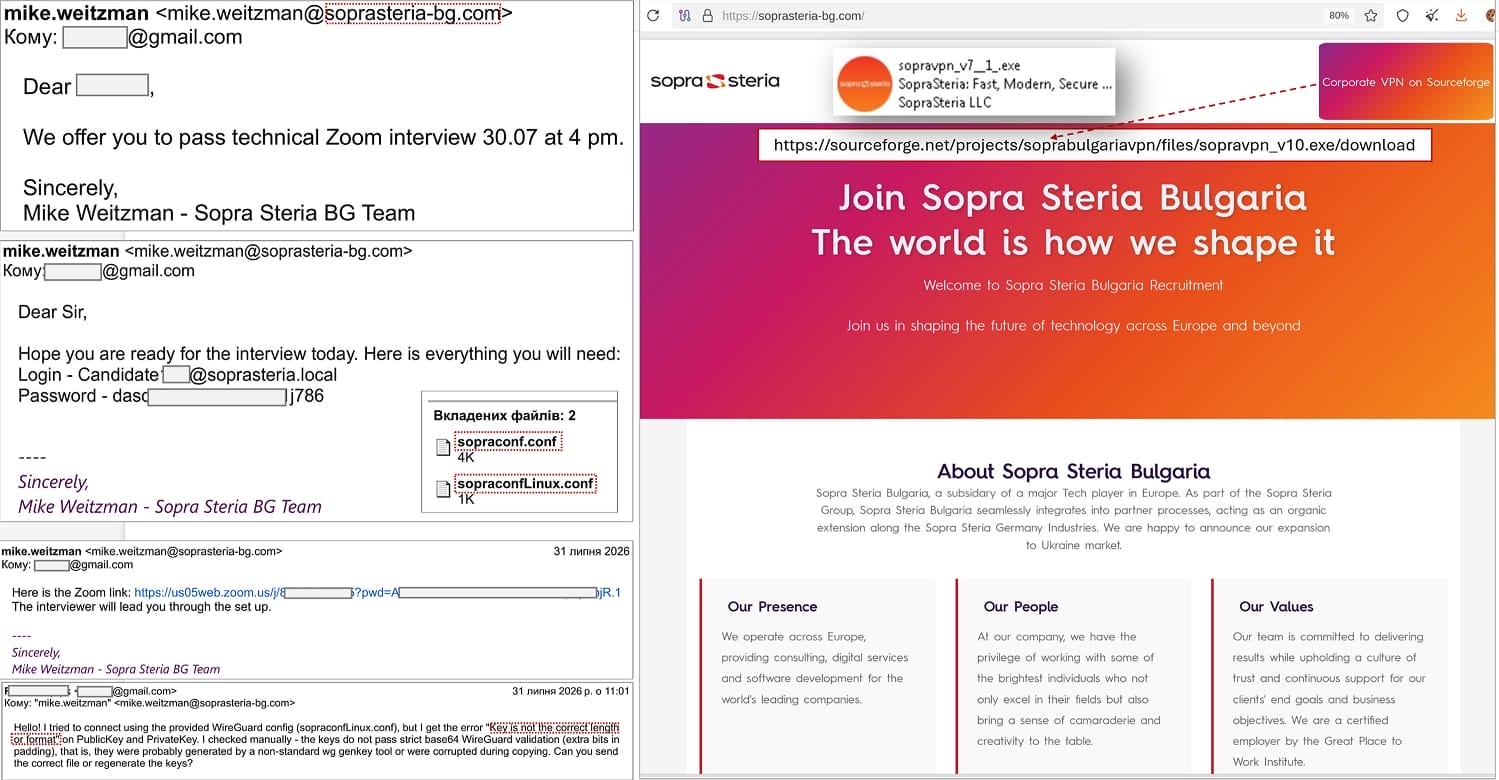
In one case that CERT-UA observed, the attacker impersonated the international IT firm Sopra Steria using seemingly legitimate email addresses similar to the company’s office in Bulgaria.
“In parallel, additional instructions for the technical interview are sent via email, including configuration files for connecting to a ‘corporate’ VPN using Wireguard (Linux/Windows) to supposedly perform test tasks,” CERT-UA says.
Advertisement
Malicious emails and VPN download link Source: CERT-UA
The downloaded file is configured to produce a fake error. The attackers then prompt the victim to download a modified WireGuard-based client called “SopraVPN” from SourceForge.
The SourceForge page even includes a link to soprasteria-bg[.]com to increase credibility, although the domain has no connection to the legitimate company.
The trojanized client supports a malicious, nonstandard “SymmetricKey” configuration option that decrypts and executes embedded PowerShell code.
On Windows, the malicious command creates a scheduled task and downloads an additional payload from the Internet.
On Linux, it uses cURL to retrieve another executable from attacker-controlled infrastructure through the VPN.
Advertisement
CERT-UA also noted that WireGuard’s standard Base64 decoding was replaced in the trojanized version with a custom, dynamically generated Base64 alphabet, which renders key strings unreadable with standard decoders and protects the PowerShell code from analysis.
The Ukrainian cyber agency advises telecommunications providers and IT companies whose staff are targeted by this campaign to restrict corporate resource access to managed, continuously monitored devices protected by EDR, including when employees use personal equipment.







You must be logged in to post a comment Login