Tech
Schiit Bifrost 3 DAC Goes Mesh, Adds EQ and Somehow Costs Less

Schiit Audio has spent years convincing audiophiles that multibit DACs, proprietary digital filtering, modular hardware, and refusing to chase every new format were all perfectly sensible ideas. With the new Bifrost 3, the Texas manufacturer is keeping three of those ideas and making a rather significant change to the fourth.
Priced at $699 in black and $729 in silver, Bifrost 3 replaces the $799 Bifrost 2/64 as Schiit’s midrange standalone DAC. It adds 32-bit/384 kHz USB playback, Forkbeard control, parametric EQ, digital preamplifier functions, over-the-air firmware updates, and a new Mesh conversion architecture. Preorders require a refundable $10 deposit, with shipping expected around the end of October 2026.
And yes, it costs $100 less than the model it replaces. Somewhere an accountant has been asked to leave the audiophile industry.
What Happened to True Multibit?
Bifrost 2/64 used Schiit’s True Multibit architecture with four Texas Instruments DAC8812 converters in a hardware-balanced configuration. Bifrost 3 instead uses Schiit’s Mesh 8×39 architecture, combining the company’s proprietary time- and frequency-domain optimized digital filter running on an Analog Devices SHARC DSP with ESS ES9039 devices operating as delta-sigma modulators.
That does not mean Schiit has abandoned Multibit. Gungnir 2 and versions of Yggdrasil continue down that path, and the company says it intends to keep developing both multibit and hybrid approaches.
What has changed is Schiit’s belief that Mesh can now meet or exceed the subjective performance it has achieved from True Multibit while delivering stronger measured performance at a lower manufacturing cost. Schiit specifically credits its own SMD production line for helping reduce the price.
Translation: Schiit found another way to make a DAC it likes, and apparently decided ideological consistency was less important than whether the thing actually sounds good. How disappointingly rational.
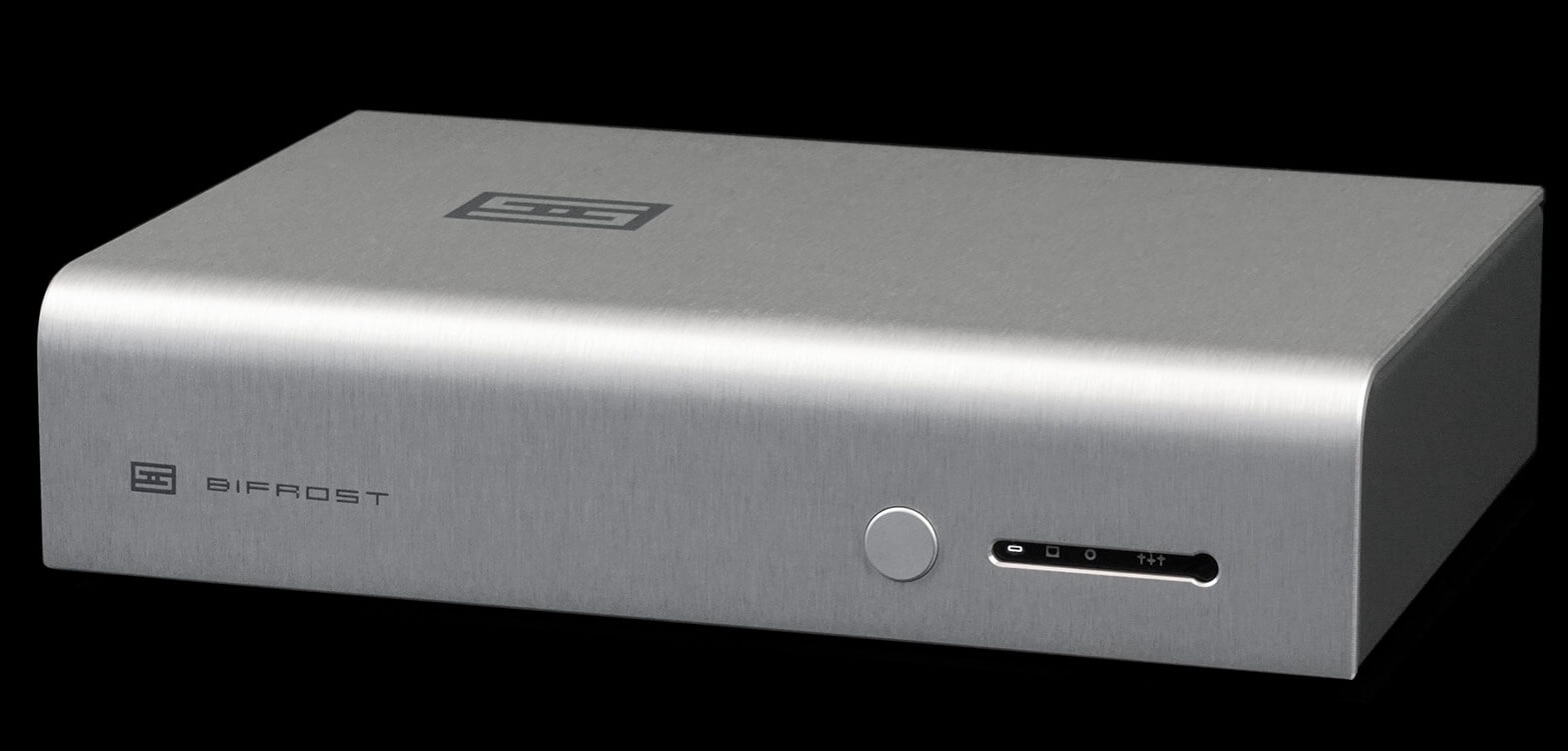

Bifrost 3 Specifications
- Price: $699 black; $729 silver
- Conversion: Schiit Mesh with ESS ES9039 delta-sigma modulation
- Digital processing: Proprietary Schiit filter on Analog Devices SHARC DSP
- USB: Unison 384
- USB resolution: Up to 32-bit/384 kHz PCM
- Coaxial/optical: Up to 24-bit/192 kHz
- Inputs: USB, coaxial S/PDIF, optical S/PDIF
- Outputs: RCA and balanced XLR
- Maximum output: 2V RMS RCA; 4V RMS XLR
- THD+N: <0.00015%, -118 dB typical
- S/N: >125 dB
- IMD: <0.0003%
- Crosstalk: -128 dB, 20 Hz–20 kHz
- Output impedance: 75 ohms
- Analog stage: AD4898-based I/V and filtering
- Power supply: Internal linear supply with 11 stages of regulation
- Power consumption: 15 watts
- Dimensions: 9 x 6 x 2 inches
- Weight: 6 pounds
- Warranty: 5 years


Forkbeard Changes What Bifrost Can Do
The other major change is Forkbeard, Schiit’s control platform.
With the included Forkbeard module, Bifrost 3 can operate as a digital preamplifier with volume control, parametric EQ, balance and loudness adjustment. Firmware can also be updated over the air, eliminating the MicroSD-card update routine required by Bifrost 2.
There is still an included IR remote for source selection, phase inversion and mute, because apparently not every function in 2026 needs an app and a password.
Bifrost 3 remains fully modular as well. Its DAC and input cards slide out for replacement, maintaining one of the most useful aspects of the Bifrost platform.
What About Bifrost 2 Owners?
This is where Schiit deserves some credit.
The new $250 Bifrost 3 Mesh card can be installed in Bifrost 2, with the required firmware supplied on an SD card. Even more unusually, the original Bifrost 2 AD5781 analog card and the later Bifrost 2/64 DAC8812 card can both be installed in Bifrost 3.
What you cannot add to Bifrost 2 is Forkbeard. Schiit says that would require a new motherboard, chassis and other hardware, at which point you have essentially recreated the new DAC using the least convenient method possible.
The outgoing Bifrost 2/64 remains a 24-bit/192 kHz True Multibit DAC with NOS mode, while Bifrost 3 raises USB capability to 32-bit/384 kHz and adds the digital preamp/EQ functionality. Published THD+N also improves from under 0.0008% to under 0.00015%, although not every specification moves dramatically in the same direction: Bifrost 2/64 lists slightly better crosstalk and a tighter frequency-response tolerance on paper.
Numbers remain useful. Worshipping them requires membership on some audio forum obsessed with measurements and not actually listening.
The Bottom Line
Bifrost 3 is interesting because Schiit has not merely updated Bifrost 2/64. It has changed the technological premise of the product. True Multibit is no longer the default. Mesh is.
In exchange, buyers get higher-rate USB, Forkbeard EQ and preamp functionality, OTA firmware updates, substantially lower measured distortion, and a price that drops from $799 to $699. Existing Bifrost 2 owners can also adopt the new Mesh conversion card without throwing their current DAC into the recycling bin.
That last point matters. Schiit has built much of its reputation around selling equipment that can evolve rather than expire, and Bifrost 3 continues that philosophy even while changing direction internally.
Whether longtime Bifrost owners prefer Mesh to True Multibit is something only listening will settle. Which, inconveniently, means audiophiles may eventually have to stop arguing about DAC architecture on the internet and actually play some music.
For more information: schiit.com
You must be logged in to post a comment Login