Tech
Schiit Buf Tube Buffer Launches at $99: A Subtle Upgrade or Sonic “Buf”?

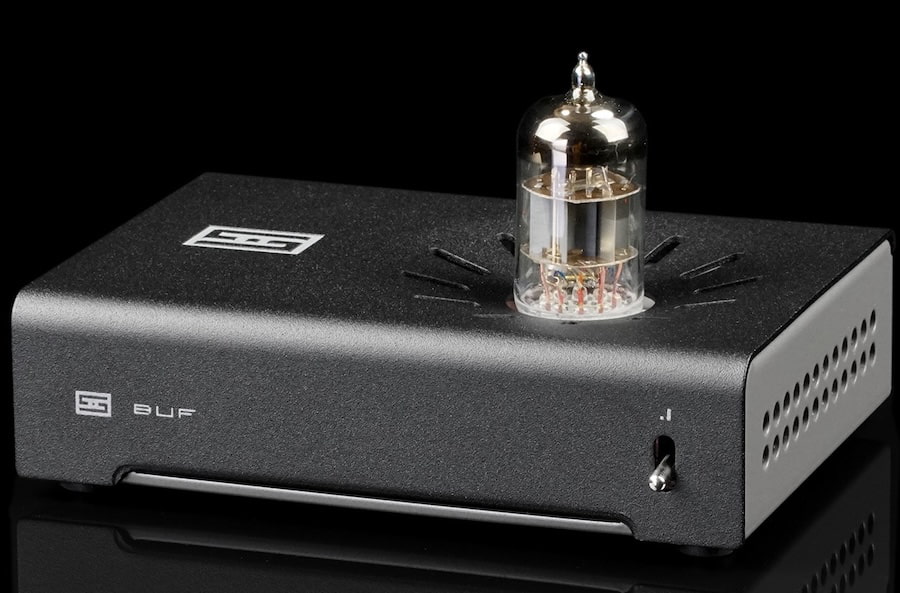
Schiit Audio is taking a more practical swing at tubes with the $99 Buf. It’s a compact tube buffer designed to sit in your signal chain, not take it over.
Buf isn’t a preamp and it’s not a DAC. There are no inputs for sources beyond basic line level, no volume control, and no system control duties. You place it between components; typically between a DAC and amplifier, or between a source and powered speakers, and it inserts a tube stage into the chain. If you don’t want that, it can be switched out and used as a straight pass through.
That makes it easy to experiment without committing to a full tube setup. It can be used to slightly reshape a solid state system, take the edge off a brighter chain, or add some variation to a desktop or headphone rig. It’s also flexible enough to move around depending on the system or use case, which fits Schiit’s usual modular approach.
At $99, Buf is less about replacing components and more about giving users a simple way to try a tube stage in different setups and decide if it works for them.

Tubes Anywhere Without Rebuilding Your System
Schiit Audio isn’t pretending the $99 Buf is neutral. In fact, they’re leaning in the opposite direction.
“Buf is a tube buffer. It adds a ton of low-order harmonic distortion, without adding a bunch of noise. It destroys the big perfect of ‘measurement gear.’ At the same time, lots of people, including those who use Audio Precisions all day, think it sounds better. So we figured we’d make this thing and let you find out for yourself,” said Jason Stoddard.
That’s the pitch. Not accuracy in the lab sense, but a different presentation that some listeners may prefer, especially in systems that lean hard into ultra-low distortion solid state performance.
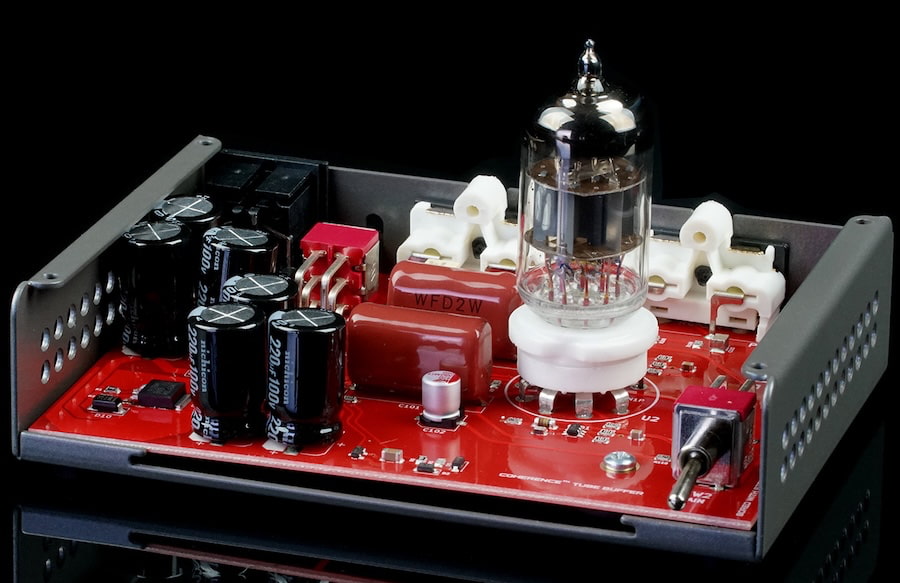
Despite the price, this isn’t a stripped-down implementation. The Schiit Buf runs a 100V plate voltage, uses a linear power supply, and incorporates higher-grade parts including Panasonic film capacitors. Schiit’s Coherence topology is also in play, maintaining absolute phase and offering selectable gain; either 0dB or 12dB from a front panel switch.
Stoddard is also clear that this isn’t a generic design.
“It’s not just another cathode follower,” he explained. “It’s more akin to our Lyr and Vali tube amps, but it’s different than both—a simple Class A stage optimized for line level use, rather than driving headphones.”
That last part matters. Buf isn’t trying to power anything. It’s there to sit in the chain and influence it, subtly or not, depending on the system and gain setting.
Connectivity is simple: RCA in, RCA out. It will work in most two-channel or desktop setups without much thought. And because it can be fully bypassed, it’s easy to evaluate in real time without pulling cables.
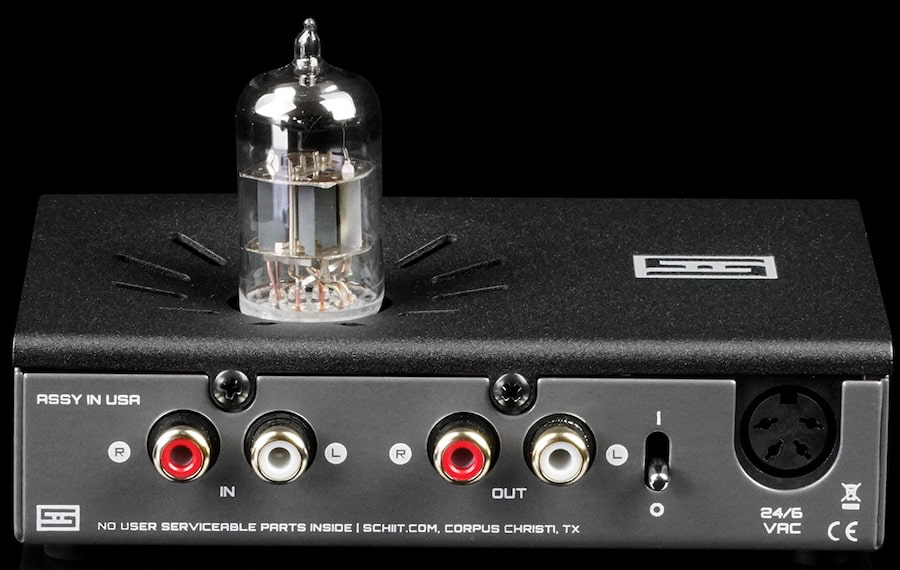

Schiit Buf Specifications
- Gain Modes
- Low Gain (0dB): 20Hz–20kHz ±1dB, THD <0.5%, IMD <0.6%, SNR >106dB, Crosstalk -90dB
- High Gain (12dB): 20Hz–20kHz ±1dB, THD <0.2%, IMD <0.4%, SNR >97dB, Crosstalk -80dB
- Performance & Design
- Output Impedance: 75 ohms
- Input Impedance: 470k ohms
- Maximum Output: 8.2V RMS
- Topology: Coherence tube gain with BJT inverter, Class A
- Protection: Delayed start, fast shutdown, muting relay
- Power & Build
- Power Supply: External 24VAC and 6VAC wall adapter, linear regulated rails, 6V AC heater
- Power Consumption: 6W
- Dimensions: 5 x 3.5 x 2.75 inches
- Weight: 1 lbs

Schiit Buf Setup, Tube Use, and Basics
Buf can be added to a system in two straightforward ways. You can place it between a preamp and power amplifier, which allows it to affect every source connected to the preamp. Alternatively, you can insert it between a single source such as a DAC and an integrated amplifier, preamp, or headphone amplifier. In that setup, Buf only influences that specific source.
Tube lifespan is typically around 5,000 hours of use. That figure reflects active operating time, so it’s best to turn the unit off when it’s not in use to extend tube life.
Buf is compatible with tubes that use a standard 6922 pinout, with heater current up to 600mA. Supported types include 6N1P, 6922, ECC88, and 6DJ8. For simplicity and consistency, using the included tube is the most straightforward option.
Like the rest of Schiit’s lineup, Buf is built in the USA, with assembly in Texas and chassis work in California. It carries a 3-year warranty, with the tube itself covered for 90 days.
The Bottom Line
The $99 Schiit Buf is a simple way to add a tube stage to almost any system without changing your core components and you can bypass it when you don’t want it. What’s unique is the price, true tube implementation, and flexibility. What’s missing is everything else: no volume control, no inputs beyond basic RCA switching, no DAC, no remote. This is for users who already have a system and want to experiment with tube character without committing to a full tube preamp or amplifier.
Where to buy: $99 at Schiit
You must be logged in to post a comment Login