Connect with us

Tech

Scientists Just Doubled Our Catalog of Black Hole and Neutron Star Collisions

Published

on

Colliding black holes were detected through spacetime ripples for the first time in 2015 by the Laser Interferometer Gravitational-Wave Observatory (LIGO), notes Space.com:


Since then, LIGO and its partner gravitational wave detectors Virgo in Italy and KAGRA (Kamioka Gravitational Wave Detector) in Japan have detected a multitude of gravitational waves from colliding black holes, merging neutron stars, and even the odd “mixed merger” between a black hole and a neutron star… During the first three observing runs of LIGO, Virgo and KAGRA, scientists had only “heard” 90 potential gravitational wave sources.

But now they’ve published new data from the LIGO-Virgo-KAGRA (LVK) Collaboration that includes 128 more gravitatational wave sources — some incredibly distant:

[Gravitational-Wave Transient Catalog-4.0, or GWTC-4] was collected during the fourth observational run of these gravitational wave detectors, which was conducted between May 2023 and Jan. 2024… Excitingly, GWTC-4 could technically have been even larger, as around 170 other gravitational wave detections made by LIGO, Virgo and KAGRA haven’t yet made their way into the catalog.

One aspect of GWTC-4 that really stands out is the variety of events that created these signals. Within this catalog are gravitational waves from mergers between the heaviest black hole binaries yet, each about 130 times as massive as the sun, lopsided mergers between black holes with seriously mismatched masses, and black holes that are spinning at incredible speeds of around 40% the speed of light. In these cases, scientists think the extreme characteristics of the black holes involved in these mergers are the result of prior collisions, providing evidence of merger chains that explain how some black holes grow to masses billions of times that of the sun… GWTC-4 also includes two new mixed mergers involving black holes and neutron stars.

Advertisement

[LVK member Daniel Williams, of the University of Glasgow in the U.K., said in their statement] “We are really pushing the edges, and are seeing things that are more massive, spinning faster, and are more astrophysically interesting and unusual.” The catalog also demonstrates just how sensitive the LVK detectors have become. Some of the neutron star mergers occurred up to 1 billion light-years away, while some of the black hole mergers occurred up to 10 billion light-years away.
Einstein’s theory of general relativity can be tested with these detections, and “So far, the theory is passing all our tests,” says LVK member Aaron Zimmerman, of the University of Texas at Austin. “But we’re also learning that we have to make even more accurate predictions to keep up with all the data the universe is giving us.” And LVK member Rachel Gray, a lecturer at the University of Glasgow, says “every merging black hole gives us a measurement of the Hubble constant, and by combining all of the gravitational wave sources together, we can vastly improve how accurate this measurement is.”

In short, says LVK member Lucy Thomas of the California Institute of Technology (Caltech), “Each new gravitational-wave detection allows us to unlock another piece of the universe’s puzzle in ways we couldn’t just a decade ago.”

Source link

Advertisement
Continue Reading
Click to comment

Leave a Reply

Your email address will not be published. Required fields are marked *

Tech

Ring’s Jamie Siminoff is still trying to calm privacy fears, but his answers may not help

Published

on

When Ring founder and CEO Jamie Siminoff decided to use the company’s first-ever Super Bowl commercial to introduce Search Party, an AI-powered feature that uses Ring camera footage to help find lost dogs, he expected Americans to love it. Instead, the TV spot set off a firestorm.

Practically since the moment the ad aired in February, Siminoff has been making the rounds on CNN, NBC and in the pages of the New York Times, explaining that his critics fundamentally misunderstand what Ring is building. He sat down with TechCrunch a few days ago to make his case again, and while he was candid and eager to re-frame the narrative, some of his answers may raise fresh questions among those already uneasy about the growth of home surveillance.

The feature at the center of the controversy is fairly mundane on the surface: A dog goes missing, Ring alerts nearby Ring owners to ask whether the animal shows up in their footage, and users can respond or ignore the request entirely to stay uninvolved. Siminoff leaned heavily on this throughout our conversation — the idea that doing nothing counts as opting out, and no one is conscripted into participating.

“It is no different than finding a dog in your backyard, looking at the collar and deciding whether or not to call the number,” he said.

Advertisement

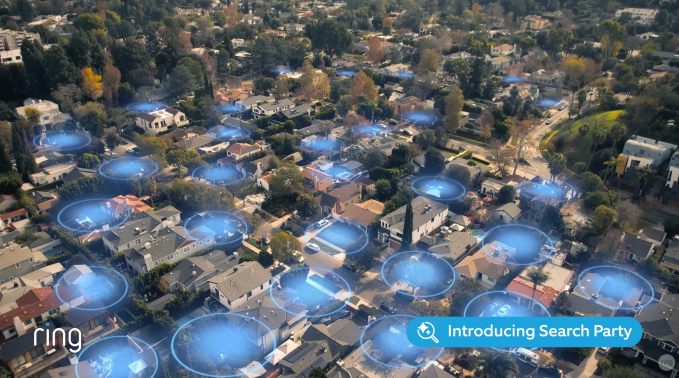
What he believes actually prompted the backlash was the visual in the Super Bowl spot: a map showing blue circles pulsing outward from house after house as cameras switched on across a neighborhood grid. “I would change that,” he said. “It wasn’t our job to try to poke anyone to try and get some response.”

Ring also picked a rocky moment to make its case. Nancy Guthrie, the 84-year-old mother of NBC show Today anchor Savannah Guthrie, had vanished from her Tucson home in late January. Footage from a Google Nest camera at the property showing a masked figure trying to smother the lens with foliage soon swept across the internet. Suddenly, home surveillance camera makers found themselves squarely into the center of a national argument about safety, privacy, and who gets to watch whom. 

Siminoff leaned into the Guthrie case. In a separate interview with Fortune, he contended it was an argument for putting more cameras on more houses. “I do believe if they had more [footage from Guthrie’s home], if there was more cameras on the house, I think we might have solved [the case],” he said. Ring’s own network, he noted, had turned up footage of a suspicious vehicle two-and-a-half miles from the Guthrie property.

Techcrunch event

San Francisco, CA
|
October 13-15, 2026

Advertisement

Whether you find that heartening or disturbing depends on your point of view. Siminoff clearly believes video surveillance is a social good, but some might hear those statements and see a company founder using a kidnapping to sell more of his products.

Either way, the discomfort with Search Party isn’t simply about those blue concentric circles in the ad. The feature sits alongside two others: Fire Watch, which crowdsources neighborhood fire mapping, and Community Requests, which allows local law enforcement to ask Ring users in a given area whether they have relevant footage from an incident.

Advertisement

Ring relaunched Community Requests in September through a partnership with Axon, which makes police body cameras and tasers, and operates the evidence management platform, Evidence.com. Axon and Ring announced the partnership in April of last year, shortly after Siminoff rejoined the company after stepping away in 2023.

A previous version of that partnership involved Flock Safety, which operates AI-powered license plate readers. Ring ended that arrangement several days after the Super Bowl ad aired, with Siminoff citing the “workload” it would create when he talked with us.

Siminoff declined to address whether reports of Flock sharing data with U.S. Customs and Border Protection also played a role. Dozens of towns across the U.S. have cut ties with Flock over exactly those concerns. Still, the timing of Ring’s decision was notable. While Siminoff believes some customers are misreading his products, he knows Ring can’t afford to dismiss their anxieties, particularly right now.

None of this is happening in isolation. Just days ago, NPR published an investigation compiled from dozens of accounts from people who found themselves caught in the Department of Homeland Security’s expanding surveillance apparatus, including U.S. citizens with no immigration status issues at all.

Advertisement

One woman, a constitutional observer trailing an ICE vehicle in Minneapolis in late January, described a masked federal agent leaning out the window, photographing her, and then calling out her name and home address. “Their message was not subtle,” she told NPR. “They were, in effect, saying, we see you. We can get to you whenever we want to.” 

Siminoff seems to understand that his answers about Ring’s data practices take on added weight as a result. When we talked, he pointed to end-to-end encryption as Ring’s strongest privacy protection, and confirmed that when it’s enabled, not even Ring employees can view the footage, as decryption requires a passphrase tied to the user’s own device. He described this as an industry first for residential camera companies. 

The matter of facial recognition is where things get more tangled. Two months before the Super Bowl ad, Ring rolled out a feature called Familiar Faces that lets users catalog up to 50 frequent visitors — family members, delivery drivers, or neighbors — so that the camera sends a notification identifying the person at the door, say, “Mom at Front Door.” Siminoff described the feature enthusiastically during our conversation, saying that he gets alerts, for example, when his teenage son pulls into the driveway.

He compared it to the facial recognition now routine at TSA checkpoints – the implication being that the public has already made its peace with this kind of thing. When asked about consent from people who appear on a Ring camera but never agreed to be catalogued, he said simply that Ring adheres to applicable local and state laws. 

Advertisement

Siminoff was also careful when asked whether Amazon draws on Ring’s facial recognition data. “Amazon does not access that data,” he said, then he added: “In the future, if we could see a feature where the customer wanted to opt in to do something with that, maybe you could see that happening.”

He further volunteered that end-to-end encryption is an opt-in feature: Users have to manually enable it in the Ring app’s Control Center. But according to Ring’s own support documentation, the tradeoff for enabling it is steep: The full list of features disabled by end-to-end encryption includes event timelines, rich notifications, quick replies, video access on Ring.com, shared user access, AI video search, 24/7 video recording, pre-roll, snapshot capture, bird’s eye view, person detection, AI video descriptions, video preview alerts, virtual security guard, and Familiar Faces, which requires processing in the cloud.

In other words, the two things Ring is actively promoting as flagship capabilities — AI-powered recognition of who’s at your door, and true privacy from Ring itself — are mutually exclusive. You can have one or the other, not both.

As for whether Ring users should worry about their footage ending up in front of a federal immigration agency, Siminoff said no, explaining that community requests run only through local law enforcement channels. He pointed to Ring’s transparency report on government subpoenas, but didn’t say what happens when that boundary proves porous.

Advertisement

Unsurprisingly, Siminoff is building toward something that reaches farther than doorbell cameras. Ring has more than 100 million cameras in the field, and is now quietly dipping a toe into enterprise security with a new “elite” camera line and a security trailer product.

He said that small businesses have been pulling the company’s cameras into their spaces, whether Ring markets to them or not. He’s also open to outdoor drones: “If we could get the cost in a place where it made sense.”

On the topic of license plate detection, which Flock Safety has made its core business, he declined to say never. Ring is “definitely not” working on it today, he said, although he didn’t say the company wouldn’t explore that option. “It’s very hard to say we’re never going to do something in the future.”

Siminoff frames all of it through a belief that he says he has held from Ring’s beginning: Each home is a node controlled by its owner, and residents should be able to choose whether to participate in neighborhood-level cooperation when something happens. 

Advertisement

But we live in a time when federal agents are photographing and identifying civilians observing arrests, and a kidnapping case has become a national talking point about privacy. The question isn’t just about whether Ring’s opt-in framework is designed well; it’s whether what Ring is building can remain as benign as Siminoff may intend it.

Source link

Continue Reading

Tech

Screen-Free Schools? Some Legislators Push for a New Normal

Published

on

When Kim Whitman’s son was in kindergarten in 2015, it was the first time their school district rolled out a one-to-one device program, assigning an electronic device to every child. Beyond using it in the classroom, the children were required to bring it home each night to charge it — but with that came the temptation to use the device after hours.

“My children never had a device and suddenly they had these iPads at home I had to manage,” Whitman, now the co-lead for the Distraction-Free Schools Policy Project, says.

Over a decade later, personal devices are more ubiquitous in some classrooms than mechanical pencils. Device adoption catapulted during the COVID-19 pandemic, thanks to an influx of federal dollars and to usher children into virtual schooling. But that adoption rush created what some experts deemed as a bit of toothpaste-out-of-the-tube moment, where decisions were made without fully thinking through the ramifications.

“For a lot of logistical reasons and necessity through the pandemic, we sort of went all in — we had to,” says Kate Blocker, director of research and programs at Children and Screens: Institute of Digital Media and Child Development. “Digital programs and edtech broadly has come with a lot of promise, including improving student learning and improving teacher and administration efficiency. The question people are starting to ask themselves is, ‘Are we seeing those benefits?’”

Advertisement

Some legislators and advocates are pushing to roll back the reliance on devices, particularly at a younger level when children are more susceptible to distractions.

“You don’t tell smokers to sit next to a pack of cigarettes,” Angela Duckworth, a professor at the University of Pennsylvania and leader in the educational psychology sector, says. “You tell them to remove yourself from temptation.”

What Brought Us Here

With many parents thinking more critically about their children’s relationships with screen time comes a new swell of concern about personal devices, especially in learning environments. According to federal data, 9 in 10 public schools had a one-to-one program giving every student a school-issued device for the 2024–25 school year.

While research is sparse on the overall effects of personal devices like laptops and iPads in school, they are becoming a proven distraction in the classroom. Duckworth served as the lead investigator for a newly released study that found teachers estimate 1 in 3 students used laptops during class for non-academic purposes, including texting and social media scrolling.

Advertisement

“It was becoming clear to us, from our previous open-ended responses to the survey, that phones are not the only digital distraction in the classroom,” she says.

Duckworth herself has a “no technology” rule in her lecture hall, put in place after finding many of her students were using their laptops to watch movies, online shop or study for other classes.

“If you see a kid with a phone, you know they’re not supposed to be doing something,” she says. “With a laptop, kids become Oscar-winning actors and actresses: They look up and down and seem like they’re doing something they’re supposed to be doing.”

There is also the concern of data collection for unknowing students.

Advertisement

“I’m aware of pressure around data and data management, with questions around appropriate guardrails in place,” Blocker says. “So many companies hold an immense amount of student data. Is that being managed properly and held to the same standards as the curriculum?”

And the rise — and rising fear — of artificial intelligence may have also fueled this hard look at education technology and its devices.

“There’s the larger techno-panic happening around devices in schools especially now that AI has arrived,” says Carrie James, co-director of the Center for the Center for Digital Thriving at the Harvard Graduate School of Education. “In the past, schools have been very intentional: They have a school committee meeting and make very clear decisions about which pieces of technology they’re going to adopt. The challenge around generative AI is it arrived on everyone’s devices, and now schools have to reckon with it. I think that piece is exacerbating it.”

Reigning in Tech

Whitman says roughly nine states have presented some form of “Safe Schools Technology” legislation, following the lobbying of the Distraction-Free Schools Policy Project.

Advertisement

She is quick to point out the legislation is not seeking to ban technology entirely, but instead will require schools to limit it so that students don’t have “unsafe, ineffective or inappropriate experiences.”

“We believe in tech education,” Whitman says. “You need education on technology — how to use Excel, how to type — these are all really important skills for students to have. But it doesn’t mean we have to teach everything through the device.”

State policymakers are trying a few different methods of regulating edtech through legislation. There’s limiting screen time, but keeping the technology – a strategy particularly popular in elementary schools – and has been introduced in bills in Oklahoma, West Virginia and Missouri. Vermont introduced a bill earlier this year allowing parents to opt their kids out of using electronic devices in the classroom.

And some leaders in Kansas are attempting to ban hardware devices in elementary schools, but allow a shared-device model — like a computer lab — in middle schools, and limit classroom screen time to one hour a day. For high school students, that would be bumped up to 90 minutes a day.

Advertisement

There is also a focus on the edtech itself, with state efforts attempting to ensure it is certified in the same way other curricula are certified, outlining steps for evaluating and choosing products and communicating about that process to parents.

That is a particularly tricky conversation, with questions swirling around the onus of verification: if it is the school’s job or the company’s responsibility, or if that task belongs to a third party. Experts say there is no national, catch-all system that easily shows if an edtech company does what it claims to do, though the Internet Safety Lab and American Academy of Pediatrics have given some guidelines that can help.

Whitman pushed for third-party intervention.

“There is nobody right now that is confirming these products are safe, effective and legal,” she says. “It should not fall on the district’s IT director; it would be impossible for them to do it. And the companies should not be tasked with doing it — that would be like nicotine companies vetting their own cigarettes.”

Advertisement

But many districts, particularly those that serve low-income and minority populations, are in a tough spot with mitigating edtech usage and implementations. They often do not have the funds to purchase new textbooks, which typically cost more than their digital counterparts. They have also invested heavily — often through grants or federal funds — in digital devices.

“That is in fact the conundrum: School administrators are in a tug of war,” Blocker says. “They’ve invested in so much, and a lot of the products came with promise. It’s not like they grabbed a brick and said, ‘I’m going to make this work.’ They were told they were going to have all these benefits.”

And James, of the Center for the Center for Digital Thriving, said it is important to remember some student populations, such as her neurodivergent child, benefit greatly from the expanded access digital products can provide.

“Edtech and assistant technology are key for her learning,” James says, pushing against a sweeping blanket ban. “That’s where the decision has to be school-community specific. Educators know their community best, and these regulations have to be designed for their students.”

Advertisement

Widespread Adoption?

The new efforts targeting laptops and edtech tools follow a swell of states banning student cellphones in the classroom, with many restricting them in between class periods and lunch time as well. While that has been one of the rare successful bipartisan efforts at the state and federal levels, experts say going entirely device-free in schools is a much more nuanced conversation.

“School phone bans are less about technology for learning’s sake and more about technology interfering with learning,” Blocker says. “I think it was clearer for everyone to see why [banning phones] might have a good outcome. It is much harder with edtech; there is evidence, particularly for older students, that when used well it can be beneficial.”

Whitman disagrees, though, saying while it may be a slower uptick than phone bans, she does believe edtech bans will eventually reach that same level.

“Parents are becoming aware and coming together with collective action,” she says. “I think this will be similar to phone-free schools eventually. It will, but we’re on the cusp of it right now.”

Advertisement

James urges schools and districts to focus less on silver-bullet solutions like total bans and more on multifaceted approaches to integrating technology well.

“Bans might feel like they can be a starting point for better learning, but they can’t really be the finish line,” she says.

For the sake of children and teens, James adds, “we have to build agency and intentionality for using technology well, because as soon as they walk out of school, you typically have pretty incredible access to technology.”

Source link

Advertisement
Continue Reading

Tech

What is the release date for Virgin River season 7 on Netflix?

Published

on

I know, I know… we need answers fromVirgin River season 7 as much as we need air to breathe. The season 6 finale was a total shocker, leaving us with five huge cliffhangers that need immediate answers.

Brie (Zibby Allen) needed to decide whether she wanted to marry Mike (Marco Grazzini), while Brady (Ben Hollingsworth) wanted to get his money back from mysterious Lark (Elise Gatien).

Advertisement

Source link

Continue Reading

Tech

Augur raises $15M to protect critical infrastructure

Published

on

A London startup founded by the creator of safety app Path is betting that the cameras and sensors already deployed across Europe’s transport hubs, stadiums, and power stations are gathering dust when they matter most.


In the first week of February 2026, anarchists severed electrical cables near Bologna on the opening day of the Milan–Cortina Winter Olympics, stranding thousands of travellers across northern Italy.

That same month, the Vulkangruppe,  a far-left German extremist group with a fifteen-year record of infrastructure attacks, brought down the Lichterfelde power station in Berlin, cutting electricity to around 45,000 homes in temperatures well below freezing. One elderly resident died.

The previous September, a ransomware attack on aviation IT provider Collins Aerospace caused widespread disruption at Heathrow, Brussels, and Berlin airports, forcing airlines to revert to manual check-in processes across the continent.

Advertisement

The 💜 of EU tech

The latest rumblings from the EU tech scene, a story from our wise ol’ founder Boris, and some questionable AI art. It’s free, every week, in your inbox. Sign up now!

Three incidents, three different threat actors, three different attack vectors. What they share is this: in each case, organisations responsible for public safety found themselves scrambling to understand, in real time, what was happening and where.

That gap, between what surveillance infrastructure sees and what operators can actually do with the data during an unfolding incident, is the problem a London startup called Augur is trying to close.

Advertisement

The company announced today that it has raised $15 million in a seed round led by Plural, the early-stage European fund co-founded by the founders of Wise, Skype, and Songkick, with additional participation from First Kind, SNR, Flix, and Tiny VC.

Harry Mead, who serves as CEO, is not an obvious fit for the defence-adjacent security sector. Before Augur, he ran restaurants and then retrained in coding to build Path Community, a personal safety app, launched in December 2021, that let users share their journey with trusted contacts and send automatic alerts if they deviated significantly from their route.

The app attracted enough attention to earn Mead a personal letter of thanks from then-Prime Minister Boris Johnson and a Points of Light award from the government. The problem Path was trying to solve, people feeling unsafe in public spaces, and the infrastructure around them failing to help, is essentially the same problem Augur is addressing at a much larger scale.

Alongside Mead, the company’s founders include Imran Lone as chief technology officer and Stefan Kopieczek as head of engineering.

Advertisement

Both are described in company materials as Palantir alumni, bringing what Augur says is nearly two decades of combined experience working with European governments, defence organisations, and public-sector operators on complex, data-driven security challenges.

Since launching in 2024, the company has grown to 30 people in London.

The investors and their framing

Plural’s Khaled Helioui led the investment. Helioui is a co-founder and partner of the fund, whose other co-founders include Taavet Hinrikus of Wise and Sten Tamkivi of Skype, and has previously led Plural’s investment in Helsing, the European defence AI company. His public statement on the Augur deal was notably geopolitical in tone, even by the standards of a European defence-tech investment round.

“When it comes to protecting our people and critical infrastructure, we cannot afford to be as complacent and naive as we were in protecting Ukraine,” Helioui said. “The new focus on grey zone warfare and domestic sabotage is not a threat we are currently equipped to contain.”

Advertisement

The subtext is clear. Plural, which positions itself as a fund willing to back companies addressing systemic risks, has made a bet that the European market for critical infrastructure security technology is about to expand sharply.

The bet is not an unreasonable one. Western security research organisations, including IISS and CSIS, have documented that state-linked sabotage attacks on European infrastructure roughly tripled between 2023 and 2024, targeting transport networks, energy facilities, and communications infrastructure.

Martyn’s Law, formally the Terrorism (Protection of Premises) Act 2025, named after Martyn Hett, who died in the 2017 Manchester Arena attack, received Royal Assent in April 2025.

With an implementation window of at least 24 months, venues and operators across the UK face new statutory duties around threat assessment and security measures. Augur is pitching directly into that compliance pressure.

Advertisement

The harder question

Whether Augur’s technology actually works in the environments it is targeting is a question the company has not yet had to answer publicly. It says it has begun deployments with “major UK infrastructure and venue operators” but has not named them.

Critical infrastructure operators and government bodies are notoriously slow procurement clients. Their reluctance to move quickly is partly rational;  the consequences of a security system failing in a live incident are severe, and partly institutional.

Winning their trust requires a combination of technical credibility, regulatory compliance, and relationship-building that takes time to accumulate.

The $15 million will be used to accelerate product development and expand deployments. The company’s pitch, stripped to its essentials, is that it can deliver meaningful improvement in situational awareness without asking clients to replace their existing hardware or compromise on privacy.

Advertisement

If it can demonstrate that in live deployments, the market it is addressing is large and, increasingly, legally mandated. If it can’t, the cameras will keep recording, and operators will keep scrambling.

Source link

Advertisement
Continue Reading

Tech

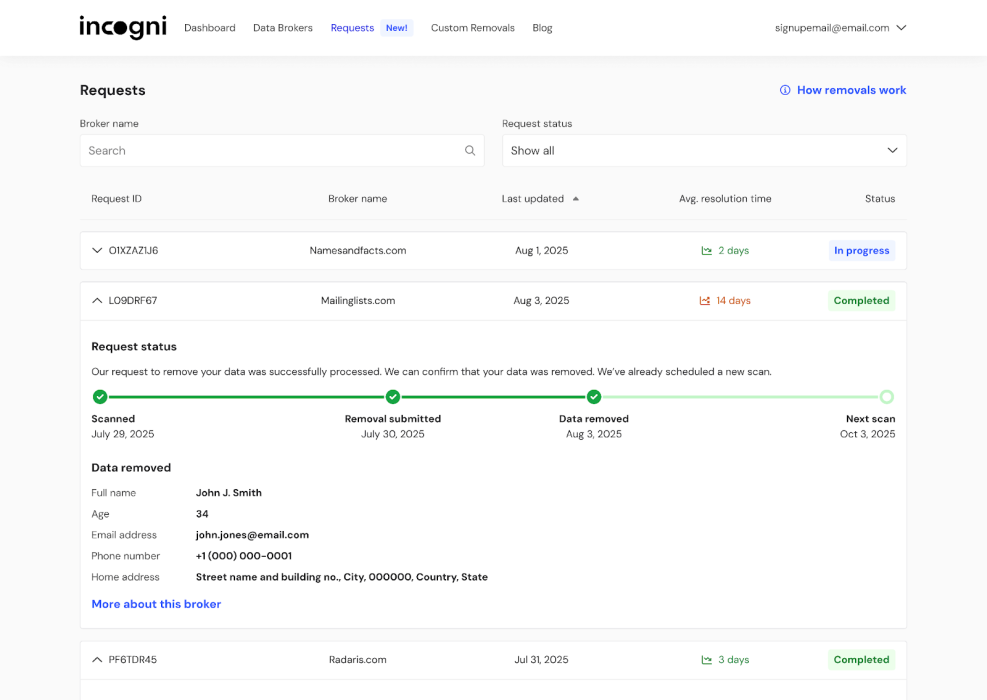
Incogni vs Aura (2026): Which Privacy Service Is Worth It This Year?

Published

on

Personal data removal services have been gaining popularity in recent years, as more and more people become concerned about their online privacy. In 2026, two big names appear in almost all industry rankings: Incogni and Aura.

Both providers promise to reduce your online visibility and risks tied to data exposure. However, they aren’t the same, and their offers vary significantly. Incogni is a dedicated data broker removal specialist; Aura is a broader tool that comes with different identity and digital security features.

To help you decide, we prepared the guide below that breaks down how these two services compare, what they have in common, and how they are different. Read on to decide which one you need in 2026.

Aura vs Incogni: Quick Comparison Table (2026)

Feature Incogni Aura
Starting price (when billed annually) From $7.99/month From $9.99/month
Removal model Ongoing automated broker outreach Limited removal integrated into identity protection plan
Broker coverage 420+ both public and private listings 200+ broker sites
Monitoring Ongoing re-checks and follow-ups Identity and credit monitoring
Free option 30-day money-back guarantee 14-day free trial, 60-day money-back guarantee
Third-party verification Deloitte Limited Assurance Assessment No public verification
Primary strength Dedicated data broker removal All-in-one identity protection

Incogni vs Aura: Service Design and Operational Model

Incogni

Incogni is designed specifically to remove personal information from the web. Its process includes:

  • Formal identity verification after signing up, allowing Incogni to act on a user’s behalf
  • Removal requests sent to data brokers automatically
  • Response tracking
  • Escalation and follow-ups when necessary
  • Ongoing monitoring to prevent re-listings

As of 2026, Incogni declares working with 420+ data brokers, including people-search platforms and marketing databases. In 2025, the provider underwent a Limited Assurance assessment by Deloitte, which confirmed that its processes operate as described.

Overall, the system is designed for long-term protection and persistence rather than one-time clean-ups.

Advertisement

Aura

Aura is built around a broader issue: identity risk detection, web monitoring, and mitigation. It offers:

  • Credit monitoring
  • Fraud alerts
  • Identity theft insurance
  • Financial transaction monitoring
  • Detecting misuse of exposed personal data

Data removal is, of course, included with some subscription plans, but it’s not Aura’s field of expertise. Its backend infrastructure is designed to detect threats and alert the user, rather than rely on systematic broker suppression or wide coverage – it spans roughly 200+ data brokers.

To sum up: Incogni is removal-first. Aura is monitoring-first.

Incogni vs Aura: Data Removal Coverage and Depth

Incogni

  • Targets 420+ data brokers (publicly referenced and expanding)

  • An additional 2,000+ sites with Unlimited plans (Custom Removals)

  • Covers people-search sites, risk intelligence databases, marketing listings, recruitment lists, and more
  • Sends legally-grounded, regulation-compliant removal requests
  • Performs continuous re-checks to avoid data resurfacing
  • Follows up when brokers fail to respond

Aura

With Aura, data removal is secondary as it comes with a broader service. 

  • Broker coverage is not very expansive
  • No publicly available breakdown of total broker targets
  • No documented independent verification of its removal process
  • Covers people-search sites, credit solicitors, junk mailers, Google search cleanup

To sum up: When it comes to data removal specifically, Incogni offers greater depth and removal transparency.

Incogni vs Aura: Transparency, Verification, and Public Reputation

Incogni

Incogni, even though it’s a relatively young company, already has a strong position and excellent reputation in the privacy sector

The provider sits at 4.4 out of 5 supported by over 2,000 reviews on Trustpilot as of February, 2026. It has received Editors’ Choice recognition from both PCMag and PCWorld. The abovementioned publication of a Deloitte Limited Assurance Assessment is a further layer of independent verification to Incogni’s claims. This is extremely rare in the data removal field, if not unique.

Aura

Aura has been operating a little longer in the online protection services space and maintains a strong public profile. It holds a Trustpilot rating of 4.2 out of 5 based on almost 1,000 reviews. It is frequently described as a comprehensive digital safety platform and praised for its solid protection capabilities. However, Aura hasn’t published any third-party verification specific to data removal.

To sum up: Both providers hold a positive reputation in the industry and are widely well-reviewed. The difference is in the transparency and effectiveness of their broker removal services specifically. 

Advertisement

Incogni vs Aura: User Experience & Automation Level

Incogni

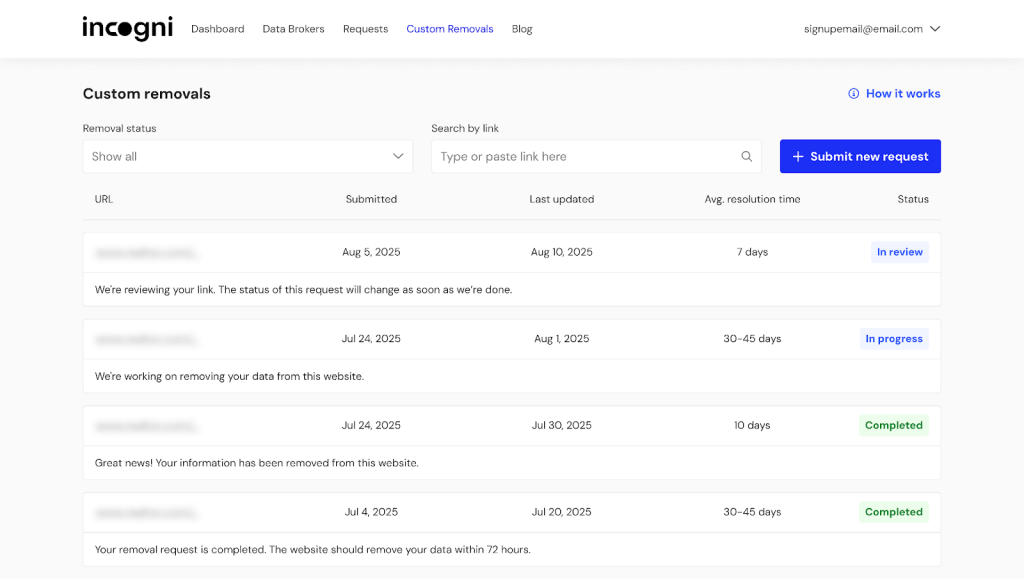
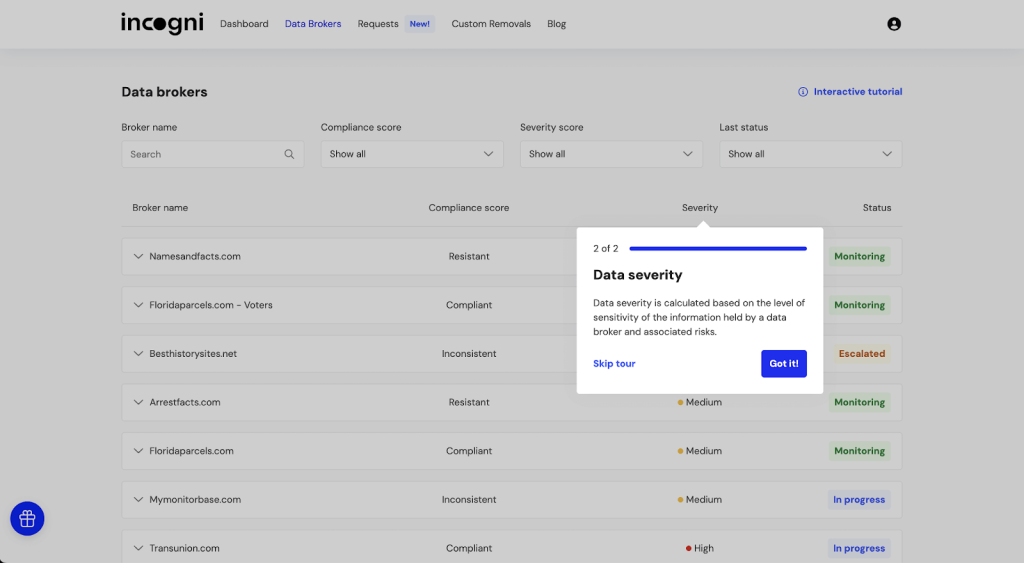
Incogni’s entire user experience is streamlined and thus intentionally simple. After signing up and verifying their identity, users are presented with a dashboard that shows the whole progress: requests sent, responses, updates, and what needs a followup. It prioritizes clarity and ease-of-use over complexity, especially that its process is mostly automated. There are also no additional modules of feature clusters to navigate – Incogni is a highly specialized tool. And once it’s activated, it runs without interruption and with minimal user engagement.

Aura

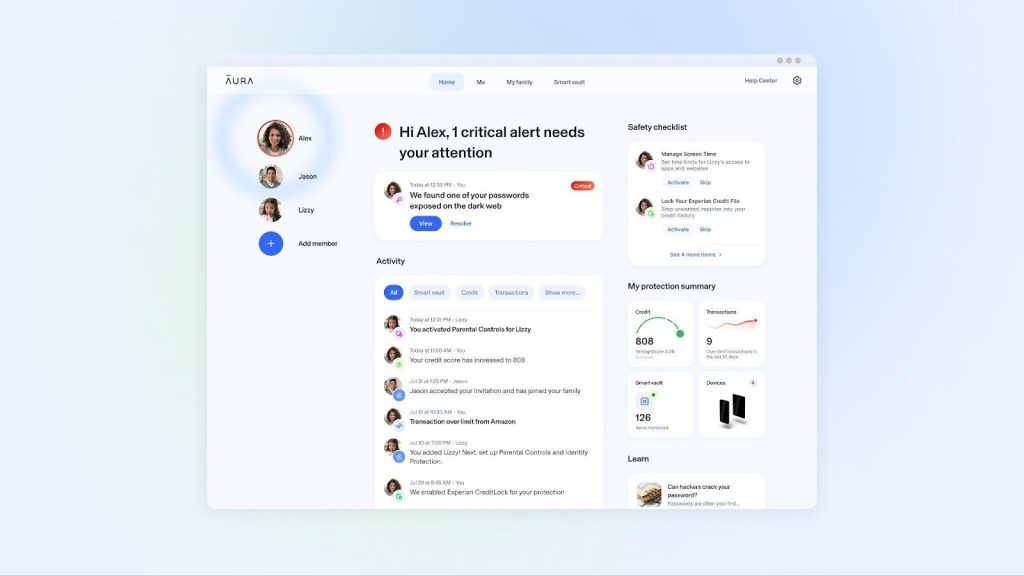
Aura offers a broader online protection toolkit, and its interface reflects its scope. Users can track their credit score updates, receive fraud alerts, manage antivirus protection, and set a VPN – all within one dashboard. This feels like a true digital security control center, and data removal is part of it. The platform requires more user involvement but offers wider visibility into online risks. 

To sum up: Incogni is all about simplicity and background automation. Aura offers multiple protection layers. However, if you seek data removal specifically, Aura can be overwhelming.

Incogni vs Aura: Pricing Breakdown (February 2026)

Incogni

Plan Monthly price when billed annually Monthly price when billed monthly Data removal features
Standard $7.99 $15.98 Automated data removal, 420+ data broker sites covered, removal of multiple emails, addresses, phone numbers, recurring removals
Standard Unlimited $14.99 $29.98 All of the above and 2,000+ additional sites covered through unlimited custom removal requests, live phone support
Family $15.99 $31.98 Standard plan but for up to 5 members and family account management
Family Unlimited $22.99 $45.98 Standard Unlimited plan but for up to 5 members and family account management

You can also get Incogni through bundled offers: combined with NordProtect or in the Surfshark One+ subscription.

Aura

Plan Monthly price when billed annually Monthly price when billed monthly Data removal features
Individual $9.99 $12.99 Data removal from 200+ broker sites, people-search sites, credit solicitors, junk mailers, Google Search Cleanup, Digital Account Cleanup, registry with National Do Not Call List (US)
Couple $17.99 $19.99 All of the above but for two people
Family $24.99 $47.99 All of the above but for up to 5 adults, unlimited kids, and unlimited devices

To sum up: When it comes to data removal, Incogni is more cost-efficient. But if you want a broader privacy toolkit, Aura provides more features at a higher price point.

Advertisement

Customer Support and Accessibility

Customer support quality plays a vital role in every service, but with privacy protection, urgent concerns and personal data handling, it becomes even more important.

Contact Channels Comparison

Support Channel Incogni Aura
Email / Ticket system Yes Yes
Live Chat Yes (for all subscribers) 24/7 Yes (through its app) 8am-8pm EST
Help Center / Knowledge Base Yes Yes
Phone Yes (for Unlimited subscribers) 24/7 Yes 24/7
User feedback Generally fast, often within 24 hours Generally fast; priority support for higher tiers

Final Verdict: Choosing the Right Data Removal Service in 2026

When it comes to Incogni vs Aura in the data removal space, your decision depends on what you seek.

If your goal is to reduce online data exposure across vast broker networks with minimal ongoing effort on your part, a specialized and continuously operating service provider like Incogni is better for your needs.

If you look for a wider toolkit – basic data removal combined with credit monitoring, fraud alerts, and identity theft insurance – a broader security platform like Aura may be a better option.

Advertisement

Overall, in 2026, Incogni stands out as the stronger choice for focused personal data removal.

FAQ

What is the core difference between Incogni and Aura?

Incogni is a specialized data scrubbing tool. Aura is an all-encompassing digital security suite that includes data removal alongside a VPN, antivirus, and identity theft insurance.

Advertisement
Is a Social Security Number required to use these services?

Aura requires your SSN to provide its primary identity and credit monitoring alerts. Incogni does not ask for or store your SSN.

Which service checks for new data listings more frequently?
Advertisement

Aura performs daily scans of its 200+ covered brokers. Incogni covers a larger list of 420+ brokers, but re-scans them every 60 to 90 days.

Source link

Advertisement
Continue Reading

Tech

Enterprise agentic AI requires a process layer most companies haven’t built

Published

on

Presented by Celonis


85% of enterprises want to become agentic within three years — yet 76% admit their operations can’t support it. According to the Celonis 2026 Process Optimization Report, based on a survey of more than 1,600 global business leaders, organizations are aggressively pursuing AI-driven transformation. Yet most acknowledge that the foundational work — modernizing workflows, reducing process friction, and building operational resilience — remains unfinished. The ambition is clear. The infrastructure to execute on it is not.

To act autonomously and effectively, AI agents need optimized, AI-ready processes and the process data and operational context that only comes from process intelligence. Without that, they’re guessing. And 82% of decision-makers believe AI will fail to deliver return on investment (ROI) if it doesn’t understand how the business runs.

“The scale of the opportunity is truly remarkable: 89% of leaders see AI as their biggest competitive opportunity,” says Patrick Thompson, global SVP of customer transformation. “That’s not a marginal finding. What’s interesting is the shift in the framing. Leaders are confident that AI will transform operations. The question now is how to fuel their ambitions with the right AI enablers.”

Advertisement

Explaining the gap between ambition and reality

Right now, 85% of teams are using gen AI tools for everyday tasks, so the “will this work?” question is largely settled. The real question has shifted to: “Why isn’t it working the way we need it to?” And that’s a much harder problem, because it’s structural. It’s siloed teams. Systems that don’t talk to each other. AI that looks impressive in a demo but falters once it’s dropped into a real enterprise environment. That’s the wall companies are hitting.

So, despite the overwhelming ambition, only 19% of organizations use multi-agent systems today. It all comes down to an operational readiness problem, Thompson says.

“Nine in ten leaders are already using or exploring multi-agent systems, so the will is absolutely there, but ambition without infrastructure doesn’t get you very far,” he explains.

Until now, process has largely been a “good enough” problem, because processes that are messy and disconnected can still produce results, just inefficient and opaque. As long as the business is growing, there hasn’t been a burning urge to fix them. AI changed the calculus. If 82% of leaders believe AI can only deliver ROI with proper business context, then sub-optimal processes aren’t just an operational inconvenience, they’re actively blocking an AI strategy. Suddenly, process optimization isn’t a background IT project, but a prerequisite for competing.

Advertisement

“This is where structural modernization becomes critical,” he says. “Organizations that have invested in modernizing their data, systems, and processes are in a far stronger position to enable AI at scale.”

The other AI stopper: Lack of business context

AI will not be able to provide the strongest ROI possible until it understands the operational context of the business. That includes how KPIs are defined and calculated, any unique internal policies and procedures, how the organization is structured, and where the real decision authority sits.

This knowledge is usually trapped in different departments that have developed their own languages and systems over time. They don’t naturally share a common understanding. Bringing AI into that environment is something like dropping someone into a conversation that’s been going on for years, without any of the backstory.

Process intelligence becomes the connective layer — a shared operational language that grounds AI decisions in how the business actually runs.

Advertisement

Why AI adoption is also a change management problem

The AI adoption challenge is less a technology problem and more of a change-management and operating-model problem than many more leaders want to admit, because technology problems feel easier to solve. The data shows that only 6% of leaders cite resistance to change as a hurdle. The real blockers are siloed teams (54%) and a lack of coordination between departments (44%). And 93% of process and operations leaders explicitly state that process optimization is as much about people and culture as it is about tools and technology.

“When companies come to us looking for a technology fix, part of our job is helping them see that the operating model has to evolve alongside the tooling,” Thompson says. “You can’t bolt AI onto a broken process and expect it to work. True enterprise modernization means redesigning how teams, systems, and decisions connect, and AI only works when that modernization happens first.”

Making process optimization a strategic advantage

How do you make process optimization a strategic advantage, rather than another operational project? Connect it directly to outcomes that executives care about. When processes work, they go beyond IT metrics, directly affecting board-level concerns. A full 63% of leaders use process optimization to proactively manage risks, while 58% see faster decision-making.

Plus, the economic and geopolitical environment right now makes agility a survival skill. Look at the supply chain industry, where 66% already view process optimization as a critical business-wide initiative.

Advertisement

“That’s the mindset shift we’re trying to catalyze across the rest of the organization,” Thompson says. “It’s not maintenance work. It’s what lets you move fast when the world changes, and right now the world is moving constantly.”

Closing the readiness gap in enterprise agentic AI

To succeed, and even triumph, organizations must be ready to close the readiness gap, and they need to be honest about where they’re starting from, Thompson says.

“The biggest risk I see is companies continuing to layer AI on top of fragmented, opaque processes and then wondering why they’re not getting results,” he says. “Moving from static, traditional tools to real process intelligence, where you have live visibility into how your operations actually run, that’s the foundational shift that makes agentic AI viable.”

Without it, agents get deployed in the wrong places, can’t be integrated with existing systems, and organizations end up with expensive pilots that don’t scale. The call to action is clear: stop starting with tools and start with operational visibility.

Advertisement

“The leaders who will win in the agentic era aren’t necessarily the ones with the most sophisticated AI,” he says. “They’re the ones who’ve done the hard work of building a shared, accurate picture of their operations. Process intelligence is the starting point. It’s what enables enterprise modernization in practice, creating the operational clarity AI needs to deliver real ROI. Master your processes, give AI the context it needs, and then you can actually deploy it somewhere it will deliver.”


Sponsored articles are content produced by a company that is either paying for the post or has a business relationship with VentureBeat, and they’re always clearly marked. For more information, contact sales@venturebeat.com.

Source link

Advertisement
Continue Reading

Tech

Nscale raises $2bn Series C at $14.6bn valuation

Published

on

The UK hyperscaler has now raised over $4.5bn across equity rounds in less than six months, and says it is the largest Series C ever closed in Europe. That claim deserves scrutiny.


When Josh Payne founded Nscale, the company was barely a year old, and the world’s appetite for GPU compute had not yet tipped into anything approaching panic. That was 2024. By March 2026, his company will have closed a $2 billion Series C, carry a $14.6 billion valuation, and have recruited three of the most recognisable names in global technology and politics to its board.

The question is no longer whether Nscale can raise money. It is whether the infrastructure it is racing to build will be ready before the market moves on.

Nscale announced the round today, led jointly by Aker ASA, the Norwegian industrial conglomerate that also led its $1.1 billion Series B in September 2025, and 8090 Industries, a Dallas-based industrial technology fund co-founded by Rayyan Islam.

Advertisement

The 💜 of EU tech

The latest rumblings from the EU tech scene, a story from our wise ol’ founder Boris, and some questionable AI art. It’s free, every week, in your inbox. Sign up now!

Additional investors in the round include Astra Capital Management, Citadel, Dell, Jane Street, Lenovo, Linden Advisors, Nokia, NVIDIA, and Point72. Goldman Sachs and J.P. Morgan acted as joint placement agents, and the raise is inclusive of the pre-Series C SAFE that Nscale closed in October 2025.

The company says the round is the largest Series C ever completed in Europe.

Advertisement

The infrastructure play

Nscale’s proposition is vertically integrated AI infrastructure: GPU compute, networking, data services, and orchestration software, delivered from its own and colocated data centres across Europe, North America, and Asia. The pitch is that the bottleneck in the AI economy is not demand; everyone wants compute, but the ability to deploy capacity reliably and at scale.

Nscale’s data centres are designed from first principles to handle GPU-dense workloads rather than retrofitting facilities built for traditional cloud computing.

The company has moved quickly. Since its Series B in September 2025, it has signed a $1.4 billion delayed-draw term loan backed by GPUs, which it announced in February 2026, and has secured large-scale contracts with Microsoft, including plans for a facility in Texas targeting 104,000 NVIDIA GB300 GPUs.

Its data centre footprint spans Norway, the UK, Portugal, Iceland, and the US, with its Norwegian presence anchored by the Glomfjord and Narvik sites. In July 2025, it announced the Stargate Norway project alongside Aker and OpenAI, targeting 100,000 NVIDIA GPUs by the end of 2026.

Advertisement

Alongside the fundraising, Nscale has also resolved a structural question that had been hanging over the Norway operations. The Aker–Nscale joint venture, announced in July 2025, will be wound into Nscale as a wholly owned entity.

Aker remains a leading shareholder, its CEO, Øyvind Eriksen, continues to sit on the board, and the company says all existing projects under the joint venture remain fully operational. The practical effect is to put delivery and governance under a single roof.

“This step strengthens execution by putting delivery and governance under one roof, while keeping continuity for the people and projects already underway,” Eriksen said in a statement. “We have full confidence in Nscale’s ability to deliver responsibly in Norway over the long term.”

The new board

The three board appointments announced today are striking in different ways. Sheryl Sandberg, the former Meta COO who stepped down from the company’s board in 2024, is the co-founder of Sandberg Bernthal Venture Partners, an early-stage fund she has been building since 2021.

Advertisement

Her addition brings operational credibility from a company that scaled to hundreds of billions in revenue during her tenure, and, notably, deep expertise in the advertising and data infrastructure that underpins modern AI products.

Susan Decker, former president of Yahoo and CEO of the university community platform Raftr, brings financial acumen and a long record of corporate governance, including serving as lead director of Berkshire Hathaway.

Her Berkshire role gives Nscale a board member with rare experience overseeing a conglomerate that owns businesses across energy, infrastructure, and financial services, the sectors Nscale is increasingly operating in.

Nick Clegg is the most overtly political appointment. The former UK Deputy Prime Minister and Meta President of Global Affairs joined Hiro Capital as a General Partner in December 2025, where he focuses on spatial computing and AI investment across Europe.

Advertisement

He joins Nscale’s board, bringing a combination of European regulatory fluency, Meta-era experience of AI governance debates, and political networks that could prove valuable as Nscale pursues sovereign AI mandates and government contracts across the UK and EU.

Payne, speaking in the press release, framed the round as more than a fundraiser. “Nscale is leading this buildout,” he said, describing the company’s ambition as building “the foundation that the market sits on, the engine of superintelligence.” The language is bullish even by AI infrastructure standards.

The harder questions

Nscale has raised over $4.5 billion in equity rounds since its Series B in September 2025. That velocity would be remarkable for any company; for one incorporated only in 2024, it is extraordinary. What it also means is that the gap between capital raised and assets deployed is wide and growing.

Building the infrastructure that Nscale has committed to, across multiple continents, at GPU densities that require bespoke facility design, is an execution problem of considerable complexity.

Advertisement

The company’s own published data centre pipeline and the Microsoft contract details that have been reported suggest it is making real progress. But significant infrastructure projects routinely fall behind schedule, and Nscale has not yet had a delivery cycle long enough to fully validate its operational model at the scale it is now targeting.

The $2 billion will be used to accelerate global deployments, expand engineering and operations teams, and strengthen the platform. Nscale’s IPO ambitions, which CEO Payne has previously flagged for as early as 2026, add another variable.

Whether markets are ready to absorb a listing from a company this young, at this valuation, will depend on whether the compute economy continues to grow at the pace of the last two years, and whether Nscale can demonstrate that it is not just a capital vehicle but an operator.

The board hires suggest the company knows the next phase is about governance and credibility as much as fundraising. Whether Sandberg, Decker, and Clegg can help deliver that remains to be seen.

Advertisement

Source link

Continue Reading

Tech

Hackers abuse .arpa DNS and ipv6 to evade phishing defenses

Published

on


Threat actors are abusing the special-use “.arpa” domain and IPv6 reverse DNS in phishing campaigns that more easily evade domain reputation checks and email security gateways.

The .arpa domain is a special top-level domain reserved for internet infrastructure rather than normal websites. It is used for reverse DNS lookups, which allow systems to map an IP address back to a hostname.

IPv4 reverse lookups use the in-addr.arpa domain, while IPv6 uses ip6.arpa. In these lookups, DNS queries a hostname derived from the IP address, written in reverse order and appended to one of these domains.

Advertisement

For example, www.google.com has the IP addresses 192.178.50.36 (IPv4) and 2607:f8b0:4008:802::2004 (IPv6). Querying Google’s IP of 192.178.50.36 via the dig tool resolves to an in-addr.arpa hostname and ultimately a regular hostname:


; <<>> DiG 9.18.39-0ubuntu0.24.04.2-Ubuntu <<>> -x 192.178.50.36
;; global options: +cmd
;; Got answer:
;; ->>HEADER<<- opcode: QUERY, status: NOERROR, id: 59754
;; flags: qr rd ra; QUERY: 1, ANSWER: 1, AUTHORITY: 0, ADDITIONAL: 1

;; OPT PSEUDOSECTION:
; EDNS: version: 0, flags:; udp: 4096
;; QUESTION SECTION:
;36.50.178.192.in-addr.arpa.    IN      PTR

;; ANSWER SECTION:
36.50.178.192.in-addr.arpa. 1386 IN     PTR     lcmiaa-aa-in-f4.1e100.net.

;; Query time: 7 msec
;; SERVER: 127.0.0.1#53(127.0.0.1) (UDP)
;; WHEN: Fri Mar 06 13:57:31 EST 2026
;; MSG SIZE  rcvd: 94

Querying Google’s IPv6 address of 2607:f8b0:4008:802::2004 shows that it first resolves to an IPv6.arpa hostname and then a hostname, as shown below.


; <<>> DiG 9.18.39-0ubuntu0.24.04.2-Ubuntu <<>> -x 2607:f8b0:4008:802::2004
;; global options: +cmd
;; Got answer:
;; ->>HEADER<<- opcode: QUERY, status: NOERROR, id: 31116
;; flags: qr rd ra; QUERY: 1, ANSWER: 2, AUTHORITY: 0, ADDITIONAL: 1

;; OPT PSEUDOSECTION:
; EDNS: version: 0, flags:; udp: 4096
;; QUESTION SECTION:
;4.0.0.2.0.0.0.0.0.0.0.0.0.0.0.0.2.0.8.0.8.0.0.4.0.b.8.f.7.0.6.2.ip6.arpa. IN PTR

;; ANSWER SECTION:
4.0.0.2.0.0.0.0.0.0.0.0.0.0.0.0.2.0.8.0.8.0.0.4.0.b.8.f.7.0.6.2.ip6.arpa. 78544 IN PTR tzmiaa-af-in-x04.1e100.net.
4.0.0.2.0.0.0.0.0.0.0.0.0.0.0.0.2.0.8.0.8.0.0.4.0.b.8.f.7.0.6.2.ip6.arpa. 78544 IN PTR mia07s48-in-x04.1e100.net.

;; Query time: 10 msec
;; SERVER: 127.0.0.1#53(127.0.0.1) (UDP)
;; WHEN: Fri Mar 06 13:58:43 EST 2026
;; MSG SIZE  rcvd: 171

Phishing campaign abuses in .arpa domains

A phishing campaign observed by Infoblox uses the ip6.arpa reverse DNS TLD, which normally maps IPv6 addresses back to hostnames using PTR records.

However, attackers found that if they reserve their own IPv6 address space, they can abuse the reverse DNS zone for the IP range by configuring additional DNS records for phishing sites.

Advertisement

In normal DNS functionality, reverse DNS domains are used for PTR records, which allow systems to determine the hostname associated with a queried IP address.

However, attackers discovered that once they gained control over the DNS zone for an IPv6 range, some DNS management platforms allowed them to configure other record types that can be abused for phishing attacks.

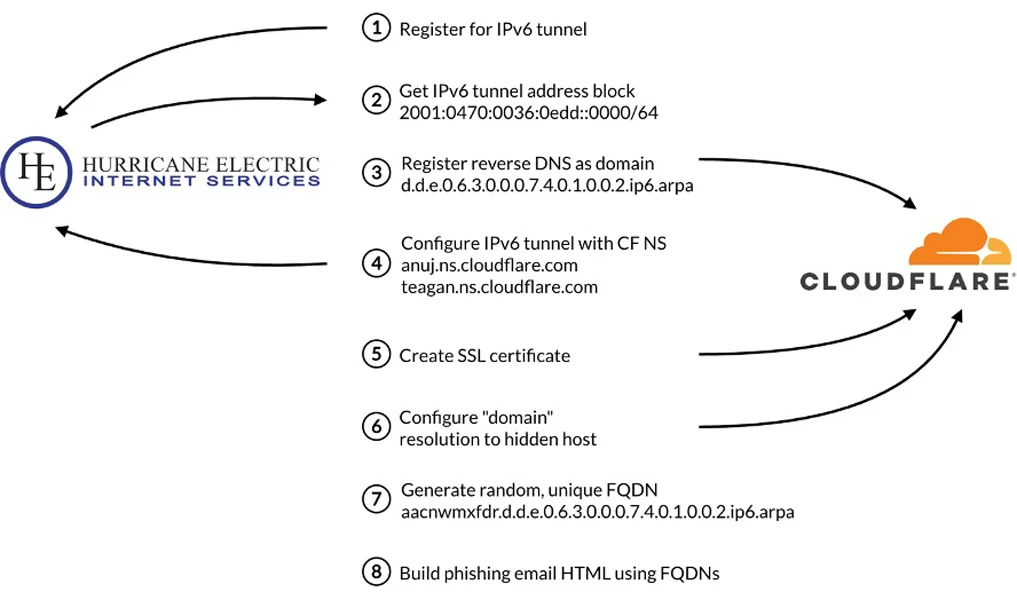
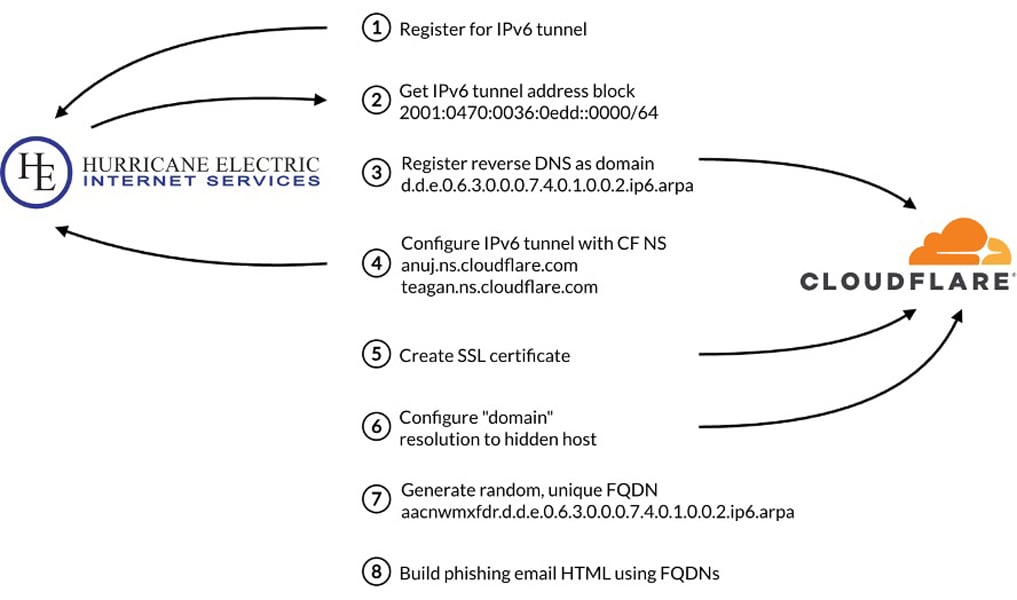
“We have seen threat actors abuse Hurricane Electric and Cloudflare to create these records—both of which have good reputations that actors leverage—and we confirmed that some other DNS providers also allow these configurations,” explains Infoblox.

“Our tests were not exhaustive, but we notified the providers where we discovered a gap. Figure 2 depicts the process the threat actor used to create the domain used in the phishing emails.”

Advertisement

To set up the infrastructure, the attackers first obtained a block of IPv6 addresses via IPv6 tunneling services.

Infoblox's overview of how the .arpa TLD is abused in phishing emails
Infoblox’s overview of how the .arpa TLD is abused in phishing emails
Source: Infoblox

After gaining control of the address space, the attackers then generate reverse DNS hostnames from the IPv6 address range using randomly generated subdomains that are difficult to detect or block.

Instead of configuring PTR records as expected, the attackers create A records that point those reverse DNS domains to infrastructure hosting phishing sites.

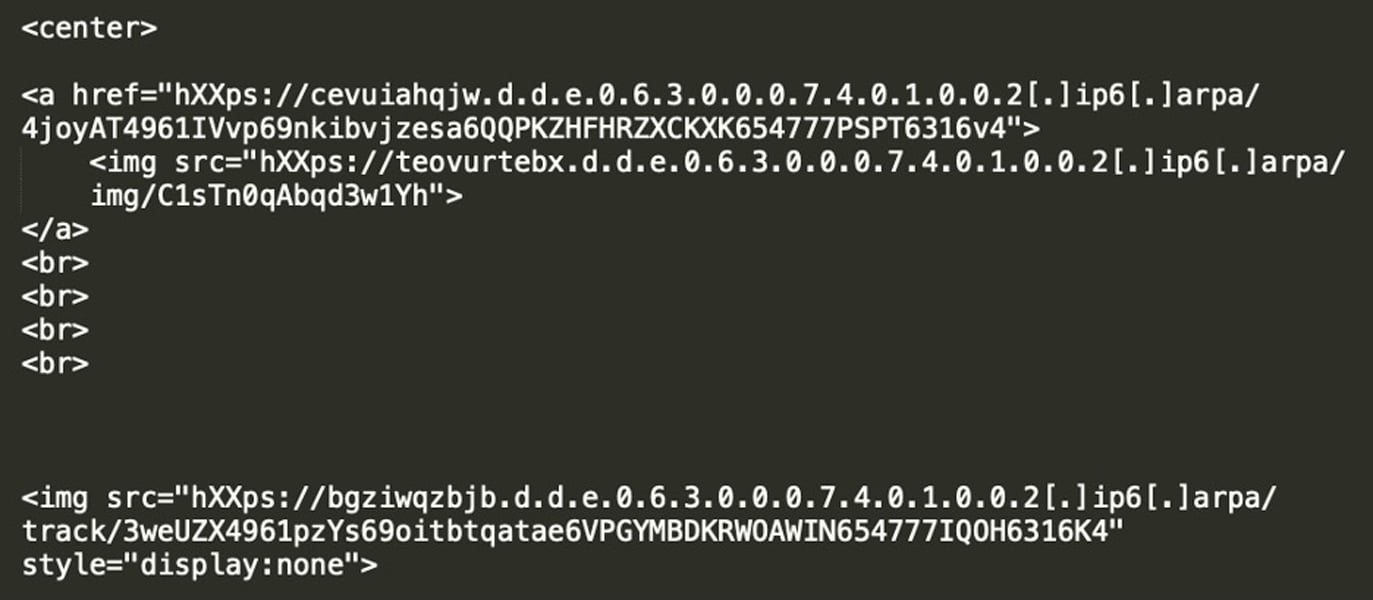
The phishing emails in this campaign use lures that promise a prize, a survey reward, or an account notification. The lures are embedded in the emails as images linked to a reverse IPv6 DNS record, such as  “d.d.e.0.6.3.0.0.0.7.4.0.1.0.0.2.ip6.arpa,” rather than a regular hostname, so the target doesn’t see a strange arpa hostname.

Phishing email lures
Source: Infoblox

When a victim clicks the phishing email image, the device resolves the attacker-controlled reverse DNS name servers via a DNS provider.

HTML showing image and link using .arpa hostnames
Source: Infoblox

In some cases, the authoritative name servers were hosted by Cloudflare, and the reverse DNS domains resolved to Cloudflare IP addresses, hiding the location of the backend phishing infrastructure.

After clicking the image, victims are redirected through a traffic distribution system (TDS) that determines whether they are a valid target, commonly based on device type, IP address, web referers, and other criteria. If the visitor passes validation, they are redirected to a phishing site. Otherwise, they are sent to a legitimate website.

Advertisement

Infoblox says the phishing links are short-lived, only active for a few days. After the links expire, they redirect users to domain errors or other legitimate sites.

The researchers believe this is done to make it harder for security researchers to analyze and investigate the phishing campaign.

Furthermore, as the ‘.arpa’ domain is reserved for internet infrastructure, it does not include data normally found in registered domains, such as WHOIS info, domain age, or contact information. This makes it harder for email gateways and security tools to detect malicious domains.

The researchers also observed the phishing campaign using other techniques, such as hijacking dangling CNAME records and subdomain shadowing, allowing the attackers to push phishing content through subdomains linked to legitimate organizations.

Advertisement

“We found over 100 instances where the threat actor used hijacked CNAMEs of well-known government agencies, universities, telecommunication companies, media organizations, and retailers,” explained Infoblox.

By weaponizing trusted reverse DNS features used by security tools, attackers can generate phishing URLs that bypass traditional detection methods.

As always, the best way to avoid phishing attacks like these is to avoid clicking on unexpected links in emails and instead visit services directly through their official websites.

Malware is getting smarter. The Red Report 2026 reveals how new threats use math to detect sandboxes and hide in plain sight.

Download our analysis of 1.1 million malicious samples to uncover the top 10 techniques and see if your security stack is blinded.

Advertisement

Source link

Continue Reading

Tech

OpenAI’s robotics hardware lead resigns following deal with the Department of Defense

Published

on

OpenAI‘s robotics hardware lead is out. Caitlin Kalinowski, who oversaw hardware within the robotics division of OpenAI, posted on X that she was resigning from her role, while criticizing the company’s haste in partnering with the Department of Defense without investigating proper guardrails. OpenAI told Engadget that there are no plans to replace Kalinowski.

Kalinowski, who previously worked at Meta before leaving to join OpenAI in late 2024, wrote on X that “surveillance of Americans without judicial oversight and lethal autonomy without human authorization are lines that deserved more deliberation than they got.” Responding to another post, the former OpenAI exec explained that “the announcement was rushed without the guardrails defined,” adding that it was a “governance concern first and foremost.”

OpenAI confirmed Kalinowski’s resignation and said in a statement to Engadget that the company understands people have “strong views” about these issues and will continue to engage in discussions with relevant parties. The company also explained in the statement that it doesn’t support the issues that Kalinowski brought up.

“We believe our agreement with the Pentagon creates a workable path for responsible national security uses of AI while making clear our red lines: no domestic surveillance and no autonomous weapons,” the OpenAI statement read.

Advertisement

Kalinowski’s resignation may be the most high-profile fallout from OpenAI’s decision to sign a deal with the Department of Defense. The decision came just after Anthropic refused to comply with lifting certain AI guardrails around mass surveillance and developing fully autonomous weapons. However, even OpenAI’s CEO, Sam Altman, said that he would amend the deal with the Department of Defense to prohibit spying on Americans.

Correction, March 8 2026, 10:30AM ET: This story has been updated to correct Kalinowski’s role at OpenAI to “robotics hardware lead” instead of “head of robotics.”

Source link

Advertisement
Continue Reading

Tech

Top Benefits of Implementing Salesforce Agentforce for Enterprise Businesses

Published

on

Most enterprise teams struggle with systems built to support strategy and processes but cannot keep up. As a result, Sales teams are stuck doing manual data entry; service teams are responding to backlogs. Additionally, operations managers are pulling reports from three different platforms just to get a picture of past incidents. The compounding effect of these inefficiencies leads to deals slowing down, customers getting inconsistent experiences, and the more a business grows, the more difficult it gets to manage these complex issues. Agentforce implementation services address this directly. 

Using these services allows enterprises to deploy AI agents that act inside the Salesforce environment, not just surface recommendations but execute tasks. There are other benefits to Salesforce agentforce consulting which we’ll cover. In this blog, we’ll cover 7 practical benefits of Agentforce for enterprise businesses. In addition, we’ll also discuss a few steps to help you identify the right Agentforce implementation services partner.

Driving Enterprise Impact: 7 Benefits of Agentforce Implementation Services

Here are 7 transformative advantages of Salesforce Agentforce implementation services:

1. Automated Operational Workflows

Advertisement

Even well-designed automation still depends on humans to start it, for instance, an agent logs a call, or a manager approves the next step. Each of those handoffs introduces delay, but Agentforce eliminates that dependency. AI agents execute tasks like updating records, routing escalations, triggering follow-on steps; now conditions are met, not when a team member is available to act. At enterprise scale, removing that delay across thousands of daily interactions is not an incremental gain. It’s a structural advantage over organizations still relying on human-initiated workflows to drive execution.

2. Human-Centered Service Allocation

Enterprise service operations face persistent capacity problems. Query volume grows faster than hiring capacity, and every routine request handled by a trained agent is time that could have been spent resolving a genuinely complex case. Agentforce reallocates that effort when routine queries are addressed immediately and accurately. This is without manual searching, and resolutions are applied or recommended in real time. Businesses that engage Salesforce Agentforce consulting to configure the agents to their specific service workflows consistently report faster resolution times and lower escalation rates.

3. Standardized Sales Execution

Advertisement

Large sales organizations face a consistent challenge: performance varies not because of product or pricing, but because individual execution varies. One territory delivers results because of a disciplined manager while another underperforms because follow-up processes are inconsistently applied. With the help of Agentforce, you can standardize execution at the system level. 

High-intent accounts are identified and flagged before opportunities lapse, and relevant account context is given at the appropriate stage of the deal. So, the agent who’s performing the best becomes the default process for all of them/ When applied across the sales ecosystem, the standardization brings in tangible business outcomes.

4. Maximized Existing Salesforce ROI

Enterprises accumulated Salesforce investments carry substantial sunk costs in licenses, customizations, and integrations. Sometimes, a part of that infrastructure remains underutilized, like data collect fields that are rarely reviewed, or even reports are generated but do not reach decision-makers in time to be actionable. Agentforce does not require building a new system on top of existing ones; it activates what is already in place. Engaging a certified Salesforce implementation partner to handle the configuration correctly from the outset prevents the accumulation of a second layer of technical debt. The ROI case extends beyond Agentforce itself and helps businesses extract full value from the broader Salesforce platform it has already committed to.

Advertisement

5. Scalable Capacity Efficiency

It’s simple math: more customers require more service capacity, more pipelines require more sales coverage, and in addition, more operational activity requires more administrative overhead. Agentforce interrupts that relationship as AI agents absorb increased volume without a corresponding increase in cost, and without the onboarding time or training requirements. This enables enterprises to manage high-demand periods by expanding operational capacity without restructuring staff or systems.

6. Real-Time Actionable Data

If leaders don’t get insights in real-time, they often make decisions based on outdated information. So, when a problem appears in the report, the opportunity to respond promptly is usually closed by then. But with Agentforce, you can process data as it moves through the system. You can also uncover relevant indicators in real time, shifts in pipeline health, service queue build-up, performance variances without requiring anyone to prepare a report in advance.

Advertisement

Therefore, when you opt for Salesforce Consulting Services, you can design the reporting architecture that makes this visibility consistent across business units and geographies. Thus, ensuring leadership is acting on current information rather than a delayed representation of it.

7. Built-In Compliance Assurance

Regulated industries such as financial services, healthcare, and insurance, compliance is an ongoing operational responsibility. Regulators require a clear account of what occurred, when it occurred, and under authority. When producing those answers depends on manually reconstructing a process after the fact, the burden in time, resources, and risk is considerable. Agentforce captures every agent’s action by default: each decision made, each workflow initiated; each record modified is logged as part of normal system operation. 

This makes it possible for organizations to establish compliance boundaries within the operation of the agents. Additionally, you can enforce these parameters uniformly without having to invest in another maintenance effort. This is very helpful for businesses in regulated industries as it transforms the reactive documentation into an integrated responsibility and limits compliance risk for them.

Advertisement

How to Find the Right Agentforce Implementation Services Partner

While assessing Certified Salesforce implementation partners, look specifically for credentials in Agentforce and the Salesforce clouds relevant to your operations.

With the right enterprise experience, you get expertise in multi-cloud, data volume, and complex rollouts.

Proper discovery covers your workflows, integration requirements, data structure, and where the real operational friction sits, not just the features you asked about.

A poor implementation costs far more in rework than the initial savings are worth, so ensure you have insight into the depth of a partner with Salesforce consulting services.

Advertisement

Ensure the selected Salesforce agentforce consulting service partner also offers ongoing support, internal team training, and optimization services.

Closing Remarks

Agentforce is not a feature upgrade, especially for enterprises. For them, it represents a structural change in how work gets done inside Salesforce: less waiting, less manual effort, more consistent execution across teams that are already stretched. What determines whether that plays out in practice is the implementation. The right Agentforce implementation services partner brings the technical credentials, the enterprise experience, and the operational discipline to make sure the system works the way the business actually runs. 

Source link

Advertisement
Continue Reading

Trending

Copyright © 2025