Connect with us
DAPA Banner

Tech

Search Engines, AI, And The Long Fight Over Fair Use

Published

on

from the don’t-throw-out-fair-use dept

Long before generative AI, copyright holders warned that new technologies for reading and analyzing information would destroy creativity. Internet search engines, they argued, were infringement machines—tools that copied copyrighted works at scale without permission. As they had with earlier information technologies like the photocopier and the VCR, copyright owners sued.

Courts disagreed. They recognized that copying works in order to understand, index, and locate information is a classic fair use—and a necessary condition for a free and open internet.

Today, the same argument is being recycled against AI. It’s whether copyright owners should be allowed to control how others analyze, reuse, and build on existing works.

Fair Use Protects Analysis—Even When It’s Automated

U.S. courts have long recognized that copying for purposes of analysis, indexing, and learning is a classic fair use. That principle didn’t originate with artificial intelligence. It doesn’t disappear just because the processes are performed by a machine.

Advertisement

Copying that works in order to understand them, extract information from them, or make them searchable is transformative and lawful. That’s why search engines can index the web, libraries can make digital indexes, and researchers can analyze large collections of text and data without negotiating licenses from millions of rightsholders. These uses don’t substitute for the original works; they enable new forms of knowledge and expression.

Training AI models fits squarely within that tradition. An AI system learns by analyzing patterns across many works. The purpose of that copying is not to reproduce or replace the original texts, but to extract statistical relationships that allow the AI system to generate new outputs. That is the hallmark of a transformative use. 

Attacking AI training on copyright grounds misunderstands what’s at stake. If copyright law is expanded to require permission for analyzing or learning from existing works, the damage won’t be limited to generative AI tools. It could threaten long-standing practices in machine learning and text-and-data mining that underpin research in science, medicine, and technology. 

Researchers already rely on fair use to analyze massive datasets such as scientific literature. Requiring licenses for these uses would often be impractical or impossible, and it would advantage only the largest companies with the money to negotiate blanket deals. Fair use exists to prevent copyright from becoming a barrier to understanding the world. The law has protected learning before. It should continue to do so now, even when that learning is automated. 

Advertisement

A Road Forward For AI Training And Fair Use 

One court has already shown how these cases should be analyzed. In Bartz v. Anthropic, the court found that using copyrighted works to train an AI model is a highly transformative use. Training is a kind of studying how language works—not about reproducing or supplanting the original books. Any harm to the market for the original works was speculative. 

The court in Bartz rejected the idea that an AI model might infringe because, in some abstract sense, its output competes with existing works. While EFF disagrees with other parts of the decision, the court’s ruling on AI training and fair use offers a good approach. Courts should focus on whether training is transformative and non-substitutive, not on fear-based speculation about how a new tool could affect someone’s market share. 

AI Can Create Problems, But Expanding Copyright Is the Wrong Fix 

Workers’ concerns about automation and displacement are real and should not be ignored. But copyright is the wrong tool to address them. Managing economic transitions and protecting workers during turbulent times may be core functions of government, but copyright law doesn’t help with that task in the slightest. Expanding copyright control over learning and analysis won’t stop new forms of worker automation—it never has. But it will distort copyright law and undermine free expression. 

Broad licensing mandates may also do harm by entrenching the current biggest incumbent companies. Only the largest tech firms can afford to negotiate massive licensing deals covering millions of works. Smaller developers, research teams, nonprofits, and open-source projects will all get locked out. Copyright expansion won’t restrain Big Tech—it will give it a new advantage.  

Advertisement

Fair Use Still Matters

Learning from prior work is foundational to free expression. Rightsholders cannot be allowed to control it. Courts have rejected that move before, and they should do so again.

Search, indexing, and analysis didn’t destroy creativity. Nor did the photocopier, nor the VCR. They expanded speech, access to knowledge, and participation in culture. Artificial intelligence raises hard new questions, but fair use remains the right starting point for thinking about training.

Republished from the EFF’s Deeplinks blog.

Filed Under: ai, anaylysis, copyright, fair use, search

Advertisement

Source link

Continue Reading
Click to comment

You must be logged in to post a comment Login

Leave a Reply

Tech

MSI launches $85,000 XpertStation WS300 with Nvidia GB300 Ultra and massive memory that redefines local AI performance

Published

on


  • XpertStation WS300 supports trillion-parameter models without relying on cloud infrastructure
  • Dual 400GbE LAN ports enable high-speed distributed multi-node AI workloads
  • Unified HBM3e GPU and LPDDR5X CPU memory maximizes bandwidth for AI

MSI has officially launched the XpertStation WS300, a deskside AI workstation based on Nvidia’s DGX Station architecture.

This system is designed to handle demanding large language models, generative AI, and advanced data science workloads.

Advertisement

Source link

Continue Reading

Tech

Apple wanted to buy Halide, co-founder lawsuit reveals

Published

on

A lawsuit has revealed Apple was close to acquiring Lux Optics, the developer of the Halide camera app for iOS, but the partnership between the cofounders later broke down over the alleged misuse of funds.

iPhone screen showing camera interface photographing an Apple Vision Pro headset, next to a silver app icon with a circular geometric logo on a dark gradient background
Halide for iOS

Apple’s acquisitions are big news, but discussions are typically held with utmost secrecy, as per Apple’s usual way of operating. While confirmations of acquisitions often surface after they have been agreed upon by both sides, it’s rare to find out about failed acquisition attempts.
One such instance occurred to Lux Optics, makers of the third-party camera app Halide and video app Kino. The Information reports that Lux Optics was in talks with Apple for a potential acquisition during the summer of 2025.
Continue Reading on AppleInsider | Discuss on our Forums

Source link

Continue Reading

Tech

Fifth Circuit: Actually, Putting The Ten Commandments In Schools Is Probably Fine

Published

on

from the fifth-circus dept

Last June, the Fifth Circuit Appeals Court upheld a lower court’s ruling declaring a Louisiana law mandating the posting of the Ten Commandments in public schools to be a violation of the Constitution.

This decision made immediate sense, given that courts elsewhere in the nation (including the US Supreme Court) had repeatedly ruled that laws like these destroyed the separation of church and state. These laws were extremely obvious violations of the First Amendment that elevated one particular religion to a position of prominence with the backing of government power.

That hasn’t stopped MAGA legislators from creating similarly unconstitutional laws around the nation. These opportunists are hoping to convert their Trump coattail-riding into local iterations of Trump’s white Christian nationalist efforts.

Last June may as well be a lifetime ago. In that ruling, the Fifth Circuit made it clear the law was nothing more than an unconstitutional way for the state government to shove its preferred deity down students’ throats.

Advertisement

The statute does not require that the Ten Commandments be integrated into a curriculum of study. On the contrary, under the statute’s minimum requirements, the posters must be indiscriminately displayed in every public school classroom in Louisiana regardless of class subject-matter. See La. R.S. § 17:2124(B)(1). Louisiana insists, however, that unlike Kentucky, its Legislature has a valid “secular historical and educational purpose” for displaying the Ten Commandments in classrooms, which is reflected in the statute.

[…]

Louisiana’s purported legislative purpose states:
It is the Legislature’s intent to apply the decision set forth by the Supreme Court of the United States in Van Orden v. Perry, 545 U.S. 677 (2005), to continue the rich tradition [of including the Ten Commandments in the education of our children] and ensure that the students in our public schools may understand and appreciate the foundational documents of our state and national government.

[…]

It is also unclear how H.B. 71 ensures that students in Louisiana public schools “understand and appreciate the foundational documents of [its] state and national government” when it makes displaying those “foundational” documents optional, and does not require that they also be printed in a large, easily readable font. La. R.S. § 17:2124(A)(9). When the Ten Commandments must be posted prominently and legibly, while the other “contextual” materials need not be visible at all, the disparity lays bare the pretext.

That was the court refusing to let Louisiana lawmakers have their cake and eat it too by pretending the Ten Commandments were both “optional” and essential to students’ instruction.

Advertisement

The en banc opinion [PDF] — released in late February — goes in a completely different direction. The majority somehow reaches the conclusion that the lawsuit is premature. It lifts the injunction preventing the law from taking effect. The court contorts itself to give Louisiana a free pass to post the Ten Commandments prominently in public schools by pretending it doesn’t know how this mandate will actually look in practice.

While H.B. 71 sets certain “minimum requirement[s]” regarding the text, size, and accompanying “context statement” of the displays, it leaves “[t]he nature of the display” entirely to the discretion of local school boards. La. Rev. Stat. § 17:2124(B)(1)–(3). That delegation and those minimum requirements—necessarily leave numerous essential questions unanswered. We do not know, for example, how prominently the displays will appear, what other materials might accompany them, or how—if at all— teachers will reference them during instruction. More fundamentally, we do not even know the full content of the displays themselves. Although the statute requires inclusion of the Commandments and a context statement, it expressly permits additional content—such as “the Mayflower Compact, the Declaration of Independence, and the Northwest Ordinance”—to appear alongside them. Id. § 2124(B)(4).

Simply put, we cannot evaluate “how the text is used,” Van Orden, 545 U.S. at 701 (Breyer, J., concurring in the judgment) (emphasis omitted), because we do not yet know—and cannot yet know—how the text will be used.

But we do actually know all of these things. And the Court does too, even if it has conveniently chosen to ignore the law to give the GOP what it wants yet again. (See also: this, this, this, this, etc.) As Rachel Lager — one of the attorneys representing the plaintiffs in this case — points out in her article for The Hill, the state’s lawyers and the bill’s proponents have already answered the questions the Fifth Circuit is now pretending are in need of further examination.

This law intends for the government (public schools) to convey that the words of the Ten Commandments — including “I AM the LORD thy God. Thou shalt have no other gods before me,” and “Remember the Sabbath day, to keep it holy” — are mandates for all children, regardless of whether they and their families are Hindu and believe in many gods or nonreligious and believe in none.

Lest there be any doubt that this law was written to proselytize students, state Rep. Dodie Horton (R), the law’s sponsor, told us so when she proposed the bill: “I’m not concerned with an atheist. I’m not concerned with a Muslim, I’m concerned with our children looking and seeing what God’s law is.” Judge James Dennis was on point in his dissent when he called the court’s reasoning “procedural artifice.”

Advertisement

That vast gap between the Fifth Circuit’s “narrow” holding and the facts on the ground likely explain why there’s only a single published concurrence and several dissents. The sole concurrence was written by Judge James Ho, who boldly, baldly declares Supreme Court precedent on the subject is “no longer good law,” despite the Supreme Court never having said so itself. Ho also says the lawsuit isn’t just premature, but entirely without merit.

Multiple dissents disagree. The first, written by James Dennis and co-signed by three other judges — says James Ho and the rest of the majority are wrong. Pretending Supreme Court precedent regarding the mandated posting of the Ten Commandments (via a Kentucky state law) is no longer relevant because the Supreme Court ruled in favor of a coach who was fired for engaging in post-game prayers with his players is deliberately ignoring the difference between state action and personal action in order to reach the conclusion these pro-Bible-down-your-throat judges had already decided was the correct ruling.

Bound by Stone v. Graham and its progeny, and mindful that we are not the Supreme Court, I conclude that permanently posting the Ten Commandments in every public school classroom, without curricular incorporation and with compulsory attendance, violates the Establishment Clause. Our court avoids confronting that conclusion only through procedural artifice. I dissent.

Another dissent points out what the state, its legislators, and the majority of Fifth Circuit judges have also chosen to ignore: that religious leaders don’t even want the state to do what it’s doing.

Indeed, every faith-based organization before us—on behalf of thousands of members—and every clergy and devout plaintiff agree that Louisiana must not pick and post specific scripture that the state commands will confront children in state classrooms. All religious voices submitted to us, barring one individual, oppose Louisiana’s attempt to select, inculcate, and enforce this version of gospel text in compulsory public education.

The only people left arguing for this are arguing in bad faith. Parents and religious leaders who pretend any instruction in anything they’re opposed to (gender issues, evolution, socialism, etc.) is a form of indoctrination are more than willing to sign off on literal government indoctrination so long as it’s the sort of indoctrination they like.

Advertisement

Even if the en banc court felt this might need more discussion, it should have erred on the side of plaintiffs. In choosing to do otherwise, it’s basically telling plaintiffs in the Fifth Circuit that their rights need to be violated first because they can start questioning the constitutionality of enacted laws. That’s insane. But it’s the sort of insane the Fifth Circuit is known for. The only question now is whether the Supreme Court still has enough honest justices left to reverse this obviously unconstitutional decision by the Fifth.

Filed Under: 10 commandments, 1st amendment, 5th circuit, church and state, establishment clause, freedom of religion, james ho, louisiana

Advertisement

Source link

Continue Reading

Tech

Apple’s foldable iPhone is coming… not just when you thought

Published

on

Apple loyalists hoping to snap shut their foldable iPhone by autumn may need to exercise a little more patience. The iPhone Fold, initially expected to launch alongside the iPhone 18 Pro and iPhone 18 Pro Max at Apple’s September event, might not ship with these iPhones. 

According to Apple analyst Tim Long, the iPhone Fold will likely begin shipping in December, rather than in September. This contradicts previous reports suggesting a September release (via MacRumors).

So, what will Apple showcase in September 2026?

To me, it sounds like Apple could still showcase the iPhone Fold at the iPhone 18 Pro launch (as a teaser or brief preview of the technology that has gone into the smartphone), while clearly indicating that it will start shipping in a few months. 

The reason behind delaying the iPhone Fold’s shipments could be simple. By releasing the iPhone 18 Pro in September and the iPhone Fold in December, the Pro series gets two months of undivided attention from buyers. 

I know plenty of buyers in India who align their upgrade cycle with Apple’s September launches, and the staggered strategy could be to protect the iPhone 18 Pro’s early sales. Meanwhile, the iPhone Fold would get another two months of hype, with rumors and leaks coming in from all directions, keeping potential buyers on their toes. 

Advertisement

Historically, Apple has done the same thing with the iPhone X. It was available to purchase roughly 10 days after the iPhone 8 and iPhone 8 Plus went on sale. 

Apple might want to launch the iPhone Fold at the safest time

Now, the gap between the iPhone 18 Pro and the iPhone Fold isn’t the same, but the iPhone Fold is going to be the most expensive model in Apple’s lineup so far. Apple might want to launch it when there’s no potential threat to its sales. Further, the foldable could also benefit from the holiday shopping season. 

Along with the iPhone Fold’s launch, the analyst also shared some information about the company’s future roadmap. First, the regular iPhone 18 could launch in March 2027 alongside an iPhone 18e. Second, these phones could be accompanied by either an iPhone 18 Plus or an iPhone Air 2

I am not sure about the iPhone 18 Plus, as there haven’t been any recent leaks or chatter about the handset since Apple killed it with the iPhone 17 lineup. The Air 2, on the other hand, could very well be a part of Apple’s March 2027 product list.

Advertisement

Source link

Continue Reading

Tech

Announcing The Winners Of The 8th Annual Public Domain Game Jam

Published

on

from the gaming-like-it’s-1930 dept

It’s finally time! Once again it took us a little while to get through all the entries this year, but we’ve now selected the winners in the latest installment of our public domain game jam, Gaming Like It’s 1930!

As usual, we’ve got winners in six categories. Plus, at the end, we’ve got some honorable mentions for games that didn’t quite make the cut. Let’s get started!


Best Analog Game — Diary of a Provincial Lady by donnabooby

When E. M. Delafield published her semi-autobiographical comedy Diary of a Provincial Lady in 1930, it became an instant smash hit that has never been out of print to this day. With a little polish and expansion, we wouldn’t be surprised to see this party game of the same name achieve a similar status. It combines the gameplay of popular rotating-judge games like Apples to Apples, in which players compete to craft the funniest combinations from a set of cards, with the found-object art techniques of blackout poetry, in which creators turn existing text into a new work by subtraction. Players modify entries from the titular diary to suit randomly selected prompts, competing to collect cards featuring the book’s charming illustrations. It’s simple, fun, funny, and a fitting winner of this year’s Best Analog Game.

Advertisement

Best Digital Game — I Could Do That! by Geouug

Among the notable paintings to enter the public domain this year is Piet Mondrian’s Composition with Red, Blue and Yellow, one of the most recognizable works from the abstract art pioneer’s series of geometric compositions in primary colors. Of course, like many deceptively simple works of abstract art, it is often met with the declaration: I Could Do That! So what better title for this game, which responds: prove it! Players are given a brief look at the painting then sent to a blank canvas with some simple drawing tools and challenged to reproduce it, after which their effort is compared pixel-by-pixel with the original and assigned a numerical score with a detailed breakdown of just how close they got. It’s a clever and somewhat cheeky rebuke to dismissive attitudes about abstract art, and this year’s Best Digital Game.


Best Adaptation — I am Sam Spade by Marshview Games

Dashiel Hammet’s 1930 novel The Maltese Falcon is one of the definitive early works of the “hardboiled” genre of detective stories, and its main character Sam Spade was a major inspiration for Raymond Chandler’s famous detective Philip Marlowe. I am Sam Spade is a TTRPG based on the novel that does something very interesting as an adaptation: it draws inspiration from Chandler’s stories, which explored Marlowe’s thoughts and inner life in a way that came to define the character and genre, to enrich Hammet’s story, which very much did not do the same for Spade. To accomplish this, it makes use of mechanics from the brilliant minimalist TTRPG Everyone is John, and has all the players taking turns as Sam Spade, each inhabiting and fleshing out a different aspect of his personality. It’s an intriguing and thoughtful way of reflecting on this seminal novel and character, making it this year’s Best Adaptation.

Advertisement

Best Remix — Lilac Song by Autumn Chen

Lilac Song is a rich piece of interactive fiction that casts the player as a servant in the household of Prussian Minister-President Otto Braun during the last few years of the Weimar Republic. In this charged historical setting, it explores heavy themes of gender, democracy, socialism, and the rise of the Nazis, and it does so with grace through its excellent writing. On top of this, the game mixes together a perfect selection of public domain works to anchor its story with a background aesthetic: the player guides the character as they admire 1930 paintings by Klee and Kandinsky and listen to a variety of early 20th century musical compositions. The use of these works is subtle and elegant, serving to enhance the game’s original story without overtaking it, and for that it’s this year’s Best Remix.


Best Deep Cut — CARAMENTRAN by RedSPINE and poymakes

In the Carnivals of Southern France, there is a tradition: parading an effigy representing the “King of Carnival” or Caramentran. He is scapegoated for all the past year’s misfortunes, placed on trial, and ultimately burned at the stake to conclude the festivities. In a dual entry for both this game jam and the Themed Horror Game Jam, CARAMENTRAN is a haunting video game in which the player is the effigy, trying desperately to extinguish the rising flames and repel the townspeople who hurl accusations and admonishments at you. This premise is unsettling enough, but it’s made all the moreso by the collage graphics that clip their elements from archive images, postcards, magazine advertisements, and other obscure 1930 sources that could easily be overlooked and forgotten. For that, it’s this year’s Best Deep Cut.

Advertisement

Best Visuals — As I Lay Flying by Geouug

There are no returning winners from past editions in this year’s selection, but there is a first for these game jams: a double winner! In addition to winning Best Digital Game, designer Geouug has locked down a second win with As I Lay Flying, which was in fact a strong contender for the former category as well. The game is based on William Faulkner’s 1930 novel As I Lay Dying, and transforms it into a rather silly and slapstick physics-based challenge while still carrying forth a surprising amount of the story and heart of the book. But on top of that, it looks great: it has a robust array of well-polished graphics including original character portraits, parallax backgrounds, and thematically appropriate interface elements. Check it out and you’ll quickly see why it’s this year’s winner for Best Visuals.


Honorable Mentions

It’s always hard to narrow things down to just six winners, and we always end up having to leave out a few that we still feel deserve recognition. Here are some of our other favorite entries:

Advertisement

The Agatha Effect by A.M.Homunculus and Matteo Ignestia very creative narrative game that has players jointly crafting a unique murder mystery then conducting a seance with the spirit of Agatha Christie in order to find the solution.

Early Sunday Morning by Nora Katza truly unique entry that involves neither a computer nor a tabletop, as it sends players out into the streets of their home city for a play session that combines hide-and-seek with an improvised scavenger hunt.

The House Hunter Mystery by Gwen C. Katza genuinely fun little object-finding video game based on Nancy Drew, in which the player must solve a series of riddles while exploring the rooms of a house.

Poetry Appreciator 2K26 by ZapJacksona comedic exploration of T. S. Eliot’s Ash Wednesday that combines purposely-obtuse resource-management style mechanics with some funny and surprising twists as you click on words to “appreciate” the poem.

Advertisement

The winning designers will be contacted via their Itch pages to arrange their prizes, so if you see your game listed here, keep an eye on your incoming comments!

A huge thanks to all the designers who submitted games to this year’s jam! Stay tuned for our series of spotlight posts taking a closer look at each of the winning entries, and for an episode of the Techdirt Podcast where we’ll be discussing them. In the mean time, go check out all the other great entries on Itch!

Filed Under: game jam, games, gaming like it’s 1930, public domain

Advertisement

Source link

Continue Reading

Tech

These 5 Home Depot Products Will Save Your Back

Published

on


We may receive a commission on purchases made from links.

If you’ve never experienced back pain, consider yourself lucky — and keep lifting with those legs! According to the Georgetown University Health Policy Institute, back pain ranks among the costliest medical conditions in the U.S., and about 16 million adults experience chronic pain in their backs that limits everyday activities. It’s also a leading cause of disability and absence from work. Anyone can experience back pain at any age, but it’s most common in women and those between 50 and 55 years of age.

We’re not here to offer medical advice, though we can give you tips on shoveling snow more efficiently. You should always talk to your doctor if you need clinical guidance. However, we can help you find household products that may assist you if you suffer from back pain or that may help protect your back from injury in the first place. Home Depot sells thousands of products both in-store and online, from building materials and appliances to garden supplies and, of course, tools. The following products are useful for many consumers, not just those who suffer from back pain, and they can help you get the job done without the aches and grimaces that may well remind you that you were born in a year that started with 19!

Advertisement

Ergonomic secondary handle

You may already own an ergonomic or a battle-ready electric snow shovel, but this 18-inch handle is an attachment you can add to any shovel, spade, or even a broom to help reduce back strain and fatigue. The handle, which Home Depot advertises as attaching in less than one second without any tools, gives users a second handhold. It will allow you to maintain an upright stance, reducing strain on your lower back and helping to distribute the weight.

This tool will do more than make shoveling snow easier. Priced at $29.99 for a pack of two at the time of writing, it can be used on virtually anything that has a long handle, even rakes and mops, provided the shaft is approximately one-and-a-half inches in diameter. It was designed for comfortable gripping and can be used in temperatures from -31 degrees Fahrenheit to 95 degrees Fahrenheit. It’s easy to disconnect and can be stored anywhere, including hanging storage. Home Depot has a standard 90-day return policy for most merchandise.

Advertisement

Rolling garden cart with seat

Gardeners know the best dirt, or so the saying goes, and while there are plenty of high-tech tools for this classic pastime, you may want to consider a more low-tech solution if your back aches after hours spent bent over your petunias. This inexpensive garden cart is wheeled and lightweight for easy portability. It offers a tool tray underneath the seat so that you don’t have to carry your gardening gloves and small tools. It’s made from heavy-duty plastic with a stainless steel frame and can support up to 200 pounds.

Not only does this cart allow you to tote your tools around, but it also acts like a seat or stool while you’re planting and weeding. It can also be used for other household jobs, such as painting or even automobile repair. Buyers should note that according to the product’s Q&A section, its height is not adjustable, and the wheels do not lock in place. Some reviewers reported issues with durability. If you’re willing to spend a bit more, this steel garden cart is more durable and has a seat with 360-degree swivel motion.

Advertisement

Stair climbing hand truck

A hand truck or dolly is a useful tool if you frequently move large boxes, appliances, or furniture. These tools are intended to literally lighten the load and reduce the manual effort needed for big jobs, easing the strain on the user’s body, including their back. If you have a big moving job and you’re worried about potential injuries, although back-saving tools for older DIYers can help, you may want more than just a simple hand truck. Try taking it one step further and pick up this stair climber hand truck, currently priced at $101.99.

Users typically have to pull a standard hand truck up or down stairs, but this product has a tri-wheel design that is intended to reduce back strain when pulling it over curbs, up stairs, and even on uneven surfaces. Its steel frame can carry up to 154 pounds, and it works on both hard surfaces and carpet. It’s also collapsible for easy storage. This hand truck can be used for more than big moves — one reviewer uses it to move water jugs and when repositioning their portable air conditioner. You could use it to move your trash cans, haul your groceries, or even carry your laundry from one floor to another.

Advertisement

DeWalt backpack sprayer

Lawn care can be a time-consuming process that can also wreak havoc on your back. Repetitive movement, kneeling or hunching over for prolonged periods, and carrying heavy loads can cause muscle fatigue. This DeWalt four-gallon backpack sprayer can help relieve some of those issues. It features what Home Depot describes as a “deluxe harness” with padded shoulder straps that follow the contours of your body. It also has an adjustable hip harness that helps to distribute the weight of a full sprayer.

Advertisement

This sprayer comes with multiple nozzle tips, and the extras can be stored in the belt so you can switch out mid-job. The pump can reach up to 150 psi, allowing users to spray from a distance, and the controls are made to be handled while you’re wearing work gloves. The product has a three-year limited warranty and gets mixed reviews from Home Depot customers. Some found the sprayer tended to leak and was difficult to put together, while others were pleased with both assembly and product performance. It currently retails for $109. Owners have a lot to say about DeWalt’s 20V backpack sprayer, so if you need a heavier-duty option, you might want to check it out. It’s also available at Home Depot.

Advertisement

Magnetic grabber reacher tool

You may have a toolbox full of interesting gadgets, but a reacher tool probably isn’t on your radar unless you’ve borrowed your kid’s toy version — the one with the ridiculous shark head that can barely hold a piece of paper. This grabber tool at Home Depot has a 360-degree rotating “jaw” with anti-slip grabbers and a built-in magnet that allows users to grab what they need from almost any angle. It’s able to support up to two pounds horizontally and five pounds vertically and is designed for those with limited mobility. It weighs only 8.15 ounces and is almost 17 inches long with a soft handle that is easy to grip.

This multi-use tool is perfect for grabbing something off a high shelf, avoiding stepladders, or retrieving items from low, dark spaces — haven’t we all dropped our phones into the depths of the couch at least once? It can even be used in daily household chores, like taking laundry out of the washer or dryer without straining your back. The magnetic feature can be handy for grabbing your keys or anything metal, and you can even use this tool to simply turn handles or open cabinets. This grabber has a compact design and folds for easy storage, and is priced at about $48 at the time of writing.


Advertisement

Source link

Continue Reading

Tech

Stripe’s crypto joint venture Tempo launches payments protocol for AI

Published

on

Stripe describes Machine Payments Protocol as an ‘internet-native way for agents to pay’.

Big Tech leaders are convinced that consumers will soon be using AI to shop online, despite public sentiment reflecting some level of apprehension.

McKinsey has found that most European consumers already use AI to help shape their purchase decisions, but not at checkout, where money passes hands. However, it noted that this sentiment could change, and fast.

McKinsey also found that by 2030, agentic commerce could orchestrate up to $5trn globally. But Morgan Stanley research earlier this year noted that only 1pc of shoppers currently choose the agentic route, leaving much to speculation and a hope that consumers will let AI shop for them.

Advertisement

Regardless, many – such as Revolut, Google and PayPal – are already trying to build protocols to support this new incoming age of AI-led shopping.

Adding to that is Stripe’s joint venture with Paradigm, Tempo, which has launched the ‘Machine Payments Protocol’ (MPP). Described as an “internet-native way for agents to pay”, MPP is attempting to create an alternate financial system built specifically for AI agents to use.

The protocol is offering a system where AI agents are not met with the challenges of navigating a financial system built for humans, such as the need to create shopping accounts, navigate pricing pages, choose between subscription tiers, enter payment details, and set up billing.

“The tools of the current financial system were built for humans, so agents struggle to use them”, noted Stripe’s agentic commerce leads in a blogpost. MPP lets agents and services coordinate payments programmatically, enabling micro-transactions and recurring payments.

Advertisement

Once Stripe users set up MPP, businesses can accept payments directly from agents in both stablecoins and fiat, as well as use features such as ‘buy now, pay later’. Companies such as browser infrastructure provider Browserbase and New York City-based Prospect Butcher Co already use MPP to allow agentic commerce.

Tempo was reportedly valued at $5bn last October, after a $500m raise. The crypto venture launched from incubation a month prior.

In November, Swedish fintech giant Klarna, whose CEO was once a crypto sceptic, became the first bank to plan to launch a stablecoin on Tempo with ‘KlarnaUSD’. The coin, set to release this year, is expected to help cut down on transaction fees.

At the time, sources told the Financial Times that the stablecoin would also help Klarna move large amounts of money globally by cutting out parties such as the Society for Worldwide Interbank Financial Telecommunications (SWIFT) network.

Advertisement

Meanwhile, Stripe acquired US billing and invoice software provider Metronome in December. Metronome enables organisations to create and manage user-based pricing models, which Stripe CEO Patrick Collison said is “the native business model for the AI era”.

Bloomberg news reported last month that Stripe was considered acquiring some or all of its long-standing fintech rival PayPal. Founded in the late 1990s, PayPal has struggled in recent years to modernise against its emerging rivals. The 2010-founded Stripe, meanwhile, was recently valued at $159bn after an employee tender offer.

Don’t miss out on the knowledge you need to succeed. Sign up for the Daily Brief, Silicon Republic’s digest of need-to-know sci-tech news.

Advertisement

Source link

Continue Reading

Tech

Can Private Space Companies Replace the ISS Before 2030?

Published

on

China’s orbital outpost Tiangong was completed in 2022 and is hosting up to three astronauts at a time, reports CNN.

But meanwhile U.S. lawmakers are now signaling there’s not time to develop and launch a replacement for the International Space Station — considered the signal most expensive object ever built — before its deorbiting in 2030. A recent Senate bill calls for the U.S. to continue funding it as late as 2032, but that bill still awaits approval from the U.S. Senate and the House.

But some private space companies are already building their alternatives:


Private companies that are in the early design and mockup phase of developing these space stations are still waiting on NASA for guidance — and money… [NASA’s “Requests for Proposals”] were delayed, in part because it took all of 2025 to cinch a confirmation for Trump’s on-again-off-again pick for NASA administrator, Jared Isaacman [confirmed in December]… Similarly, 2025 saw a 45-day government shutdown, the longest in history — adding another hiccup in the space agency’s plans to begin formally soliciting proposals from the private sector. Companies now expect that NASA will issue its Request for Proposals in late March or early April, one CEO told CNN…

Advertisement

Several commercial outfits have recently announced big funding influxes aimed at speeding up the development and launch of new orbiting outposts. Houston-based Axiom Space announced a $350 million funding round last month. Its California-based competitor Vast then notched a $500 million raise in early March. Vast is determined to launch a bare-bones station to orbit as soon as possible, with or without federal input, according to the company. “Our approach is to actually not wait for (NASA) and get going and build a minimum viable product, single-module space station called Haven-1, which we’re launching into orbit next year,” Vast CEO Max Haot told CNN in a phone interview earlier this month. Similarly, Axiom Space is working toward a 2028 launch date for a module that it plans to initially attach to the ISS before breaking off to orbit on its own. A spokesperson told CNN that it the company is “committed” to winning the NASA contract money and may continue pursing such goals even without contract awards.

Still, there’s lingering doubt that any of the companies pursuing space stations will be able to stay afloat without securing a coveted NASA contract or at least cinching significant business from the public sector.
The article includes “Another complicating fact: Russia, the United States’ primary partner on the ISS, has not pledged to keep operating its half of the space station past 2028.” NASA will eventually evaluate proposals for an ISS alternative from Vast, Axiom Space, Jeff Bezos’ Blue Origin, Max Space and several competitors including Voyager Technologies, CNN notes, ultimately handing out an estimated $1.5 billion in contracts between 2026 and 2031.

And while those companies may wait decades before a return on their investment, the article includes this quotes from the cofounder/general partner of Balerion Space Ventures, which led the fundraising for Vast. ” What’s obvious to us is you’re going to have multiple vehicles with myriad companies go into space. You’re going to have vehicles leaving from celestial bodies, like the moon. And we need a habitat.”

Source link

Advertisement
Continue Reading

Tech

Vivo’s best camera phone option has a launch date

Published

on

Vivo has finally locked in a launch date for its next big camera phone.

The Vivo X300 Ultra is expected to be the brand’s top-tier photography flagship, and it’ll officially make its debut on March 30 in China. It will launch alongside a second device, the Vivo X300s.

The announcement comes after weeks of teasers and a brief appearance at MWC 2026. However, this time Vivo is also giving us a clearer look at the design. In a post shared on Weibo, product manager Han Boxiao revealed both phones in a new ‘Film Green’ colour. They feature a two-tone finish that leans into the Ultra’s camera-first identity.

Unsurprisingly, the X300 Ultra is all about the camera module. It looks broadly similar to the X300 Pro at a glance, but there are some tweaks — including a revised lens layout and what appears to be a multispectral sensor tucked into the setup. If previous leaks are anything to go by, that extra sensor could play a role in improving colour accuracy and image processing. Vivo hasn’t confirmed specifics just yet, though.

Advertisement

Advertisement

The X300s, meanwhile, takes a more familiar route. Its design sticks closer to the standard X300, though it does get a refreshed camera ring. The overall sensor layout doesn’t seem to change much, suggesting more of a refinement than a major upgrade.

Vivo hasn’t shared full specs yet, but it’s clear the Ultra is the main event here. Notably, it’s also expected to launch globally, unlike some of Vivo’s previous camera-focused flagships.

With just days to go before the official reveal, more details are likely to drop soon. But even from this early look, the X300 Ultra is shaping up to be Vivo’s most serious shot at a best-in-class camera phone yet.

Advertisement

Source link

Continue Reading

Tech

Best Protein Bars (2026): Vegan, Gluten-Free, High Fiber

Published

on

The best protein bars are grab-and-go snacks, not meal replacements. They’re most helpful when whole foods aren’t available or when your schedule won’t allow for a proper meal. The most beneficial sources of protein come with fiber, healthy fats, and other nutrients. (That’s why registered dietitians recommend whole foods over ultra-processed alternatives.) So, while high-protein snacks may boast impressive counts on the label, they’re not always the healthiest option.

After consulting the nutrition experts about key ingredients to look for (and what to avoid), we’ve rounded up the best protein bars that meet those standards. For more tips on protein, check out our guide to the Best Protein Powders and How Much Protein Do I Need?

Updated March 2026: I added Aloha Organic Protein Bars, Promix Protein Puff Bars, and Mush Protein Bars as new picks. I added an Honorable Mentions section with more protein bars to consider, as well as a FAQ section that includes a note about David Protein Bars. Lastly, I’ve included my testing process and updated existing picks with new information, prices, and links.

More Sections

Advertisement

Best Protein Bars Overall

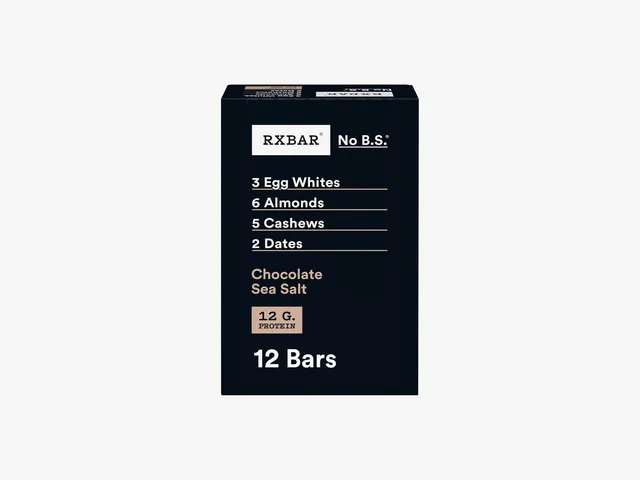
RxBar now offers a couple of different protein bars, but the Classic 12G remains the best. Made from whole foods, the base is a mix of egg whites—a complete protein—dates for sweetness and binding, and nuts (pecans, hazelnuts, cashews, walnuts, peanuts, almonds). I’ve taste-tested the chocolate sea salt, but RxBar also sells blueberry, peanut butter, peanut butter chocolate, vanilla almond, coconut chocolate, and strawberry. It has a sticky, uber-chewy texture, so if that’s not your taste, there’s a nut butter & oat variety pack that swaps the dates for rolled oats. These may also be a better option if you follow a keto diet or are concerned about the sugar from dates, but keep in mind that nut butters still contain sugar, and protein content varies by flavor, so check the nutrition label.

Avoid these if you’re allergic to eggs. The formula is otherwise simple and clean, with the exception of “natural flavors.” RxBar has shared more information on what those entail, which is more clarity than most companies offer, but it may still be a concern if you prioritize full transparency.

TL;DR: RxBars is one of the cleanest protein bars available, with a short ingredient list and balanced macros. There are several variations to choose from, but avoid them entirely if you have an egg allergy. 7.25/10.

Best Plant-Based Protein Bars

  • Photograph: Boutayna Chokrane

  • Photograph: Boutayna Chokrane

Aloha

Organic Protein Bars

Advertisement

Aloha Protein Bars are a standout vegan option, offering 14 grams of protein from brown rice and pumpkin seed blends. They also deliver between 6 and 10 grams of fiber, depending on the flavor, so some bars (like the cookies and creme) are as much a fiber boost as a protein snack. They’re free from soy, dairy, gluten, stevia, and sugar alcohols. Their sweetness comes from monk fruit, tapioca syrup, and rice syrup powder. While mostly clean, they do contain natural flavors, which seem to be the only processed outlier.

Source link

Continue Reading

Trending

Copyright © 2025