Tech
Sendy Audio KYLIN Review: Class A Headphone Power Without the Software Circus

The desktop headphone market is starting to look a lot like the rest of high-end audio: fewer boxes, fewer cables, and more functionality packed into a single component. Instead of assembling separate DACs and headphone amplifiers, listeners can increasingly choose one-box solutions designed to handle digital conversion, amplification, source switching, and even preamplifier duties without surrendering performance.
That is precisely the problem the Sendy Audio KYLIN is trying to solve. At $1,499/£1,499, however, simply combining a DAC and headphone amplifier in one handsome chassis is no longer enough. This has become a fiercely competitive category, and buyers spending this much should expect excellent sound, enough power for demanding headphones, useful connectivity, low noise, strong build quality, and the ability to genuinely replace multiple components on the desktop.
Sendy Audio has been one of my favourite headphone manufacturers in recent years. The Aiva 2 impressed me with its craftsmanship and engaging presentation, while the Egret has been one of my favourite planar magnetic headphones of the year so far.
I first listened to the KYLIN at CanJam London and enjoyed it enough that I wanted to spend considerably more time with one away from the noise and chaos of an audio show. Having now lived with it, that initial attraction is still very much there.
But at $1,499/£1,499, excellent sound is only the price of admission. The more important question is whether the Sendy Audio KYLIN does enough to justify replacing a stack of very capable DACs and headphone amplifiers already competing for the same space on your desk.
Related Reading:
Inside the Sendy Audio KYLIN: DAC, Class A Amplification and Connectivity
The KYLIN represents Sendy Audio’s move beyond headphones and into desktop electronics, combining a DAC, preamplifier, and headphone amplifier inside a single, substantial aluminium chassis.
Digital conversion is handled by the familiar ESS ES9038Q2M DAC, partnered with an XMOS USB implementation. Sendy Audio specifies support for native DSD512 playback, while digital connectivity includes USB-B, coaxial, and optical inputs.
Rather than building the KYLIN around the kind of highly integrated amplifier topology that has become commonplace in modern desktop DAC/amps, Sendy has gone with a Class A output stage employing matched Hitachi transistors. Dual Burr-Brown OPA604 op-amps are used in the preamplifier section, with WIMA and Nichicon capacitors also featuring internally.
This is not really trying to compete with products from Topping, FiiO, and similar manufacturers by offering the longest feature list or the most extravagant collection of measurements. The KYLIN feels much more like an old-school headphone amplifier that happens to have a very capable DAC built into it.
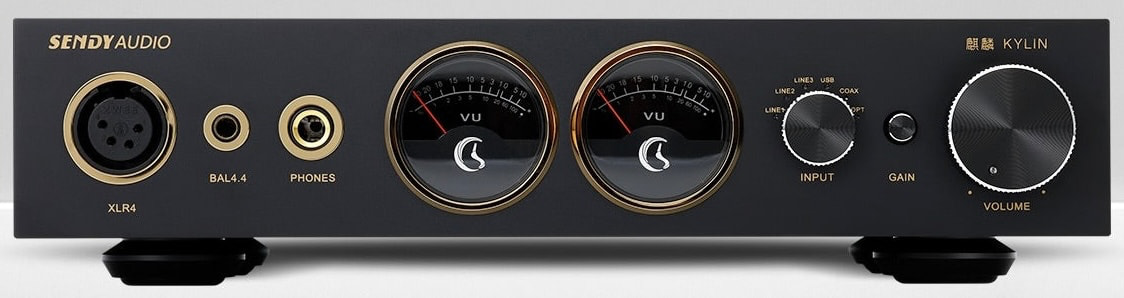


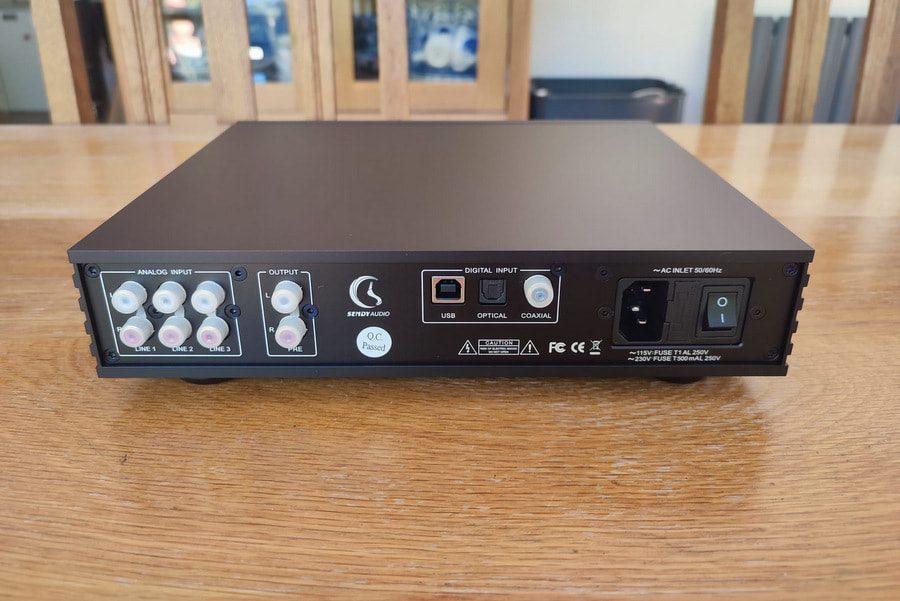
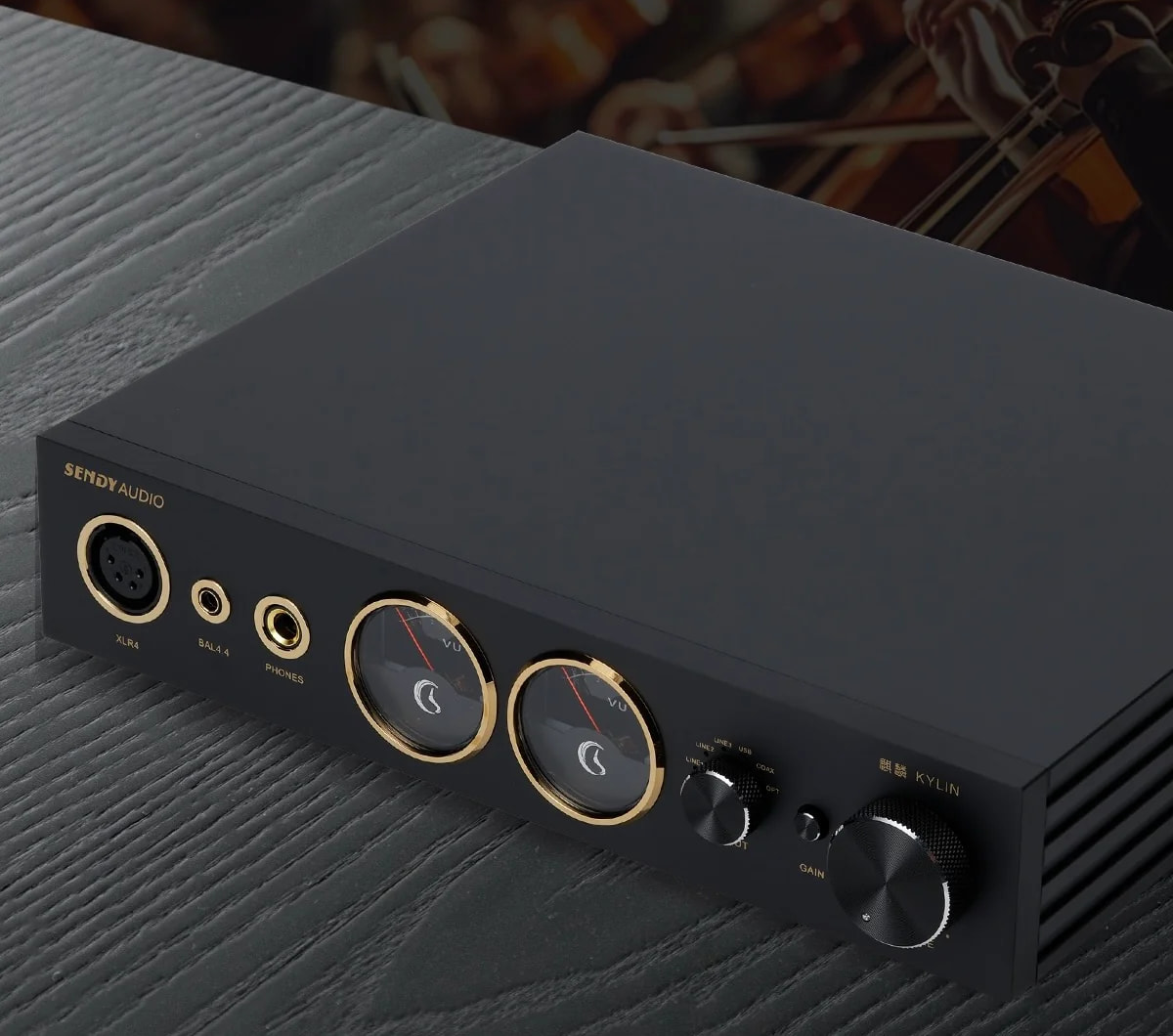
Three headphone connections are provided on the front panel: 6.35mm, 4.4mm, and four-pin XLR. Around the back are USB-B, coaxial, and optical digital inputs, alongside three sets of RCA analogue inputs and RCA preamplifier/line-level connectivity.
At this price, I would have liked balanced XLR line outputs. There is certainly enough room on the rear panel, and I am not convinced that three sets of RCA analogue inputs will prove more useful to most buyers than having the option of balanced connectivity to active loudspeakers or a separate power amplifier.
Furthermore, the KYLIN provides an altogether more analogue user experience. There are no digital filters to cycle through, no parametric EQ, no large colour interface, and no labyrinth of internal settings to configure. There is not even a remote control. Depending on your perspective, that will either sound refreshingly simple or surprisingly limited.
Plenty of considerably cheaper DAC/amps now offer PEQ, extensive filter controls, Bluetooth, saved profiles, and increasingly sophisticated software ecosystems. Some all-in-one components are even beginning to dabble in AI-assisted functionality.
The KYLIN gives you knobs, switches, and two physical VU meters. I suspect Sendy Audio is perfectly happy with that distinction.
Design & Build
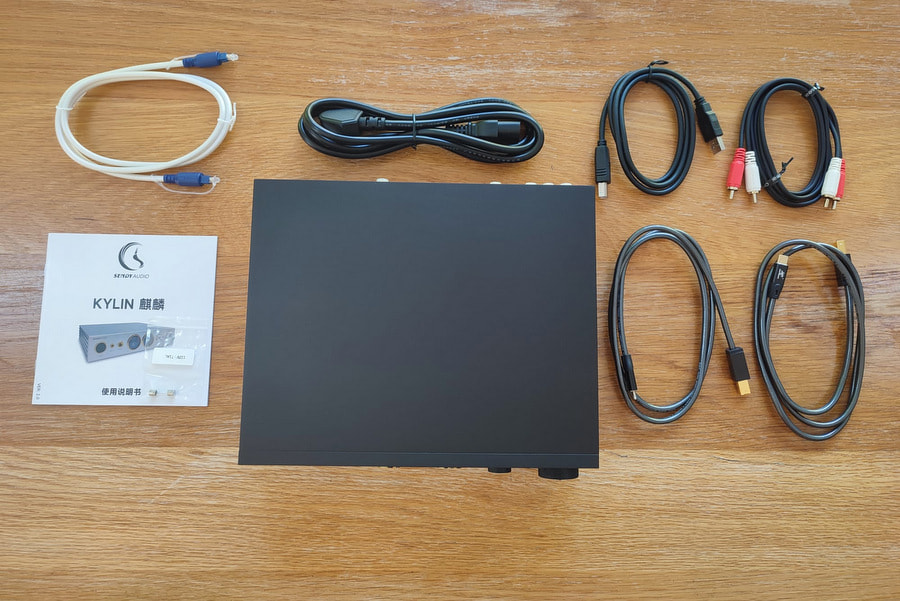
Inside the box, Sendy Audio supplies the KYLIN with the necessary power cable alongside an unusually generous collection of interconnects, including RCA, optical, and multiple USB cables intended to cover the most common computer and mobile-device configurations. It is one of those rare products where you can open the box and have a very good chance of finding the cable you actually need rather than immediately rummaging through a drawer or making another online purchase.
I think the unit itself is beautifully made. That should not come as an enormous surprise if you have handled Sendy Audio’s cans before. Its headphones place considerable emphasis on materials and machining, and the KYLIN takes a similar approach to desktop electronics.

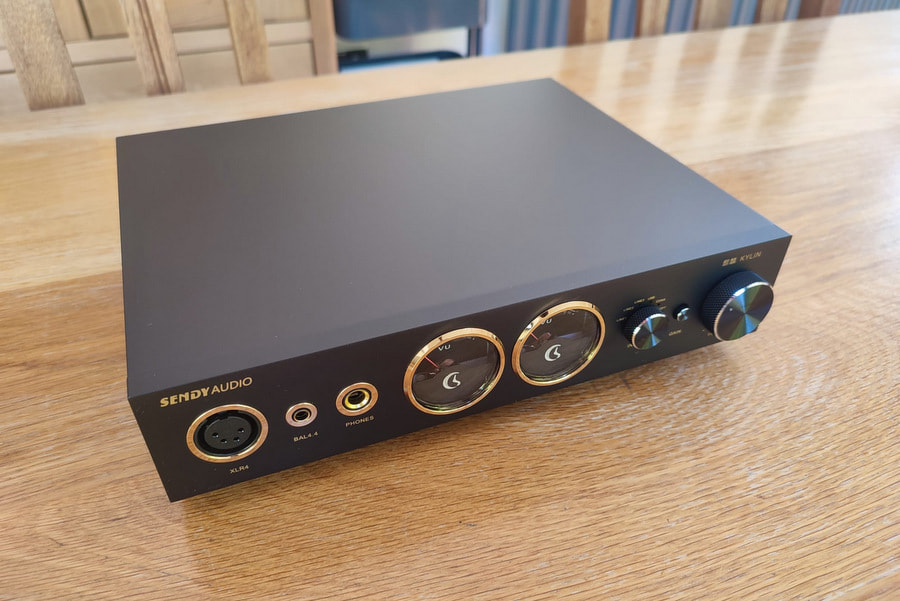
At 245 x 225 x 50mm (9.6 x 8.9 x 2 inches) and roughly 3.1kg, it is not especially large, but there is enough weight to stop it from moving around the desk every time you connect a pair of headphones.
The centrepiece is unquestionably the pair of analogue VU meters. Of course, they are not exactly necessary, but they do look cool. Screens have become almost unavoidable on modern desktop audio equipment. The advantage is obvious when a product has dozens of settings, filters, and input modes, but there is something satisfying about using an amplifier that does not resemble another small computer sitting next to my PC.
The volume knob deserves particular praise because it feels excellent. There is real weight to its movement, with enough resistance that adjustments feel deliberate and precise rather than loose or vague.
Unfortunately, the KYLIN has an unusually small usable window before things get loud. Even with the HiFiMAN HE6se V2 — hardly a headphone famous for being easy to drive — I was operating within roughly the first 10% of the potentiometer’s travel for much of my normal listening. Small movements therefore create disproportionately large changes in output level.
That is irritating with demanding headphones and becomes a much bigger problem with efficient ones. Fine adjustment at lower listening levels is far more difficult than it should be.
There is also audible background noise with sufficiently sensitive headphones. I could hear a noise floor with easy to drive full size dynamic headphones such as the THIEAUDIO Cypher, and I would be very cautious about buying the KYLIN primarily for sensitive IEMs.
Unless you listen to a lot of classical music with very wide dynamic range, extended rests, or extremely quiet passages, the noise floor should not pose a significant problem in normal use. But for a $1,499 headphone amplifier, it is still something that should not really be there.
There are certainly no complaints about the thermal performance, though. Despite the Class A design, the chassis only became lukewarm to the touch during extended use. Having spent time with products such as the Aune S17 Pro and LAiV Audio Crescendo VERSE, both of which can generate considerably more heat, I was expecting the Sendy Audio to become rather toasty. It never did.
That makes the KYLIN much easier to live with on a normal desk and gives you far more freedom over placement than some other Class A designs.
Listening & Headphone Synergy
The Sendy Audio KYLIN was used primarily as an all-in-one DAC and headphone amplifier with a range of planar magnetic and dynamic driver headphones. I fed the unit a mixture of high resolution FLAC files and Spotify streams from both my PC and smartphone.
As mentioned previously, my first proper listen to the KYLIN was at CanJam London, where its combination of warmth, dynamics, and physicality immediately stood out. I can now say that those initial impressions have largely survived extended listening.
Perhaps the best thing about the KYLIN is just how dynamic it sounds. Bass has real texture and physical presence, with enough weight behind kick drums and bass guitars to give music a convincing sense of scale. Transients have plenty of impact, and the KYLIN never sounds short of energy, especially in the low end, even when connected to more demanding planar magnetic headphones.
I especially enjoyed listening to Michael Jackson’s “Billie Jean,” where the recurring bassline punched through the rest of the track and gave the song even greater impact.
There is also a subtle old school Class A warmth to its presentation. It is not thick or syrupy in the traditional sense, but there is a little additional richness through the lower registers and midrange that gives instruments more body without completely neutering treble energy.
For that reason, I think the KYLIN pairs especially well with dead neutral headphones such as the HiFiMAN HE1000 Unveiled, adding a hint of cosiness that can otherwise be missing at times. It can also help tone down particularly spicy sections of certain tracks. Hans Zimmer’s “2049” can cause listening fatigue with some systems, but I had no such issues with the KYLIN.
As alluded to previously, the unit also has no trouble driving some of the most demanding headphones currently on the market. The HE6se V2 has earned a reputation for exposing amplifiers that look powerful on paper but struggle to provide convincing control and dynamic authority in practice. Despite this, the KYLIN had plenty of headroom while retaining bass impact and definition, and large dynamic swings never collapsed or became noticeably compressed.
British rapper AJ Tracey’s “Wifey Riddim 4” delivered the level of hard hitting impact I was looking for with the KYLIN paired with the Sendy Audio Egret.
The subtle warmth continues into the midrange, where vocals and guitars possess a pleasing sense of density without obscuring detail. There is enough clarity through the upper midrange and treble to prevent the KYLIN from becoming overly romantic, and it manages to retain a sense of openness despite its richer tonal balance.
That is refreshing in a market dominated by components chasing neutrality and increasingly impressive measurements. The KYLIN still sounds similarly clean and resolving to products from Topping or SMSL, but it adds a degree of dynamic exuberance and tonal character that gives the presentation some personality.

The Bottom Line
In an era when a DAC/headphone amplifier costing under $500 can offer colour touchscreens, Bluetooth, parametric EQ, a myriad of filters, and enough menu options to keep you occupied for an entire day, the $1,499 Sendy Audio KYLIN might not initially seem like the most enticing all in one option. It has physical VU meters, conventional controls, and very little in the way of software.
But that more analogue user experience will be exactly what some listeners are looking for. It allows you to focus on the music rather than constantly fiddling with settings in an attempt to make the listening experience that little bit more convenient.
And the KYLIN simply sounds magnificent. It has acres of power, a slightly warm tonal balance that draws attention to its powerful and immaculately controlled bass performance, yet still manages to retain a high level of detail and spatial precision. That is a difficult balance to achieve. The unit is also beautifully constructed, with a reassuring heft and level of finish that make it feel every bit like a serious piece of desktop audio equipment.
Just be aware of the lack of balanced XLR line outputs and the fact that the KYLIN is not the best companion for sensitive IEMs or easy to drive dynamic headphones, owing to its audible noise floor and very narrow usable volume range.
Pros:
- Beautifully constructed chassis with excellent physical controls
- Analogue VU meters give the KYLIN real character
- Substantial power for difficult full-size headphones
- Excellent pairing with hard-to-drive planar headphones
- Dynamic, textured bass response
- Slight Class A warmth without excessive treble roll-off
- Runs surprisingly cool for a Class A desktop amplifier
- Generous selection of supplied cables
Cons:
- Very narrow usable range on the volume control
- Audible noise floor with sensitive headphones
- No balanced XLR line outputs or remote control
- No PEQ, digital-filter selection or extensive internal configuration
Our Ratings:
★★★★★★★★★★ Sound Quality
★★★★★★★★★★ Build Quality
★★★★★★★★★★ Usability
★★★★★★★★★★ Features
★★★★★★★★★★ Value
You must be logged in to post a comment Login